1
Lecture-02: Introduction to Neural
Networks
2
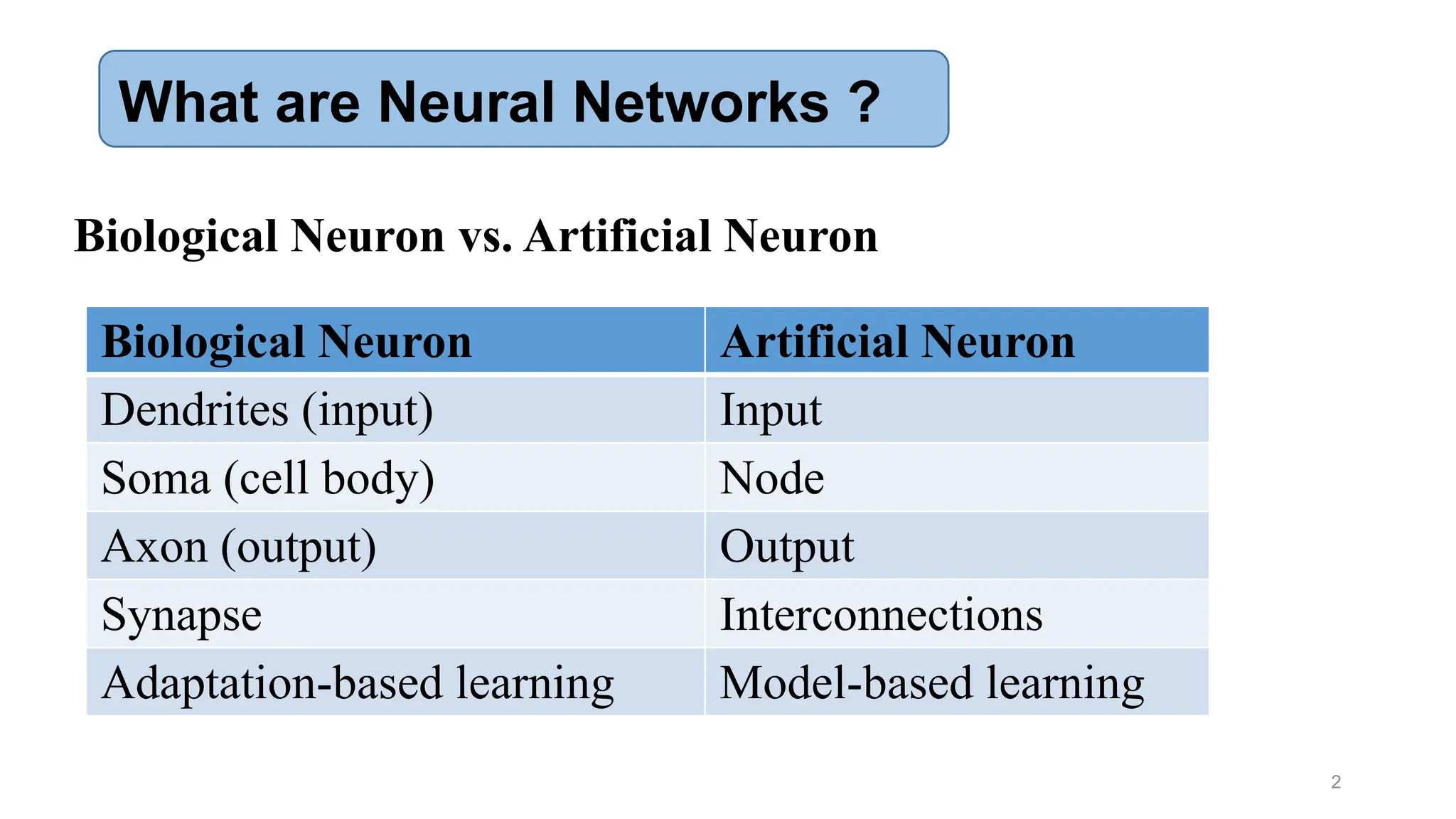
Biological Neuron vs. Artificial Neuron
What are Neural Networks ?
Biological Neuron Artificial Neuron
Dendrites (input) Input
Soma (cell body) Node
Axon (output) Output
Synapse Interconnections
Adaptation-based learning Model-based learning
3
• Two main algorithms:
• Perceptron: Initial algorithm for learning simple neural
networks (with no hidden layer) developed in the 1950’s.
• Backpropagation: More complex algorithm for learning multi-
layer neural networks developed in the 1980’s.
Neural Network Learning Algorithms (1)
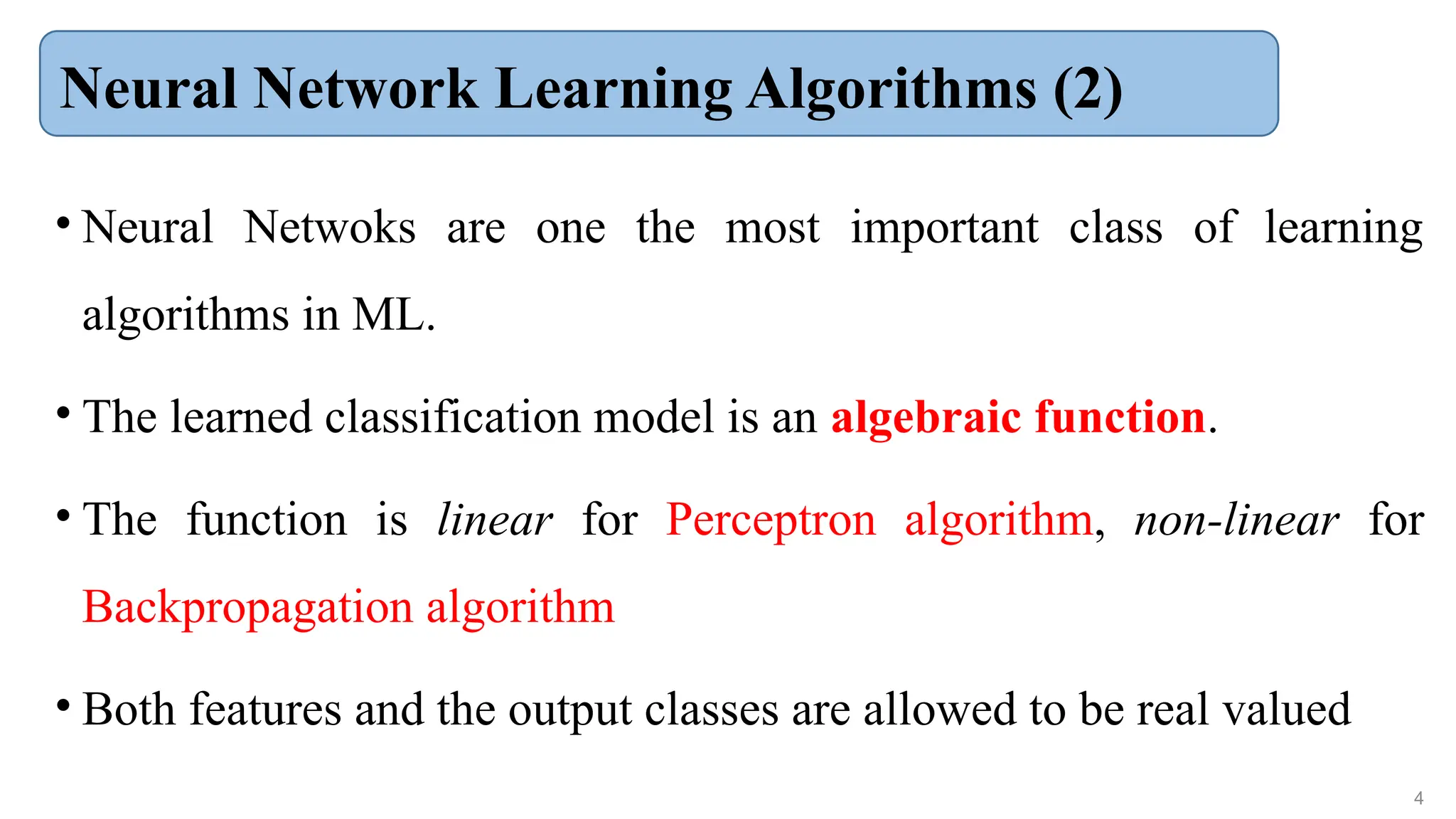
• Neural Netwoks are one the most important class of learning
algorithms in ML.
• The learned classification model is an algebraic function.
• The function is linear for Perceptron algorithm, non-linear for
Backpropagation algorithm
• Both features and the output classes are allowed to be real valued
4
Neural Network Learning Algorithms (2)
Perceptron: The First Neural Network
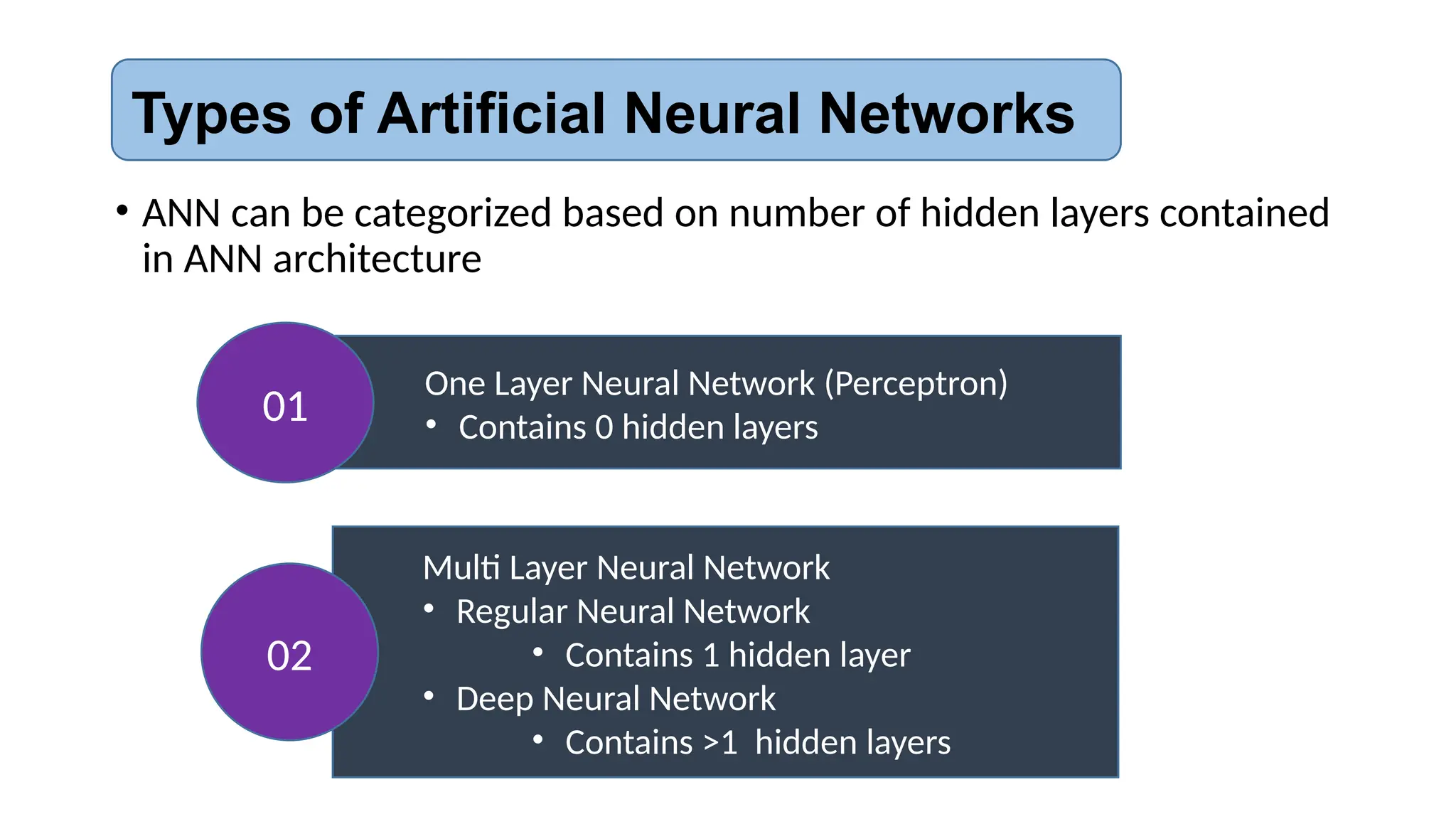
• ANN can be categorized based on number of hidden layers contained
in ANN architecture
One Layer Neural Network (Perceptron)
• Contains 0 hidden layers
01
Multi Layer Neural Network
• Regular Neural Network
• Contains 1 hidden layer
• Deep Neural Network
• Contains >1 hidden layers
02
Types of Artificial Neural Networks
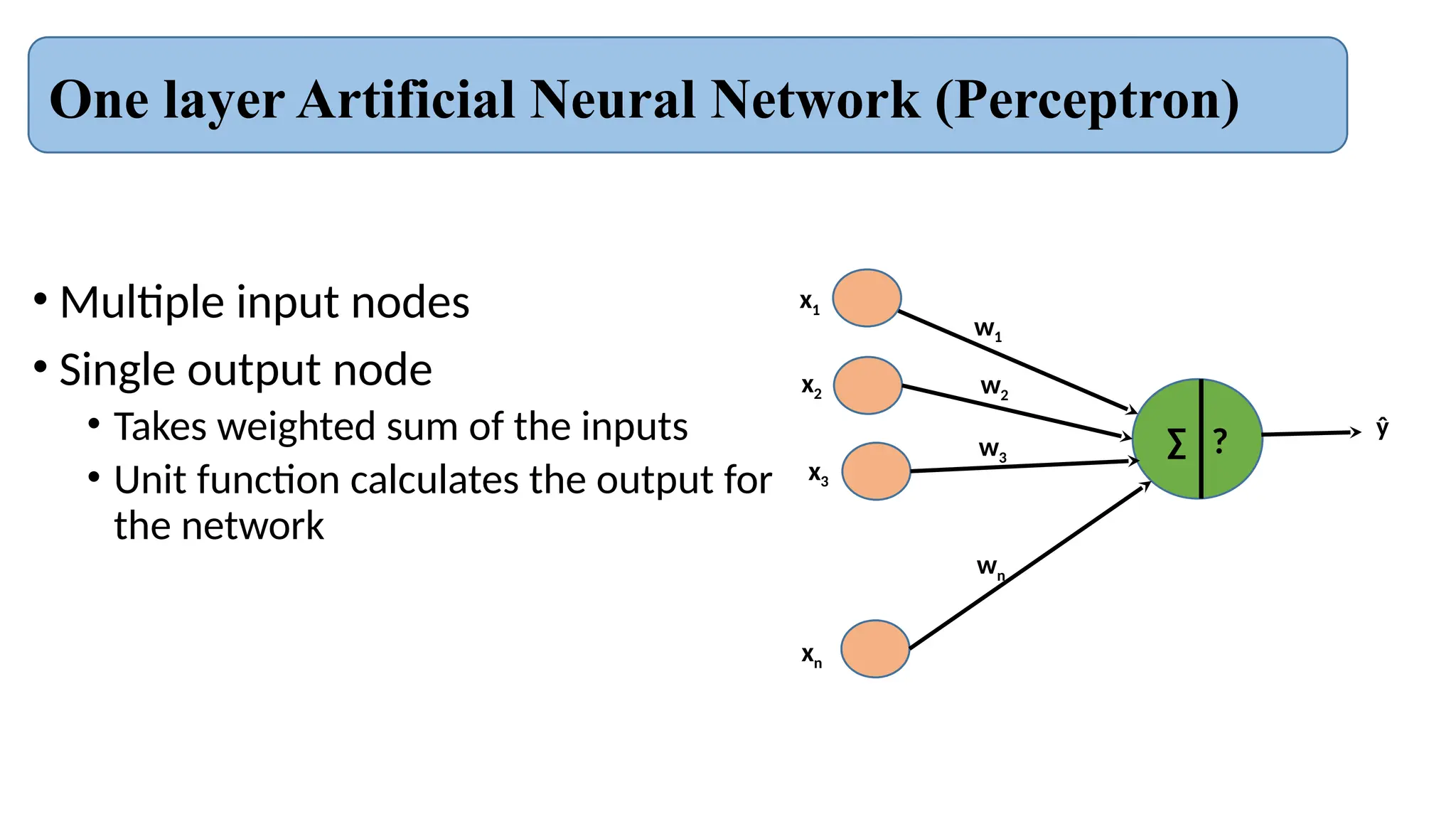
• Multiple input nodes
• Single output node
• Takes weighted sum of the inputs
• Unit function calculates the output for
the network
One layer Artificial Neural Network (Perceptron)
x1
x2
x3
xn
∑ ? ŷ
w1
w2
w3
wn
• Linear Function
• Simply output the weighted sum
Unit Function
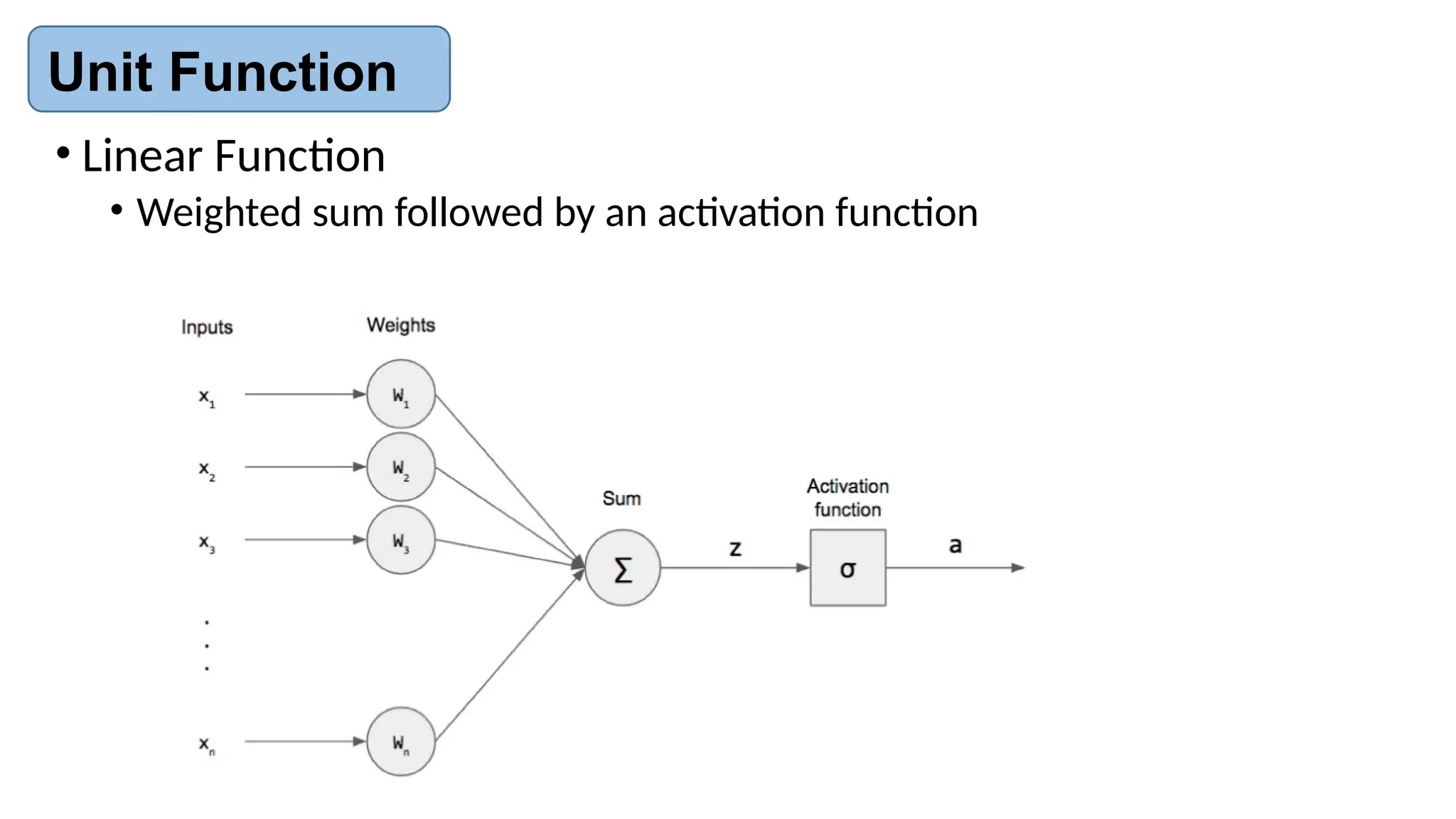
• Linear Function
• Weighted sum followed by an activation function
Unit Function
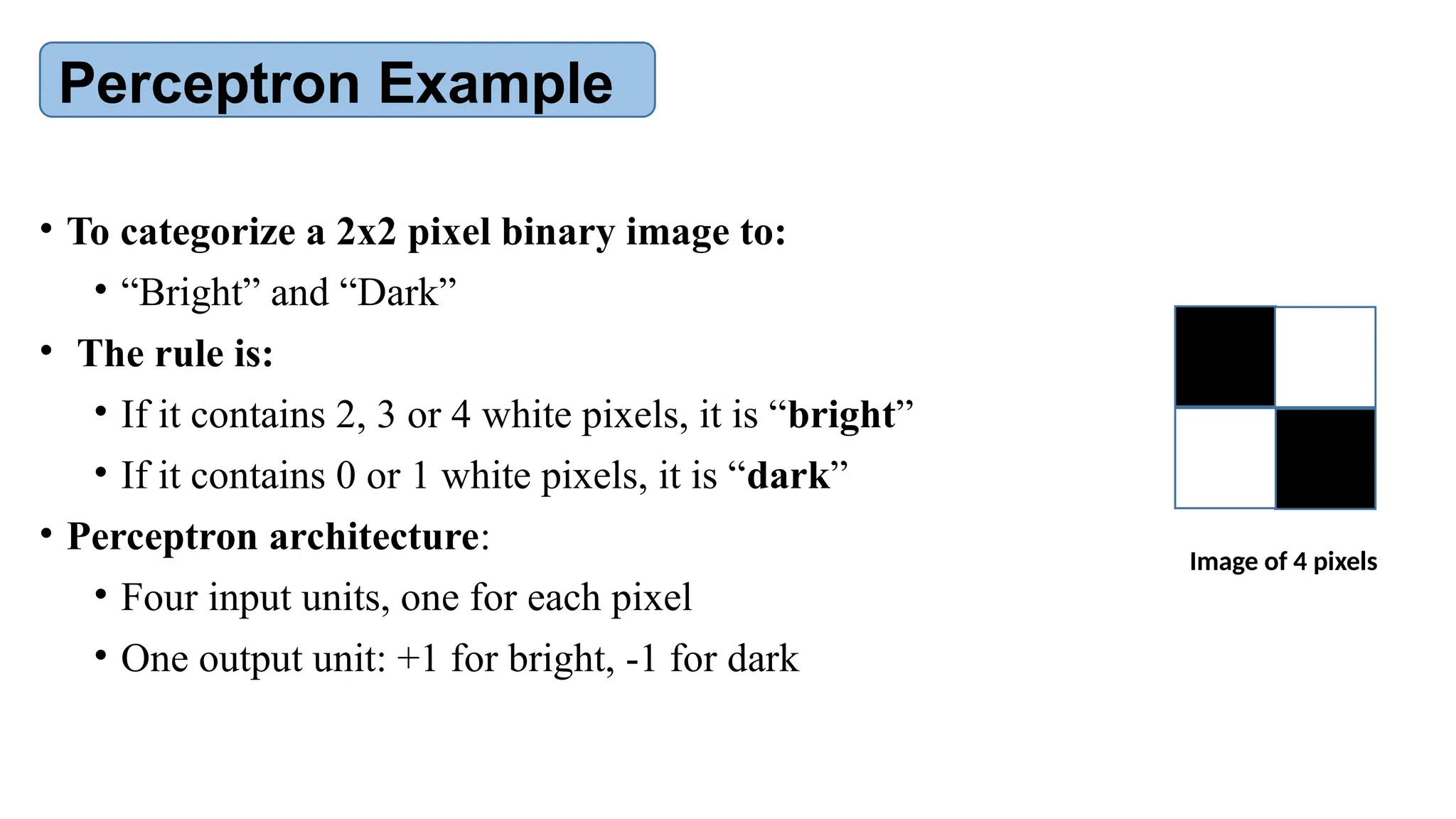
• To categorize a 2x2 pixel binary image to:
• “Bright” and “Dark”
• The rule is:
• If it contains 2, 3 or 4 white pixels, it is “bright”
• If it contains 0 or 1 white pixels, it is “dark”
• Perceptron architecture:
• Four input units, one for each pixel
• One output unit: +1 for bright, -1 for dark
Perceptron Example
Image of 4 pixels
x1
x2
x3
x4
S ŷ
0.25
0.25
0.25
0.25
Pixel 1
Pixel 4
Pixel 3
Pixel 2
+1 Bright
If S> -0.1
-1 Dark
S= 0.25*x1 + 0.25*x2 + 0.25*x3 + 0.25*x4
Otherwise
Perceptron Example
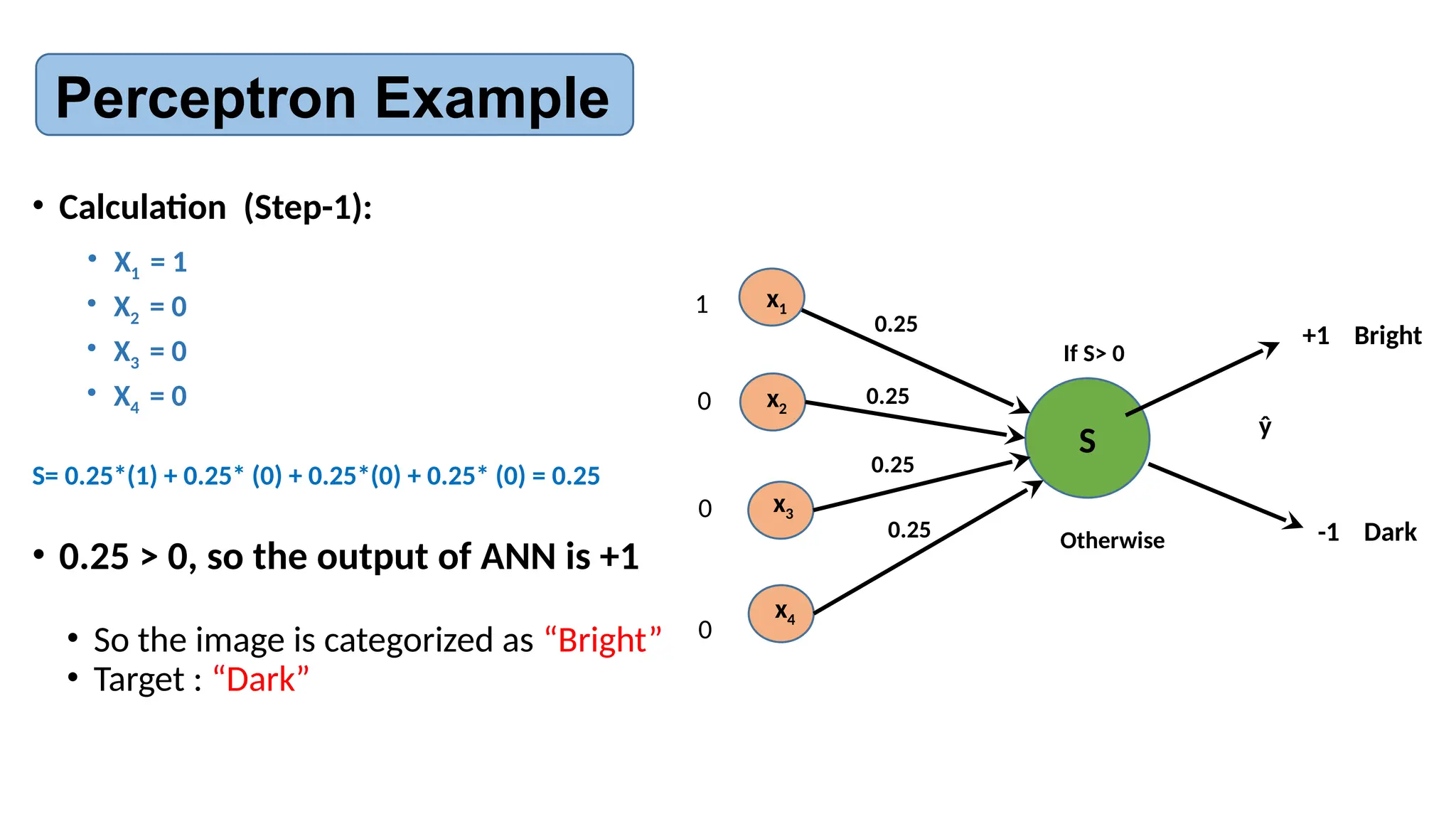
• Calculation (Step-1):
• X1 = 1
• X2 = 0
• X3 = 0
• X4 = 0
S= 0.25*(1) + 0.25* (0) + 0.25*(0) + 0.25* (0) = 0.25
• 0.25 > 0, so the output of ANN is +1
• So the image is categorized as “Bright”
• Target : “Dark”
Perceptron Example
x1
x2
x3
x4
S ŷ
0.25
0.25
0.25
0.25
1
0
0
0
+1 Bright
If S> 0
-1 Dark
Otherwise
Perceptron Training Rule (How to update weights)
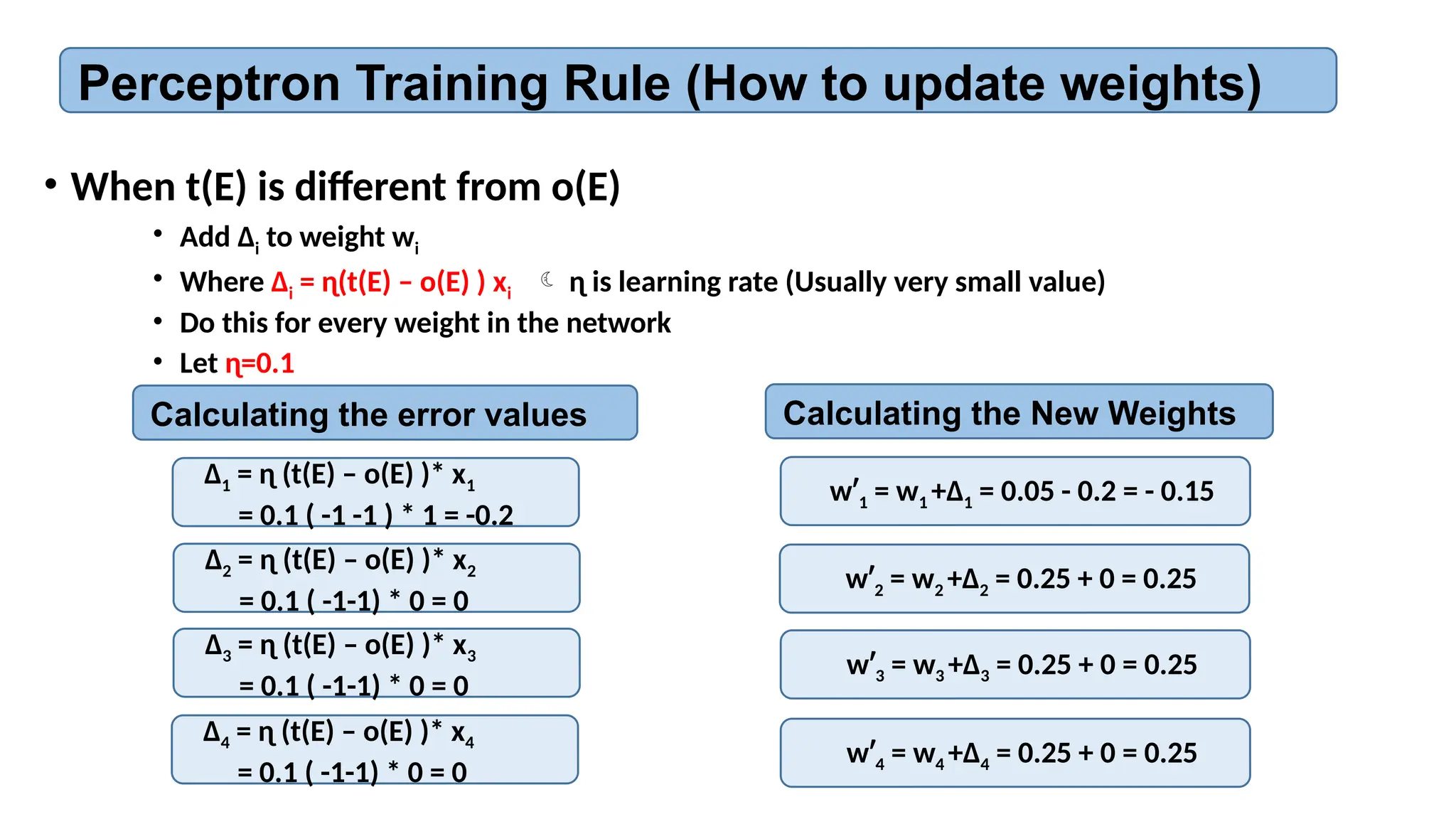
• When t(E) is different from o(E)
• Add ∆i to weight wi
• Where ∆i = ɳ(t(E) – o(E) ) xi  ɳ is learning rate (Usually very small value)
• Do this for every weight in the network
• Let ɳ=0.1
∆1 = ɳ (t(E) – o(E) )* x1
= 0.1 ( -1-1) * 1 = -0.2
∆2 = ɳ (t(E) – o(E) )* x2
= 0.1 ( -1-1) * 0 = 0
∆3 = ɳ (t(E) – o(E) )* x3
= 0.1 ( -1-1) * 0 = 0
∆4 = ɳ (t(E) – o(E) )* x4
= 0.1 ( -1-1) * 0 = 0
wʹ1 = w1 +∆1 = 0.25 - 0.2 = 0.05
wʹ2 = w2 +∆2 = 0.25 + 0 = 0.25
wʹ3 = w3 +∆3 = 0.25 + 0 = 0.25
wʹ4 = w4 +∆4 = 0.25 + 0 = 0.25
Calculating the error values Calculating the New Weights
• Calculation (Step-2):
• X1 = 1
• X2 = 0
• X3 = 0
• X4 = 0
S= 0.05*(1) + 0.25* (0) + 0.25*(0) + 0.25* (0) = 0.05
• 0.05 > 0, so the output of ANN is +1
• So the image is categorized as “Bright”
• Target : “Dark”
Perceptron Example
x1
x2
x3
x4
S ŷ
0.05
0.25
0.25
0.25
1
0
0
0
+1 Bright
If S> 0
-1 Dark
Otherwise
Perceptron Training Rule (How to update weights)
• When t(E) is different from o(E)
• Add ∆i to weight wi
• Where ∆i = ɳ(t(E) – o(E) ) xi  ɳ is learning rate (Usually very small value)
• Do this for every weight in the network
• Let ɳ=0.1
∆1 = ɳ (t(E) – o(E) )* x1
= 0.1 ( -1 -1 ) * 1 = -0.2
∆2 = ɳ (t(E) – o(E) )* x2
= 0.1 ( -1-1) * 0 = 0
∆3 = ɳ (t(E) – o(E) )* x3
= 0.1 ( -1-1) * 0 = 0
∆4 = ɳ (t(E) – o(E) )* x4
= 0.1 ( -1-1) * 0 = 0
wʹ1 = w1 +∆1 = 0.05 - 0.2 = - 0.15
wʹ2 = w2 +∆2 = 0.25 + 0 = 0.25
wʹ3 = w3 +∆3 = 0.25 + 0 = 0.25
wʹ4 = w4 +∆4 = 0.25 + 0 = 0.25
Calculating the error values Calculating the New Weights
• Calculation (Step-3):
• X1 = 1
• X2 = 0
• X3 = 0
• X4 = 0
S= - 0.15*(1) + 0.25* (0) + 0.25*(0) + 0.25* (0) = - 0.15
• - 0.15 < 0, so the output of ANN is -1
• So the image is categorized as “Dark”
• Target : “Dark”
Perceptron Example
x1
x2
x3
x4
S ŷ
-0.15
0.2
5
0.2
5
0.2
5
1
0
0
0
+1 Bright
If S> 0
-1 Dark
Otherwise
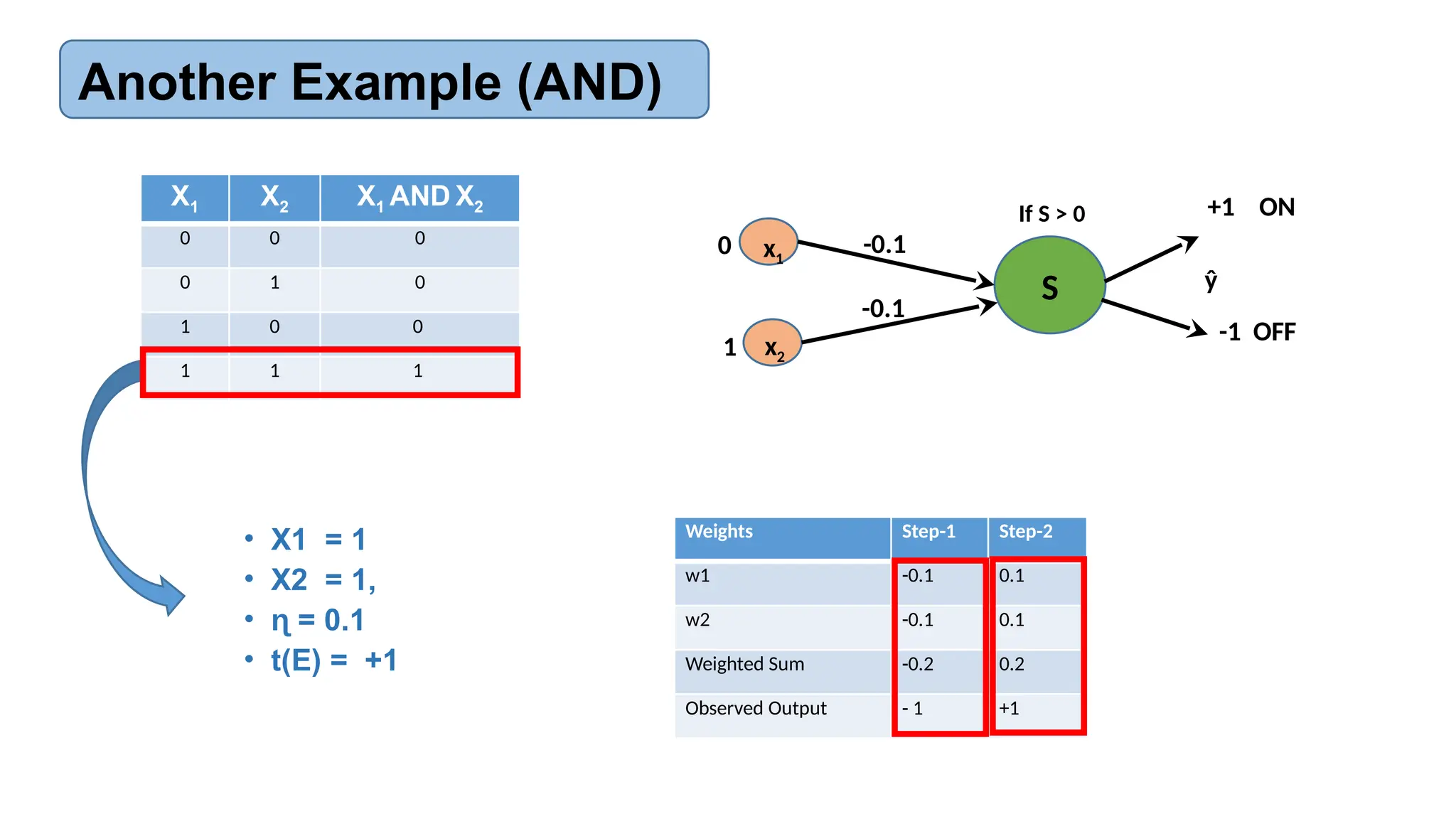
Another Example (AND)
x1
x2
S ŷ
W1=0.5
W2=0.5
+1 ON
-1 OFF
If S > 0
0
1
X1 X2 X1 AND X2
0 0 0
0 1 0
1 0 0
1 1 1
Weights Step-1 Step-2 Step-3 Step-4
w1 0.5 0.5 0.5 0.5
w2 0.5 0.3 0.1 -0.1
Weighted Sum 0.5 0.3 0.1 -0.1
Observed Output +1 +1 +1 -1
• X1 = 0
• X2 = 1,
• = 0.1
ɳ
• t(E) = -1
Another Example (AND)
x1
x2
S ŷ
0.5
-0.1
+1 ON
-1 OFF
If S > 0
0
1
X1 X2 X1 AND X2
0 0 0
0 1 0
1 0 0
1 1 1
Weights Step-1 Step-2 Step-3 Step-4
w1 0.5 0.3 0.1 -0.1
w2 -0.1 -0.1 -0.1 -0.1
Weighted Sum 0.5 0.3 0.1 -0.1
Observed Output +1 +1 +1 -1
• X1 = 1
• X2 = 0,
• = 0.1
ɳ
• t(E) = -1
Another Example (AND)
x1
x2
S ŷ
-0.1
-0.1
+1 ON
-1 OFF
If S > 0
0
1
X1 X2 X1 AND X2
0 0 0
0 1 0
1 0 0
1 1 1
Weights Step-1 Step-2
w1 -0.1 0.1
w2 -0.1 0.1
Weighted Sum -0.2 0.2
Observed Output - 1 +1
• X1 = 1
• X2 = 1,
• = 0.1
ɳ
• t(E) = +1
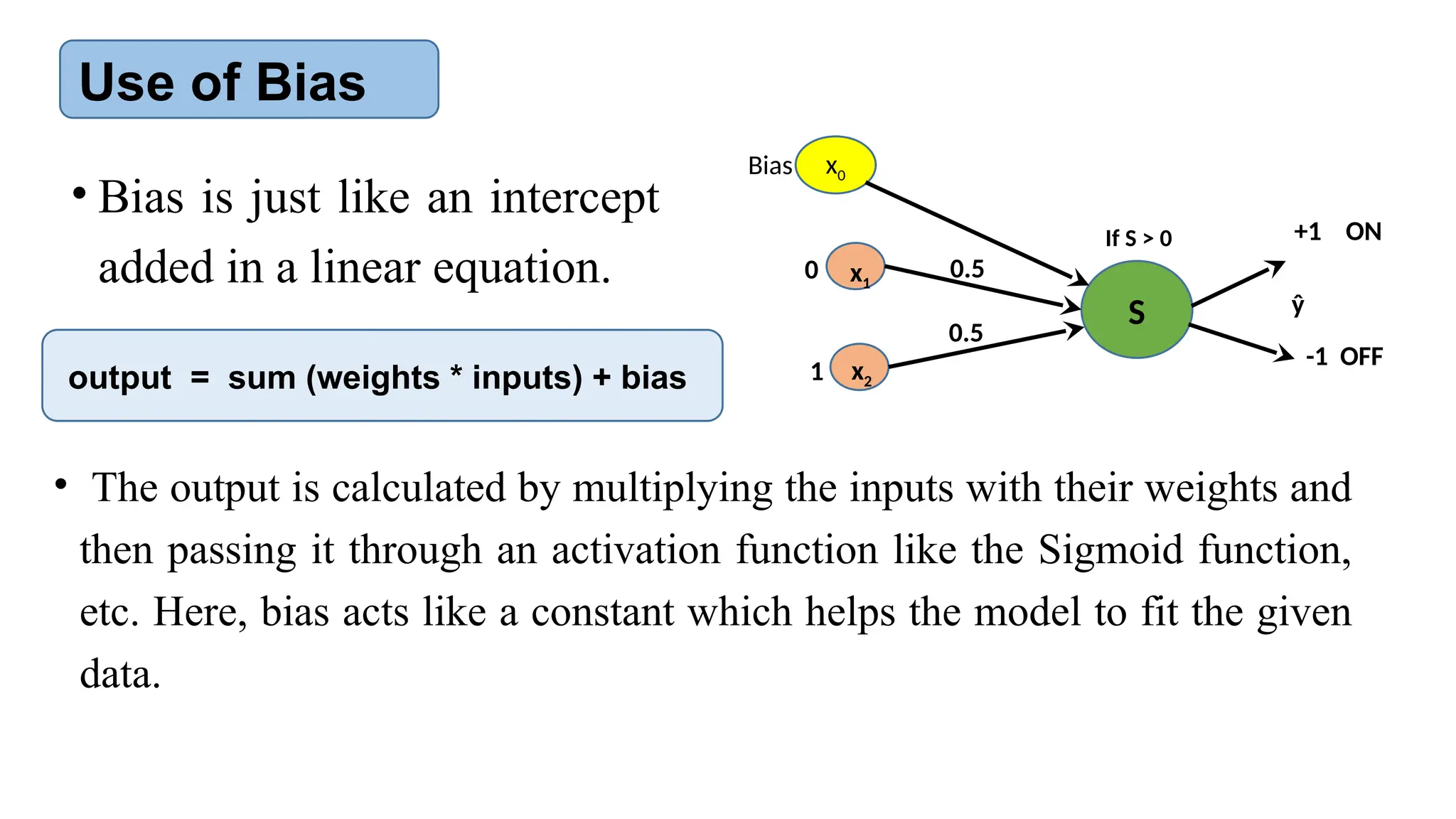
Use of Bias
x1
x2
S ŷ
0.5
0.5
+1 ON
-1 OFF
If S > 0
0
1
• Bias is just like an intercept
added in a linear equation.
output = sum (weights * inputs) + bias
• The output is calculated by multiplying the inputs with their weights and
then passing it through an activation function like the Sigmoid function,
etc. Here, bias acts like a constant which helps the model to fit the given
data.
x0
Bias
Use of Bias
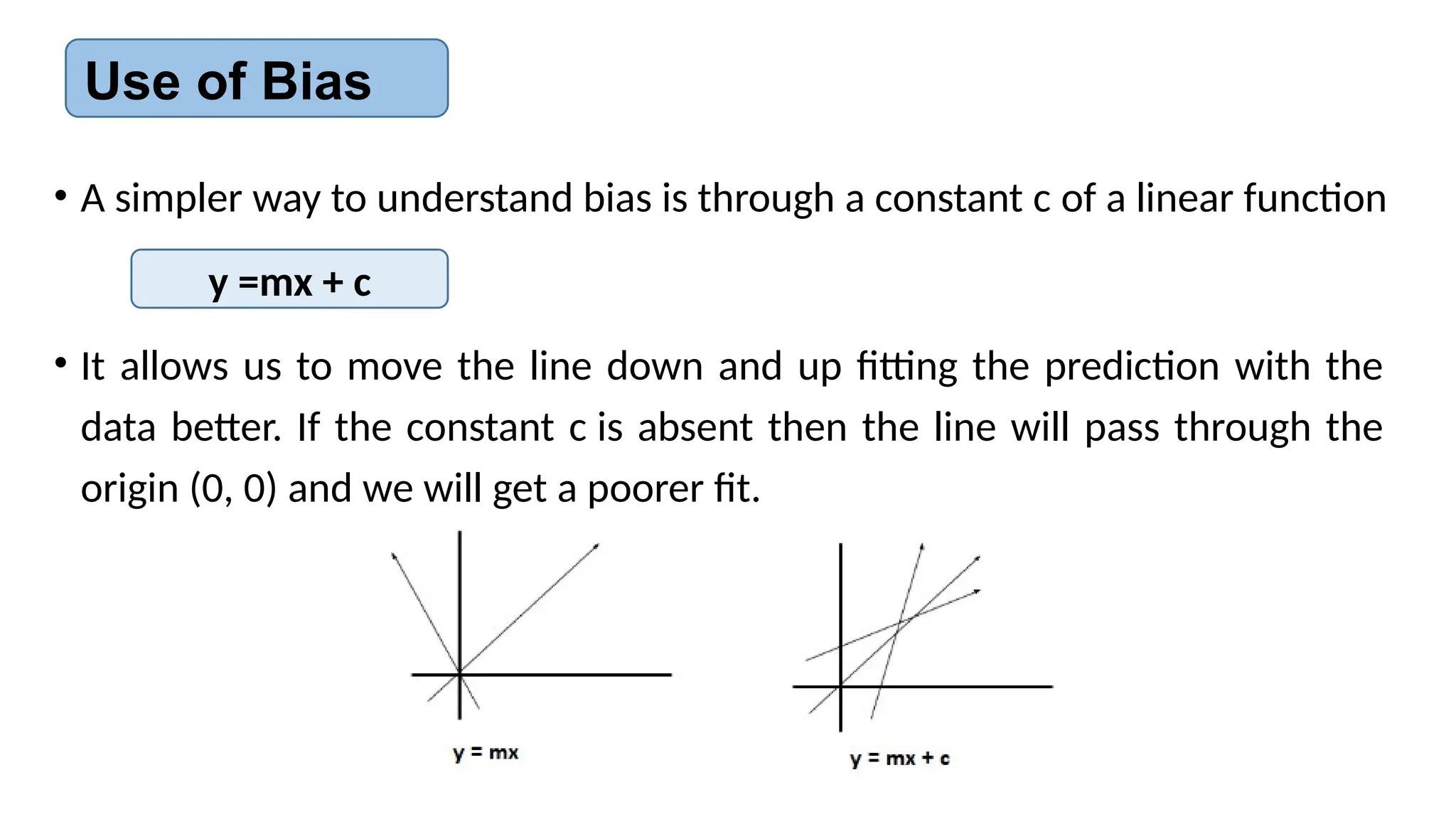
• A simpler way to understand bias is through a constant c of a linear function
y =mx + c
• It allows us to move the line down and up fitting the prediction with the
data better. If the constant c is absent then the line will pass through the
origin (0, 0) and we will get a poorer fit.
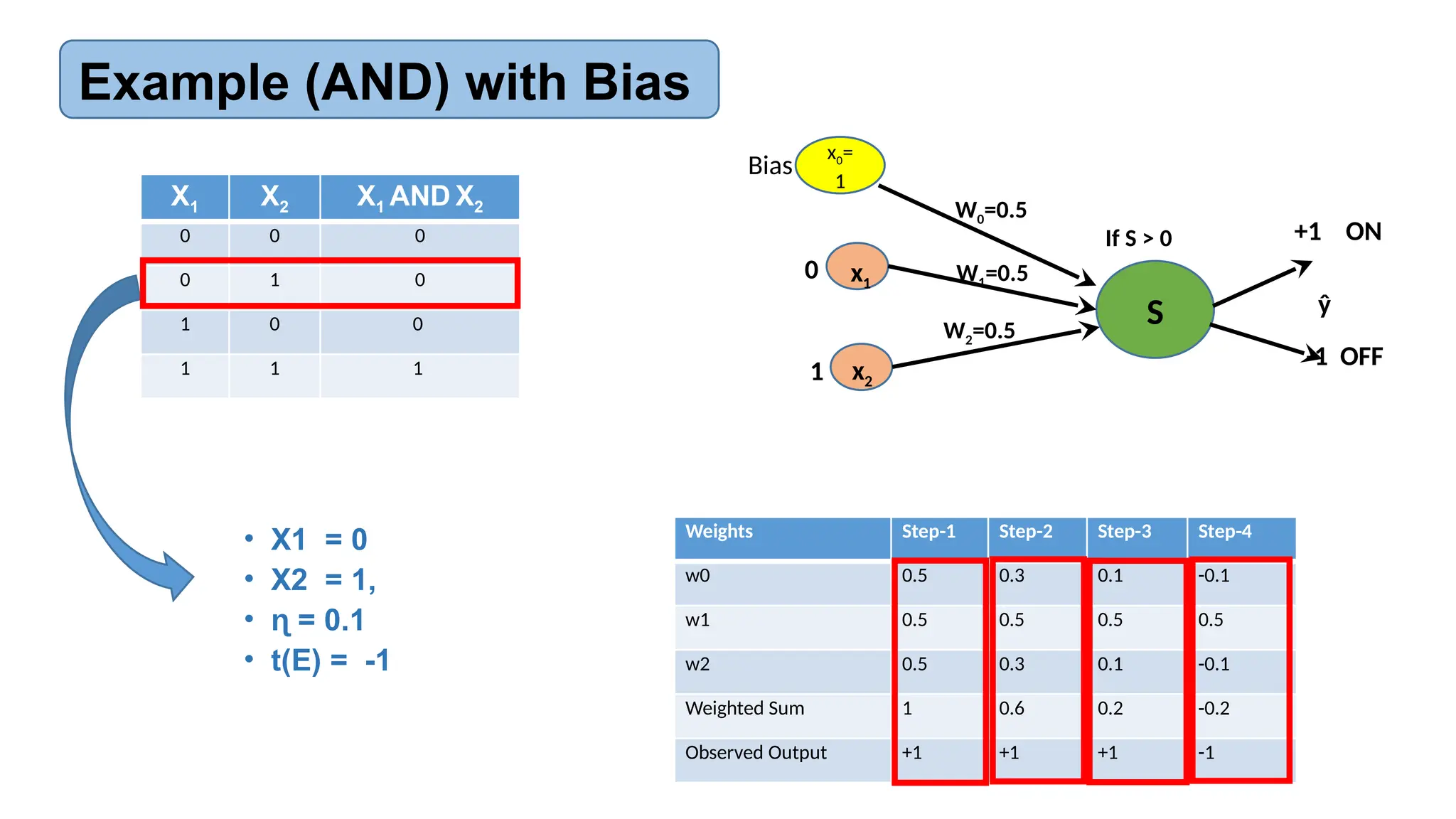
Example (AND) with Bias
X1 X2 X1 AND X2
0 0 0
0 1 0
1 0 0
1 1 1
Weights Step-1 Step-2 Step-3 Step-4
w0 0.5 0.3 0.1 -0.1
w1 0.5 0.5 0.5 0.5
w2 0.5 0.3 0.1 -0.1
Weighted Sum 1 0.6 0.2 -0.2
Observed Output +1 +1 +1 -1
• X1 = 0
• X2 = 1,
• = 0.1
ɳ
• t(E) = -1
x1
x2
S ŷ
W1=0.5
W2=0.5
+1 ON
-1 OFF
If S > 0
0
1
x0=
1
Bias
W0=0.5
X1 X2 X1 AND X2
0 0 0
0 1 0
1 0 0
1 1 1
Weights Step-1 Step-2
w0 -0.1 -0.3
w1 0.5 0.3
w2 -0.1 -0.1
Weighted Sum 0.4 0
Observed Output +1 -1
• X1 = 1
• X2 = 0,
• = 0.1
ɳ
• t(E) = -1
x1
x2
S ŷ
W1=0.
5
W2=-
0.1
+1 ON
-1 OFF
If S > 0
0
1
x0=
1
Bias
W0=-0.1
Example (AND) with Bias
X1 X2 X1 AND X2
0 0 0
0 1 0
1 0 0
1 1 1
Weights Step-1 Step-2
w0 -0.3 -0.1
w1 0.3 0.5
w2 -0.1 0.1
Weighted Sum 0 0.5
Observed Output -1 +1
• X1 = 1
• X2 = 1,
• = 0.1
ɳ
• t(E) = +1
x1
x2
S ŷ
W1=0.
3
W2=-
0.1
+1 ON
-1 OFF
If S > 0
0
1
x0=
1
Bias
W0=-0.3
Example (AND) with Bias
X1 X2 X1 AND X2
0 0 0
0 1 0
1 0 0
1 1 1
Weights
w0 - 0.3
w1 0.3
w2 0.1
• X1 = 0
• X2 = 1,
• = 0.1
ɳ
• t(E) = -1
x1
x2
S ŷ
W1=
0.3
W2=
0.1
+1 ON
-1 OFF
If S > 0
0
1
x0=
1
Bias
W0= -
0.3
After 2 Epochs
Final Weights
Example (AND) with Bias
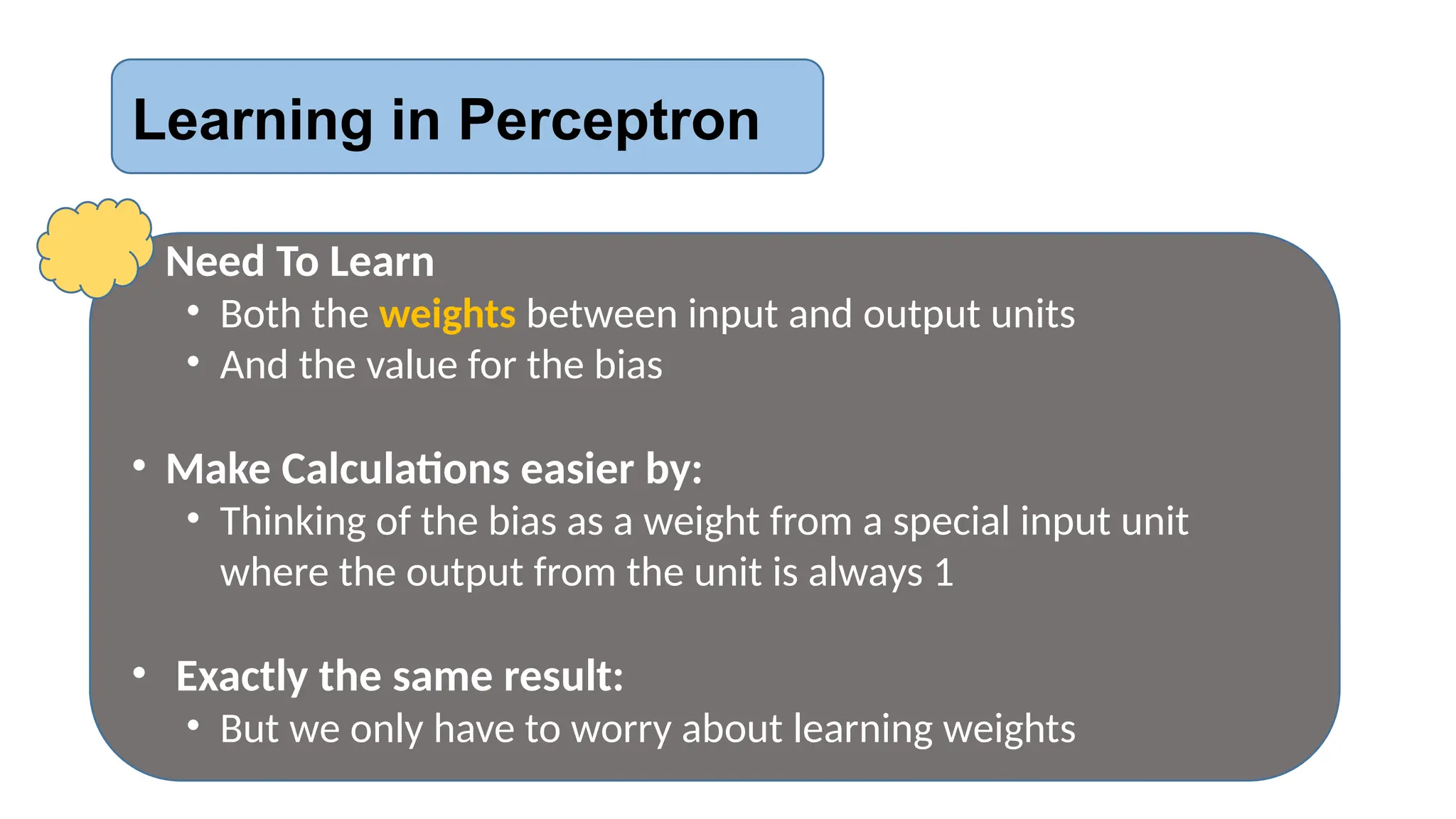
Learning in Perceptron
• Need To Learn
• Both the weights between input and output units
• And the value for the bias
• Make Calculations easier by:
• Thinking of the bias as a weight from a special input unit
where the output from the unit is always 1
• Exactly the same result:
• But we only have to worry about learning weights
New Representation for Perceptron
Special input, which is
always 1
x1
x2
xn
S ŷ
w1
w2
wn
1
w0
If S > 0
+1
-1
Otherwis
e
Threshold function has
become this
S= w0 + w1*x1 + w2*x2 . . . . . . . wn*xn
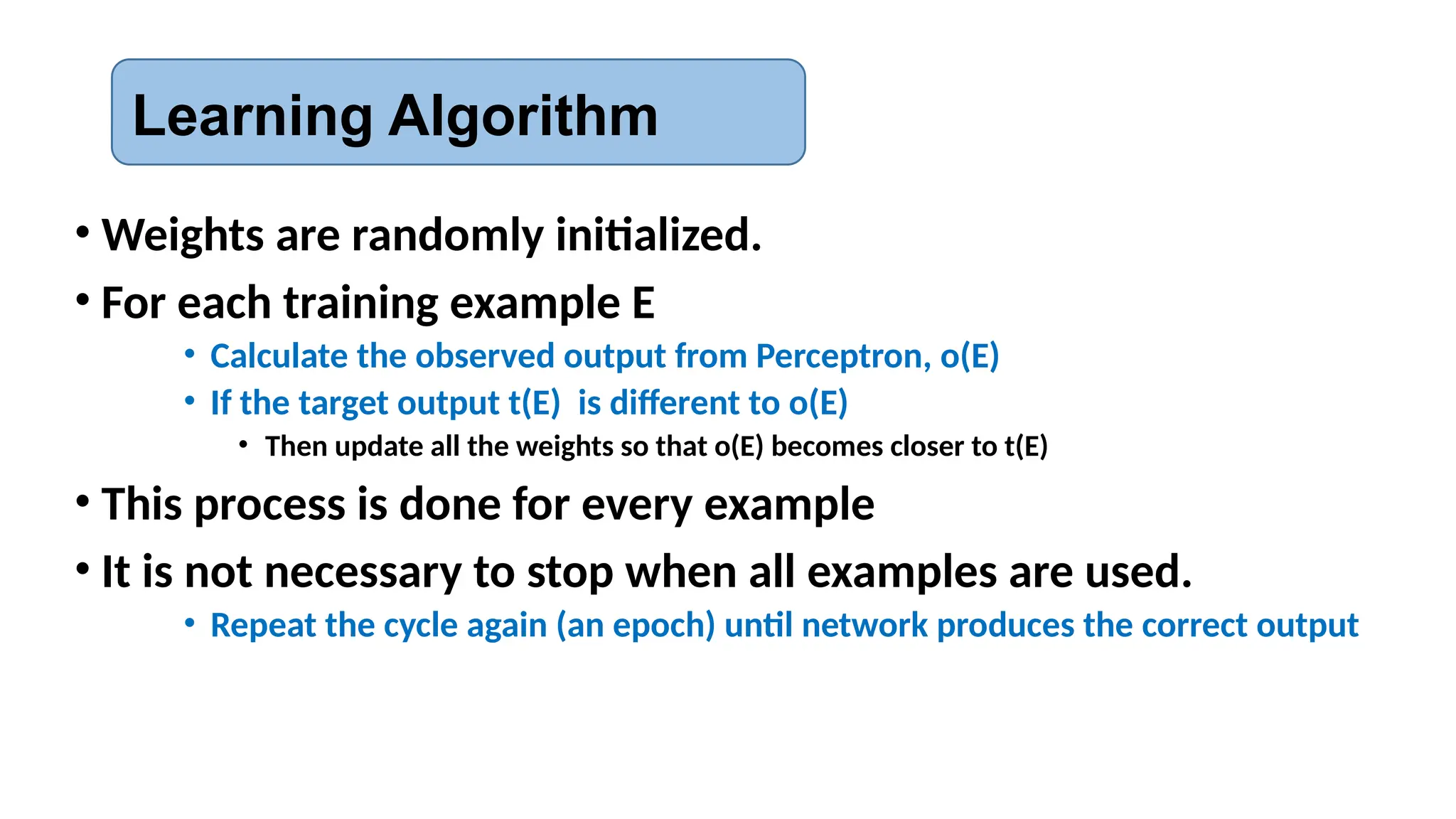
Learning Algorithm
• Weights are randomly initialized.
• For each training example E
• Calculate the observed output from Perceptron, o(E)
• If the target output t(E) is different to o(E)
• Then update all the weights so that o(E) becomes closer to t(E)
• This process is done for every example
• It is not necessary to stop when all examples are used.
• Repeat the cycle again (an epoch) until network produces the correct output
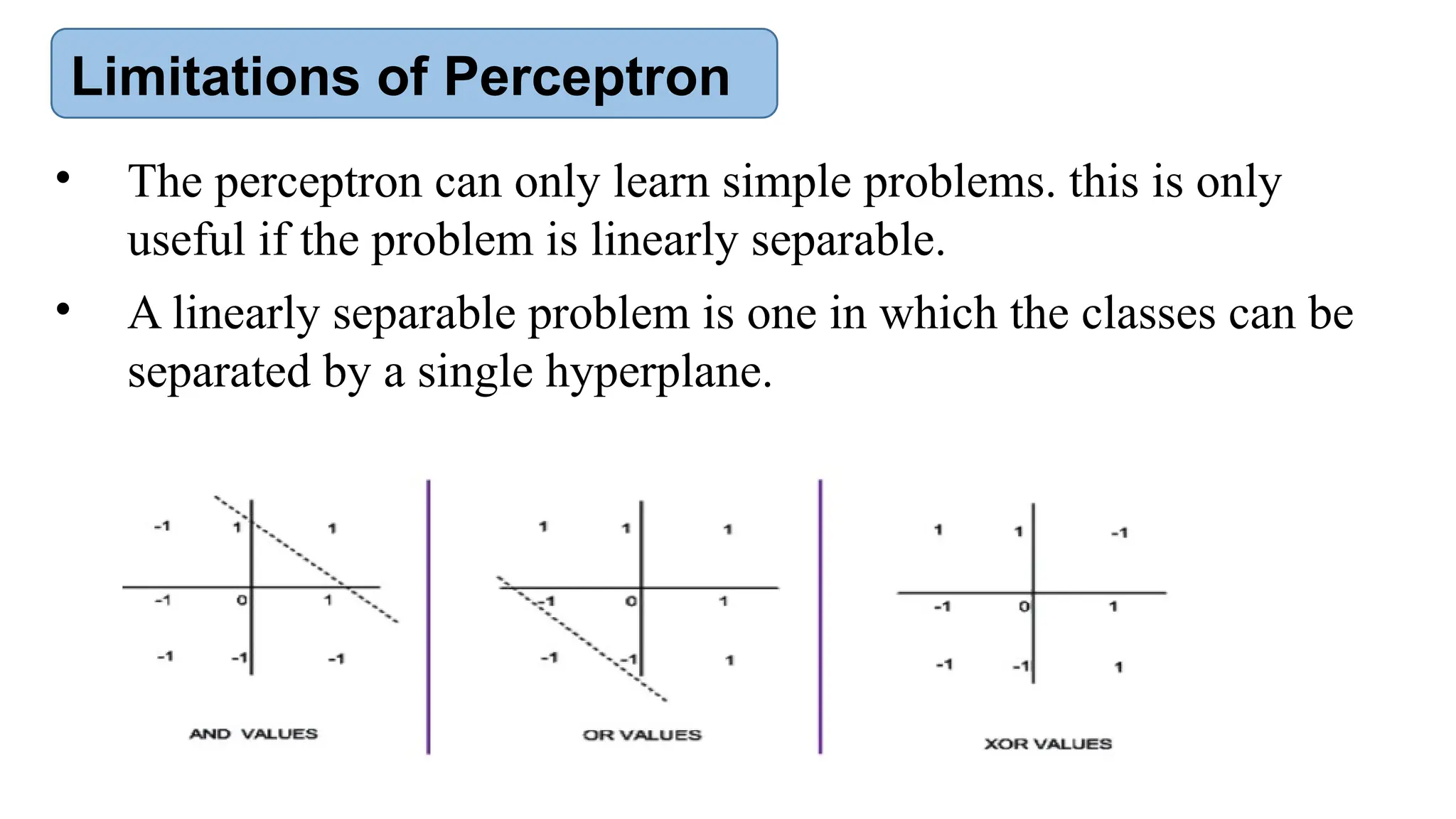
Limitations of Perceptron
• by a single hyperplane.
• The perceptron can only learn simple problems. this is only
useful if the problem is linearly separable.
• A linearly separable problem is one in which the classes can be
separated by a single hyperplane.
Any Questions?

An example of Machine Learning model.pptx

  • 1.
  • 2.
    2 Biological Neuron vs.Artificial Neuron What are Neural Networks ? Biological Neuron Artificial Neuron Dendrites (input) Input Soma (cell body) Node Axon (output) Output Synapse Interconnections Adaptation-based learning Model-based learning
  • 3.
    3 • Two mainalgorithms: • Perceptron: Initial algorithm for learning simple neural networks (with no hidden layer) developed in the 1950’s. • Backpropagation: More complex algorithm for learning multi- layer neural networks developed in the 1980’s. Neural Network Learning Algorithms (1)
  • 4.
    • Neural Netwoksare one the most important class of learning algorithms in ML. • The learned classification model is an algebraic function. • The function is linear for Perceptron algorithm, non-linear for Backpropagation algorithm • Both features and the output classes are allowed to be real valued 4 Neural Network Learning Algorithms (2)
  • 5.
    Perceptron: The FirstNeural Network
  • 6.
    • ANN canbe categorized based on number of hidden layers contained in ANN architecture One Layer Neural Network (Perceptron) • Contains 0 hidden layers 01 Multi Layer Neural Network • Regular Neural Network • Contains 1 hidden layer • Deep Neural Network • Contains >1 hidden layers 02 Types of Artificial Neural Networks
  • 7.
    • Multiple inputnodes • Single output node • Takes weighted sum of the inputs • Unit function calculates the output for the network One layer Artificial Neural Network (Perceptron) x1 x2 x3 xn ∑ ? ŷ w1 w2 w3 wn
  • 8.
    • Linear Function •Simply output the weighted sum Unit Function
  • 9.
    • Linear Function •Weighted sum followed by an activation function Unit Function
  • 10.
    • To categorizea 2x2 pixel binary image to: • “Bright” and “Dark” • The rule is: • If it contains 2, 3 or 4 white pixels, it is “bright” • If it contains 0 or 1 white pixels, it is “dark” • Perceptron architecture: • Four input units, one for each pixel • One output unit: +1 for bright, -1 for dark Perceptron Example Image of 4 pixels
  • 11.
    x1 x2 x3 x4 S ŷ 0.25 0.25 0.25 0.25 Pixel 1 Pixel4 Pixel 3 Pixel 2 +1 Bright If S> -0.1 -1 Dark S= 0.25*x1 + 0.25*x2 + 0.25*x3 + 0.25*x4 Otherwise Perceptron Example
  • 12.
    • Calculation (Step-1): •X1 = 1 • X2 = 0 • X3 = 0 • X4 = 0 S= 0.25*(1) + 0.25* (0) + 0.25*(0) + 0.25* (0) = 0.25 • 0.25 > 0, so the output of ANN is +1 • So the image is categorized as “Bright” • Target : “Dark” Perceptron Example x1 x2 x3 x4 S ŷ 0.25 0.25 0.25 0.25 1 0 0 0 +1 Bright If S> 0 -1 Dark Otherwise
  • 13.
    Perceptron Training Rule(How to update weights) • When t(E) is different from o(E) • Add ∆i to weight wi • Where ∆i = ɳ(t(E) – o(E) ) xi  ɳ is learning rate (Usually very small value) • Do this for every weight in the network • Let ɳ=0.1 ∆1 = ɳ (t(E) – o(E) )* x1 = 0.1 ( -1-1) * 1 = -0.2 ∆2 = ɳ (t(E) – o(E) )* x2 = 0.1 ( -1-1) * 0 = 0 ∆3 = ɳ (t(E) – o(E) )* x3 = 0.1 ( -1-1) * 0 = 0 ∆4 = ɳ (t(E) – o(E) )* x4 = 0.1 ( -1-1) * 0 = 0 wʹ1 = w1 +∆1 = 0.25 - 0.2 = 0.05 wʹ2 = w2 +∆2 = 0.25 + 0 = 0.25 wʹ3 = w3 +∆3 = 0.25 + 0 = 0.25 wʹ4 = w4 +∆4 = 0.25 + 0 = 0.25 Calculating the error values Calculating the New Weights
  • 14.
    • Calculation (Step-2): •X1 = 1 • X2 = 0 • X3 = 0 • X4 = 0 S= 0.05*(1) + 0.25* (0) + 0.25*(0) + 0.25* (0) = 0.05 • 0.05 > 0, so the output of ANN is +1 • So the image is categorized as “Bright” • Target : “Dark” Perceptron Example x1 x2 x3 x4 S ŷ 0.05 0.25 0.25 0.25 1 0 0 0 +1 Bright If S> 0 -1 Dark Otherwise
  • 15.
    Perceptron Training Rule(How to update weights) • When t(E) is different from o(E) • Add ∆i to weight wi • Where ∆i = ɳ(t(E) – o(E) ) xi  ɳ is learning rate (Usually very small value) • Do this for every weight in the network • Let ɳ=0.1 ∆1 = ɳ (t(E) – o(E) )* x1 = 0.1 ( -1 -1 ) * 1 = -0.2 ∆2 = ɳ (t(E) – o(E) )* x2 = 0.1 ( -1-1) * 0 = 0 ∆3 = ɳ (t(E) – o(E) )* x3 = 0.1 ( -1-1) * 0 = 0 ∆4 = ɳ (t(E) – o(E) )* x4 = 0.1 ( -1-1) * 0 = 0 wʹ1 = w1 +∆1 = 0.05 - 0.2 = - 0.15 wʹ2 = w2 +∆2 = 0.25 + 0 = 0.25 wʹ3 = w3 +∆3 = 0.25 + 0 = 0.25 wʹ4 = w4 +∆4 = 0.25 + 0 = 0.25 Calculating the error values Calculating the New Weights
  • 16.
    • Calculation (Step-3): •X1 = 1 • X2 = 0 • X3 = 0 • X4 = 0 S= - 0.15*(1) + 0.25* (0) + 0.25*(0) + 0.25* (0) = - 0.15 • - 0.15 < 0, so the output of ANN is -1 • So the image is categorized as “Dark” • Target : “Dark” Perceptron Example x1 x2 x3 x4 S ŷ -0.15 0.2 5 0.2 5 0.2 5 1 0 0 0 +1 Bright If S> 0 -1 Dark Otherwise
  • 17.
    Another Example (AND) x1 x2 Sŷ W1=0.5 W2=0.5 +1 ON -1 OFF If S > 0 0 1 X1 X2 X1 AND X2 0 0 0 0 1 0 1 0 0 1 1 1 Weights Step-1 Step-2 Step-3 Step-4 w1 0.5 0.5 0.5 0.5 w2 0.5 0.3 0.1 -0.1 Weighted Sum 0.5 0.3 0.1 -0.1 Observed Output +1 +1 +1 -1 • X1 = 0 • X2 = 1, • = 0.1 ɳ • t(E) = -1
  • 18.
    Another Example (AND) x1 x2 Sŷ 0.5 -0.1 +1 ON -1 OFF If S > 0 0 1 X1 X2 X1 AND X2 0 0 0 0 1 0 1 0 0 1 1 1 Weights Step-1 Step-2 Step-3 Step-4 w1 0.5 0.3 0.1 -0.1 w2 -0.1 -0.1 -0.1 -0.1 Weighted Sum 0.5 0.3 0.1 -0.1 Observed Output +1 +1 +1 -1 • X1 = 1 • X2 = 0, • = 0.1 ɳ • t(E) = -1
  • 19.
    Another Example (AND) x1 x2 Sŷ -0.1 -0.1 +1 ON -1 OFF If S > 0 0 1 X1 X2 X1 AND X2 0 0 0 0 1 0 1 0 0 1 1 1 Weights Step-1 Step-2 w1 -0.1 0.1 w2 -0.1 0.1 Weighted Sum -0.2 0.2 Observed Output - 1 +1 • X1 = 1 • X2 = 1, • = 0.1 ɳ • t(E) = +1
  • 20.
    Use of Bias x1 x2 Sŷ 0.5 0.5 +1 ON -1 OFF If S > 0 0 1 • Bias is just like an intercept added in a linear equation. output = sum (weights * inputs) + bias • The output is calculated by multiplying the inputs with their weights and then passing it through an activation function like the Sigmoid function, etc. Here, bias acts like a constant which helps the model to fit the given data. x0 Bias
  • 21.
    Use of Bias •A simpler way to understand bias is through a constant c of a linear function y =mx + c • It allows us to move the line down and up fitting the prediction with the data better. If the constant c is absent then the line will pass through the origin (0, 0) and we will get a poorer fit.
  • 22.
    Example (AND) withBias X1 X2 X1 AND X2 0 0 0 0 1 0 1 0 0 1 1 1 Weights Step-1 Step-2 Step-3 Step-4 w0 0.5 0.3 0.1 -0.1 w1 0.5 0.5 0.5 0.5 w2 0.5 0.3 0.1 -0.1 Weighted Sum 1 0.6 0.2 -0.2 Observed Output +1 +1 +1 -1 • X1 = 0 • X2 = 1, • = 0.1 ɳ • t(E) = -1 x1 x2 S ŷ W1=0.5 W2=0.5 +1 ON -1 OFF If S > 0 0 1 x0= 1 Bias W0=0.5
  • 23.
    X1 X2 X1AND X2 0 0 0 0 1 0 1 0 0 1 1 1 Weights Step-1 Step-2 w0 -0.1 -0.3 w1 0.5 0.3 w2 -0.1 -0.1 Weighted Sum 0.4 0 Observed Output +1 -1 • X1 = 1 • X2 = 0, • = 0.1 ɳ • t(E) = -1 x1 x2 S ŷ W1=0. 5 W2=- 0.1 +1 ON -1 OFF If S > 0 0 1 x0= 1 Bias W0=-0.1 Example (AND) with Bias
  • 24.
    X1 X2 X1AND X2 0 0 0 0 1 0 1 0 0 1 1 1 Weights Step-1 Step-2 w0 -0.3 -0.1 w1 0.3 0.5 w2 -0.1 0.1 Weighted Sum 0 0.5 Observed Output -1 +1 • X1 = 1 • X2 = 1, • = 0.1 ɳ • t(E) = +1 x1 x2 S ŷ W1=0. 3 W2=- 0.1 +1 ON -1 OFF If S > 0 0 1 x0= 1 Bias W0=-0.3 Example (AND) with Bias
  • 25.
    X1 X2 X1AND X2 0 0 0 0 1 0 1 0 0 1 1 1 Weights w0 - 0.3 w1 0.3 w2 0.1 • X1 = 0 • X2 = 1, • = 0.1 ɳ • t(E) = -1 x1 x2 S ŷ W1= 0.3 W2= 0.1 +1 ON -1 OFF If S > 0 0 1 x0= 1 Bias W0= - 0.3 After 2 Epochs Final Weights Example (AND) with Bias
  • 26.
    Learning in Perceptron •Need To Learn • Both the weights between input and output units • And the value for the bias • Make Calculations easier by: • Thinking of the bias as a weight from a special input unit where the output from the unit is always 1 • Exactly the same result: • But we only have to worry about learning weights
  • 27.
    New Representation forPerceptron Special input, which is always 1 x1 x2 xn S ŷ w1 w2 wn 1 w0 If S > 0 +1 -1 Otherwis e Threshold function has become this S= w0 + w1*x1 + w2*x2 . . . . . . . wn*xn
  • 28.
    Learning Algorithm • Weightsare randomly initialized. • For each training example E • Calculate the observed output from Perceptron, o(E) • If the target output t(E) is different to o(E) • Then update all the weights so that o(E) becomes closer to t(E) • This process is done for every example • It is not necessary to stop when all examples are used. • Repeat the cycle again (an epoch) until network produces the correct output
  • 29.
    Limitations of Perceptron •by a single hyperplane. • The perceptron can only learn simple problems. this is only useful if the problem is linearly separable. • A linearly separable problem is one in which the classes can be separated by a single hyperplane.
  • 30.