ET 6803 Special Topics of Optics


Network Virtualization – A Survey


                        Aris Cahyadi Risdianto
                                     23210016
ET 6803 Special Topics of Optics


    INTRODUCTION
Background

   Infrastructure Usage Utilization is not cost effective.
    Total cost can be reduced by sharing network resources
   Cloud Solutions (Cloud Computing, etc) do not take
    infrastructure as concern.
    Always take network connectivity for granted and do not
    approach considering QoS [1]
   Requirement of connection between               components
    respecting service requirements.
    Virtualized service platform respecting all service
    requirements, e.g. as expressed by interactive real-time
    services, on transport layer [1]
Definition

   ”A promising approach to cover individual and dynamic
      resource provision while keeping strong individual QoS
      requirements and optimizing the overall resource
      usage” , Oberle [1].

   "A technique for isolating computational and network
      resources through virtualization to allocate them to a
      logical (virtual) network for accommodating multiple
      independent and programmable virtual networks" ,
      Nakao [2].

   ”A mechanism for running multiple networks, which are
      customized to a specific purpose, over the shared
      infrastructure” , Miyamura [3].
Key Features

   Segmentation: allows several different services to share a
    physical link with given specific QoS properties
   Isolation: No crosstalk between applications in resource
    sharing caused by program crashes, sniffing, attacking, etc
   Encapsulation: enables services developers to design service
    specific on the overlay networks at a high level of abstraction,
    and then disburden them fromdealing with highly complex
    physical network infrastructures.
   Aggregation: possible to build virtually elarged resources
    (clustered resources or resources pool)
ET 6803 Special Topics of Optics


    THE CONCEPTS
ISONI Architecture

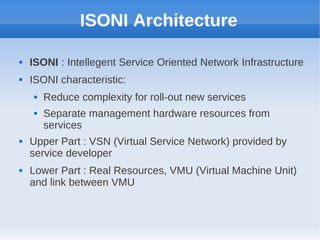
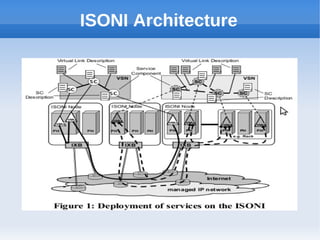
   ISONI : Intellegent Service Oriented Network Infrastructure
   ISONI characteristic:
       Reduce complexity for roll-out new services
       Separate management hardware resources from
        services
   Upper Part : VSN (Virtual Service Network) provided by
    service developer
   Lower Part : Real Resources, VMU (Virtual Machine Unit)
    and link between VMU
ISONI Architecture
VNET Architecture

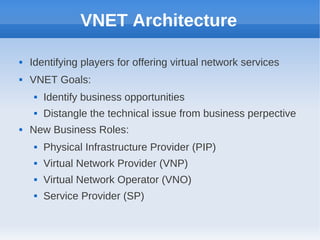
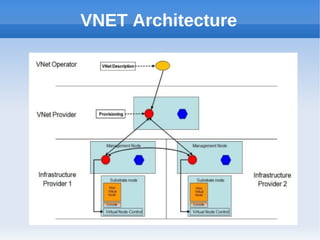
   Identifying players for offering virtual network services
   VNET Goals:
        Identify business opportunities
        Distangle the technical issue from business perpective
   New Business Roles:
        Physical Infrastructure Provider (PIP)
        Virtual Network Provider (VNP)
        Virtual Network Operator (VNO)
        Service Provider (SP)
VNET Architecture
CABO Architecture

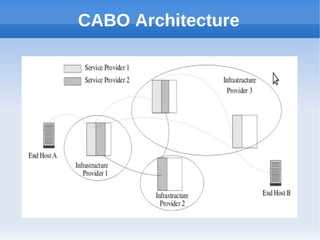
   CABO : Concurrent Architecture Better than One
   Divide ISP into two distinct entities:
        infrastructure providers (provide physically)
        service providers (provide agrement)
   Physical Resources shared by subdividing physical to
    virtual for both node and links
   Bandwidth and delay guaranteed by arbritate access to
    shared resources (CPU, memory, and bandwidth)
   End host can run multiple virtual network from different
    service provider
CABO Architecture
Network Control Mechanism

   One-Hop Source Routing
       Based on Routing overlays
       Route to intermediate node, relay to destination by
        ordinary IP routing, forwarding by tunnel
       Simple control and scalable
   Adaptive network control mechanism
       Attractor selection based VNT based on environmental
        changes adapation
       Regulatory and metabolic reactions consider as optical
        and service overlay network
Resource Allocation

   Static Approaches
       Basic Algorithm
       Traffic constraints based algorithm
       Splitting and Migration of Paths
   Dynamic Approaches
       DaVinci
   Miscellaneous Approaches
       Autonomic Systems based
       Control Theoretic based systems
ET 6803 Special Topics of Optics


PROOF OF CONCEPTS
VNET on HEN

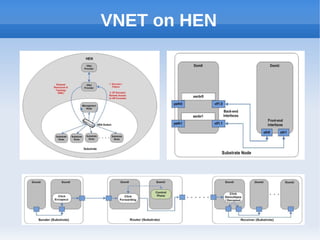
   Consist of 110 computers and single non-blocking gigabit
    etherne switch with constant latency
   Node and Link Virtualization Technologies for Instantion
   Rely on XEN's Paravirtualization for hosting virtual
    machines
   Physical Node compose substrate (PIP)
   NOC of VNP connect to dedicated management node
   XML Schema describe resource spesification for Node and
    Links
VNET on HEN
VNET on HEN
   Two option node virtualization :
        VM created and booted as guest domain
        VM resources allocated by PIP upon request
   Virtual node connection using Ipv4-in-IPv4 Tunnel
   Two NIC drivers of XEN :
        DomU (Back-end) : part kernel space of guest OS
        Dom0 (Front-end): physical domain inc, physical NIC
   Back-end and Front-end correspons with Bridging (XEN
    default) or Click
   Topology created using VLAN and Virtual links by switch-
    daemon based on request
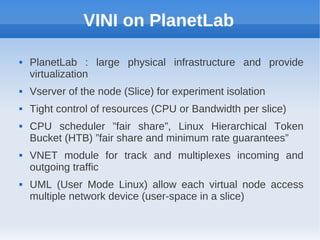
VINI on PlanetLab

   PlanetLab : large physical infrastructure and provide
    virtualization
   Vserver of the node (Slice) for experiment isolation
   Tight control of resources (CPU or Bandwidth per slice)
   CPU scheduler ”fair share”, Linux Hierarchical Token
    Bucket (HTB) ”fair share and minimum rate guarantees”
   VNET module for track and multiplexes incoming and
    outgoing traffic
   UML (User Mode Linux) allow each virtual node access
    multiple network device (user-space in a slice)
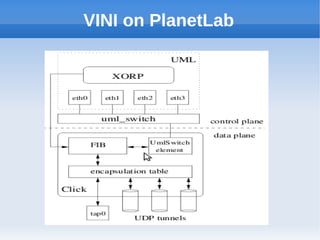
VINI on PlanetLab
VINI on PlanetLab
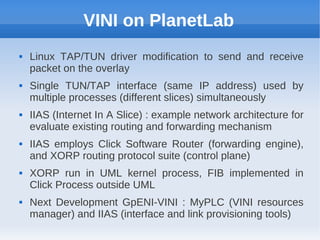
   Linux TAP/TUN driver modification to send and receive
    packet on the overlay
   Single TUN/TAP interface (same IP address) used by
    multiple processes (different slices) simultaneously
   IIAS (Internet In A Slice) : example network architecture for
    evaluate existing routing and forwarding mechanism
   IIAS employs Click Software Router (forwarding engine),
    and XORP routing protocol suite (control plane)
   XORP run in UML kernel process, FIB implemented in
    Click Process outside UML
   Next Development GpENI-VINI : MyPLC (VINI resources
    manager) and IIAS (interface and link provisioning tools)
ET 6803 Special Topics of Optics


    REFERENCEES
Reference

1) Karsten Oberle, Marcus Kessler, Manuel Stein, Thomas Voith,
   Dominik Lamp, Sören Berger, "Network Virtualization: The
   missing piece", ICIN, 2009.
2) Akihiro NAKAO, "Network Virtualization as Foundation for
   Enabling New Network Architectures and Applications", IEICE,
   March 2010.
3) Takashi Miyamura, Yuichi Ohsita, Shin’ichi Arakawa, Yuki
   Koizumi, Akeo Masuda, Kohei Shiomoto, and Masayuki Murata,
   "Network Virtualization Server for Adaptive Network Control",
   ITC Specialist Seminar, Hanoi, 2009.
4) Panagiotis Papadimitriou, Olaf Maennel, Adam Greenhalgh,
   Anja Feldmann, Laurent Mathy, ”Implementing Network
   Virtualization for a Future Internet”, Hoi An, Vietnam, 2009.
Reference

5) Panagiotis Papadimitriou, Olaf Maennel, Adam Greenhalgh,
   Anja Feldmann, Laurent Mathy, ”Network Virtualization
   Architecture: Proposal and Initial Prototype", VISA, Spain, 2009.
6) Nick Feamster, Lixin Gao, Jennifer Rexford, "How to Lease the
   Internet in Your Spare Time".
7) K. Tutschku, T. Zinner, A. Nakao, P. Tran-Gia, "Network
   Virtualization: Implementation Steps Towards the Future
   Internet", Electronic Communications of the EASST Volume 17,
   2009.
8) Aun Haider, Richard Potter, Akihiro Nakao, "Challenges in
   Resource Allocation in Network Virtualization", ITC Specialist
   Seminar, Hanoi, 2009.
Reference

9) Ramkumar Cherukuri, Xuan Liu , Andy Bavier, James P.G.
   Sterbenz, and Deep Medhi, "Network Virtualization in GpENI:
   Framework, Implementation & Integration Experience",
   IEEE/IFIP International Workshop, Ireland, 2011.
10) Andy Bavier, Nick Feamster, Mark Huang, Larry Peterson,
  Jennifer Rexford, "In VINI Veritas: Realistic and Controlled
  Network Experimentation".
ET 6803 Special Topics of Optics


        Thank You

Network virtualizations - Survey

  • 1.
  • 2.
  • 3.
    Background  Infrastructure Usage Utilization is not cost effective. Total cost can be reduced by sharing network resources  Cloud Solutions (Cloud Computing, etc) do not take infrastructure as concern. Always take network connectivity for granted and do not approach considering QoS [1]  Requirement of connection between components respecting service requirements. Virtualized service platform respecting all service requirements, e.g. as expressed by interactive real-time services, on transport layer [1]
  • 4.
    Definition  ”A promising approach to cover individual and dynamic resource provision while keeping strong individual QoS requirements and optimizing the overall resource usage” , Oberle [1].  "A technique for isolating computational and network resources through virtualization to allocate them to a logical (virtual) network for accommodating multiple independent and programmable virtual networks" , Nakao [2].  ”A mechanism for running multiple networks, which are customized to a specific purpose, over the shared infrastructure” , Miyamura [3].
  • 5.
    Key Features  Segmentation: allows several different services to share a physical link with given specific QoS properties  Isolation: No crosstalk between applications in resource sharing caused by program crashes, sniffing, attacking, etc  Encapsulation: enables services developers to design service specific on the overlay networks at a high level of abstraction, and then disburden them fromdealing with highly complex physical network infrastructures.  Aggregation: possible to build virtually elarged resources (clustered resources or resources pool)
  • 6.
  • 7.
    ISONI Architecture  ISONI : Intellegent Service Oriented Network Infrastructure  ISONI characteristic:  Reduce complexity for roll-out new services  Separate management hardware resources from services  Upper Part : VSN (Virtual Service Network) provided by service developer  Lower Part : Real Resources, VMU (Virtual Machine Unit) and link between VMU
  • 8.
  • 9.
    VNET Architecture  Identifying players for offering virtual network services  VNET Goals:  Identify business opportunities  Distangle the technical issue from business perpective  New Business Roles:  Physical Infrastructure Provider (PIP)  Virtual Network Provider (VNP)  Virtual Network Operator (VNO)  Service Provider (SP)
  • 10.
  • 11.
    CABO Architecture  CABO : Concurrent Architecture Better than One  Divide ISP into two distinct entities:  infrastructure providers (provide physically)  service providers (provide agrement)  Physical Resources shared by subdividing physical to virtual for both node and links  Bandwidth and delay guaranteed by arbritate access to shared resources (CPU, memory, and bandwidth)  End host can run multiple virtual network from different service provider
  • 12.
  • 13.
    Network Control Mechanism  One-Hop Source Routing  Based on Routing overlays  Route to intermediate node, relay to destination by ordinary IP routing, forwarding by tunnel  Simple control and scalable  Adaptive network control mechanism  Attractor selection based VNT based on environmental changes adapation  Regulatory and metabolic reactions consider as optical and service overlay network
  • 14.
    Resource Allocation  Static Approaches  Basic Algorithm  Traffic constraints based algorithm  Splitting and Migration of Paths  Dynamic Approaches  DaVinci  Miscellaneous Approaches  Autonomic Systems based  Control Theoretic based systems
  • 15.
  • 16.
    VNET on HEN  Consist of 110 computers and single non-blocking gigabit etherne switch with constant latency  Node and Link Virtualization Technologies for Instantion  Rely on XEN's Paravirtualization for hosting virtual machines  Physical Node compose substrate (PIP)  NOC of VNP connect to dedicated management node  XML Schema describe resource spesification for Node and Links
  • 17.
  • 18.
    VNET on HEN  Two option node virtualization :  VM created and booted as guest domain  VM resources allocated by PIP upon request  Virtual node connection using Ipv4-in-IPv4 Tunnel  Two NIC drivers of XEN :  DomU (Back-end) : part kernel space of guest OS  Dom0 (Front-end): physical domain inc, physical NIC  Back-end and Front-end correspons with Bridging (XEN default) or Click  Topology created using VLAN and Virtual links by switch- daemon based on request
  • 19.
    VINI on PlanetLab  PlanetLab : large physical infrastructure and provide virtualization  Vserver of the node (Slice) for experiment isolation  Tight control of resources (CPU or Bandwidth per slice)  CPU scheduler ”fair share”, Linux Hierarchical Token Bucket (HTB) ”fair share and minimum rate guarantees”  VNET module for track and multiplexes incoming and outgoing traffic  UML (User Mode Linux) allow each virtual node access multiple network device (user-space in a slice)
  • 20.
  • 21.
    VINI on PlanetLab  Linux TAP/TUN driver modification to send and receive packet on the overlay  Single TUN/TAP interface (same IP address) used by multiple processes (different slices) simultaneously  IIAS (Internet In A Slice) : example network architecture for evaluate existing routing and forwarding mechanism  IIAS employs Click Software Router (forwarding engine), and XORP routing protocol suite (control plane)  XORP run in UML kernel process, FIB implemented in Click Process outside UML  Next Development GpENI-VINI : MyPLC (VINI resources manager) and IIAS (interface and link provisioning tools)
  • 22.
  • 23.
    Reference 1) Karsten Oberle,Marcus Kessler, Manuel Stein, Thomas Voith, Dominik Lamp, Sören Berger, "Network Virtualization: The missing piece", ICIN, 2009. 2) Akihiro NAKAO, "Network Virtualization as Foundation for Enabling New Network Architectures and Applications", IEICE, March 2010. 3) Takashi Miyamura, Yuichi Ohsita, Shin’ichi Arakawa, Yuki Koizumi, Akeo Masuda, Kohei Shiomoto, and Masayuki Murata, "Network Virtualization Server for Adaptive Network Control", ITC Specialist Seminar, Hanoi, 2009. 4) Panagiotis Papadimitriou, Olaf Maennel, Adam Greenhalgh, Anja Feldmann, Laurent Mathy, ”Implementing Network Virtualization for a Future Internet”, Hoi An, Vietnam, 2009.
  • 24.
    Reference 5) Panagiotis Papadimitriou,Olaf Maennel, Adam Greenhalgh, Anja Feldmann, Laurent Mathy, ”Network Virtualization Architecture: Proposal and Initial Prototype", VISA, Spain, 2009. 6) Nick Feamster, Lixin Gao, Jennifer Rexford, "How to Lease the Internet in Your Spare Time". 7) K. Tutschku, T. Zinner, A. Nakao, P. Tran-Gia, "Network Virtualization: Implementation Steps Towards the Future Internet", Electronic Communications of the EASST Volume 17, 2009. 8) Aun Haider, Richard Potter, Akihiro Nakao, "Challenges in Resource Allocation in Network Virtualization", ITC Specialist Seminar, Hanoi, 2009.
  • 25.
    Reference 9) Ramkumar Cherukuri,Xuan Liu , Andy Bavier, James P.G. Sterbenz, and Deep Medhi, "Network Virtualization in GpENI: Framework, Implementation & Integration Experience", IEEE/IFIP International Workshop, Ireland, 2011. 10) Andy Bavier, Nick Feamster, Mark Huang, Larry Peterson, Jennifer Rexford, "In VINI Veritas: Realistic and Controlled Network Experimentation".
  • 26.