Kailash Narayan Patidar College of Science and
Technology, Bhopal
Session: 2016-17
Presented By:
Name : Kanchan Ubnare
Roll No:0xxxxxxx
M. Tech. IV Semester
Guided By: Asst. Prof. Vimal Shukla
Deptt: Computer Science Engineering
Efficient Hybrid Routing using PEGASIS and
LEACH Protocols in Wireless Networks
Under Rajiv Gandhi Proudyogiki Vishwavidyalaya
Bhopal
Contents
Objective.
Introduction
System Model.
Literature Review.
Proposed Methodology
Simulation Result.
Conclusion
Future Scope.
List of Publication
References.
2
OBJECTIVE
•The wireless networks need to be improved to live longer specially
when sensors are involved as nodes to send information to the base
station of the network considered.
•The basic fundamental to reduce the energy consumption of the
particular sensor network is to optimize the collection pattern of
information from the nodes to base station or server.
•The energy aware wireless sensor networks are the need of today's
wireless generation of information communication.
•The conservation of energy is also important due to all the wireless
network nodes are battery sourced.
• The battery has the restricted source of energy and this drawback
is also motivation to build up efficient routing system.
3
OBJECTIVE
• This work have proposed modified routing algorithm hybrid
routing of PEGASIS and LEACH and optimize the pattern of
cluster head election probability.
•The simulation has been done for 3500 rounds and the network live
longer more than 2000 rounds.
•The system design with the outcomes are explained in the proposed
methodology and simulation results sections.
4
Introduction
Like living creatures, an assortment of present day devices and
types of equipments depends on the sensory data from the
globe around it.
These sensory data comes is given by Wireless Sensor
Networks (WSN), which comprises of a few little sensor
nodes to screen physical or natural conditions, for example,
temperature, vibration, weight, sound or movement.
Drain (Low Energy Adaptive Clustering Hierarchy) is a
various leveled based directing protocol which utilizes
arbitrary revolution of the nodes required to be the bunch
heads to equally disseminate vitality utilization in the network.
5
6
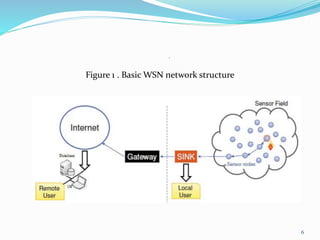
Figure 1 . Basic WSN network structure
.
A wireless sensor network (WSN) in its least difficult
frame can be characterized as a network perhaps having
low-size and optimized complexity.
The devices that are included indicated as nodes that can
detect the earth and communicate the data accumulated from
the observed field through wireless connections;
the data is sent, perhaps by means of different bounces
handing-off, to a sink that can utilize it locally, or is associated
with different networks (e.g. the Internet) through a passage.
The sink node is the node which is the destination of message
originate by sensor nodes, i.e.- It speaks to the end purpose of
data accumulation in wireless sensor network.
7
The nodes in the sensor network cooperate to gather and
send data to sink node or base station.
Sensor nodes are fitted with an on-board processor. Each
node in the sensor network, rather than sending the crude
data to alternate nodes, they have in charge of the
combination of data.
During the time spent data combination we can decrease
the measure of data transmitted between sensor nodes
and the base station. It joins at least one data parcels from
various sensor nodes to deliver a solitary bundle. The
sensor nodes utilize their preparing capacities to locally do
basic calculations and transmit just the required and
halfway processed data.
8
9
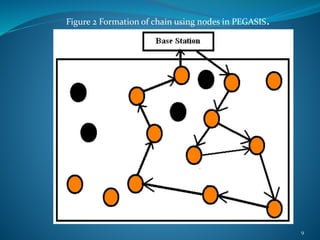
Figure 2 Formation of chain using nodes in PEGASIS.
Wireless sensor nodes sense data and send it specifically to the
base station or they perform a clustering technique as in
LEACH.
LEACH is known for cluster formation which contains cluster
members sensing the data and the cluster head which gathers
the data gathered in an intertwined manner (all the data is sent
as a single packet) to the base station.
PEGASIS is an expansion to LEACH; it has better ways of
conserving energy which last significantly more than using
cluster mechanism in LEACH.
In this way all the nodes get and combine their data, and pass
it to the following neighbor in a chain format till they all reach
the base station.
10
•SYSTEM MODEL
Every node in the network takes turns as a leader of the
chain and the one answerable to transmit the entire
intertwined data gathered by the chain of nodes to the
base station.
The average amount of energy spent by each node is
lessened.
Ravenous algorithms are utilized to see that all nodes are
utilized during the chain formation.
PEGASIS assumes that all the nodes with varying or low
energy levels can be compensated keeping in mind the
end goal to calculate the energy cost of the transmissions
with the remaining energy they are left with.
11
It is not necessary that all the nodes need to know its neighboring
nodes, the base station can determine the path or form the chain for
all nodes,
all the nodes can determine their neighboring nodes by sending a
signal.
Depending upon the signal quality, the nodes adjust their signal with
the end goal that they hear just the nearest neighbors in the network.
LITERATURE REVIEW
13
SR.No. TITLE AUTHOR YEAR METHODOLOGY
1 ModifiedLEACH
Protocolfor
Heterogeneous
Wireless Networks
A. Amwary, D. Maga and
T. Nahdi,
2016 To increase the network life
time A modified (LEACH)
protocol has been proposed
2 Security of ONS service
for applications of the
Internet of Things and
their pilot implementation
in academic network
L. Kypus, L. Vojtech and
J. Hrad,
2015 To build ONS systems past
failures could be lack of security
as the integral part of design of
each particular product,
3 Life Time Enhancement
of Sensor Network by
Using Concept of SEP
& LEACH
(LEACH-P),,
N. Gupta, H. Gupta and
R. Yadav,
2015 To boost the overall lifetime of
the wireless sensor network
developed a LEACH-P (Leach-
Modified) protocol .
4 Performance analysis of
Modified Stable Election
Protocol in heterogeneous
WSN
D. Singh and C. K.
Panda,
2015 Three cluster based routing
protocols has represents
LITERATURE REVIEW
14
5 Improving network lifetime
with mobile LEACH protocol
for Wireless Sensors
Network.
O. Mezghani and M.
Abdellaoui,
2014 Using mobile base station.
maximizing network lifetime of a
Wireless Sensors Network (WSN) b
6 Oriented energy-aware
scheme used in
heterogeneous Wireless
Sensor Networks,,
M. Saadi, M. L. Hasnaoui, A.
Beni Hssane and M. Laghdir,
2013 For heterogeneous wireless sensor
networks, An energy aware cluster
head selection algorithm,
7 Security of cluster-based
communication protocols for
wireless sensor networks
L. B. Oliveira E. Habib H. C.
Wong A. C. Ferreira, M. A.
Vilaa and A. A. Loureiro
2005 Use of cluster-based wireless sensor
network reduces system delay and
energy consumption.
PROPOSED METHODOLOGY..
15
The wireless networks are division of mobile ad-hoc network has lot of
challenges to increase the lifetime of the sensor nodes based wireless
network to live longer and keep communicating with the network
Here we are to work out main areas by which a node can live longer and
i.e. either make batteries (source of energy) equipped with nodes having
larger in size or the material having larger charges saving capability.
This approach having limited capabilities because the larger battery size
make sensor node more bulk which is not feasible in any case, and to
finding out the material has larger charge storing capability is also tough
task to do.
the hybrid form of two routing protocols mainly PEGASIS and some
feature of it modified to improve lifetime and taken from LEACH routing
protocol.
PROPOSED METHODOLOGY..
16
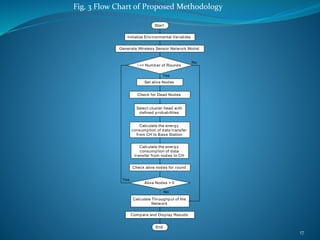
The flow chart of it is shown in the fig. it explains the step by step
execution of algorithm of proposed hybrid routing.
In existing work life span of the network is calculated up to 2000
transmission rounds.
If the network sustain for more number of rounds means life span of the
network is going better.
In proposed approach the life span of the network reaches more than 2000
rounds in 100x100 network, which is greater than the previous work.
17
Fig. 3 Flow Chart of Proposed Methodology
Start
Initialize Environmental Variables
Generate Wireless Sensor Network Model
i <= Number of Rounds
Set alive Nodes
Check for Dead Nodes
Select cluster head with
defined probabilities
Calculate the energy
consumption of data transfer
from CH to Base Station
Calculate the energy
consumption of data
transfer from nodes to CH
Check alive nodes for round
Alive Nodes > 0
Calculate Throughput of the
Network
Compare and Display Results
End
Yes
No
Yes
No
18
SIMULATION OUTCOMES
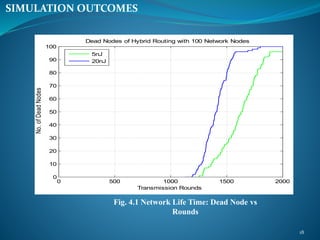
Fig. 4.1 Network Life Time: Dead Node vs
Rounds
0 500 1000 1500 2000
0
10
20
30
40
50
60
70
80
90
100
Transmission Rounds
No.ofDeadNodes Dead Nodes of Hybrid Routing with 100 Network Nodes
5nJ
20nJ
19
SIMULATION OUTCOMES
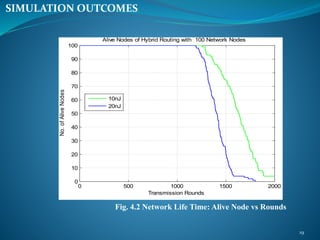
Fig. 4.2 Network Life Time: Alive Node vs Rounds
0 500 1000 1500 2000
0
10
20
30
40
50
60
70
80
90
100
Transmission Rounds
No.ofAliveNodes
Alive Nodes of Hybrid Routing with 100 Network Nodes
10nJ
20nJ
20
SIMULATION OUTCOMES
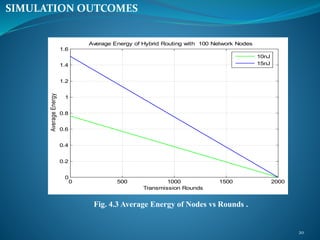
Fig. 4.3 Average Energy of Nodes vs Rounds .
0 500 1000 1500 2000
0
0.2
0.4
0.6
0.8
1
1.2
1.4
1.6
Transmission Rounds
AverageEnergy
Average Energy of Hybrid Routing with 100 Network Nodes
10nJ
15nJ
21
SIMULATION OUTCOMES
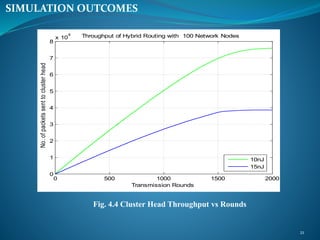
Fig. 4.4 Cluster Head Throughput vs Rounds
0 500 1000 1500 2000
0
1
2
3
4
5
6
7
8
x 10
4
Transmission Rounds
No.ofpacketssenttoclusterhead
Throughput of Hybrid Routing with 100 Network Nodes
10nJ
15nJ
22
SIMULATION OUTCOMES
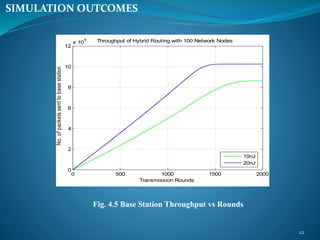
Fig. 4.5 Base Station Throughput vs Rounds
0 500 1000 1500 2000
0
2
4
6
8
10
12
x 10
4
Transmission Rounds
No.ofpacketssenttobasestation
Throughput of Hybrid Routing with 100 Network Nodes
10nJ
20nJ
SIMULATION OUTCOMES
Wireless networks are having lots of research areas to work on and here we
have chosen routing protocol to make network life span more than the previous
work.
The simulation performed on hybrid routing which is integration of PEGASIS
and LEACH protocols or it can be say that modified PEGASIS routing protocol
because the changes has been inspired by the LEACH protocol.
The routing performed on reducing the data aggregation energy. The simulated
results are showing the terms of number of alive nodes and numbers of dead
nodes versus number of transmission rounds and packets sent to base station and
packets sent to cluster groups. .
shows the dead node characteristics, alive node characteristics, average energy
of nodes, cluster head throughput and base station throughput vs transmission
rounds.
 These parameters clearly shows the merits over existing routing protocol.
23
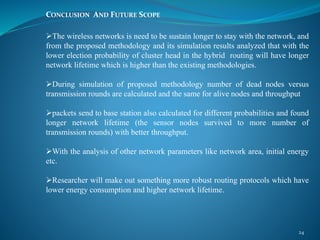
CONCLUSION AND FUTURE SCOPE
The wireless networks is need to be sustain longer to stay with the network, and
from the proposed methodology and its simulation results analyzed that with the
lower election probability of cluster head in the hybrid routing will have longer
network lifetime which is higher than the existing methodologies.
During simulation of proposed methodology number of dead nodes versus
transmission rounds are calculated and the same for alive nodes and throughput
packets send to base station also calculated for different probabilities and found
longer network lifetime (the sensor nodes survived to more number of
transmission rounds) with better throughput.
With the analysis of other network parameters like network area, initial energy
etc.
Researcher will make out something more robust routing protocols which have
lower energy consumption and higher network lifetime.
24
REFERENCES
25
1. A.Amwary, D. Maga and T. Nahdi, "Modified LEACH protocol for
heterogeneous wireless networks," 2016 New Trends in Signal Processing
(NTSP), Demanovska Dolina, 2016, pp. 1-4.
2. L. Kypus, L. Vojtech, J. Hrad, "Security of ONS Service for Applications of the
Internet of Things and Their Pilot Implementation in Academic Network," in
Proceedings of the 16th International Carpathian Control Conference (ICCC).
Piscataway: IEEE, 2015, art. no. 054, pp. 271-276. ISBN 978-1-4799-7369-9.
3. N. Gupta, H. Gupta and R. Yadav, "Life Time Enhancement of Sensor Network
by Using Concept of SEP &amp; LEACH (LEACH-P)," 2015 Second
International Conference on Advances in Computing and Communication
Engineering, Dehradun, 2015, pp. 198-201.
4. D.Singh and C. K. Panda, "Performance analysis of Modified Stable Election
Protocol in heterogeneous WSN," 2015 International Conference on Electrical,
Electronics, Signals, Communication and Optimization (EESCO),
Visakhapatnam, 2015, pp. 1-5.
5. O. Mezghani and M. Abdellaoui, "Improving network lifetime with mobile
LEACH protocol for Wireless Sensors Network," 2014 15th International
Conference on Sciences and Techniques of Automatic Control and Computer
Engineering (STA), Hammamet, 2014, pp. 613-619..
REFERENCES
26
6. M. Saadi, M. L. Hasnaoui, A. Beni Hssane and M. Laghdir, "Oriented energy-
aware scheme used in heterogeneous Wireless Sensor Networks," 2013
International Renewable and Sustainable Energy Conference (IRSEC),
Ouarzazate, 2013, pp. 414-419.
7. L. B. Oliveira E. Habib H. C. Wong A. C. Ferreira, M. A. Vilaa and A. A.
Loureiro. Security of cluster-based communication protocols for wireless sensor
networks. In 4th IEEE International Conference on Networking (ICN05),
volume Lecture Notes in Computer Science, pages 449-458, Washington, DC,
USA, 2005.
8. Jamal N. Al-karaki and Ahmed E. Kamal. Routing techniques in wireless sensor
networks: A survey. IEEE Wireless Communications, 11:6-28, 2004.
LIST OF PUBLICATIONS
27
1. Paper Name “*****************************
”
Journal Name **********************
Published
Link http://www.ijspr.com/
2. Paper Name “Efficient Hybrid Routing using PEGASIS and LEACH Protocols in
Wireless Networks”
Journal Name ***********************************
Published
Link http://http://www.ijite.com/.
Thank You
28

Kanchan ppt

  • 1.
    Kailash Narayan PatidarCollege of Science and Technology, Bhopal Session: 2016-17 Presented By: Name : Kanchan Ubnare Roll No:0xxxxxxx M. Tech. IV Semester Guided By: Asst. Prof. Vimal Shukla Deptt: Computer Science Engineering Efficient Hybrid Routing using PEGASIS and LEACH Protocols in Wireless Networks Under Rajiv Gandhi Proudyogiki Vishwavidyalaya Bhopal
  • 2.
    Contents Objective. Introduction System Model. Literature Review. ProposedMethodology Simulation Result. Conclusion Future Scope. List of Publication References. 2
  • 3.
    OBJECTIVE •The wireless networksneed to be improved to live longer specially when sensors are involved as nodes to send information to the base station of the network considered. •The basic fundamental to reduce the energy consumption of the particular sensor network is to optimize the collection pattern of information from the nodes to base station or server. •The energy aware wireless sensor networks are the need of today's wireless generation of information communication. •The conservation of energy is also important due to all the wireless network nodes are battery sourced. • The battery has the restricted source of energy and this drawback is also motivation to build up efficient routing system. 3
  • 4.
    OBJECTIVE • This workhave proposed modified routing algorithm hybrid routing of PEGASIS and LEACH and optimize the pattern of cluster head election probability. •The simulation has been done for 3500 rounds and the network live longer more than 2000 rounds. •The system design with the outcomes are explained in the proposed methodology and simulation results sections. 4
  • 5.
    Introduction Like living creatures,an assortment of present day devices and types of equipments depends on the sensory data from the globe around it. These sensory data comes is given by Wireless Sensor Networks (WSN), which comprises of a few little sensor nodes to screen physical or natural conditions, for example, temperature, vibration, weight, sound or movement. Drain (Low Energy Adaptive Clustering Hierarchy) is a various leveled based directing protocol which utilizes arbitrary revolution of the nodes required to be the bunch heads to equally disseminate vitality utilization in the network. 5
  • 6.
    6 Figure 1 .Basic WSN network structure .
  • 7.
    A wireless sensornetwork (WSN) in its least difficult frame can be characterized as a network perhaps having low-size and optimized complexity. The devices that are included indicated as nodes that can detect the earth and communicate the data accumulated from the observed field through wireless connections; the data is sent, perhaps by means of different bounces handing-off, to a sink that can utilize it locally, or is associated with different networks (e.g. the Internet) through a passage. The sink node is the node which is the destination of message originate by sensor nodes, i.e.- It speaks to the end purpose of data accumulation in wireless sensor network. 7
  • 8.
    The nodes inthe sensor network cooperate to gather and send data to sink node or base station. Sensor nodes are fitted with an on-board processor. Each node in the sensor network, rather than sending the crude data to alternate nodes, they have in charge of the combination of data. During the time spent data combination we can decrease the measure of data transmitted between sensor nodes and the base station. It joins at least one data parcels from various sensor nodes to deliver a solitary bundle. The sensor nodes utilize their preparing capacities to locally do basic calculations and transmit just the required and halfway processed data. 8
  • 9.
    9 Figure 2 Formationof chain using nodes in PEGASIS.
  • 10.
    Wireless sensor nodessense data and send it specifically to the base station or they perform a clustering technique as in LEACH. LEACH is known for cluster formation which contains cluster members sensing the data and the cluster head which gathers the data gathered in an intertwined manner (all the data is sent as a single packet) to the base station. PEGASIS is an expansion to LEACH; it has better ways of conserving energy which last significantly more than using cluster mechanism in LEACH. In this way all the nodes get and combine their data, and pass it to the following neighbor in a chain format till they all reach the base station. 10 •SYSTEM MODEL
  • 11.
    Every node inthe network takes turns as a leader of the chain and the one answerable to transmit the entire intertwined data gathered by the chain of nodes to the base station. The average amount of energy spent by each node is lessened. Ravenous algorithms are utilized to see that all nodes are utilized during the chain formation. PEGASIS assumes that all the nodes with varying or low energy levels can be compensated keeping in mind the end goal to calculate the energy cost of the transmissions with the remaining energy they are left with. 11
  • 12.
    It is notnecessary that all the nodes need to know its neighboring nodes, the base station can determine the path or form the chain for all nodes, all the nodes can determine their neighboring nodes by sending a signal. Depending upon the signal quality, the nodes adjust their signal with the end goal that they hear just the nearest neighbors in the network.
  • 13.
    LITERATURE REVIEW 13 SR.No. TITLEAUTHOR YEAR METHODOLOGY 1 ModifiedLEACH Protocolfor Heterogeneous Wireless Networks A. Amwary, D. Maga and T. Nahdi, 2016 To increase the network life time A modified (LEACH) protocol has been proposed 2 Security of ONS service for applications of the Internet of Things and their pilot implementation in academic network L. Kypus, L. Vojtech and J. Hrad, 2015 To build ONS systems past failures could be lack of security as the integral part of design of each particular product, 3 Life Time Enhancement of Sensor Network by Using Concept of SEP &amp; LEACH (LEACH-P),, N. Gupta, H. Gupta and R. Yadav, 2015 To boost the overall lifetime of the wireless sensor network developed a LEACH-P (Leach- Modified) protocol . 4 Performance analysis of Modified Stable Election Protocol in heterogeneous WSN D. Singh and C. K. Panda, 2015 Three cluster based routing protocols has represents
  • 14.
    LITERATURE REVIEW 14 5 Improvingnetwork lifetime with mobile LEACH protocol for Wireless Sensors Network. O. Mezghani and M. Abdellaoui, 2014 Using mobile base station. maximizing network lifetime of a Wireless Sensors Network (WSN) b 6 Oriented energy-aware scheme used in heterogeneous Wireless Sensor Networks,, M. Saadi, M. L. Hasnaoui, A. Beni Hssane and M. Laghdir, 2013 For heterogeneous wireless sensor networks, An energy aware cluster head selection algorithm, 7 Security of cluster-based communication protocols for wireless sensor networks L. B. Oliveira E. Habib H. C. Wong A. C. Ferreira, M. A. Vilaa and A. A. Loureiro 2005 Use of cluster-based wireless sensor network reduces system delay and energy consumption.
  • 15.
    PROPOSED METHODOLOGY.. 15 The wirelessnetworks are division of mobile ad-hoc network has lot of challenges to increase the lifetime of the sensor nodes based wireless network to live longer and keep communicating with the network Here we are to work out main areas by which a node can live longer and i.e. either make batteries (source of energy) equipped with nodes having larger in size or the material having larger charges saving capability. This approach having limited capabilities because the larger battery size make sensor node more bulk which is not feasible in any case, and to finding out the material has larger charge storing capability is also tough task to do. the hybrid form of two routing protocols mainly PEGASIS and some feature of it modified to improve lifetime and taken from LEACH routing protocol.
  • 16.
    PROPOSED METHODOLOGY.. 16 The flowchart of it is shown in the fig. it explains the step by step execution of algorithm of proposed hybrid routing. In existing work life span of the network is calculated up to 2000 transmission rounds. If the network sustain for more number of rounds means life span of the network is going better. In proposed approach the life span of the network reaches more than 2000 rounds in 100x100 network, which is greater than the previous work.
  • 17.
    17 Fig. 3 FlowChart of Proposed Methodology Start Initialize Environmental Variables Generate Wireless Sensor Network Model i <= Number of Rounds Set alive Nodes Check for Dead Nodes Select cluster head with defined probabilities Calculate the energy consumption of data transfer from CH to Base Station Calculate the energy consumption of data transfer from nodes to CH Check alive nodes for round Alive Nodes > 0 Calculate Throughput of the Network Compare and Display Results End Yes No Yes No
  • 18.
    18 SIMULATION OUTCOMES Fig. 4.1Network Life Time: Dead Node vs Rounds 0 500 1000 1500 2000 0 10 20 30 40 50 60 70 80 90 100 Transmission Rounds No.ofDeadNodes Dead Nodes of Hybrid Routing with 100 Network Nodes 5nJ 20nJ
  • 19.
    19 SIMULATION OUTCOMES Fig. 4.2Network Life Time: Alive Node vs Rounds 0 500 1000 1500 2000 0 10 20 30 40 50 60 70 80 90 100 Transmission Rounds No.ofAliveNodes Alive Nodes of Hybrid Routing with 100 Network Nodes 10nJ 20nJ
  • 20.
    20 SIMULATION OUTCOMES Fig. 4.3Average Energy of Nodes vs Rounds . 0 500 1000 1500 2000 0 0.2 0.4 0.6 0.8 1 1.2 1.4 1.6 Transmission Rounds AverageEnergy Average Energy of Hybrid Routing with 100 Network Nodes 10nJ 15nJ
  • 21.
    21 SIMULATION OUTCOMES Fig. 4.4Cluster Head Throughput vs Rounds 0 500 1000 1500 2000 0 1 2 3 4 5 6 7 8 x 10 4 Transmission Rounds No.ofpacketssenttoclusterhead Throughput of Hybrid Routing with 100 Network Nodes 10nJ 15nJ
  • 22.
    22 SIMULATION OUTCOMES Fig. 4.5Base Station Throughput vs Rounds 0 500 1000 1500 2000 0 2 4 6 8 10 12 x 10 4 Transmission Rounds No.ofpacketssenttobasestation Throughput of Hybrid Routing with 100 Network Nodes 10nJ 20nJ
  • 23.
    SIMULATION OUTCOMES Wireless networksare having lots of research areas to work on and here we have chosen routing protocol to make network life span more than the previous work. The simulation performed on hybrid routing which is integration of PEGASIS and LEACH protocols or it can be say that modified PEGASIS routing protocol because the changes has been inspired by the LEACH protocol. The routing performed on reducing the data aggregation energy. The simulated results are showing the terms of number of alive nodes and numbers of dead nodes versus number of transmission rounds and packets sent to base station and packets sent to cluster groups. . shows the dead node characteristics, alive node characteristics, average energy of nodes, cluster head throughput and base station throughput vs transmission rounds.  These parameters clearly shows the merits over existing routing protocol. 23
  • 24.
    CONCLUSION AND FUTURESCOPE The wireless networks is need to be sustain longer to stay with the network, and from the proposed methodology and its simulation results analyzed that with the lower election probability of cluster head in the hybrid routing will have longer network lifetime which is higher than the existing methodologies. During simulation of proposed methodology number of dead nodes versus transmission rounds are calculated and the same for alive nodes and throughput packets send to base station also calculated for different probabilities and found longer network lifetime (the sensor nodes survived to more number of transmission rounds) with better throughput. With the analysis of other network parameters like network area, initial energy etc. Researcher will make out something more robust routing protocols which have lower energy consumption and higher network lifetime. 24
  • 25.
    REFERENCES 25 1. A.Amwary, D.Maga and T. Nahdi, "Modified LEACH protocol for heterogeneous wireless networks," 2016 New Trends in Signal Processing (NTSP), Demanovska Dolina, 2016, pp. 1-4. 2. L. Kypus, L. Vojtech, J. Hrad, "Security of ONS Service for Applications of the Internet of Things and Their Pilot Implementation in Academic Network," in Proceedings of the 16th International Carpathian Control Conference (ICCC). Piscataway: IEEE, 2015, art. no. 054, pp. 271-276. ISBN 978-1-4799-7369-9. 3. N. Gupta, H. Gupta and R. Yadav, "Life Time Enhancement of Sensor Network by Using Concept of SEP &amp; LEACH (LEACH-P)," 2015 Second International Conference on Advances in Computing and Communication Engineering, Dehradun, 2015, pp. 198-201. 4. D.Singh and C. K. Panda, "Performance analysis of Modified Stable Election Protocol in heterogeneous WSN," 2015 International Conference on Electrical, Electronics, Signals, Communication and Optimization (EESCO), Visakhapatnam, 2015, pp. 1-5. 5. O. Mezghani and M. Abdellaoui, "Improving network lifetime with mobile LEACH protocol for Wireless Sensors Network," 2014 15th International Conference on Sciences and Techniques of Automatic Control and Computer Engineering (STA), Hammamet, 2014, pp. 613-619..
  • 26.
    REFERENCES 26 6. M. Saadi,M. L. Hasnaoui, A. Beni Hssane and M. Laghdir, "Oriented energy- aware scheme used in heterogeneous Wireless Sensor Networks," 2013 International Renewable and Sustainable Energy Conference (IRSEC), Ouarzazate, 2013, pp. 414-419. 7. L. B. Oliveira E. Habib H. C. Wong A. C. Ferreira, M. A. Vilaa and A. A. Loureiro. Security of cluster-based communication protocols for wireless sensor networks. In 4th IEEE International Conference on Networking (ICN05), volume Lecture Notes in Computer Science, pages 449-458, Washington, DC, USA, 2005. 8. Jamal N. Al-karaki and Ahmed E. Kamal. Routing techniques in wireless sensor networks: A survey. IEEE Wireless Communications, 11:6-28, 2004.
  • 27.
    LIST OF PUBLICATIONS 27 1.Paper Name “***************************** ” Journal Name ********************** Published Link http://www.ijspr.com/ 2. Paper Name “Efficient Hybrid Routing using PEGASIS and LEACH Protocols in Wireless Networks” Journal Name *********************************** Published Link http://http://www.ijite.com/.
  • 28.