Jul 17, 2025 Dr.Bokkasam Sasidhar 1
Project Management
• An interrelated set of activities with definite
starting and ending points, which results in a
unique outcome for a specific allocation of
resources.
Steps in planning projects –
1. Define work breakdown structure (statement of all
work that has to be completed)
2. Diagram the network
3. Develop the schedule
4. Analyze cost-time trade-off
5. Assert risks
Jul 17, 2025 Dr.Bokkasam Sasidhar 2
NETWORK ANALYSIS
• It is a technique for planning and controlling
large projects, such as construction work, R&D
projects, computerization of systems etc. Its
primary aim is to program and monitor the
progress of a project so that the project is
completed in the minimum time. In doing this, it
pinpoints the parts of the project which are
“crucial”.It can also be used in allocating
resources such as labour and equipment and
thus helps to make the total cost of a project
minimum.
Jul 17, 2025 Dr.Bokkasam Sasidhar 3
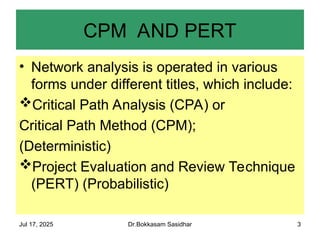
CPM AND PERT
• Network analysis is operated in various
forms under different titles, which include:
Critical Path Analysis (CPA) or
Critical Path Method (CPM);
(Deterministic)
Project Evaluation and Review Technique
(PERT) (Probabilistic)
Jul 17, 2025 Dr.Bokkasam Sasidhar 4
Drawing the network diagram
• Estimate the time needed to complete
each individual activity or task that
makes up a part of the project
• Sort out what activities must be done
one after another, and which can be
done at the same time, if required
• Represent these in a network
diagram
Jul 17, 2025 Dr.Bokkasam Sasidhar 5
■ A branch reflects an activity of a project.
■ A node represents the beginning and end of activities, referred to as
events.
■ Branches in the network indicate precedence relationships.
■ When an activity is completed at a node, it has been realized.
The Project Network - CPM/PERT
Activity-on-Arc (AOA) Network
The Project Network
House Building Project Data
Number Activity Predecessor Duration
1 Design house and obtain
financing
-- 3
months
2 Lay foundation 1 2
months
3 Order and receive materials 1 1 month
4 Build house 2,3 3
months
5 Select paint 2, 3 1 month
6 Select carper 5 1 month
7 Finish work 4, 6 1 month
Jul 17, 2025 Dr.Bokkasam Sasidhar 6
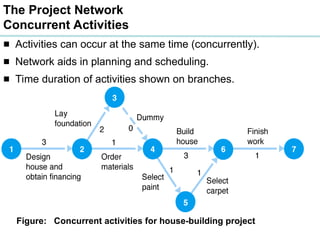
■ Activities can occur at the same time (concurrently).
■ Network aids in planning and scheduling.
■ Time duration of activities shown on branches.
The Project Network
Concurrent Activities
Figure: Concurrent activities for house-building project
■ A dummy activity shows a precedence relationship but
reflects no passage of time.
■ Two or more activities cannot share the same start and end
nodes.
The Project Network
Dummy Activities
Figure: A dummy activity
The Project Network
AON Network for House Building Project
Activity-on-Node (AON) Network
 A node represents an activity, with its label and time shown on
the node
 The branches show the precedence relationships
Figure: AON network
Jul 17, 2025 Dr.Bokkasam Sasidhar 9
Jul 17, 2025 Dr.Bokkasam Sasidhar 10
AON Network for House Building Project using QM for Windows
The Project Network
Paths Through a Network
Table:
Paths through the house-building network
Path Events
A 1247
B 12567
C 1347
D 13567
Jul 17, 2025 Dr.Bokkasam Sasidhar 11
The critical path is the longest path through the network; the
minimum time the network can be completed. From
Figure :
Path A: 1  2  4  7 3 + 2 + 3 + 1 = 9 months
Path B: 1  2  5  6  7 3 + 2 + 1 + 1 + 1= 8 months
Path C: 1  3  4  7 3 + 1 + 3 + 1 = 8 months
Path D: 1  3  5  6  7 3 + 1 + 1 + 1 + 1 = 7 months
The Project Network
The Critical Path
Jul 17, 2025 Dr.Bokkasam Sasidhar 12
The Project Network
Activity Start Times
Figure: Activity start time
The Project Network
Activity Scheduling in Activity-on-Node Configuration
Figure: Activity-on-node configuration
Jul 17, 2025 Dr.Bokkasam Sasidhar 14
■ ES is the earliest time an activity can start:
■ EF is the earliest start time plus the activity time:
The Project Network
Activity Scheduling : Earliest Times
Figure: Earliest activity start and finish times
EF ES t
 
{ }
ES Maximum EF immediate predecessors

■ LS is the latest time an activity can start without delaying
critical path time:
The Project Network
Activity Scheduling : Latest Times
Figure: Latest activity start and finish times
■ LF is the latest finish
time:
LS LF t
 
{ }
LF Minimum LS following activities

 Slack is the amount of time an activity can be delayed
without delaying the project: S = LS – ES = LF - EF
 Slack Time exists for those activities not on the critical path
for which the earliest and latest start times are not equal.
The Project Network
Activity Slack Time (1 of 2)
*Critical path
Activity LS ES LF EF Slack, S
*1 0 0 3 3 0
*2 3 3 5 5 0
3 4 3 5 4 1
*4 5 5 8 8 0
5 6 5 7 6 1
6 7 6 8 7 1
*7 8 8 9 9 0
Activity Slack Times for House Building Project using QM for Windows
The Project Network
Activity Slack Time (2 of 2)
Figure: Activity slack
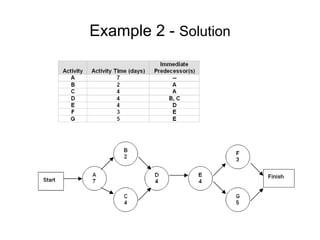
Example 2
Draw the AON network for this project.
What is the Critical Path and Project Duration?
Example 2 - Solution
Problem 2 - Critical Path and Project Duration
Problem 3 – Consider the following project
network.
Jul 17, 2025 Dr.B.Sasidhar 23
Determine the critical path and the project duration.
Jul 17, 2025 Dr.B.Sasidhar 24
Earliest Latest Earliest Latest Total On
Critical
Activity Duration Start Start Finish Finish Slack Path?
A 2 0 0 2 2 0 Yes
B 4 2 3 6 7 1 No
C 5 2 2 7 7 0 Yes
D 2 6 15 8 17 9 No
E 1 6 16 7 17 10 No
F 8 7 7 15 15 0 Yes
G 3 8 17 11 20 9 No
H 5 15 15 20 20 0 Yes
I 4 15 16 19 20 1 No
J 7 20 20 27 27 0 Yes
Problem 3 – Solution:
The critical path is A–C–F–H–J with a completion time
of 27 days.
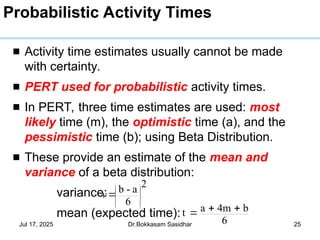
■ Activity time estimates usually cannot be made
with certainty.
■ PERT used for probabilistic activity times.
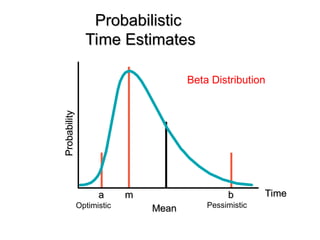
■ In PERT, three time estimates are used: most
likely time (m), the optimistic time (a), and the
pessimistic time (b); using Beta Distribution.
■ These provide an estimate of the mean and
variance of a beta distribution:
variance:
mean (expected time): a 4m b
t
6
 

2
b - a
6
v
 
 
 
 
 

Probabilistic Activity Times
Jul 17, 2025 Dr.Bokkasam Sasidhar 25
Probabilistic
Probabilistic
Time Estimates
Time Estimates
Mean
Mean
m
m
a
a b
b Time
Time
Probability
Probability
Beta Distribution
Pessimistic
Optimistic
Probabilistic Activity Times
Another Example
Jul 17, 2025 Dr.Bokkasam Sasidhar 27
To demonstrate the use of probabilistic
activity times, we will employ a new
example. (We could use the house-building
network from the previous section; however,
a network that is a little larger and more
complex will provide more experience with
different types of projects.)
Probabilistic Activity Times - Another Example
Jul 17, 2025 Dr.Bokkasam Sasidhar 28
The Southern Textile Company has decided to
install a new computerized order processing system
that will link the company with customers and
suppliers online. In the past, orders for the cloth the
company produces were processed manually,
which contributed to delays in delivering orders and
resulted in lost sales. The company wants to know
how long it will take to install the new system.
We will briefly describe the activities and the
network for the installation of the new order
processing system.
The Southern Textile Company - Activities
Jul 17, 2025 Dr.Bokkasam Sasidhar 29
The network begins with three concurrent activities: The new
computer equipment is installed (activity 1); the computerized
order processing system is developed (activity 2); and people
are recruited to operate the system (activity 3). Once people
are hired, they are trained for the job (activity 6), and other
personnel in the company, such as marketing, accounting, and
production personnel, are introduced to the new system
(activity 7). Once the system is developed (activity 2), it is
tested manually to make sure that it is logical (activity 5).
Following activity 1, the new equipment is tested, and any
necessary modifications are made (activity 4), and the newly
trained personnel begin training on the computerized system
(activity 8). Also, node 9 begins the testing of the system on the
computer to check for errors (activity 9). The final activities
include a trial run and changeover to the system (activity 11)
and final debugging of the computer system (activity 10).
Precedence relations and Activity Times– Textile Company
Task a m b Preceding Tasks
Task 1 6 8 10
Task 2 3 6 9
Task 3 1 3 5
Task 4 2 4 12 Task 1
Task 5 2 3 4 Task 2
Task 6 3 4 5 Task 3
Task 7 2 2 2 Task 3
Task 8 3 7 11 Task 1 Task 5 Task 6
Task 9 2 4 6 Task 1 Task 5 Task 6
Task 10 1 4 7 Task 4
Task 11 1 10 13 Task 7 Task 8 Task 9
Probabilistic Activity Times
The Southern Textile Company
Activity time estimates for figure
The Southern Textile Company Probabilistic Activity Times –
QM for Windows Output
Probabilistic Activity Times
The Southern Textile Company
Network for order processing system installation
The Southern Textile Company Network – QM for Windows Output
Probabilistic Activity Times
The Southern Textile Company
Earliest and latest activity times
■ Expected project time is the sum of the expected times of
the critical path activities.
■ Project variance is the sum of the critical path activities’
variances
■ The expected project time is assumed to be normally
distributed (based on central limit theorem).
■ In example, expected project time (tp) and variance (vp)
interpreted as the mean () and variance (2
) of a normal
distribution:
 = 25 weeks
2
= 62/9
= 6.9 weeks2
Probabilistic Activity Times
Expected Project Time and Variance
■ Using the normal distribution, probabilities are
determined by computing the number of standard
deviations (Z) a value is from the mean.
■ The Z value is used to find the corresponding
probability.
Probability Analysis of a Project Network
Jul 17, 2025 Dr.Bokkasam Sasidhar 37
Probability Analysis of a Project Network
The Southern Textile Company
Normal distribution of network duration
Jul 17, 2025 Dr.Bokkasam Sasidhar 38
Probability Analysis of a Project Network
The Southern Textile Company
Probability that the network will be completed in 30 weeks or less
Jul 17, 2025 Dr.Bokkasam Sasidhar 39
What is the probability that the new order
processing system will be ready by 30 weeks?
Probability Analysis of a Project Network
The Southern Textile Company
2
25
6.9
6.9 2.63
30 25
1.90
2.63
weeks
x
Z
Z







 



 
Z value of 1.90 corresponds to
probability of .4713 in Table A.1,
Appendix A. The probability of
completing project in 30 weeks or
less:
(.5000 + .4713) = .9713.
Jul 17, 2025 Dr.Bokkasam Sasidhar 40
Probability Analysis of a Project Network
The Southern Textile Company
Probability the network will be completed in 22 weeks or less
Jul 17, 2025 Dr.Bokkasam Sasidhar 41
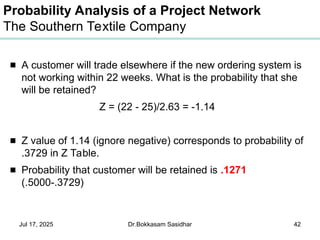
■ A customer will trade elsewhere if the new ordering system is
not working within 22 weeks. What is the probability that she
will be retained?
Z = (22 - 25)/2.63 = -1.14
■ Z value of 1.14 (ignore negative) corresponds to probability of
.3729 in Z Table.
■ Probability that customer will be retained is .1271
(.5000-.3729)
Probability Analysis of a Project Network
The Southern Textile Company
Jul 17, 2025 Dr.Bokkasam Sasidhar 42
CPM/PERT Analysis Output with
QM for Windows
Jul 17, 2025 Dr.Bokkasam Sasidhar 43
CPM/PERT Analysis with
QM for Windows
QM for Windows solution output for system installation
Jul 17, 2025 Dr.Bokkasam Sasidhar 44
Solved Problem 2
Solved Problem 2
What is the probability of
completing the project in 23
weeks?
Solved Problem 2
Solved Problem 2
Solved Problem 2
Solved Problem 2
Using the Normal Distribution, we find that the
probability of completing the project in 23 weeks
or less is 0.9357.

PERT CPM solution project Management 508

  • 1.
    Jul 17, 2025Dr.Bokkasam Sasidhar 1 Project Management • An interrelated set of activities with definite starting and ending points, which results in a unique outcome for a specific allocation of resources. Steps in planning projects – 1. Define work breakdown structure (statement of all work that has to be completed) 2. Diagram the network 3. Develop the schedule 4. Analyze cost-time trade-off 5. Assert risks
  • 2.
    Jul 17, 2025Dr.Bokkasam Sasidhar 2 NETWORK ANALYSIS • It is a technique for planning and controlling large projects, such as construction work, R&D projects, computerization of systems etc. Its primary aim is to program and monitor the progress of a project so that the project is completed in the minimum time. In doing this, it pinpoints the parts of the project which are “crucial”.It can also be used in allocating resources such as labour and equipment and thus helps to make the total cost of a project minimum.
  • 3.
    Jul 17, 2025Dr.Bokkasam Sasidhar 3 CPM AND PERT • Network analysis is operated in various forms under different titles, which include: Critical Path Analysis (CPA) or Critical Path Method (CPM); (Deterministic) Project Evaluation and Review Technique (PERT) (Probabilistic)
  • 4.
    Jul 17, 2025Dr.Bokkasam Sasidhar 4 Drawing the network diagram • Estimate the time needed to complete each individual activity or task that makes up a part of the project • Sort out what activities must be done one after another, and which can be done at the same time, if required • Represent these in a network diagram
  • 5.
    Jul 17, 2025Dr.Bokkasam Sasidhar 5 ■ A branch reflects an activity of a project. ■ A node represents the beginning and end of activities, referred to as events. ■ Branches in the network indicate precedence relationships. ■ When an activity is completed at a node, it has been realized. The Project Network - CPM/PERT Activity-on-Arc (AOA) Network
  • 6.
    The Project Network HouseBuilding Project Data Number Activity Predecessor Duration 1 Design house and obtain financing -- 3 months 2 Lay foundation 1 2 months 3 Order and receive materials 1 1 month 4 Build house 2,3 3 months 5 Select paint 2, 3 1 month 6 Select carper 5 1 month 7 Finish work 4, 6 1 month Jul 17, 2025 Dr.Bokkasam Sasidhar 6
  • 7.
    ■ Activities canoccur at the same time (concurrently). ■ Network aids in planning and scheduling. ■ Time duration of activities shown on branches. The Project Network Concurrent Activities Figure: Concurrent activities for house-building project
  • 8.
    ■ A dummyactivity shows a precedence relationship but reflects no passage of time. ■ Two or more activities cannot share the same start and end nodes. The Project Network Dummy Activities Figure: A dummy activity
  • 9.
    The Project Network AONNetwork for House Building Project Activity-on-Node (AON) Network  A node represents an activity, with its label and time shown on the node  The branches show the precedence relationships Figure: AON network Jul 17, 2025 Dr.Bokkasam Sasidhar 9
  • 10.
    Jul 17, 2025Dr.Bokkasam Sasidhar 10 AON Network for House Building Project using QM for Windows
  • 11.
    The Project Network PathsThrough a Network Table: Paths through the house-building network Path Events A 1247 B 12567 C 1347 D 13567 Jul 17, 2025 Dr.Bokkasam Sasidhar 11
  • 12.
    The critical pathis the longest path through the network; the minimum time the network can be completed. From Figure : Path A: 1  2  4  7 3 + 2 + 3 + 1 = 9 months Path B: 1  2  5  6  7 3 + 2 + 1 + 1 + 1= 8 months Path C: 1  3  4  7 3 + 1 + 3 + 1 = 8 months Path D: 1  3  5  6  7 3 + 1 + 1 + 1 + 1 = 7 months The Project Network The Critical Path Jul 17, 2025 Dr.Bokkasam Sasidhar 12
  • 13.
    The Project Network ActivityStart Times Figure: Activity start time
  • 14.
    The Project Network ActivityScheduling in Activity-on-Node Configuration Figure: Activity-on-node configuration Jul 17, 2025 Dr.Bokkasam Sasidhar 14
  • 15.
    ■ ES isthe earliest time an activity can start: ■ EF is the earliest start time plus the activity time: The Project Network Activity Scheduling : Earliest Times Figure: Earliest activity start and finish times EF ES t   { } ES Maximum EF immediate predecessors 
  • 16.
    ■ LS isthe latest time an activity can start without delaying critical path time: The Project Network Activity Scheduling : Latest Times Figure: Latest activity start and finish times ■ LF is the latest finish time: LS LF t   { } LF Minimum LS following activities 
  • 17.
     Slack isthe amount of time an activity can be delayed without delaying the project: S = LS – ES = LF - EF  Slack Time exists for those activities not on the critical path for which the earliest and latest start times are not equal. The Project Network Activity Slack Time (1 of 2) *Critical path Activity LS ES LF EF Slack, S *1 0 0 3 3 0 *2 3 3 5 5 0 3 4 3 5 4 1 *4 5 5 8 8 0 5 6 5 7 6 1 6 7 6 8 7 1 *7 8 8 9 9 0
  • 18.
    Activity Slack Timesfor House Building Project using QM for Windows
  • 19.
    The Project Network ActivitySlack Time (2 of 2) Figure: Activity slack
  • 20.
    Example 2 Draw theAON network for this project. What is the Critical Path and Project Duration?
  • 21.
    Example 2 -Solution
  • 22.
    Problem 2 -Critical Path and Project Duration
  • 23.
    Problem 3 –Consider the following project network. Jul 17, 2025 Dr.B.Sasidhar 23 Determine the critical path and the project duration.
  • 24.
    Jul 17, 2025Dr.B.Sasidhar 24 Earliest Latest Earliest Latest Total On Critical Activity Duration Start Start Finish Finish Slack Path? A 2 0 0 2 2 0 Yes B 4 2 3 6 7 1 No C 5 2 2 7 7 0 Yes D 2 6 15 8 17 9 No E 1 6 16 7 17 10 No F 8 7 7 15 15 0 Yes G 3 8 17 11 20 9 No H 5 15 15 20 20 0 Yes I 4 15 16 19 20 1 No J 7 20 20 27 27 0 Yes Problem 3 – Solution: The critical path is A–C–F–H–J with a completion time of 27 days.
  • 25.
    ■ Activity timeestimates usually cannot be made with certainty. ■ PERT used for probabilistic activity times. ■ In PERT, three time estimates are used: most likely time (m), the optimistic time (a), and the pessimistic time (b); using Beta Distribution. ■ These provide an estimate of the mean and variance of a beta distribution: variance: mean (expected time): a 4m b t 6    2 b - a 6 v            Probabilistic Activity Times Jul 17, 2025 Dr.Bokkasam Sasidhar 25
  • 26.
    Probabilistic Probabilistic Time Estimates Time Estimates Mean Mean m m a ab b Time Time Probability Probability Beta Distribution Pessimistic Optimistic
  • 27.
    Probabilistic Activity Times AnotherExample Jul 17, 2025 Dr.Bokkasam Sasidhar 27 To demonstrate the use of probabilistic activity times, we will employ a new example. (We could use the house-building network from the previous section; however, a network that is a little larger and more complex will provide more experience with different types of projects.)
  • 28.
    Probabilistic Activity Times- Another Example Jul 17, 2025 Dr.Bokkasam Sasidhar 28 The Southern Textile Company has decided to install a new computerized order processing system that will link the company with customers and suppliers online. In the past, orders for the cloth the company produces were processed manually, which contributed to delays in delivering orders and resulted in lost sales. The company wants to know how long it will take to install the new system. We will briefly describe the activities and the network for the installation of the new order processing system.
  • 29.
    The Southern TextileCompany - Activities Jul 17, 2025 Dr.Bokkasam Sasidhar 29 The network begins with three concurrent activities: The new computer equipment is installed (activity 1); the computerized order processing system is developed (activity 2); and people are recruited to operate the system (activity 3). Once people are hired, they are trained for the job (activity 6), and other personnel in the company, such as marketing, accounting, and production personnel, are introduced to the new system (activity 7). Once the system is developed (activity 2), it is tested manually to make sure that it is logical (activity 5). Following activity 1, the new equipment is tested, and any necessary modifications are made (activity 4), and the newly trained personnel begin training on the computerized system (activity 8). Also, node 9 begins the testing of the system on the computer to check for errors (activity 9). The final activities include a trial run and changeover to the system (activity 11) and final debugging of the computer system (activity 10).
  • 30.
    Precedence relations andActivity Times– Textile Company Task a m b Preceding Tasks Task 1 6 8 10 Task 2 3 6 9 Task 3 1 3 5 Task 4 2 4 12 Task 1 Task 5 2 3 4 Task 2 Task 6 3 4 5 Task 3 Task 7 2 2 2 Task 3 Task 8 3 7 11 Task 1 Task 5 Task 6 Task 9 2 4 6 Task 1 Task 5 Task 6 Task 10 1 4 7 Task 4 Task 11 1 10 13 Task 7 Task 8 Task 9
  • 31.
    Probabilistic Activity Times TheSouthern Textile Company Activity time estimates for figure
  • 32.
    The Southern TextileCompany Probabilistic Activity Times – QM for Windows Output
  • 33.
    Probabilistic Activity Times TheSouthern Textile Company Network for order processing system installation
  • 34.
    The Southern TextileCompany Network – QM for Windows Output
  • 35.
    Probabilistic Activity Times TheSouthern Textile Company Earliest and latest activity times
  • 36.
    ■ Expected projecttime is the sum of the expected times of the critical path activities. ■ Project variance is the sum of the critical path activities’ variances ■ The expected project time is assumed to be normally distributed (based on central limit theorem). ■ In example, expected project time (tp) and variance (vp) interpreted as the mean () and variance (2 ) of a normal distribution:  = 25 weeks 2 = 62/9 = 6.9 weeks2 Probabilistic Activity Times Expected Project Time and Variance
  • 37.
    ■ Using thenormal distribution, probabilities are determined by computing the number of standard deviations (Z) a value is from the mean. ■ The Z value is used to find the corresponding probability. Probability Analysis of a Project Network Jul 17, 2025 Dr.Bokkasam Sasidhar 37
  • 38.
    Probability Analysis ofa Project Network The Southern Textile Company Normal distribution of network duration Jul 17, 2025 Dr.Bokkasam Sasidhar 38
  • 39.
    Probability Analysis ofa Project Network The Southern Textile Company Probability that the network will be completed in 30 weeks or less Jul 17, 2025 Dr.Bokkasam Sasidhar 39
  • 40.
    What is theprobability that the new order processing system will be ready by 30 weeks? Probability Analysis of a Project Network The Southern Textile Company 2 25 6.9 6.9 2.63 30 25 1.90 2.63 weeks x Z Z               Z value of 1.90 corresponds to probability of .4713 in Table A.1, Appendix A. The probability of completing project in 30 weeks or less: (.5000 + .4713) = .9713. Jul 17, 2025 Dr.Bokkasam Sasidhar 40
  • 41.
    Probability Analysis ofa Project Network The Southern Textile Company Probability the network will be completed in 22 weeks or less Jul 17, 2025 Dr.Bokkasam Sasidhar 41
  • 42.
    ■ A customerwill trade elsewhere if the new ordering system is not working within 22 weeks. What is the probability that she will be retained? Z = (22 - 25)/2.63 = -1.14 ■ Z value of 1.14 (ignore negative) corresponds to probability of .3729 in Z Table. ■ Probability that customer will be retained is .1271 (.5000-.3729) Probability Analysis of a Project Network The Southern Textile Company Jul 17, 2025 Dr.Bokkasam Sasidhar 42
  • 43.
    CPM/PERT Analysis Outputwith QM for Windows Jul 17, 2025 Dr.Bokkasam Sasidhar 43
  • 44.
    CPM/PERT Analysis with QMfor Windows QM for Windows solution output for system installation Jul 17, 2025 Dr.Bokkasam Sasidhar 44
  • 45.
    Solved Problem 2 SolvedProblem 2 What is the probability of completing the project in 23 weeks?
  • 46.
  • 47.
    Solved Problem 2 SolvedProblem 2 Using the Normal Distribution, we find that the probability of completing the project in 23 weeks or less is 0.9357.