COMPUTER NETWORK COMPONENTS
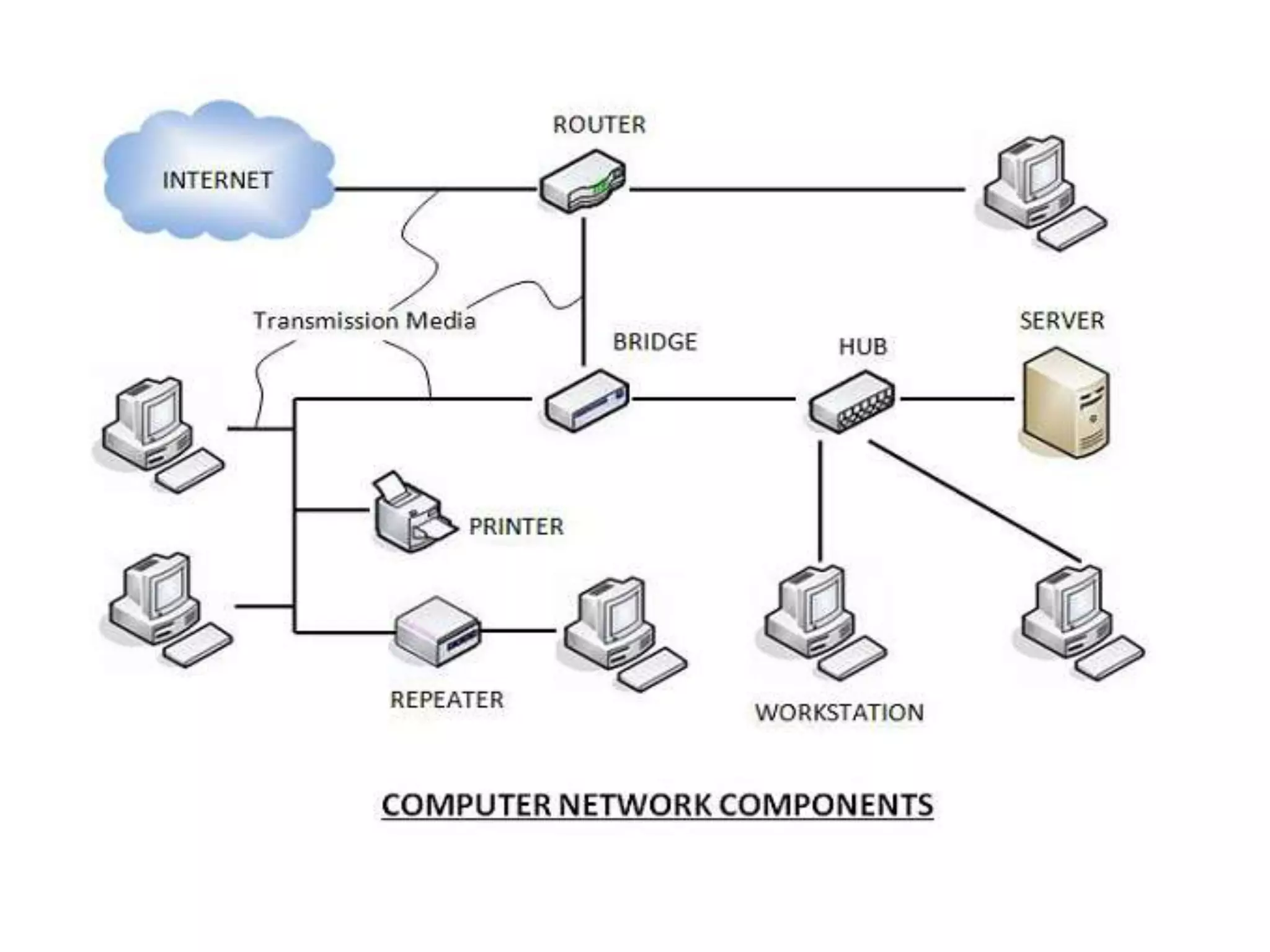
• Computer networks requires both Hardware and
Software components
• The hardware components are the
– Server,
– Client,
– Transmission Medium
– Connecting devices
• The software components are
– Operating System and
– Protocols
Hardware Components
• Servers −
– Servers are high-configuration computers
– It manages and give user access to the network
resources
– A special operating system called Network
Operating System (NOS)is typically installed in the
server
– Servers can be of various kinds: file servers,
database servers, print servers etc.
Hardware Components
• Clients − Clients are computers that request
and receive service from the servers to access
and use the network resources.
• Transmission Media −
– These are the channels through which data is
transferred from one device to another in a
network.
– It may be guided media like coaxial cable, fibre
optic cables etc; or maybe unguided media like
microwaves, infra-red waves etc.
Hardware Components
• Connecting Devices −
– Connecting devices act as middleware between various
networks devices or computers, by binding the network
media together.
– Some of the common connecting devices are:
 Hubs
 Switches
 Bridges
 Routers
 Repeaters
 Gateways
Software Components
• Networking Operating System (NOS)
– A special Operating Systems typically installed in
the server and facilitate to share files, database,
applications, printers etc.
– In addition, the client computer also must have
the OS installed with capability to participate in
the networking.
Software Components
• Protocol Suite
– A protocol is a software rule or guideline followed
by each computer for data communication.
– Protocol suite is a set of related protocols that are
laid down for computer networks.
– The two popular protocol suites are −
 OSI Model ( Open System Interconnections)
 TCP / IP Model

Network components

  • 2.
    COMPUTER NETWORK COMPONENTS •Computer networks requires both Hardware and Software components • The hardware components are the – Server, – Client, – Transmission Medium – Connecting devices • The software components are – Operating System and – Protocols
  • 3.
    Hardware Components • Servers− – Servers are high-configuration computers – It manages and give user access to the network resources – A special operating system called Network Operating System (NOS)is typically installed in the server – Servers can be of various kinds: file servers, database servers, print servers etc.
  • 4.
    Hardware Components • Clients− Clients are computers that request and receive service from the servers to access and use the network resources. • Transmission Media − – These are the channels through which data is transferred from one device to another in a network. – It may be guided media like coaxial cable, fibre optic cables etc; or maybe unguided media like microwaves, infra-red waves etc.
  • 5.
    Hardware Components • ConnectingDevices − – Connecting devices act as middleware between various networks devices or computers, by binding the network media together. – Some of the common connecting devices are:  Hubs  Switches  Bridges  Routers  Repeaters  Gateways
  • 6.
    Software Components • NetworkingOperating System (NOS) – A special Operating Systems typically installed in the server and facilitate to share files, database, applications, printers etc. – In addition, the client computer also must have the OS installed with capability to participate in the networking.
  • 7.
    Software Components • ProtocolSuite – A protocol is a software rule or guideline followed by each computer for data communication. – Protocol suite is a set of related protocols that are laid down for computer networks. – The two popular protocol suites are −  OSI Model ( Open System Interconnections)  TCP / IP Model