
DEVELOPING RMA REQUIREMENTS
UNIT – II
Developing RMA Requirements
RELIABILITY: (consistency" or "repeatability")
 the ability of a system or component to perform its
required functions under stated conditions for a
specified period of time.
MAINTAINABILITY:
 performing a successful repair action within a given
time.
 Used to Maintenance the operations.
 measures the easy and speed which a system
operational status after a failure occurs.
 to perform its required functions under stated
conditions for a specified period of time.
 AVAILABILITY:
 in the sense of available useful work.
 which a system, subsystem or equipment is in
a specified operable and committable state.
 MEASURE OF RELIABLILITY:
 Indicates the frequency of failure of the
network and its components.
 MTBF: MeanTime Between Failures
 MTBCF: MeanTime Between Mission-
Critical Failures
MTBF: Mean Time Between Failure.
 A basic measure of reliability.
 It is the predicted elapsed time(period
of time) between inherent failures of
a system during operation.
 MTBF is computing the failure rate,
which is estimated through testing or
analysis in terms of failures per hours
of operation.
 MTBCF : MeanTime Between Critical Failure.
 It is sometimes referred to as "mission reliability"
 It is a subset of MTBF because it only counts
those failures that result in a mission abort or
mission failure.
 It is a term used when redundancy exists in a
system.
 It is often used to differentiate system reliability
from series mean time between failure (MTBF).
 MEASURE OF MAINTAINABILITY:
 Statistical measure of the time to restore the
system fully operational status. Once it has
experienced a fault.(after repaired)
 MTTR: MeanTimeTo Repair: repairing a failure
system consists of detection, isolation
(separation) of the failure.
 MEASURE OF AVAILABILITY:
 Relationship between the MTBF, MTBCF, MTTR.
 A common measure of availability is expressed in
terms of percent of uptime or downtime.
 For example, a request for proposal (RFP) :
 from a potential customer may state a
required uptime of 99.999% (commonly
known as “five nines”).
 UP-TIME :
 Time during the computer is operational(ON).
 DOWN-TIME :
 Time during the computer is NOT
operational(OFF).
 Availability in terms of uptime and downtime
is measured Per week, per month, or per year
based on total amount of time for that
period.
 Analyzing a network’s availability gives us the
ability to schedule preventive maintenance and
replace.
Other measures of availability include
 uptime,
 downtime,
 error, and
 loss rates.
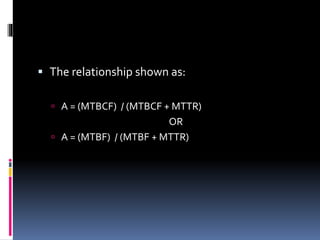
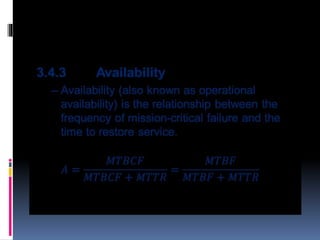
 The relationship shown as:
 A = (MTBCF) / (MTBCF + MTTR)
OR
 A = (MTBF) / (MTBF + MTTR)
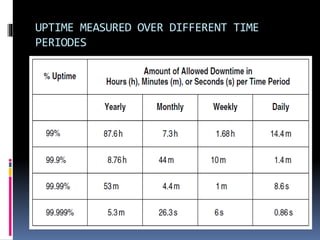
UPTIME MEASURED OVER DIFFERENT TIME
PERIODES
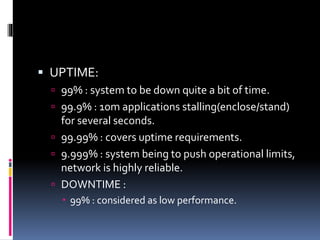
 UPTIME:
 99% : system to be down quite a bit of time.
 99.9% : 10m applications stalling(enclose/stand)
for several seconds.
 99.99% : covers uptime requirements.
 9.999% : system being to push operational limits,
network is highly reliable.
 DOWNTIME :
 99% : considered as low performance.
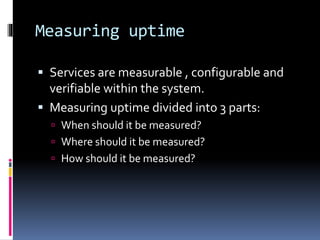
Measuring uptime
 Services are measurable , configurable and
verifiable within the system.
 Measuring uptime divided into 3 parts:
 When should it be measured?
 Where should it be measured?
 How should it be measured?
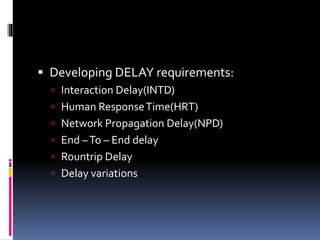
 Developing DELAY requirements:
 Interaction Delay(INTD)
 Human ResponseTime(HRT)
 Network Propagation Delay(NPD)
 End –To – End delay
 Rountrip Delay
 Delay variations
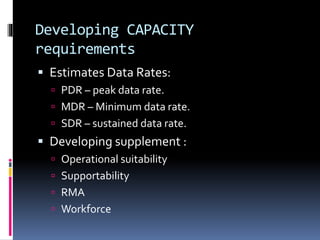
Developing CAPACITY
requirements
 Estimates Data Rates:
 PDR – peak data rate.
 MDR – Minimum data rate.
 SDR – sustained data rate.
 Developing supplement :
 Operational suitability
 Supportability
 RMA
 Workforce

Developing rma requirements

  • 1.
  • 2.
    Developing RMA Requirements RELIABILITY:(consistency" or "repeatability")  the ability of a system or component to perform its required functions under stated conditions for a specified period of time. MAINTAINABILITY:  performing a successful repair action within a given time.  Used to Maintenance the operations.  measures the easy and speed which a system operational status after a failure occurs.  to perform its required functions under stated conditions for a specified period of time.
  • 3.
     AVAILABILITY:  inthe sense of available useful work.  which a system, subsystem or equipment is in a specified operable and committable state.
  • 4.
     MEASURE OFRELIABLILITY:  Indicates the frequency of failure of the network and its components.  MTBF: MeanTime Between Failures  MTBCF: MeanTime Between Mission- Critical Failures
  • 5.
    MTBF: Mean TimeBetween Failure.  A basic measure of reliability.  It is the predicted elapsed time(period of time) between inherent failures of a system during operation.  MTBF is computing the failure rate, which is estimated through testing or analysis in terms of failures per hours of operation.
  • 6.
     MTBCF :MeanTime Between Critical Failure.  It is sometimes referred to as "mission reliability"  It is a subset of MTBF because it only counts those failures that result in a mission abort or mission failure.  It is a term used when redundancy exists in a system.  It is often used to differentiate system reliability from series mean time between failure (MTBF).
  • 7.
     MEASURE OFMAINTAINABILITY:  Statistical measure of the time to restore the system fully operational status. Once it has experienced a fault.(after repaired)  MTTR: MeanTimeTo Repair: repairing a failure system consists of detection, isolation (separation) of the failure.
  • 8.
     MEASURE OFAVAILABILITY:  Relationship between the MTBF, MTBCF, MTTR.  A common measure of availability is expressed in terms of percent of uptime or downtime.  For example, a request for proposal (RFP) :  from a potential customer may state a required uptime of 99.999% (commonly known as “five nines”).
  • 9.
     UP-TIME : Time during the computer is operational(ON).  DOWN-TIME :  Time during the computer is NOT operational(OFF).  Availability in terms of uptime and downtime is measured Per week, per month, or per year based on total amount of time for that period.
  • 10.
     Analyzing anetwork’s availability gives us the ability to schedule preventive maintenance and replace. Other measures of availability include  uptime,  downtime,  error, and  loss rates.
  • 11.
     The relationshipshown as:  A = (MTBCF) / (MTBCF + MTTR) OR  A = (MTBF) / (MTBF + MTTR)
  • 13.
    UPTIME MEASURED OVERDIFFERENT TIME PERIODES
  • 14.
     UPTIME:  99%: system to be down quite a bit of time.  99.9% : 10m applications stalling(enclose/stand) for several seconds.  99.99% : covers uptime requirements.  9.999% : system being to push operational limits, network is highly reliable.  DOWNTIME :  99% : considered as low performance.
  • 15.
    Measuring uptime  Servicesare measurable , configurable and verifiable within the system.  Measuring uptime divided into 3 parts:  When should it be measured?  Where should it be measured?  How should it be measured?
  • 17.
     Developing DELAYrequirements:  Interaction Delay(INTD)  Human ResponseTime(HRT)  Network Propagation Delay(NPD)  End –To – End delay  Rountrip Delay  Delay variations
  • 18.
    Developing CAPACITY requirements  EstimatesData Rates:  PDR – peak data rate.  MDR – Minimum data rate.  SDR – sustained data rate.  Developing supplement :  Operational suitability  Supportability  RMA  Workforce