Learning the Basics of Ethernet Networking
2
Overview
 Team Introduction
 Introduction to Westermo
 Industrial Networking Introduction and Considerations
 Physical Layers
 How does Ethernet Handle Data?
 Switching and Layer 2
 Routing and Layer 3
 Firewalls
 Tying it all together
 Further Learning
3
Introductions
John Pavlos
Managing Director
john.pavlos@westermo.com
847-453-3898
Benjamin Campbell
Technical Support Engineer
benjamin.campbell@westermo.com
847.453.3896
4
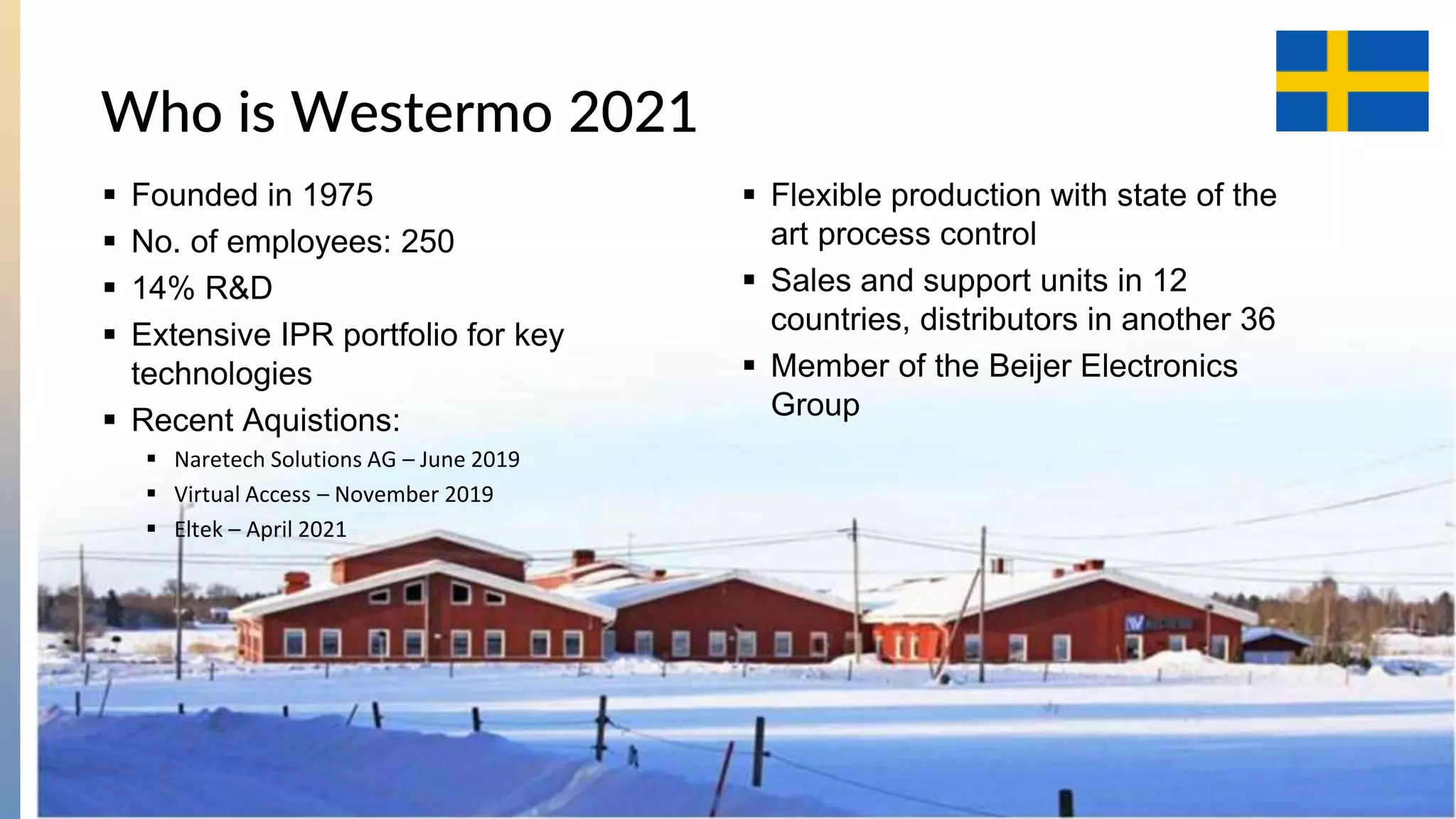
Who is Westermo 2021
 Founded in 1975
 No. of employees: 250
 14% R&D
 Extensive IPR portfolio for key
technologies
 Recent Aquistions:
 Naretech Solutions AG – June 2019
 Virtual Access – November 2019
 Eltek – April 2021
 Flexible production with state of the
art process control
 Sales and support units in 12
countries, distributors in another 36
 Member of the Beijer Electronics
Group
5
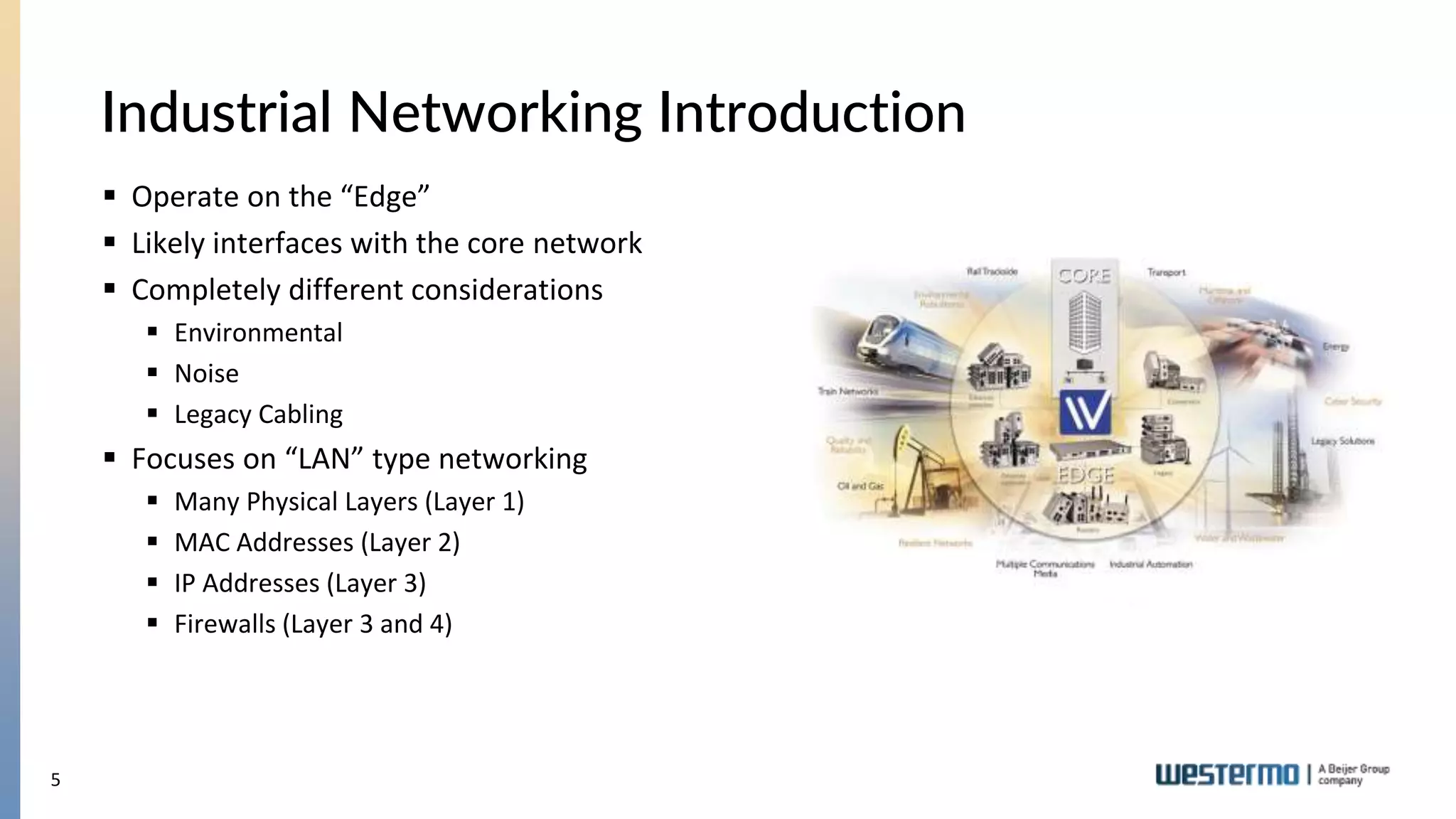
Industrial Networking Introduction
 Operate on the “Edge”
 Likely interfaces with the core network
 Completely different considerations
 Environmental
 Noise
 Legacy Cabling
 Focuses on “LAN” type networking
 Many Physical Layers (Layer 1)
 MAC Addresses (Layer 2)
 IP Addresses (Layer 3)
 Firewalls (Layer 3 and 4)
6
 Tough Physical Environment
 Noisy Electromagnetic Environments
 Many Different Physical Mediums
 Fiber
 Multi-mode
 Single-mode
 Copper
 Cat 5 and better
 “Legacy” Copper
 Legacy Devices
 Serial Devices
 ISDN
 Dial-up
Industrial Networking Considerations
7
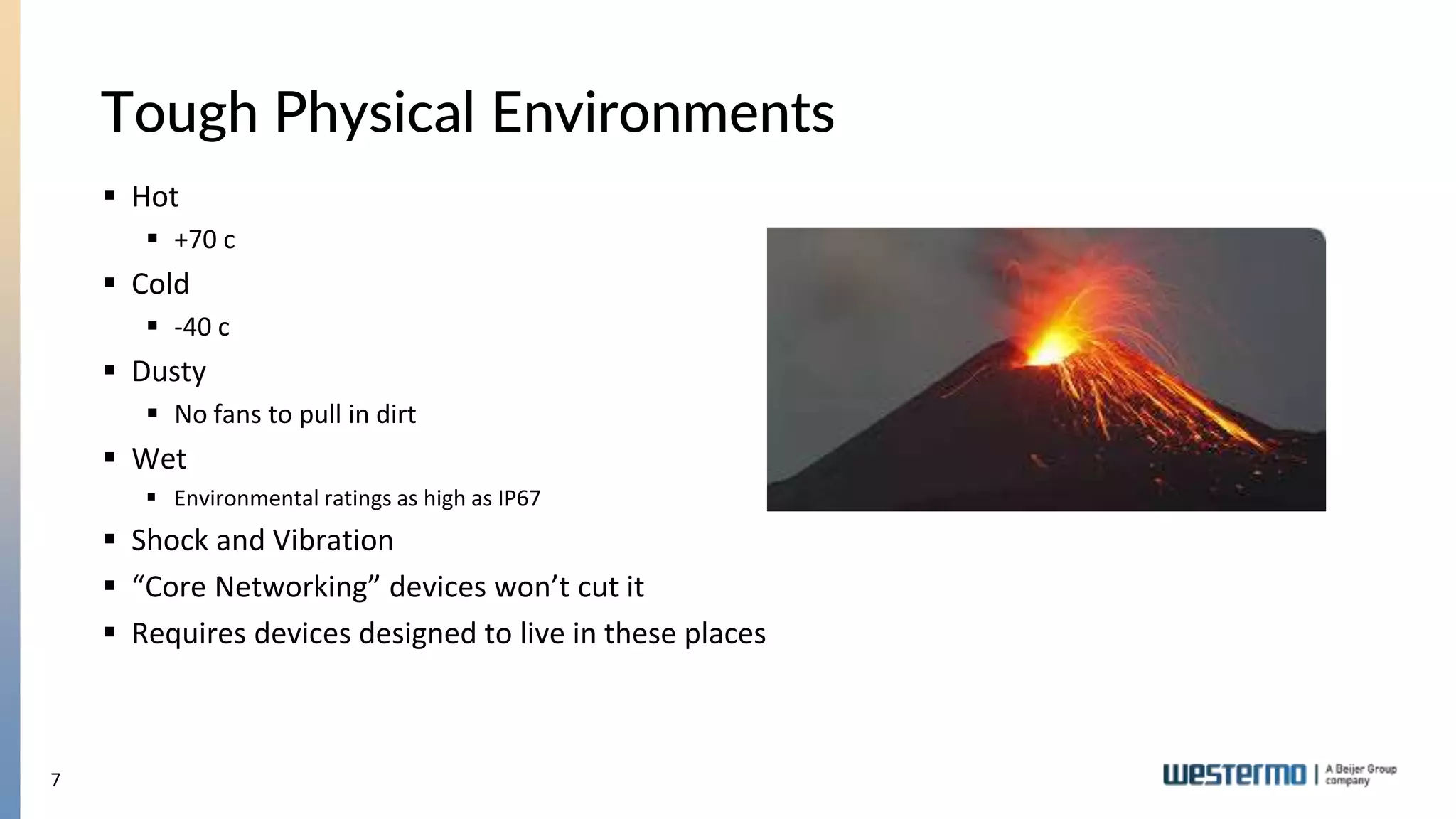
Tough Physical Environments
 Hot
 +70 c
 Cold
 -40 c
 Dusty
 No fans to pull in dirt
 Wet
 Environmental ratings as high as IP67
 Shock and Vibration
 “Core Networking” devices won’t cut it
 Requires devices designed to live in these places
8
Noisy Environments and Old Cables
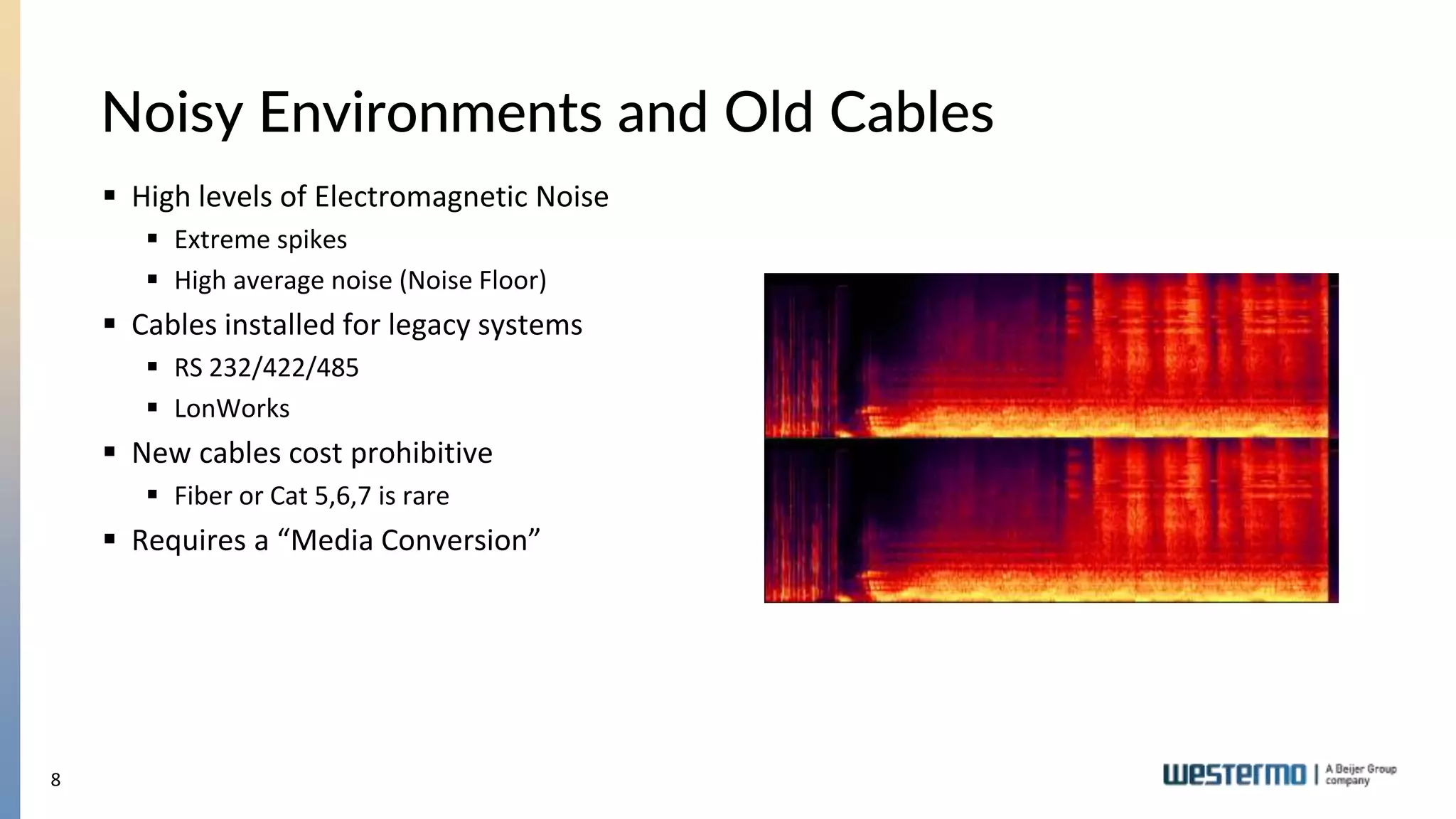
 High levels of Electromagnetic Noise
 Extreme spikes
 High average noise (Noise Floor)
 Cables installed for legacy systems
 RS 232/422/485
 LonWorks
 New cables cost prohibitive
 Fiber or Cat 5,6,7 is rare
 Requires a “Media Conversion”
9
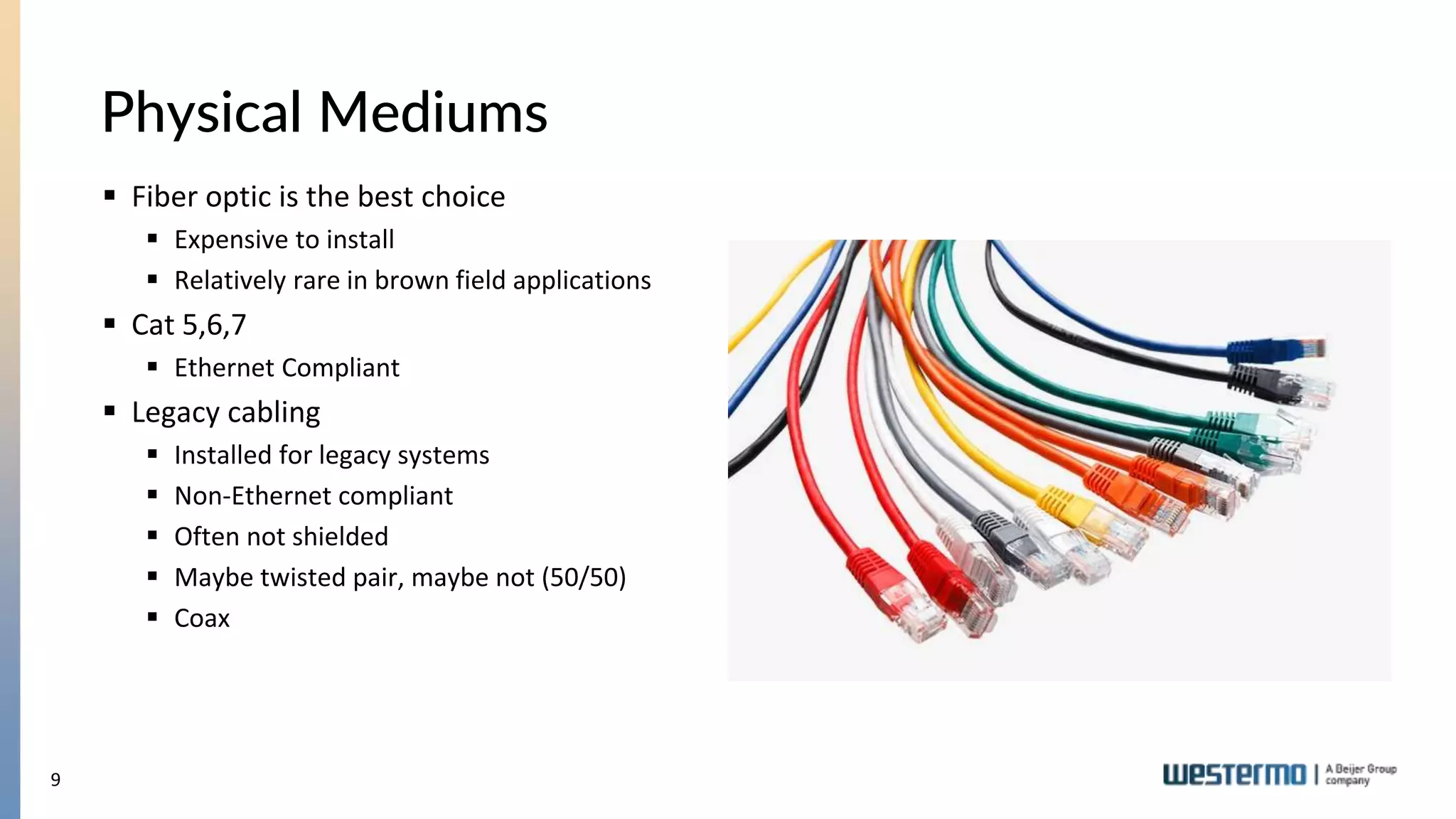
Physical Mediums
 Fiber optic is the best choice
 Expensive to install
 Relatively rare in brown field applications
 Cat 5,6,7
 Ethernet Compliant
 Legacy cabling
 Installed for legacy systems
 Non-Ethernet compliant
 Often not shielded
 Maybe twisted pair, maybe not (50/50)
 Coax
10
More Physical Mediums
 PLC
 Extreme environments
 Cable sharing
 Shorter Distances
 300 m
 Higher Speeds
 70 Mbit/s
 Wireless (WiFi)
 Only option sometimes
 Can be affected by high noise floors
 Media Conversions (Legacy Cables)
 SHDSL
 Long distances (15 km)
 High noise resilience
 Limited Speed
 15.3 Mbit/s
 30.6 Mbit/s with bonding
OSI Model and
Packetization
12
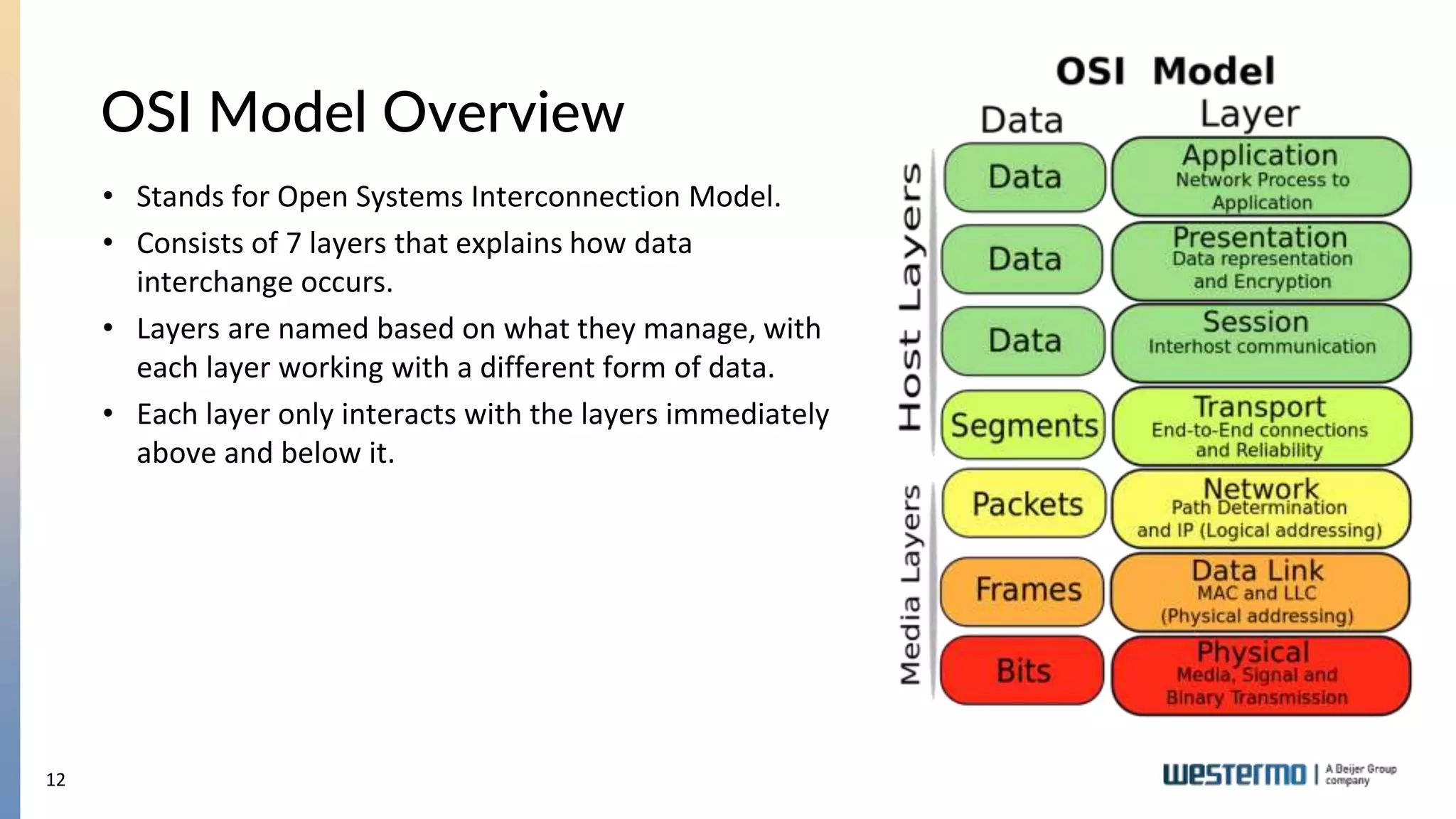
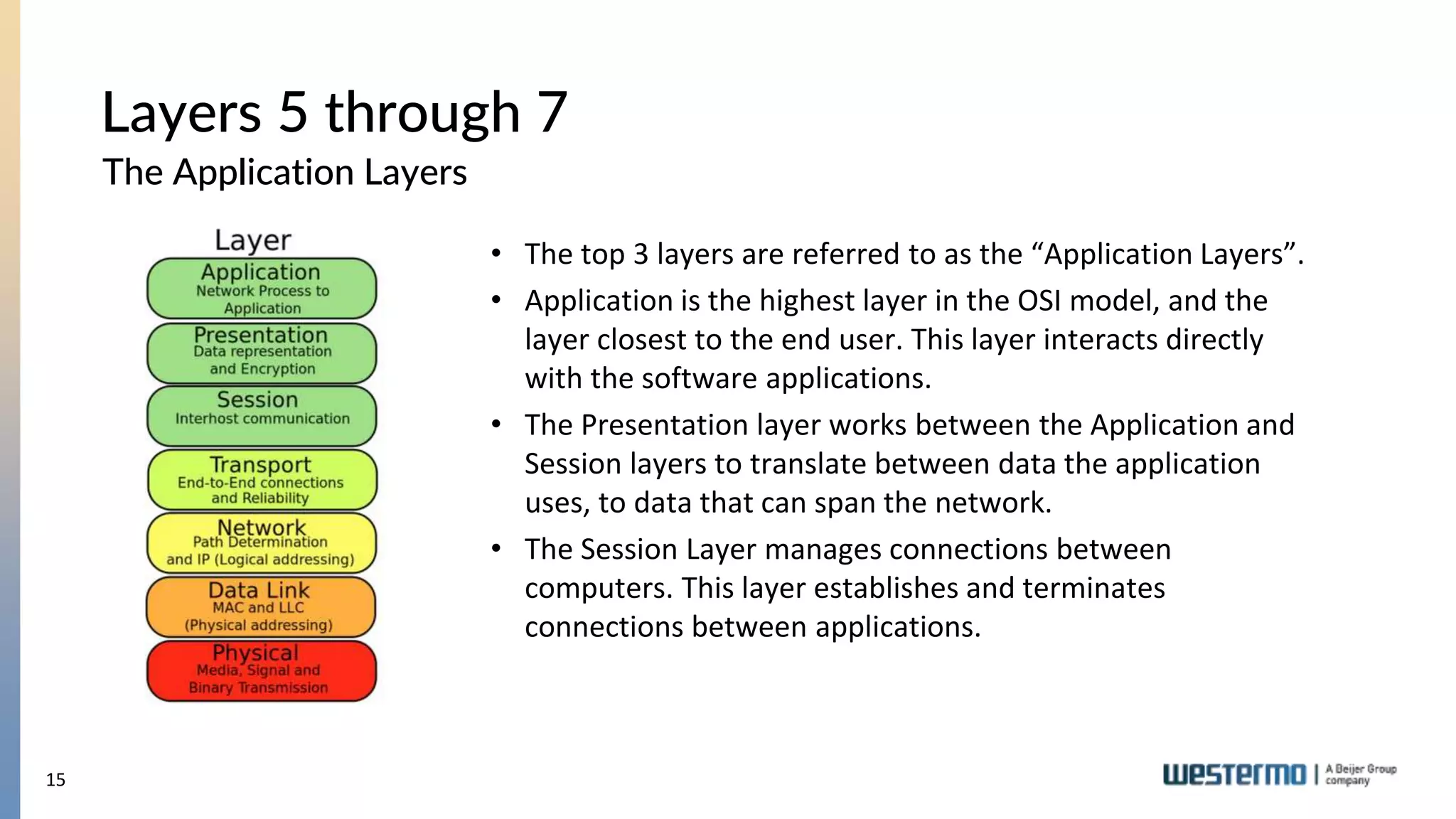
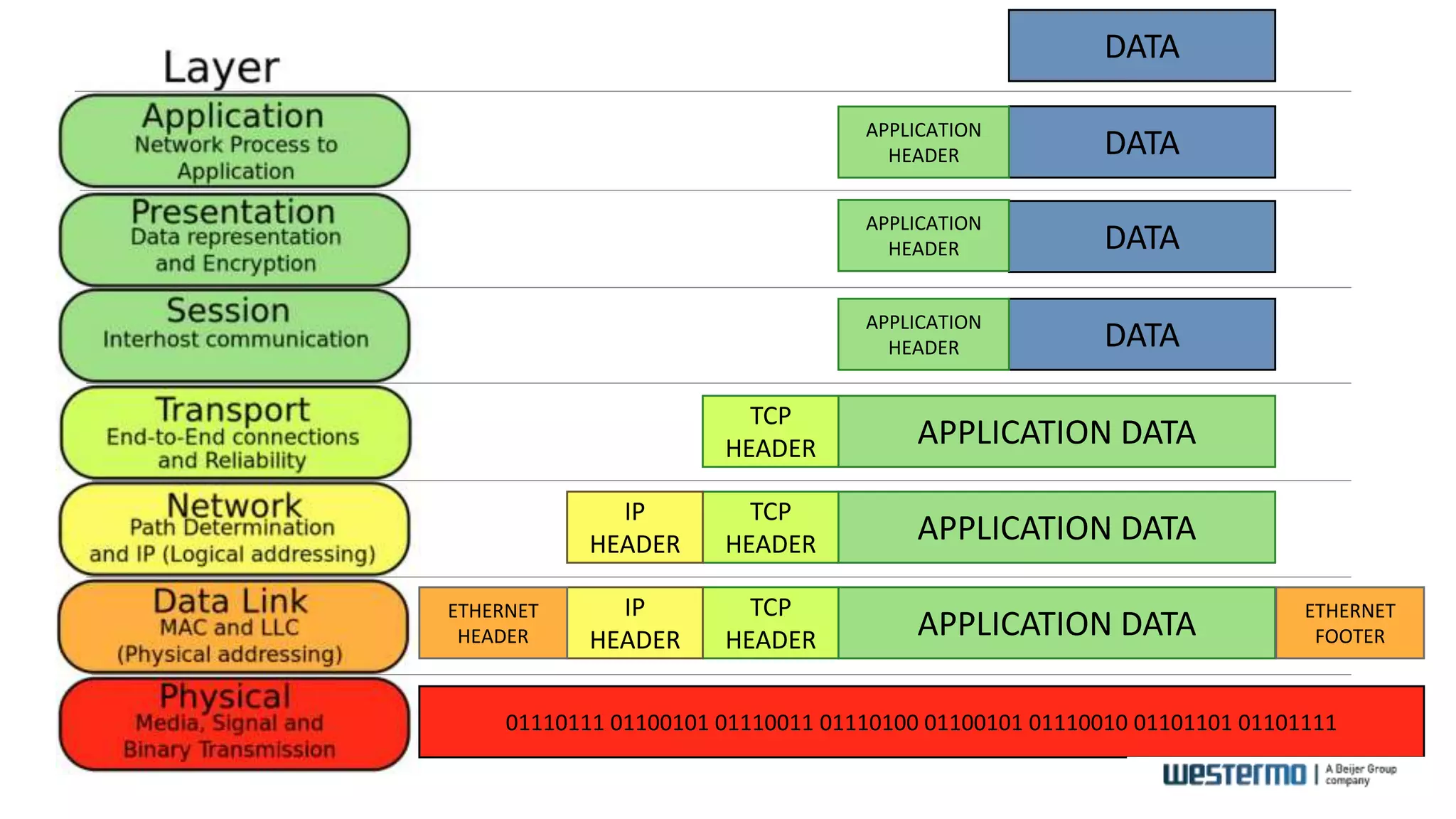
OSI Model Overview
• Stands for Open Systems Interconnection Model.
• Consists of 7 layers that explains how data
interchange occurs.
• Layers are named based on what they manage, with
each layer working with a different form of data.
• Each layer only interacts with the layers immediately
above and below it.
13
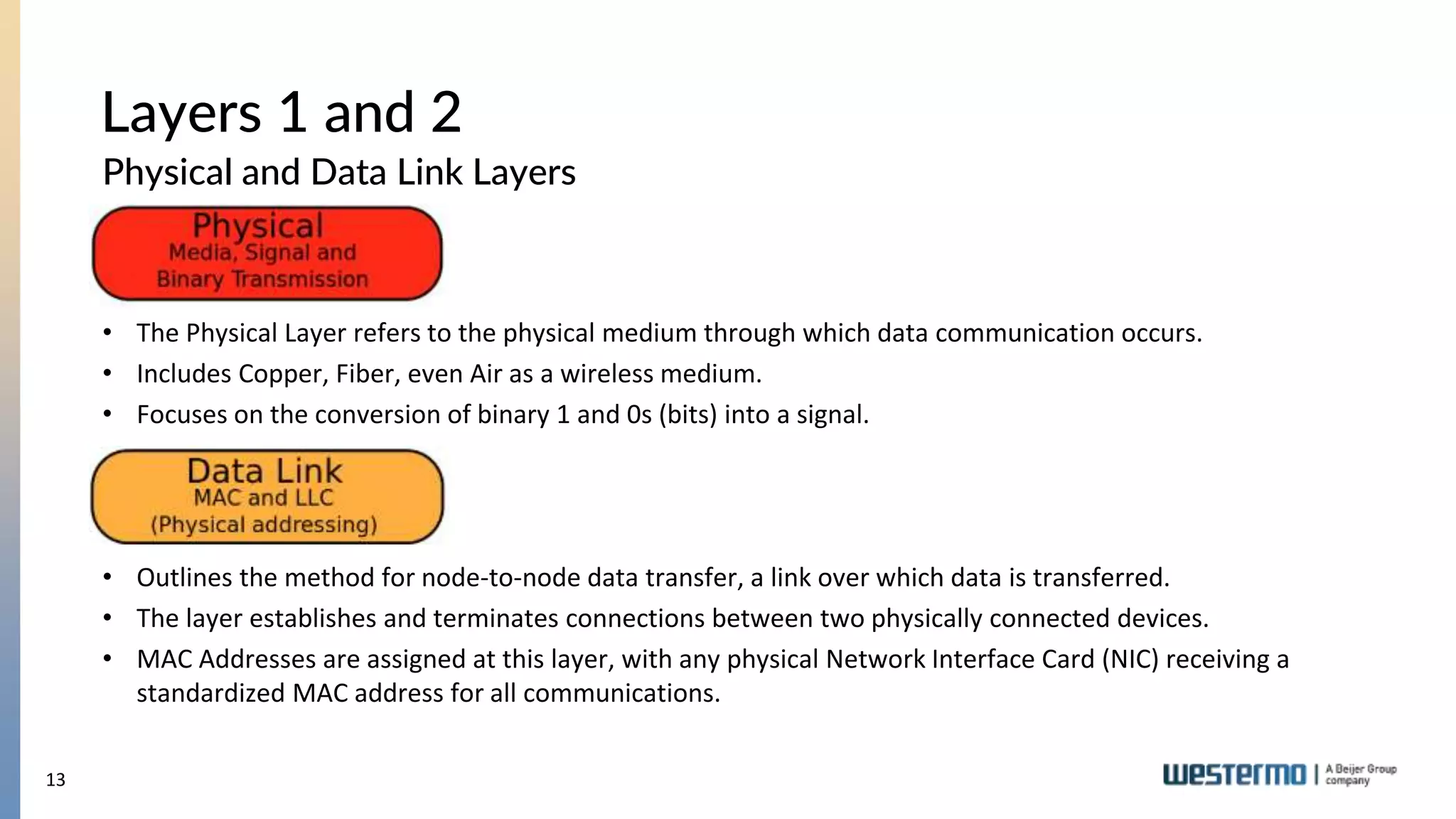
Physical and Data Link Layers
Layers 1 and 2
• The Physical Layer refers to the physical medium through which data communication occurs.
• Includes Copper, Fiber, even Air as a wireless medium.
• Focuses on the conversion of binary 1 and 0s (bits) into a signal.
• Outlines the method for node-to-node data transfer, a link over which data is transferred.
• The layer establishes and terminates connections between two physically connected devices.
• MAC Addresses are assigned at this layer, with any physical Network Interface Card (NIC) receiving a
standardized MAC address for all communications.
14
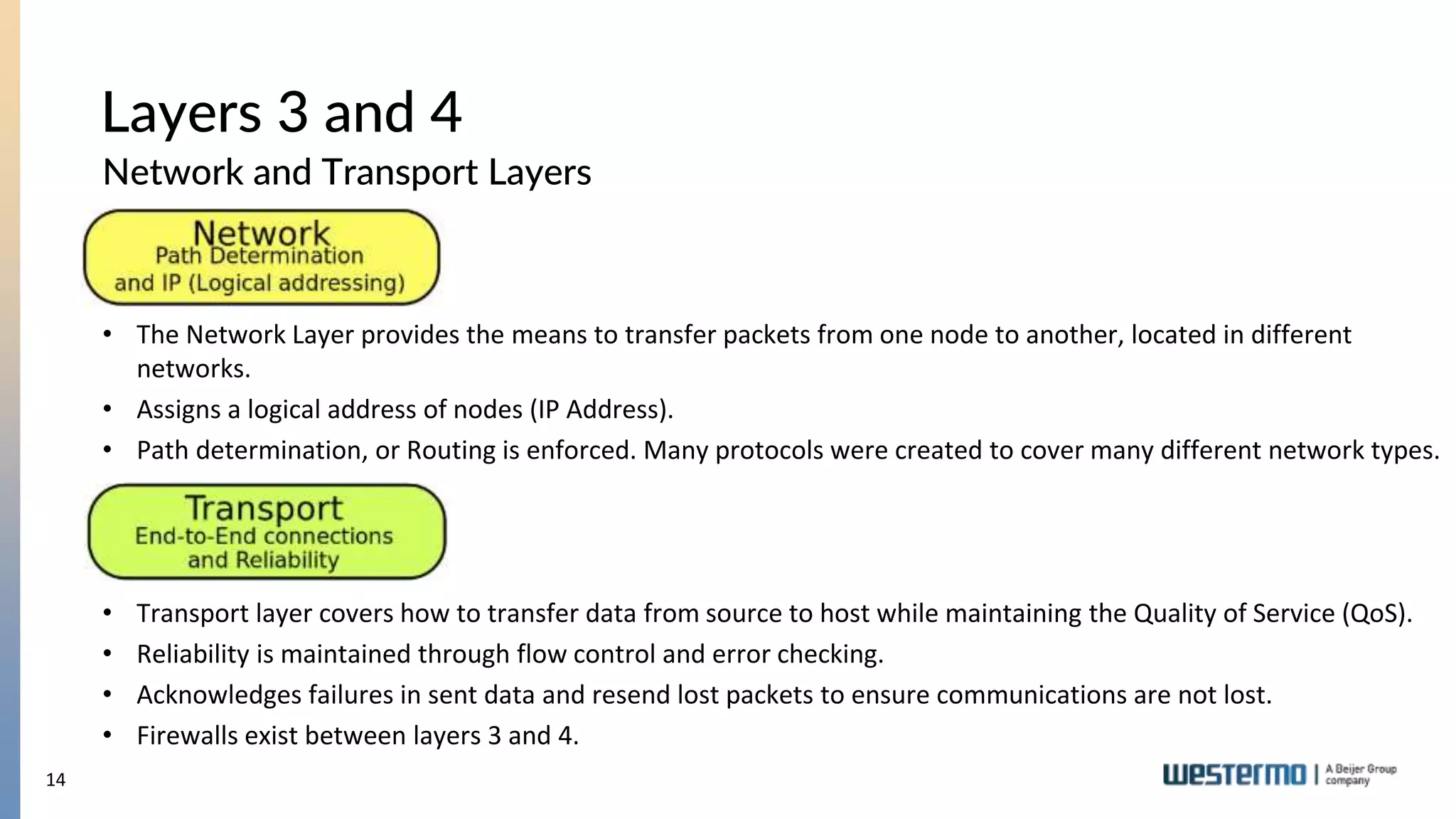
Network and Transport Layers
Layers 3 and 4
• The Network Layer provides the means to transfer packets from one node to another, located in different
networks.
• Assigns a logical address of nodes (IP Address).
• Path determination, or Routing is enforced. Many protocols were created to cover many different network types.
• Transport layer covers how to transfer data from source to host while maintaining the Quality of Service (QoS).
• Reliability is maintained through flow control and error checking.
• Acknowledges failures in sent data and resend lost packets to ensure communications are not lost.
• Firewalls exist between layers 3 and 4.
15
The Application Layers
Layers 5 through 7
• The top 3 layers are referred to as the “Application Layers”.
• Application is the highest layer in the OSI model, and the
layer closest to the end user. This layer interacts directly
with the software applications.
• The Presentation layer works between the Application and
Session layers to translate between data the application
uses, to data that can span the network.
• The Session Layer manages connections between
computers. This layer establishes and terminates
connections between applications.
16
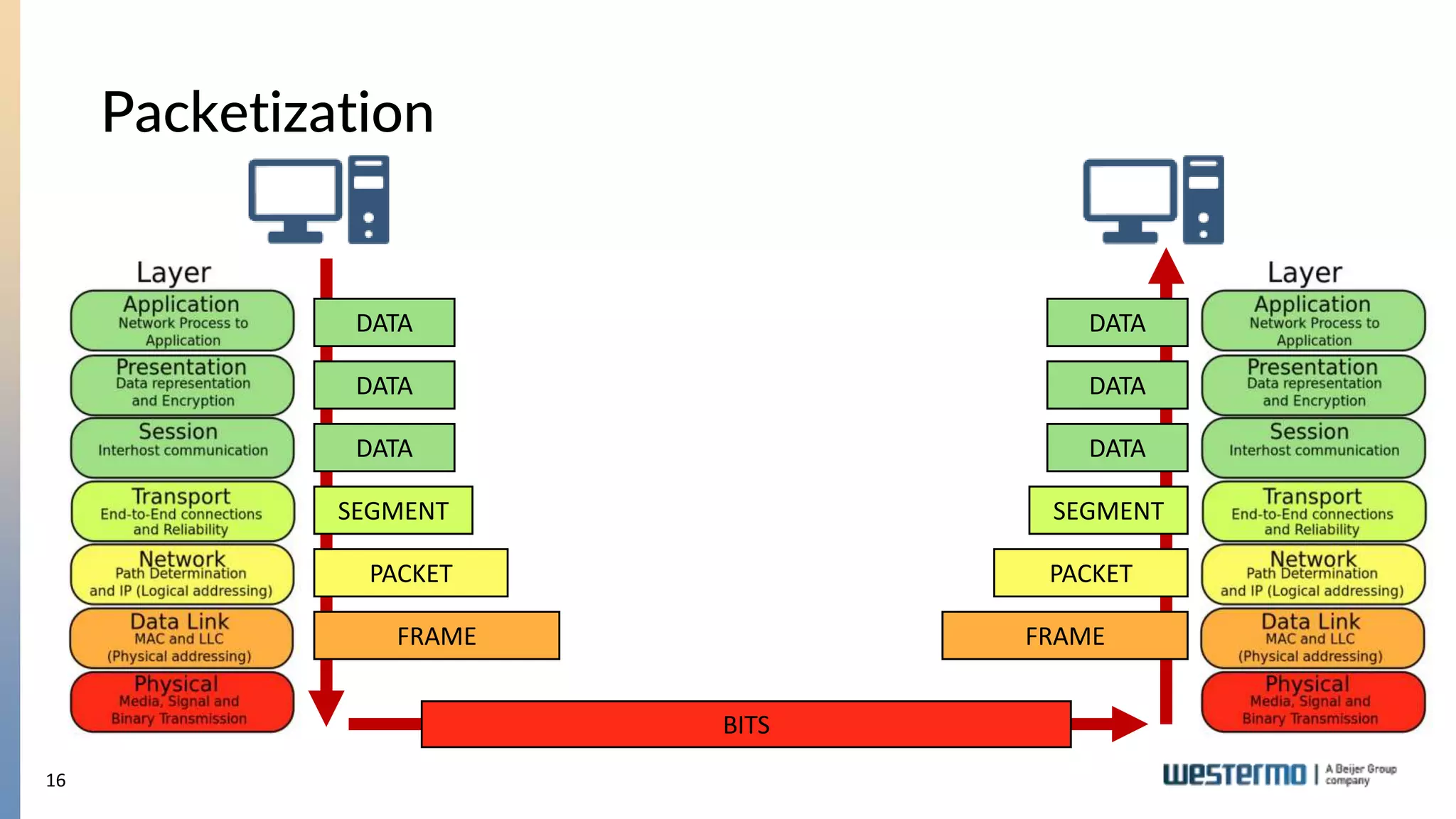
Packetization
BITS
DATA
DATA
DATA
SEGMENT
PACKET
FRAME
DATA
DATA
DATA
SEGMENT
PACKET
FRAME
DATA
DATA
APPLICATION
HEADER
DATA
APPLICATION
HEADER
DATA
APPLICATION
HEADER
APPLICATION DATA
TCP
HEADER
APPLICATION DATA
TCP
HEADER
IP
HEADER
APPLICATION DATA
TCP
HEADER
IP
HEADER
ETHERNET
HEADER
ETHERNET
FOOTER
01110111 01100101 01110011 01110100 01100101 01110010 01101101 01101111
Layer 2 Switching
Concepts
19
Introduction To Network Switching
 In network communications, traffic between nodes can result in collisions of packets,
rendering information useless.
 Hubs expand these collision domains, adding more chances of mangled packets.
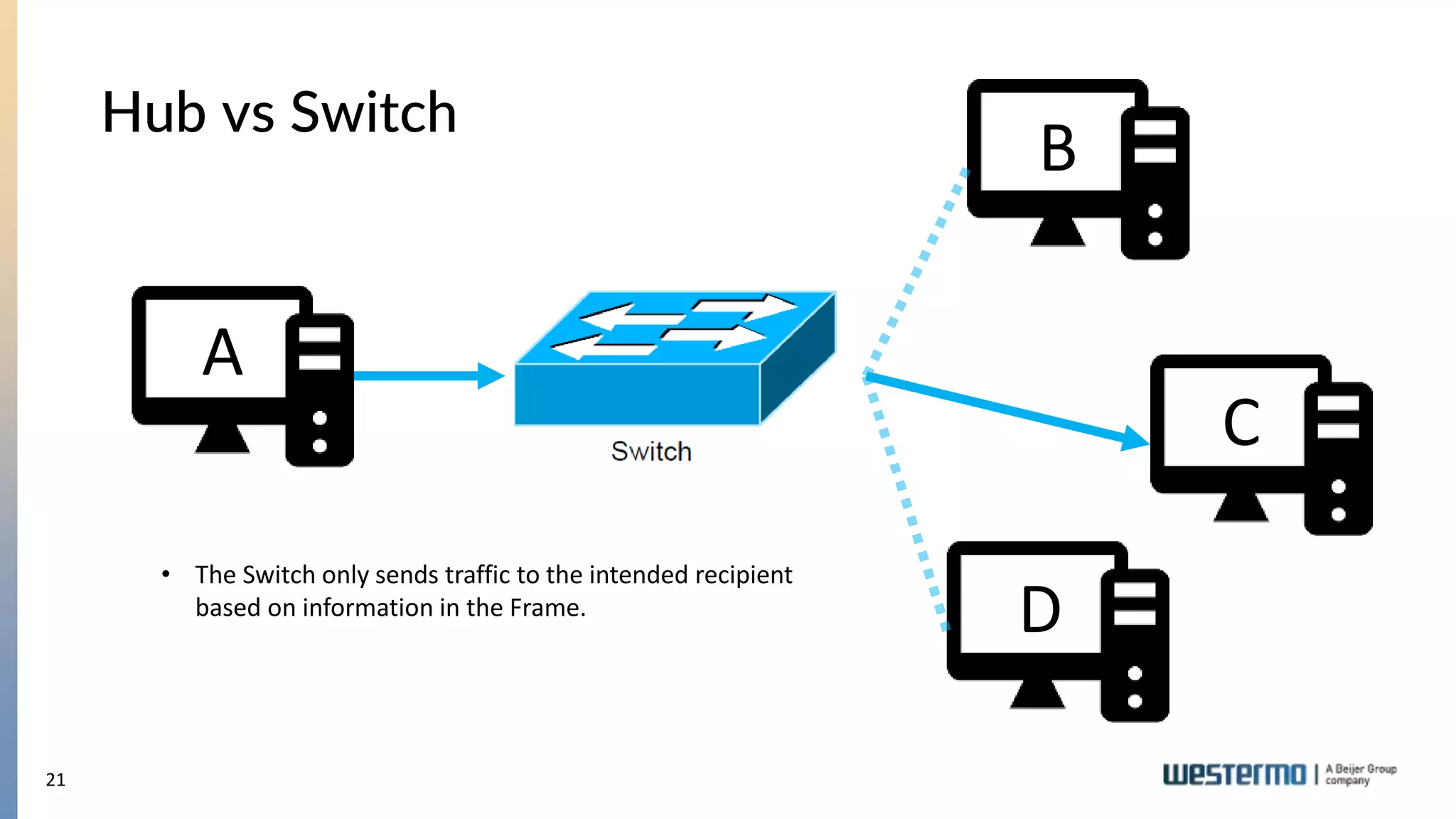
 Switches segment the collision domain between the node and the switch by directing
traffic to only go to the intended recipient rather than over broadcast.
 All data is sent through “Frames”, which list the Source and Destination MAC Address.
Switches learn the MAC Addresses of the connected nodes.
 VLANs can be implemented to add security and further segment a network in Layer 2
Switching.
 Protocols such as Spanning Tree Protocol and FRNT add redundancy to switched
networks while avoiding broadcast storms.
20
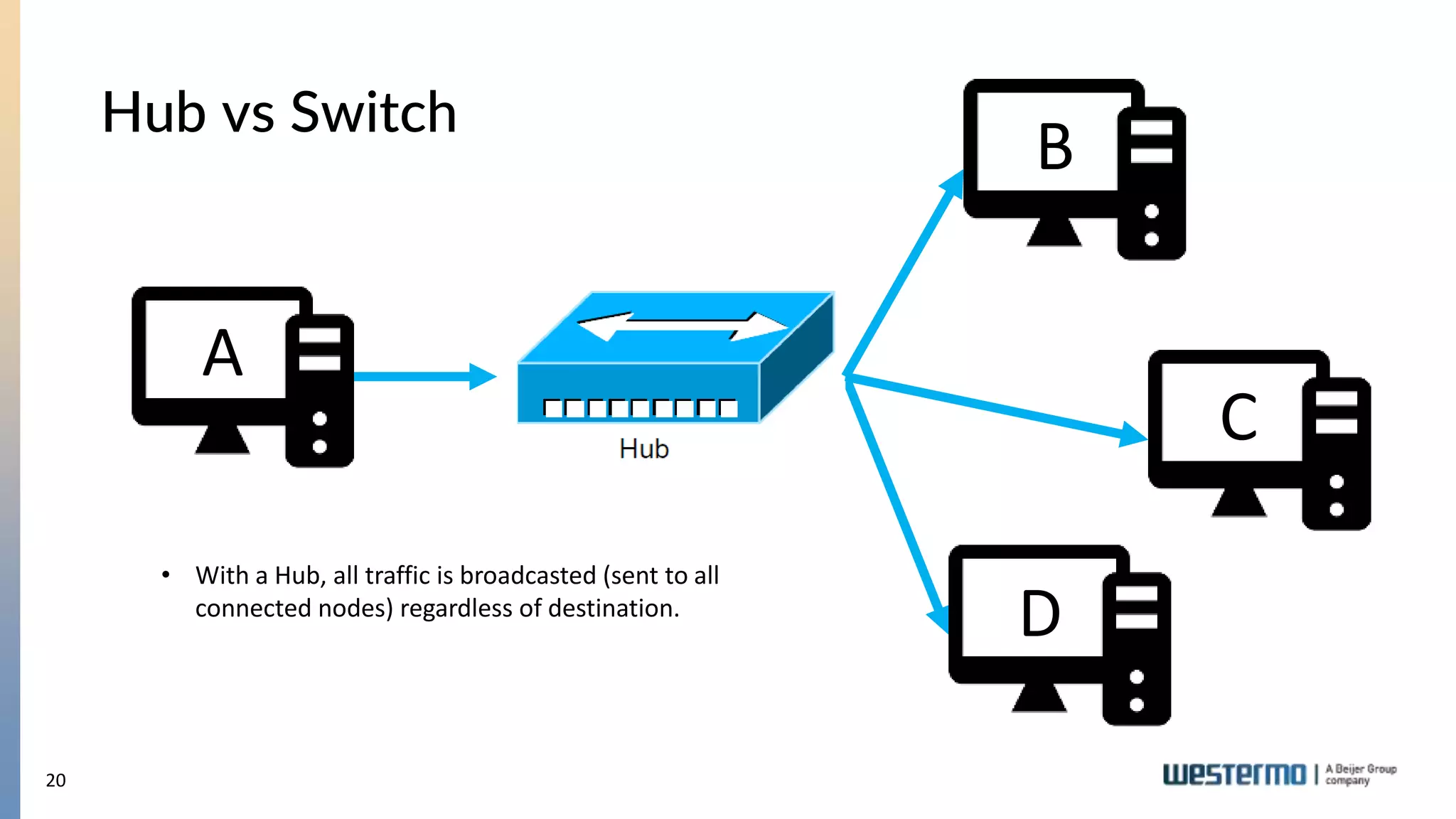
Hub vs Switch
A
D
B
C
• With a Hub, all traffic is broadcasted (sent to all
connected nodes) regardless of destination.
21
Hub vs Switch
A
D
B
C
• The Switch only sends traffic to the intended recipient
based on information in the Frame.
22
Switching and Frames
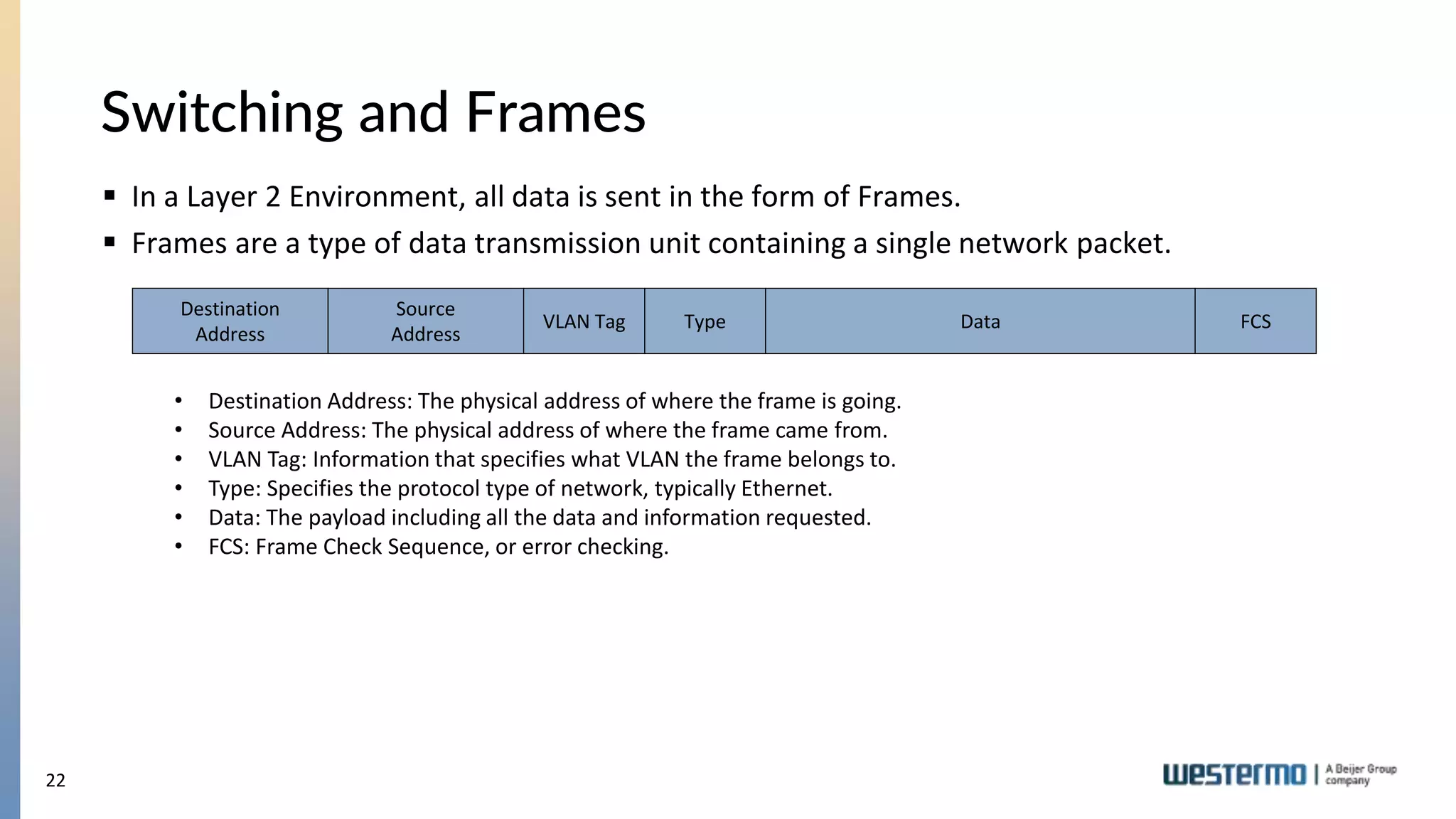
 In a Layer 2 Environment, all data is sent in the form of Frames.
 Frames are a type of data transmission unit containing a single network packet.
Destination
Address
Source
Address
VLAN Tag Type Data FCS
• Destination Address: The physical address of where the frame is going.
• Source Address: The physical address of where the frame came from.
• VLAN Tag: Information that specifies what VLAN the frame belongs to.
• Type: Specifies the protocol type of network, typically Ethernet.
• Data: The payload including all the data and information requested.
• FCS: Frame Check Sequence, or error checking.
23
MAC Addresses
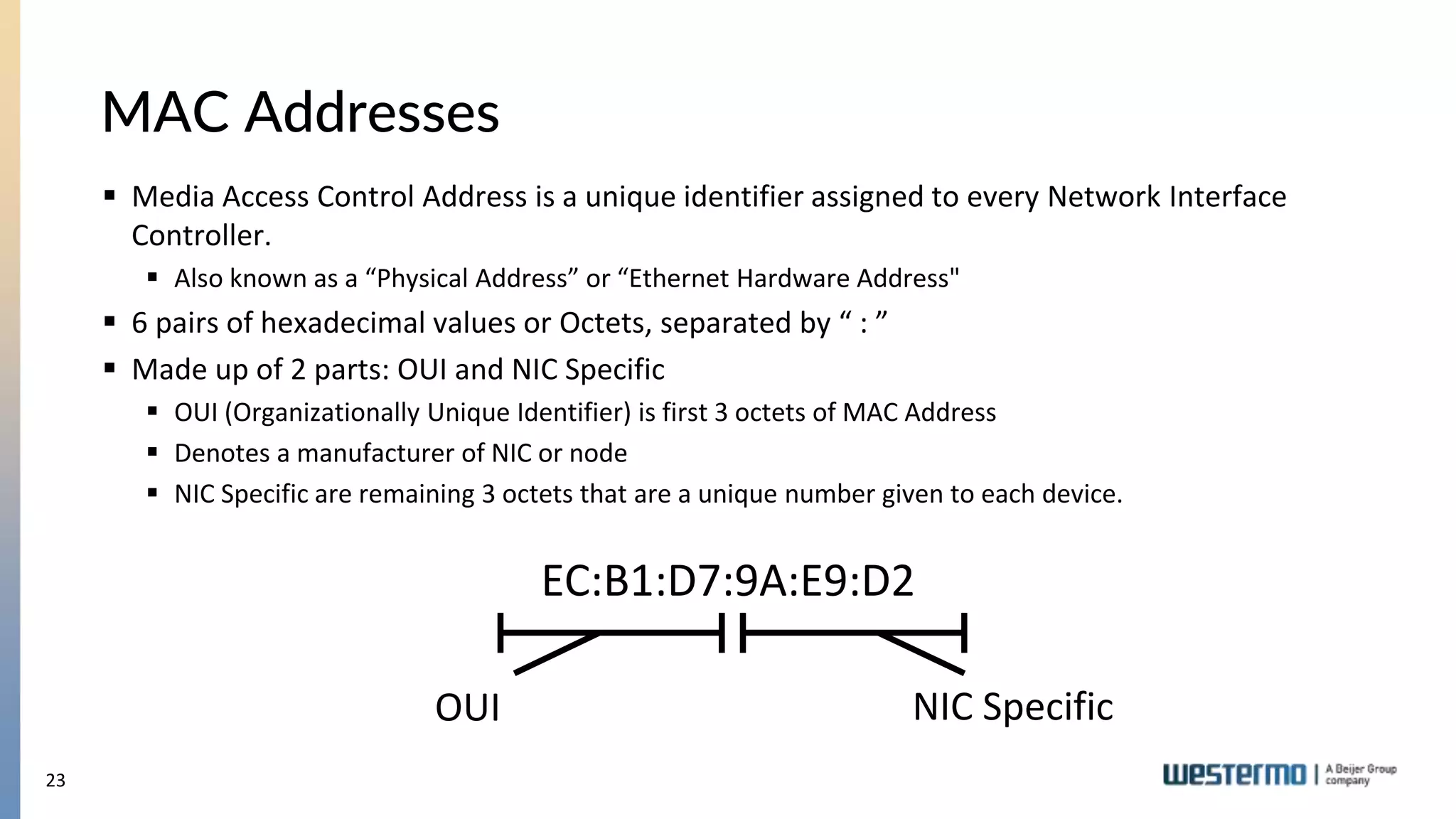
 Media Access Control Address is a unique identifier assigned to every Network Interface
Controller.
 Also known as a “Physical Address” or “Ethernet Hardware Address"
 6 pairs of hexadecimal values or Octets, separated by “ : ”
 Made up of 2 parts: OUI and NIC Specific
 OUI (Organizationally Unique Identifier) is first 3 octets of MAC Address
 Denotes a manufacturer of NIC or node
 NIC Specific are remaining 3 octets that are a unique number given to each device.
EC:B1:D7:9A:E9:D2
OUI NIC Specific
24
MAC Address Table
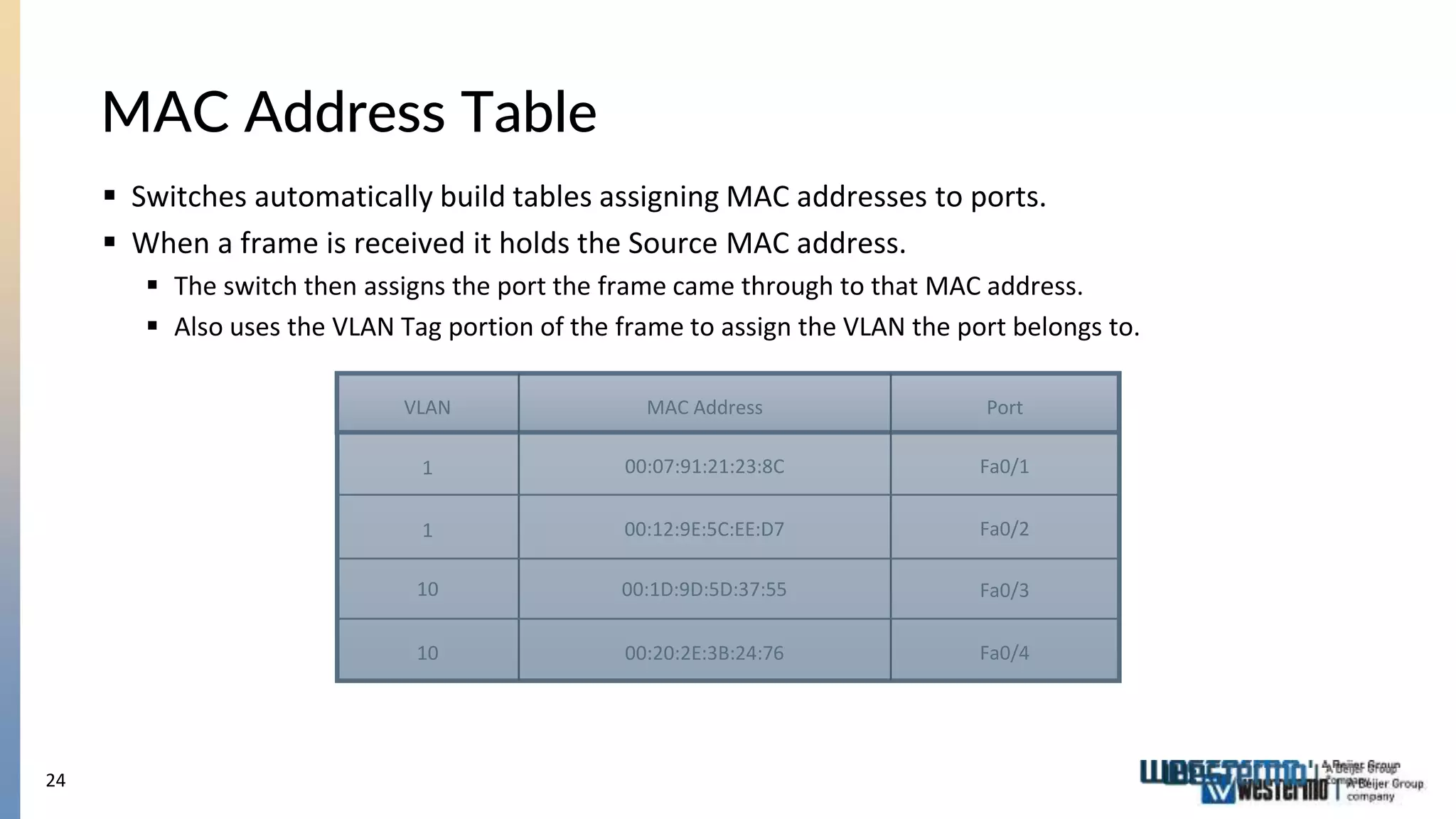
 Switches automatically build tables assigning MAC addresses to ports.
 When a frame is received it holds the Source MAC address.
 The switch then assigns the port the frame came through to that MAC address.
 Also uses the VLAN Tag portion of the frame to assign the VLAN the port belongs to.
VLAN MAC Address Port
1
1
10
10
00:07:91:21:23:8C
00:12:9E:5C:EE:D7
00:1D:9D:5D:37:55
00:20:2E:3B:24:76
Fa0/1
Fa0/2
Fa0/3
Fa0/4
25
VLANs
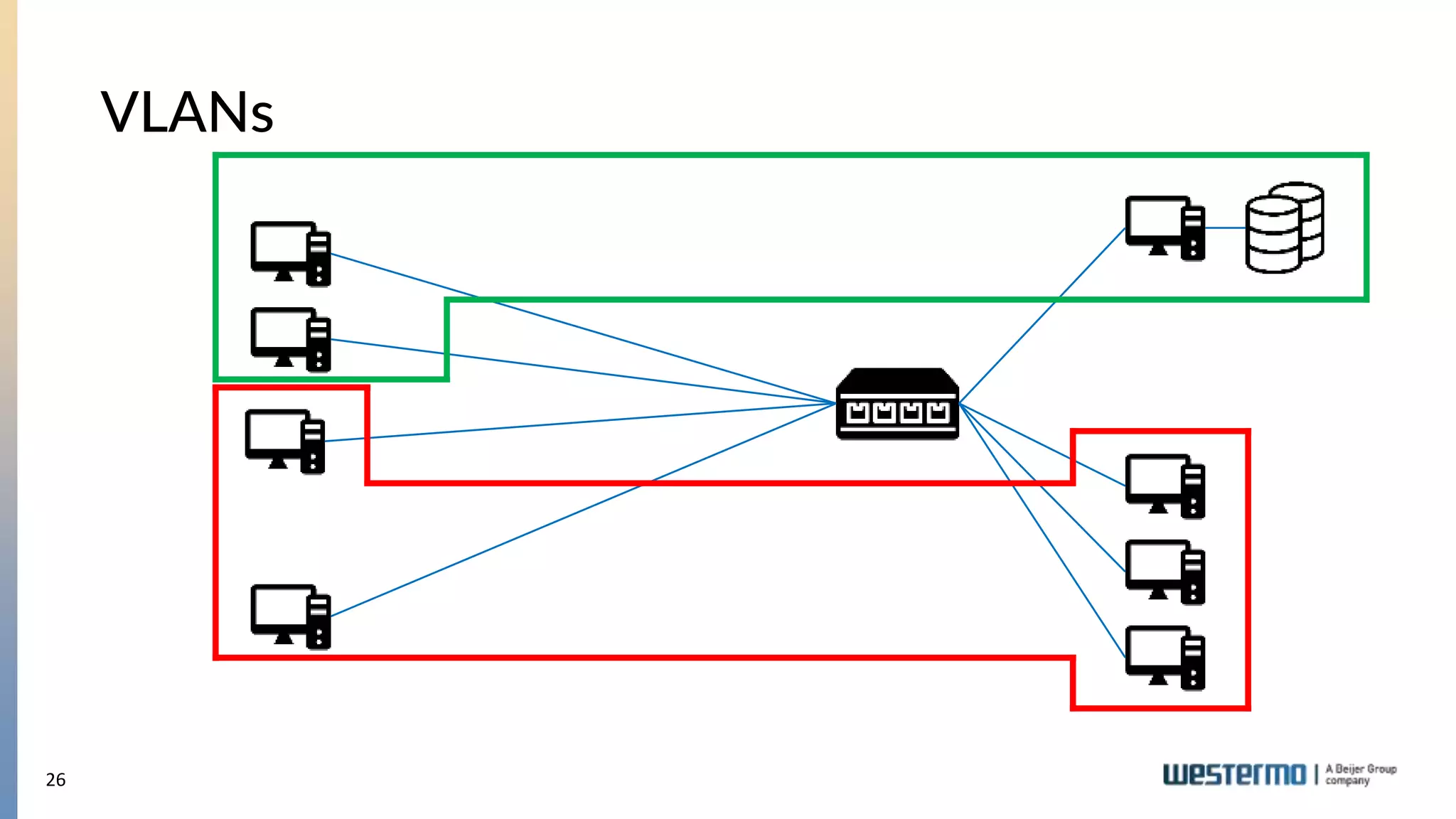
 VLAN, or Virtual LAN, or Virtual Local Area Network segments a single broadcast domain.
 Several physical devices can all share the same network while being separated by VLAN
software controls.
 “Pipes inside a pipe”
 Adds security, performance, and can organize a complex network.
 Frames are tagged with a VLAN ID to define what VLAN they belong to.
 VLANs can be configured to apply to either a physical port on the switch (Static VLAN) or
to all traffic coming from a specific MAC address (Dynamic VLAN).
26
VLANs
27
Layer 2 Redundancy
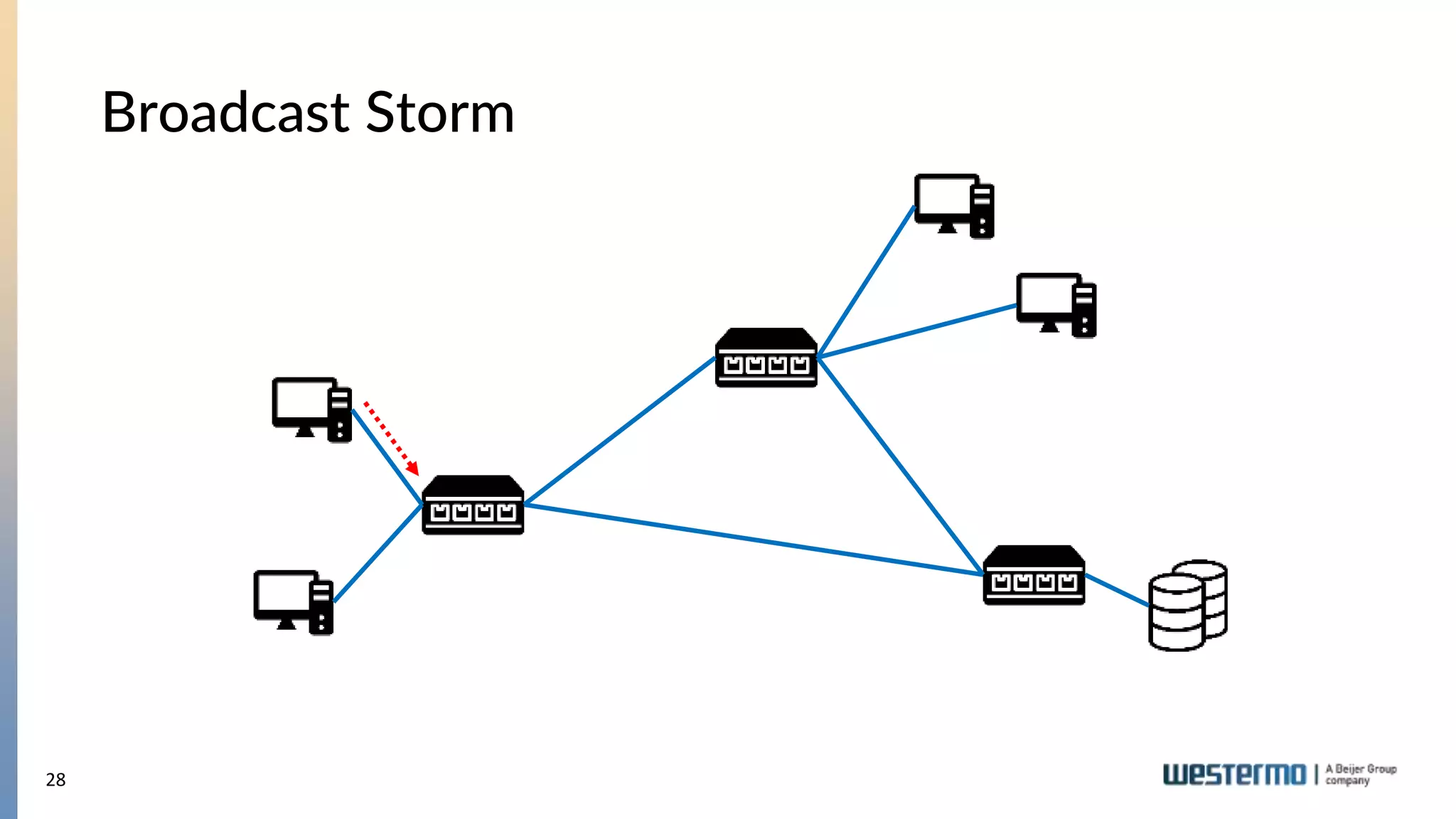
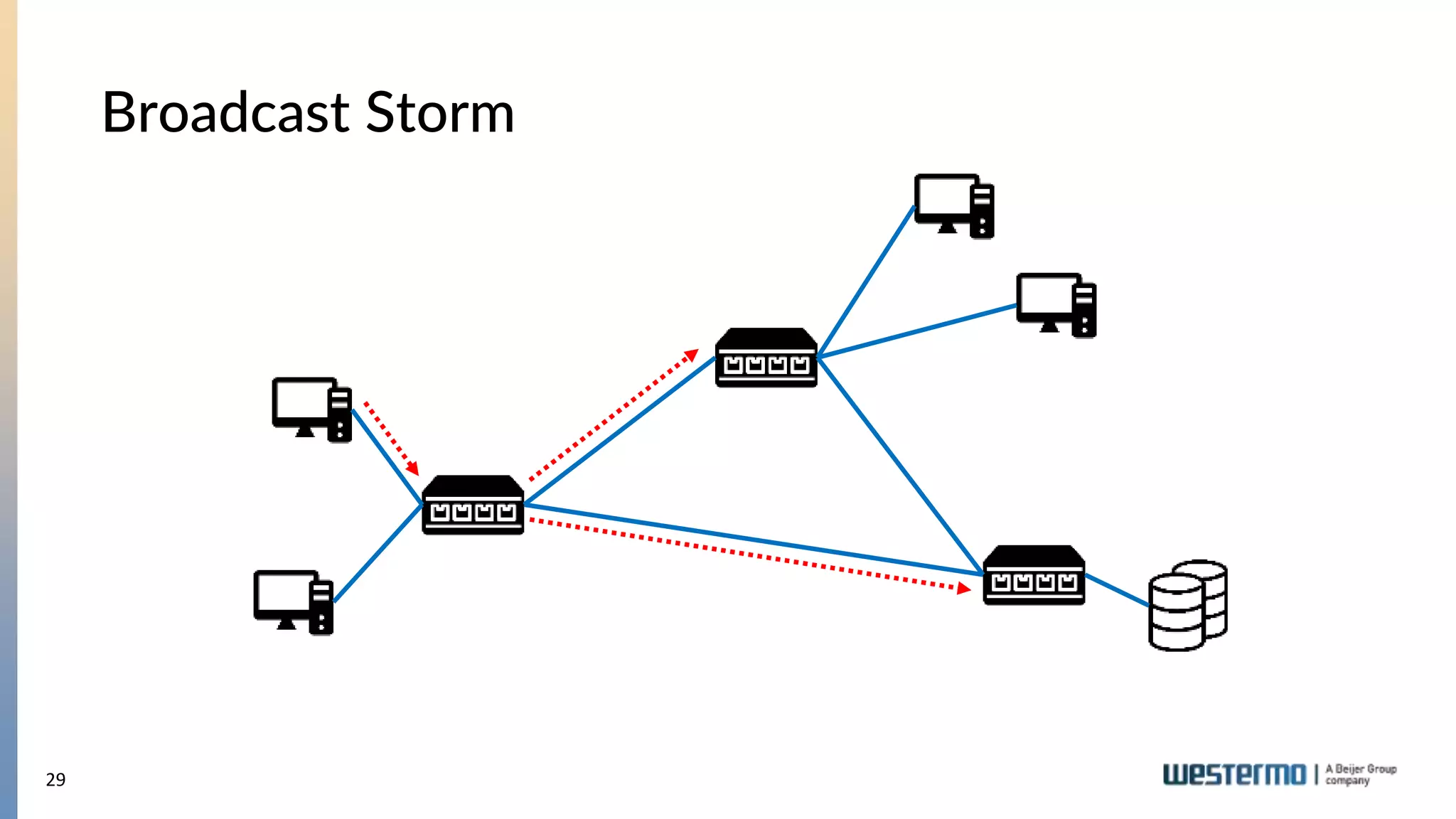
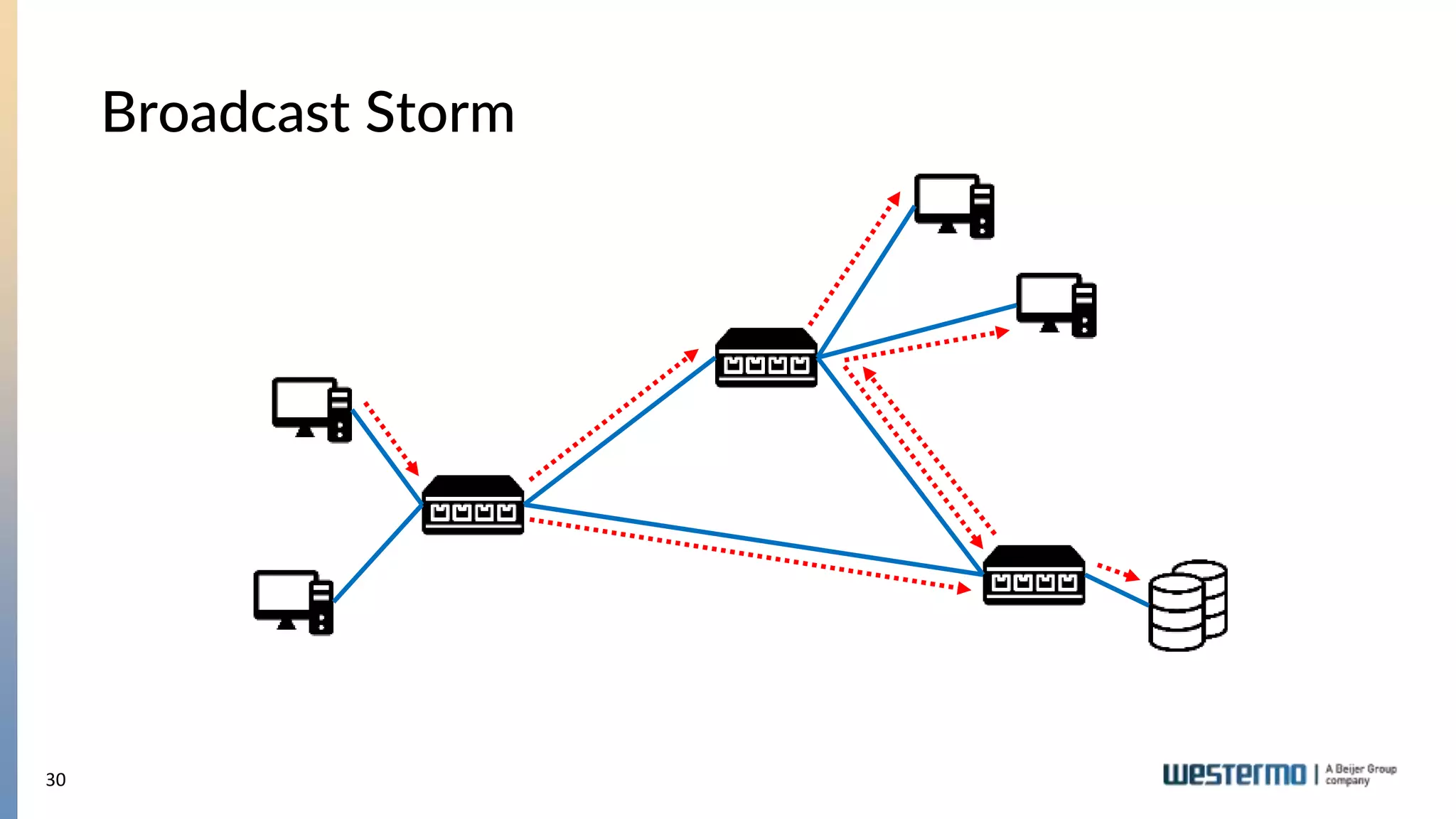
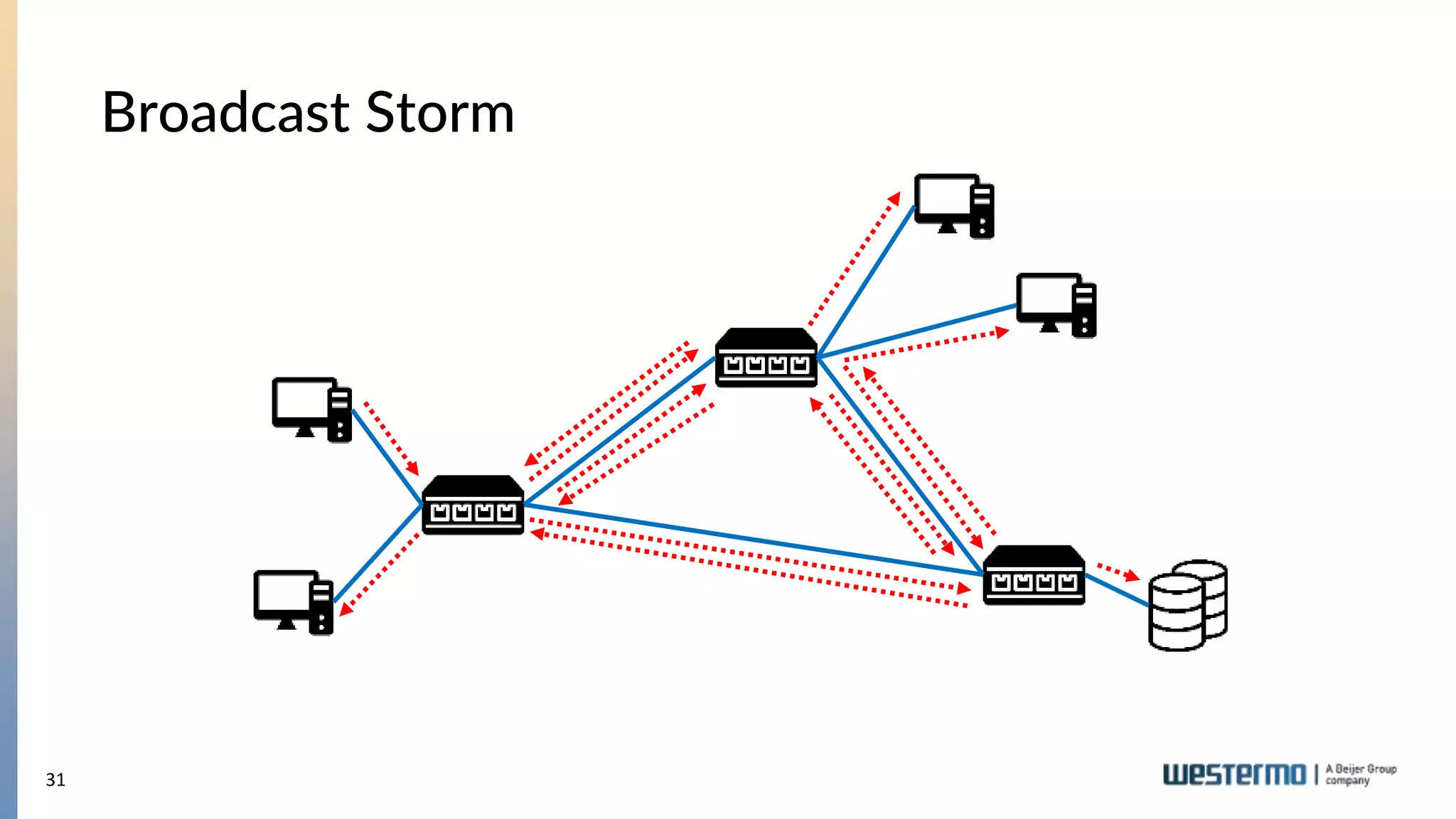
 When learning MAC Addresses, a switch broadcasts all traffic for the first time.
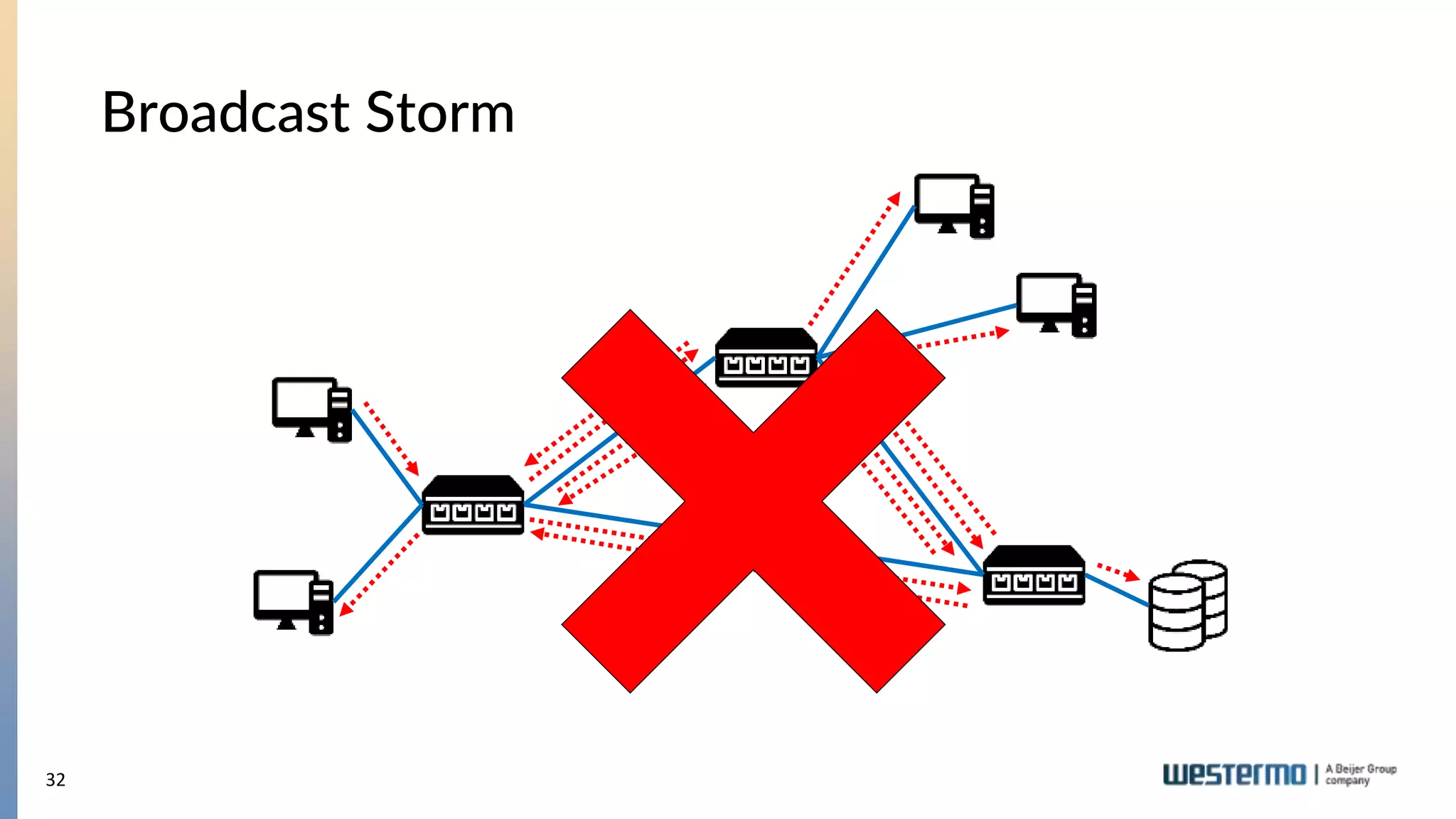
 These broadcasts can propagate and flood the network in a “Broadcast Storm” when a
loop is made between multiple switches.
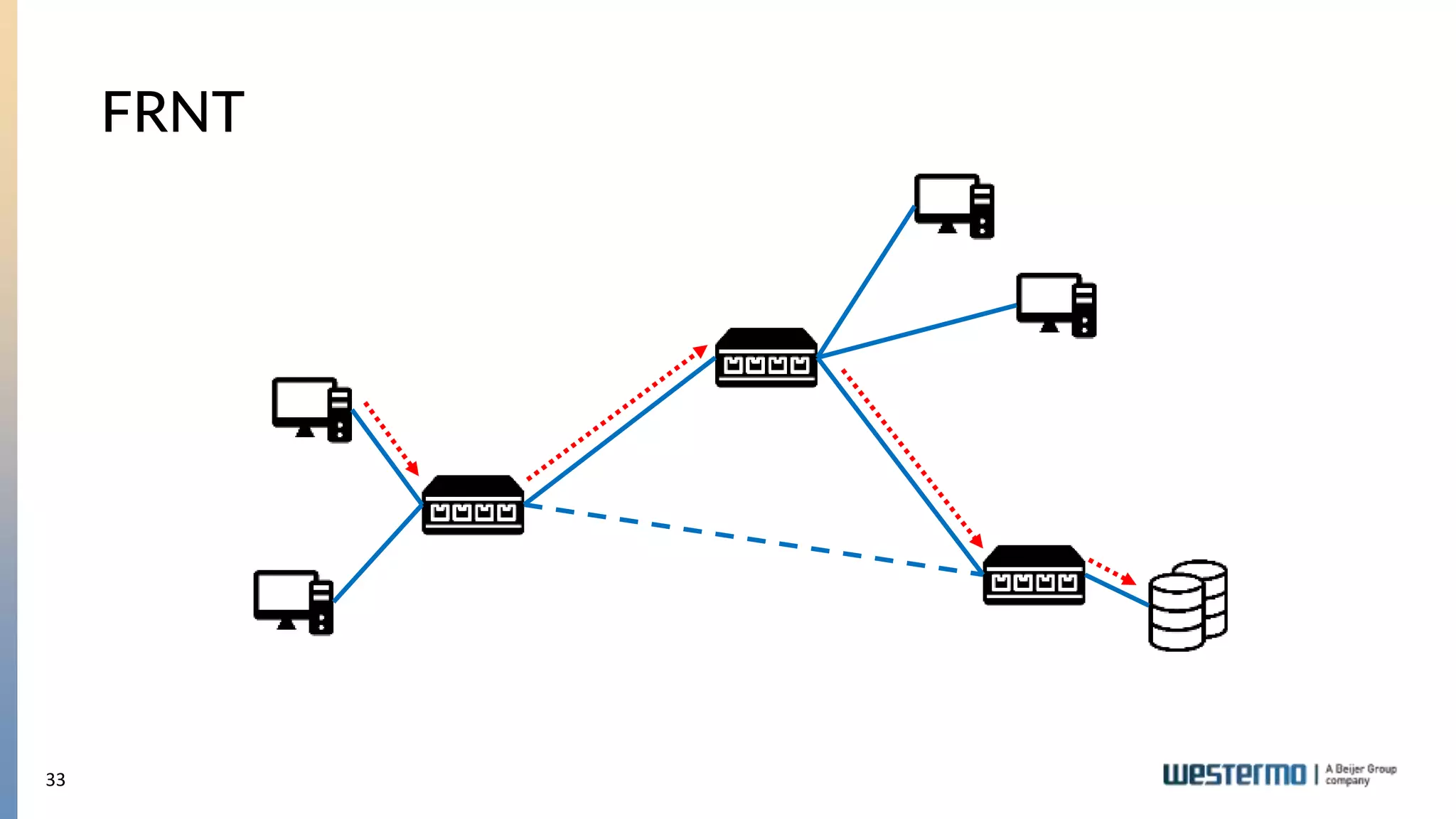
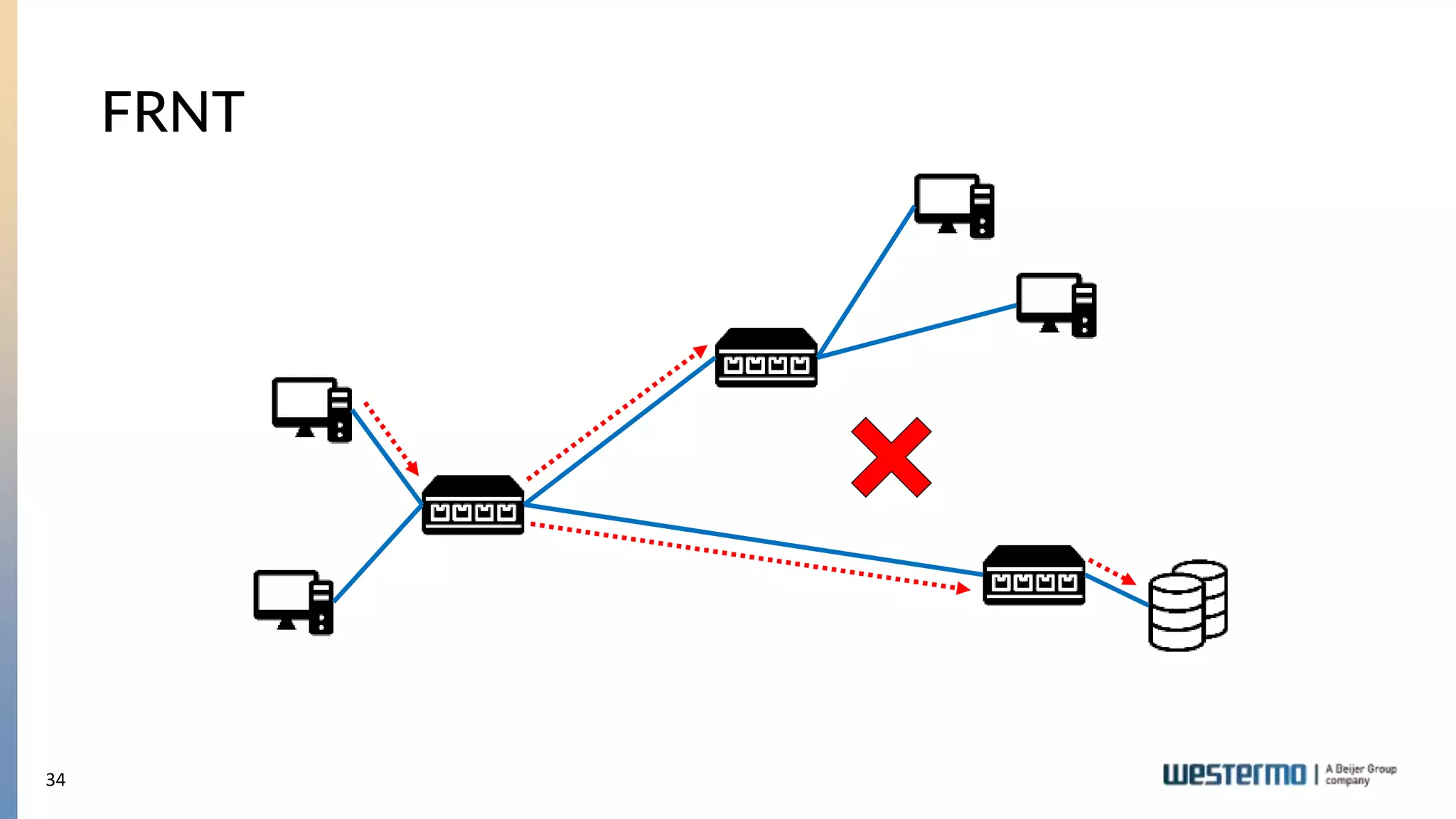
 Protocols exist such as Spanning Tree Protocol (STP) and Fast Reconfiguration of Network
Topology (FRNT) that automatically disable a link to prevent Broadcast Storms and only
enable it when another link is detected to go down.
 In networks without these protocols configured, it’s very important to avoid looping the
network.
28
Broadcast Storm
29
Broadcast Storm
30
Broadcast Storm
31
Broadcast Storm
32
Broadcast Storm
33
FRNT
34
FRNT
Layer 3 Routing Concepts
36
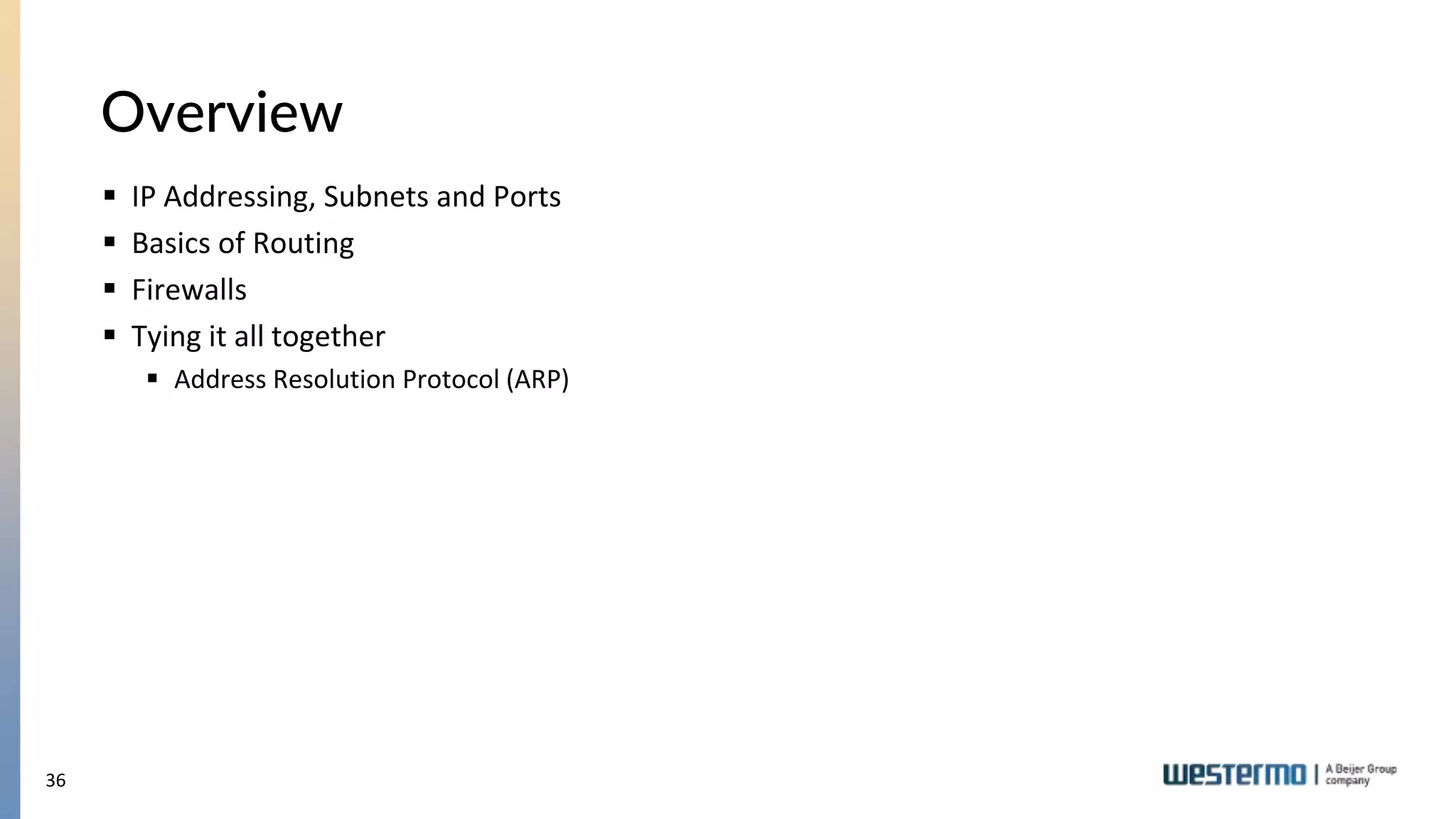
Overview
 IP Addressing, Subnets and Ports
 Basics of Routing
 Firewalls
 Tying it all together
 Address Resolution Protocol (ARP)
37
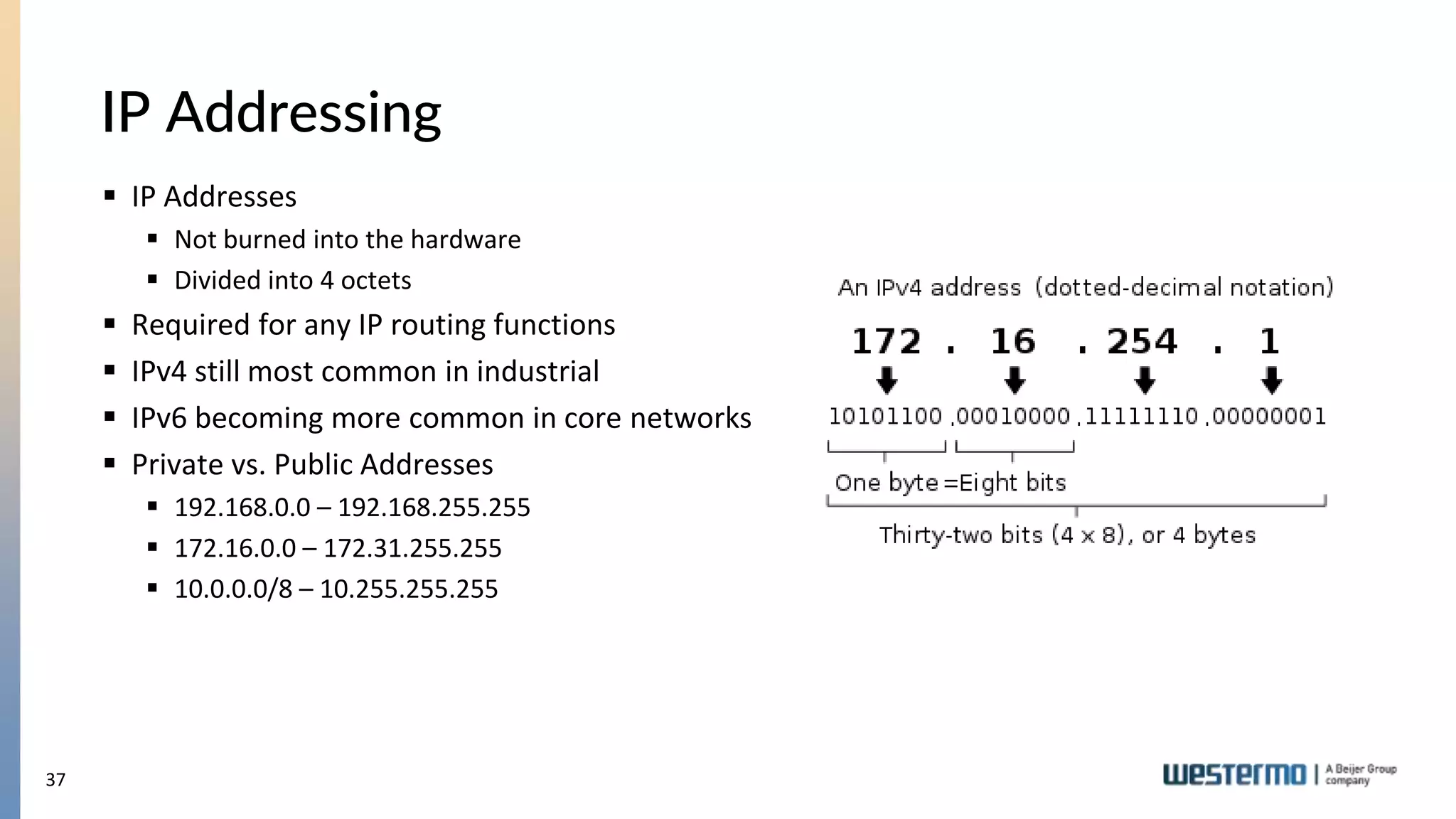
IP Addressing
 IP Addresses
 Not burned into the hardware
 Divided into 4 octets
 Required for any IP routing functions
 IPv4 still most common in industrial
 IPv6 becoming more common in core networks
 Private vs. Public Addresses
 192.168.0.0 – 192.168.255.255
 172.16.0.0 – 172.31.255.255
 10.0.0.0/8 – 10.255.255.255
38
Subnetting
 Defined by a Subnet Mask
 32 bit number like an IP Address
 Used to logically divide IP Networks
 Segregates a physical network into smaller logical subnetworks
 A “filter” of sorts
 Helps a device determine if the host it wishes to reach is in the same
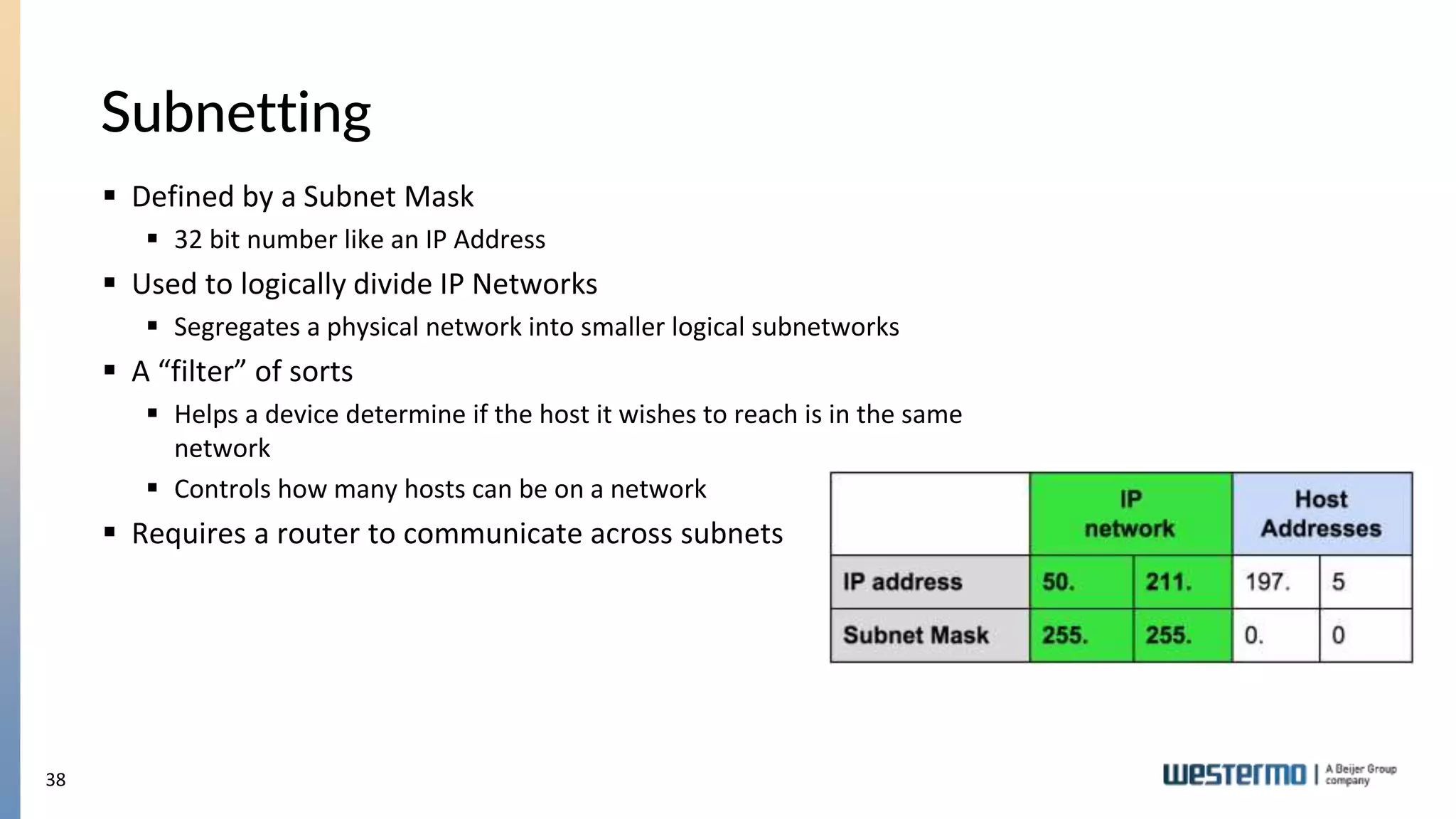
network
 Controls how many hosts can be on a network
 Requires a router to communicate across subnets
39
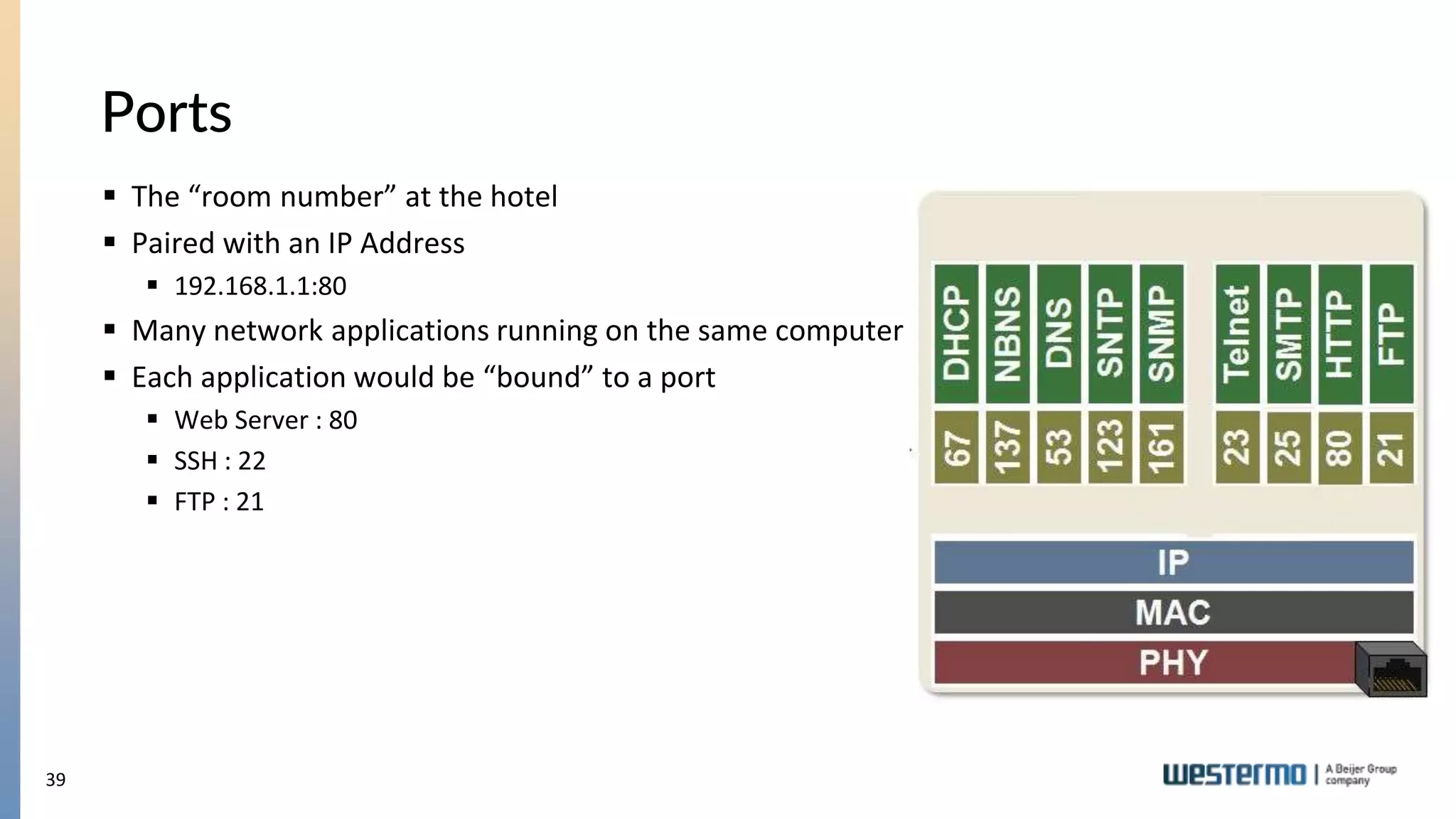
Ports
 The “room number” at the hotel
 Paired with an IP Address
 192.168.1.1:80
 Many network applications running on the same computer
 Each application would be “bound” to a port
 Web Server : 80
 SSH : 22
 FTP : 21
40
Routing Basics
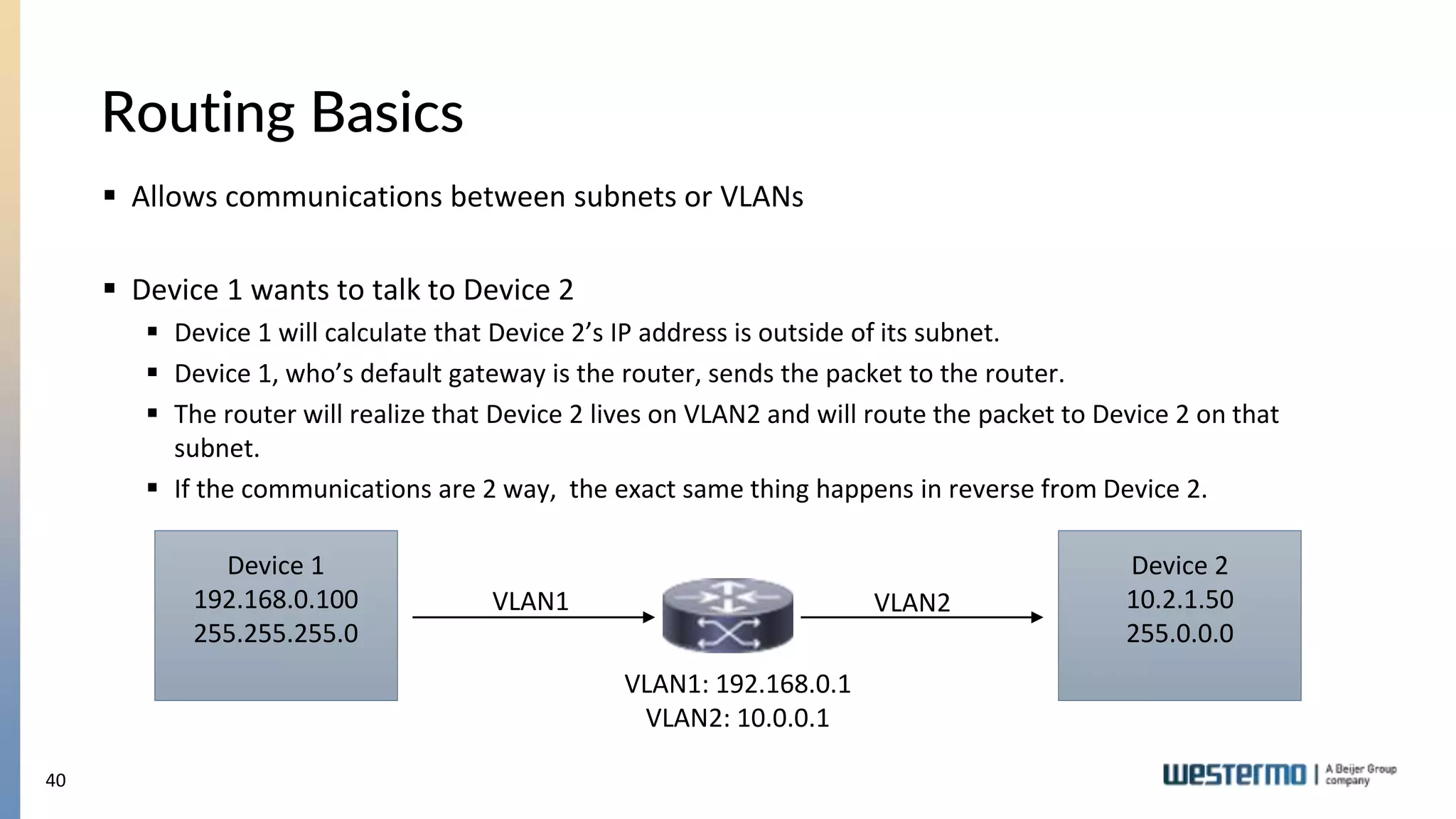
 Allows communications between subnets or VLANs
 Device 1 wants to talk to Device 2
 Device 1 will calculate that Device 2’s IP address is outside of its subnet.
 Device 1, who’s default gateway is the router, sends the packet to the router.
 The router will realize that Device 2 lives on VLAN2 and will route the packet to Device 2 on that
subnet.
 If the communications are 2 way, the exact same thing happens in reverse from Device 2.
Device 1
192.168.0.100
255.255.255.0
Device 2
10.2.1.50
255.0.0.0
VLAN1 VLAN2
VLAN1: 192.168.0.1
VLAN2: 10.0.0.1
41
Firewalls
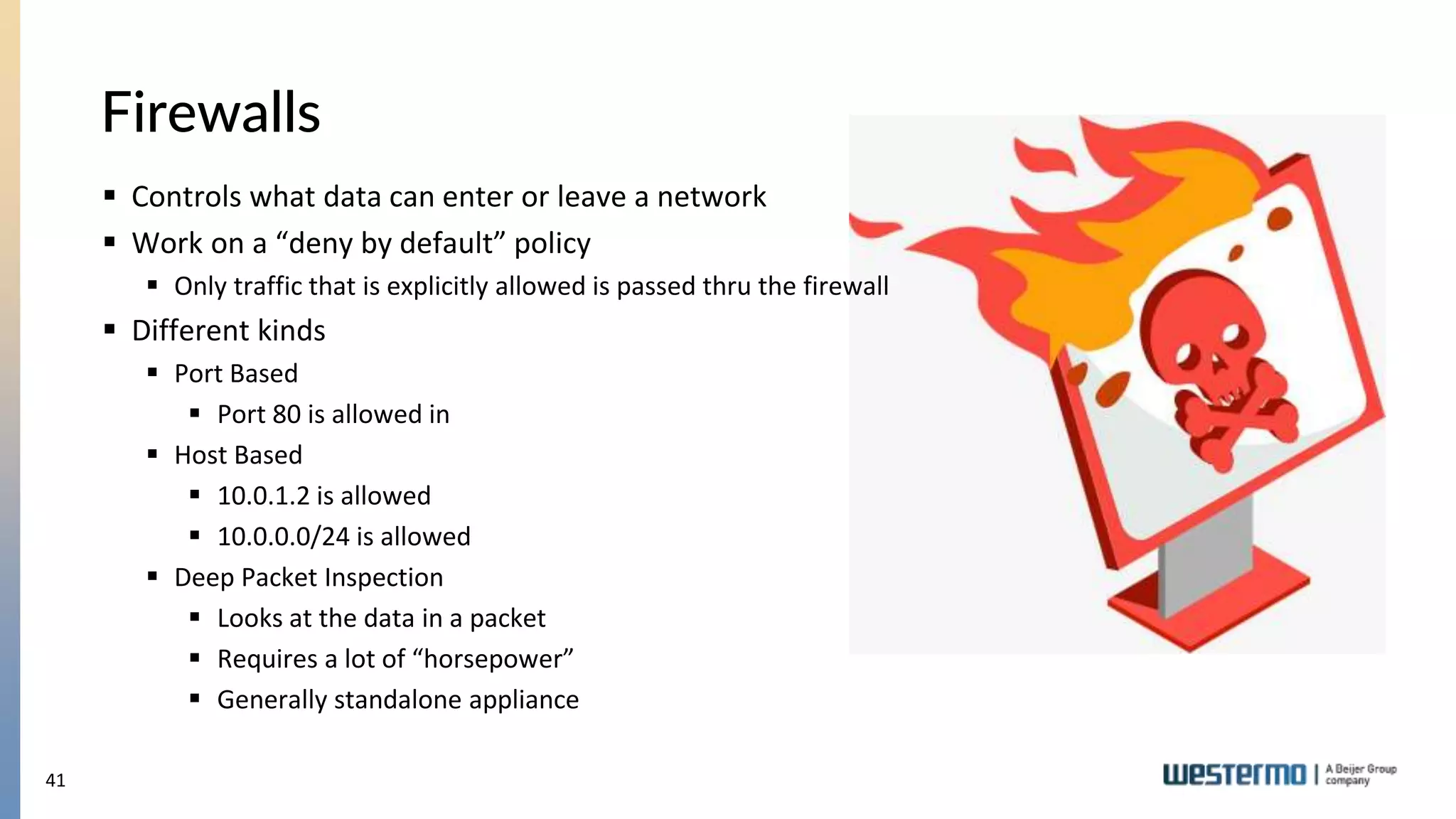
 Controls what data can enter or leave a network
 Work on a “deny by default” policy
 Only traffic that is explicitly allowed is passed thru the firewall
 Different kinds
 Port Based
 Port 80 is allowed in
 Host Based
 10.0.1.2 is allowed
 10.0.0.0/24 is allowed
 Deep Packet Inspection
 Looks at the data in a packet
 Requires a lot of “horsepower”
 Generally standalone appliance
42
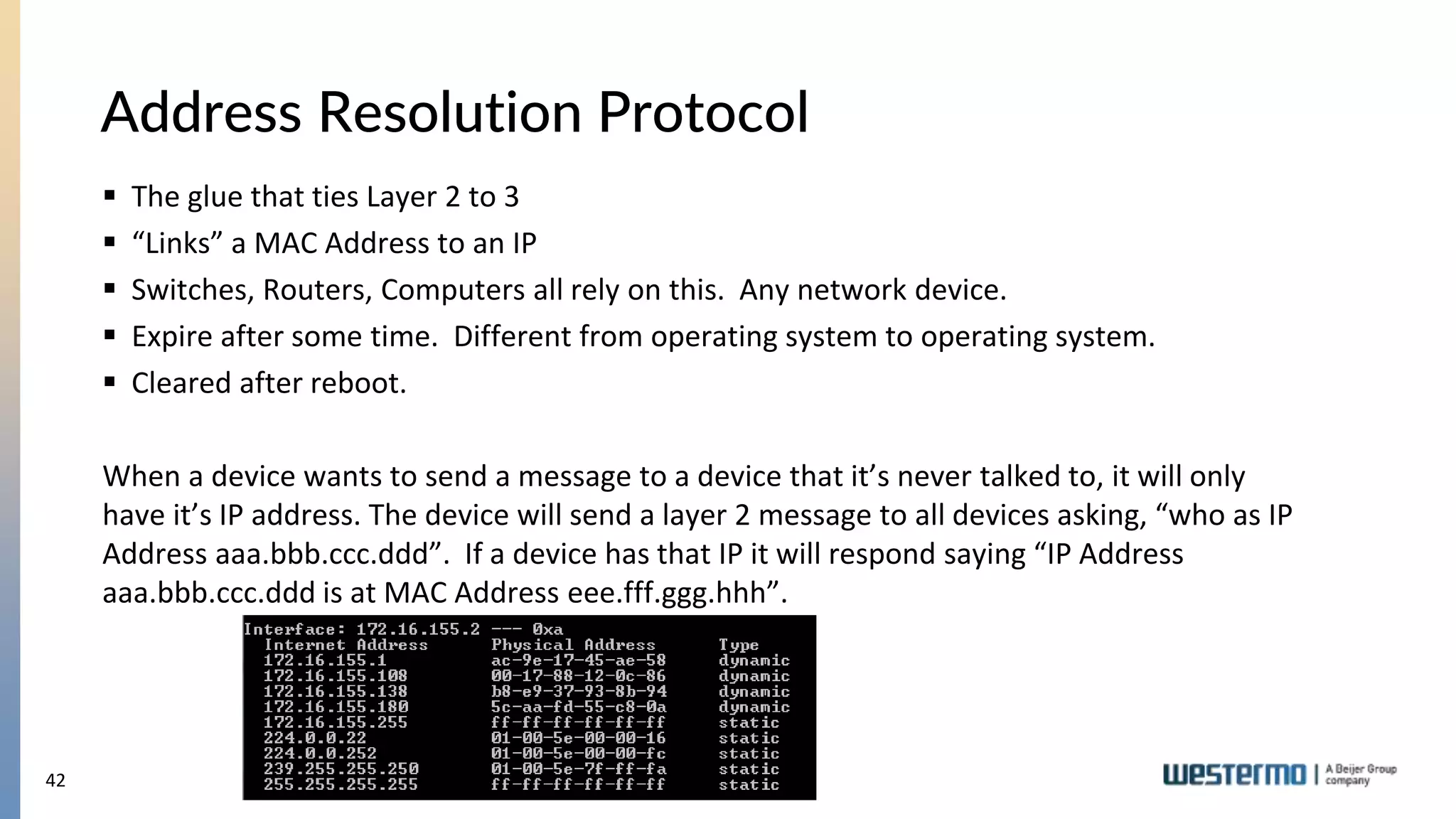
Address Resolution Protocol
 The glue that ties Layer 2 to 3
 “Links” a MAC Address to an IP
 Switches, Routers, Computers all rely on this. Any network device.
 Expire after some time. Different from operating system to operating system.
 Cleared after reboot.
When a device wants to send a message to a device that it’s never talked to, it will only
have it’s IP address. The device will send a layer 2 message to all devices asking, “who as IP
Address aaa.bbb.ccc.ddd”. If a device has that IP it will respond saying “IP Address
aaa.bbb.ccc.ddd is at MAC Address eee.fff.ggg.hhh”.
Further Learning
44
44
Westermo Certified Training
 Introduction to IP
 Introduction to WeOS
 Certified Engineer Switching
 Certified Engineer Routing
 Also Available Customer Tailored Training
https://www.westermo.us/support/academy
45
45
Further Webinars
 Redundant and Resilient Networks with Microsegmentation
 Presentation in June
 Focusing on Cybersecurity and how to configure and install a
secure network from the ground up
 Redundancy protocols, how they work, as well as VPNs and other
services
 We look forward to seeing you there!
46

Westermo webinar: Learning the Basics of Ethernet Networking

  • 1.
    Learning the Basicsof Ethernet Networking
  • 2.
    2 Overview  Team Introduction Introduction to Westermo  Industrial Networking Introduction and Considerations  Physical Layers  How does Ethernet Handle Data?  Switching and Layer 2  Routing and Layer 3  Firewalls  Tying it all together  Further Learning
  • 3.
    3 Introductions John Pavlos Managing Director john.pavlos@westermo.com 847-453-3898 BenjaminCampbell Technical Support Engineer benjamin.campbell@westermo.com 847.453.3896
  • 4.
    4 Who is Westermo2021  Founded in 1975  No. of employees: 250  14% R&D  Extensive IPR portfolio for key technologies  Recent Aquistions:  Naretech Solutions AG – June 2019  Virtual Access – November 2019  Eltek – April 2021  Flexible production with state of the art process control  Sales and support units in 12 countries, distributors in another 36  Member of the Beijer Electronics Group
  • 5.
    5 Industrial Networking Introduction Operate on the “Edge”  Likely interfaces with the core network  Completely different considerations  Environmental  Noise  Legacy Cabling  Focuses on “LAN” type networking  Many Physical Layers (Layer 1)  MAC Addresses (Layer 2)  IP Addresses (Layer 3)  Firewalls (Layer 3 and 4)
  • 6.
    6  Tough PhysicalEnvironment  Noisy Electromagnetic Environments  Many Different Physical Mediums  Fiber  Multi-mode  Single-mode  Copper  Cat 5 and better  “Legacy” Copper  Legacy Devices  Serial Devices  ISDN  Dial-up Industrial Networking Considerations
  • 7.
    7 Tough Physical Environments Hot  +70 c  Cold  -40 c  Dusty  No fans to pull in dirt  Wet  Environmental ratings as high as IP67  Shock and Vibration  “Core Networking” devices won’t cut it  Requires devices designed to live in these places
  • 8.
    8 Noisy Environments andOld Cables  High levels of Electromagnetic Noise  Extreme spikes  High average noise (Noise Floor)  Cables installed for legacy systems  RS 232/422/485  LonWorks  New cables cost prohibitive  Fiber or Cat 5,6,7 is rare  Requires a “Media Conversion”
  • 9.
    9 Physical Mediums  Fiberoptic is the best choice  Expensive to install  Relatively rare in brown field applications  Cat 5,6,7  Ethernet Compliant  Legacy cabling  Installed for legacy systems  Non-Ethernet compliant  Often not shielded  Maybe twisted pair, maybe not (50/50)  Coax
  • 10.
    10 More Physical Mediums PLC  Extreme environments  Cable sharing  Shorter Distances  300 m  Higher Speeds  70 Mbit/s  Wireless (WiFi)  Only option sometimes  Can be affected by high noise floors  Media Conversions (Legacy Cables)  SHDSL  Long distances (15 km)  High noise resilience  Limited Speed  15.3 Mbit/s  30.6 Mbit/s with bonding
  • 11.
  • 12.
    12 OSI Model Overview •Stands for Open Systems Interconnection Model. • Consists of 7 layers that explains how data interchange occurs. • Layers are named based on what they manage, with each layer working with a different form of data. • Each layer only interacts with the layers immediately above and below it.
  • 13.
    13 Physical and DataLink Layers Layers 1 and 2 • The Physical Layer refers to the physical medium through which data communication occurs. • Includes Copper, Fiber, even Air as a wireless medium. • Focuses on the conversion of binary 1 and 0s (bits) into a signal. • Outlines the method for node-to-node data transfer, a link over which data is transferred. • The layer establishes and terminates connections between two physically connected devices. • MAC Addresses are assigned at this layer, with any physical Network Interface Card (NIC) receiving a standardized MAC address for all communications.
  • 14.
    14 Network and TransportLayers Layers 3 and 4 • The Network Layer provides the means to transfer packets from one node to another, located in different networks. • Assigns a logical address of nodes (IP Address). • Path determination, or Routing is enforced. Many protocols were created to cover many different network types. • Transport layer covers how to transfer data from source to host while maintaining the Quality of Service (QoS). • Reliability is maintained through flow control and error checking. • Acknowledges failures in sent data and resend lost packets to ensure communications are not lost. • Firewalls exist between layers 3 and 4.
  • 15.
    15 The Application Layers Layers5 through 7 • The top 3 layers are referred to as the “Application Layers”. • Application is the highest layer in the OSI model, and the layer closest to the end user. This layer interacts directly with the software applications. • The Presentation layer works between the Application and Session layers to translate between data the application uses, to data that can span the network. • The Session Layer manages connections between computers. This layer establishes and terminates connections between applications.
  • 16.
  • 17.
    DATA DATA APPLICATION HEADER DATA APPLICATION HEADER DATA APPLICATION HEADER APPLICATION DATA TCP HEADER APPLICATION DATA TCP HEADER IP HEADER APPLICATIONDATA TCP HEADER IP HEADER ETHERNET HEADER ETHERNET FOOTER 01110111 01100101 01110011 01110100 01100101 01110010 01101101 01101111
  • 18.
  • 19.
    19 Introduction To NetworkSwitching  In network communications, traffic between nodes can result in collisions of packets, rendering information useless.  Hubs expand these collision domains, adding more chances of mangled packets.  Switches segment the collision domain between the node and the switch by directing traffic to only go to the intended recipient rather than over broadcast.  All data is sent through “Frames”, which list the Source and Destination MAC Address. Switches learn the MAC Addresses of the connected nodes.  VLANs can be implemented to add security and further segment a network in Layer 2 Switching.  Protocols such as Spanning Tree Protocol and FRNT add redundancy to switched networks while avoiding broadcast storms.
  • 20.
    20 Hub vs Switch A D B C •With a Hub, all traffic is broadcasted (sent to all connected nodes) regardless of destination.
  • 21.
    21 Hub vs Switch A D B C •The Switch only sends traffic to the intended recipient based on information in the Frame.
  • 22.
    22 Switching and Frames In a Layer 2 Environment, all data is sent in the form of Frames.  Frames are a type of data transmission unit containing a single network packet. Destination Address Source Address VLAN Tag Type Data FCS • Destination Address: The physical address of where the frame is going. • Source Address: The physical address of where the frame came from. • VLAN Tag: Information that specifies what VLAN the frame belongs to. • Type: Specifies the protocol type of network, typically Ethernet. • Data: The payload including all the data and information requested. • FCS: Frame Check Sequence, or error checking.
  • 23.
    23 MAC Addresses  MediaAccess Control Address is a unique identifier assigned to every Network Interface Controller.  Also known as a “Physical Address” or “Ethernet Hardware Address"  6 pairs of hexadecimal values or Octets, separated by “ : ”  Made up of 2 parts: OUI and NIC Specific  OUI (Organizationally Unique Identifier) is first 3 octets of MAC Address  Denotes a manufacturer of NIC or node  NIC Specific are remaining 3 octets that are a unique number given to each device. EC:B1:D7:9A:E9:D2 OUI NIC Specific
  • 24.
    24 MAC Address Table Switches automatically build tables assigning MAC addresses to ports.  When a frame is received it holds the Source MAC address.  The switch then assigns the port the frame came through to that MAC address.  Also uses the VLAN Tag portion of the frame to assign the VLAN the port belongs to. VLAN MAC Address Port 1 1 10 10 00:07:91:21:23:8C 00:12:9E:5C:EE:D7 00:1D:9D:5D:37:55 00:20:2E:3B:24:76 Fa0/1 Fa0/2 Fa0/3 Fa0/4
  • 25.
    25 VLANs  VLAN, orVirtual LAN, or Virtual Local Area Network segments a single broadcast domain.  Several physical devices can all share the same network while being separated by VLAN software controls.  “Pipes inside a pipe”  Adds security, performance, and can organize a complex network.  Frames are tagged with a VLAN ID to define what VLAN they belong to.  VLANs can be configured to apply to either a physical port on the switch (Static VLAN) or to all traffic coming from a specific MAC address (Dynamic VLAN).
  • 26.
  • 27.
    27 Layer 2 Redundancy When learning MAC Addresses, a switch broadcasts all traffic for the first time.  These broadcasts can propagate and flood the network in a “Broadcast Storm” when a loop is made between multiple switches.  Protocols exist such as Spanning Tree Protocol (STP) and Fast Reconfiguration of Network Topology (FRNT) that automatically disable a link to prevent Broadcast Storms and only enable it when another link is detected to go down.  In networks without these protocols configured, it’s very important to avoid looping the network.
  • 28.
  • 29.
  • 30.
  • 31.
  • 32.
  • 33.
  • 34.
  • 35.
  • 36.
    36 Overview  IP Addressing,Subnets and Ports  Basics of Routing  Firewalls  Tying it all together  Address Resolution Protocol (ARP)
  • 37.
    37 IP Addressing  IPAddresses  Not burned into the hardware  Divided into 4 octets  Required for any IP routing functions  IPv4 still most common in industrial  IPv6 becoming more common in core networks  Private vs. Public Addresses  192.168.0.0 – 192.168.255.255  172.16.0.0 – 172.31.255.255  10.0.0.0/8 – 10.255.255.255
  • 38.
    38 Subnetting  Defined bya Subnet Mask  32 bit number like an IP Address  Used to logically divide IP Networks  Segregates a physical network into smaller logical subnetworks  A “filter” of sorts  Helps a device determine if the host it wishes to reach is in the same network  Controls how many hosts can be on a network  Requires a router to communicate across subnets
  • 39.
    39 Ports  The “roomnumber” at the hotel  Paired with an IP Address  192.168.1.1:80  Many network applications running on the same computer  Each application would be “bound” to a port  Web Server : 80  SSH : 22  FTP : 21
  • 40.
    40 Routing Basics  Allowscommunications between subnets or VLANs  Device 1 wants to talk to Device 2  Device 1 will calculate that Device 2’s IP address is outside of its subnet.  Device 1, who’s default gateway is the router, sends the packet to the router.  The router will realize that Device 2 lives on VLAN2 and will route the packet to Device 2 on that subnet.  If the communications are 2 way, the exact same thing happens in reverse from Device 2. Device 1 192.168.0.100 255.255.255.0 Device 2 10.2.1.50 255.0.0.0 VLAN1 VLAN2 VLAN1: 192.168.0.1 VLAN2: 10.0.0.1
  • 41.
    41 Firewalls  Controls whatdata can enter or leave a network  Work on a “deny by default” policy  Only traffic that is explicitly allowed is passed thru the firewall  Different kinds  Port Based  Port 80 is allowed in  Host Based  10.0.1.2 is allowed  10.0.0.0/24 is allowed  Deep Packet Inspection  Looks at the data in a packet  Requires a lot of “horsepower”  Generally standalone appliance
  • 42.
    42 Address Resolution Protocol The glue that ties Layer 2 to 3  “Links” a MAC Address to an IP  Switches, Routers, Computers all rely on this. Any network device.  Expire after some time. Different from operating system to operating system.  Cleared after reboot. When a device wants to send a message to a device that it’s never talked to, it will only have it’s IP address. The device will send a layer 2 message to all devices asking, “who as IP Address aaa.bbb.ccc.ddd”. If a device has that IP it will respond saying “IP Address aaa.bbb.ccc.ddd is at MAC Address eee.fff.ggg.hhh”.
  • 43.
  • 44.
    44 44 Westermo Certified Training Introduction to IP  Introduction to WeOS  Certified Engineer Switching  Certified Engineer Routing  Also Available Customer Tailored Training https://www.westermo.us/support/academy
  • 45.
    45 45 Further Webinars  Redundantand Resilient Networks with Microsegmentation  Presentation in June  Focusing on Cybersecurity and how to configure and install a secure network from the ground up  Redundancy protocols, how they work, as well as VPNs and other services  We look forward to seeing you there!
  • 46.