






UNIT - III
 OBJECTIVES:
 This chapter introduces flows and
flow concepts, data sources and
data sinks, and flow models will help
us to identify, size, and describe
flows.
 FLOWS:
 Flows also known as network flows
or traffic flows or data flows.
 It provides the traffic movement in
the network.
 A sequence of packets sent from a
particular source to a particular
(unicast or multicast) destination.
 FLOWS ANALYSIS:
 Flow analysis is the process of describing
/characterizing traffic flows for a
network.
 Where they are likely 2take place/occur.
 What levels of performance they will
require.
BENEFITS:
 Provides hierarchy (arrangement) levels.
 In choosing interconnection strategies
such as (switching, routing and hybrid)
mechanisms.
 Flows are represented as Unidirectional
or Bidirectional performance.
 Bidirectional :
 Unidirectional:
 It is represented as single and
double sided arrows.
 Most flows are Bi-Directional
arrows.
 Flows are important in analysis,
architecture and design process.
 TRAFFIC FLOW:
 Traffic flow is the study of
interactions between traffic
control devices and minimal
traffic congestion(packet loss)
problems.
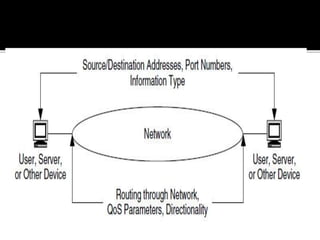
 Flow attributes, such as
 Source/Destination address,
 Type of information,
 PORT numbers like,
▪ 21 FTP (File Transfer Protocol)
▪ 25 SMTP (Send Mail Transfer Protocol)
▪ 68 DHCP (Dynamic Host Control Protocol)
▪ 80 HTTP (Hyper-Text Transfer Protocol)
▪ 161 SNMP (Simple Network Management Protocol)
▪ 8080 HTTP
Composite
flows
Individual
flows
Flows
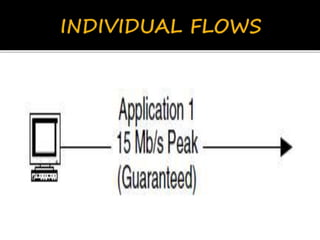
 It is an One-Way delay/application
requirement for a single session.
 Requirements are left with individual flow
and not consolidated with other
requirements.
 Uni-directional (UPSTREAM).
 Single applications of flows that share a
common link, path or network.
 It has guaranteed requirements.
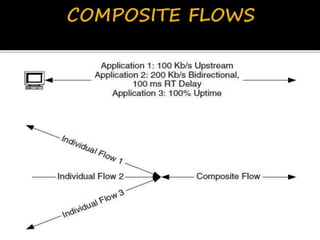
 The combination of requirements
from multiple applications of
individual flows that share a
common link, path or network.
 Bi-directional (UPSTREAM/DOWNSTREAM).
 Most flows in a network are
composites.
 It requires high or guaranteed
performance that are operate
/control the architecture and design.
 Example:
 Mission critical(MTBF,MTBCF)
 Rate critical(PDR,SDR)
 Real critical.
 An activity, device, service or system
whose failure or problems which
interrupt an event will cause a
failure in business operations.
 For example, an online business's
mission critical.
 Mission critical refers to any factor
of a system like,
 equipment,
 process,
 procedure,
 Software
 whose failure will result in the
failure of business operations.
 Critical rate is an attribute of your
character that determines how
often you make a critical attack.
 For example,
 if your critical rate is 40% then on
average 4 out of every 10 attacks
will be a critical attack.
 Focusing on particular application
 Developing a profile
 Choosing the top N applications
 Focusing on an application
 Application group
 Device / functions.
 Profile or template can be developed
for applications.
 Each flow fits the profile identified
with profile tag.
 Profiles are used to simplify
information.
 Top 5 Applications
 Web browsing
 E-mail
 File Transfer
 Word processing
 DB transaction
 The purpose, determine which
application represent the most
important requirements for the
network.
 Data sources:
 It is used to generate the data flow.
 Represented as circle with
cross(star/asterisk).
 Two dimensional plane, arrow coming
out.
 Data sinks:
 It is used to terminate the data flow.
 The group of flows publicly display the
consistent behavior characteristics is
called as ‘flow models’.
 Useful to identify and categorize flows
in an
 Environment
 peer-to-peer
 client-server
 hierarchical client-server and
 distributed computing.
 FLOW PRIORITIZATION
 Flows can be prioritized according to
importance, based on the characteristics.
 To determine which flows get the most
resources or which flows get resources first.
 Some prioritizations include:
▪ Business objectives
▪ Political objectives
▪ RMA and QoS
▪ Security Requirements
▪ The numbers of users, applications and devices.
 It is a mechanism to combine these
performance requirements (capacity,
delay and RMA).
 To describe the optimal composite
performance for that flow or group
of flows.
 Example:
 Building and device locations
▪ Requirement analysis
▪ Flow models
▪ Flow map
THANK YOU

Flow analysis overview

  • 1.
  • 2.
     OBJECTIVES:  Thischapter introduces flows and flow concepts, data sources and data sinks, and flow models will help us to identify, size, and describe flows.
  • 3.
     FLOWS:  Flowsalso known as network flows or traffic flows or data flows.  It provides the traffic movement in the network.  A sequence of packets sent from a particular source to a particular (unicast or multicast) destination.
  • 4.
     FLOWS ANALYSIS: Flow analysis is the process of describing /characterizing traffic flows for a network.  Where they are likely 2take place/occur.  What levels of performance they will require.
  • 5.
    BENEFITS:  Provides hierarchy(arrangement) levels.  In choosing interconnection strategies such as (switching, routing and hybrid) mechanisms.  Flows are represented as Unidirectional or Bidirectional performance.  Bidirectional :  Unidirectional:
  • 6.
     It isrepresented as single and double sided arrows.  Most flows are Bi-Directional arrows.  Flows are important in analysis, architecture and design process.
  • 7.
     TRAFFIC FLOW: Traffic flow is the study of interactions between traffic control devices and minimal traffic congestion(packet loss) problems.
  • 8.
     Flow attributes,such as  Source/Destination address,  Type of information,  PORT numbers like, ▪ 21 FTP (File Transfer Protocol) ▪ 25 SMTP (Send Mail Transfer Protocol) ▪ 68 DHCP (Dynamic Host Control Protocol) ▪ 80 HTTP (Hyper-Text Transfer Protocol) ▪ 161 SNMP (Simple Network Management Protocol) ▪ 8080 HTTP
  • 11.
  • 12.
     It isan One-Way delay/application requirement for a single session.  Requirements are left with individual flow and not consolidated with other requirements.  Uni-directional (UPSTREAM).  Single applications of flows that share a common link, path or network.  It has guaranteed requirements.
  • 14.
     The combinationof requirements from multiple applications of individual flows that share a common link, path or network.  Bi-directional (UPSTREAM/DOWNSTREAM).  Most flows in a network are composites.
  • 16.
     It requireshigh or guaranteed performance that are operate /control the architecture and design.  Example:  Mission critical(MTBF,MTBCF)  Rate critical(PDR,SDR)  Real critical.
  • 17.
     An activity,device, service or system whose failure or problems which interrupt an event will cause a failure in business operations.  For example, an online business's mission critical.
  • 18.
     Mission criticalrefers to any factor of a system like,  equipment,  process,  procedure,  Software  whose failure will result in the failure of business operations.
  • 19.
     Critical rateis an attribute of your character that determines how often you make a critical attack.  For example,  if your critical rate is 40% then on average 4 out of every 10 attacks will be a critical attack.
  • 20.
     Focusing onparticular application  Developing a profile  Choosing the top N applications
  • 21.
     Focusing onan application  Application group  Device / functions.
  • 22.
     Profile ortemplate can be developed for applications.  Each flow fits the profile identified with profile tag.  Profiles are used to simplify information.
  • 23.
     Top 5Applications  Web browsing  E-mail  File Transfer  Word processing  DB transaction  The purpose, determine which application represent the most important requirements for the network.
  • 24.
     Data sources: It is used to generate the data flow.  Represented as circle with cross(star/asterisk).  Two dimensional plane, arrow coming out.  Data sinks:  It is used to terminate the data flow.
  • 25.
     The groupof flows publicly display the consistent behavior characteristics is called as ‘flow models’.  Useful to identify and categorize flows in an  Environment  peer-to-peer  client-server  hierarchical client-server and  distributed computing.
  • 26.
     FLOW PRIORITIZATION Flows can be prioritized according to importance, based on the characteristics.  To determine which flows get the most resources or which flows get resources first.  Some prioritizations include: ▪ Business objectives ▪ Political objectives ▪ RMA and QoS ▪ Security Requirements ▪ The numbers of users, applications and devices.
  • 27.
     It isa mechanism to combine these performance requirements (capacity, delay and RMA).  To describe the optimal composite performance for that flow or group of flows.
  • 28.
     Example:  Buildingand device locations ▪ Requirement analysis ▪ Flow models ▪ Flow map
  • 29.