REQUIREMENT ANALYSIS
UNIT - II
REQUIREMENT ANALYSIS PROCESS
 process of determining the needs or conditions to
meet for a new or altered product.
 Figure shows the requirements analysis process:
 In involves [5] steps:
 Gather and list requirements
 Develop service metrics
 Characterize behavior
 Develop requirements
 Map requirements
Metrics – measurements | behavior - range of actions
Develop
service
matrics
Character
ize
behavior
Develop
Rqrmnts
Map
Rqrmnts
Gather &
List
rqrmnts
GATHERING AND LISTING REQUIREMENTS
 Communicate with the users to gather their
requirements.
 Service requirements are gathered and developed
with initial conditions on the architecture and
design, with input from users, administration and
management.
 Then refined(process of purification/ unwanted
requirements removed) by applying our experience
and knowledge about the analysis process.
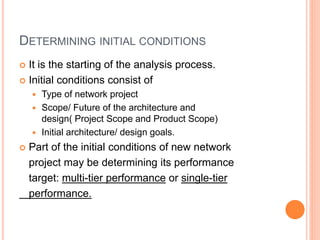
DETERMINING INITIAL CONDITIONS
 It is the starting of the analysis process.
 Initial conditions consist of
 Type of network project
 Scope/ Future of the architecture and
design( Project Scope and Product Scope)
 Initial architecture/ design goals.
 Part of the initial conditions of new network
project may be determining its performance
target: multi-tier performance or single-tier
performance.
DETERMINING INITIAL CONDITIONS
 Type of Network Project:
 New Network
 Modification of an Existing network
 Scope/Future of Network Project:
 Network size
 Number of sites
 Analysis of network problems
 Outsourcing : across multiple vendors.
 Consolidation : facilitate ability to pursue financings for
working capital.
 Upgrade: replacing a product with a newer version.
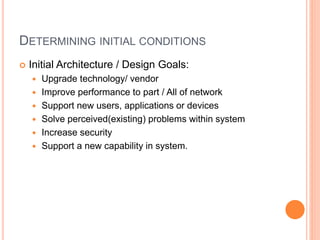
DETERMINING INITIAL CONDITIONS
 Initial Architecture / Design Goals:
 Upgrade technology/ vendor
 Improve performance to part / All of network
 Support new users, applications or devices
 Solve perceived(existing) problems within system
 Increase security
 Support a new capability in system.
DETERMINING INITIAL CONDITIONS
 Common constrains(activity) on a network project
include
 Funding limitations
 Organizational rules and regulations
 Time and schedule limitations
 Technical constrains for existing users , applications,
devices, networks and management.
 performance target:
 Single tier performance
 Multi tier performance
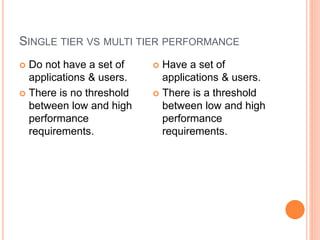
SINGLE TIER VS MULTI TIER PERFORMANCE
 Do not have a set of
applications & users.
 There is no threshold
between low and high
performance
requirements.
 Have a set of
applications & users.
 There is a threshold
between low and high
performance
requirements.
SETTING CUSTOMER EXPECTATIONS
 It is important to begin to set customer
expectations.
This consists of:
a rapid(happening in a short time), initial
evaluation(estimation) of the problem, and
estimating resources and schedule.
 The intent is to inform customers, early in the
process, when their expectations are
not realistic.
WORKING WITH USER
 There are some successful techniques that
can be used:
 developing a survey to email, FAX, or mail to
users.
 following up on the survey with one-on-one
telephone calls or conference calls.
 following up calls with face-to-face meetings with
selected individuals or groups.
 whiteboard sessions to elicit ideas from users.
 spending time with users while they work.
TAKING PERFORMANCE MEASUREMENTS
 It is helpful to measure performance levels of
applications and devices that will be used in
the planned network.
 Either by testing applications and devices on
a separate, controlled network (e.g., testbed
network) or by measuring their performance
levels on the existing network.
 Measurements of peak application and device
performance can be used to determine how much
degradation in performance is experienced on the
existing network.
 It become a validation of performance problems on
the existing network.
 Capture all of the traffic from an application
session, by characterized monitoring of the
network.
TRACKING AND MANAGING REQUIREMENTS
 Requirements also need to be tracked(rough path)
and managed.
 A listing of requirements should be kept up to date,
in a location where everyone involved in the
process has access them.
 Web is a great tool for posting, tracking and
managing requirements.
 Number of methods used to track and manage
requirements.
TYPES OF MANAGING REQUIREMENTS
 Two ways:
 Paragraph form
 Tabular form
 Paragraph form:
 Where a requirement is changed within its original
paragraph.
 Tabular form:
 Other software tools can be used for this process, such
as databases and spreadsheets.
 the key point is requirements documents should be
living documents, updated on a regular basis.
ID/NAME DATE TYPE DESCRIPTION
USER’S
REQUIREMENTS
26 -SEP-2014 ORIGINAL Technology based
upgrades
27 -SEP-2014 CHANGE Software based
upgrades.
28 -SEP-2014 DELETE topology based
upgrades.
(LAN,WAN,MAN)
MAPPING LOCATION INFORMATION
 The locations of applications and devices will be
mapped to show their relative physical locations.
 When gathering requirements, note the locations of
servers and specialized devices and where specific
applications are being used.
 Shows an example of how this is done with a
Metropolitan-Area Environment with devices and
applications.
THANK YOU
DEVELOPING SERVICE METRICS
 RMA
 CAPACITY
 DELAY
 FRAME RELAY
 UPTIME
 DOWNTIME
 PACKET LOSS RATIO
 PACKET ERROR RATE
 BIT ERROR RATE
 MEASUREMENT TOOLS
 Where to apply service metrics
CHARACTERIZING BEHAVIOR
 Estimates of user session duration
 The number of active sessions
 Data sizes
 Complex / detailed models of user application
behaviour.
MODELLING AND SIMULATION
 Equipment type
 Placement
 Configuration
 Behavior under stress / failure.
USER BEHAVIOUR
 User work-time and durations
 Each application the total number of users.
 Duration of activity
APPLICATION BEHAVIOR
 Characterizing application behaviour
 Data sizes that the application will be processing
 Passing across the network
 Frequency and time duration.
 Flow directions(client to server)
 Requirements for multicasting/broadcasting.
DEVELOPING RMA REQUIREMENTS
 Reliability
 Maintainabiliy
 Availability.
 Monthly / weekly / yearly:
 Uptime (how to measure)
 Downtime (how to measure)
DEVELOPING CAPACITY REQUIREMENTS
 Capacity:
 Estimating data rates
 Peak data rate(PDA)
 Minimum data rate(MDR)
DEVELOPING SUPPLEMENTAL PERFORMANCE
REQUIREMENTS
 Operational suitability (operation/support)
 Supportability
 Confidence
RMA
TOOLS
REPAIR AND SPARE PARTS
REQUIREMENT MAPPING

Requirement analysis

  • 1.
  • 2.
    REQUIREMENT ANALYSIS PROCESS process of determining the needs or conditions to meet for a new or altered product.  Figure shows the requirements analysis process:  In involves [5] steps:  Gather and list requirements  Develop service metrics  Characterize behavior  Develop requirements  Map requirements
  • 3.
    Metrics – measurements| behavior - range of actions Develop service matrics Character ize behavior Develop Rqrmnts Map Rqrmnts Gather & List rqrmnts
  • 4.
    GATHERING AND LISTINGREQUIREMENTS  Communicate with the users to gather their requirements.  Service requirements are gathered and developed with initial conditions on the architecture and design, with input from users, administration and management.  Then refined(process of purification/ unwanted requirements removed) by applying our experience and knowledge about the analysis process.
  • 5.
    DETERMINING INITIAL CONDITIONS It is the starting of the analysis process.  Initial conditions consist of  Type of network project  Scope/ Future of the architecture and design( Project Scope and Product Scope)  Initial architecture/ design goals.  Part of the initial conditions of new network project may be determining its performance target: multi-tier performance or single-tier performance.
  • 6.
    DETERMINING INITIAL CONDITIONS Type of Network Project:  New Network  Modification of an Existing network  Scope/Future of Network Project:  Network size  Number of sites  Analysis of network problems  Outsourcing : across multiple vendors.  Consolidation : facilitate ability to pursue financings for working capital.  Upgrade: replacing a product with a newer version.
  • 7.
    DETERMINING INITIAL CONDITIONS Initial Architecture / Design Goals:  Upgrade technology/ vendor  Improve performance to part / All of network  Support new users, applications or devices  Solve perceived(existing) problems within system  Increase security  Support a new capability in system.
  • 8.
    DETERMINING INITIAL CONDITIONS Common constrains(activity) on a network project include  Funding limitations  Organizational rules and regulations  Time and schedule limitations  Technical constrains for existing users , applications, devices, networks and management.  performance target:  Single tier performance  Multi tier performance
  • 9.
    SINGLE TIER VSMULTI TIER PERFORMANCE  Do not have a set of applications & users.  There is no threshold between low and high performance requirements.  Have a set of applications & users.  There is a threshold between low and high performance requirements.
  • 10.
    SETTING CUSTOMER EXPECTATIONS It is important to begin to set customer expectations. This consists of: a rapid(happening in a short time), initial evaluation(estimation) of the problem, and estimating resources and schedule.  The intent is to inform customers, early in the process, when their expectations are not realistic.
  • 11.
    WORKING WITH USER There are some successful techniques that can be used:  developing a survey to email, FAX, or mail to users.  following up on the survey with one-on-one telephone calls or conference calls.  following up calls with face-to-face meetings with selected individuals or groups.  whiteboard sessions to elicit ideas from users.  spending time with users while they work.
  • 12.
    TAKING PERFORMANCE MEASUREMENTS It is helpful to measure performance levels of applications and devices that will be used in the planned network.  Either by testing applications and devices on a separate, controlled network (e.g., testbed network) or by measuring their performance levels on the existing network.
  • 14.
     Measurements ofpeak application and device performance can be used to determine how much degradation in performance is experienced on the existing network.  It become a validation of performance problems on the existing network.  Capture all of the traffic from an application session, by characterized monitoring of the network.
  • 15.
    TRACKING AND MANAGINGREQUIREMENTS  Requirements also need to be tracked(rough path) and managed.  A listing of requirements should be kept up to date, in a location where everyone involved in the process has access them.  Web is a great tool for posting, tracking and managing requirements.  Number of methods used to track and manage requirements.
  • 16.
    TYPES OF MANAGINGREQUIREMENTS  Two ways:  Paragraph form  Tabular form  Paragraph form:  Where a requirement is changed within its original paragraph.  Tabular form:  Other software tools can be used for this process, such as databases and spreadsheets.  the key point is requirements documents should be living documents, updated on a regular basis.
  • 17.
    ID/NAME DATE TYPEDESCRIPTION USER’S REQUIREMENTS 26 -SEP-2014 ORIGINAL Technology based upgrades 27 -SEP-2014 CHANGE Software based upgrades. 28 -SEP-2014 DELETE topology based upgrades. (LAN,WAN,MAN)
  • 18.
  • 19.
    MAPPING LOCATION INFORMATION The locations of applications and devices will be mapped to show their relative physical locations.  When gathering requirements, note the locations of servers and specialized devices and where specific applications are being used.  Shows an example of how this is done with a Metropolitan-Area Environment with devices and applications.
  • 20.
  • 21.
    DEVELOPING SERVICE METRICS RMA  CAPACITY  DELAY  FRAME RELAY  UPTIME  DOWNTIME  PACKET LOSS RATIO  PACKET ERROR RATE  BIT ERROR RATE  MEASUREMENT TOOLS  Where to apply service metrics
  • 22.
    CHARACTERIZING BEHAVIOR  Estimatesof user session duration  The number of active sessions  Data sizes  Complex / detailed models of user application behaviour.
  • 23.
    MODELLING AND SIMULATION Equipment type  Placement  Configuration  Behavior under stress / failure.
  • 24.
    USER BEHAVIOUR  Userwork-time and durations  Each application the total number of users.  Duration of activity
  • 25.
    APPLICATION BEHAVIOR  Characterizingapplication behaviour  Data sizes that the application will be processing  Passing across the network  Frequency and time duration.  Flow directions(client to server)  Requirements for multicasting/broadcasting.
  • 26.
    DEVELOPING RMA REQUIREMENTS Reliability  Maintainabiliy  Availability.  Monthly / weekly / yearly:  Uptime (how to measure)  Downtime (how to measure)
  • 27.
    DEVELOPING CAPACITY REQUIREMENTS Capacity:  Estimating data rates  Peak data rate(PDA)  Minimum data rate(MDR)
  • 28.
    DEVELOPING SUPPLEMENTAL PERFORMANCE REQUIREMENTS Operational suitability (operation/support)  Supportability  Confidence
  • 29.
  • 30.
  • 31.
  • 32.