IDENTIFYING THE RULES OF
NETIQUETTE


Group: 7
Leader:
Leonard
Members:
Jackie
Xiang Yu
CONTENT
-Social media etiqutte
-Phone etiquette
-Electronic Mail etiquette
SOCIAL MEDIA ETIQUETTE
Social networks like Facebook and Twitter are platforms which
  people can connect with each other, however , remember that
  what you post can be viewed by others too.
• Do not overpost
• Write in intelligible English , not (tlkng lk ths isnt gd 4 ne1 )
• Post statuses like “Wow… I cant believe that just happened.”
  which are vague and context-free
CELL PHONE ETIQUETTE
Mobile phone use can be an social discourtesy, for example: phones ringing at
 weddings (awkward!), funerals (even more awkward!), toilets (embarrassing!),
 cinemas and theatres (not cool). Some bookshops, libraries, doctor's offices and
 cinemas ban the use of mobile phones so the other patrons will be not disturbed by
 conversations. Some facilities install signal-jamming devices to deter their patrons
 from using their phones, although this is usually illegal in the United States. Some
 new auditoriums have installed wire mesh in the walls to create a Faraday cage,
 which prevents signal penetration without violating signal jamming laws. Most
 schools do not allow students to use mobile phones during curriculum time, as this
 will cause too many disruptions, thus preventing the class from learning effectively.
 Mobile phones are also banned from the examination room for fear of cheating
 through texting. Pupils found with mobile phones during the examination will
 sometimes be disqualified immediately, even if the phone was not even turned on at
 the time. Mobile phones can also be used for bullying and threats to other students,
 or for displaying inappropriate material in school.
                                                               Done by Jackie
TEXT MESSAGING
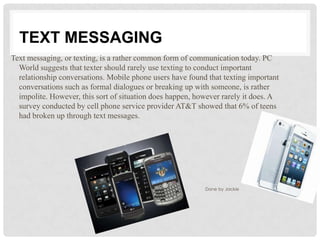
Text messaging, or texting, is a rather common form of communication today. PC
  World suggests that texter should rarely use texting to conduct important
  relationship conversations. Mobile phone users have found that texting important
  conversations such as formal dialogues or breaking up with someone, is rather
  impolite. However, this sort of situation does happen, however rarely it does. A
  survey conducted by cell phone service provider AT&T showed that 6% of teens
  had broken up through text messages.


                                                           Done by Jackie
TIPS FOR BETTER EMAIL
ETIQUETTE
1.Be informal,not sloppy. Your friends may use commonly accepted abbreviations in email,
   but when communicating with external customers, everyone should follow the standard
   writing format.
2.Keep your emails brief and to the point. Do not beat around the bush. Just because your
   writing is grammatically correct does not mean it has to be long.
3.Use sentence case. If you are using capital letters, it will look as if you are shouting and is
   impolite.Additionally, using all lower case looks lazy.
4.Do not use email as an excuse to avoid personal contact. Do not forget the most
   important is still face to face value or even voice-to-voice communication.
5.Be sparing with the group email and send a group email only when it is useful to every
   member.
6.Remember that email is not private. It is considered property of the company and can be
   retrieved, examined and used in the court of law.
7.Use the subject field to indicate content and purpose. Do not just say "hi!" or "From XXX".
   Agree on acronyms which quickly identify actions.
8.Do not send chain letters, virus warnings or junk mails. If a constant chain of jokes given by
   a friend annoy you, be honest and request to be removed from the list.
9.Remember that your tone cannot be heard in email.Through email communication, it is
   unable to convey the nuances of verbal communication.
10.Use a signature that includes contact information. To ensure people know who you are,
   include a signature that has your contact information, including your mailing address and
   phone number.
TIPS FOR BETTER EMAIL
ETIQUETTE
11.Summarize long discussions. Scrolling through pages of replies to understand a discussion
    is annoying. Instead of continuing to forward a message, take some time to summarize it
    for your reader. You could even highlight the relevant passage, then include your
    response. However, these are some points to be noted and cautioned:
If you are forwarding a messaging you have received, do not change the wording of the
    message.
If you want to repost to a group a message you have received individually, ask the author
    for permission first.
And do not forget to give proper attribution
REFERENCES
http://www.pcworld.com/article/258898/the_10_com
 mandments_of_social_media_etiquette.html
Wikipedia :
 http://en.wikipedia.org/wiki/Etiquette_(technology)

http://office.microsoft.com/en-us/outlook-help/12-
 tips-for-better-e-mail-etiquette-HA001205410.aspx

Netiquette hci

  • 1.
    IDENTIFYING THE RULESOF NETIQUETTE Group: 7 Leader: Leonard Members: Jackie Xiang Yu
  • 2.
    CONTENT -Social media etiqutte -Phoneetiquette -Electronic Mail etiquette
  • 3.
    SOCIAL MEDIA ETIQUETTE Socialnetworks like Facebook and Twitter are platforms which people can connect with each other, however , remember that what you post can be viewed by others too. • Do not overpost • Write in intelligible English , not (tlkng lk ths isnt gd 4 ne1 ) • Post statuses like “Wow… I cant believe that just happened.” which are vague and context-free
  • 4.
    CELL PHONE ETIQUETTE Mobilephone use can be an social discourtesy, for example: phones ringing at weddings (awkward!), funerals (even more awkward!), toilets (embarrassing!), cinemas and theatres (not cool). Some bookshops, libraries, doctor's offices and cinemas ban the use of mobile phones so the other patrons will be not disturbed by conversations. Some facilities install signal-jamming devices to deter their patrons from using their phones, although this is usually illegal in the United States. Some new auditoriums have installed wire mesh in the walls to create a Faraday cage, which prevents signal penetration without violating signal jamming laws. Most schools do not allow students to use mobile phones during curriculum time, as this will cause too many disruptions, thus preventing the class from learning effectively. Mobile phones are also banned from the examination room for fear of cheating through texting. Pupils found with mobile phones during the examination will sometimes be disqualified immediately, even if the phone was not even turned on at the time. Mobile phones can also be used for bullying and threats to other students, or for displaying inappropriate material in school. Done by Jackie
  • 5.
    TEXT MESSAGING Text messaging,or texting, is a rather common form of communication today. PC World suggests that texter should rarely use texting to conduct important relationship conversations. Mobile phone users have found that texting important conversations such as formal dialogues or breaking up with someone, is rather impolite. However, this sort of situation does happen, however rarely it does. A survey conducted by cell phone service provider AT&T showed that 6% of teens had broken up through text messages. Done by Jackie
  • 6.
    TIPS FOR BETTEREMAIL ETIQUETTE 1.Be informal,not sloppy. Your friends may use commonly accepted abbreviations in email, but when communicating with external customers, everyone should follow the standard writing format. 2.Keep your emails brief and to the point. Do not beat around the bush. Just because your writing is grammatically correct does not mean it has to be long. 3.Use sentence case. If you are using capital letters, it will look as if you are shouting and is impolite.Additionally, using all lower case looks lazy. 4.Do not use email as an excuse to avoid personal contact. Do not forget the most important is still face to face value or even voice-to-voice communication. 5.Be sparing with the group email and send a group email only when it is useful to every member. 6.Remember that email is not private. It is considered property of the company and can be retrieved, examined and used in the court of law. 7.Use the subject field to indicate content and purpose. Do not just say "hi!" or "From XXX". Agree on acronyms which quickly identify actions. 8.Do not send chain letters, virus warnings or junk mails. If a constant chain of jokes given by a friend annoy you, be honest and request to be removed from the list. 9.Remember that your tone cannot be heard in email.Through email communication, it is unable to convey the nuances of verbal communication. 10.Use a signature that includes contact information. To ensure people know who you are, include a signature that has your contact information, including your mailing address and phone number.
  • 7.
    TIPS FOR BETTEREMAIL ETIQUETTE 11.Summarize long discussions. Scrolling through pages of replies to understand a discussion is annoying. Instead of continuing to forward a message, take some time to summarize it for your reader. You could even highlight the relevant passage, then include your response. However, these are some points to be noted and cautioned: If you are forwarding a messaging you have received, do not change the wording of the message. If you want to repost to a group a message you have received individually, ask the author for permission first. And do not forget to give proper attribution
  • 8.
    REFERENCES http://www.pcworld.com/article/258898/the_10_com mandments_of_social_media_etiquette.html Wikipedia : http://en.wikipedia.org/wiki/Etiquette_(technology) http://office.microsoft.com/en-us/outlook-help/12- tips-for-better-e-mail-etiquette-HA001205410.aspx