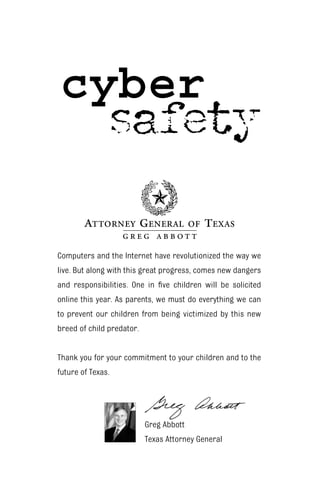
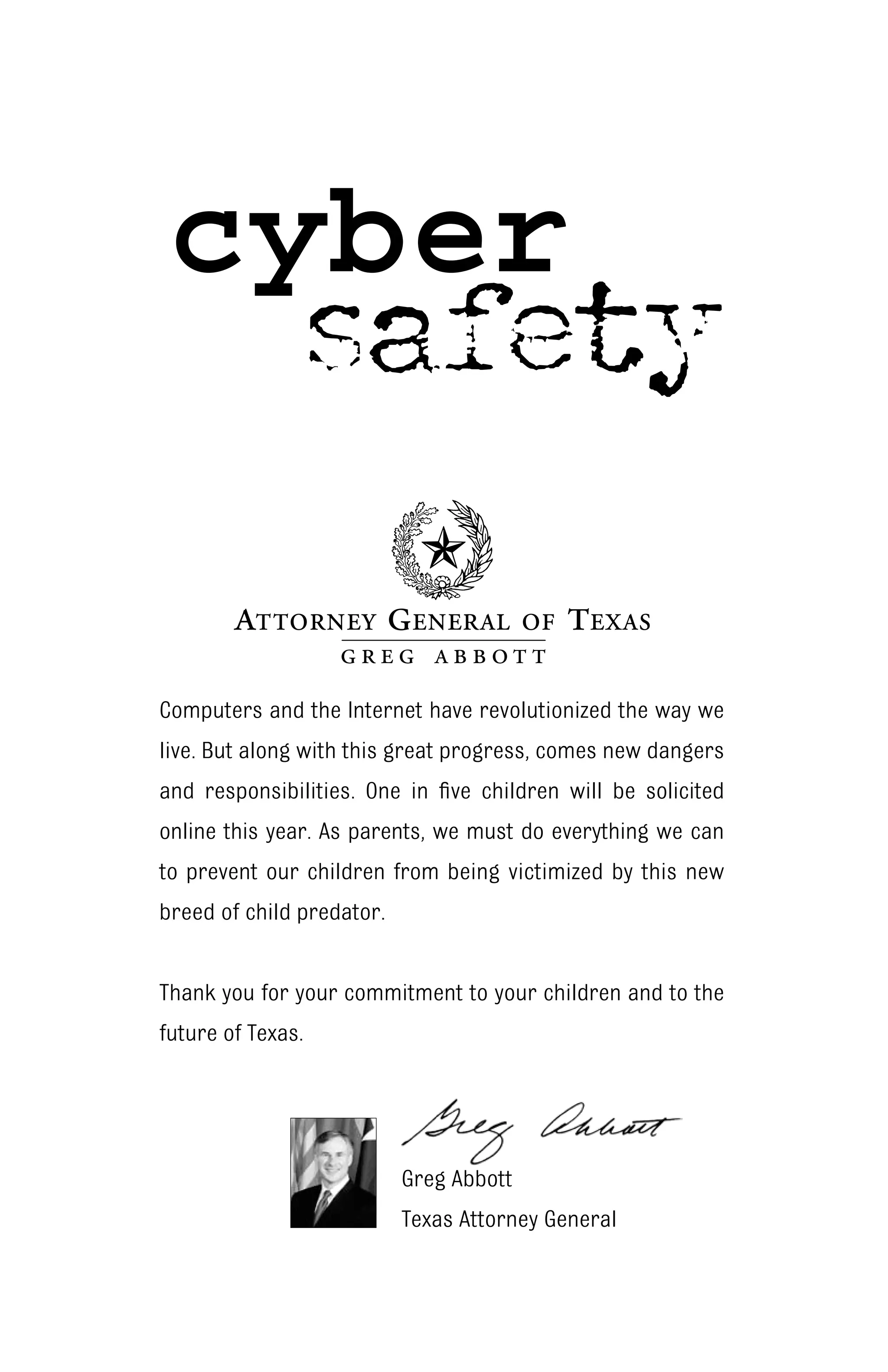
Computers and the Internet have revolutionized the way we
live. But along with this great progress, comes new dangers
and responsibilities. One in five children will be solicited
online this year. As parents, we must do everything we can
to prevent our children from being victimized by this new
breed of child predator.
Thank you for your commitment to your children and to the
future of Texas.
				
			 Greg Abbott
			 Texas Attorney General
cyber
safety
Internet Safety Tips for Parents
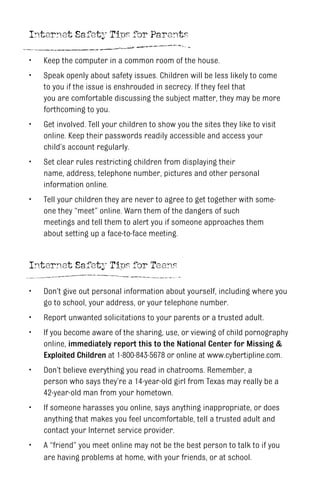
Keep the computer in a common room of the house.
Speak openly about safety issues. Children will be less likely to come
to you if the issue is enshrouded in secrecy. If they feel that
you are comfortable discussing the subject matter, they may be more
forthcoming to you.
Get involved. Tell your children to show you the sites they like to visit
online. Keep their passwords readily accessible and access your
child’s account regularly.
Set clear rules restricting children from displaying their
name, address, telephone number, pictures and other personal
information online.
Tell your children they are never to agree to get together with some-
one they “meet” online. Warn them of the dangers of such
meetings and tell them to alert you if someone approaches them
about setting up a face-to-face meeting.
•
•
•
•
•
Internet Safety Tips for Teens
Don’t give out personal information about yourself, including where you
go to school, your address, or your telephone number.
Report unwanted solicitations to your parents or a trusted adult.
If you become aware of the sharing, use, or viewing of child pornography
online, immediately report this to the National Center for Missing &
Exploited Children at 1-800-843-5678 or online at www.cybertipline.com.
Don’t believe everything you read in chatrooms. Remember, a
person who says they’re a 14-year-old girl from Texas may really be a
42-year-old man from your hometown.
If someone harasses you online, says anything inappropriate, or does
anything that makes you feel uncomfortable, tell a trusted adult and
contact your Internet service provider.
A “friend” you meet online may not be the best person to talk to if you
are having problems at home, with your friends, or at school.
•
•
•
•
•
•
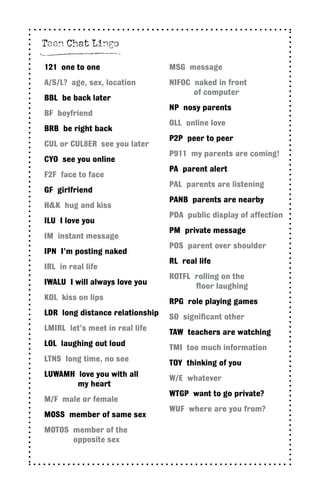
121 one to one
A/S/L? age, sex, location
BBL be back later
BF boyfriend
BRB be right back
CUL or CUL8ER see you later
CYO see you online
F2F face to face
GF girlfriend
H&K hug and kiss
ILU I love you
IM instant message
IPN I’m posting naked
IRL in real life
IWALU I will always love you
KOL kiss on lips
LDR long distance relationship
LMIRL let’s meet in real life
LOL laughing out loud
LTNS long time, no see
LUWAMH love you with all
	 my heart
M/F male or female
MOSS member of same sex
MOTOS member of the
opposite sex
MSG message
NIFOC naked in front
of computer
NP nosy parents
OLL online love
P2P peer to peer
P911 my parents are coming!
PA parent alert
PAL parents are listening
PANB parents are nearby
PDA public display of affection
PM private message
POS parent over shoulder
RL real life
ROTFL rolling on the
floor laughing
RPG role playing games
SO significant other
TAW teachers are watching
TMI too much information
TOY thinking of you
W/E whatever
WTGP want to go private?
WUF where are you from?
Teen Chat Lingo
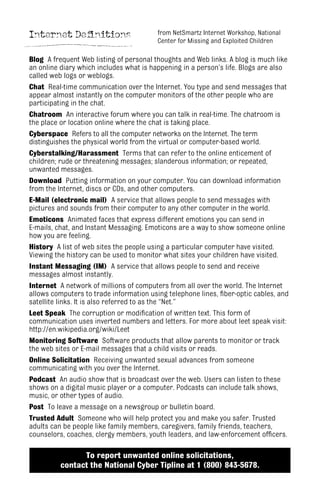
Internet Definitions
Blog A frequent Web listing of personal thoughts and Web links. A blog is much like
an online diary which includes what is happening in a person’s life. Blogs are also
called web logs or weblogs.
Chat Real-time communication over the Internet. You type and send messages that
appear almost instantly on the computer monitors of the other people who are
participating in the chat.
Chatroom An interactive forum where you can talk in real-time. The chatroom is
the place or location online where the chat is taking place.
Cyberspace Refers to all the computer networks on the Internet. The term
distinguishes the physical world from the virtual or computer-based world.
Cyberstalking/Harassment Terms that can refer to the online enticement of
children; rude or threatening messages; slanderous information; or repeated,
unwanted messages.
Download Putting information on your computer. You can download information
from the Internet, discs or CDs, and other computers.
E-Mail (electronic mail) A service that allows people to send messages with
pictures and sounds from their computer to any other computer in the world.
Emoticons Animated faces that express different emotions you can send in
E-mails, chat, and Instant Messaging. Emoticons are a way to show someone online
how you are feeling.
History A list of web sites the people using a particular computer have visited.
Viewing the history can be used to monitor what sites your children have visited.
Instant Messaging (IM) A service that allows people to send and receive
messages almost instantly.
Internet A network of millions of computers from all over the world. The Internet
allows computers to trade information using telephone lines, fiber-optic cables, and
satellite links. It is also referred to as the “Net.”
Leet Speak The corruption or modification of written text. This form of
communication uses inverted numbers and letters. For more about leet speak visit:
http://en.wikipedia.org/wiki/Leet
Monitoring Software Software products that allow parents to monitor or track
the web sites or E-mail messages that a child visits or reads.
Online Solicitation Receiving unwanted sexual advances from someone
communicating with you over the Internet.
Podcast An audio show that is broadcast over the web. Users can listen to these
shows on a digital music player or a computer. Podcasts can include talk shows,
music, or other types of audio.
Post To leave a message on a newsgroup or bulletin board.
Trusted Adult Someone who will help protect you and make you safer. Trusted
adults can be people like family members, caregivers, family friends, teachers,
counselors, coaches, clergy members, youth leaders, and law-enforcement officers.
To report unwanted online solicitations,
contact the National Cyber Tipline at 1 (800) 843-5678.
from NetSmartz Internet Workshop, National
Center for Missing and Exploited Children

Cybersafety

  • 1.
    Computers and theInternet have revolutionized the way we live. But along with this great progress, comes new dangers and responsibilities. One in five children will be solicited online this year. As parents, we must do everything we can to prevent our children from being victimized by this new breed of child predator. Thank you for your commitment to your children and to the future of Texas. Greg Abbott Texas Attorney General cyber safety
  • 2.
    Internet Safety Tipsfor Parents Keep the computer in a common room of the house. Speak openly about safety issues. Children will be less likely to come to you if the issue is enshrouded in secrecy. If they feel that you are comfortable discussing the subject matter, they may be more forthcoming to you. Get involved. Tell your children to show you the sites they like to visit online. Keep their passwords readily accessible and access your child’s account regularly. Set clear rules restricting children from displaying their name, address, telephone number, pictures and other personal information online. Tell your children they are never to agree to get together with some- one they “meet” online. Warn them of the dangers of such meetings and tell them to alert you if someone approaches them about setting up a face-to-face meeting. • • • • • Internet Safety Tips for Teens Don’t give out personal information about yourself, including where you go to school, your address, or your telephone number. Report unwanted solicitations to your parents or a trusted adult. If you become aware of the sharing, use, or viewing of child pornography online, immediately report this to the National Center for Missing & Exploited Children at 1-800-843-5678 or online at www.cybertipline.com. Don’t believe everything you read in chatrooms. Remember, a person who says they’re a 14-year-old girl from Texas may really be a 42-year-old man from your hometown. If someone harasses you online, says anything inappropriate, or does anything that makes you feel uncomfortable, tell a trusted adult and contact your Internet service provider. A “friend” you meet online may not be the best person to talk to if you are having problems at home, with your friends, or at school. • • • • • •
  • 3.
    121 one toone A/S/L? age, sex, location BBL be back later BF boyfriend BRB be right back CUL or CUL8ER see you later CYO see you online F2F face to face GF girlfriend H&K hug and kiss ILU I love you IM instant message IPN I’m posting naked IRL in real life IWALU I will always love you KOL kiss on lips LDR long distance relationship LMIRL let’s meet in real life LOL laughing out loud LTNS long time, no see LUWAMH love you with all my heart M/F male or female MOSS member of same sex MOTOS member of the opposite sex MSG message NIFOC naked in front of computer NP nosy parents OLL online love P2P peer to peer P911 my parents are coming! PA parent alert PAL parents are listening PANB parents are nearby PDA public display of affection PM private message POS parent over shoulder RL real life ROTFL rolling on the floor laughing RPG role playing games SO significant other TAW teachers are watching TMI too much information TOY thinking of you W/E whatever WTGP want to go private? WUF where are you from? Teen Chat Lingo
  • 4.
    Internet Definitions Blog Afrequent Web listing of personal thoughts and Web links. A blog is much like an online diary which includes what is happening in a person’s life. Blogs are also called web logs or weblogs. Chat Real-time communication over the Internet. You type and send messages that appear almost instantly on the computer monitors of the other people who are participating in the chat. Chatroom An interactive forum where you can talk in real-time. The chatroom is the place or location online where the chat is taking place. Cyberspace Refers to all the computer networks on the Internet. The term distinguishes the physical world from the virtual or computer-based world. Cyberstalking/Harassment Terms that can refer to the online enticement of children; rude or threatening messages; slanderous information; or repeated, unwanted messages. Download Putting information on your computer. You can download information from the Internet, discs or CDs, and other computers. E-Mail (electronic mail) A service that allows people to send messages with pictures and sounds from their computer to any other computer in the world. Emoticons Animated faces that express different emotions you can send in E-mails, chat, and Instant Messaging. Emoticons are a way to show someone online how you are feeling. History A list of web sites the people using a particular computer have visited. Viewing the history can be used to monitor what sites your children have visited. Instant Messaging (IM) A service that allows people to send and receive messages almost instantly. Internet A network of millions of computers from all over the world. The Internet allows computers to trade information using telephone lines, fiber-optic cables, and satellite links. It is also referred to as the “Net.” Leet Speak The corruption or modification of written text. This form of communication uses inverted numbers and letters. For more about leet speak visit: http://en.wikipedia.org/wiki/Leet Monitoring Software Software products that allow parents to monitor or track the web sites or E-mail messages that a child visits or reads. Online Solicitation Receiving unwanted sexual advances from someone communicating with you over the Internet. Podcast An audio show that is broadcast over the web. Users can listen to these shows on a digital music player or a computer. Podcasts can include talk shows, music, or other types of audio. Post To leave a message on a newsgroup or bulletin board. Trusted Adult Someone who will help protect you and make you safer. Trusted adults can be people like family members, caregivers, family friends, teachers, counselors, coaches, clergy members, youth leaders, and law-enforcement officers. To report unwanted online solicitations, contact the National Cyber Tipline at 1 (800) 843-5678. from NetSmartz Internet Workshop, National Center for Missing and Exploited Children