Spanish Exploration LaNeetra James Duncanville High School August 28, 2009 http://www.duncanvilleisd.org/ljames/ TEKS 1B, , 21A 24B, 25A, 25C-D TAKS Gr.10/11: Obj.2:WG1B; Obj.3:US21A; Obj.5:US24B, WH25C, WH26C
The Vikings Arrive  The first Europeans to arrive in the Americas were the  Norse , or Vikings, a people from Scandinavia. In A.D. 1001  Leif Ericsson  explored and stayed the winter in Newfoundland. Viking permanent settlements failed because of Native Americans opposition.
Columbus’ plan In the A.D. 100S, the scholar  Claudius Ptolemy  drew maps of a round world and his basic system of lines of latitude and longitude are still used . Ptolemy’s calculations made the earth smaller.
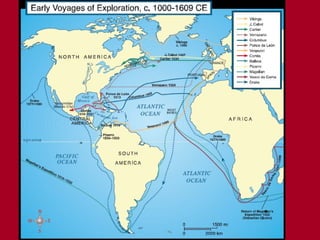
Columbus  Columbus  used Ptolemy to calculate a Western voyage from Spain to India. Spain’s  Ferdinand  and  Isabella  financed Columbus. He left Spain in August 1492. They reached the Bahamas, calling the people Indians, thinking he reached the Indies. He made three more voyages, claiming many lands for Spain never finding a trade route to Asia.
In 1494 Spain and Portugal signed the  Treaty of Tordesillas . This gave Portugal the route around Africa to India and Brazil. Spain claimed most of the Americas.
 
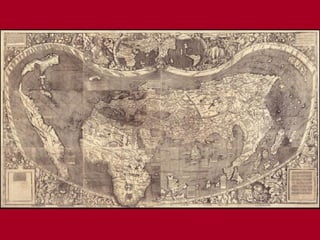
Continuing Expeditions  The Americas were named after  Amerigo Vespucci , an Italian who discovered that the Americas were not part of Asia.  Juan Ponce de Leon  discovered Florida in 1513. In 1513  Vasco de Balboa  became the first European to see the Pacific Ocean. In 1520  Ferdinand Magellan  discovered the strait at southern South America while  circumnavigating , or sailing around, the globe.
 
Columbian Exchange  Native Americans taught the Europeans local farming methods and introduced corn, tobacco, and the potato. Europeans introduced the Native Americans to wheat, oats, and barley, domestic livestock and technologies, such as metalworking. Europeans brought diseases that killed millions of Native Americans because they lacked immunity.
 
Bibliography Appleby, Joyce. Brinkley, Alan. Broussard, Albert. McPherson, James. Ritchie, Donald.  The American Republic Since 1877-Texas Edition ; Columbus, OH: Glencoe, 2003. Kennedy, David M., Cohen, Lizabeth, Bailey, Thomas A..  The American Pageant: A History of the  Republic .  New York, NY: Houghton Mifflin Company, 2002.   Tindall, George Brown, and Shi, David E.  America, A Narrative History ; New York, NY :  Norton, 1992.

1 3 Spanish Exploration

  • 1.
  • 2.
    Spanish Exploration LaNeetraJames Duncanville High School August 28, 2009 http://www.duncanvilleisd.org/ljames/ TEKS 1B, , 21A 24B, 25A, 25C-D TAKS Gr.10/11: Obj.2:WG1B; Obj.3:US21A; Obj.5:US24B, WH25C, WH26C
  • 3.
    The Vikings Arrive The first Europeans to arrive in the Americas were the Norse , or Vikings, a people from Scandinavia. In A.D. 1001 Leif Ericsson explored and stayed the winter in Newfoundland. Viking permanent settlements failed because of Native Americans opposition.
  • 4.
    Columbus’ plan Inthe A.D. 100S, the scholar Claudius Ptolemy drew maps of a round world and his basic system of lines of latitude and longitude are still used . Ptolemy’s calculations made the earth smaller.
  • 5.
    Columbus Columbus used Ptolemy to calculate a Western voyage from Spain to India. Spain’s Ferdinand and Isabella financed Columbus. He left Spain in August 1492. They reached the Bahamas, calling the people Indians, thinking he reached the Indies. He made three more voyages, claiming many lands for Spain never finding a trade route to Asia.
  • 6.
    In 1494 Spainand Portugal signed the Treaty of Tordesillas . This gave Portugal the route around Africa to India and Brazil. Spain claimed most of the Americas.
  • 7.
  • 8.
    Continuing Expeditions The Americas were named after Amerigo Vespucci , an Italian who discovered that the Americas were not part of Asia. Juan Ponce de Leon discovered Florida in 1513. In 1513 Vasco de Balboa became the first European to see the Pacific Ocean. In 1520 Ferdinand Magellan discovered the strait at southern South America while circumnavigating , or sailing around, the globe.
  • 9.
  • 10.
    Columbian Exchange Native Americans taught the Europeans local farming methods and introduced corn, tobacco, and the potato. Europeans introduced the Native Americans to wheat, oats, and barley, domestic livestock and technologies, such as metalworking. Europeans brought diseases that killed millions of Native Americans because they lacked immunity.
  • 11.
  • 12.
    Bibliography Appleby, Joyce.Brinkley, Alan. Broussard, Albert. McPherson, James. Ritchie, Donald. The American Republic Since 1877-Texas Edition ; Columbus, OH: Glencoe, 2003. Kennedy, David M., Cohen, Lizabeth, Bailey, Thomas A.. The American Pageant: A History of the Republic . New York, NY: Houghton Mifflin Company, 2002. Tindall, George Brown, and Shi, David E. America, A Narrative History ; New York, NY : Norton, 1992.

Editor's Notes

  • #3 kkdfbslfwljflewuyfewiu