MARKETING ASSIGNMENT ON
FMCG PRODUCT- MAGGI NOODLES
BY GROUP 9
KETAKI KUNTE ROLL NO. 26
MANALI JADHAV ROLL NO. 22
HARHSHARAN NAGRA ROLL NO. 32
ROHIT ARORA ROLL NO. 40
HIMANSHU GOSAIN ROLL NO. 20
INTRODUCTION
• Maggi founded by Swiss entrepreneur Julius
maggi
• Became pioneer by bringing protein rich and
vegetable meals in market
• Maggi brand synonymous with taste and quality
• International brand for soups, bouillons, cubes,
ketchups, sauces. Seasonings and instant
noodles
• Launched in India in 1982
• Market size of instant noodles is 2200 crores
• Market share in India less than 70%
• In India first instant noodle brand
• Particularly well known in India, Pakistan,
Australia, Nigeria, New Zealand, Malaysia and
Singapore
• Offers a wide variety of products in India
MARKET TRENDS
• A trend is a set or sequence of events that has some momentum and
durability
• FMCG market treble US$11.6 billion in 2003 to US$33.4 in 2015
• Maggi noodles penetration level 30% indicating untapped market
potential
• Growth in Indian population an opportunity to branded product makers
to convert consumers to branded products
• Growth fuelled by estimated 200 million people shift to processed and
packaged food
• Rural marketing demands sachets in consumer goods
• Instant noodles not treated as main meals
• Increased health consciousness means growing demand for multigrains
and Atta noodles
PRODUCT LAUNCH
• Strategy carefully planned and scheduled with goal
to make big happening and make big sales in short
time
• Launched in India in 1982
• Faced rejection when changed formulation in mid
90’s
• Returned to old formulation
• India largest market for maggi 90%market share
• After two decades maggi launching new products
PRODUCT LIFE CYCLE
• CYCLE CONSISTING FOUR STAGE
 Introduction
A period of slow sales growth as product is
launched in the market. Profits are non existent
because of heavy expenses incurred with product
introduction
 Growth
A period of rapid market acceptance and
substantial profit improvements
 Maturity
A period of slowdown in sales growth because
the product has achieved acceptance by most
potential buyers. Profit stabilise or decline
because of increased competition
 Decline
The period shows a downward drift and profit
erode
4 P’S OF
MARKETING
MAGGI PRODUCT MIX
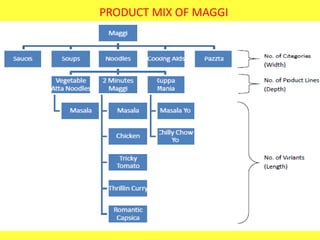
• All the products offered by a company to its customers.
• Product mix consists of a number of product lines.
• Product mix of any company has four dimensions:
1. Width
2. Length
3. Depth
4. Consistency
• Width: number of product lines a company offers
• Length: total number of items in the product mix of a company.
• Depth: the assortment of size, colour and models offered in each
item of the product line.
• Consistency: the relationship of various product line- end use,
production, distribution channel etc.
PRODUCT MIX OF MAGGI
PRICING STRATEGY OF MAGGI
Since maggi is a FMCG product mainly consumed by youngsters and kids the company has
kept the pricing optimum and affordable to all which can be explained as below:
VARIETY OF MAGGI NET WEIGHT PRICE OF THE PRODUCT
(RS.)
1. Maggi Masala Noodles 70
150
300
450
560
10
20
40
60
77
2. Maggi Atta Noodles 80
320
21
78
3. Maggi Chicken Noodles 80
152
304
15
29
59
4. Maggi Cupamania 70 40
PROMOTION STRATEGY OF MAGGI
The various promotion techniques used by
maggi are:
• Exchange offers
• Free gifts
• Use of print media
• Arranging competition on schools
• Organizing Maggi club for children
• Using big Bollywood entities to promote
the product
• Introduced new types of product.
• Followed a 360 degree marketing approach
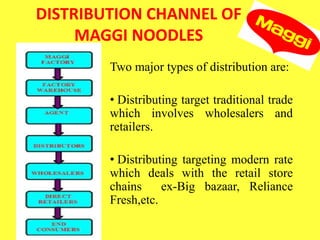
DISTRIBUTION CHANNEL OF
MAGGI NOODLES
Two major types of distribution are:
• Distributing target traditional trade
which involves wholesalers and
retailers.
• Distributing targeting modern rate
which deals with the retail store
chains ex-Big bazaar, Reliance
Fresh,etc.
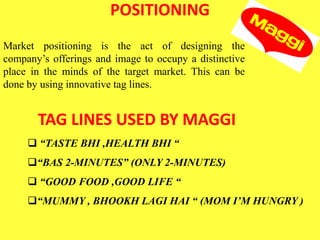
POSITIONING
Market positioning is the act of designing the
company’s offerings and image to occupy a distinctive
place in the minds of the target market. This can be
done by using innovative tag lines.
TAG LINES USED BY MAGGI
 “TASTE BHI ,HEALTH BHI “
“BAS 2-MINUTES” (ONLY 2-MINUTES)
 “GOOD FOOD ,GOOD LIFE “
“MUMMY , BHOOKH LAGI HAI “ (MOM I’M HUNGRY )
COMPETITORS
TOP RAMEN
SUNFEAST YIPPEE
NOODLES
KNOR NOODLES
SMITH & JONES
• CHING’S
NOODLES
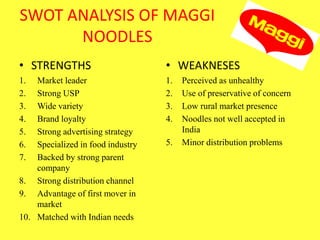
SWOT ANALYSIS OF MAGGI
NOODLES
• STRENGTHS
1. Market leader
2. Strong USP
3. Wide variety
4. Brand loyalty
5. Strong advertising strategy
6. Specialized in food industry
7. Backed by strong parent
company
8. Strong distribution channel
9. Advantage of first mover in
market
10. Matched with Indian needs
• WEAKNESES
1. Perceived as unhealthy
2. Use of preservative of concern
3. Low rural market presence
4. Noodles not well accepted in
India
5. Minor distribution problems
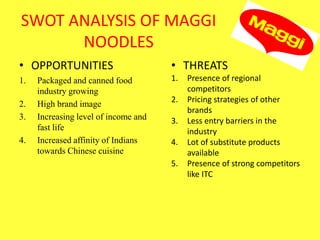
• OPPORTUNITIES
1. Packaged and canned food
industry growing
2. High brand image
3. Increasing level of income and
fast life
4. Increased affinity of Indians
towards Chinese cuisine
• THREATS
1. Presence of regional
competitors
2. Pricing strategies of other
brands
3. Less entry barriers in the
industry
4. Lot of substitute products
available
5. Presence of strong competitors
like ITC
SWOT ANALYSIS OF MAGGI
NOODLES
LITERATURE REVIEW
ARUNACHAL WOMAN CONQUERS MOUNT EVEREST ON
HALF-PLATE OF MAGGI NOODLES
THE TRUTH ABOUT MAGGI NOODLES-A BLOG BY REENA
DARUWALLA
THE ADVENT OF THE ATTA NOODLE
CONSUMER SURVEY
OBJECTIVE:
•To find out the behaviour of consumers in relation to various attributes.
•To find out the general trends in market with respect to instant noodle
market.
•To find peoples approach towards maggi -a instant noodle brand.
SAMPLE SIZE
The sample size taken into consideration while compiling and analysing the
data to come to a conclusion is 50 respondents
AGE GROUP
The age group taken into consideration is between 20 years to 50 years.
RESEARCH METHODOLOGY:
We have used both Primary as well as Secondary methods to collect the
respective data:
But prominently primary data is used.
In primary data questionnaire method of collective data is specifically used.
For secondary data the sources used are quickmba.com, Wikipedia, Times
of India, etc.
ANALYSIS OF
SURVEY
56%
8%
14%
4%
8%
10%
AGE GROUP
20-25 25-30 30-35 35-40 40-45 45-50
0
5
10
15
20
25
30
35
40
45
50
50-100 100-150 150-200 ABOVE 200 NOT
APPLICABLE
TOTAL
NO.OFPEOPLE
AMOUNT IN RS.
MONTHLY
SPENDING
0 10 20 30 40 50 60
TASTE
BRAND
PRICE
NO DIFFERENCE
NOT APPLICABLE
TOTAL
NO. OF PEOPLE
DIFFERNTIATING
FACTOR
MULTIGRAIN
NOODLES
12%
ATTA NOODLES
28%
REGULAR (MAIDA)
NOODLES
52%
CUPAMANIA
4%
NA
4%
VARIETY PREFERENCE
YES NO
MORE FLAVOURS REQUIRED? 33 17
0
5
10
15
20
25
30
35
NO.OFPEOPLE
MORE FLAVOURS REQUIRED?
RATING 1 RATING 2 RATING 3 RATING 4 RATING 5
RATING FOR ATTRIBUTES
TASTE 3 1 5 23 16
AVAILABILITY 0 1 2 12 33
PRICE 2 8 12 16 10
PACKAGING 0 3 18 13 14
VARIETY 2 7 31 7 1
0
5
10
15
20
25
30
35
NO.OFPEOPLE
RATINGS
(5 BEING HIGHEST)
MASALA MAGGI
60%
CHICKEN NOODLES
4%
TOMATO NOODLES
6%
ATTA NOODLES
26%
NA
4%
VARIANTS PREFERRED
0 5 10 15 20 25 30
EASY TO COOK
JUNK FOOD
GOOD TO HEALTH
TASTY/FUN EATING
30
9
2
9
PEOPLES OUTLOOK
NO. OF PEOPLE
0
5
10
15
20
25
30
35
40
45
50
YES NO
MOUTH PUBLICITY 46 4
NO.OFPEOPLE
MOUTH PUBLICITY
0 5 10 15 20 25 30 35 40
YES
NO
NO. OF PEOPLE
HEALTH PERCEPTION
36
14
70%
30%
AWARENESS OF NEW VARIANT
(OAT NOODLE)
YES NO
CONCLUSION
 There are some who lead and are called market leaders and there are
some who follow, called followers. Maggi has been a leader for
decades and it is Maggi who educated Indian consumer about
noodles.
 People are shifting their liking from Regular variant to Atta noodles
i.e the healthy variant introduced by maggi to sustain against stiff
competition.
 Of course, their market share might get depleted in course of time,
by the entry of some very big players but Maggi will not sit silent.
They will also reinforce their activities which will ultimately benefit
the consumer.
 The consumers have suggested to introduce a Masala Atta Noodle
flavour which will also signify its “TASTE BHI HEALTH BHI”
tag line.
 People will definitely taste for a change, but it is very difficult to
change ones taste bud and the top of mind game, as Maggi has
become a generic name in India for their long presence…..
BIBLOGRAPHY
http://www.karteikarte.com/card/327646/difference-between-
product-range-mix-and-product-line
http://smallbusiness.chron.com/product-mix-639.html
http://slideshare.net/maggi
http://wikipedia.org
http://economictimes.indiatimes.com
http://maggi.in
http://noodles.blogspot.in
http://timesofindia.indiatimes.com
http://rajeshaithal.blog.in
http://euromonitor.com
http://nestleprofessional.com

maggie

  • 1.
    MARKETING ASSIGNMENT ON FMCGPRODUCT- MAGGI NOODLES BY GROUP 9 KETAKI KUNTE ROLL NO. 26 MANALI JADHAV ROLL NO. 22 HARHSHARAN NAGRA ROLL NO. 32 ROHIT ARORA ROLL NO. 40 HIMANSHU GOSAIN ROLL NO. 20
  • 2.
    INTRODUCTION • Maggi foundedby Swiss entrepreneur Julius maggi • Became pioneer by bringing protein rich and vegetable meals in market • Maggi brand synonymous with taste and quality • International brand for soups, bouillons, cubes, ketchups, sauces. Seasonings and instant noodles • Launched in India in 1982 • Market size of instant noodles is 2200 crores • Market share in India less than 70% • In India first instant noodle brand • Particularly well known in India, Pakistan, Australia, Nigeria, New Zealand, Malaysia and Singapore • Offers a wide variety of products in India
  • 3.
    MARKET TRENDS • Atrend is a set or sequence of events that has some momentum and durability • FMCG market treble US$11.6 billion in 2003 to US$33.4 in 2015 • Maggi noodles penetration level 30% indicating untapped market potential • Growth in Indian population an opportunity to branded product makers to convert consumers to branded products • Growth fuelled by estimated 200 million people shift to processed and packaged food • Rural marketing demands sachets in consumer goods • Instant noodles not treated as main meals • Increased health consciousness means growing demand for multigrains and Atta noodles
  • 4.
    PRODUCT LAUNCH • Strategycarefully planned and scheduled with goal to make big happening and make big sales in short time • Launched in India in 1982 • Faced rejection when changed formulation in mid 90’s • Returned to old formulation • India largest market for maggi 90%market share • After two decades maggi launching new products
  • 5.
    PRODUCT LIFE CYCLE •CYCLE CONSISTING FOUR STAGE  Introduction A period of slow sales growth as product is launched in the market. Profits are non existent because of heavy expenses incurred with product introduction  Growth A period of rapid market acceptance and substantial profit improvements  Maturity A period of slowdown in sales growth because the product has achieved acceptance by most potential buyers. Profit stabilise or decline because of increased competition  Decline The period shows a downward drift and profit erode
  • 6.
  • 7.
    MAGGI PRODUCT MIX •All the products offered by a company to its customers. • Product mix consists of a number of product lines. • Product mix of any company has four dimensions: 1. Width 2. Length 3. Depth 4. Consistency • Width: number of product lines a company offers • Length: total number of items in the product mix of a company. • Depth: the assortment of size, colour and models offered in each item of the product line. • Consistency: the relationship of various product line- end use, production, distribution channel etc.
  • 8.
  • 9.
    PRICING STRATEGY OFMAGGI Since maggi is a FMCG product mainly consumed by youngsters and kids the company has kept the pricing optimum and affordable to all which can be explained as below: VARIETY OF MAGGI NET WEIGHT PRICE OF THE PRODUCT (RS.) 1. Maggi Masala Noodles 70 150 300 450 560 10 20 40 60 77 2. Maggi Atta Noodles 80 320 21 78 3. Maggi Chicken Noodles 80 152 304 15 29 59 4. Maggi Cupamania 70 40
  • 10.
    PROMOTION STRATEGY OFMAGGI The various promotion techniques used by maggi are: • Exchange offers • Free gifts • Use of print media • Arranging competition on schools • Organizing Maggi club for children • Using big Bollywood entities to promote the product • Introduced new types of product. • Followed a 360 degree marketing approach
  • 11.
    DISTRIBUTION CHANNEL OF MAGGINOODLES Two major types of distribution are: • Distributing target traditional trade which involves wholesalers and retailers. • Distributing targeting modern rate which deals with the retail store chains ex-Big bazaar, Reliance Fresh,etc.
  • 12.
    POSITIONING Market positioning isthe act of designing the company’s offerings and image to occupy a distinctive place in the minds of the target market. This can be done by using innovative tag lines. TAG LINES USED BY MAGGI  “TASTE BHI ,HEALTH BHI “ “BAS 2-MINUTES” (ONLY 2-MINUTES)  “GOOD FOOD ,GOOD LIFE “ “MUMMY , BHOOKH LAGI HAI “ (MOM I’M HUNGRY )
  • 13.
    COMPETITORS TOP RAMEN SUNFEAST YIPPEE NOODLES KNORNOODLES SMITH & JONES • CHING’S NOODLES
  • 14.
    SWOT ANALYSIS OFMAGGI NOODLES • STRENGTHS 1. Market leader 2. Strong USP 3. Wide variety 4. Brand loyalty 5. Strong advertising strategy 6. Specialized in food industry 7. Backed by strong parent company 8. Strong distribution channel 9. Advantage of first mover in market 10. Matched with Indian needs • WEAKNESES 1. Perceived as unhealthy 2. Use of preservative of concern 3. Low rural market presence 4. Noodles not well accepted in India 5. Minor distribution problems
  • 15.
    • OPPORTUNITIES 1. Packagedand canned food industry growing 2. High brand image 3. Increasing level of income and fast life 4. Increased affinity of Indians towards Chinese cuisine • THREATS 1. Presence of regional competitors 2. Pricing strategies of other brands 3. Less entry barriers in the industry 4. Lot of substitute products available 5. Presence of strong competitors like ITC SWOT ANALYSIS OF MAGGI NOODLES
  • 16.
    LITERATURE REVIEW ARUNACHAL WOMANCONQUERS MOUNT EVEREST ON HALF-PLATE OF MAGGI NOODLES THE TRUTH ABOUT MAGGI NOODLES-A BLOG BY REENA DARUWALLA THE ADVENT OF THE ATTA NOODLE
  • 17.
    CONSUMER SURVEY OBJECTIVE: •To findout the behaviour of consumers in relation to various attributes. •To find out the general trends in market with respect to instant noodle market. •To find peoples approach towards maggi -a instant noodle brand. SAMPLE SIZE The sample size taken into consideration while compiling and analysing the data to come to a conclusion is 50 respondents AGE GROUP The age group taken into consideration is between 20 years to 50 years. RESEARCH METHODOLOGY: We have used both Primary as well as Secondary methods to collect the respective data: But prominently primary data is used. In primary data questionnaire method of collective data is specifically used. For secondary data the sources used are quickmba.com, Wikipedia, Times of India, etc.
  • 18.
  • 19.
  • 20.
    0 5 10 15 20 25 30 35 40 45 50 50-100 100-150 150-200ABOVE 200 NOT APPLICABLE TOTAL NO.OFPEOPLE AMOUNT IN RS. MONTHLY SPENDING
  • 21.
    0 10 2030 40 50 60 TASTE BRAND PRICE NO DIFFERENCE NOT APPLICABLE TOTAL NO. OF PEOPLE DIFFERNTIATING FACTOR
  • 22.
  • 23.
    YES NO MORE FLAVOURSREQUIRED? 33 17 0 5 10 15 20 25 30 35 NO.OFPEOPLE MORE FLAVOURS REQUIRED?
  • 24.
    RATING 1 RATING2 RATING 3 RATING 4 RATING 5 RATING FOR ATTRIBUTES TASTE 3 1 5 23 16 AVAILABILITY 0 1 2 12 33 PRICE 2 8 12 16 10 PACKAGING 0 3 18 13 14 VARIETY 2 7 31 7 1 0 5 10 15 20 25 30 35 NO.OFPEOPLE RATINGS (5 BEING HIGHEST)
  • 25.
    MASALA MAGGI 60% CHICKEN NOODLES 4% TOMATONOODLES 6% ATTA NOODLES 26% NA 4% VARIANTS PREFERRED
  • 26.
    0 5 1015 20 25 30 EASY TO COOK JUNK FOOD GOOD TO HEALTH TASTY/FUN EATING 30 9 2 9 PEOPLES OUTLOOK NO. OF PEOPLE
  • 27.
  • 28.
    0 5 1015 20 25 30 35 40 YES NO NO. OF PEOPLE HEALTH PERCEPTION 36 14
  • 29.
    70% 30% AWARENESS OF NEWVARIANT (OAT NOODLE) YES NO
  • 30.
    CONCLUSION  There aresome who lead and are called market leaders and there are some who follow, called followers. Maggi has been a leader for decades and it is Maggi who educated Indian consumer about noodles.  People are shifting their liking from Regular variant to Atta noodles i.e the healthy variant introduced by maggi to sustain against stiff competition.  Of course, their market share might get depleted in course of time, by the entry of some very big players but Maggi will not sit silent. They will also reinforce their activities which will ultimately benefit the consumer.  The consumers have suggested to introduce a Masala Atta Noodle flavour which will also signify its “TASTE BHI HEALTH BHI” tag line.  People will definitely taste for a change, but it is very difficult to change ones taste bud and the top of mind game, as Maggi has become a generic name in India for their long presence…..
  • 31.