THE NINE PLANETS
Can you name the NINE planets?
The NINE planets
Mercury
Venus Venus is the second planet from the Sun, and the sixth largest of all the nine planets.  Venus' hot temperature is due to what we call "the Greenhouse Effect." The large amount of carbon dioxide in Venus' atmosphere acts like a blanket. The heat gets trapped underneath the thick layer of clouds. Because the heat has nowhere to go, Venus gets hotter and stays hot.
Earth Average Distance From Sun  Kilometers: 149,600,000  Miles: 93,000,000  Astronomical Units: 1.000  Length of Year :  365.26 days  Length of Day :  23 hours 56 minutes 4 seconds  Average Orbital Speed   Kilometers/Second: 29.79  Miles/Second: 18.51  Equatorial Diameter   Kilometers: 12,756  Miles: 7,926  Earth=1: 1.000  Mass  (Earth=1):  1.000  Volume  (Earth=1):  1.000  Number of Known Satellites :  1 The Earth is a small, rocky planet which supports a variety of life. As far as we know, Earth is unique from all other planets in this respect.  The Earth moves around the sun, taking one year to go around once. The moon goes around the Earth. It is smaller than the sun, but it looks as big as the sun because it is much closer to us.
Earth’s Moon The moon is roughly one sixth the size of Earth. It rotates around Earth every twenty-seven days, seven hours, and forty-three minutes. However, we only see one side of it because the other side never faces the Earth.  Several Americans have walked on the moon as part of the Apollo space program. Average Distance From Earth  Kilometers: 384,500  Miles: 238,900  Astronomical Units: 0.0026  Length of Year (To Orbit Earth):   27.32 days  Length of Day:  27 days 7 hours 43 minutes  Average Orbital Speed   Kilometers/Second: 1.023  Miles/Second: 0.636  Equatorial Diameter   Kilometers: 3,476  Miles: 2,160  Earth=1: 0.24  Mass (Earth=1):   0.012  Volume (Earth=1):   0.020
Moon Picture This picture shows you how the size of the Earth compares to the size of the moon.
Astronauts left the American flag on the moon.
Mars Mars is a small, rocky planet. There are no seas and it is always very cold.  The air is so thin that we could not breath it. It is smaller than the Earth, though bigger than our moon.  Mars has permanent ice caps at both poles made up mostly of solid carbon dioxide. We know this as "dry ice." Very strong winds and vast dust storms sometimes blow through the entire planet for months!  Mars has two tiny moons which orbit very close to the surface. Their names are Phobos and Deimos.
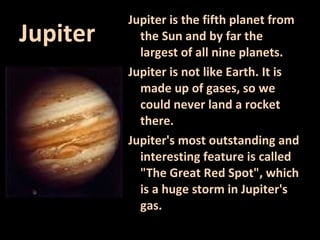
Jupiter Jupiter is the fifth planet from the Sun and by far the largest of all nine planets.  Jupiter is not like Earth. It is made up of gases, so we could never land a rocket there.  Jupiter's most outstanding and interesting feature is called "The Great Red Spot", which is a huge storm in Jupiter's gas.
Jupiter’s GREAT  red  spot This is a huge storm that has been going for decades!!!
Jupiter’s Rings Jupiter has very faint rings.  They are much more difficult to see than the rings of Saturn.
Saturn Saturn is the sixth planet from the Sun, and the second largest of the nine planets. Like Jupiter, Saturn has a surface made up of gas.  Saturn has rings around it, which are made of little bits of ice moving around Saturn.  Saturn has eighteen moons that we know of.  Average Distance From Sun   Kilometers: 1,427,000,000  Miles: 886,700,000  Astronomical Units: 9.539  Length of Year:   29.46 years  Length of Day:   10 hours 39 minutes 24 seconds (at equator)  Average Orbital Speed   Kilometers/Seconds: 9.64  Miles/Second: 5.99  Equatorial Diameter   Kilometers: 120,000  Miles: 74,565  Earth=1: 9.44  Mass (Earth=1):   95.15  Volume (Earth=1):   833  Number of Known Satellites:   22 (plus rings)
Uranus Average Distance From Sun   Kilometers: 2,870,000,000  Miles: 1,783,000,000  Astronomical Units: 19.18  Length of Year:   84.01 years  Length of Day:   17 hours 14 minutes ? seconds (Retrograde)  Average Orbital Speed   Kilometers: 6.81  Miles: 4.23  Equatorial Diameter   Kilometers: 50,800  Miles: 31,600  Earth=1: 4.10  Mass (Earth=1):   14.54  Volume (Earth=1):   63.0  Number of Known Satellites:   21 (plus  rings) Uranus is a cold, giant gas planet which is made up of mostly rock and various ices. Uranus has a faint ring system and 21 known moons.  Uranus is a very odd planet. It sits on its side with the north and south poles sticking out the sides.
Neptune Neptune is a cold, giant gas planet which is made up of mostly rock and various ices. Neptune is about half as big as Saturn and has eight known moons; seven small ones and a large moon called Triton.   Neptune is usually the eighth planet from the Sun but occasionally the ninth planet Pluto crosses Neptune's orbit and becomes the "eighth planet".  Its bluish color comes from its atmosphere of methane gas.
Pluto Pluto is the farthest planet from the Sun (usually) and by far the smallest of the nine planets.   Discovered in 1930, Pluto has always appeared as nothing more than a dot of light in even the largest earth-based telescopes.  The Hubble Space Telescope is able to get better images of this distant planet.  Pluto is 2/3 the size of Earth's Moon but 1,200 times farther away. Viewing surface detail is as difficult as trying to read the printing on a golf ball located thirty-three miles away! Average Distance From Sun   Kilometers: 5,913,520,000  Miles: 3,666,000,000  Astronomical Units: 39.44  Length of Year:   248.54 years  Length of Day:   6 days 9 hours 17 minutes  Average Orbital Velocity   Kilometers/Second: 4.74  Miles/Second: 2.95  Equatorial Diameter   Kilometers: 2,294  Miles: 1,425  Earth=1: 0.18  Mass (Earth=1):   0.0022  Volume (Earth=1):   0.013?  Number of Known Satellites:   1
Pluto’s size This shows Pluto on the left and its moon Chiron on the right.  By comparing them to the map of the United States, you can see how small they are.
Credits Facts:  Bell , Richard S. . &quot;The Solar System.&quot;  Stargazer Online . <http://my.voyager.net/stargazer/solar_system.html>.  Text:  Smith, Gail . &quot;The Planets.&quot;  The Planets of Our Solar System . <http://scils.rutgers.edu/~gails/planets.html>.

The Nine Planets

  • 1.
  • 2.
    Can you namethe NINE planets?
  • 3.
  • 4.
  • 5.
    Venus Venus isthe second planet from the Sun, and the sixth largest of all the nine planets. Venus' hot temperature is due to what we call &quot;the Greenhouse Effect.&quot; The large amount of carbon dioxide in Venus' atmosphere acts like a blanket. The heat gets trapped underneath the thick layer of clouds. Because the heat has nowhere to go, Venus gets hotter and stays hot.
  • 6.
    Earth Average DistanceFrom Sun Kilometers: 149,600,000 Miles: 93,000,000 Astronomical Units: 1.000 Length of Year : 365.26 days Length of Day : 23 hours 56 minutes 4 seconds Average Orbital Speed Kilometers/Second: 29.79 Miles/Second: 18.51 Equatorial Diameter Kilometers: 12,756 Miles: 7,926 Earth=1: 1.000 Mass (Earth=1): 1.000 Volume (Earth=1): 1.000 Number of Known Satellites : 1 The Earth is a small, rocky planet which supports a variety of life. As far as we know, Earth is unique from all other planets in this respect. The Earth moves around the sun, taking one year to go around once. The moon goes around the Earth. It is smaller than the sun, but it looks as big as the sun because it is much closer to us.
  • 7.
    Earth’s Moon Themoon is roughly one sixth the size of Earth. It rotates around Earth every twenty-seven days, seven hours, and forty-three minutes. However, we only see one side of it because the other side never faces the Earth. Several Americans have walked on the moon as part of the Apollo space program. Average Distance From Earth Kilometers: 384,500 Miles: 238,900 Astronomical Units: 0.0026 Length of Year (To Orbit Earth): 27.32 days Length of Day: 27 days 7 hours 43 minutes Average Orbital Speed Kilometers/Second: 1.023 Miles/Second: 0.636 Equatorial Diameter Kilometers: 3,476 Miles: 2,160 Earth=1: 0.24 Mass (Earth=1): 0.012 Volume (Earth=1): 0.020
  • 8.
    Moon Picture Thispicture shows you how the size of the Earth compares to the size of the moon.
  • 9.
    Astronauts left theAmerican flag on the moon.
  • 10.
    Mars Mars isa small, rocky planet. There are no seas and it is always very cold. The air is so thin that we could not breath it. It is smaller than the Earth, though bigger than our moon. Mars has permanent ice caps at both poles made up mostly of solid carbon dioxide. We know this as &quot;dry ice.&quot; Very strong winds and vast dust storms sometimes blow through the entire planet for months! Mars has two tiny moons which orbit very close to the surface. Their names are Phobos and Deimos.
  • 11.
    Jupiter Jupiter isthe fifth planet from the Sun and by far the largest of all nine planets. Jupiter is not like Earth. It is made up of gases, so we could never land a rocket there. Jupiter's most outstanding and interesting feature is called &quot;The Great Red Spot&quot;, which is a huge storm in Jupiter's gas.
  • 12.
    Jupiter’s GREAT red spot This is a huge storm that has been going for decades!!!
  • 13.
    Jupiter’s Rings Jupiterhas very faint rings. They are much more difficult to see than the rings of Saturn.
  • 14.
    Saturn Saturn isthe sixth planet from the Sun, and the second largest of the nine planets. Like Jupiter, Saturn has a surface made up of gas. Saturn has rings around it, which are made of little bits of ice moving around Saturn.  Saturn has eighteen moons that we know of. Average Distance From Sun Kilometers: 1,427,000,000 Miles: 886,700,000 Astronomical Units: 9.539 Length of Year: 29.46 years Length of Day: 10 hours 39 minutes 24 seconds (at equator) Average Orbital Speed Kilometers/Seconds: 9.64 Miles/Second: 5.99 Equatorial Diameter Kilometers: 120,000 Miles: 74,565 Earth=1: 9.44 Mass (Earth=1): 95.15 Volume (Earth=1): 833 Number of Known Satellites: 22 (plus rings)
  • 15.
    Uranus Average DistanceFrom Sun Kilometers: 2,870,000,000 Miles: 1,783,000,000 Astronomical Units: 19.18 Length of Year: 84.01 years Length of Day: 17 hours 14 minutes ? seconds (Retrograde) Average Orbital Speed Kilometers: 6.81 Miles: 4.23 Equatorial Diameter Kilometers: 50,800 Miles: 31,600 Earth=1: 4.10 Mass (Earth=1): 14.54 Volume (Earth=1): 63.0 Number of Known Satellites: 21 (plus rings) Uranus is a cold, giant gas planet which is made up of mostly rock and various ices. Uranus has a faint ring system and 21 known moons. Uranus is a very odd planet. It sits on its side with the north and south poles sticking out the sides.
  • 16.
    Neptune Neptune isa cold, giant gas planet which is made up of mostly rock and various ices. Neptune is about half as big as Saturn and has eight known moons; seven small ones and a large moon called Triton.  Neptune is usually the eighth planet from the Sun but occasionally the ninth planet Pluto crosses Neptune's orbit and becomes the &quot;eighth planet&quot;. Its bluish color comes from its atmosphere of methane gas.
  • 17.
    Pluto Pluto isthe farthest planet from the Sun (usually) and by far the smallest of the nine planets.  Discovered in 1930, Pluto has always appeared as nothing more than a dot of light in even the largest earth-based telescopes. The Hubble Space Telescope is able to get better images of this distant planet. Pluto is 2/3 the size of Earth's Moon but 1,200 times farther away. Viewing surface detail is as difficult as trying to read the printing on a golf ball located thirty-three miles away! Average Distance From Sun Kilometers: 5,913,520,000 Miles: 3,666,000,000 Astronomical Units: 39.44 Length of Year: 248.54 years Length of Day: 6 days 9 hours 17 minutes Average Orbital Velocity Kilometers/Second: 4.74 Miles/Second: 2.95 Equatorial Diameter Kilometers: 2,294 Miles: 1,425 Earth=1: 0.18 Mass (Earth=1): 0.0022 Volume (Earth=1): 0.013? Number of Known Satellites: 1
  • 18.
    Pluto’s size Thisshows Pluto on the left and its moon Chiron on the right. By comparing them to the map of the United States, you can see how small they are.
  • 19.
    Credits Facts: Bell , Richard S. . &quot;The Solar System.&quot; Stargazer Online . <http://my.voyager.net/stargazer/solar_system.html>. Text: Smith, Gail . &quot;The Planets.&quot; The Planets of Our Solar System . <http://scils.rutgers.edu/~gails/planets.html>.