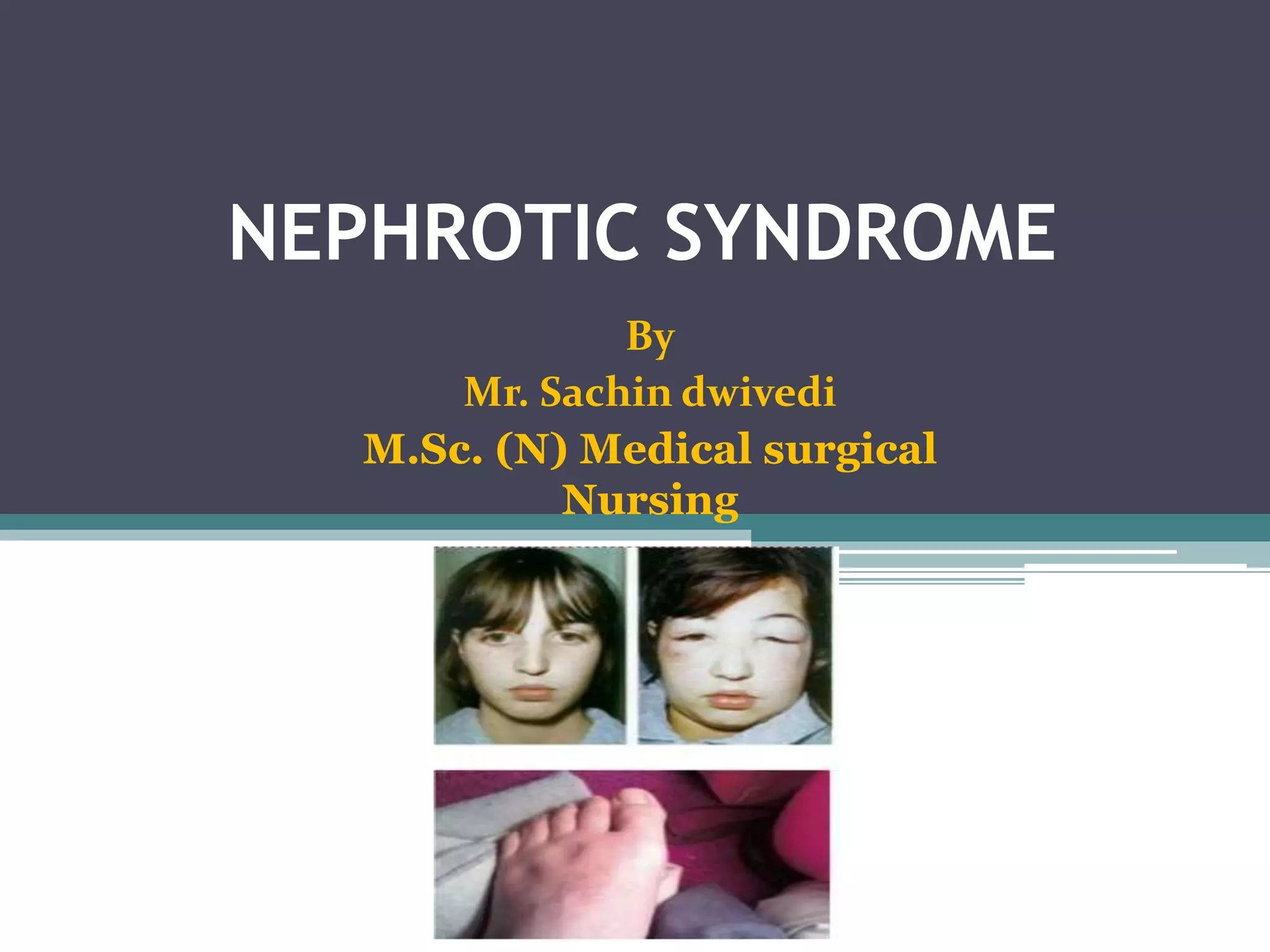
NEPHROTIC SYNDROME
By
Mr. Sachin dwivedi
M.Sc. (N) Medical surgical
Nursing
OUTLINE
• Introduction
• Anatomy and Physiology of Kidney.
• Definition.
• Incidence.
• Cause
• Pathophysiology.
• Clinical Manifestation.
• Diagnostic measure.
• Management: Medical, Pharmacological and
Nursing.
• Complication.
• Prognosis.
Genito-Urinary System
G.U.S.
Kidneys
Ureters.
Bladder.
Urethra.
Function of Genito-Urinary System
Produce and excrete urine
Regulate the volume
Acid –Base balance of body fluid
Detoxify the blood and remove waste
Support red cell production.
NEPHRON
• Nephron: functional unit of
kidney.
• Glomerulus (rounded structure
of Blood capillaries ).
• Glomerular capsule
• Proximal convoluted tubule
• Loop of Henle.
• The distal convoluted tubule
PHYSIOLOGY
The urine is formed by
certain process:-
• Glomerular filtration
• Tubular filtration
• Tubular secretion
INTRODUCTION
Nephrotic/syndrome
kidney / A group of symptoms
• Nephrotic syndrome is a collection of symptoms
due to kidney damage.
• This includes protein in the urine, low blood
albumin levels, high blood lipids, and significant
swelling.
DEFINITION
• Nephrotic syndrome is a primary glomerular
disease characterized by-
1. Proteinuria
2. Hypoalbuminemia.
3. Hyperlipidemia.
INCIDENCE
• Nephrotic syndrome is present in as many as 7
children per 100, 000 population younger than 9
years of age.
• The average age of onset is 2.5 years, with most
cases occurring between the ages of 2 and 6
years.
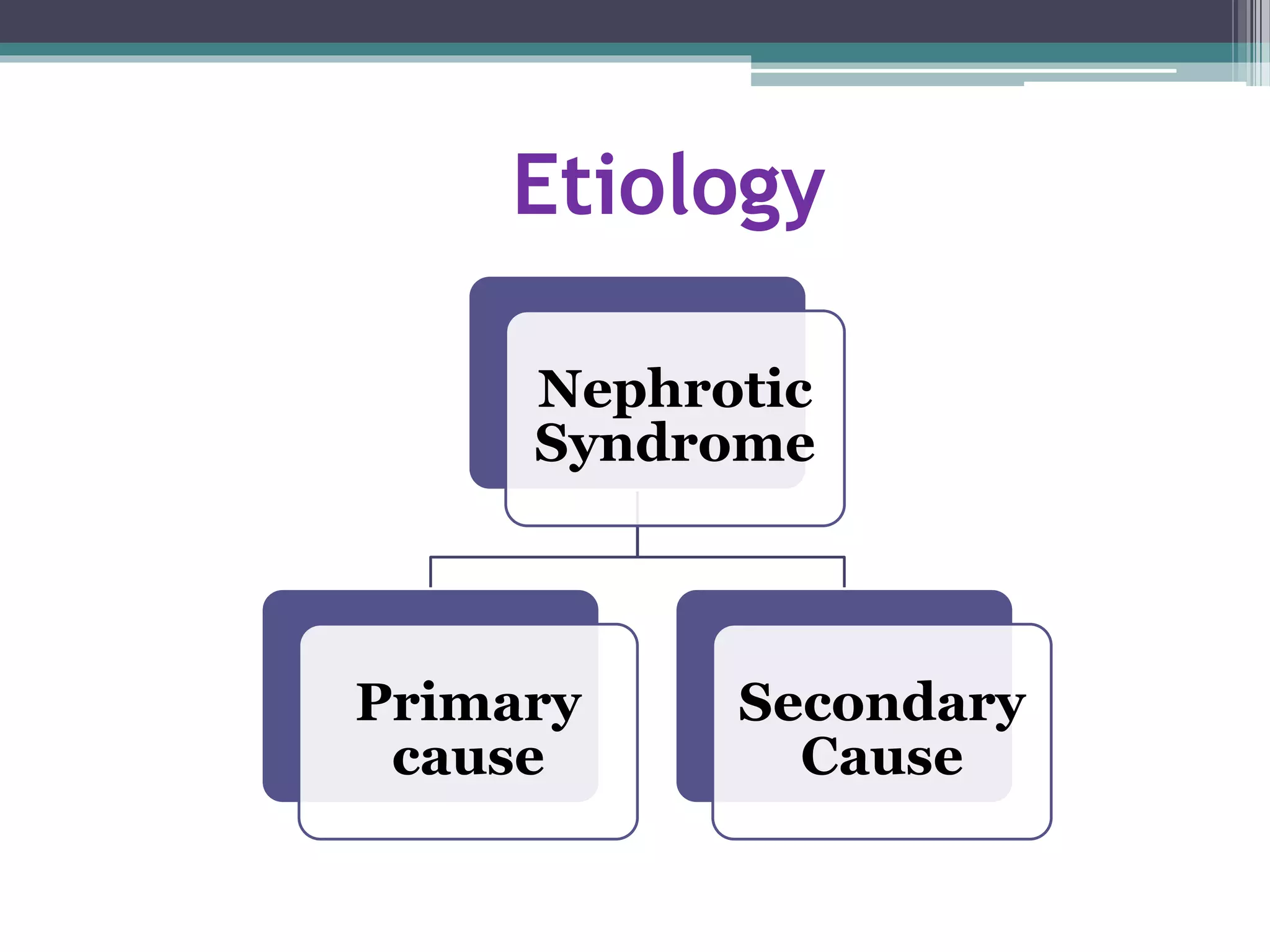
Etiology
Nephrotic
Syndrome
Primary
cause
Secondary
Cause
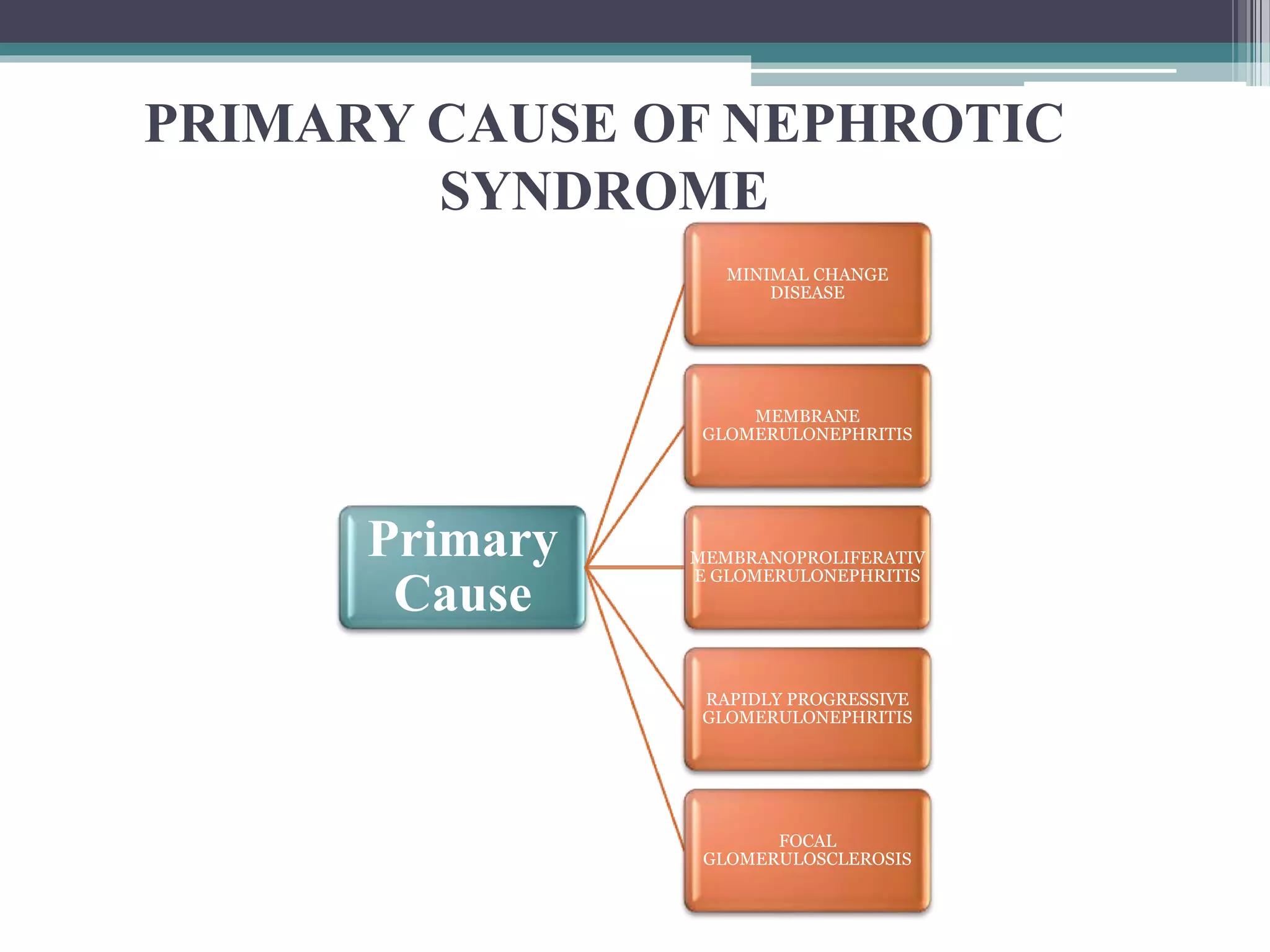
PRIMARY CAUSE OF NEPHROTIC
SYNDROME
Primary
Cause
MINIMAL CHANGE
DISEASE
MEMBRANE
GLOMERULONEPHRITIS
MEMBRANOPROLIFERATIV
E GLOMERULONEPHRITIS
RAPIDLY PROGRESSIVE
GLOMERULONEPHRITIS
FOCAL
GLOMERULOSCLEROSIS
SECONDARY CAUSES OF
NEPHROTIC SYNDROME
Systemic lupus erythematosus
Diabetes mellitus
Bacterial infection
Drugs: NSAIDs
PATHOPHYSIOLOGY
LOSS OF PLASMA PROTEIN [ ALBUMIN]
DUE TO CAUSES- DAMAGE GLOMERRULAR CAPILLARY MEMBRANE
STIMULATES SYNTHESIS OF
LIPOPROTEIN
HYPERLIPIDEMIA
HYPOALBUMINEMIA
GENERALIZED OEDEMA
ACTIVATION OF RENIN ANGIOTENSIN SYSTEM
SODIUM RETENTION
EDEMA
DECREASE OSMOTIC PRESSURE
FLUID MOVES FROM IVS TO ECS
CLINICAL MANIFESTATION
NEPHROTRIC
SYNDROME
HYPERLIPIDEMIA
HYPO-
ALBUMINEMIA PROTEINURIA
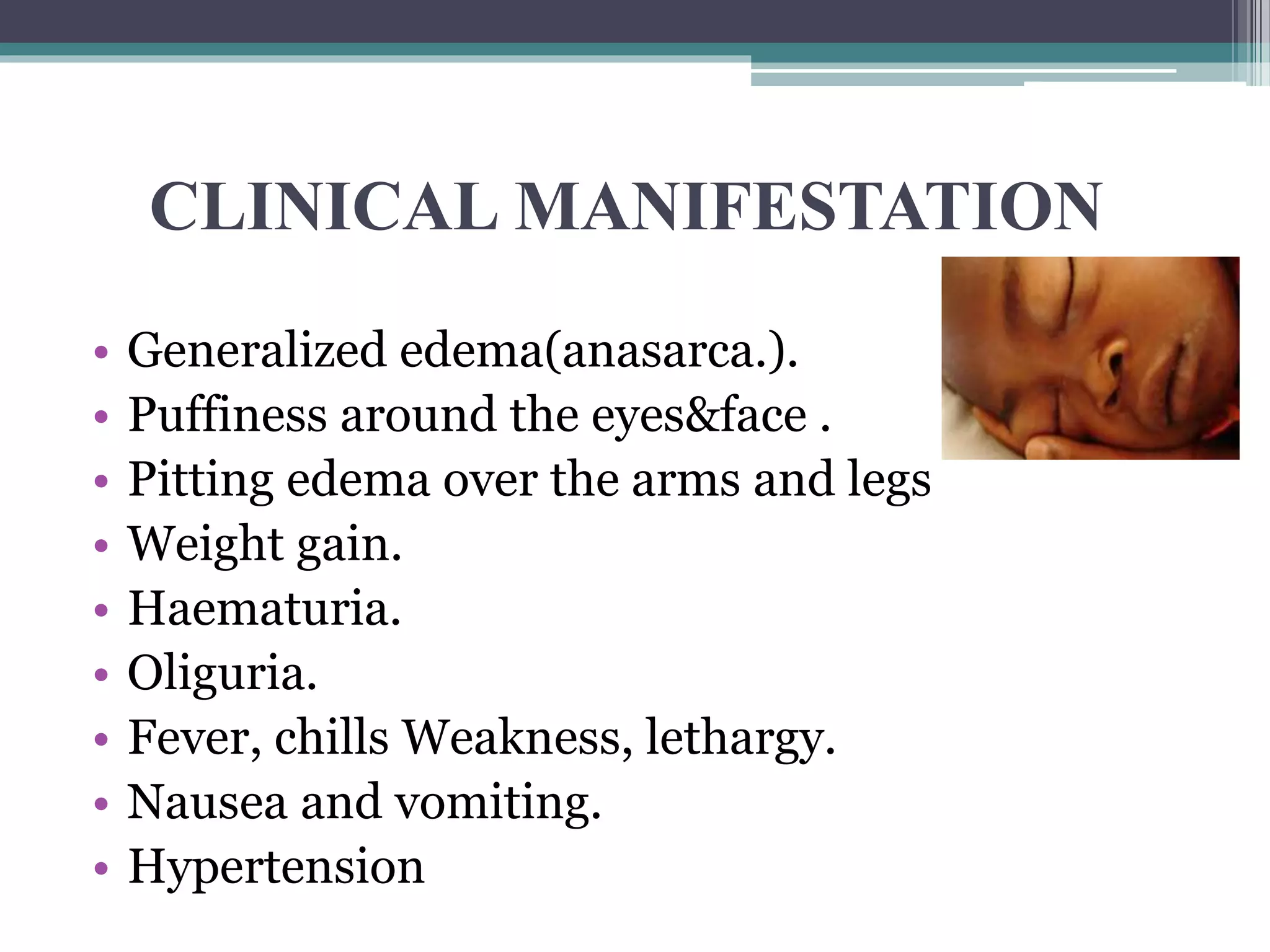
CLINICAL MANIFESTATION
• Generalized edema(anasarca.).
• Puffiness around the eyes&face .
• Pitting edema over the arms and legs
• Weight gain.
• Haematuria.
• Oliguria.
• Fever, chills Weakness, lethargy.
• Nausea and vomiting.
• Hypertension
DIAGNOSTIC MEASURES
History Taking:
Physical Examination:
Blood test: Elevated electrolyte, BUN, Creatinine, Decrease Hb.
Comprehensive Metabolic Panel:
Urinalysis: Protein,
Throat Culture: (Group-a Beta H.)
KUB: show bilateral Renal Enlargement
Medical Management
• Fluid restriction to decrease edema.
• Monitor Intake and output chart
• Dietary sodium restriction.
• Correction of electrolyte imbalance.
Pharmacological Management
• Antibiotic therapy: amoxicillin 500 mg/BD
• Loop Diuretic such as Lasix 1-2 mg/kg/d/ IV
• ACE Inhibitors and Angiotensin receptor blocker
Such as anapril initial: 2.5-5 mg PO qDay.
• Corticosteroids such as pridnisone 1 mg/kg/day.
Nursing Management
Nursing Assessment
• Assess the complete history of client.
• Assess the signs of edema, pitting and facial
puffiness.
• Assess fluid intake and output.
• Assess the condition of skin,
• Assess the blood pressure, Respiration,
Temperature.
Nursing Diagnosis
1. Excess Fluid Volume related to fluid
accumulation.
2. Imbalance nutrition less then body
requirement related poor appetite.
3. Activity Intolerance related to
insufficient physiological energy.
4. Risk for impaired skin integrity related
low body defense.
5. Risk for Infection related to
immunosuppression.
Nursing Intervention
• Monitoring fluid intake and output.
• Improving nutritional intake.
• Promoting skin integrity.
• Promoting energy conservation.
• Preventing infection.
COMPLICATIONS
Atherosclerosis. Hypertension.
Nutritional
deficiency
Renal failure Infection
PROGNOSIS
• The prognosis depends on the cause of nephrotic
syndrome.
• It is usually good in children, because minimal
change disease responds very well to steroids
and does not cause chronic renal failure.
• However other causes such as focal segmental
glomerulosclerosis frequently lead to end stage
renal disease.
SUMMARY
• Introduction
• Anatomy and Physiology of Kidney.
• Definition.
• Incidence.
• Cause
• Pathophysiology.
• Clinical Manifestation.
• Diagnostic measure.
• Management: Medical, Pharmacological and
Nursing.
• Complication.
• Prognosis.
REFERENCES
• Brunner and Suddarth's (2010)Textbook of Medical-Surgical
Nursing, 10th edition, Lippincott Williams & Wilkins,.
• Black M.Joyce and Hawks Hokanson Jane. (2012). Medical
Surgical Nursing,Clinical Management for Positive
Outcome.Mumbai.Elsevier Publication.
• Black. M. Joyce et.al. (2005). Medical Surgical Nursing.8th
edition .Vol.2
• Hinkle L. Janice and Cheever H. Kerry (2014).Text book of
Medical-Surgical Nursing 13th edition. NewDelhi. Wolters
Kluwer publication.
• Nephrotic syndrome, Nurseslabs, retrieved on 05 July 2019
from https://nurseslabs.com/nephrotic-syndrome/.
• Nephrotic syndrome, Kidney Foundation retrieved on 05 July
2019 from http://www.kidneyfund.org/kidney-disease/other-
kidney-conditions/rare-diseases/nephrotic-syndrome/.
THANK YOU

Nephrotic syndrome By Sachin Dwivedi

  • 1.
    NEPHROTIC SYNDROME By Mr. Sachindwivedi M.Sc. (N) Medical surgical Nursing
  • 2.
    OUTLINE • Introduction • Anatomyand Physiology of Kidney. • Definition. • Incidence. • Cause • Pathophysiology. • Clinical Manifestation. • Diagnostic measure. • Management: Medical, Pharmacological and Nursing. • Complication. • Prognosis.
  • 3.
  • 4.
    Function of Genito-UrinarySystem Produce and excrete urine Regulate the volume Acid –Base balance of body fluid Detoxify the blood and remove waste Support red cell production.
  • 5.
    NEPHRON • Nephron: functionalunit of kidney. • Glomerulus (rounded structure of Blood capillaries ). • Glomerular capsule • Proximal convoluted tubule • Loop of Henle. • The distal convoluted tubule
  • 6.
    PHYSIOLOGY The urine isformed by certain process:- • Glomerular filtration • Tubular filtration • Tubular secretion
  • 7.
    INTRODUCTION Nephrotic/syndrome kidney / Agroup of symptoms • Nephrotic syndrome is a collection of symptoms due to kidney damage. • This includes protein in the urine, low blood albumin levels, high blood lipids, and significant swelling.
  • 8.
    DEFINITION • Nephrotic syndromeis a primary glomerular disease characterized by- 1. Proteinuria 2. Hypoalbuminemia. 3. Hyperlipidemia.
  • 9.
    INCIDENCE • Nephrotic syndromeis present in as many as 7 children per 100, 000 population younger than 9 years of age. • The average age of onset is 2.5 years, with most cases occurring between the ages of 2 and 6 years.
  • 10.
  • 11.
    PRIMARY CAUSE OFNEPHROTIC SYNDROME Primary Cause MINIMAL CHANGE DISEASE MEMBRANE GLOMERULONEPHRITIS MEMBRANOPROLIFERATIV E GLOMERULONEPHRITIS RAPIDLY PROGRESSIVE GLOMERULONEPHRITIS FOCAL GLOMERULOSCLEROSIS
  • 12.
    SECONDARY CAUSES OF NEPHROTICSYNDROME Systemic lupus erythematosus Diabetes mellitus Bacterial infection Drugs: NSAIDs
  • 13.
    PATHOPHYSIOLOGY LOSS OF PLASMAPROTEIN [ ALBUMIN] DUE TO CAUSES- DAMAGE GLOMERRULAR CAPILLARY MEMBRANE STIMULATES SYNTHESIS OF LIPOPROTEIN HYPERLIPIDEMIA HYPOALBUMINEMIA GENERALIZED OEDEMA ACTIVATION OF RENIN ANGIOTENSIN SYSTEM SODIUM RETENTION EDEMA DECREASE OSMOTIC PRESSURE FLUID MOVES FROM IVS TO ECS
  • 14.
  • 15.
    CLINICAL MANIFESTATION • Generalizededema(anasarca.). • Puffiness around the eyes&face . • Pitting edema over the arms and legs • Weight gain. • Haematuria. • Oliguria. • Fever, chills Weakness, lethargy. • Nausea and vomiting. • Hypertension
  • 16.
    DIAGNOSTIC MEASURES History Taking: PhysicalExamination: Blood test: Elevated electrolyte, BUN, Creatinine, Decrease Hb. Comprehensive Metabolic Panel: Urinalysis: Protein, Throat Culture: (Group-a Beta H.) KUB: show bilateral Renal Enlargement
  • 17.
    Medical Management • Fluidrestriction to decrease edema. • Monitor Intake and output chart • Dietary sodium restriction. • Correction of electrolyte imbalance.
  • 18.
    Pharmacological Management • Antibiotictherapy: amoxicillin 500 mg/BD • Loop Diuretic such as Lasix 1-2 mg/kg/d/ IV • ACE Inhibitors and Angiotensin receptor blocker Such as anapril initial: 2.5-5 mg PO qDay. • Corticosteroids such as pridnisone 1 mg/kg/day.
  • 19.
    Nursing Management Nursing Assessment •Assess the complete history of client. • Assess the signs of edema, pitting and facial puffiness. • Assess fluid intake and output. • Assess the condition of skin, • Assess the blood pressure, Respiration, Temperature.
  • 20.
    Nursing Diagnosis 1. ExcessFluid Volume related to fluid accumulation. 2. Imbalance nutrition less then body requirement related poor appetite. 3. Activity Intolerance related to insufficient physiological energy. 4. Risk for impaired skin integrity related low body defense. 5. Risk for Infection related to immunosuppression.
  • 21.
    Nursing Intervention • Monitoringfluid intake and output. • Improving nutritional intake. • Promoting skin integrity. • Promoting energy conservation. • Preventing infection.
  • 22.
  • 23.
    PROGNOSIS • The prognosisdepends on the cause of nephrotic syndrome. • It is usually good in children, because minimal change disease responds very well to steroids and does not cause chronic renal failure. • However other causes such as focal segmental glomerulosclerosis frequently lead to end stage renal disease.
  • 24.
    SUMMARY • Introduction • Anatomyand Physiology of Kidney. • Definition. • Incidence. • Cause • Pathophysiology. • Clinical Manifestation. • Diagnostic measure. • Management: Medical, Pharmacological and Nursing. • Complication. • Prognosis.
  • 25.
    REFERENCES • Brunner andSuddarth's (2010)Textbook of Medical-Surgical Nursing, 10th edition, Lippincott Williams & Wilkins,. • Black M.Joyce and Hawks Hokanson Jane. (2012). Medical Surgical Nursing,Clinical Management for Positive Outcome.Mumbai.Elsevier Publication. • Black. M. Joyce et.al. (2005). Medical Surgical Nursing.8th edition .Vol.2 • Hinkle L. Janice and Cheever H. Kerry (2014).Text book of Medical-Surgical Nursing 13th edition. NewDelhi. Wolters Kluwer publication. • Nephrotic syndrome, Nurseslabs, retrieved on 05 July 2019 from https://nurseslabs.com/nephrotic-syndrome/. • Nephrotic syndrome, Kidney Foundation retrieved on 05 July 2019 from http://www.kidneyfund.org/kidney-disease/other- kidney-conditions/rare-diseases/nephrotic-syndrome/.
  • 26.

Editor's Notes

  • #11 podocytes, increasing permeability.