Principle, Scope, Nature
and Administration of
Health Services in Nigeria
Dr Ibeh
Outline
Introduction
Components of National health System and Levels of Health Care Delivery
Administration of Health Care Delivery at the Federal, State and Local
Government Level
National Health Act
NHIS
Introduction
Nigeria became an independent sovereign state
within the Commonwealth of Nations in
October 1960, and an automatic member of the
World Health Organization.
The country started with one central and three
regional governments in 1960, and has grown to
one central and 36 state governments, plus the
Federal Capital Territory of Abuja.
Introduction 2
Health is a fundamental human right
Most sensitive developmental issue on the socio-
economic compact scale
A good health system delivers quality services to all
people, when and where they need them
The exact configuration of services varies from country
to country, but in all cases requires the following:
Introduction 3
A well-trained and adequately paid workforce;
A robust financing mechanism
Reliable information on which to base decisions and
policy;
A well maintained facilities and logistics to deliver
quality medicines and technologies.
Introduction 4
Health is on concurrent list of the 1999 Constitution, each of
the tier of government has concomitant responsibility for
providing health services
“The Federal Ministry of Health, every State Ministry of
Health and every local government shall establish such
health services as are required under this Act.” Draft
National Health Bill for the Federal Republic of Nigeria, 2006.
Introduction 5
Nigerian health system is
pluralistic.
•It includes orthodox, alternative
and traditional health care
delivery systems operating
alongside each other.
Principle and scope
The principle and a system-wide strategy underpinning our health care
system is primary health care philosophy
Primary health is the essential health care based on practical,
scientifically sound and socially acceptable methods and technology
made universally accessible to individuals and families in the
community through their full participation and at a cost that the
community can afford to maintain at every stage of their development
in the spirit of self reliance and self determination.
Principles and scope
The basic principles include:
• Equity
• Inter-sectoral collaboration,
• Community participation,
• Appropriate technology.
• 2 way referral system
The scope include preventive, curative and
rehabilitation care
Components of the National Health System
(a) The Federal Ministry of Health;
(b) The Ministry of Health in every state and the Federal Capital Territory
Department responsible for Health;
(c) Parastatals under the federal and state ministries of health;
(d) All local government health authorities;
(e) The ward health committees;
(f) The village health committees;
(g) The private health care providers;
(h) Traditional health care providers; and
(i) Alternative healthcare providers.
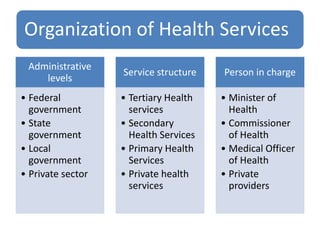
Organization of Health Services
Administrative
levels
• Federal
government
• State
government
• Local
government
• Private sector
Service structure
• Tertiary Health
services
• Secondary
Health Services
• Primary Health
Services
• Private health
services
Person in charge
• Minister of
Health
• Commissioner
of Health
• Medical Officer
of Health
• Private
providers
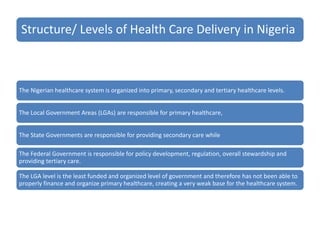
Structure/ Levels of Health Care Delivery in Nigeria
The Nigerian healthcare system is organized into primary, secondary and tertiary healthcare levels.
The Local Government Areas (LGAs) are responsible for primary healthcare,
The State Governments are responsible for providing secondary care while
The Federal Government is responsible for policy development, regulation, overall stewardship and
providing tertiary care.
The LGA level is the least funded and organized level of government and therefore has not been able to
properly finance and organize primary healthcare, creating a very weak base for the healthcare system.
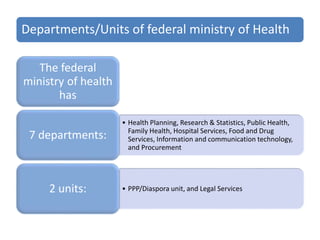
Departments/Units of federal ministry of Health
The federal
ministry of health
has
• Health Planning, Research & Statistics, Public Health,
Family Health, Hospital Services, Food and Drug
Services, Information and communication technology,
and Procurement
7 departments:
• PPP/Diaspora unit, and Legal Services2 units:
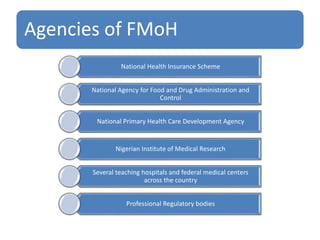
Agencies of FMoH
National Health Insurance Scheme
National Agency for Food and Drug Administration and
Control
National Primary Health Care Development Agency
Nigerian Institute of Medical Research
Several teaching hospitals and federal medical centers
across the country
Professional Regulatory bodies
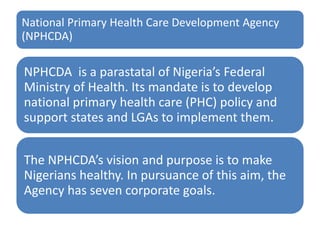
National Primary Health Care Development Agency
(NPHCDA)
NPHCDA is a parastatal of Nigeria’s Federal
Ministry of Health. Its mandate is to develop
national primary health care (PHC) policy and
support states and LGAs to implement them.
The NPHCDA’s vision and purpose is to make
Nigerians healthy. In pursuance of this aim, the
Agency has seven corporate goals.
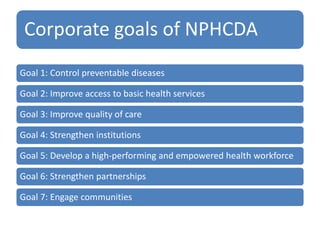
Corporate goals of NPHCDA
Goal 1: Control preventable diseases
Goal 2: Improve access to basic health services
Goal 3: Improve quality of care
Goal 4: Strengthen institutions
Goal 5: Develop a high-performing and empowered health workforce
Goal 6: Strengthen partnerships
Goal 7: Engage communities
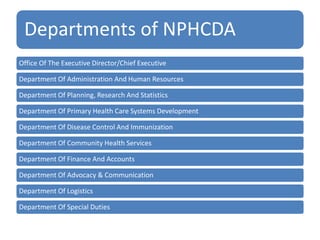
Departments of NPHCDA
Office Of The Executive Director/Chief Executive
Department Of Administration And Human Resources
Department Of Planning, Research And Statistics
Department Of Primary Health Care Systems Development
Department Of Disease Control And Immunization
Department Of Community Health Services
Department Of Finance And Accounts
Department Of Advocacy & Communication
Department Of Logistics
Department Of Special Duties
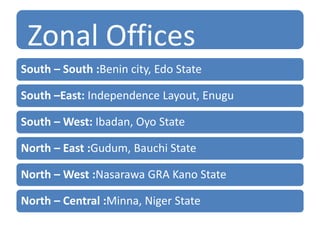
Zonal Offices
South – South :Benin city, Edo State
South –East: Independence Layout, Enugu
South – West: Ibadan, Oyo State
North – East :Gudum, Bauchi State
North – West :Nasarawa GRA Kano State
North – Central :Minna, Niger State
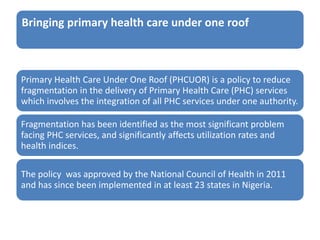
Bringing primary health care under one roof
Primary Health Care Under One Roof (PHCUOR) is a policy to reduce
fragmentation in the delivery of Primary Health Care (PHC) services
which involves the integration of all PHC services under one authority.
Fragmentation has been identified as the most significant problem
facing PHC services, and significantly affects utilization rates and
health indices.
The policy was approved by the National Council of Health in 2011
and has since been implemented in at least 23 states in Nigeria.
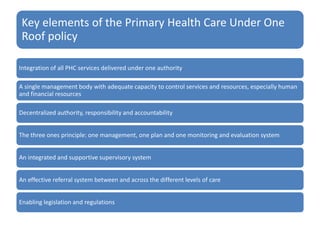
Key elements of the Primary Health Care Under One
Roof policy
Integration of all PHC services delivered under one authority
A single management body with adequate capacity to control services and resources, especially human
and financial resources
Decentralized authority, responsibility and accountability
The three ones principle: one management, one plan and one monitoring and evaluation system
An integrated and supportive supervisory system
An effective referral system between and across the different levels of care
Enabling legislation and regulations
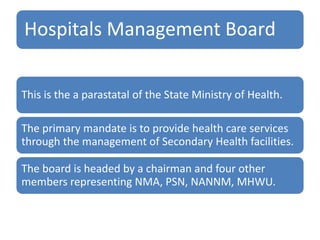
Hospitals Management Board
This is the a parastatal of the State Ministry of Health.
The primary mandate is to provide health care services
through the management of Secondary Health facilities.
The board is headed by a chairman and four other
members representing NMA, PSN, NANNM, MHWU.
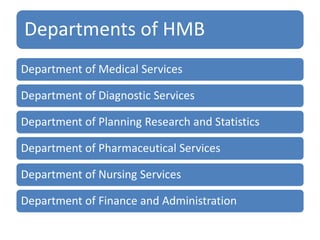
Departments of HMB
Department of Medical Services
Department of Diagnostic Services
Department of Planning Research and Statistics
Department of Pharmaceutical Services
Department of Nursing Services
Department of Finance and Administration
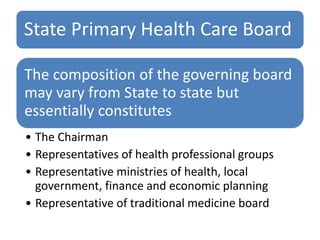
State Primary Health Care Board
The composition of the governing board
may vary from State to state but
essentially constitutes
• The Chairman
• Representatives of health professional groups
• Representative ministries of health, local
government, finance and economic planning
• Representative of traditional medicine board
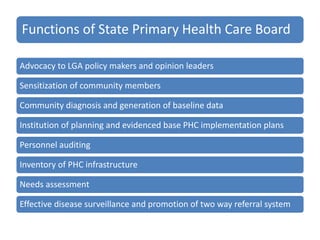
Functions of State Primary Health Care Board
Advocacy to LGA policy makers and opinion leaders
Sensitization of community members
Community diagnosis and generation of baseline data
Institution of planning and evidenced base PHC implementation plans
Personnel auditing
Inventory of PHC infrastructure
Needs assessment
Effective disease surveillance and promotion of two way referral system
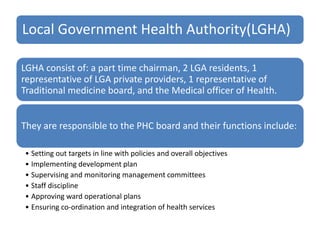
Local Government Health Authority(LGHA)
LGHA consist of: a part time chairman, 2 LGA residents, 1
representative of LGA private providers, 1 representative of
Traditional medicine board, and the Medical officer of Health.
They are responsible to the PHC board and their functions include:
• Setting out targets in line with policies and overall objectives
• Implementing development plan
• Supervising and monitoring management committees
• Staff discipline
• Approving ward operational plans
• Ensuring co-ordination and integration of health services
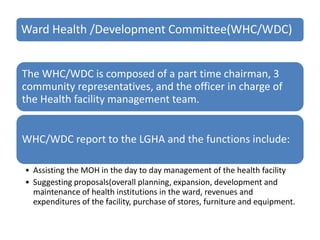
Ward Health /Development Committee(WHC/WDC)
The WHC/WDC is composed of a part time chairman, 3
community representatives, and the officer in charge of
the Health facility management team.
WHC/WDC report to the LGHA and the functions include:
• Assisting the MOH in the day to day management of the health facility
• Suggesting proposals(overall planning, expansion, development and
maintenance of health institutions in the ward, revenues and
expenditures of the facility, purchase of stores, furniture and equipment.
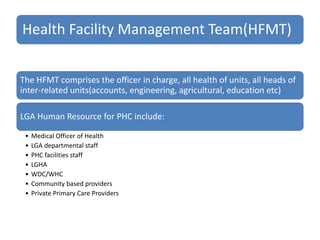
Health Facility Management Team(HFMT)
The HFMT comprises the officer in charge, all health of units, all heads of
inter-related units(accounts, engineering, agricultural, education etc)
LGA Human Resource for PHC include:
• Medical Officer of Health
• LGA departmental staff
• PHC facilities staff
• LGHA
• WDC/WHC
• Community based providers
• Private Primary Care Providers
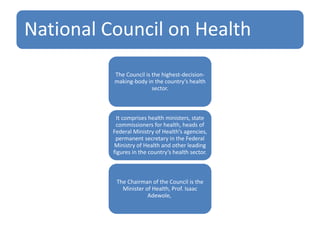
National Council on Health
The Council is the highest-decision-
making-body in the country’s health
sector.
It comprises health ministers, state
commissioners for health, heads of
Federal Ministry of Health’s agencies,
permanent secretary in the Federal
Ministry of Health and other leading
figures in the country’s health sector.
The Chairman of the Council is the
Minister of Health, Prof. Isaac
Adewole,
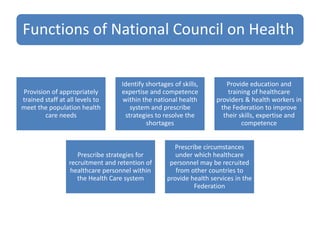
Functions of National Council on Health
Provision of appropriately
trained staff at all levels to
meet the population health
care needs
Identify shortages of skills,
expertise and competence
within the national health
system and prescribe
strategies to resolve the
shortages
Provide education and
training of healthcare
providers & health workers in
the Federation to improve
their skills, expertise and
competence
Prescribe strategies for
recruitment and retention of
healthcare personnel within
the Health Care system
Prescribe circumstances
under which healthcare
personnel may be recruited
from other countries to
provide health services in the
Federation
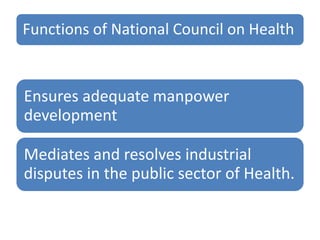
Functions of National Council on Health
Ensures adequate manpower
development
Mediates and resolves industrial
disputes in the public sector of Health.
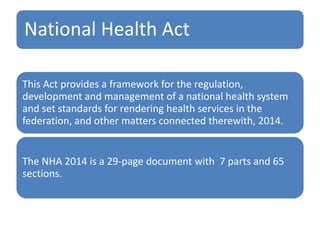
National Health Act
This Act provides a framework for the regulation,
development and management of a national health system
and set standards for rendering health services in the
federation, and other matters connected therewith, 2014.
The NHA 2014 is a 29-page document with 7 parts and 65
sections.
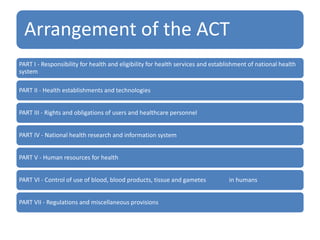
Arrangement of the ACT
PART I - Responsibility for health and eligibility for health services and establishment of national health
system
PART II - Health establishments and technologies
PART III - Rights and obligations of users and healthcare personnel
PART IV - National health research and information system
PART V - Human resources for health
PART VI - Control of use of blood, blood products, tissue and gametes in humans
PART VII - Regulations and miscellaneous provisions
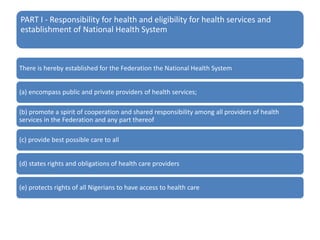
PART I - Responsibility for health and eligibility for health services and
establishment of National Health System
There is hereby established for the Federation the National Health System
(a) encompass public and private providers of health services;
(b) promote a spirit of cooperation and shared responsibility among all providers of health
services in the Federation and any part thereof
(c) provide best possible care to all
(d) states rights and obligations of health care providers
(e) protects rights of all Nigerians to have access to health care
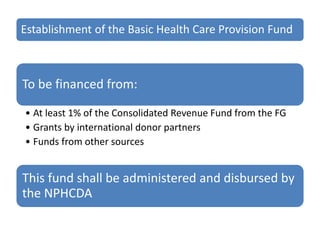
Establishment of the Basic Health Care Provision Fund
To be financed from:
• At least 1% of the Consolidated Revenue Fund from the FG
• Grants by international donor partners
• Funds from other sources
This fund shall be administered and disbursed by
the NPHCDA
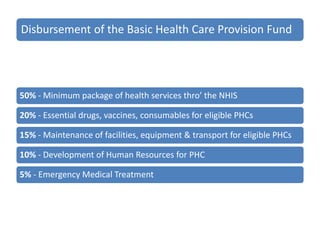
Disbursement of the Basic Health Care Provision Fund
50% - Minimum package of health services thro’ the NHIS
20% - Essential drugs, vaccines, consumables for eligible PHCs
15% - Maintenance of facilities, equipment & transport for eligible PHCs
10% - Development of Human Resources for PHC
5% - Emergency Medical Treatment
Health financing
Health care in Nigeria is financed by a combination of:
• Tax revenue from the sale of oil and gas
• Out of pocket payments
• Donor funding
• Health insurance (private, public, social and community).
The TGHE as % of GDP in 2011 was 5.3
Per capita GGHE (2012) was US$ 29.2
Per capita THE (PPP int. $) was 139.3
NHIS in Nigeria covers only the formal sector employees (mandatory). 90% coverage has
been achieved.
Social Health Insurance
NHIS contribution represent 15% of basic salary
The employer pays 10% and the employee pays 5%
The package covers the contributor, a spouse, and four (4) biological children below age 18.
Services under the NHIS are:
• Out-patient care including necessary consumables.
• Prescribed drugs.
• Maternity care up to four (4) live births.
• preventive care.
• Hospital care up to 15 days per year.
• Consultations with specialists
• Eye examinations
• A range of prostheses (limited to artificial limbs produced in Nigeria)
National Health Insurance Scheme (NHIS)
The National Health Insurance Scheme (NHIS) is a body
corporate established under Act 35 of 1999 by the Federal
Government of Nigeria aimed at providing easy access to
healthcare for all Nigerians at an affordable cost through
various prepayment systems.
NHIS is totally committed to securing universal coverage and
access to adequate and affordable healthcare in order to
improve the health status of Nigerians, especially for those
participating in the various programmes/products of the
Scheme
National Health Insurance Scheme (NHIS) 2
NHIS is to provide social health insurance in Nigeria where health care services of contributors are paid
from the common pool of funds contributed by the participants of the Scheme.
It is a pre-payment plan where participants pay a fixed regular amount. The amount/funds are pooled,
allowing the Health Maintenance Organisations(HMOs) to pay for those needing medical attention. It is
primarily a risk sharing arrangement which can improve resource mobilisation and equity. It is indeed
regarded as the most widely used form of health care financing worldwide.
NHIS also regulate private health Insurance operated by HMOs. HMOs should have a hyperlink to the
HMOs list on the site
Health Insurance is social security system that guarantees the provision of needed health services to
persons on the payment of token contributions at regular intervals.

Health services in nigeria

  • 1.
    Principle, Scope, Nature andAdministration of Health Services in Nigeria Dr Ibeh
  • 2.
    Outline Introduction Components of Nationalhealth System and Levels of Health Care Delivery Administration of Health Care Delivery at the Federal, State and Local Government Level National Health Act NHIS
  • 3.
    Introduction Nigeria became anindependent sovereign state within the Commonwealth of Nations in October 1960, and an automatic member of the World Health Organization. The country started with one central and three regional governments in 1960, and has grown to one central and 36 state governments, plus the Federal Capital Territory of Abuja.
  • 4.
    Introduction 2 Health isa fundamental human right Most sensitive developmental issue on the socio- economic compact scale A good health system delivers quality services to all people, when and where they need them The exact configuration of services varies from country to country, but in all cases requires the following:
  • 5.
    Introduction 3 A well-trainedand adequately paid workforce; A robust financing mechanism Reliable information on which to base decisions and policy; A well maintained facilities and logistics to deliver quality medicines and technologies.
  • 6.
    Introduction 4 Health ison concurrent list of the 1999 Constitution, each of the tier of government has concomitant responsibility for providing health services “The Federal Ministry of Health, every State Ministry of Health and every local government shall establish such health services as are required under this Act.” Draft National Health Bill for the Federal Republic of Nigeria, 2006.
  • 7.
    Introduction 5 Nigerian healthsystem is pluralistic. •It includes orthodox, alternative and traditional health care delivery systems operating alongside each other.
  • 8.
    Principle and scope Theprinciple and a system-wide strategy underpinning our health care system is primary health care philosophy Primary health is the essential health care based on practical, scientifically sound and socially acceptable methods and technology made universally accessible to individuals and families in the community through their full participation and at a cost that the community can afford to maintain at every stage of their development in the spirit of self reliance and self determination.
  • 9.
    Principles and scope Thebasic principles include: • Equity • Inter-sectoral collaboration, • Community participation, • Appropriate technology. • 2 way referral system The scope include preventive, curative and rehabilitation care
  • 10.
    Components of theNational Health System (a) The Federal Ministry of Health; (b) The Ministry of Health in every state and the Federal Capital Territory Department responsible for Health; (c) Parastatals under the federal and state ministries of health; (d) All local government health authorities; (e) The ward health committees; (f) The village health committees; (g) The private health care providers; (h) Traditional health care providers; and (i) Alternative healthcare providers.
  • 11.
    Organization of HealthServices Administrative levels • Federal government • State government • Local government • Private sector Service structure • Tertiary Health services • Secondary Health Services • Primary Health Services • Private health services Person in charge • Minister of Health • Commissioner of Health • Medical Officer of Health • Private providers
  • 12.
    Structure/ Levels ofHealth Care Delivery in Nigeria The Nigerian healthcare system is organized into primary, secondary and tertiary healthcare levels. The Local Government Areas (LGAs) are responsible for primary healthcare, The State Governments are responsible for providing secondary care while The Federal Government is responsible for policy development, regulation, overall stewardship and providing tertiary care. The LGA level is the least funded and organized level of government and therefore has not been able to properly finance and organize primary healthcare, creating a very weak base for the healthcare system.
  • 13.
    Departments/Units of federalministry of Health The federal ministry of health has • Health Planning, Research & Statistics, Public Health, Family Health, Hospital Services, Food and Drug Services, Information and communication technology, and Procurement 7 departments: • PPP/Diaspora unit, and Legal Services2 units:
  • 14.
    Agencies of FMoH NationalHealth Insurance Scheme National Agency for Food and Drug Administration and Control National Primary Health Care Development Agency Nigerian Institute of Medical Research Several teaching hospitals and federal medical centers across the country Professional Regulatory bodies
  • 15.
    National Primary HealthCare Development Agency (NPHCDA) NPHCDA is a parastatal of Nigeria’s Federal Ministry of Health. Its mandate is to develop national primary health care (PHC) policy and support states and LGAs to implement them. The NPHCDA’s vision and purpose is to make Nigerians healthy. In pursuance of this aim, the Agency has seven corporate goals.
  • 16.
    Corporate goals ofNPHCDA Goal 1: Control preventable diseases Goal 2: Improve access to basic health services Goal 3: Improve quality of care Goal 4: Strengthen institutions Goal 5: Develop a high-performing and empowered health workforce Goal 6: Strengthen partnerships Goal 7: Engage communities
  • 17.
    Departments of NPHCDA OfficeOf The Executive Director/Chief Executive Department Of Administration And Human Resources Department Of Planning, Research And Statistics Department Of Primary Health Care Systems Development Department Of Disease Control And Immunization Department Of Community Health Services Department Of Finance And Accounts Department Of Advocacy & Communication Department Of Logistics Department Of Special Duties
  • 18.
    Zonal Offices South –South :Benin city, Edo State South –East: Independence Layout, Enugu South – West: Ibadan, Oyo State North – East :Gudum, Bauchi State North – West :Nasarawa GRA Kano State North – Central :Minna, Niger State
  • 19.
    Bringing primary healthcare under one roof Primary Health Care Under One Roof (PHCUOR) is a policy to reduce fragmentation in the delivery of Primary Health Care (PHC) services which involves the integration of all PHC services under one authority. Fragmentation has been identified as the most significant problem facing PHC services, and significantly affects utilization rates and health indices. The policy was approved by the National Council of Health in 2011 and has since been implemented in at least 23 states in Nigeria.
  • 20.
    Key elements ofthe Primary Health Care Under One Roof policy Integration of all PHC services delivered under one authority A single management body with adequate capacity to control services and resources, especially human and financial resources Decentralized authority, responsibility and accountability The three ones principle: one management, one plan and one monitoring and evaluation system An integrated and supportive supervisory system An effective referral system between and across the different levels of care Enabling legislation and regulations
  • 21.
    Hospitals Management Board Thisis the a parastatal of the State Ministry of Health. The primary mandate is to provide health care services through the management of Secondary Health facilities. The board is headed by a chairman and four other members representing NMA, PSN, NANNM, MHWU.
  • 22.
    Departments of HMB Departmentof Medical Services Department of Diagnostic Services Department of Planning Research and Statistics Department of Pharmaceutical Services Department of Nursing Services Department of Finance and Administration
  • 23.
    State Primary HealthCare Board The composition of the governing board may vary from State to state but essentially constitutes • The Chairman • Representatives of health professional groups • Representative ministries of health, local government, finance and economic planning • Representative of traditional medicine board
  • 24.
    Functions of StatePrimary Health Care Board Advocacy to LGA policy makers and opinion leaders Sensitization of community members Community diagnosis and generation of baseline data Institution of planning and evidenced base PHC implementation plans Personnel auditing Inventory of PHC infrastructure Needs assessment Effective disease surveillance and promotion of two way referral system
  • 25.
    Local Government HealthAuthority(LGHA) LGHA consist of: a part time chairman, 2 LGA residents, 1 representative of LGA private providers, 1 representative of Traditional medicine board, and the Medical officer of Health. They are responsible to the PHC board and their functions include: • Setting out targets in line with policies and overall objectives • Implementing development plan • Supervising and monitoring management committees • Staff discipline • Approving ward operational plans • Ensuring co-ordination and integration of health services
  • 26.
    Ward Health /DevelopmentCommittee(WHC/WDC) The WHC/WDC is composed of a part time chairman, 3 community representatives, and the officer in charge of the Health facility management team. WHC/WDC report to the LGHA and the functions include: • Assisting the MOH in the day to day management of the health facility • Suggesting proposals(overall planning, expansion, development and maintenance of health institutions in the ward, revenues and expenditures of the facility, purchase of stores, furniture and equipment.
  • 27.
    Health Facility ManagementTeam(HFMT) The HFMT comprises the officer in charge, all health of units, all heads of inter-related units(accounts, engineering, agricultural, education etc) LGA Human Resource for PHC include: • Medical Officer of Health • LGA departmental staff • PHC facilities staff • LGHA • WDC/WHC • Community based providers • Private Primary Care Providers
  • 28.
    National Council onHealth The Council is the highest-decision- making-body in the country’s health sector. It comprises health ministers, state commissioners for health, heads of Federal Ministry of Health’s agencies, permanent secretary in the Federal Ministry of Health and other leading figures in the country’s health sector. The Chairman of the Council is the Minister of Health, Prof. Isaac Adewole,
  • 29.
    Functions of NationalCouncil on Health Provision of appropriately trained staff at all levels to meet the population health care needs Identify shortages of skills, expertise and competence within the national health system and prescribe strategies to resolve the shortages Provide education and training of healthcare providers & health workers in the Federation to improve their skills, expertise and competence Prescribe strategies for recruitment and retention of healthcare personnel within the Health Care system Prescribe circumstances under which healthcare personnel may be recruited from other countries to provide health services in the Federation
  • 30.
    Functions of NationalCouncil on Health Ensures adequate manpower development Mediates and resolves industrial disputes in the public sector of Health.
  • 31.
    National Health Act ThisAct provides a framework for the regulation, development and management of a national health system and set standards for rendering health services in the federation, and other matters connected therewith, 2014. The NHA 2014 is a 29-page document with 7 parts and 65 sections.
  • 32.
    Arrangement of theACT PART I - Responsibility for health and eligibility for health services and establishment of national health system PART II - Health establishments and technologies PART III - Rights and obligations of users and healthcare personnel PART IV - National health research and information system PART V - Human resources for health PART VI - Control of use of blood, blood products, tissue and gametes in humans PART VII - Regulations and miscellaneous provisions
  • 33.
    PART I -Responsibility for health and eligibility for health services and establishment of National Health System There is hereby established for the Federation the National Health System (a) encompass public and private providers of health services; (b) promote a spirit of cooperation and shared responsibility among all providers of health services in the Federation and any part thereof (c) provide best possible care to all (d) states rights and obligations of health care providers (e) protects rights of all Nigerians to have access to health care
  • 34.
    Establishment of theBasic Health Care Provision Fund To be financed from: • At least 1% of the Consolidated Revenue Fund from the FG • Grants by international donor partners • Funds from other sources This fund shall be administered and disbursed by the NPHCDA
  • 35.
    Disbursement of theBasic Health Care Provision Fund 50% - Minimum package of health services thro’ the NHIS 20% - Essential drugs, vaccines, consumables for eligible PHCs 15% - Maintenance of facilities, equipment & transport for eligible PHCs 10% - Development of Human Resources for PHC 5% - Emergency Medical Treatment
  • 36.
    Health financing Health carein Nigeria is financed by a combination of: • Tax revenue from the sale of oil and gas • Out of pocket payments • Donor funding • Health insurance (private, public, social and community). The TGHE as % of GDP in 2011 was 5.3 Per capita GGHE (2012) was US$ 29.2 Per capita THE (PPP int. $) was 139.3 NHIS in Nigeria covers only the formal sector employees (mandatory). 90% coverage has been achieved.
  • 37.
    Social Health Insurance NHIScontribution represent 15% of basic salary The employer pays 10% and the employee pays 5% The package covers the contributor, a spouse, and four (4) biological children below age 18. Services under the NHIS are: • Out-patient care including necessary consumables. • Prescribed drugs. • Maternity care up to four (4) live births. • preventive care. • Hospital care up to 15 days per year. • Consultations with specialists • Eye examinations • A range of prostheses (limited to artificial limbs produced in Nigeria)
  • 38.
    National Health InsuranceScheme (NHIS) The National Health Insurance Scheme (NHIS) is a body corporate established under Act 35 of 1999 by the Federal Government of Nigeria aimed at providing easy access to healthcare for all Nigerians at an affordable cost through various prepayment systems. NHIS is totally committed to securing universal coverage and access to adequate and affordable healthcare in order to improve the health status of Nigerians, especially for those participating in the various programmes/products of the Scheme
  • 39.
    National Health InsuranceScheme (NHIS) 2 NHIS is to provide social health insurance in Nigeria where health care services of contributors are paid from the common pool of funds contributed by the participants of the Scheme. It is a pre-payment plan where participants pay a fixed regular amount. The amount/funds are pooled, allowing the Health Maintenance Organisations(HMOs) to pay for those needing medical attention. It is primarily a risk sharing arrangement which can improve resource mobilisation and equity. It is indeed regarded as the most widely used form of health care financing worldwide. NHIS also regulate private health Insurance operated by HMOs. HMOs should have a hyperlink to the HMOs list on the site Health Insurance is social security system that guarantees the provision of needed health services to persons on the payment of token contributions at regular intervals.