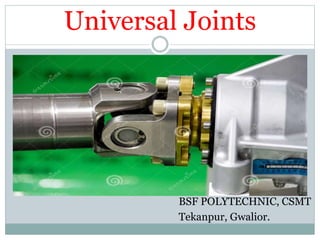
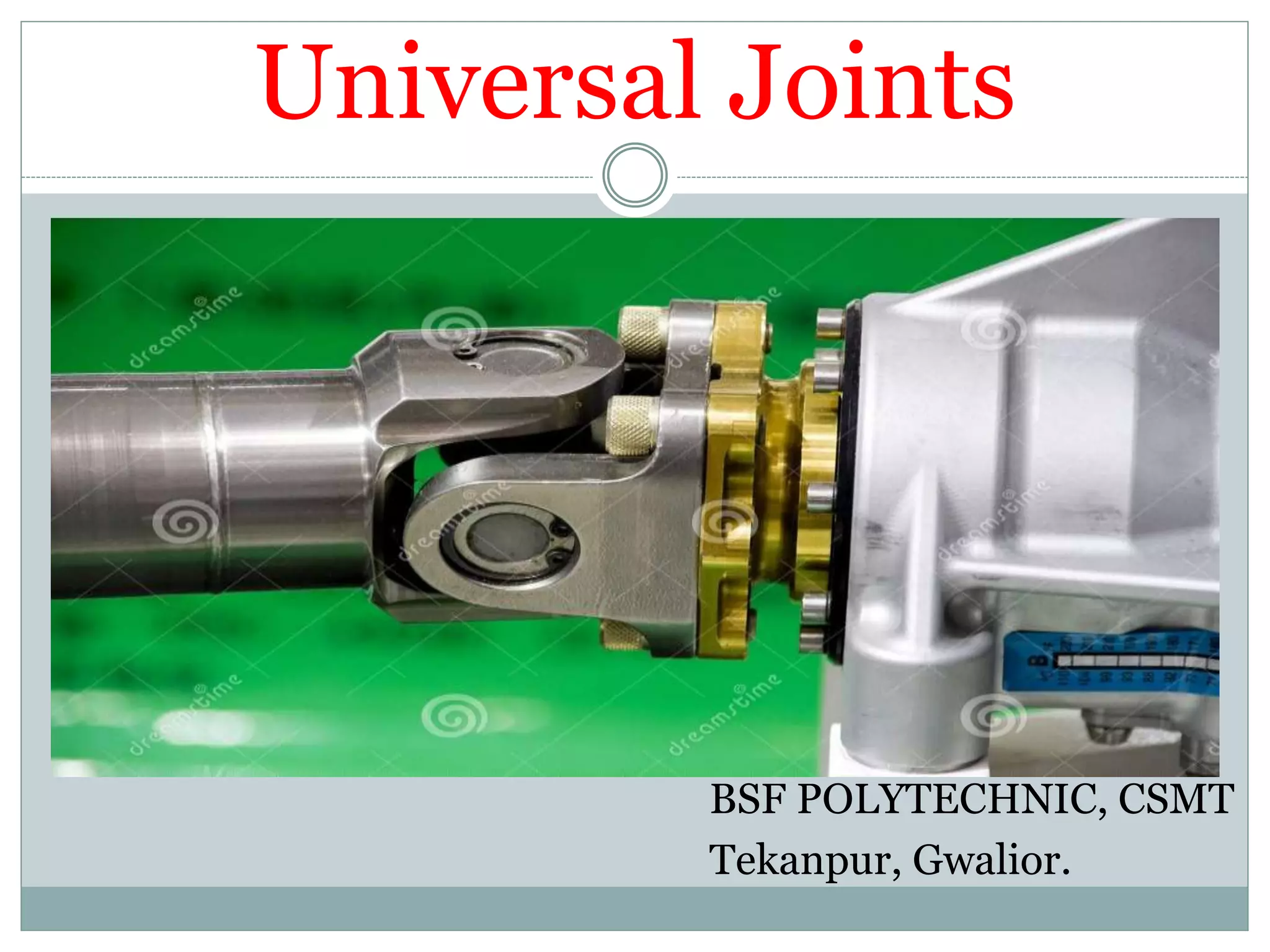

Universal Joints
BSF POLYTECHNIC, CSMT
Tekanpur, Gwalior.
What is a Universal Joint? What is it’s purpose?
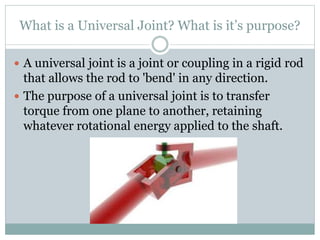
 A universal joint is a joint or coupling in a rigid rod
that allows the rod to 'bend' in any direction.
 The purpose of a universal joint is to transfer
torque from one plane to another, retaining
whatever rotational energy applied to the shaft.
Types of Universal Joints
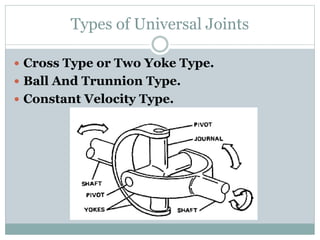
 Cross Type or Two Yoke Type.
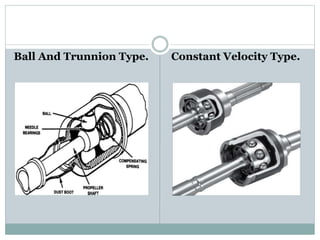
 Ball And Trunnion Type.
 Constant Velocity Type.
Ball And Trunnion Type. Constant Velocity Type.
Design/Structure
 A universal joint uses basic mechanical principles,
there are four points of attachment (usually with
needle bearings), two per shaft.
 Each of these shaft ends (called yoke arms or yoke
ends) attaches to a cross piece, providing a flexible
joint which can take large loads.
Features and Functions
 As mentioned earlier the whole concept of a
universal joint is to provide a mechanical means
for transmitting torque and rotation.
 The Universal joint only suffers from one major
problem: even when the input drive shaft axle
rotates at a constant speed, the output drive shaft
axle rotates at a varying speed.
Materials Used
 Universal joints can be made out of almost any
material depending on the application.
 Steel, cast iron, brass or even plastic.
 Cost can effect the materials.
THANKS A LOT. . .
#PRESENTED BY:-
#Shailendra Singh Tomar
ENROLLMENT NO:- 14042A03048.
Submitted To : Durgesh Singh, Sir.

Universal Joints & It Types from Shailendra

  • 1.
    Universal Joints BSF POLYTECHNIC,CSMT Tekanpur, Gwalior.
  • 2.
    What is aUniversal Joint? What is it’s purpose?  A universal joint is a joint or coupling in a rigid rod that allows the rod to 'bend' in any direction.  The purpose of a universal joint is to transfer torque from one plane to another, retaining whatever rotational energy applied to the shaft.
  • 3.
    Types of UniversalJoints  Cross Type or Two Yoke Type.  Ball And Trunnion Type.  Constant Velocity Type.
  • 4.
    Ball And TrunnionType. Constant Velocity Type.
  • 5.
    Design/Structure  A universaljoint uses basic mechanical principles, there are four points of attachment (usually with needle bearings), two per shaft.  Each of these shaft ends (called yoke arms or yoke ends) attaches to a cross piece, providing a flexible joint which can take large loads.
  • 6.
    Features and Functions As mentioned earlier the whole concept of a universal joint is to provide a mechanical means for transmitting torque and rotation.  The Universal joint only suffers from one major problem: even when the input drive shaft axle rotates at a constant speed, the output drive shaft axle rotates at a varying speed.
  • 7.
    Materials Used  Universaljoints can be made out of almost any material depending on the application.  Steel, cast iron, brass or even plastic.  Cost can effect the materials.
  • 8.
    THANKS A LOT.. . #PRESENTED BY:- #Shailendra Singh Tomar ENROLLMENT NO:- 14042A03048. Submitted To : Durgesh Singh, Sir.