No
Cellphone
Principles Of Accounting (1)Principles Of Accounting (1)
RevisionRevision
Chapters 1 to 8Chapters 1 to 8
Mohamed Mahmoud
mmahmoud@eelu.edu.eg
Tel: (+202) 33318449
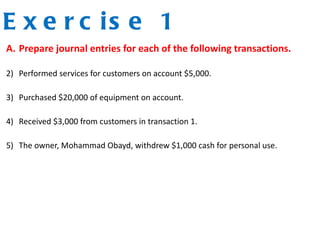
E x e r c is e 1
A. Prepare journal entries for each of the following transactions.
2) Performed services for customers on account $5,000.
3) Purchased $20,000 of equipment on account.
4) Received $3,000 from customers in transaction 1.
5) The owner, Mohammad Obayd, withdrew $1,000 cash for personal use.
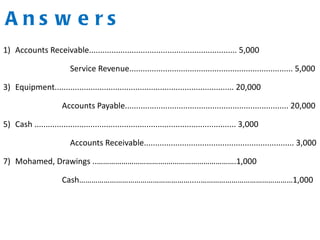
1) Accounts Receivable.................................................................. 5,000
Service Revenue......................................................................... 5,000
3) Equipment................................................................................ 20,000
Accounts Payable......................................................................... 20,000
5) Cash .......................................................................................... 3,000
Accounts Receivable................................................................... 3,000
7) Mohamed, Drawings ..…………………………….…………………………….1,000
Cash……………………………………………….....………………………………………1,000
A n s w e r s
E x e r c is e
2
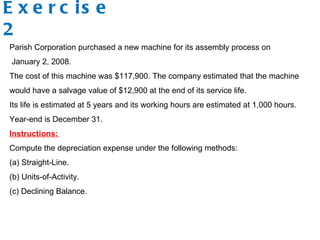
Parish Corporation purchased a new machine for its assembly process on
January 2, 2008.
The cost of this machine was $117,900. The company estimated that the machine
would have a salvage value of $12,900 at the end of its service life.
Its life is estimated at 5 years and its working hours are estimated at 1,000 hours.
Year-end is December 31.
Instructions:
Compute the depreciation expense under the following methods:
(a) Straight-Line.
(b) Units-of-Activity.
(c) Declining Balance.
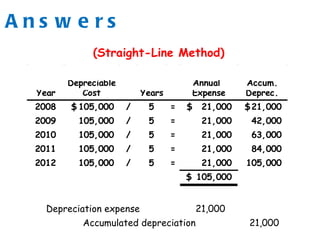
Depreciable Annual Accum.
Year Cost Years Expense Deprec.
2008 105,000$ / 5 = 21,000$ 21,000$
2009 105,000 / 5 = 21,000 42,000
2010 105,000 / 5 = 21,000 63,000
2011 105,000 / 5 = 21,000 84,000
2012 105,000 / 5 = 21,000 105,000
105,000$
Depreciation expense 21,000
Accumulated depreciation 21,000
(Straight-Line Method)
A n s w e r s
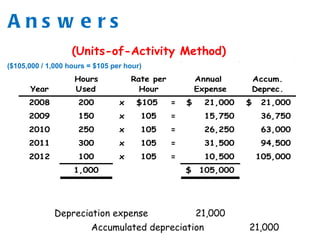
Hours Rate per Annual Accum.
Year Used Hour Expense Deprec.
2008 200 x $105 = 21,000$ 21,000$
2009 150 x 105 = 15,750 36,750
2010 250 x 105 = 26,250 63,000
2011 300 x 105 = 31,500 94,500
2012 100 x 105 = 10,500 105,000
1,000 105,000$
Depreciation expense 21,000
Accumulated depreciation 21,000
($105,000 / 1,000 hours = $105 per hour)
A n s w e r s
(Units-of-Activity Method)
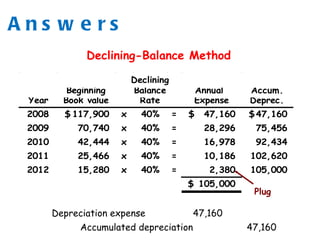
Declining
Beginning Balance Annual Accum.
Year Book value Rate Expense Deprec.
2008 117,900$ x 40% = 47,160$ 47,160$
2009 70,740 x 40% = 28,296 75,456
2010 42,444 x 40% = 16,978 92,434
2011 25,466 x 40% = 10,186 102,620
2012 15,280 x 40% = 2,380 105,000
105,000$
Declining-Balance Method
Depreciation expense 47,160
Accumulated depreciation 47,160
Plug
A n s w e r s
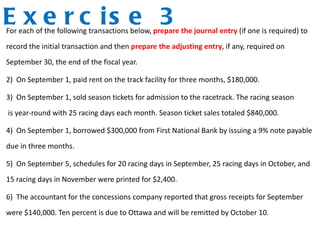
E x e r c is e 3For each of the following transactions below, prepare the journal entry (if one is required) to
record the initial transaction and then prepare the adjusting entry, if any, required on
September 30, the end of the fiscal year.
2) On September 1, paid rent on the track facility for three months, $180,000.
3) On September 1, sold season tickets for admission to the racetrack. The racing season
is year-round with 25 racing days each month. Season ticket sales totaled $840,000.
4) On September 1, borrowed $300,000 from First National Bank by issuing a 9% note payable
due in three months.
5) On September 5, schedules for 20 racing days in September, 25 racing days in October, and
15 racing days in November were printed for $2,400.
6) The accountant for the concessions company reported that gross receipts for September
were $140,000. Ten percent is due to Ottawa and will be remitted by October 10.
A n s w e r s
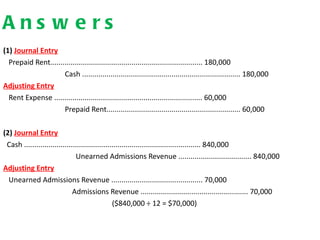
(1) Journal Entry
Prepaid Rent........................................................................... 180,000
Cash .............................................................................. 180,000
Adjusting Entry
Rent Expense ......................................................................... 60,000
Prepaid Rent.................................................................. 60,000
(2) Journal Entry
Cash ....................................................................................... 840,000
Unearned Admissions Revenue .................................... 840,000
Adjusting Entry
Unearned Admissions Revenue ............................................. 70,000
Admissions Revenue ..................................................... 70,000
($840,000 ÷ 12 = $70,000)
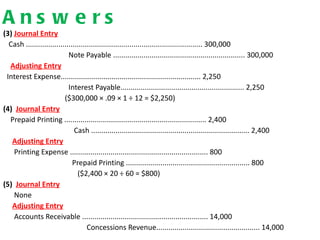
(3) Journal Entry
Cash ....................................................................................... 300,000
Note Payable ................................................................. 300,000
Adjusting Entry
Interest Expense..................................................................... 2,250
Interest Payable............................................................. 2,250
($300,000 × .09 × 1 ÷ 12 = $2,250)
(4) Journal Entry
Prepaid Printing ...................................................................... 2,400
Cash .............................................................................. 2,400
Adjusting Entry
Printing Expense .................................................................... 800
Prepaid Printing ............................................................. 800
($2,400 × 20 ÷ 60 = $800)
(5) Journal Entry
None
Adjusting Entry
Accounts Receivable .............................................................. 14,000
Concessions Revenue................................................... 14,000
A n s w e r s
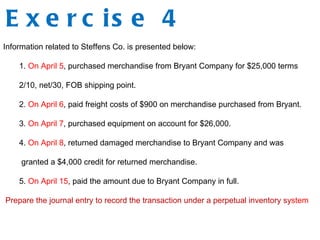
E x e r c is e 4
Information related to Steffens Co. is presented below:
1. On April 5, purchased merchandise from Bryant Company for $25,000 terms
2/10, net/30, FOB shipping point.
2. On April 6, paid freight costs of $900 on merchandise purchased from Bryant.
3. On April 7, purchased equipment on account for $26,000.
4. On April 8, returned damaged merchandise to Bryant Company and was
granted a $4,000 credit for returned merchandise.
5. On April 15, paid the amount due to Bryant Company in full.
Prepare the journal entry to record the transaction under a perpetual inventory system
A n s w e r s
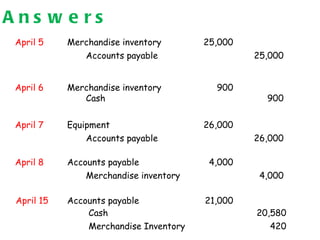
Merchandise inventory 25,000April 5
Accounts payable 25,000
Merchandise inventory 900April 6
Cash 900
Equipment 26,000April 7
Accounts payable 26,000
Accounts payable 4,000April 8
Merchandise inventory 4,000
Accounts payable 21,000April 15
Cash 20,580
Merchandise Inventory 420
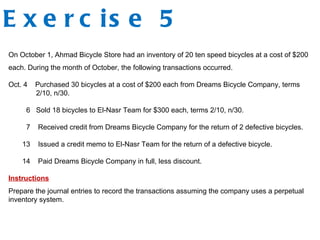
E x e r c is e 5
On October 1, Ahmad Bicycle Store had an inventory of 20 ten speed bicycles at a cost of $200
each. During the month of October, the following transactions occurred.
Oct. 4 Purchased 30 bicycles at a cost of $200 each from Dreams Bicycle Company, terms
2/10, n/30.
6 Sold 18 bicycles to El-Nasr Team for $300 each, terms 2/10, n/30.
7 Received credit from Dreams Bicycle Company for the return of 2 defective bicycles.
13 Issued a credit memo to El-Nasr Team for the return of a defective bicycle.
14 Paid Dreams Bicycle Company in full, less discount.
Instructions
Prepare the journal entries to record the transactions assuming the company uses a perpetual
inventory system.
A n s w e r s
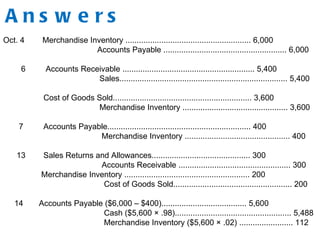
Oct. 4 Merchandise Inventory ........................................................ 6,000
Accounts Payable ....................................................... 6,000
6 Accounts Receivable ........................................................... 5,400
Sales........................................................................... 5,400
Cost of Goods Sold.............................................................. 3,600
Merchandise Inventory ............................................... 3,600
7 Accounts Payable................................................................ 400
Merchandise Inventory ............................................... 400
13 Sales Returns and Allowances............................................ 300
Accounts Receivable .................................................. 300
Merchandise Inventory ........................................................ 200
Cost of Goods Sold..................................................... 200
14 Accounts Payable ($6,000 – $400)...................................... 5,600
Cash ($5,600 × .98).................................................... 5,488
Merchandise Inventory ($5,600 × .02) ........................ 112
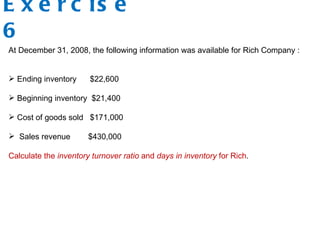
E x e r c is e
6
At December 31, 2008, the following information was available for Rich Company :
 Ending inventory $22,600
 Beginning inventory $21,400
 Cost of goods sold $171,000
 Sales revenue $430,000
Calculate the inventory turnover ratio and days in inventory for Rich.
A n s w e r s
- Inventory Turnover Ratio = $171,000 ÷ [($21,400 + $22,600) ÷ 2]
= 7.8 times
- Days in Inventory = 365 ÷ 7.8 = 46.8 days
E x e r c is e
7
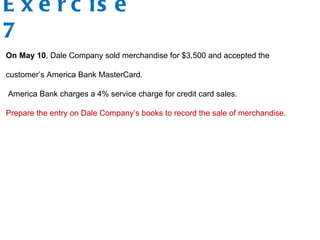
On May 10, Dale Company sold merchandise for $3,500 and accepted the
customer’s America Bank MasterCard.
America Bank charges a 4% service charge for credit card sales.
Prepare the entry on Dale Company’s books to record the sale of merchandise.
A n s w e r s
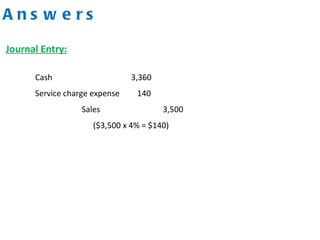
Cash 3,360
Service charge expense 140
Sales 3,500
($3,500 x 4% = $140)
Journal Entry:
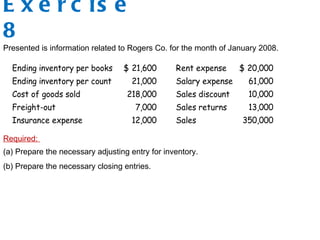
Presented is information related to Rogers Co. for the month of January 2008.
Ending inventory per books 21,600$ Rent expense 20,000$
Ending inventory per count 21,000 Salary expense 61,000
Cost of goods sold 218,000 Sales discount 10,000
Freight-out 7,000 Sales returns 13,000
Insurance expense 12,000 Sales 350,000
Required:
(a) Prepare the necessary adjusting entry for inventory.
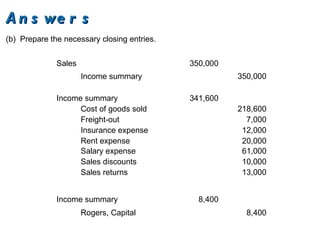
(b) Prepare the necessary closing entries.
E x e r c is e
8
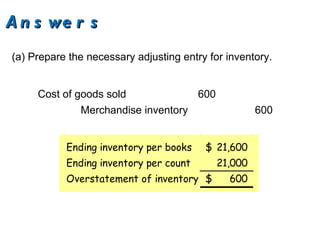
(a) Prepare the necessary adjusting entry for inventory.
Cost of goods sold 600
Merchandise inventory 600
Ending inventory per books 21,600$
Ending inventory per count 21,000
Overstatement of inventory 600$
A n s we r sA n s we r s
Sales 350,000
Income summary 350,000
Income summary 341,600
Cost of goods sold 218,600
Freight-out 7,000
Insurance expense 12,000
Income summary 8,400
Rogers, Capital 8,400
Rent expense 20,000
(b) Prepare the necessary closing entries.
Salary expense 61,000
Sales discounts 10,000
Sales returns 13,000
A n s we r sA n s we r s
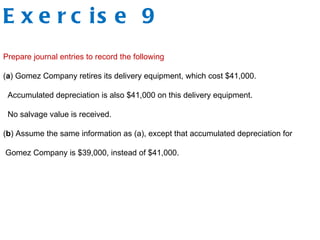
E x e r c is e 9
Prepare journal entries to record the following
(a) Gomez Company retires its delivery equipment, which cost $41,000.
Accumulated depreciation is also $41,000 on this delivery equipment.
No salvage value is received.
(b) Assume the same information as (a), except that accumulated depreciation for
Gomez Company is $39,000, instead of $41,000.
A n s we r sA n s we r s
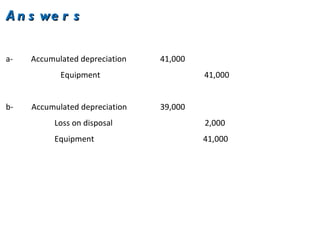
a- Accumulated depreciation 41,000
Equipment 41,000
b- Accumulated depreciation 39,000
Loss on disposal 2,000
Equipment 41,000
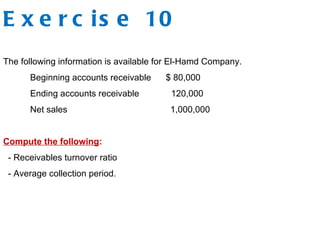
E x e r c is e 10
The following information is available for El-Hamd Company.
Beginning accounts receivable $ 80,000
Ending accounts receivable 120,000
Net sales 1,000,000
Compute the following:
- Receivables turnover ratio
- Average collection period.
A n s we rA n s we r
Receivables turnover = $1,000,000 ÷ [($80,000 + $120,000) ÷ 2]
= 10 times
Average collection period = 365 ÷ 10
= 36.5 days
E x e r c is e 11
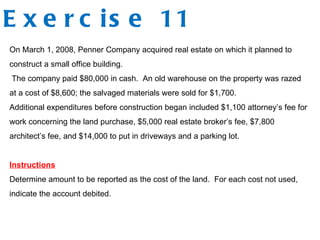
On March 1, 2008, Penner Company acquired real estate on which it planned to
construct a small office building.
The company paid $80,000 in cash. An old warehouse on the property was razed
at a cost of $8,600; the salvaged materials were sold for $1,700.
Additional expenditures before construction began included $1,100 attorney’s fee for
work concerning the land purchase, $5,000 real estate broker’s fee, $7,800
architect’s fee, and $14,000 to put in driveways and a parking lot.
Instructions
Determine amount to be reported as the cost of the land. For each cost not used,
indicate the account debited.
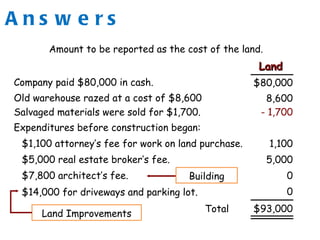
A n s w e r s
LandLand
Amount to be reported as the cost of the land.
Company paid $80,000 in cash.
Old warehouse razed at a cost of $8,600
Salvaged materials were sold for $1,700. - 1,700
8,600
$80,000
Expenditures before construction began:
$1,100 attorney’s fee for work on land purchase.
$5,000 real estate broker’s fee.
$7,800 architect’s fee.
$14,000 for driveways and parking lot.
1,100
5,000
0
0
$93,000Total
Building
Land Improvements
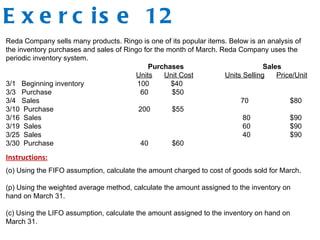
E x e r c is e 12
Reda Company sells many products. Ringo is one of its popular items. Below is an analysis of
the inventory purchases and sales of Ringo for the month of March. Reda Company uses the
periodic inventory system.
Purchases Sales
Units Unit Cost Units Selling Price/Unit
3/1 Beginning inventory 100 $40
3/3 Purchase 60 $50
3/4 Sales 70 $80
3/10 Purchase 200 $55
3/16 Sales 80 $90
3/19 Sales 60 $90
3/25 Sales 40 $90
3/30 Purchase 40 $60
Instructions:
(o) Using the FIFO assumption, calculate the amount charged to cost of goods sold for March.
(p) Using the weighted average method, calculate the amount assigned to the inventory on
hand on March 31.
(c) Using the LIFO assumption, calculate the amount assigned to the inventory on hand on
March 31.
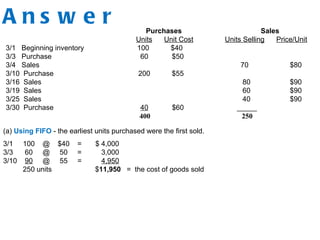
A n s w e r Purchases Sales
Units Unit Cost Units Selling Price/Unit
3/1 Beginning inventory 100 $40
3/3 Purchase 60 $50
3/4 Sales 70 $80
3/10 Purchase 200 $55
3/16 Sales 80 $90
3/19 Sales 60 $90
3/25 Sales 40 $90
3/30 Purchase 40 $60 _____
400 250
(a) Using FIFO - the earliest units purchased were the first sold.
3/1 100 @ $40 = $ 4,000
3/3 60 @ 50 = 3,000
3/10 90 @ 55 = 4,950
250 units $11,950 = the cost of goods sold
A n s w e r Purchases Sales
Units Unit Cost Units Selling Price/Unit
3/1 Beginning inventory 100 $40
3/3 Purchase 60 $50
3/4 Sales 70 $80
3/10 Purchase 200 $55
3/16 Sales 80 $90
3/19 Sales 60 $90
3/25 Sales 40 $90
3/30 Purchase 40 $60 _____
400 250
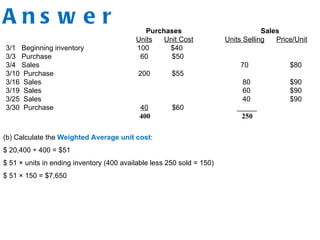
(b) Calculate the Weighted Average unit cost:
$ 20,400 ÷ 400 = $51
$ 51 × units in ending inventory (400 available less 250 sold = 150)
$ 51 × 150 = $7,650
A n s w e r Purchases Sales
Units Unit Cost Units Selling Price/Unit
3/1 Beginning inventory 100 $40
3/3 Purchase 60 $50
3/4 Sales 70 $80
3/10 Purchase 200 $55
3/16 Sales 80 $90
3/19 Sales 60 $90
3/25 Sales 40 $90
3/30 Purchase 40 $60 _____
400 250
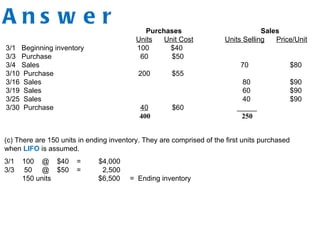
(c) There are 150 units in ending inventory. They are comprised of the first units purchased
when LIFO is assumed.
3/1 100 @ $40 = $4,000
3/3 50 @ $50 = 2,500
150 units $6,500 = Ending inventory
Section 11   revision

Section 11 revision

  • 2.
  • 3.
    Principles Of Accounting(1)Principles Of Accounting (1) RevisionRevision Chapters 1 to 8Chapters 1 to 8 Mohamed Mahmoud mmahmoud@eelu.edu.eg Tel: (+202) 33318449
  • 4.
    E x er c is e 1 A. Prepare journal entries for each of the following transactions. 2) Performed services for customers on account $5,000. 3) Purchased $20,000 of equipment on account. 4) Received $3,000 from customers in transaction 1. 5) The owner, Mohammad Obayd, withdrew $1,000 cash for personal use.
  • 5.
    1) Accounts Receivable..................................................................5,000 Service Revenue......................................................................... 5,000 3) Equipment................................................................................ 20,000 Accounts Payable......................................................................... 20,000 5) Cash .......................................................................................... 3,000 Accounts Receivable................................................................... 3,000 7) Mohamed, Drawings ..…………………………….…………………………….1,000 Cash……………………………………………….....………………………………………1,000 A n s w e r s
  • 6.
    E x er c is e 2 Parish Corporation purchased a new machine for its assembly process on January 2, 2008. The cost of this machine was $117,900. The company estimated that the machine would have a salvage value of $12,900 at the end of its service life. Its life is estimated at 5 years and its working hours are estimated at 1,000 hours. Year-end is December 31. Instructions: Compute the depreciation expense under the following methods: (a) Straight-Line. (b) Units-of-Activity. (c) Declining Balance.
  • 7.
    Depreciable Annual Accum. YearCost Years Expense Deprec. 2008 105,000$ / 5 = 21,000$ 21,000$ 2009 105,000 / 5 = 21,000 42,000 2010 105,000 / 5 = 21,000 63,000 2011 105,000 / 5 = 21,000 84,000 2012 105,000 / 5 = 21,000 105,000 105,000$ Depreciation expense 21,000 Accumulated depreciation 21,000 (Straight-Line Method) A n s w e r s
  • 8.
    Hours Rate perAnnual Accum. Year Used Hour Expense Deprec. 2008 200 x $105 = 21,000$ 21,000$ 2009 150 x 105 = 15,750 36,750 2010 250 x 105 = 26,250 63,000 2011 300 x 105 = 31,500 94,500 2012 100 x 105 = 10,500 105,000 1,000 105,000$ Depreciation expense 21,000 Accumulated depreciation 21,000 ($105,000 / 1,000 hours = $105 per hour) A n s w e r s (Units-of-Activity Method)
  • 9.
    Declining Beginning Balance AnnualAccum. Year Book value Rate Expense Deprec. 2008 117,900$ x 40% = 47,160$ 47,160$ 2009 70,740 x 40% = 28,296 75,456 2010 42,444 x 40% = 16,978 92,434 2011 25,466 x 40% = 10,186 102,620 2012 15,280 x 40% = 2,380 105,000 105,000$ Declining-Balance Method Depreciation expense 47,160 Accumulated depreciation 47,160 Plug A n s w e r s
  • 10.
    E x er c is e 3For each of the following transactions below, prepare the journal entry (if one is required) to record the initial transaction and then prepare the adjusting entry, if any, required on September 30, the end of the fiscal year. 2) On September 1, paid rent on the track facility for three months, $180,000. 3) On September 1, sold season tickets for admission to the racetrack. The racing season is year-round with 25 racing days each month. Season ticket sales totaled $840,000. 4) On September 1, borrowed $300,000 from First National Bank by issuing a 9% note payable due in three months. 5) On September 5, schedules for 20 racing days in September, 25 racing days in October, and 15 racing days in November were printed for $2,400. 6) The accountant for the concessions company reported that gross receipts for September were $140,000. Ten percent is due to Ottawa and will be remitted by October 10.
  • 11.
    A n sw e r s (1) Journal Entry Prepaid Rent........................................................................... 180,000 Cash .............................................................................. 180,000 Adjusting Entry Rent Expense ......................................................................... 60,000 Prepaid Rent.................................................................. 60,000 (2) Journal Entry Cash ....................................................................................... 840,000 Unearned Admissions Revenue .................................... 840,000 Adjusting Entry Unearned Admissions Revenue ............................................. 70,000 Admissions Revenue ..................................................... 70,000 ($840,000 ÷ 12 = $70,000)
  • 12.
    (3) Journal Entry Cash....................................................................................... 300,000 Note Payable ................................................................. 300,000 Adjusting Entry Interest Expense..................................................................... 2,250 Interest Payable............................................................. 2,250 ($300,000 × .09 × 1 ÷ 12 = $2,250) (4) Journal Entry Prepaid Printing ...................................................................... 2,400 Cash .............................................................................. 2,400 Adjusting Entry Printing Expense .................................................................... 800 Prepaid Printing ............................................................. 800 ($2,400 × 20 ÷ 60 = $800) (5) Journal Entry None Adjusting Entry Accounts Receivable .............................................................. 14,000 Concessions Revenue................................................... 14,000 A n s w e r s
  • 13.
    E x er c is e 4 Information related to Steffens Co. is presented below: 1. On April 5, purchased merchandise from Bryant Company for $25,000 terms 2/10, net/30, FOB shipping point. 2. On April 6, paid freight costs of $900 on merchandise purchased from Bryant. 3. On April 7, purchased equipment on account for $26,000. 4. On April 8, returned damaged merchandise to Bryant Company and was granted a $4,000 credit for returned merchandise. 5. On April 15, paid the amount due to Bryant Company in full. Prepare the journal entry to record the transaction under a perpetual inventory system
  • 14.
    A n sw e r s Merchandise inventory 25,000April 5 Accounts payable 25,000 Merchandise inventory 900April 6 Cash 900 Equipment 26,000April 7 Accounts payable 26,000 Accounts payable 4,000April 8 Merchandise inventory 4,000 Accounts payable 21,000April 15 Cash 20,580 Merchandise Inventory 420
  • 15.
    E x er c is e 5 On October 1, Ahmad Bicycle Store had an inventory of 20 ten speed bicycles at a cost of $200 each. During the month of October, the following transactions occurred. Oct. 4 Purchased 30 bicycles at a cost of $200 each from Dreams Bicycle Company, terms 2/10, n/30. 6 Sold 18 bicycles to El-Nasr Team for $300 each, terms 2/10, n/30. 7 Received credit from Dreams Bicycle Company for the return of 2 defective bicycles. 13 Issued a credit memo to El-Nasr Team for the return of a defective bicycle. 14 Paid Dreams Bicycle Company in full, less discount. Instructions Prepare the journal entries to record the transactions assuming the company uses a perpetual inventory system.
  • 16.
    A n sw e r s Oct. 4 Merchandise Inventory ........................................................ 6,000 Accounts Payable ....................................................... 6,000 6 Accounts Receivable ........................................................... 5,400 Sales........................................................................... 5,400 Cost of Goods Sold.............................................................. 3,600 Merchandise Inventory ............................................... 3,600 7 Accounts Payable................................................................ 400 Merchandise Inventory ............................................... 400 13 Sales Returns and Allowances............................................ 300 Accounts Receivable .................................................. 300 Merchandise Inventory ........................................................ 200 Cost of Goods Sold..................................................... 200 14 Accounts Payable ($6,000 – $400)...................................... 5,600 Cash ($5,600 × .98).................................................... 5,488 Merchandise Inventory ($5,600 × .02) ........................ 112
  • 17.
    E x er c is e 6 At December 31, 2008, the following information was available for Rich Company :  Ending inventory $22,600  Beginning inventory $21,400  Cost of goods sold $171,000  Sales revenue $430,000 Calculate the inventory turnover ratio and days in inventory for Rich.
  • 18.
    A n sw e r s - Inventory Turnover Ratio = $171,000 ÷ [($21,400 + $22,600) ÷ 2] = 7.8 times - Days in Inventory = 365 ÷ 7.8 = 46.8 days
  • 19.
    E x er c is e 7 On May 10, Dale Company sold merchandise for $3,500 and accepted the customer’s America Bank MasterCard. America Bank charges a 4% service charge for credit card sales. Prepare the entry on Dale Company’s books to record the sale of merchandise.
  • 20.
    A n sw e r s Cash 3,360 Service charge expense 140 Sales 3,500 ($3,500 x 4% = $140) Journal Entry:
  • 21.
    Presented is informationrelated to Rogers Co. for the month of January 2008. Ending inventory per books 21,600$ Rent expense 20,000$ Ending inventory per count 21,000 Salary expense 61,000 Cost of goods sold 218,000 Sales discount 10,000 Freight-out 7,000 Sales returns 13,000 Insurance expense 12,000 Sales 350,000 Required: (a) Prepare the necessary adjusting entry for inventory. (b) Prepare the necessary closing entries. E x e r c is e 8
  • 22.
    (a) Prepare thenecessary adjusting entry for inventory. Cost of goods sold 600 Merchandise inventory 600 Ending inventory per books 21,600$ Ending inventory per count 21,000 Overstatement of inventory 600$ A n s we r sA n s we r s
  • 23.
    Sales 350,000 Income summary350,000 Income summary 341,600 Cost of goods sold 218,600 Freight-out 7,000 Insurance expense 12,000 Income summary 8,400 Rogers, Capital 8,400 Rent expense 20,000 (b) Prepare the necessary closing entries. Salary expense 61,000 Sales discounts 10,000 Sales returns 13,000 A n s we r sA n s we r s
  • 24.
    E x er c is e 9 Prepare journal entries to record the following (a) Gomez Company retires its delivery equipment, which cost $41,000. Accumulated depreciation is also $41,000 on this delivery equipment. No salvage value is received. (b) Assume the same information as (a), except that accumulated depreciation for Gomez Company is $39,000, instead of $41,000.
  • 25.
    A n swe r sA n s we r s a- Accumulated depreciation 41,000 Equipment 41,000 b- Accumulated depreciation 39,000 Loss on disposal 2,000 Equipment 41,000
  • 26.
    E x er c is e 10 The following information is available for El-Hamd Company. Beginning accounts receivable $ 80,000 Ending accounts receivable 120,000 Net sales 1,000,000 Compute the following: - Receivables turnover ratio - Average collection period.
  • 27.
    A n swe rA n s we r Receivables turnover = $1,000,000 ÷ [($80,000 + $120,000) ÷ 2] = 10 times Average collection period = 365 ÷ 10 = 36.5 days
  • 28.
    E x er c is e 11 On March 1, 2008, Penner Company acquired real estate on which it planned to construct a small office building. The company paid $80,000 in cash. An old warehouse on the property was razed at a cost of $8,600; the salvaged materials were sold for $1,700. Additional expenditures before construction began included $1,100 attorney’s fee for work concerning the land purchase, $5,000 real estate broker’s fee, $7,800 architect’s fee, and $14,000 to put in driveways and a parking lot. Instructions Determine amount to be reported as the cost of the land. For each cost not used, indicate the account debited.
  • 29.
    A n sw e r s LandLand Amount to be reported as the cost of the land. Company paid $80,000 in cash. Old warehouse razed at a cost of $8,600 Salvaged materials were sold for $1,700. - 1,700 8,600 $80,000 Expenditures before construction began: $1,100 attorney’s fee for work on land purchase. $5,000 real estate broker’s fee. $7,800 architect’s fee. $14,000 for driveways and parking lot. 1,100 5,000 0 0 $93,000Total Building Land Improvements
  • 30.
    E x er c is e 12 Reda Company sells many products. Ringo is one of its popular items. Below is an analysis of the inventory purchases and sales of Ringo for the month of March. Reda Company uses the periodic inventory system. Purchases Sales Units Unit Cost Units Selling Price/Unit 3/1 Beginning inventory 100 $40 3/3 Purchase 60 $50 3/4 Sales 70 $80 3/10 Purchase 200 $55 3/16 Sales 80 $90 3/19 Sales 60 $90 3/25 Sales 40 $90 3/30 Purchase 40 $60 Instructions: (o) Using the FIFO assumption, calculate the amount charged to cost of goods sold for March. (p) Using the weighted average method, calculate the amount assigned to the inventory on hand on March 31. (c) Using the LIFO assumption, calculate the amount assigned to the inventory on hand on March 31.
  • 31.
    A n sw e r Purchases Sales Units Unit Cost Units Selling Price/Unit 3/1 Beginning inventory 100 $40 3/3 Purchase 60 $50 3/4 Sales 70 $80 3/10 Purchase 200 $55 3/16 Sales 80 $90 3/19 Sales 60 $90 3/25 Sales 40 $90 3/30 Purchase 40 $60 _____ 400 250 (a) Using FIFO - the earliest units purchased were the first sold. 3/1 100 @ $40 = $ 4,000 3/3 60 @ 50 = 3,000 3/10 90 @ 55 = 4,950 250 units $11,950 = the cost of goods sold
  • 32.
    A n sw e r Purchases Sales Units Unit Cost Units Selling Price/Unit 3/1 Beginning inventory 100 $40 3/3 Purchase 60 $50 3/4 Sales 70 $80 3/10 Purchase 200 $55 3/16 Sales 80 $90 3/19 Sales 60 $90 3/25 Sales 40 $90 3/30 Purchase 40 $60 _____ 400 250 (b) Calculate the Weighted Average unit cost: $ 20,400 ÷ 400 = $51 $ 51 × units in ending inventory (400 available less 250 sold = 150) $ 51 × 150 = $7,650
  • 33.
    A n sw e r Purchases Sales Units Unit Cost Units Selling Price/Unit 3/1 Beginning inventory 100 $40 3/3 Purchase 60 $50 3/4 Sales 70 $80 3/10 Purchase 200 $55 3/16 Sales 80 $90 3/19 Sales 60 $90 3/25 Sales 40 $90 3/30 Purchase 40 $60 _____ 400 250 (c) There are 150 units in ending inventory. They are comprised of the first units purchased when LIFO is assumed. 3/1 100 @ $40 = $4,000 3/3 50 @ $50 = 2,500 150 units $6,500 = Ending inventory