
Trustees’ Week 2020
Refreshing the Code
Dan Francis, Lead governance consultant, NCVO
Pari Dhillon, Consultant reviewing the Diversity Principle
Rosie Chapman, Independent chair CGC steering group
Supported by: Group members Observer
What we will cover
• The journey so far and a recap on the consultation
• Sharing updates to the integrity principle
• Practical findings from work on the diversity principle
• Updates to the diversity principle
• Next steps and plans for publication
• Questions
The journey so far
Public consultation findings
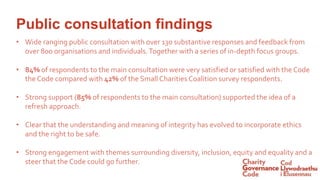
• Wide ranging public consultation with over 130 substantive responses and feedback from
over 800 organisations and individuals.Together with a series of in-depth focus groups.
• 84% of respondents to the main consultation were very satisfied or satisfied with the Code
the Code compared with 42% of the Small Charities Coalition survey respondents.
• Strong support (85% of respondents to the main consultation) supported the idea of a
refresh approach.
• Clear that the understanding and meaning of integrity has evolved to incorporate ethics
and the right to be safe.
• Strong engagement with themes surrounding diversity, inclusion, equity and equality and a
steer that the Code could go further.
Changes to integrity principle
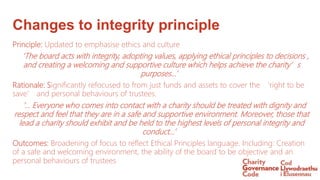
Principle: Updated to emphasise ethics and culture
‘The board acts with integrity, adopting values, applying ethical principles to decisions ,
and creating a welcoming and supportive culture which helps achieve the charity’s
purposes…’
Rationale: Significantly refocused to from just funds and assets to cover the ‘right to be
save’ and personal behaviours of trustees.
‘… Everyone who comes into contact with a charity should be treated with dignity and
respect and feel that they are in a safe and supportive environment. Moreover, those that
lead a charity should exhibit and be held to the highest levels of personal integrity and
conduct…’
Outcomes: Broadening of focus to reflect Ethical Principles language. Including: Creation
of a safe and welcoming environment, the ability of the board to be objective and an
personal behaviours of trustees
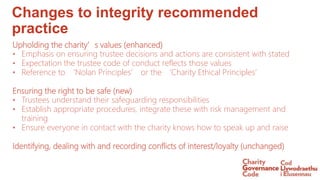
Upholding the charity’s values (enhanced)
• Emphasis on ensuring trustee decisions and actions are consistent with stated
• Expectation the trustee code of conduct reflects those values
• Reference to ‘Nolan Principles’ or the ‘Charity Ethical Principles’
Ensuring the right to be safe (new)
• Trustees understand their safeguarding responsibilities
• Establish appropriate procedures, integrate these with risk management and
training
• Ensure everyone in contact with the charity knows how to speak up and raise
Identifying, dealing with and recording conflicts of interest/loyalty (unchanged)
Changes to integrity recommended
practice
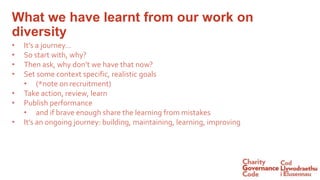
• It’s a journey…
• So start with, why?
• Then ask, why don’t we have that now?
• Set some context specific, realistic goals
• (*note on recruitment)
• Take action, review, learn
• Publish performance
• and if brave enough share the learning from mistakes
• It’s an ongoing journey: building, maintaining, learning, improving
What we have learnt from our work on
diversity
What the learning might mean for the
updated Equality, Diversity and Inclusion
principle (1)
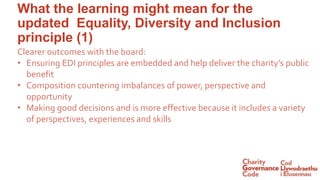
Clearer outcomes with the board:
• Ensuring EDI principles are embedded and help deliver the charity’s public
benefit
• Composition countering imbalances of power, perspective and
opportunity
• Making good decisions and is more effective because it includes a variety
of perspectives, experiences and skills
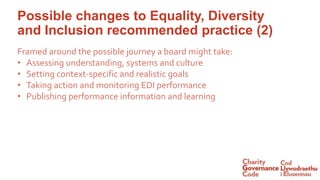
Possible changes to Equality, Diversity
and Inclusion recommended practice (2)
Framed around the possible journey a board might take:
• Assessing understanding, systems and culture
• Setting context-specific and realistic goals
• Taking action and monitoring EDI performance
• Publishing performance information and learning
Questions and comments
Supported by:
What we have not done/included?
• The strengths and limitations of a Code
• Supporting guidance and a possible role for other organisations.
• Call to action for others to provide supporting guidance to help charities
on this journey
Next steps
• Finalise the Equality, Diversity and Inclusion wording (test out with critical
friends)
• Aim to publish by the end of the year
• Will review on a regular basis
• Charity Governance Code website
• Details of the consultation and the full report into findings (published
today)
• Blogs from the steering group
More on refreshing the Charity
Governance Code:
Supported by:

NCVO webinar: An update on changes to the Charity Governance Code

  • 1.
    Trustees’ Week 2020 Refreshingthe Code Dan Francis, Lead governance consultant, NCVO Pari Dhillon, Consultant reviewing the Diversity Principle Rosie Chapman, Independent chair CGC steering group Supported by: Group members Observer
  • 2.
    What we willcover • The journey so far and a recap on the consultation • Sharing updates to the integrity principle • Practical findings from work on the diversity principle • Updates to the diversity principle • Next steps and plans for publication • Questions
  • 3.
  • 4.
    Public consultation findings •Wide ranging public consultation with over 130 substantive responses and feedback from over 800 organisations and individuals.Together with a series of in-depth focus groups. • 84% of respondents to the main consultation were very satisfied or satisfied with the Code the Code compared with 42% of the Small Charities Coalition survey respondents. • Strong support (85% of respondents to the main consultation) supported the idea of a refresh approach. • Clear that the understanding and meaning of integrity has evolved to incorporate ethics and the right to be safe. • Strong engagement with themes surrounding diversity, inclusion, equity and equality and a steer that the Code could go further.
  • 5.
    Changes to integrityprinciple Principle: Updated to emphasise ethics and culture ‘The board acts with integrity, adopting values, applying ethical principles to decisions , and creating a welcoming and supportive culture which helps achieve the charity’s purposes…’ Rationale: Significantly refocused to from just funds and assets to cover the ‘right to be save’ and personal behaviours of trustees. ‘… Everyone who comes into contact with a charity should be treated with dignity and respect and feel that they are in a safe and supportive environment. Moreover, those that lead a charity should exhibit and be held to the highest levels of personal integrity and conduct…’ Outcomes: Broadening of focus to reflect Ethical Principles language. Including: Creation of a safe and welcoming environment, the ability of the board to be objective and an personal behaviours of trustees
  • 6.
    Upholding the charity’svalues (enhanced) • Emphasis on ensuring trustee decisions and actions are consistent with stated • Expectation the trustee code of conduct reflects those values • Reference to ‘Nolan Principles’ or the ‘Charity Ethical Principles’ Ensuring the right to be safe (new) • Trustees understand their safeguarding responsibilities • Establish appropriate procedures, integrate these with risk management and training • Ensure everyone in contact with the charity knows how to speak up and raise Identifying, dealing with and recording conflicts of interest/loyalty (unchanged) Changes to integrity recommended practice
  • 7.
    • It’s ajourney… • So start with, why? • Then ask, why don’t we have that now? • Set some context specific, realistic goals • (*note on recruitment) • Take action, review, learn • Publish performance • and if brave enough share the learning from mistakes • It’s an ongoing journey: building, maintaining, learning, improving What we have learnt from our work on diversity
  • 8.
    What the learningmight mean for the updated Equality, Diversity and Inclusion principle (1) Clearer outcomes with the board: • Ensuring EDI principles are embedded and help deliver the charity’s public benefit • Composition countering imbalances of power, perspective and opportunity • Making good decisions and is more effective because it includes a variety of perspectives, experiences and skills
  • 9.
    Possible changes toEquality, Diversity and Inclusion recommended practice (2) Framed around the possible journey a board might take: • Assessing understanding, systems and culture • Setting context-specific and realistic goals • Taking action and monitoring EDI performance • Publishing performance information and learning
  • 10.
  • 11.
    What we havenot done/included? • The strengths and limitations of a Code • Supporting guidance and a possible role for other organisations. • Call to action for others to provide supporting guidance to help charities on this journey
  • 12.
    Next steps • Finalisethe Equality, Diversity and Inclusion wording (test out with critical friends) • Aim to publish by the end of the year • Will review on a regular basis
  • 13.
    • Charity GovernanceCode website • Details of the consultation and the full report into findings (published today) • Blogs from the steering group More on refreshing the Charity Governance Code: Supported by:

Editor's Notes

  • #2 Thank you to everyone for taking the trouble to dial into the webinar today. I’m delighted to be joined by three members of the Code’s steering group, which oversees the Code: Dan Francis from NCVO, Mair Rigby from their Welsh sister organisation WCVA and Louise Thomson from ICSA: The Governance Institute. Thanks also to our funders without whom this wouldn’t be possible CWC and BCT. Shown significant commitment to the code over many years. What we’re hoping to do is to give you a quick update on what people told us during the recent consultation on possible changes to the Charity Governance Code. As the consultation took place between November last year and February this year it was prior to the emergence of the Covid-19 pandemic and its consequences. Despite this timing and the subsequent events, the Code’s steering group believes there’s still merit in analysing and publishing the consultation responses, and updating the Code accordingly. If anything, we think that Covid-19 has made the changes we’re proposing as a result of the consultation even more relevant as you’ll see when we discuss the responses. So I’m going to kick off the seminar by giving you a general overview of the consultation feedback, and you can find more details on our website. (But please stay, and don’t go off and make a cup of tea!)
  • #3  We were pleasantly surprised by the interest in the consultation, which we’d deliberately badged as a refresh. We received consultation responses via (273 Code Survey, 513 SCC survey): A tailored SurveyMonkey survey which received over 270 responses, with 131 completing more than the introductory Qs A survey that the Small Charities Coalition sent to its members, which received over 510 responses to its governance related Qs 12 substantive submissions, for example from the Charity Law Association As well as this we received feedback to the various online polls that we ran on twitter. The majority of responses – 87% - were from either CEOs, directors or trustees, although numerically we did get a lot of interest from people with a professional interest in governance. We also asked people if they used the current Code…
  • #4 While we appreciate that people responding to the survey are self-selecting we were nonetheless pleased to see that 90% have either fully, or partially adopted the Code or are working towards full adoption of the Code. The SCC survey asked people if they had heard of the Code and while 71% said they did, only 34% said they were using it, so there’s clearly more work to be done in publicising the micro and smaller versions of the Code to these charities. As a final overview question, we asked how satisfied people were with the Code…
  • #5 It is also pleasing to see that those who use the Code are generally very satisfied or satisfied with it with 84% registering their satisfaction. However, once again there is a disparity amongst smaller charities with the Small Charities Coalition survey recoding 42% to a similar question and with 58% of those responding neutral on the question.
  • #9 The CGC steering group anticipated that the Diversity Principle would be one to be highlighted for the refresh This is a key topic for the sector and is being more and more widely recognised by charities and trustees as an area for improvement Sector is not doing as well as others on this –Charity Commission research (trustee boards still predominantly older, white and male), ACEVO research, Getting on Board Campaign, #ChaitySoWhite campaign have all highlighted the issue. It isn’t new, but there is increasing awareness and I think we are reaching a ‘tipping point’ in terms of agreement that action is needed. Unsurprisingly, the consultation exercise revealed a strong appetite for a reshaping of this principle and also a request for more practical guidance for trustees on this topic. ‘Questions about this principle received the most responses across the range of communication methods to engage with users of the Code’
  • #11 Finally – thanks again to our funders.