EASING OF LOCKDOWN: PRACTICAL
CONSIDERATIONS FOR MANAGING AND
SUPPORT STAFF
29 JUNE 2020
WELCOME AND INTRODUCTIONS
• Josie Hinton, Capacity-building programmes manager, NCVO
• Amanda Chadwick, Croner (NCVO trusted supplier)
• Vicky Scott, Operations and HR manager, Hackney CVS
WHAT WE WILL COVER
• Key HR considerations for employers in returning to work
• Update on the furlough scheme and flexible furlough
• How employers can support employees at this time
• In practice: Hackney CVS
PRACTICAL CONSIDERATIONS FOR
MANAGING AND SUPPORTING STAFF
AMANDA CHADWICK
COVID-19 EMPLOYEE CONSIDERATIONS
• Your duty of care – health and safety
Employers have a duty of care towards their employees which includes not exposing
them to unnecessary risk.
May include not putting them in a position in which they could become infected without
taking all reasonable precautions – delegation – policies.
• Wellbeing
Important to acknowledge that employees will be worried about the virus and that, in
most cases, concerns will be valid.
In addition to having duty of care to protect health and safety, you also need to
consider their wellbeing. Remind employees of any wellbeing initiatives you have.
POLL 1
Have you taken advantage of the government’s furlough scheme?
1. Yes
2. No
UPDATES – FURLOUGH SCHEME
• No change on level of assistance during June and July.
• From the start of August, employers will have to pay the national insurance
contributions and employer’s pension contributions (this comes to 5% of total wage
costs in average claim).
• From the start of September, employers will have to contribute 10% towards the
80% wages of furloughed employees, plus NI and pension contributions as above.
The Scheme will fund 70% of wage.
• From start of October, employers will have to contribute 20% towards the 80%
wages of furloughed employees, plus NI and pension contributions as above. The
Scheme will fund 60% of wage.
• The Scheme will close at the end of October.
FURLOUGH/FLEXIBLE FURLOUGH
• From 1 July 2020, furloughed staff will be able to be brought back to work on a
part-time basis.
• New agreement
• This means that employers will still be able to claim the furlough grant for the hours
their flexibly furloughed employees do not work, compared to the hours they would
normally have worked in that period.
• From 1 July 2020, only employees that their employer has previously successfully
claimed a previous grant for will be eligible for more grants under the furlough
scheme.
• Exemptions apply
HOLIDAYS AND FURLOUGH
• Annual leave
• Bank holidays
• Contractual rules
• Working time regulations
• Utilising excess holidays and management
• Request and refusal
• Family friendly rights and flexible working rights
FACTORS TO CONSIDER BEFORE REOPENING
• Employees may be hesitant to return to work if they have concerns that overall
conditions are not sufficiently safe.
• Specific circumstances, refusal options, other leave.
• Your back-to-work plans may depend on your location or sector.
• Parents may find it difficult to go back to work if schools or day caring centres
remain shut.
• It is unlikely all staff will be able to return at once.
• Speak to employees.
• Return to work interviews – commitments.
• Keeping in touch.
• Measured response and communication.
WHAT DO WE PAY SOMEONE WHO SELF-ISOLATES?
Currently, SSP applies to any employee with covid-19 or in self-isolation
Make sure your written sickness policy reflects what your business provides, either
SSP or contractual sick pay
Recovery of SSP
Emergency legislation will also enable employers to recover SSP payments for
coronavirus from the government
Only applies to employers with fewer than 250 employees and only to a maximum of
14 days’ SSP payment.
Government claim site opened on the 26 May 2020
Communication/health conditions/pregnancy
WHAT HAPPENS IF SCHOOLS REMAIN CLOSED
AND STAFF HAVE TO LOOK AFTER THEIR
CHILDREN?• Look into alternatives such as letting staff work from home or take annual
leave
• Explain how pay and working applies over this period
• Have clear absence reporting and time off for dependants' policies
• Keep those staff furloughed if possible
• Provide employees with guidance on childcare (EAP)
• Ensure all of this is reflected in your company handbook.
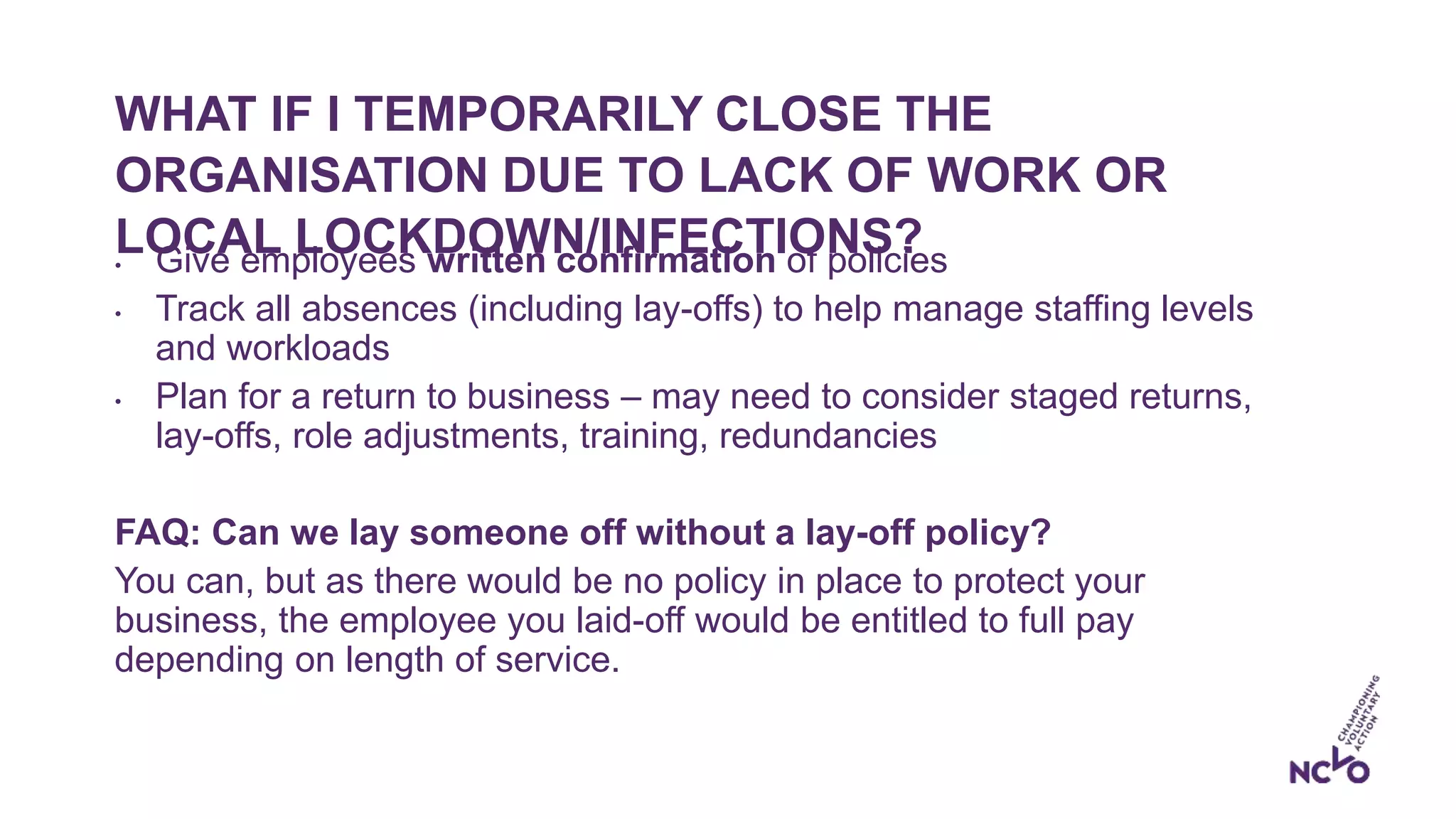
WHAT IF I TEMPORARILY CLOSE THE
ORGANISATION DUE TO LACK OF WORK OR
LOCAL LOCKDOWN/INFECTIONS?• Give employees written confirmation of policies
• Track all absences (including lay-offs) to help manage staffing levels
and workloads
• Plan for a return to business – may need to consider staged returns,
lay-offs, role adjustments, training, redundancies
FAQ: Can we lay someone off without a lay-off policy?
You can, but as there would be no policy in place to protect your
business, the employee you laid-off would be entitled to full pay
depending on length of service.
POLL 2
What has been your key concern in managing and supporting staff
during covid-19?
1. Supporting staff wellbeing
2. Ensuring we have the appropriate policies and procedures
3. Managing capacity with furlough
4. Adapting to an online environment
14
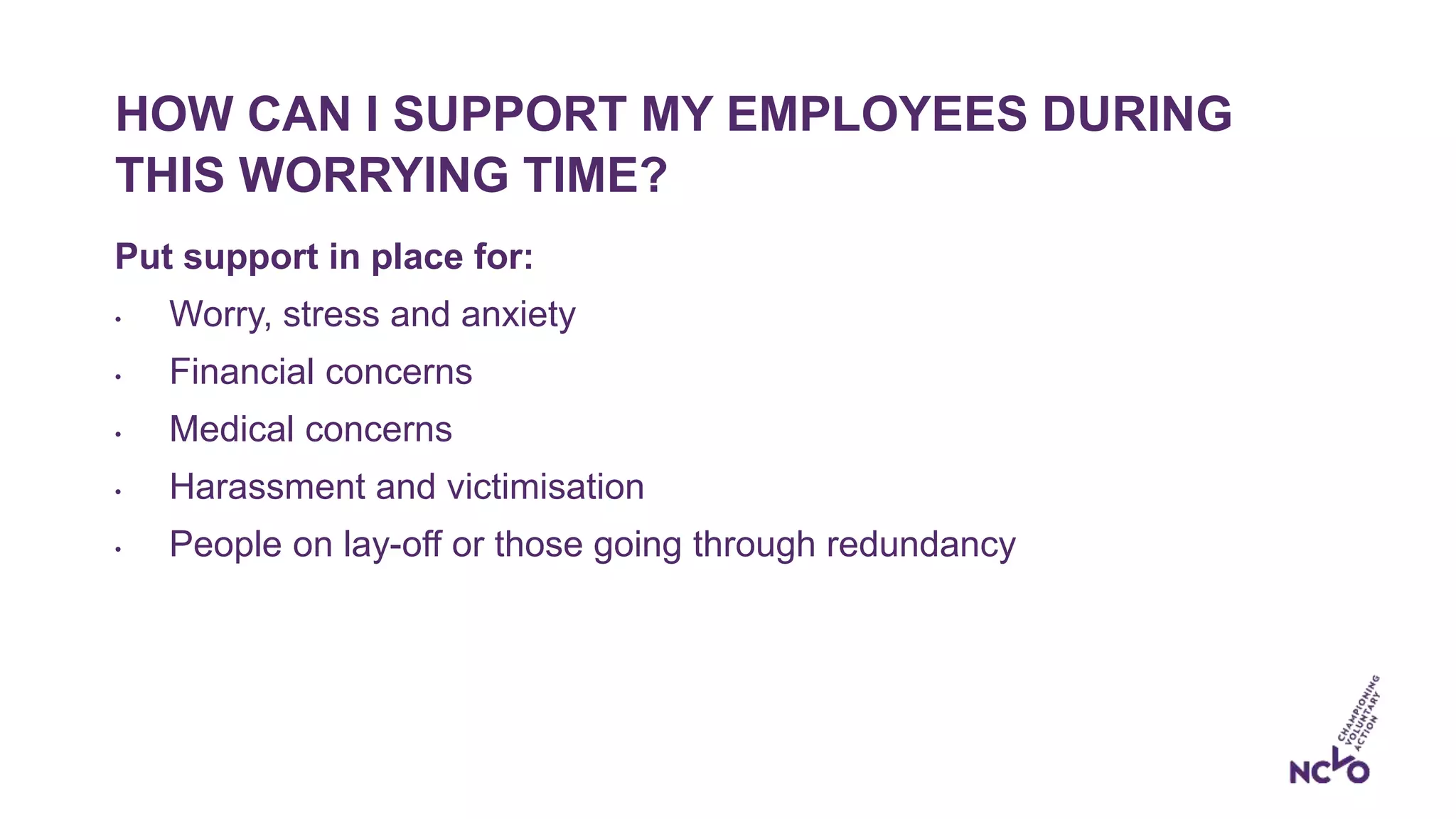
HOW CAN I SUPPORT MY EMPLOYEES DURING
THIS WORRYING TIME?
Put support in place for:
• Worry, stress and anxiety
• Financial concerns
• Medical concerns
• Harassment and victimisation
• People on lay-off or those going through redundancy
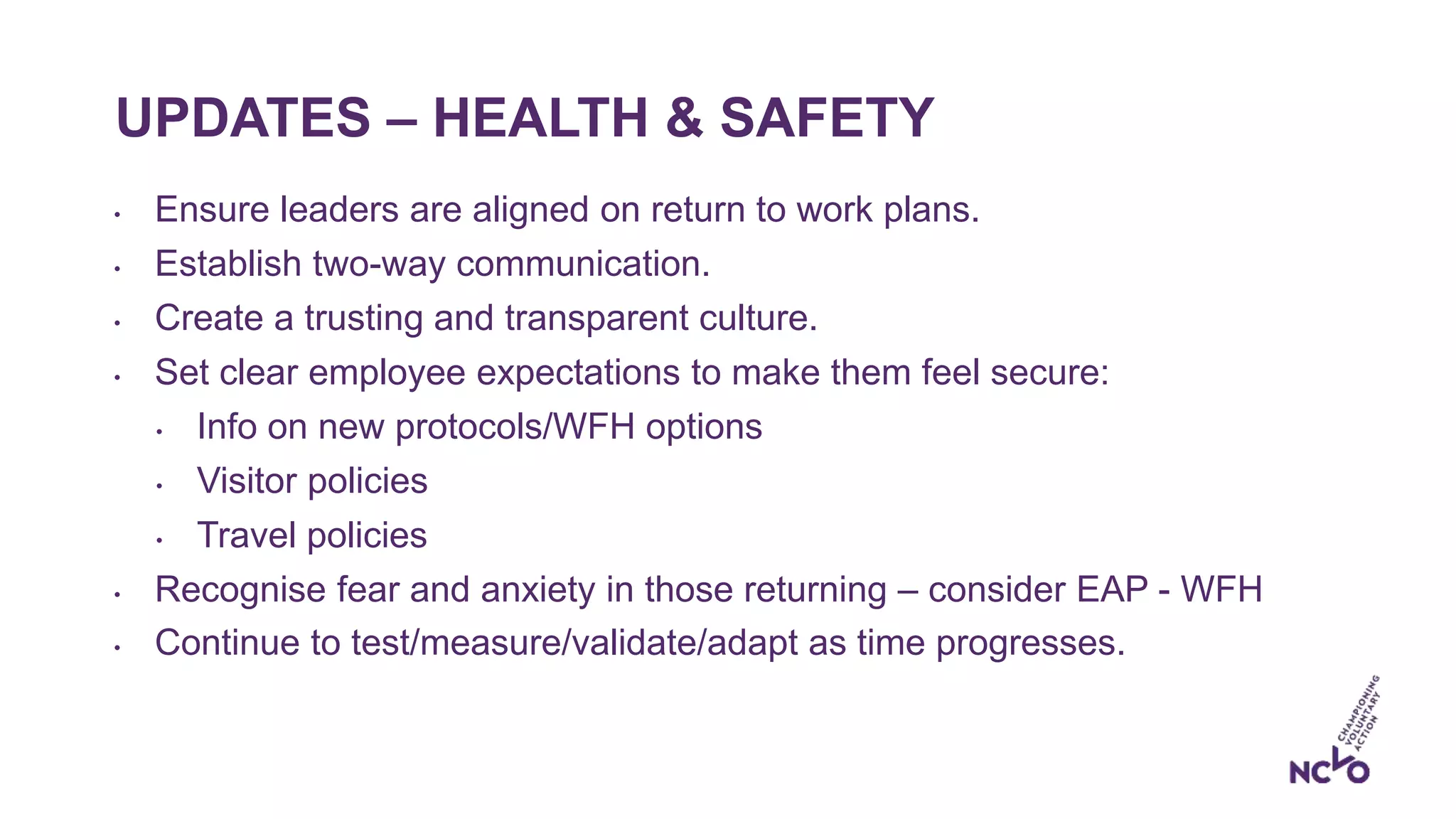
UPDATES – HEALTH & SAFETY
• Ensure leaders are aligned on return to work plans.
• Establish two-way communication.
• Create a trusting and transparent culture.
• Set clear employee expectations to make them feel secure:
• Info on new protocols/WFH options
• Visitor policies
• Travel policies
• Recognise fear and anxiety in those returning – consider EAP - WFH
• Continue to test/measure/validate/adapt as time progresses.
ONGOING CHANGES TO WORKPLACE POLICIES
A thorough analysis of existing policies should be undertaken to include adjustments
made for recent legislation. Some of the policies may include:
• Attendance
• Holidays/paid time off
• Remote work
• Work hours, including start/stop time, breaks, lunch times, flexible hours, and
staggered work hours
• Timekeeping including clock in/out procedures.
• Leave policies including sick leave.
• Travel policies including business and personal travel
• Information technology and usage.
IN PRACTICE: HACKNEY CVS
VICKY SCOTT
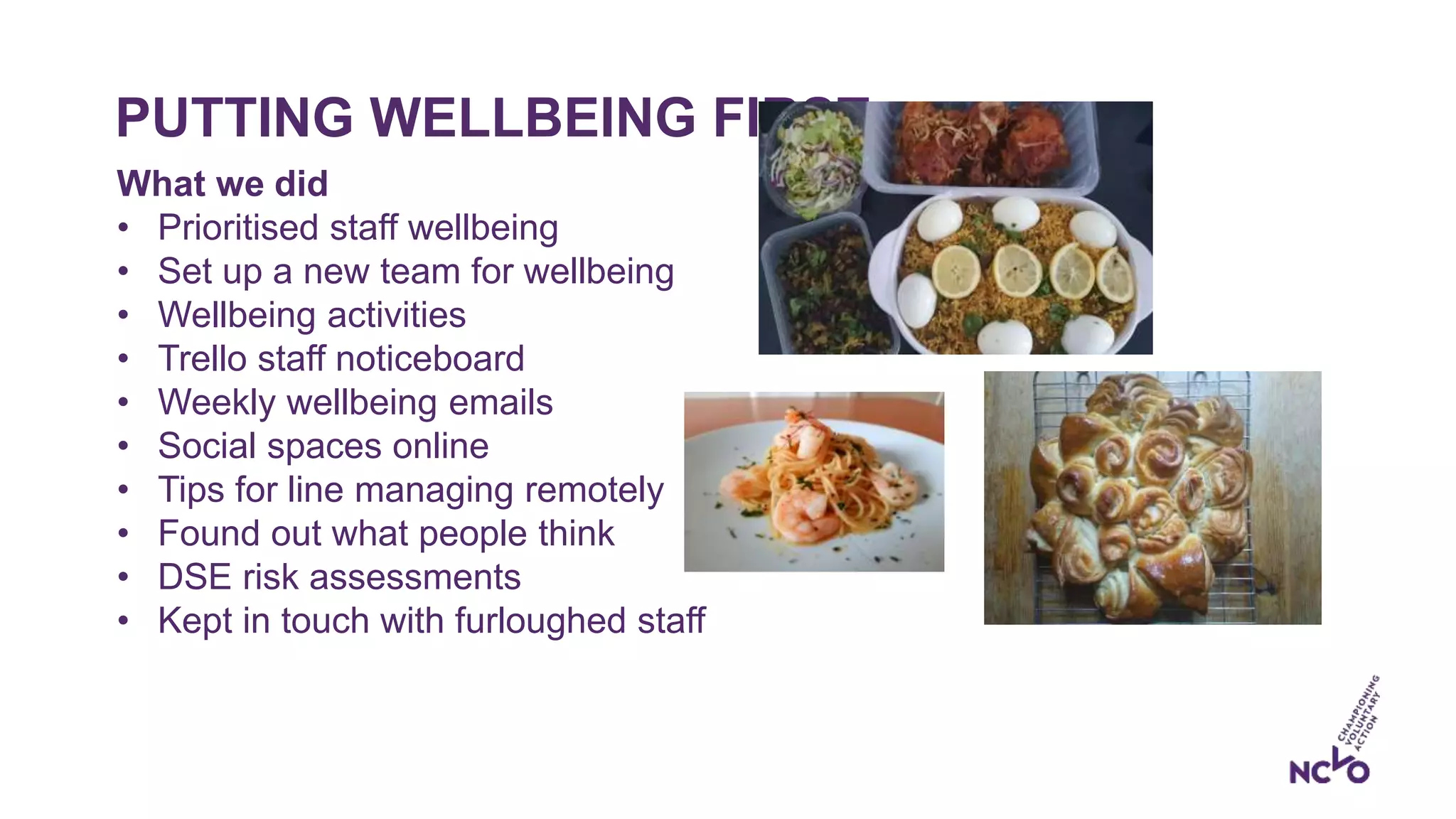
PUTTING WELLBEING FIRST
What we did
• Prioritised staff wellbeing
• Set up a new team for wellbeing
• Wellbeing activities
• Trello staff noticeboard
• Weekly wellbeing emails
• Social spaces online
• Tips for line managing remotely
• Found out what people think
• DSE risk assessments
• Kept in touch with furloughed staff
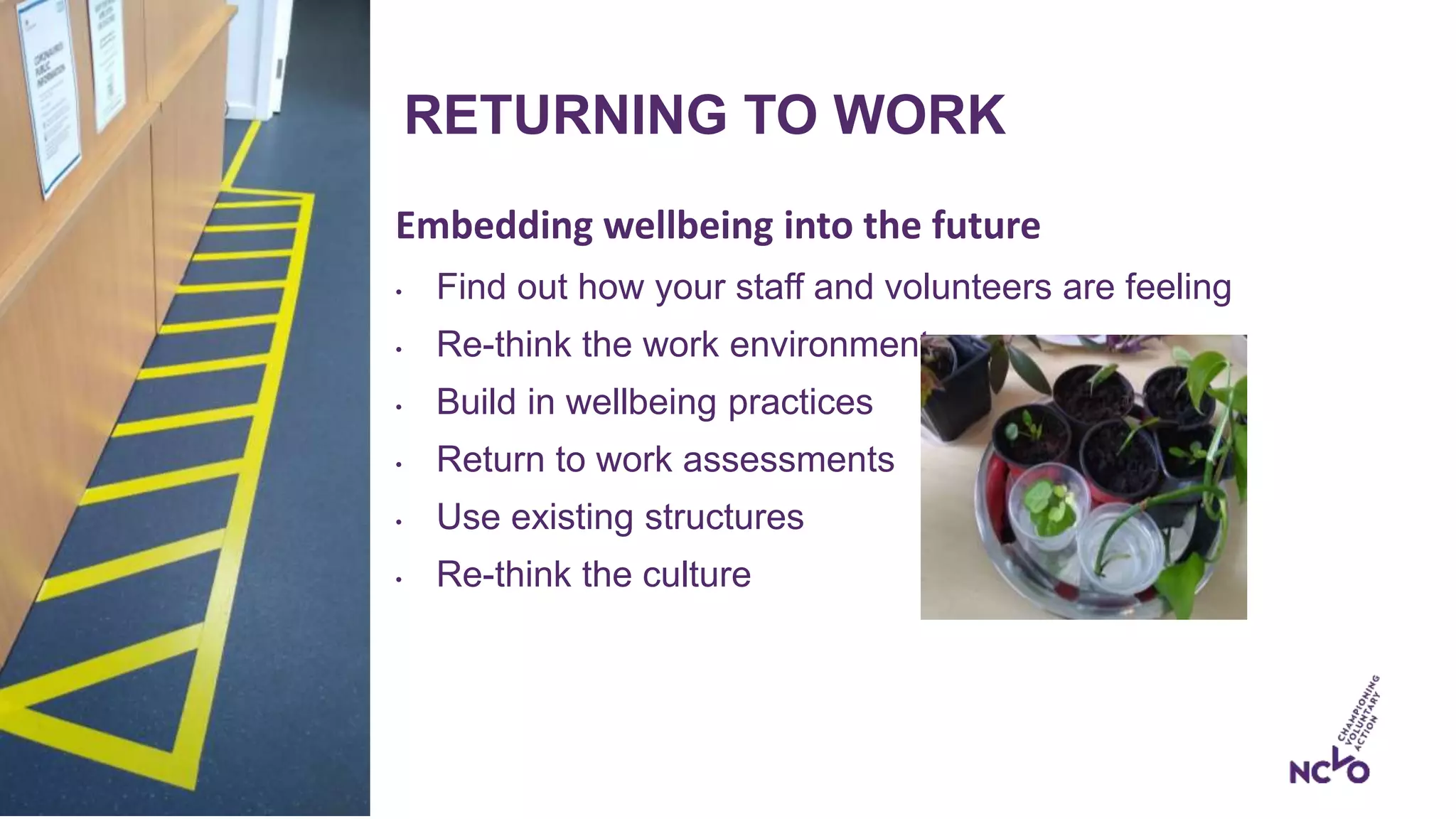
RETURNING TO WORK
Embedding wellbeing into the future
• Find out how your staff and volunteers are feeling
• Re-think the work environment
• Build in wellbeing practices
• Return to work assessments
• Use existing structures
• Re-think the culture
QUESTIONS
PRACTICAL SUPPORT AND RESOURCES
NCVO PRACTICAL SUPPORT
All organisations can access our NCVO Knowhow guidance, tools
and resources.
Check out our webinar series on topics relevant to the pandemic on
NCVO’s training platform.
Next webinar: New Almanac data – covid-19 impact and planning
Recording and signposting to relevant material will be sent round.
We would love to hear your feedback.
USEFUL RESOURCES
NCVO guidance
• Knowhow guidance: Supporting staff and volunteers and employee
rights and entitlements
• Webinar: legal and practical considerations for returning to work
Croner
• Getting back to work toolkit
• Croner business helpline for all organisations: 0844 561 8133
Hackney CVS
• Useful resources for organisations
NCVO champions the voluntary sector and volunteer movement
to create a better society.
We connect, represent and support over 13,000 voluntary sector
member organisations, from the smallest community groups to the
largest charities.
This helps our members and their millions of volunteers make the
biggest difference to the causes they believe in.
• Search for NCVO membership
• Visit www.ncvo.org.uk/join
• Email membership@ncvo.org.uk
25

Easing of lockdown practical considerations for managing and support staff

  • 1.
    EASING OF LOCKDOWN:PRACTICAL CONSIDERATIONS FOR MANAGING AND SUPPORT STAFF 29 JUNE 2020
  • 2.
    WELCOME AND INTRODUCTIONS •Josie Hinton, Capacity-building programmes manager, NCVO • Amanda Chadwick, Croner (NCVO trusted supplier) • Vicky Scott, Operations and HR manager, Hackney CVS
  • 3.
    WHAT WE WILLCOVER • Key HR considerations for employers in returning to work • Update on the furlough scheme and flexible furlough • How employers can support employees at this time • In practice: Hackney CVS
  • 4.
    PRACTICAL CONSIDERATIONS FOR MANAGINGAND SUPPORTING STAFF AMANDA CHADWICK
  • 5.
    COVID-19 EMPLOYEE CONSIDERATIONS •Your duty of care – health and safety Employers have a duty of care towards their employees which includes not exposing them to unnecessary risk. May include not putting them in a position in which they could become infected without taking all reasonable precautions – delegation – policies. • Wellbeing Important to acknowledge that employees will be worried about the virus and that, in most cases, concerns will be valid. In addition to having duty of care to protect health and safety, you also need to consider their wellbeing. Remind employees of any wellbeing initiatives you have.
  • 6.
    POLL 1 Have youtaken advantage of the government’s furlough scheme? 1. Yes 2. No
  • 7.
    UPDATES – FURLOUGHSCHEME • No change on level of assistance during June and July. • From the start of August, employers will have to pay the national insurance contributions and employer’s pension contributions (this comes to 5% of total wage costs in average claim). • From the start of September, employers will have to contribute 10% towards the 80% wages of furloughed employees, plus NI and pension contributions as above. The Scheme will fund 70% of wage. • From start of October, employers will have to contribute 20% towards the 80% wages of furloughed employees, plus NI and pension contributions as above. The Scheme will fund 60% of wage. • The Scheme will close at the end of October.
  • 8.
    FURLOUGH/FLEXIBLE FURLOUGH • From1 July 2020, furloughed staff will be able to be brought back to work on a part-time basis. • New agreement • This means that employers will still be able to claim the furlough grant for the hours their flexibly furloughed employees do not work, compared to the hours they would normally have worked in that period. • From 1 July 2020, only employees that their employer has previously successfully claimed a previous grant for will be eligible for more grants under the furlough scheme. • Exemptions apply
  • 9.
    HOLIDAYS AND FURLOUGH •Annual leave • Bank holidays • Contractual rules • Working time regulations • Utilising excess holidays and management • Request and refusal • Family friendly rights and flexible working rights
  • 10.
    FACTORS TO CONSIDERBEFORE REOPENING • Employees may be hesitant to return to work if they have concerns that overall conditions are not sufficiently safe. • Specific circumstances, refusal options, other leave. • Your back-to-work plans may depend on your location or sector. • Parents may find it difficult to go back to work if schools or day caring centres remain shut. • It is unlikely all staff will be able to return at once. • Speak to employees. • Return to work interviews – commitments. • Keeping in touch. • Measured response and communication.
  • 11.
    WHAT DO WEPAY SOMEONE WHO SELF-ISOLATES? Currently, SSP applies to any employee with covid-19 or in self-isolation Make sure your written sickness policy reflects what your business provides, either SSP or contractual sick pay Recovery of SSP Emergency legislation will also enable employers to recover SSP payments for coronavirus from the government Only applies to employers with fewer than 250 employees and only to a maximum of 14 days’ SSP payment. Government claim site opened on the 26 May 2020 Communication/health conditions/pregnancy
  • 12.
    WHAT HAPPENS IFSCHOOLS REMAIN CLOSED AND STAFF HAVE TO LOOK AFTER THEIR CHILDREN?• Look into alternatives such as letting staff work from home or take annual leave • Explain how pay and working applies over this period • Have clear absence reporting and time off for dependants' policies • Keep those staff furloughed if possible • Provide employees with guidance on childcare (EAP) • Ensure all of this is reflected in your company handbook.
  • 13.
    WHAT IF ITEMPORARILY CLOSE THE ORGANISATION DUE TO LACK OF WORK OR LOCAL LOCKDOWN/INFECTIONS?• Give employees written confirmation of policies • Track all absences (including lay-offs) to help manage staffing levels and workloads • Plan for a return to business – may need to consider staged returns, lay-offs, role adjustments, training, redundancies FAQ: Can we lay someone off without a lay-off policy? You can, but as there would be no policy in place to protect your business, the employee you laid-off would be entitled to full pay depending on length of service.
  • 14.
    POLL 2 What hasbeen your key concern in managing and supporting staff during covid-19? 1. Supporting staff wellbeing 2. Ensuring we have the appropriate policies and procedures 3. Managing capacity with furlough 4. Adapting to an online environment 14
  • 15.
    HOW CAN ISUPPORT MY EMPLOYEES DURING THIS WORRYING TIME? Put support in place for: • Worry, stress and anxiety • Financial concerns • Medical concerns • Harassment and victimisation • People on lay-off or those going through redundancy
  • 16.
    UPDATES – HEALTH& SAFETY • Ensure leaders are aligned on return to work plans. • Establish two-way communication. • Create a trusting and transparent culture. • Set clear employee expectations to make them feel secure: • Info on new protocols/WFH options • Visitor policies • Travel policies • Recognise fear and anxiety in those returning – consider EAP - WFH • Continue to test/measure/validate/adapt as time progresses.
  • 17.
    ONGOING CHANGES TOWORKPLACE POLICIES A thorough analysis of existing policies should be undertaken to include adjustments made for recent legislation. Some of the policies may include: • Attendance • Holidays/paid time off • Remote work • Work hours, including start/stop time, breaks, lunch times, flexible hours, and staggered work hours • Timekeeping including clock in/out procedures. • Leave policies including sick leave. • Travel policies including business and personal travel • Information technology and usage.
  • 18.
    IN PRACTICE: HACKNEYCVS VICKY SCOTT
  • 19.
    PUTTING WELLBEING FIRST Whatwe did • Prioritised staff wellbeing • Set up a new team for wellbeing • Wellbeing activities • Trello staff noticeboard • Weekly wellbeing emails • Social spaces online • Tips for line managing remotely • Found out what people think • DSE risk assessments • Kept in touch with furloughed staff
  • 20.
    RETURNING TO WORK Embeddingwellbeing into the future • Find out how your staff and volunteers are feeling • Re-think the work environment • Build in wellbeing practices • Return to work assessments • Use existing structures • Re-think the culture
  • 21.
  • 22.
  • 23.
    NCVO PRACTICAL SUPPORT Allorganisations can access our NCVO Knowhow guidance, tools and resources. Check out our webinar series on topics relevant to the pandemic on NCVO’s training platform. Next webinar: New Almanac data – covid-19 impact and planning Recording and signposting to relevant material will be sent round. We would love to hear your feedback.
  • 24.
    USEFUL RESOURCES NCVO guidance •Knowhow guidance: Supporting staff and volunteers and employee rights and entitlements • Webinar: legal and practical considerations for returning to work Croner • Getting back to work toolkit • Croner business helpline for all organisations: 0844 561 8133 Hackney CVS • Useful resources for organisations
  • 25.
    NCVO champions thevoluntary sector and volunteer movement to create a better society. We connect, represent and support over 13,000 voluntary sector member organisations, from the smallest community groups to the largest charities. This helps our members and their millions of volunteers make the biggest difference to the causes they believe in. • Search for NCVO membership • Visit www.ncvo.org.uk/join • Email membership@ncvo.org.uk 25