Assessing health & safety risks in uncertain times
20th May 2020
Sharon Kearns
Risk Consultant, Zurich Insurance
©Zurich
 Review the risk environment and identify key operational risks
 Benefits of a risk assessment approach
 Risk control hierarchy and selection
 Risk assessment and liability defence
Objectives
2
©Zurich
 Understanding the basics of risk management
– Why is risk management important?
– What particular risks do charities face?
– How can risk be managed?
– Disaster recovery planning
 Risk management model
– Establishing a risk policy
– Identifying risks
– Assessing risk
– Evaluating what action needs to be taken
– Periodic monitoring and assessment
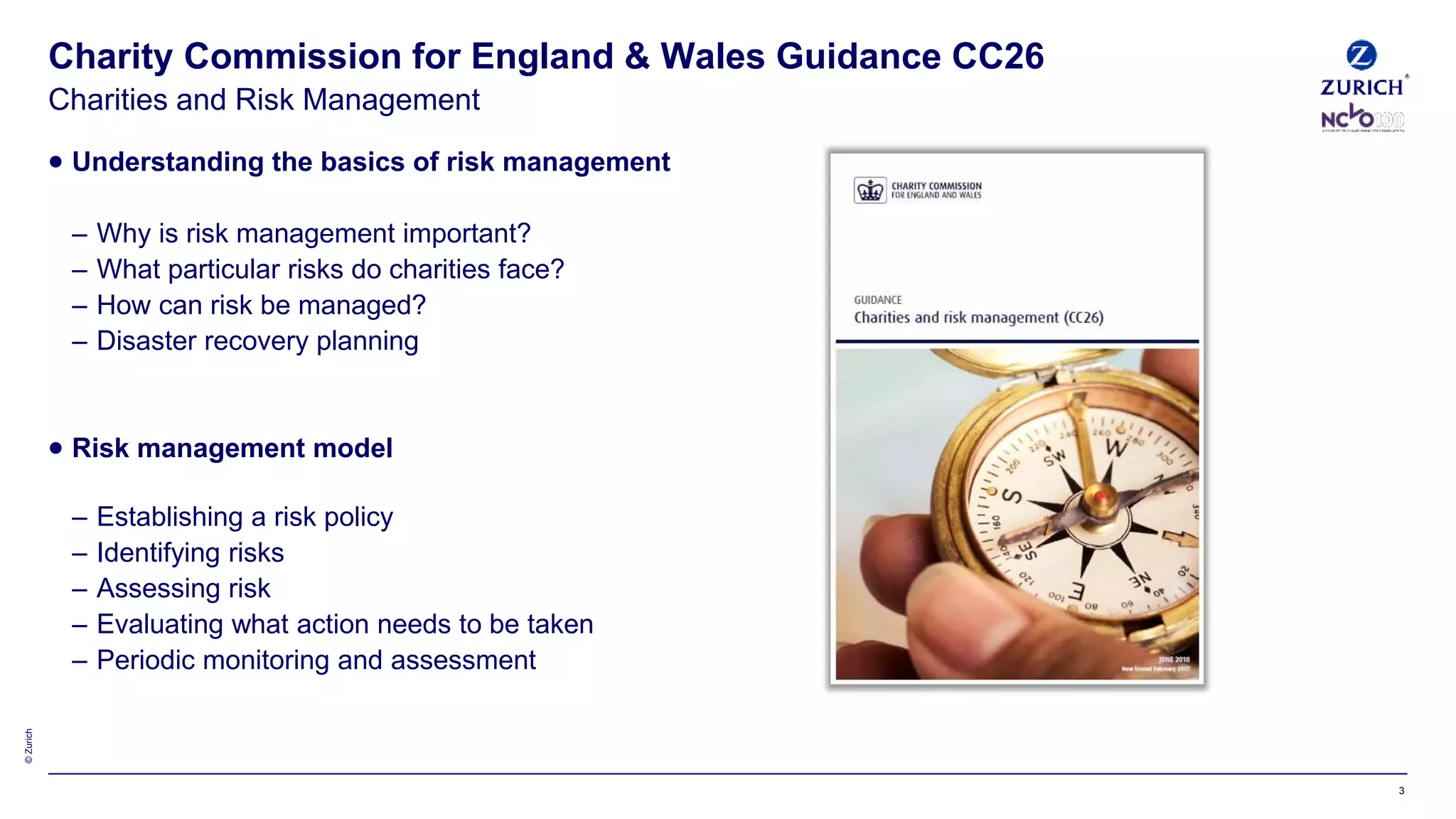
Charity Commission for England & Wales Guidance CC26
Charities and Risk Management
3
©Zurich
4
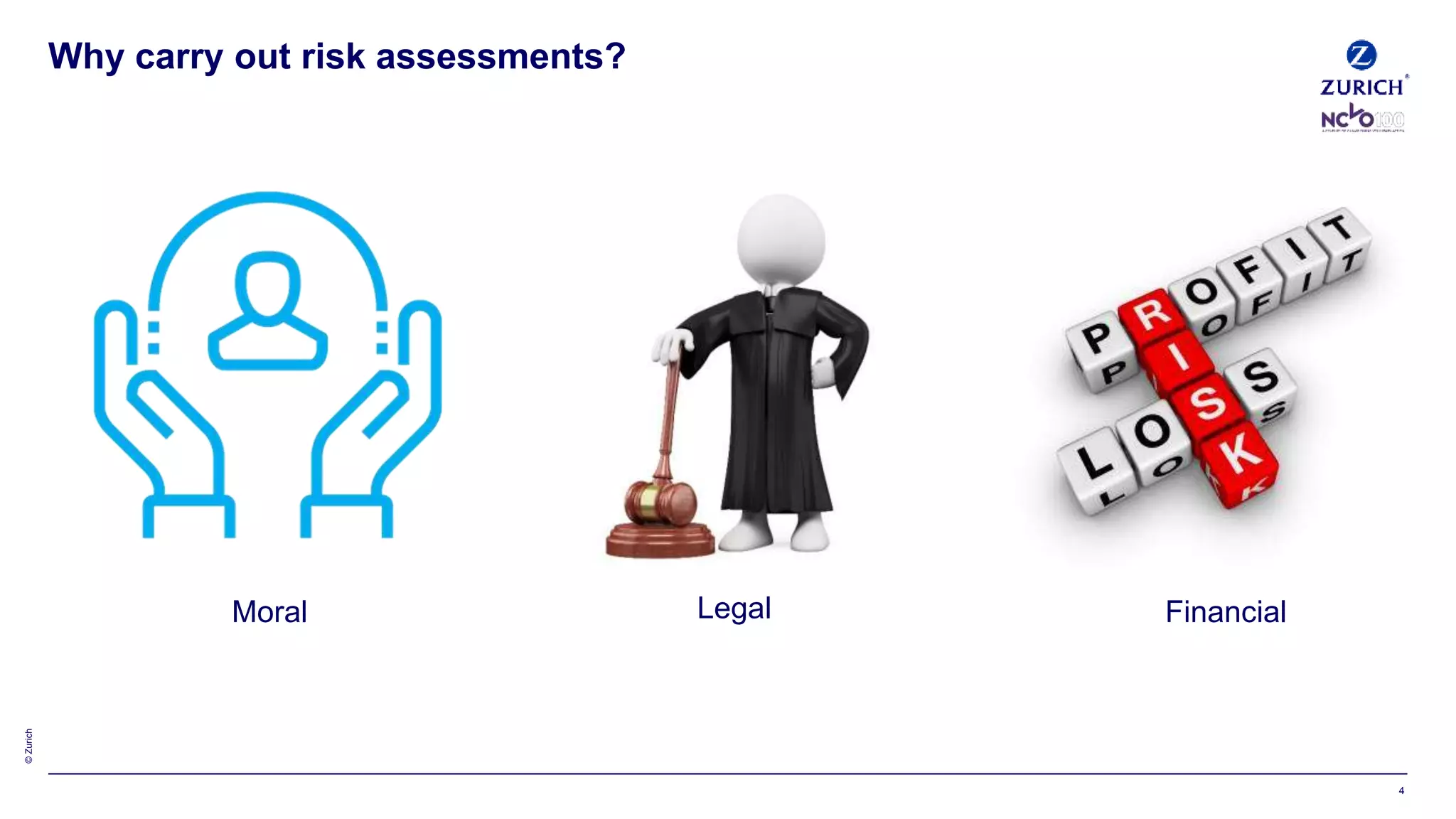
Moral Legal Financial
Why carry out risk assessments?
©Zurich
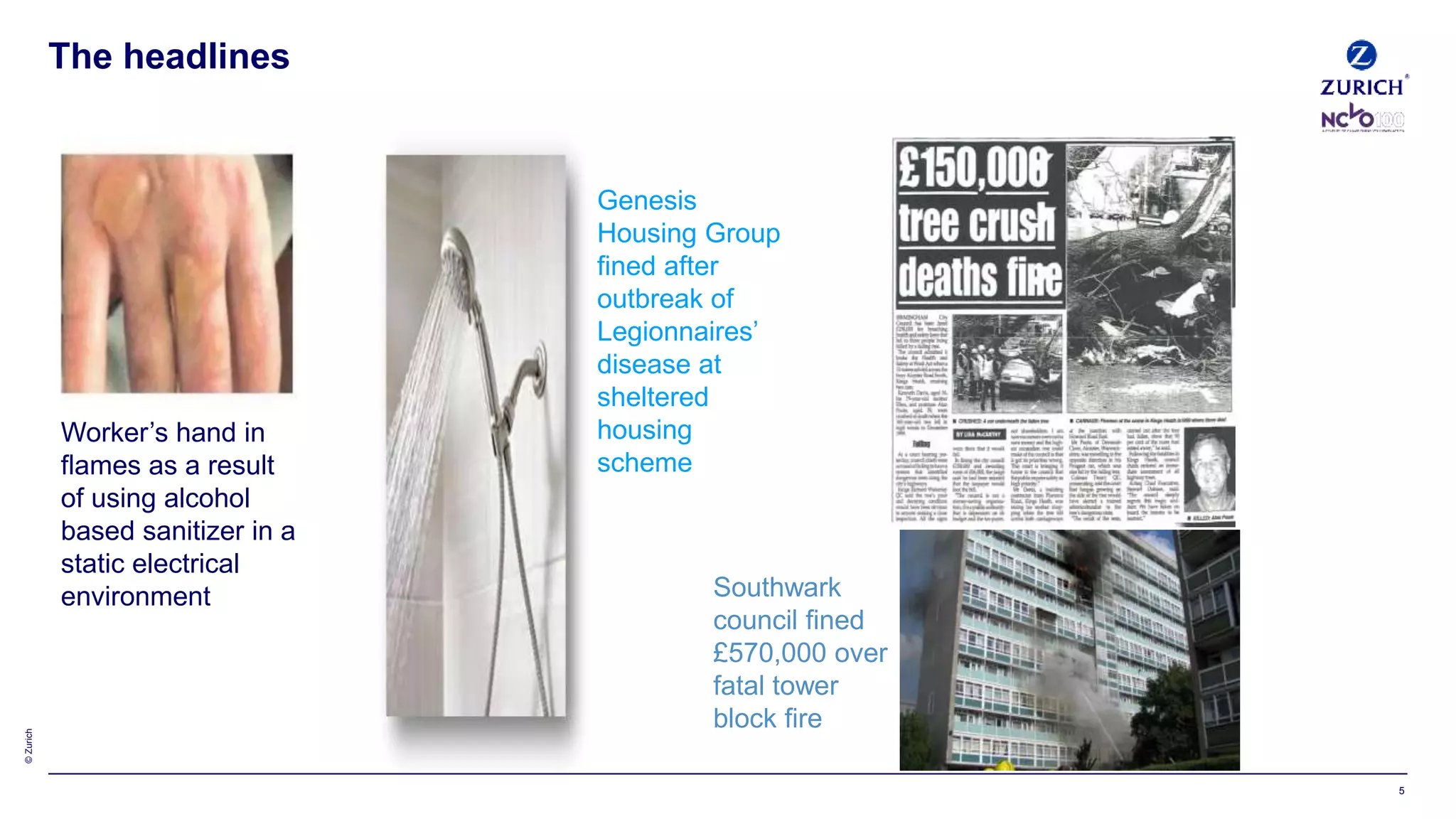
The headlines
5
Genesis
Housing Group
fined after
outbreak of
Legionnaires’
disease at
sheltered
housing
scheme
Southwark
council fined
£570,000 over
fatal tower
block fire
Worker’s hand in
flames as a result
of using alcohol
based sanitizer in a
static electrical
environment
©Zurich
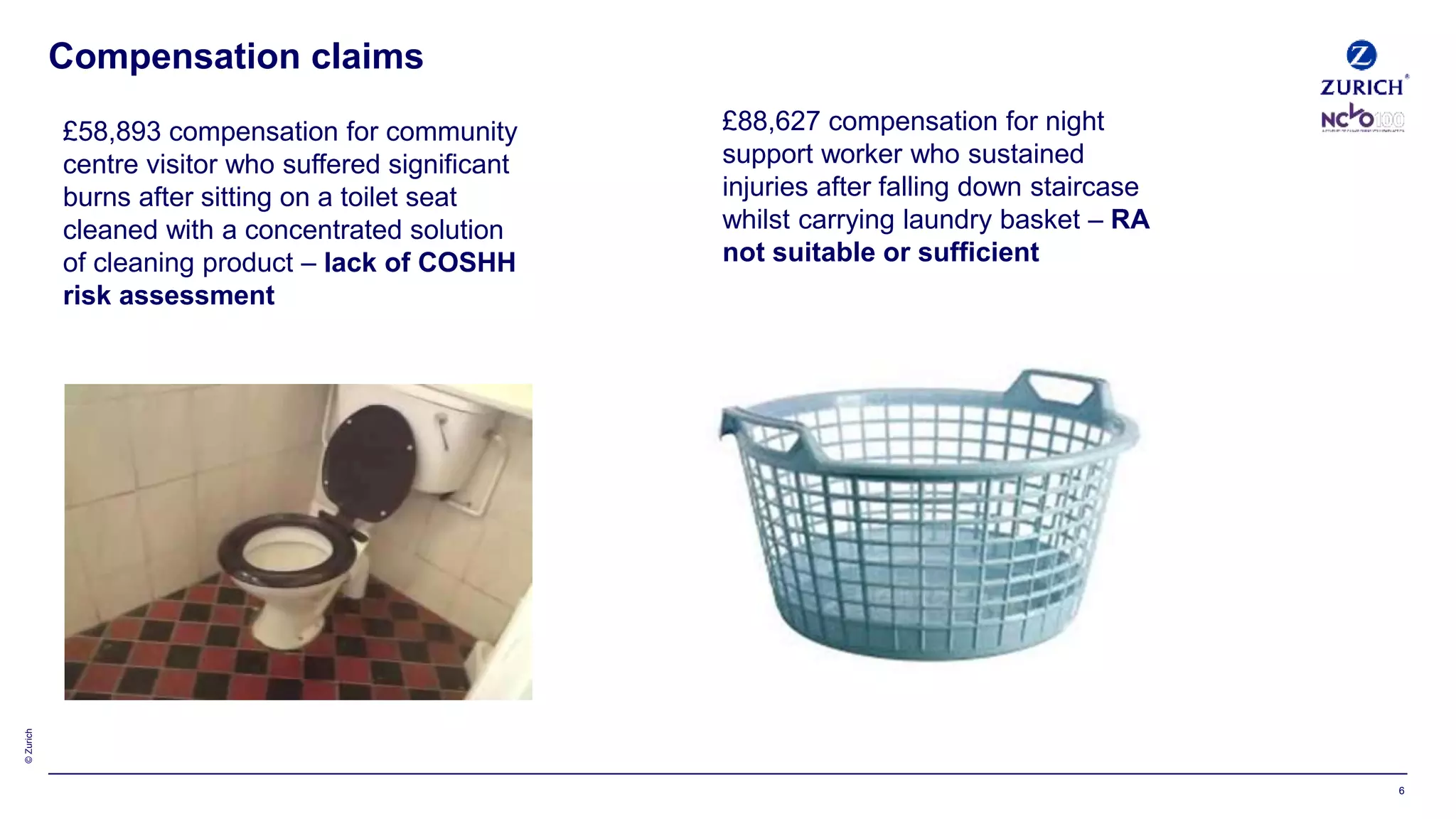
Compensation claims
6
£88,627 compensation for night
support worker who sustained
injuries after falling down staircase
whilst carrying laundry basket – RA
not suitable or sufficient
£58,893 compensation for community
centre visitor who suffered significant
burns after sitting on a toilet seat
cleaned with a concentrated solution
of cleaning product – lack of COSHH
risk assessment
©Zurich
“A systematic examination of a work
activity, undertaking, premises/area, equipment, etc..” HSE
Risk = Likelihood (probability) x Severity
Carried out by competent person
What is a risk assessment?
7
©Zurich
Have you formally identified the competent
health & safety risk assessors in your
organisation?
YES or NO
Go to slido now to vote
Poll
8
©Zurich
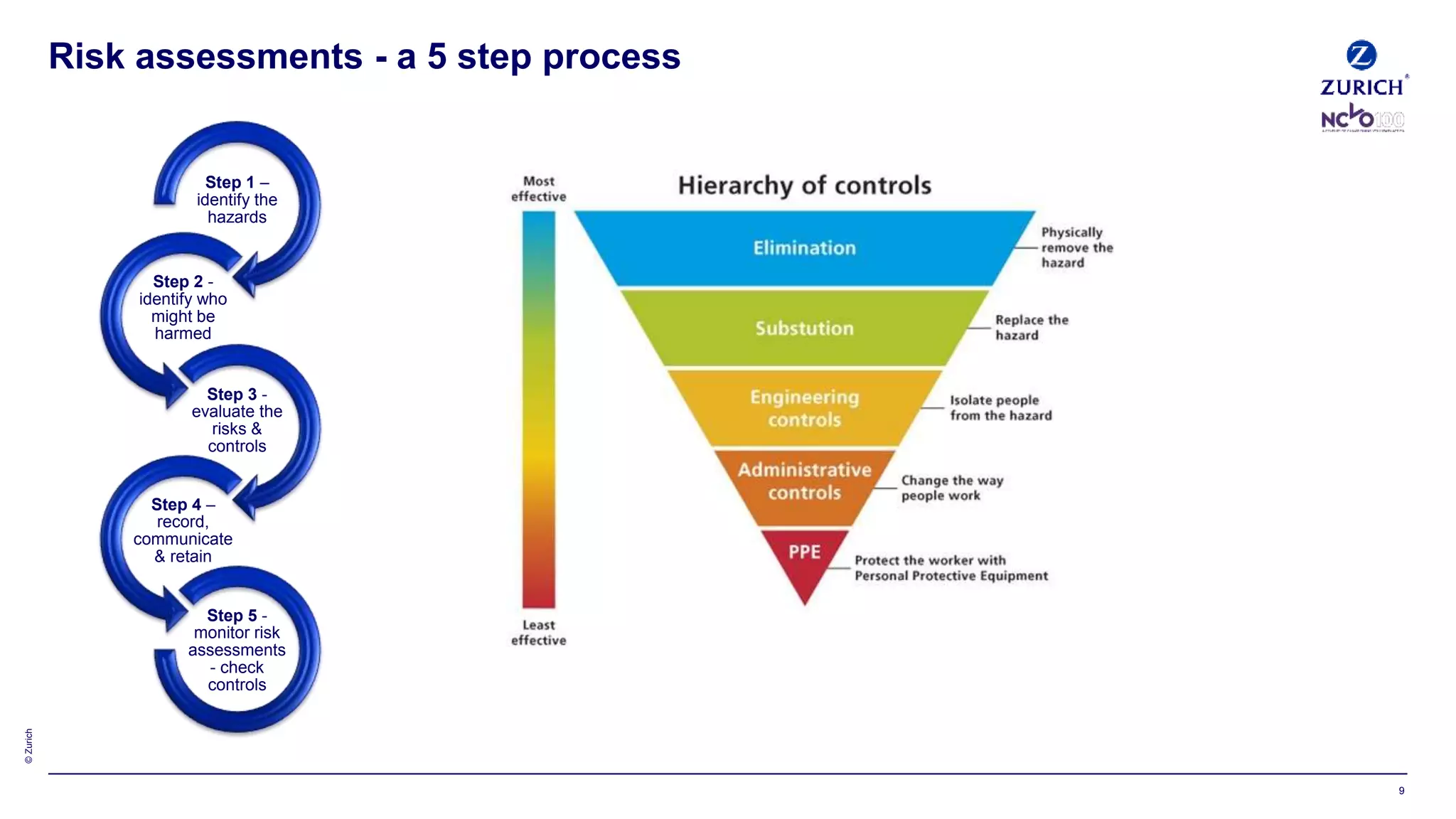
9
Step 1 –
identify the
hazards
Step 2 -
identify who
might be
harmed
Step 3 -
evaluate the
risks &
controls
Step 4 –
record,
communicate
& retain
Step 5 -
monitor risk
assessments
- check
controls
Risk assessments - a 5 step process
©Zurich
10
Covid-19 presents a new risk…
©Zurich
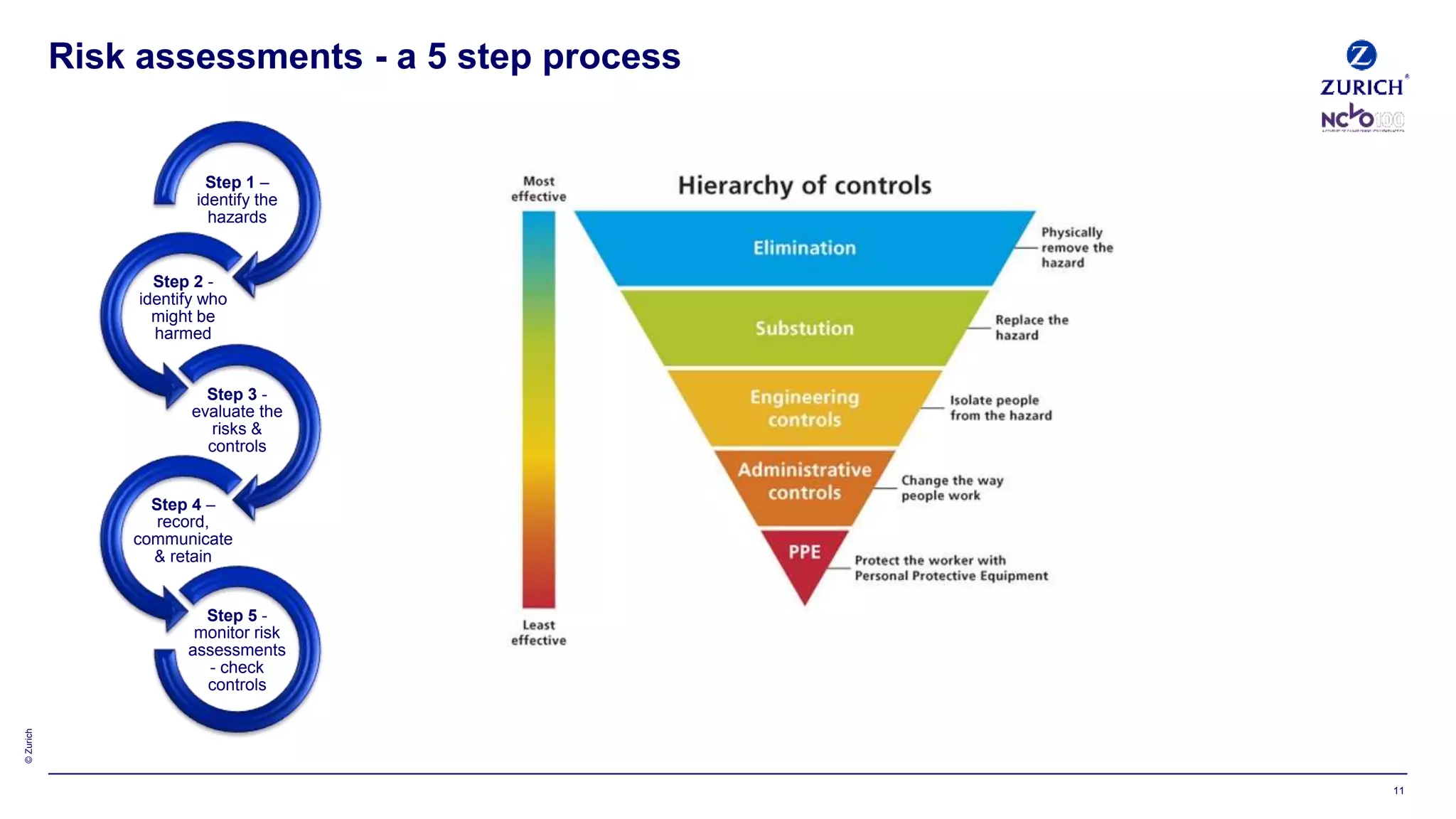
11
Step 1 –
identify the
hazards
Step 2 -
identify who
might be
harmed
Step 3 -
evaluate the
risks &
controls
Step 4 –
record,
communicate
& retain
Step 5 -
monitor risk
assessments
- check
controls
Risk assessments - a 5 step process
©Zurich
 All safe systems of work should be reviewed e.g.
– Can the work be carried out from home?
– Can travel to a job be carried out whilst observing social distancing rules?
– Can tasks be carried out safely while observing social distancing rules?
– Can normal and emergency operations continue safely with fewer staff at work, or
when those with key skills are absent?
– Can the required PPE be provided to continue a specific task?
– Will fatigue be likely if staff are working longer hours?
* Government advice - certain types of businesses / work must close during the lockdown.
Safe systems of work
12
©Zurich
13
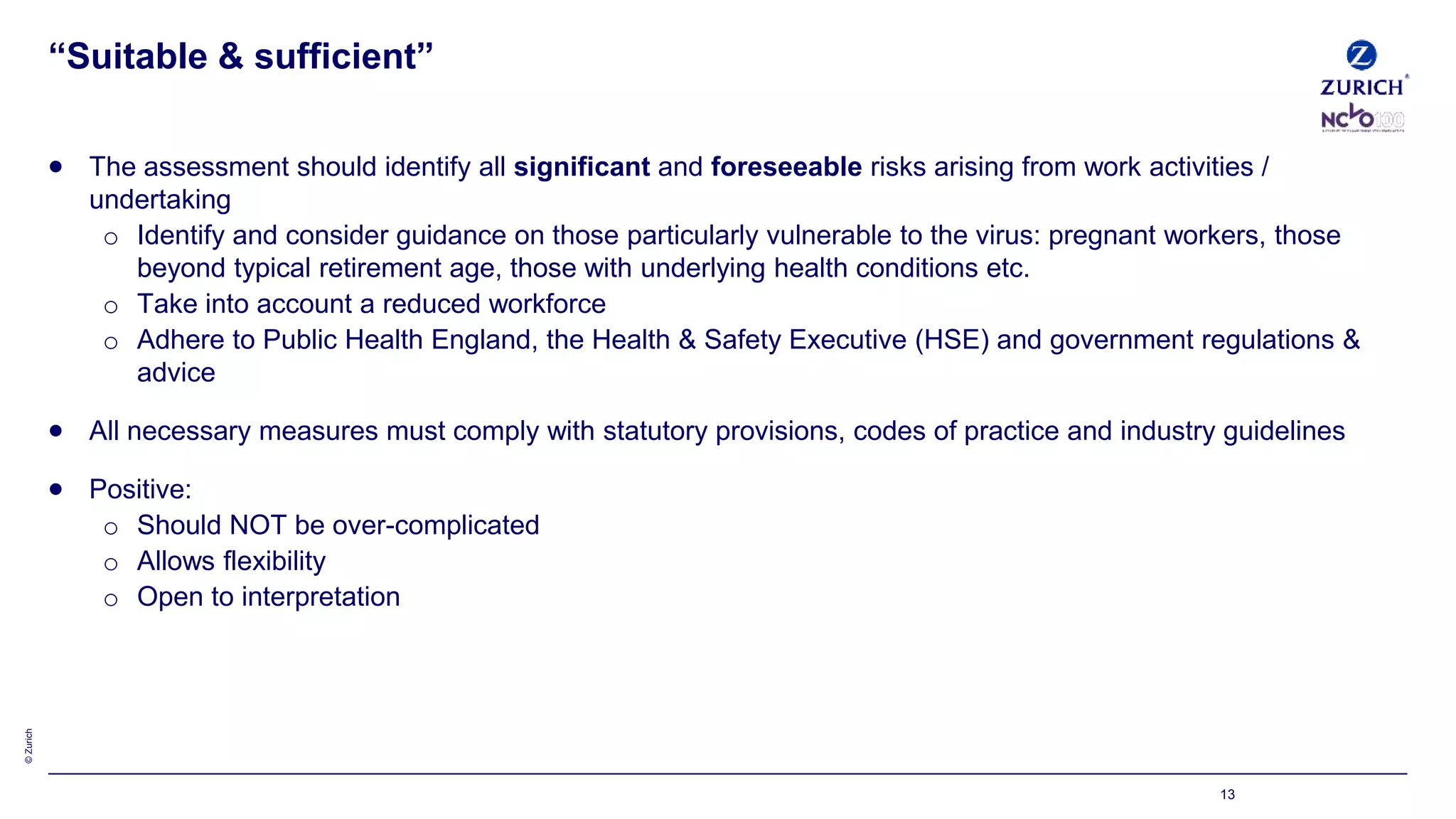
“Suitable & sufficient”
 The assessment should identify all significant and foreseeable risks arising from work activities /
undertaking
o Identify and consider guidance on those particularly vulnerable to the virus: pregnant workers, those
beyond typical retirement age, those with underlying health conditions etc.
o Take into account a reduced workforce
o Adhere to Public Health England, the Health & Safety Executive (HSE) and government regulations &
advice
 All necessary measures must comply with statutory provisions, codes of practice and industry guidelines
 Positive:
o Should NOT be over-complicated
o Allows flexibility
o Open to interpretation
©Zurich
14
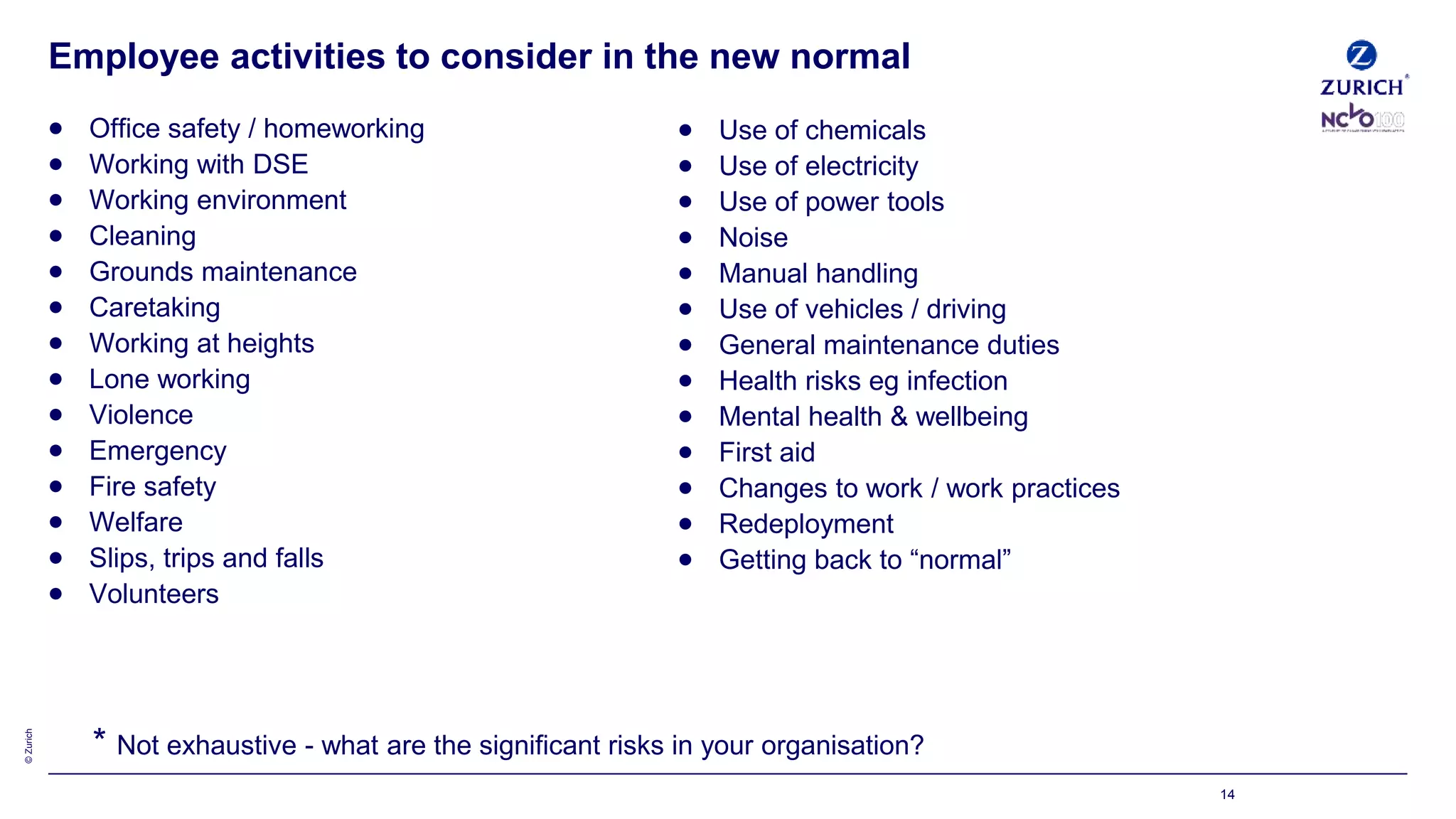
 Office safety / homeworking
 Working with DSE
 Working environment
 Cleaning
 Grounds maintenance
 Caretaking
 Working at heights
 Lone working
 Violence
 Emergency
 Fire safety
 Welfare
 Slips, trips and falls
 Volunteers
 Use of chemicals
 Use of electricity
 Use of power tools
 Noise
 Manual handling
 Use of vehicles / driving
 General maintenance duties
 Health risks eg infection
 Mental health & wellbeing
 First aid
 Changes to work / work practices
 Redeployment
 Getting back to “normal”
* Not exhaustive - what are the significant risks in your organisation?
Employee activities to consider in the new normal
©Zurich
15
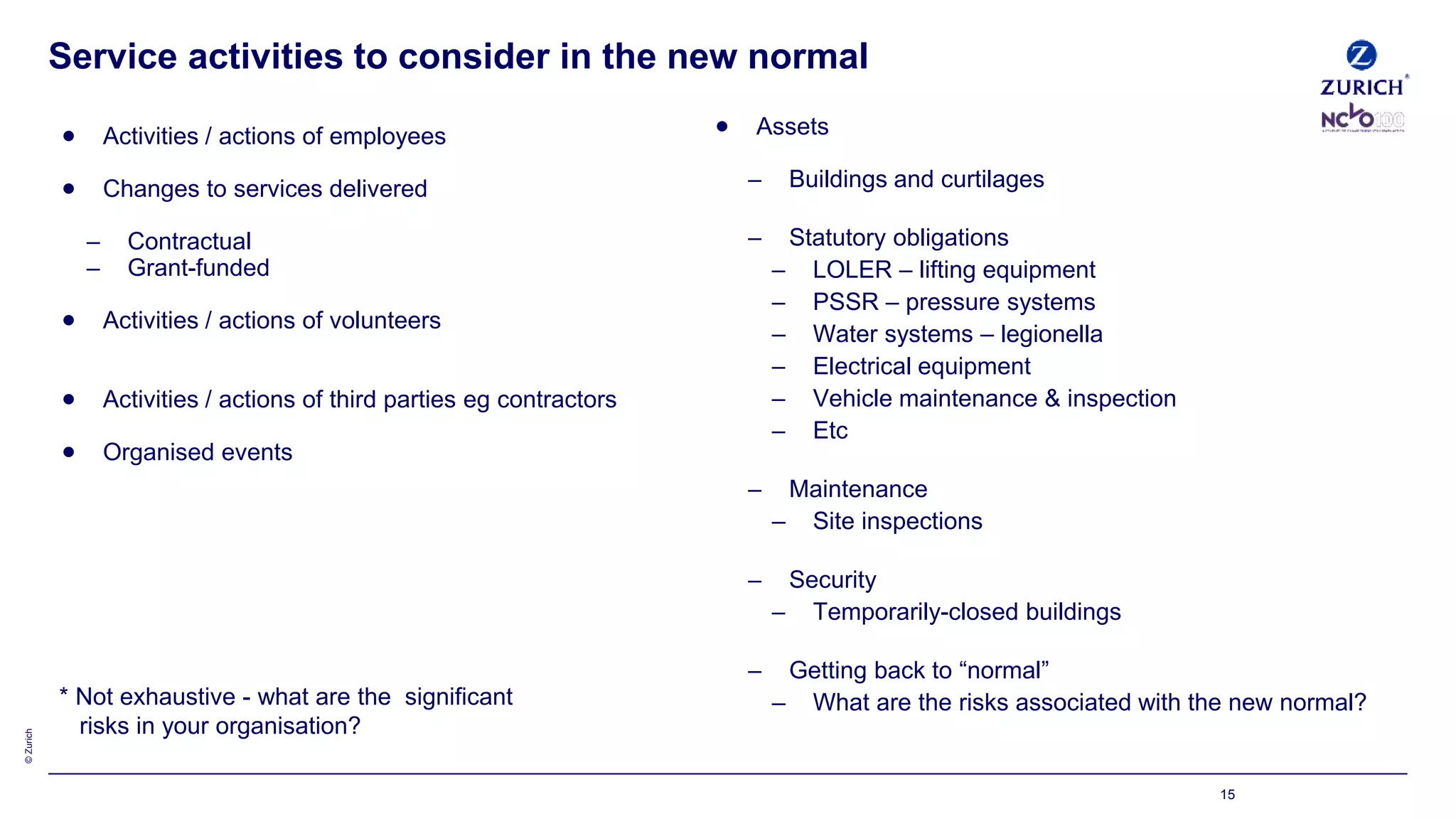
Service activities to consider in the new normal
 Activities / actions of employees
 Changes to services delivered
– Contractual
– Grant-funded
 Activities / actions of volunteers
 Activities / actions of third parties eg contractors
 Organised events
 Assets
– Buildings and curtilages
– Statutory obligations
– LOLER – lifting equipment
– PSSR – pressure systems
– Water systems – legionella
– Electrical equipment
– Vehicle maintenance & inspection
– Etc
– Maintenance
– Site inspections
– Security
– Temporarily-closed buildings
– Getting back to “normal”
– What are the risks associated with the new normal?* Not exhaustive - what are the significant
risks in your organisation?
©Zurich
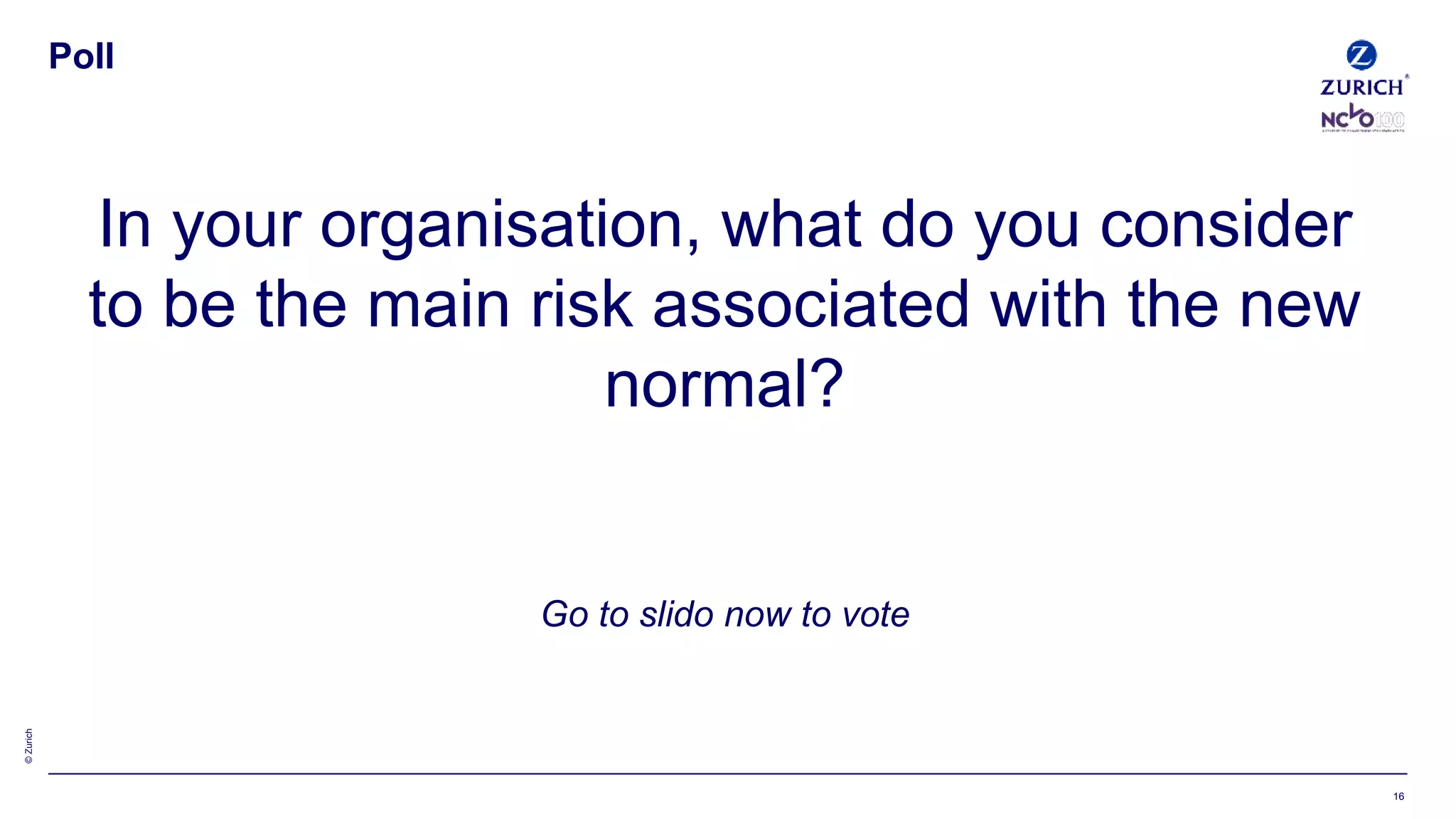
Poll
In your organisation, what do you consider
to be the main risk associated with the new
normal?
Go to slido now to vote
16
©Zurich
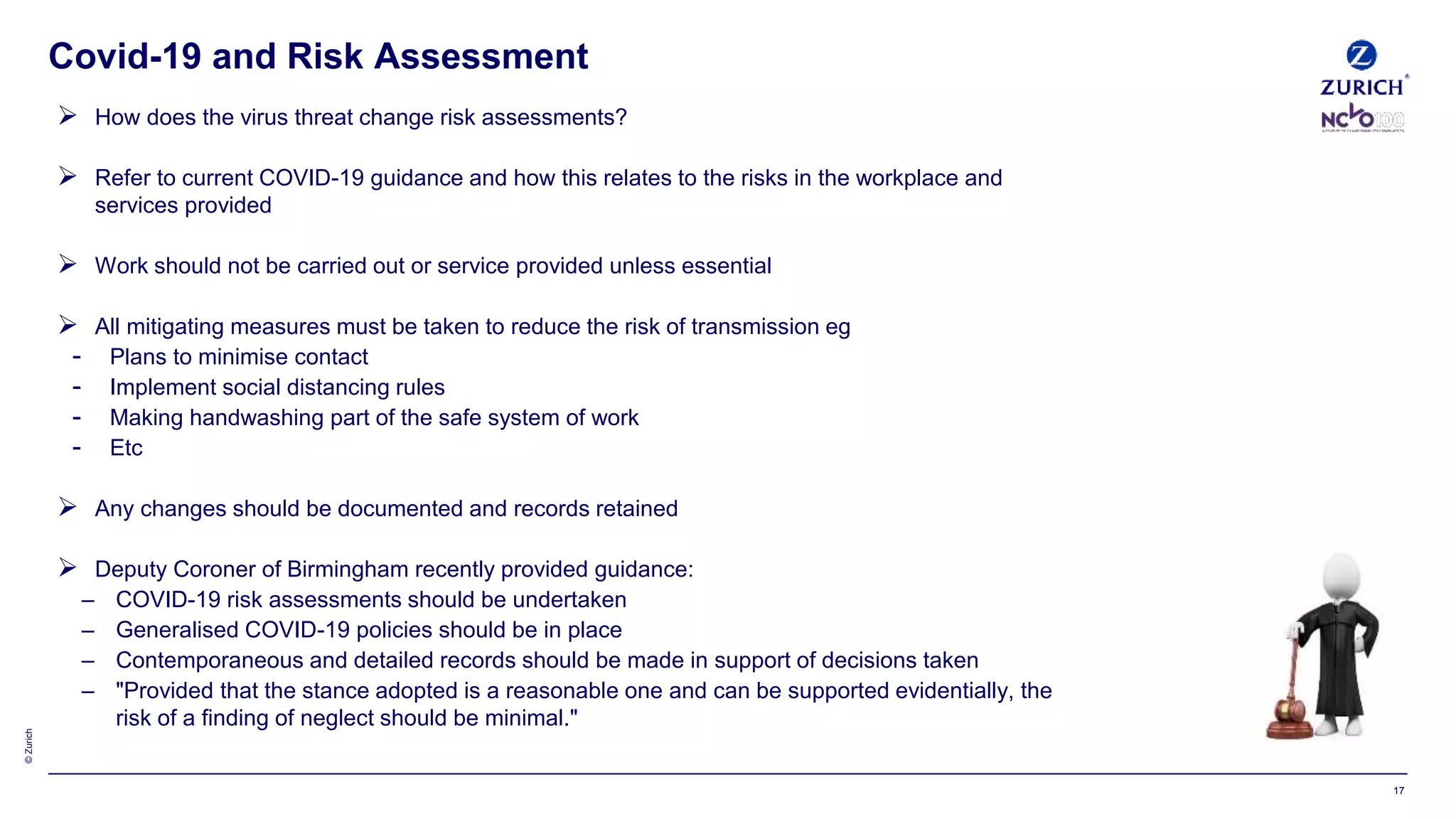
Covid-19 and Risk Assessment
17
 How does the virus threat change risk assessments?
 Refer to current COVID-19 guidance and how this relates to the risks in the workplace and
services provided
 Work should not be carried out or service provided unless essential
 All mitigating measures must be taken to reduce the risk of transmission eg
- Plans to minimise contact
- Implement social distancing rules
- Making handwashing part of the safe system of work
- Etc
 Any changes should be documented and records retained
 Deputy Coroner of Birmingham recently provided guidance:
– COVID-19 risk assessments should be undertaken
– Generalised COVID-19 policies should be in place
– Contemporaneous and detailed records should be made in support of decisions taken
– "Provided that the stance adopted is a reasonable one and can be supported evidentially, the
risk of a finding of neglect should be minimal."
©Zurich
18
• Review existing risk assessments
• Complete risk assessments for new or changed practices
• Review controls and safe systems in place in the wake of COVID
19
• Confirm that controls reduce the likelihood of the risk occurring or
mitigate it’s impact
• Ensure that risks assessments, controls and safe systems of work
are recorded
• Monitor the implementation of safe systems of work
• Review risk assessments and safe systems of work
“Would it be reasonably practicable to do more taking into account
circumstances of your services and Covid-19?”
Covid-19 – risk assess, risk assess, risk assess
©Zurich
 NCVO is collecting information about how lockdown will affect charities – please complete and submit
– https://www.ncvo.org.uk/easing-lockdown-form
– https://knowhow.ncvo.org.uk/tools-resources/risk-management/template-risk-register
Sharing your experience
19
©Zurich
20
 https://www.gov.uk/government/publications/charities-and-risk-management-cc26
 https://www.zurich.co.uk/municipal/en-gb/risk-management
 https://www.zurich.co.uk/insurance/coronavirus
 membership@ncvo.org.uk
 News & Views - Zurich
 Managing Safety at Events - Zurich Municipal
 Local Community Advisory Service - Zurich Municipal
 www.hse.gov.uk
 https://www.gov.uk/guidance/social-distancing-in-the-workplace-during-coronavirus-covid-19-sector-
guidance
 https://www.gov.uk/guidance/coronavirus-covid-19-guidance-for-the-charity-sector
 https://www.gov.uk/government/publications/guidance-to-employers-and-businesses-about-covid-19
 https://www.ncvo.org.uk/practical-support/information/coronavirus
 https://www.gov.uk/government/publications/guidance-for-social-or-community-care-and-residential-
settings-on-covid-19/guidance-for-social-or-community-care-and-residential-settings-on-covid-19
 https://www.gov.uk/government/publications/guidance-to-educational-settings-about-covid-19/guidance-to-
educational-settings-about-covid-19
 https://www.gov.uk/government/publications/covid-19-residential-care-supported-living-and-home-care-
guidance/covid-19-guidance-on-home-care-provision
 https://www.hse.gov.uk/toolbox/ppe.htm
 https://www.gov.uk/government/publications/covid-19-guidance-on-social-distancing-and-for-vulnerable-
people/guidance-on-social-distancing-for-everyone-in-the-uk-and-protecting-older-people-and-vulnerable-
adults
 https://www.gov.uk/government/publications/covid-19-decontamination-in-non-healthcare-settings/covid-
19-decontamination-in-non-healthcare-settings
Useful references

Assessing health and safety risk in uncertain times

  • 1.
    Assessing health &safety risks in uncertain times 20th May 2020 Sharon Kearns Risk Consultant, Zurich Insurance
  • 2.
    ©Zurich  Review therisk environment and identify key operational risks  Benefits of a risk assessment approach  Risk control hierarchy and selection  Risk assessment and liability defence Objectives 2
  • 3.
    ©Zurich  Understanding thebasics of risk management – Why is risk management important? – What particular risks do charities face? – How can risk be managed? – Disaster recovery planning  Risk management model – Establishing a risk policy – Identifying risks – Assessing risk – Evaluating what action needs to be taken – Periodic monitoring and assessment Charity Commission for England & Wales Guidance CC26 Charities and Risk Management 3
  • 4.
    ©Zurich 4 Moral Legal Financial Whycarry out risk assessments?
  • 5.
    ©Zurich The headlines 5 Genesis Housing Group finedafter outbreak of Legionnaires’ disease at sheltered housing scheme Southwark council fined £570,000 over fatal tower block fire Worker’s hand in flames as a result of using alcohol based sanitizer in a static electrical environment
  • 6.
    ©Zurich Compensation claims 6 £88,627 compensationfor night support worker who sustained injuries after falling down staircase whilst carrying laundry basket – RA not suitable or sufficient £58,893 compensation for community centre visitor who suffered significant burns after sitting on a toilet seat cleaned with a concentrated solution of cleaning product – lack of COSHH risk assessment
  • 7.
    ©Zurich “A systematic examinationof a work activity, undertaking, premises/area, equipment, etc..” HSE Risk = Likelihood (probability) x Severity Carried out by competent person What is a risk assessment? 7
  • 8.
    ©Zurich Have you formallyidentified the competent health & safety risk assessors in your organisation? YES or NO Go to slido now to vote Poll 8
  • 9.
    ©Zurich 9 Step 1 – identifythe hazards Step 2 - identify who might be harmed Step 3 - evaluate the risks & controls Step 4 – record, communicate & retain Step 5 - monitor risk assessments - check controls Risk assessments - a 5 step process
  • 10.
  • 11.
    ©Zurich 11 Step 1 – identifythe hazards Step 2 - identify who might be harmed Step 3 - evaluate the risks & controls Step 4 – record, communicate & retain Step 5 - monitor risk assessments - check controls Risk assessments - a 5 step process
  • 12.
    ©Zurich  All safesystems of work should be reviewed e.g. – Can the work be carried out from home? – Can travel to a job be carried out whilst observing social distancing rules? – Can tasks be carried out safely while observing social distancing rules? – Can normal and emergency operations continue safely with fewer staff at work, or when those with key skills are absent? – Can the required PPE be provided to continue a specific task? – Will fatigue be likely if staff are working longer hours? * Government advice - certain types of businesses / work must close during the lockdown. Safe systems of work 12
  • 13.
    ©Zurich 13 “Suitable & sufficient” The assessment should identify all significant and foreseeable risks arising from work activities / undertaking o Identify and consider guidance on those particularly vulnerable to the virus: pregnant workers, those beyond typical retirement age, those with underlying health conditions etc. o Take into account a reduced workforce o Adhere to Public Health England, the Health & Safety Executive (HSE) and government regulations & advice  All necessary measures must comply with statutory provisions, codes of practice and industry guidelines  Positive: o Should NOT be over-complicated o Allows flexibility o Open to interpretation
  • 14.
    ©Zurich 14  Office safety/ homeworking  Working with DSE  Working environment  Cleaning  Grounds maintenance  Caretaking  Working at heights  Lone working  Violence  Emergency  Fire safety  Welfare  Slips, trips and falls  Volunteers  Use of chemicals  Use of electricity  Use of power tools  Noise  Manual handling  Use of vehicles / driving  General maintenance duties  Health risks eg infection  Mental health & wellbeing  First aid  Changes to work / work practices  Redeployment  Getting back to “normal” * Not exhaustive - what are the significant risks in your organisation? Employee activities to consider in the new normal
  • 15.
    ©Zurich 15 Service activities toconsider in the new normal  Activities / actions of employees  Changes to services delivered – Contractual – Grant-funded  Activities / actions of volunteers  Activities / actions of third parties eg contractors  Organised events  Assets – Buildings and curtilages – Statutory obligations – LOLER – lifting equipment – PSSR – pressure systems – Water systems – legionella – Electrical equipment – Vehicle maintenance & inspection – Etc – Maintenance – Site inspections – Security – Temporarily-closed buildings – Getting back to “normal” – What are the risks associated with the new normal?* Not exhaustive - what are the significant risks in your organisation?
  • 16.
    ©Zurich Poll In your organisation,what do you consider to be the main risk associated with the new normal? Go to slido now to vote 16
  • 17.
    ©Zurich Covid-19 and RiskAssessment 17  How does the virus threat change risk assessments?  Refer to current COVID-19 guidance and how this relates to the risks in the workplace and services provided  Work should not be carried out or service provided unless essential  All mitigating measures must be taken to reduce the risk of transmission eg - Plans to minimise contact - Implement social distancing rules - Making handwashing part of the safe system of work - Etc  Any changes should be documented and records retained  Deputy Coroner of Birmingham recently provided guidance: – COVID-19 risk assessments should be undertaken – Generalised COVID-19 policies should be in place – Contemporaneous and detailed records should be made in support of decisions taken – "Provided that the stance adopted is a reasonable one and can be supported evidentially, the risk of a finding of neglect should be minimal."
  • 18.
    ©Zurich 18 • Review existingrisk assessments • Complete risk assessments for new or changed practices • Review controls and safe systems in place in the wake of COVID 19 • Confirm that controls reduce the likelihood of the risk occurring or mitigate it’s impact • Ensure that risks assessments, controls and safe systems of work are recorded • Monitor the implementation of safe systems of work • Review risk assessments and safe systems of work “Would it be reasonably practicable to do more taking into account circumstances of your services and Covid-19?” Covid-19 – risk assess, risk assess, risk assess
  • 19.
    ©Zurich  NCVO iscollecting information about how lockdown will affect charities – please complete and submit – https://www.ncvo.org.uk/easing-lockdown-form – https://knowhow.ncvo.org.uk/tools-resources/risk-management/template-risk-register Sharing your experience 19
  • 20.
    ©Zurich 20  https://www.gov.uk/government/publications/charities-and-risk-management-cc26  https://www.zurich.co.uk/municipal/en-gb/risk-management https://www.zurich.co.uk/insurance/coronavirus  membership@ncvo.org.uk  News & Views - Zurich  Managing Safety at Events - Zurich Municipal  Local Community Advisory Service - Zurich Municipal  www.hse.gov.uk  https://www.gov.uk/guidance/social-distancing-in-the-workplace-during-coronavirus-covid-19-sector- guidance  https://www.gov.uk/guidance/coronavirus-covid-19-guidance-for-the-charity-sector  https://www.gov.uk/government/publications/guidance-to-employers-and-businesses-about-covid-19  https://www.ncvo.org.uk/practical-support/information/coronavirus  https://www.gov.uk/government/publications/guidance-for-social-or-community-care-and-residential- settings-on-covid-19/guidance-for-social-or-community-care-and-residential-settings-on-covid-19  https://www.gov.uk/government/publications/guidance-to-educational-settings-about-covid-19/guidance-to- educational-settings-about-covid-19  https://www.gov.uk/government/publications/covid-19-residential-care-supported-living-and-home-care- guidance/covid-19-guidance-on-home-care-provision  https://www.hse.gov.uk/toolbox/ppe.htm  https://www.gov.uk/government/publications/covid-19-guidance-on-social-distancing-and-for-vulnerable- people/guidance-on-social-distancing-for-everyone-in-the-uk-and-protecting-older-people-and-vulnerable- adults  https://www.gov.uk/government/publications/covid-19-decontamination-in-non-healthcare-settings/covid- 19-decontamination-in-non-healthcare-settings Useful references