BASIC LIFE SUPPORT
( BLS )
FOR HEALTHCARE WORKER
NCORT BLS Subcommittee 2015!
1. Objectives
2. Introduction
3. Anatomy and physiology of cardiopulmonary
system
4. Overview of Basic Life Support (BLS)
5. Automated External Defibrillator (AED)
6. Summary
CONTENTS
1. Describe the links in the chain of
survival
2. Understand relevant anatomy and
physiology of cardiopulmonary
system
3. Describe, understand and perform
BLS
Objectives
• Basic life support (BLS) includes:
1. airway,
2. breathing
3. circulation
4. automated external defibrillator (AED)
5. management of choking or foreign body
airway obstruction (FBAO).
Introduction!
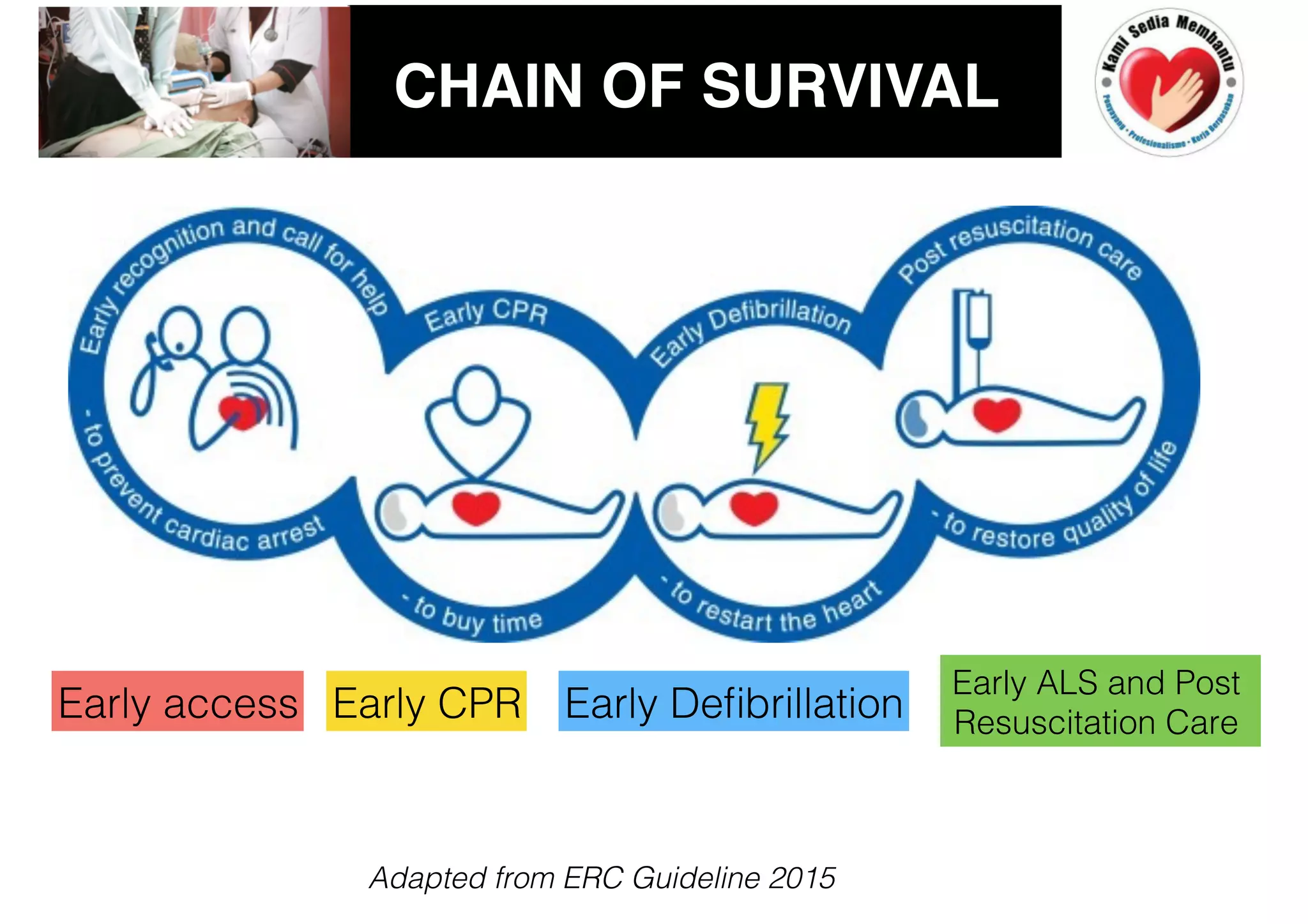
Early access! Early CPR! Early Defibrillation!
Early ALS and Post
Resuscitation Care !
Adapted from ERC Guideline 2015!
CHAIN OF SURVIVAL
• Sudden cardiac arrest (SCA) is a condition in
which the heart suddenly and unexpectedly stops
beating.
• If this happens, blood stops flowing to the brain
and other vital organs.
• SCA causes death if it's not treated within
minutes.
SUDDEN CARDIAC ARRREST!
Sudden Cardiac Arrest!
• Signs and symptoms of cardiac arrest:
1. Unresponsiveness
2. No breathing
3. Abnormal breathing/ agonal breathing
4. Seizure
SUDDEN CARDIAC ARRREST!
Sudden cardiac arrest!
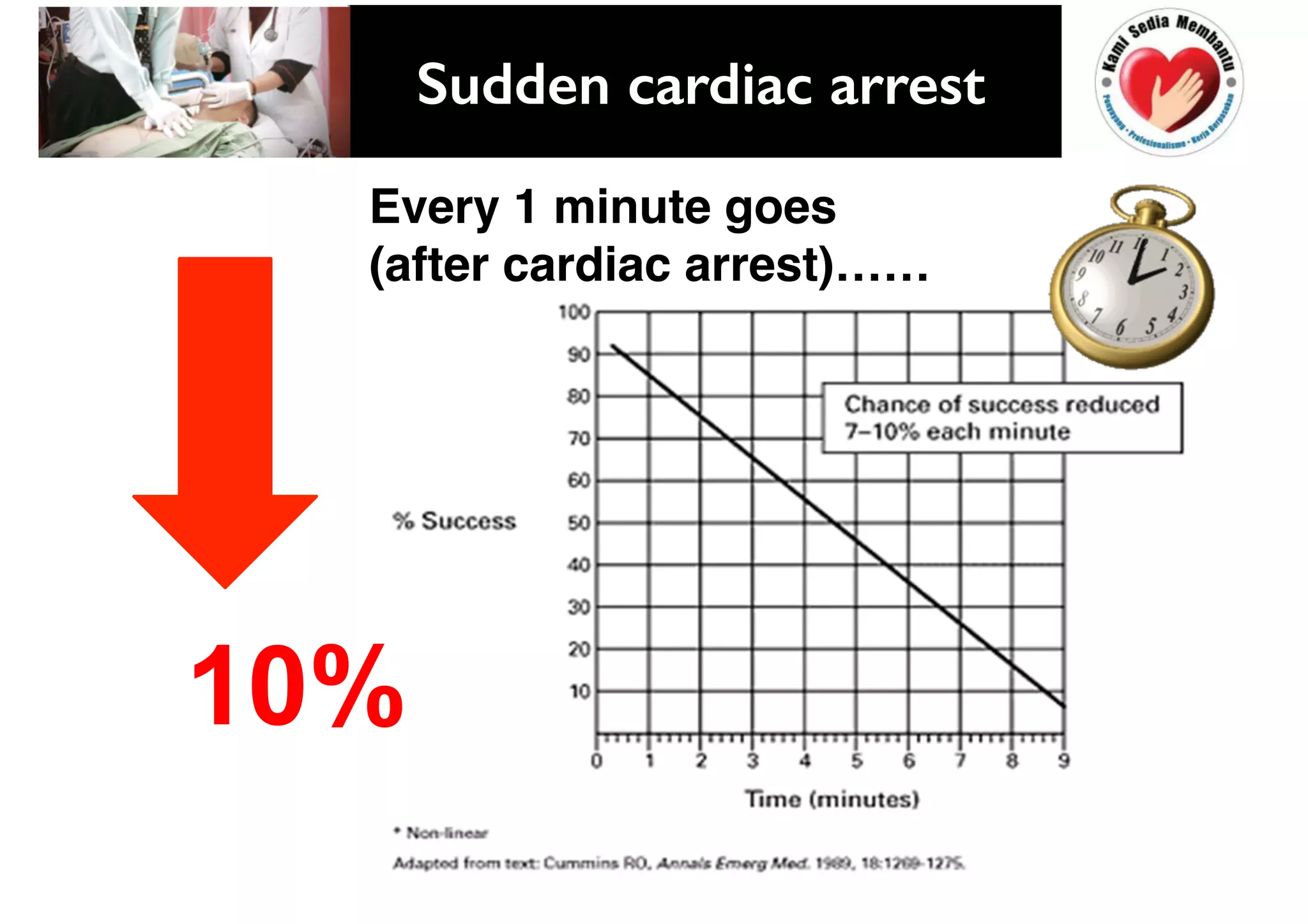
10%
Every 1 minute goes
(after cardiac arrest)……
Sudden cardiac arrest!
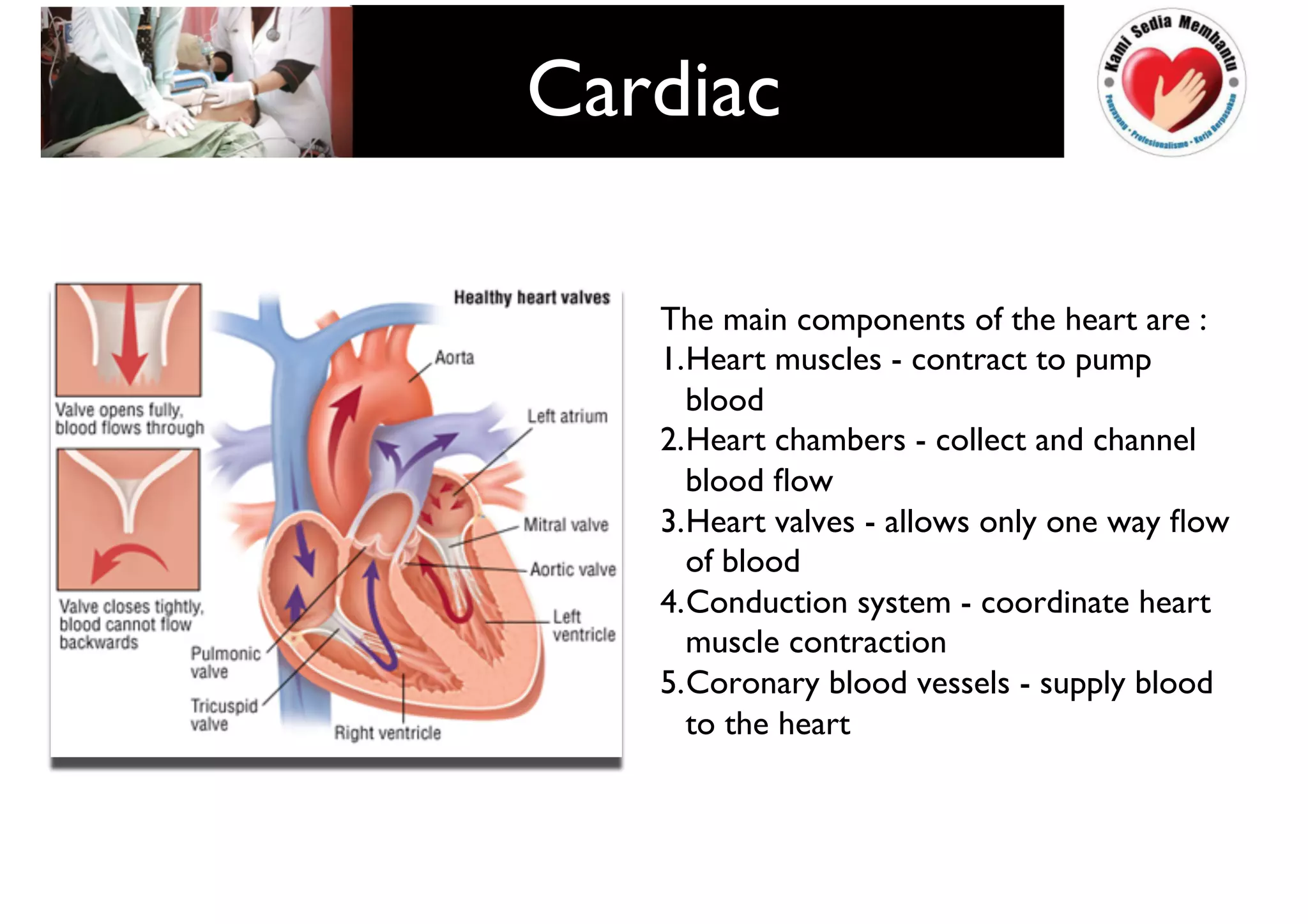
The main components of the heart are :
1.Heart muscles - contract to pump
blood
2.Heart chambers - collect and channel
blood flow
3.Heart valves - allows only one way flow
of blood
4.Conduction system - coordinate heart
muscle contraction
5.Coronary blood vessels - supply blood
to the heart
Cardiac
Effective external chest compressions pushes blood out of heart
chambers thus maintain blood flow and oxygen delivery to vital organs
Physiology of
Chest Compression
Room air -21% oxygen.
Rescue breathing -16% oxygen
Physiology of
Respiratory System
BLS Overview
AGE GROUP
Adult Children Infant
After the
onset of
puberty
1 year to
puberty
1 month to 12
months
TERMINOLOGY
The victim will
clutch the neck
with the thumb
& fingers and
attempt to cough
out the foreign body !
The Universal !
Choking Sign!
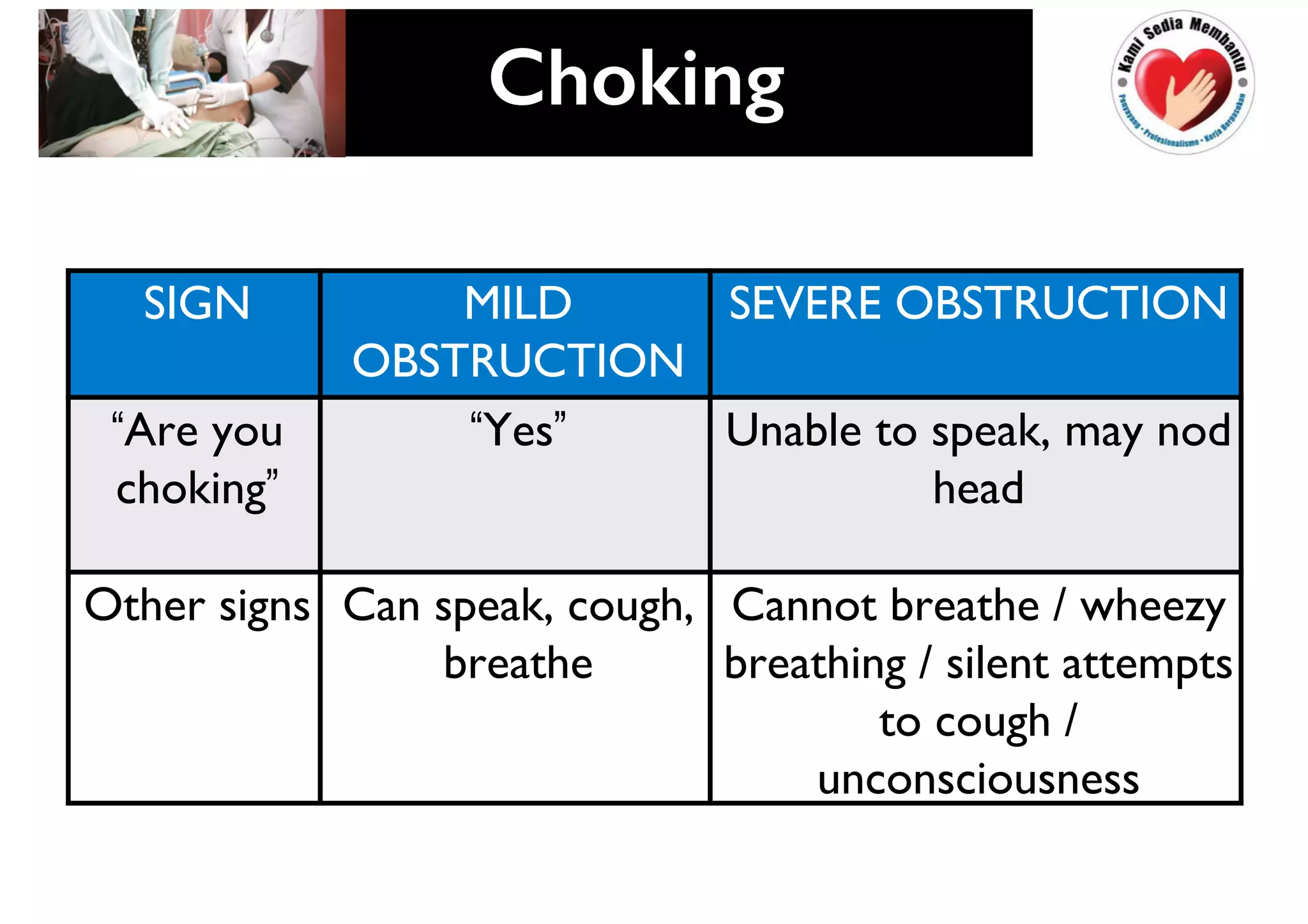
SIGN MILD
OBSTRUCTION
SEVERE OBSTRUCTION
“Are you
choking”
“Yes” Unable to speak, may nod
head
Other signs Can speak, cough,
breathe
Cannot breathe / wheezy
breathing / silent attempts
to cough /
unconsciousness
Choking!
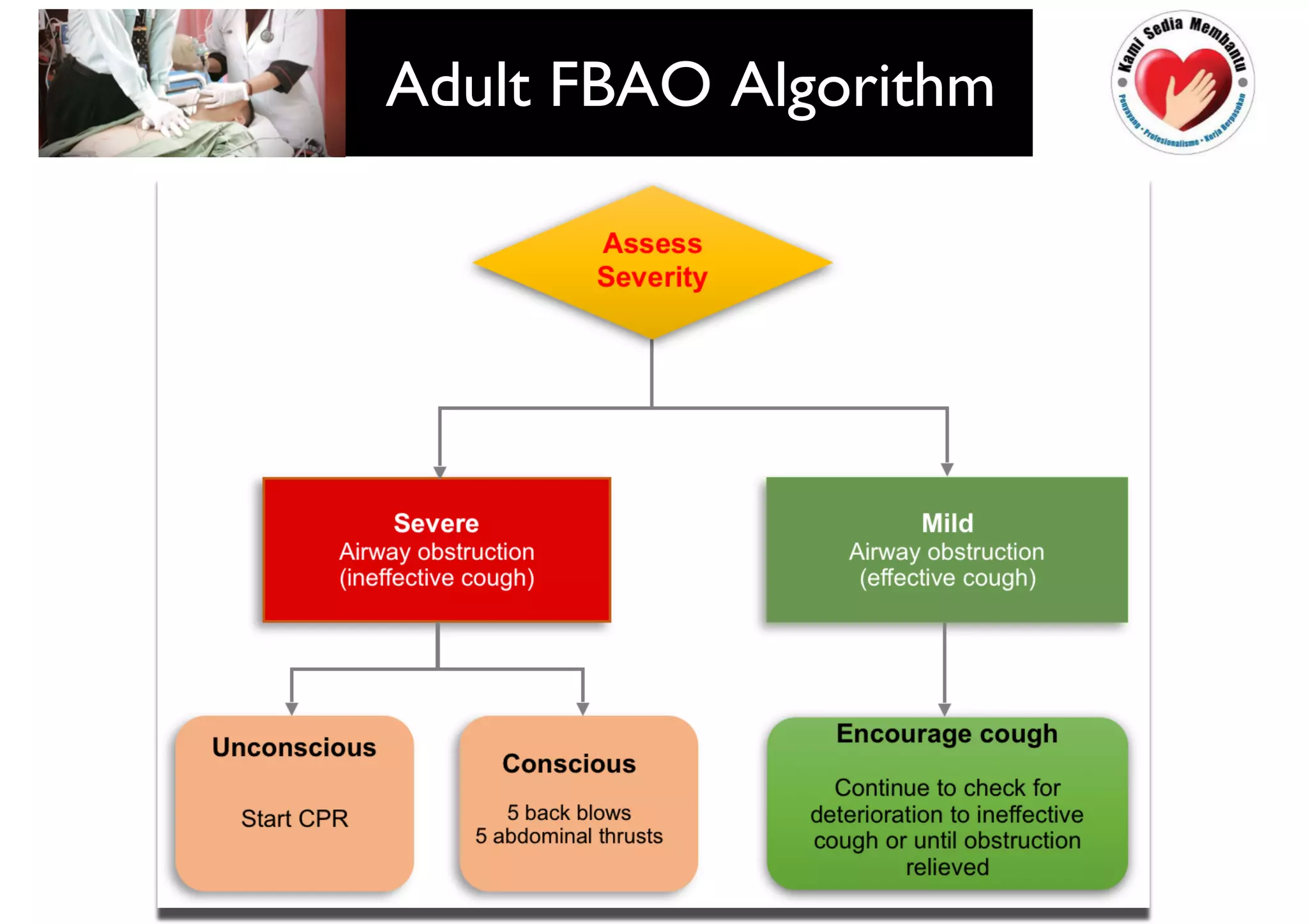
Adult FBAO Algorithm
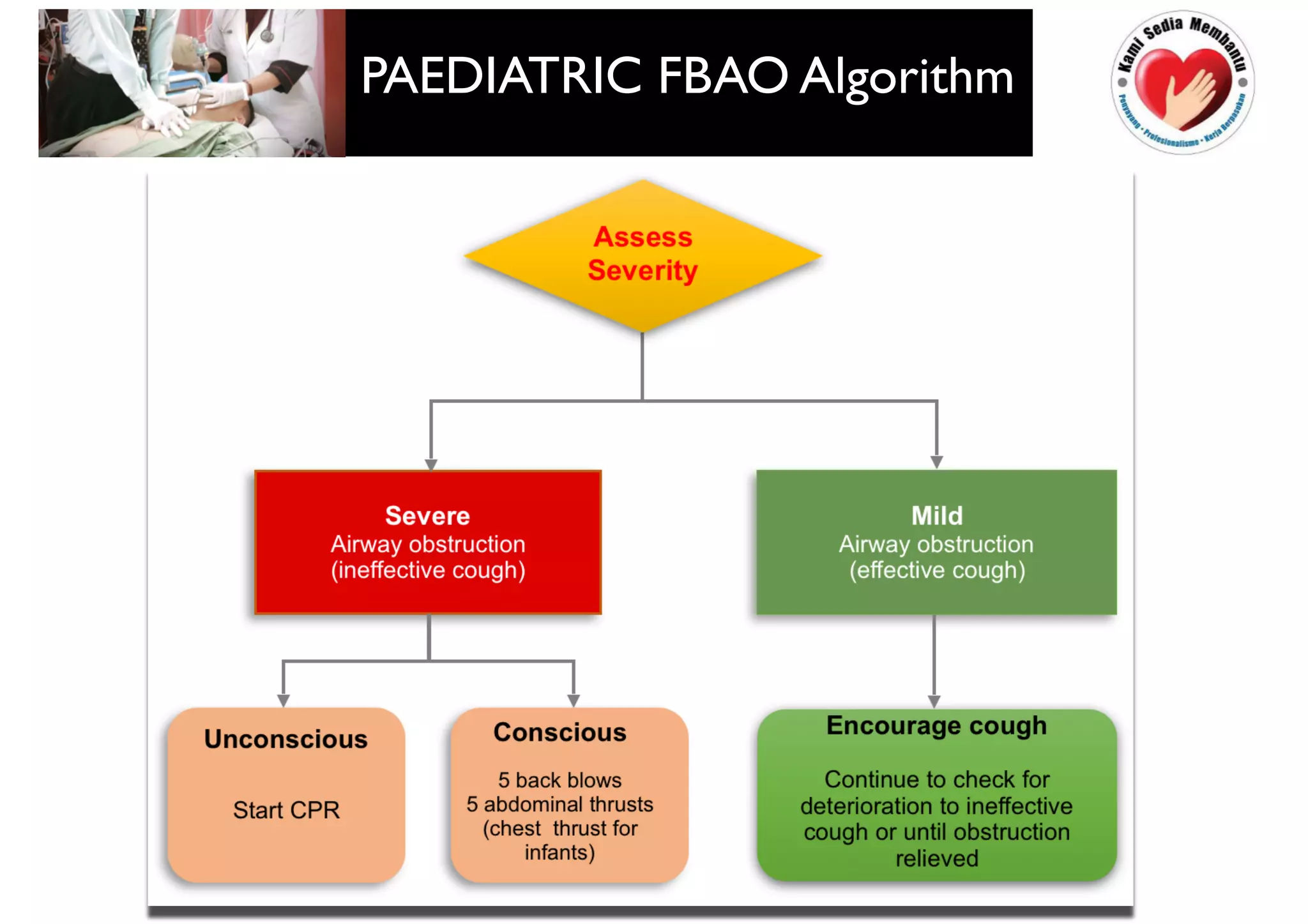
PAEDIATRIC FBAO Algorithm
• Defibrillators are machines that are
capable of delivering DC shock to a
patient in cardiac arrest for the purpose
of terminating VF and pulseless VT.
• AED are machines that automatically
read and interpret a victim heart’s
rhythm and determine whether or not
that victim is in need of defibrillation
Defibrillators
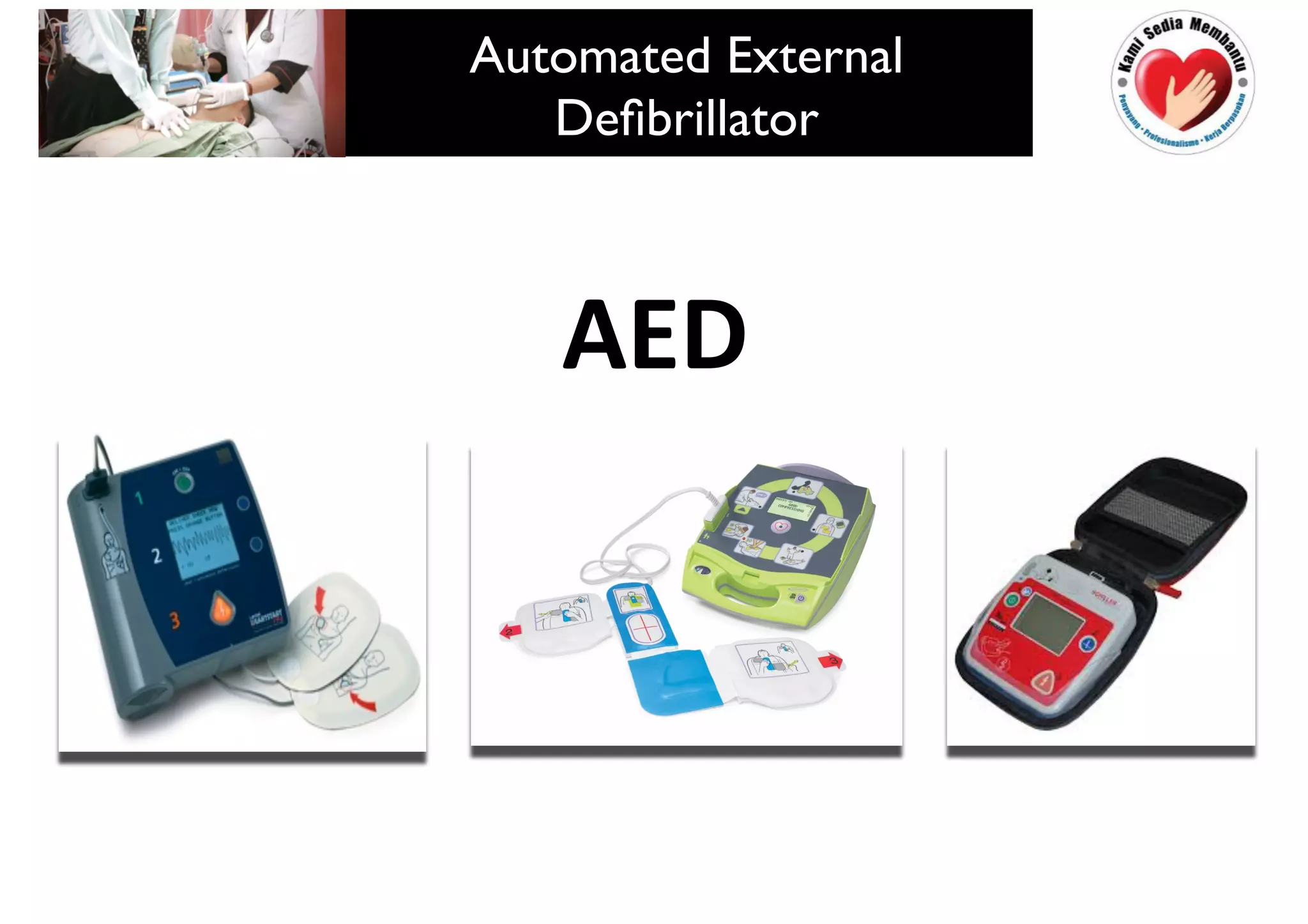
AED
Automated External
Defibrillator
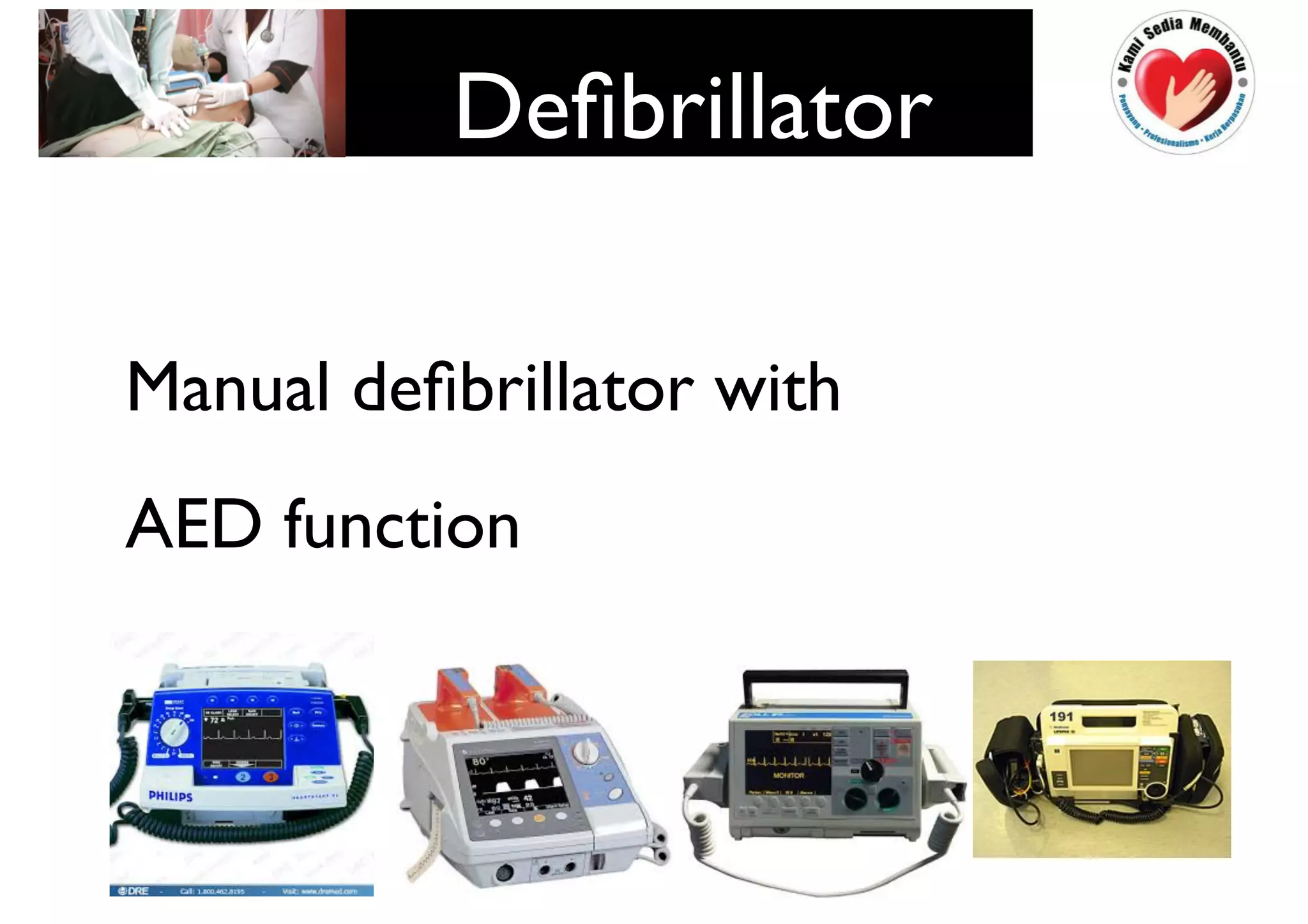
Manual defibrillator with
AED function
Defibrillator
Chances of
survival if cardiac
arrest occur &
CPR applied
3 – 5%
Chances of survival
with defibrillation
30 -70 %
Defibrillators
Summary
Component Recommendation
Adult Children Infants
Recognition Unresponsive
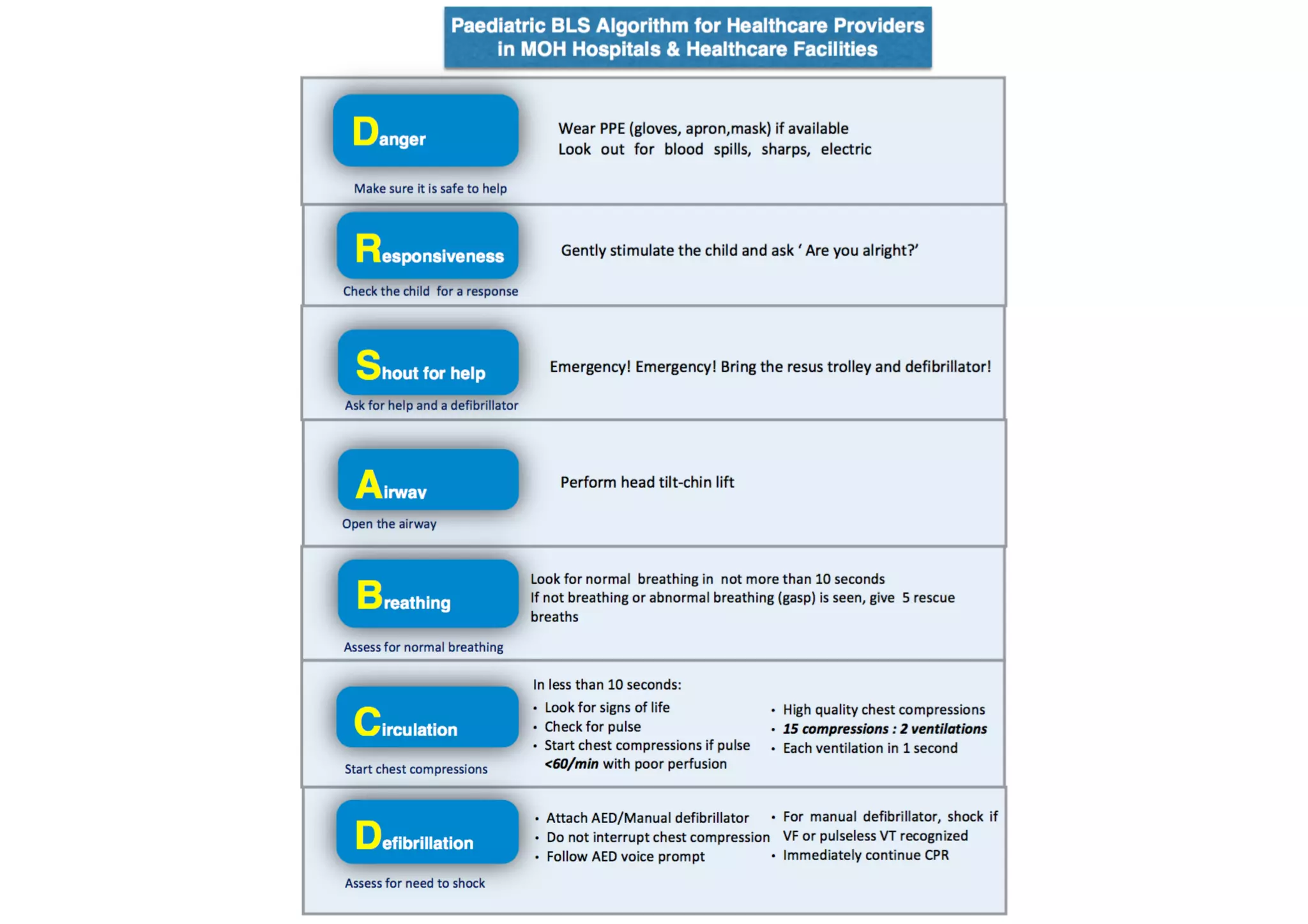
CPR sequence DRSABCD! DRSABCD! DRSABCD!
Compression rate 100-120
compression per
minute !
100-120 compression
per minute !
100-120 compression
per minute !
Compression Depth 5cm but not more
than 6cm !
at least 1/3 the depth
of the chest or 5 cm
at least 1/3 the depth of
the chest or 4 cm
Chest Wall recoil Allow complete recoil after each compression!
Compression
intruption
Minimised interruption in chest compression and limit interruption
less than 10 seconds!
Compression-
ventilation ratio
30:2
One HCW CPR - 15:2 !
!
2 Two HCW CPR 15:2
One HCW CPR - 15:2 !
!
2 Two HCW CPR - 15:2
Ventilation with
advanced airway
1 breath every 6-8 seconds
Defibrillation Use AED as soon as available
THANK YOU
References
• National Committee on Resuscitation Training Guidelines
2011!
• 2015 International Consensus on Cardiopulmonary
Resuscitation and Emergency Cardiovascular Care Science
with Treatment Recommendations, International Liaison
Committee on Resuscitation (ILCOR). !
• European Resuscitation Council (ERC) Guidelines for
Resuscitation 2015 !
• 2015 American Heart Association (AHA) Guidelines Update
for Cardiopulmonary Resuscitation and Emergency
Cardiovascular Care !
THANK YOU
1. Dr Mohd Lotfi Bin Hamzah
2. Dr Luah Lean Wah
3. Dr Abdul Kursi Bin Abdul Latif
4. Dr Mohd Shukrudeen Bin Mohd Salleh
5. Dr Mohd Amin Bin Mohidin
6. Dr Khor Cheng Hoon
7. Dr Cheah Pike Kuan
NATIONAL COMMITTEE ON RESUSCITATION!
SUBCOMMITTEE FOR BASIC LIFE SUPPORT 2015!

NCORT BLS for HCW 2015 ppt_220704_103351.pdf

  • 1.
    BASIC LIFE SUPPORT (BLS ) FOR HEALTHCARE WORKER NCORT BLS Subcommittee 2015!
  • 2.
    1. Objectives 2. Introduction 3.Anatomy and physiology of cardiopulmonary system 4. Overview of Basic Life Support (BLS) 5. Automated External Defibrillator (AED) 6. Summary CONTENTS
  • 3.
    1. Describe thelinks in the chain of survival 2. Understand relevant anatomy and physiology of cardiopulmonary system 3. Describe, understand and perform BLS Objectives
  • 4.
    • Basic lifesupport (BLS) includes: 1. airway, 2. breathing 3. circulation 4. automated external defibrillator (AED) 5. management of choking or foreign body airway obstruction (FBAO). Introduction!
  • 5.
    Early access! EarlyCPR! Early Defibrillation! Early ALS and Post Resuscitation Care ! Adapted from ERC Guideline 2015! CHAIN OF SURVIVAL
  • 6.
    • Sudden cardiacarrest (SCA) is a condition in which the heart suddenly and unexpectedly stops beating. • If this happens, blood stops flowing to the brain and other vital organs. • SCA causes death if it's not treated within minutes. SUDDEN CARDIAC ARRREST! Sudden Cardiac Arrest!
  • 7.
    • Signs andsymptoms of cardiac arrest: 1. Unresponsiveness 2. No breathing 3. Abnormal breathing/ agonal breathing 4. Seizure SUDDEN CARDIAC ARRREST! Sudden cardiac arrest!
  • 8.
    10% Every 1 minutegoes (after cardiac arrest)…… Sudden cardiac arrest!
  • 9.
    The main componentsof the heart are : 1.Heart muscles - contract to pump blood 2.Heart chambers - collect and channel blood flow 3.Heart valves - allows only one way flow of blood 4.Conduction system - coordinate heart muscle contraction 5.Coronary blood vessels - supply blood to the heart Cardiac
  • 10.
    Effective external chestcompressions pushes blood out of heart chambers thus maintain blood flow and oxygen delivery to vital organs Physiology of Chest Compression
  • 11.
    Room air -21%oxygen. Rescue breathing -16% oxygen Physiology of Respiratory System
  • 12.
  • 15.
    AGE GROUP Adult ChildrenInfant After the onset of puberty 1 year to puberty 1 month to 12 months TERMINOLOGY
  • 17.
    The victim will clutchthe neck with the thumb & fingers and attempt to cough out the foreign body ! The Universal ! Choking Sign!
  • 18.
    SIGN MILD OBSTRUCTION SEVERE OBSTRUCTION “Areyou choking” “Yes” Unable to speak, may nod head Other signs Can speak, cough, breathe Cannot breathe / wheezy breathing / silent attempts to cough / unconsciousness Choking!
  • 19.
  • 20.
  • 21.
    • Defibrillators aremachines that are capable of delivering DC shock to a patient in cardiac arrest for the purpose of terminating VF and pulseless VT. • AED are machines that automatically read and interpret a victim heart’s rhythm and determine whether or not that victim is in need of defibrillation Defibrillators
  • 22.
  • 23.
    Manual defibrillator with AEDfunction Defibrillator
  • 24.
    Chances of survival ifcardiac arrest occur & CPR applied 3 – 5% Chances of survival with defibrillation 30 -70 % Defibrillators
  • 25.
  • 26.
    Component Recommendation Adult ChildrenInfants Recognition Unresponsive CPR sequence DRSABCD! DRSABCD! DRSABCD! Compression rate 100-120 compression per minute ! 100-120 compression per minute ! 100-120 compression per minute ! Compression Depth 5cm but not more than 6cm ! at least 1/3 the depth of the chest or 5 cm at least 1/3 the depth of the chest or 4 cm Chest Wall recoil Allow complete recoil after each compression! Compression intruption Minimised interruption in chest compression and limit interruption less than 10 seconds! Compression- ventilation ratio 30:2 One HCW CPR - 15:2 ! ! 2 Two HCW CPR 15:2 One HCW CPR - 15:2 ! ! 2 Two HCW CPR - 15:2 Ventilation with advanced airway 1 breath every 6-8 seconds Defibrillation Use AED as soon as available
  • 27.
    THANK YOU References • NationalCommittee on Resuscitation Training Guidelines 2011! • 2015 International Consensus on Cardiopulmonary Resuscitation and Emergency Cardiovascular Care Science with Treatment Recommendations, International Liaison Committee on Resuscitation (ILCOR). ! • European Resuscitation Council (ERC) Guidelines for Resuscitation 2015 ! • 2015 American Heart Association (AHA) Guidelines Update for Cardiopulmonary Resuscitation and Emergency Cardiovascular Care !
  • 28.
    THANK YOU 1. DrMohd Lotfi Bin Hamzah 2. Dr Luah Lean Wah 3. Dr Abdul Kursi Bin Abdul Latif 4. Dr Mohd Shukrudeen Bin Mohd Salleh 5. Dr Mohd Amin Bin Mohidin 6. Dr Khor Cheng Hoon 7. Dr Cheah Pike Kuan NATIONAL COMMITTEE ON RESUSCITATION! SUBCOMMITTEE FOR BASIC LIFE SUPPORT 2015!