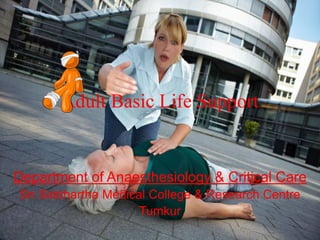

Adult Basic Life Support
Department of Anaesthesiology & Critical Care
Sri Siddhartha Medical College & Research Centre
Tumkur
Definition
Cardiac arrest-
Diagnosis
Cardio Pulmonary Resuscitation is a technique
of basic life support for oxygenating the brain
and heart until appropriate, definitive medical
treatment can restore normal heart and
ventilatory action.
Definition of Terms
Adult-
An adult is anyone who is going through or who has
already gone though puberty.
Patient is Responsive-
Someone who ‘Responds’ moves, speaks, blinks or
otherwise reacts when you tap him and ask if he’s
OK.
Compression-
A ‘Compression’ is the act of pushing on the chest.
AED- automated external defibrillator
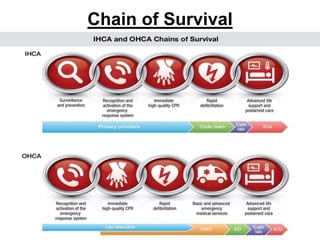
Chain of Survival
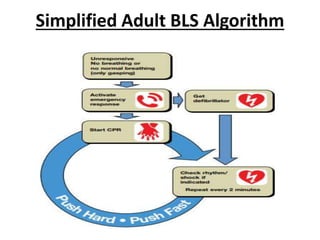
Simplified Adult BLS Algorithm
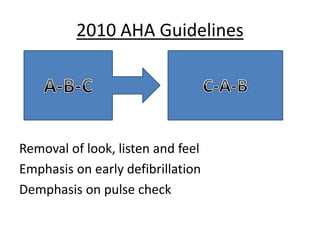
2010 AHA Guidelines
Removal of look, listen and feel
Emphasis on early defibrillation
Demphasis on pulse check
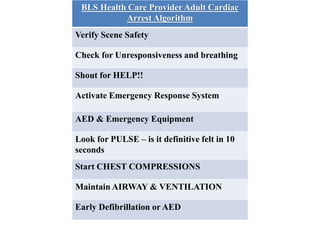
BLS Health Care Provider Adult Cardiac
Arrest Algorithm
Verify Scene Safety
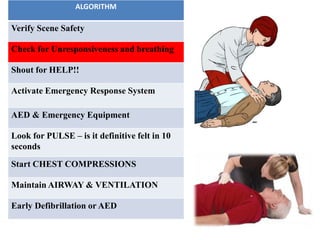
Check for Unresponsiveness and breathing
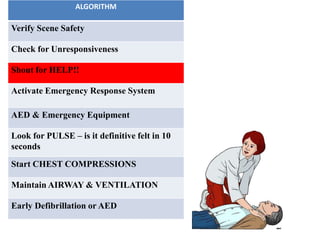
Shout for HELP!!
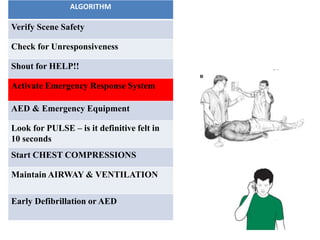
Activate Emergency Response System
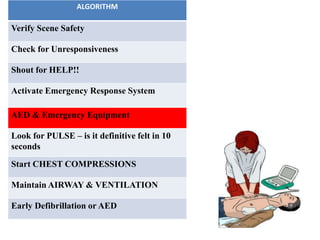
AED & Emergency Equipment
Look for PULSE – is it definitive felt in 10
seconds
Start CHEST COMPRESSIONS
Maintain AIRWAY & VENTILATION
Early Defibrillation or AED
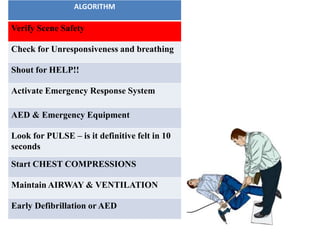
ALGORITHM
Verify Scene Safety
Check for Unresponsiveness and breathing
Shout for HELP!!
Activate Emergency Response System
AED & Emergency Equipment
Look for PULSE – is it definitive felt in 10
seconds
Start CHEST COMPRESSIONS
Maintain AIRWAY & VENTILATION
Early Defibrillation or AED
ALGORITHM
Verify Scene Safety
Check for Unresponsiveness and breathing
Shout for HELP!!
Activate Emergency Response System
AED & Emergency Equipment
Look for PULSE – is it definitive felt in 10
seconds
Start CHEST COMPRESSIONS
Maintain AIRWAY & VENTILATION
Early Defibrillation or AED
ALGORITHM
Verify Scene Safety
Check for Unresponsiveness
Shout for HELP!!
Activate Emergency Response System
AED & Emergency Equipment
Look for PULSE – is it definitive felt in 10
seconds
Start CHEST COMPRESSIONS
Maintain AIRWAY & VENTILATION
Early Defibrillation or AED
ALGORITHM
Verify Scene Safety
Check for Unresponsiveness
Shout for HELP!!
Activate Emergency Response System
AED & Emergency Equipment
Look for PULSE – is it definitive felt in
10 seconds
Start CHEST COMPRESSIONS
Maintain AIRWAY & VENTILATION
Early Defibrillation or AED
ALGORITHM
Verify Scene Safety
Check for Unresponsiveness
Shout for HELP!!
Activate Emergency Response System
AED & Emergency Equipment
Look for PULSE – is it definitive felt in 10
seconds
Start CHEST COMPRESSIONS
Maintain AIRWAY & VENTILATION
Early Defibrillation or AED
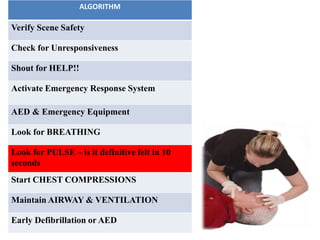
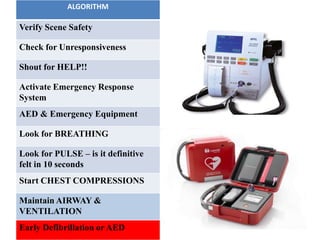
ALGORITHM
Verify Scene Safety
Check for Unresponsiveness
Shout for HELP!!
Activate Emergency Response System
AED & Emergency Equipment
Look for BREATHING
Look for PULSE – is it definitive felt in 10
seconds
Start CHEST COMPRESSIONS
Maintain AIRWAY & VENTILATION
Early Defibrillation or AED
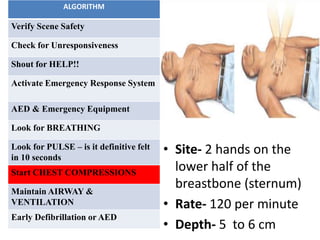
• Site- 2 hands on the
lower half of the
breastbone (sternum)
• Rate- 120 per minute
• Depth- 5 to 6 cm
ALGORITHM
Verify Scene Safety
Check for Unresponsiveness
Shout for HELP!!
Activate Emergency Response System
AED & Emergency Equipment
Look for BREATHING
Look for PULSE – is it definitive felt
in 10 seconds
Start CHEST COMPRESSIONS
Maintain AIRWAY &
VENTILATION
Early Defibrillation or AED
• Chest compressions of adequate rate, 100-120,
with 120/min being the maximum
• Chest compressions of adequate depth
(maximum of 6cm or 2.4 inches)
• Allowing full chest recoil in between
compressions, avoid leaning on victims chest
Increased emphasis on high quality
CPR
Increased emphasis on high
quality CPR
• Minimizing interruptions in between
compressions as shorter pauses are associated
with greater success (class I).
• Avoiding excessive ventilation
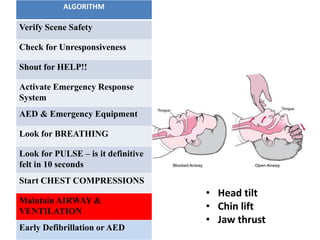
• Head tilt
• Chin lift
• Jaw thrust
ALGORITHM
Verify Scene Safety
Check for Unresponsiveness
Shout for HELP!!
Activate Emergency Response
System
AED & Emergency Equipment
Look for BREATHING
Look for PULSE – is it definitive
felt in 10 seconds
Start CHEST COMPRESSIONS
Maintain AIRWAY &
VENTILATION
Early Defibrillation or AED
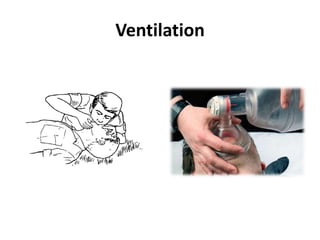
Ventilation
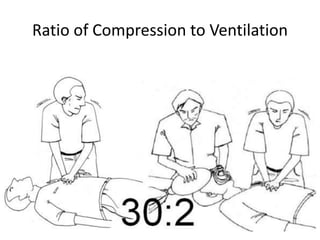
Ratio of Compression to Ventilation
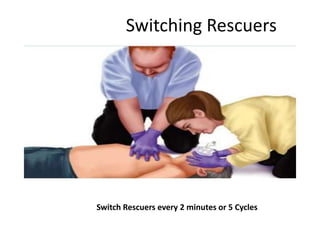
Switching Rescuers
Switch Rescuers every 2 minutes or 5 Cycles
ALGORITHM
Verify Scene Safety
Check for Unresponsiveness
Shout for HELP!!
Activate Emergency Response
System
AED & Emergency Equipment
Look for BREATHING
Look for PULSE – is it definitive
felt in 10 seconds
Start CHEST COMPRESSIONS
Maintain AIRWAY &
VENTILATION
Early Defibrillation or AED
SHOCK first OR CPR first
• In an witnessed cardiac arrest, if AED is
immediately available, reasonable to use AED
as soon as possible
When to STOP!!
• Return of spontaneous circulation
• Until help arrives
• Physical fatigue.
• Obivious Death
Possible Complications
1. Rib fractures
2. Hemothorax
3. Hemopericardium
4. Coronary Vessel injury
5. Sternal fracture
6. Spleen Injury
Thank you..

Adult basic life support for junior doctors

  • 1.
    Adult Basic LifeSupport Department of Anaesthesiology & Critical Care Sri Siddhartha Medical College & Research Centre Tumkur
  • 2.
    Definition Cardiac arrest- Diagnosis Cardio PulmonaryResuscitation is a technique of basic life support for oxygenating the brain and heart until appropriate, definitive medical treatment can restore normal heart and ventilatory action.
  • 3.
    Definition of Terms Adult- Anadult is anyone who is going through or who has already gone though puberty. Patient is Responsive- Someone who ‘Responds’ moves, speaks, blinks or otherwise reacts when you tap him and ask if he’s OK. Compression- A ‘Compression’ is the act of pushing on the chest. AED- automated external defibrillator
  • 4.
  • 5.
  • 6.
    2010 AHA Guidelines Removalof look, listen and feel Emphasis on early defibrillation Demphasis on pulse check
  • 7.
    BLS Health CareProvider Adult Cardiac Arrest Algorithm Verify Scene Safety Check for Unresponsiveness and breathing Shout for HELP!! Activate Emergency Response System AED & Emergency Equipment Look for PULSE – is it definitive felt in 10 seconds Start CHEST COMPRESSIONS Maintain AIRWAY & VENTILATION Early Defibrillation or AED
  • 8.
    ALGORITHM Verify Scene Safety Checkfor Unresponsiveness and breathing Shout for HELP!! Activate Emergency Response System AED & Emergency Equipment Look for PULSE – is it definitive felt in 10 seconds Start CHEST COMPRESSIONS Maintain AIRWAY & VENTILATION Early Defibrillation or AED
  • 9.
    ALGORITHM Verify Scene Safety Checkfor Unresponsiveness and breathing Shout for HELP!! Activate Emergency Response System AED & Emergency Equipment Look for PULSE – is it definitive felt in 10 seconds Start CHEST COMPRESSIONS Maintain AIRWAY & VENTILATION Early Defibrillation or AED
  • 10.
    ALGORITHM Verify Scene Safety Checkfor Unresponsiveness Shout for HELP!! Activate Emergency Response System AED & Emergency Equipment Look for PULSE – is it definitive felt in 10 seconds Start CHEST COMPRESSIONS Maintain AIRWAY & VENTILATION Early Defibrillation or AED
  • 11.
    ALGORITHM Verify Scene Safety Checkfor Unresponsiveness Shout for HELP!! Activate Emergency Response System AED & Emergency Equipment Look for PULSE – is it definitive felt in 10 seconds Start CHEST COMPRESSIONS Maintain AIRWAY & VENTILATION Early Defibrillation or AED
  • 12.
    ALGORITHM Verify Scene Safety Checkfor Unresponsiveness Shout for HELP!! Activate Emergency Response System AED & Emergency Equipment Look for PULSE – is it definitive felt in 10 seconds Start CHEST COMPRESSIONS Maintain AIRWAY & VENTILATION Early Defibrillation or AED
  • 13.
    ALGORITHM Verify Scene Safety Checkfor Unresponsiveness Shout for HELP!! Activate Emergency Response System AED & Emergency Equipment Look for BREATHING Look for PULSE – is it definitive felt in 10 seconds Start CHEST COMPRESSIONS Maintain AIRWAY & VENTILATION Early Defibrillation or AED
  • 14.
    • Site- 2hands on the lower half of the breastbone (sternum) • Rate- 120 per minute • Depth- 5 to 6 cm ALGORITHM Verify Scene Safety Check for Unresponsiveness Shout for HELP!! Activate Emergency Response System AED & Emergency Equipment Look for BREATHING Look for PULSE – is it definitive felt in 10 seconds Start CHEST COMPRESSIONS Maintain AIRWAY & VENTILATION Early Defibrillation or AED
  • 15.
    • Chest compressionsof adequate rate, 100-120, with 120/min being the maximum • Chest compressions of adequate depth (maximum of 6cm or 2.4 inches) • Allowing full chest recoil in between compressions, avoid leaning on victims chest Increased emphasis on high quality CPR
  • 16.
    Increased emphasis onhigh quality CPR • Minimizing interruptions in between compressions as shorter pauses are associated with greater success (class I). • Avoiding excessive ventilation
  • 17.
    • Head tilt •Chin lift • Jaw thrust ALGORITHM Verify Scene Safety Check for Unresponsiveness Shout for HELP!! Activate Emergency Response System AED & Emergency Equipment Look for BREATHING Look for PULSE – is it definitive felt in 10 seconds Start CHEST COMPRESSIONS Maintain AIRWAY & VENTILATION Early Defibrillation or AED
  • 18.
  • 19.
    Ratio of Compressionto Ventilation
  • 20.
    Switching Rescuers Switch Rescuersevery 2 minutes or 5 Cycles
  • 21.
    ALGORITHM Verify Scene Safety Checkfor Unresponsiveness Shout for HELP!! Activate Emergency Response System AED & Emergency Equipment Look for BREATHING Look for PULSE – is it definitive felt in 10 seconds Start CHEST COMPRESSIONS Maintain AIRWAY & VENTILATION Early Defibrillation or AED
  • 22.
    SHOCK first ORCPR first • In an witnessed cardiac arrest, if AED is immediately available, reasonable to use AED as soon as possible
  • 23.
    When to STOP!! •Return of spontaneous circulation • Until help arrives • Physical fatigue. • Obivious Death
  • 24.
    Possible Complications 1. Ribfractures 2. Hemothorax 3. Hemopericardium 4. Coronary Vessel injury 5. Sternal fracture 6. Spleen Injury
  • 25.