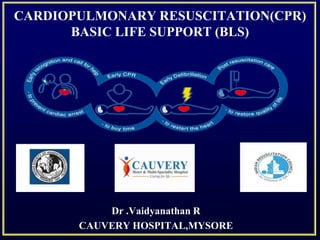
CARDIOPULMONARY RESUSCITATION(CPR)
BASIC LIFE SUPPORT (BLS)
Dr .Vaidyanathan R
CAUVERY HOSPITAL,MYSORE
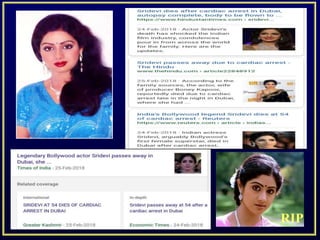
RIP
THE ARREST
• CARDIAC ARREST – commonest cause of death.
Cessation of function of heart making patient
unresponsive.
• RESPIRATORY ARREST – Next most frequent
mode of death. Patient often gasps for breath often
breathing little or none.
• SUDDEN CARDIAC DEATH or cardiac arrest is
the leading cause of death all over the world
• Sudden loss of responsiveness
• Not breathing or breathing abnormally
• No Pulse
• No response to tapping on shoulders
• Does nothing when you ask if he’s OK
Signs of Sudden Cardiac Arrest
• HEART ATTACK(Ischemic Heart Disease) is the
leading cause of death in the world.
• 1 in 3 deaths worldwide is cardiovascular.
• Timely intervention can save lives.
• Most victims will die without immediate and
appropriate intervention
Why is this so important?
• Not the same thing.
– Sudden cardiac arrest occurs when electrical
impulses in the heart become rapid or chaotic,
which causes the heart to suddenly stop beating.
– A heart attack occurs when the blood supply to
part of the heart muscle is blocked. A heart attack
may cause cardiac arrest.
Cardiac Arrest or Heart Attack??
Conducting system. Blood supply
CPR
• CARDIAC RESUSCITATION , AND
• PULMONARY RESUSCITATION
• RESUSCITATION – Means bringing
something back to life,starts from scene of
action
What is CPR?
• CPR combines rescue breathing and
chest compressions.
• Rescue breathing provides oxygen to
the person's lungs.
• Chest compressions keep oxygen-rich
blood flowing until the heartbeat and
breathing can be restored.
 OTHER THAN SUDDEN CARDIAC
ARREST,EMERGENCIES AND TRAUMA FORMS
MOST IMPORTANT CAUSES OF PREVENTABLE
MORTALITY.
 PROPER FIRST AID AND EARLY REFERRASL TO
NEAREST PROPER HOSPITAL SAVES MORE THAN
40% OF LIVES.
GOLDEN HOUR
• Trauma – Golden hour and platinum 15 mins.
• Acting at the scene and proper and timely referral
reduces casualties by 50%.
• Ambulance personnel , emergency first aid
workers and police personnel have often a vital
role to play
RULE OF GOLDEN HOUR –
NEAREST PROPER HOSPITAL IS
WHERE ALL FACILITIES /
INFRASTRUCTURE IS PRESENT
OTHER THAN TRAUMA ,CARDIAC
ARREST, RESPIRATORY PROBLEMS,
HANGING,DROWNING,POISONING,
TABLET CONSUMPTIONS FORM
IMPORTANT CAUSES OF PREVENTABLE
MORTALITY
Five Links in the Adult Chain of
Survival
Copyright © Texas Education Agency, 2014. All rights reserved.
6
Integrated
post-cardiac
arrest care
Effective
advanced life
support
Rapid
defibrillation
Early CPR
with an
emphasis on
chest
compressions
Immediate
recognition of
cardiac arrest
and activation of
the emergency
response system
BLS & ALS
• BLS – BASIC LIFE SUPPORT ,GIVEN AT THE
SCENE WITHOUT ANY SPECIALIZED
EQUIPMENT BY MINIMALLY TRAINED PEOPLE
• ALS - ADVANCED LIFE SUPPORT , GIVEN
WITHIN THE HOSPITAL BY SPECIALY TRAINED
PEOPLE OFTEN WITH ADVANCED
EQUIPMMENTS AND DRUGS
BLS – WHO CAN GET TRAINED?
• AMBULANCE PERSONNEL
• PARAMEDICS
• AUXILLARY HEALTH CARE WORKERS
• ARMY PERSONNEL
• POLICE PERSONNEL
• ANY SOCIALLY CONSCIOUS CITIZEN
• The life you save with CPR is
most likely to be a loved one.
– 4 out of 5 cardiac arrests
happen at home.
– The life that you save is likely
to be someone at home: child,
parent or friend.
Who Can you Save with CPR?
• Your actions can only help.
• Anyone can learn CPR and
everyone should!!!
Don’t be Afraid!!!
THE BLS
• BLS
-- COLS (COMPRESSIONS ONLY LIFE SUPPORT)
(HANDS ONLY CPR)
-- BCLS (BASIC CARDIOVASCULAR LIFE SUPPORT)
(CONVENTIONAL BLS)
INDEED,EVERYBODY HAS TO BE A LIFE SAVER……
THE BLS
• ABC – Airway,
Breathing ,
Circulation
Airway – Head tilt, chin lift & jaw thrust
Breathing -
Circulation – Chest compressions
Look , listen and feel.
BCLS-CONVENTIONAL BLS
 F:CPR1-Rescuer CPR Demo.mpg
 F:CPR2-Rescuer CPR Demo.mpg
 F:CPRAdultRescueBrwBagMask.mpg
COLS / HANDS ONLY CPR
• F:CPRHands-Only CPR Demo Video.mp4
cprVideo_20181020132832283_by_videosho
w.mp4
• F:CPRHands-Only CPR Instructional
Video (For English-speakers outside the
U.S.).mp4
• cprVID-20180915-WA0002.mp4
Review of Hands-Only CPR Procedure
(COLS)
If you see an unresponsive person who is not
breathing or not breathing normally:
1.Call 108 or have someone call 9-1-1/ 108 .
2. Do chest Compressions
a. Position your hands over the center of
the person’s chest.
b. Press down hard at a rate of 120 times per minute
c. Check for responsiveness after 5 sets of 30
compressions each
The Automated External Defibrillator -
AED
• A rescue device that delivers a controlled,
precise shock to the heart. An AED can
restore the heart’s electrical rhythm and
heart beat in the event of a cardiac arrest.
Steps in Using an AED
Step 1: Before using an AED, check for the
presence of water near the unconscious
person. Move him or her away from wetness
when delivering shocks.
Step 2: Turn on the AED’s power. The device
will give you step by step instructions. You will
hear voice prompts and see prompts on a
screen.
Step 3: Expose the person’s chest. If the
person’s chest is wet, dry it.
Step 4: Place the pads on the person’s chest
as illustrated:
Step 5: Check that the wires from the
electrodes are connected to the AED. Make
sure that no one is touching the person, and
then press the “analyze” button. Stay clear
while the machine checks the person’s heart
rhythm.
Step 6: If shock is needed, the AED will let
you know when to deliver it. Stand clear of
the person and make sure others are clear
before you push the AED’s “shock” button.
Step 7: Start or resume CPR until emergency
medical help arrives. Report all information
that you have to the emergency crew.
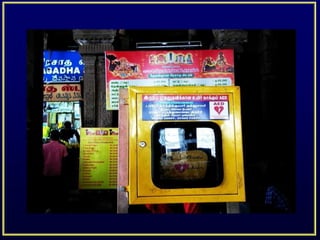
Where is an AED found?
– An AED may be located on the school campus or
close by at a community facility.
– It will be helpful for all to know the location of these
devices and who to contact if an AED is needed.
32
RECOVERY POSITION
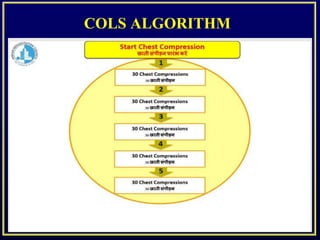
COLS ALGORITHM
THANK YOU

Bls new

  • 1.
    CARDIOPULMONARY RESUSCITATION(CPR) BASIC LIFESUPPORT (BLS) Dr .Vaidyanathan R CAUVERY HOSPITAL,MYSORE
  • 2.
  • 3.
    THE ARREST • CARDIACARREST – commonest cause of death. Cessation of function of heart making patient unresponsive. • RESPIRATORY ARREST – Next most frequent mode of death. Patient often gasps for breath often breathing little or none. • SUDDEN CARDIAC DEATH or cardiac arrest is the leading cause of death all over the world
  • 5.
    • Sudden lossof responsiveness • Not breathing or breathing abnormally • No Pulse • No response to tapping on shoulders • Does nothing when you ask if he’s OK Signs of Sudden Cardiac Arrest
  • 6.
    • HEART ATTACK(IschemicHeart Disease) is the leading cause of death in the world. • 1 in 3 deaths worldwide is cardiovascular. • Timely intervention can save lives. • Most victims will die without immediate and appropriate intervention Why is this so important?
  • 7.
    • Not thesame thing. – Sudden cardiac arrest occurs when electrical impulses in the heart become rapid or chaotic, which causes the heart to suddenly stop beating. – A heart attack occurs when the blood supply to part of the heart muscle is blocked. A heart attack may cause cardiac arrest. Cardiac Arrest or Heart Attack??
  • 8.
  • 9.
    CPR • CARDIAC RESUSCITATION, AND • PULMONARY RESUSCITATION • RESUSCITATION – Means bringing something back to life,starts from scene of action
  • 10.
    What is CPR? •CPR combines rescue breathing and chest compressions. • Rescue breathing provides oxygen to the person's lungs. • Chest compressions keep oxygen-rich blood flowing until the heartbeat and breathing can be restored.
  • 12.
     OTHER THANSUDDEN CARDIAC ARREST,EMERGENCIES AND TRAUMA FORMS MOST IMPORTANT CAUSES OF PREVENTABLE MORTALITY.  PROPER FIRST AID AND EARLY REFERRASL TO NEAREST PROPER HOSPITAL SAVES MORE THAN 40% OF LIVES.
  • 13.
    GOLDEN HOUR • Trauma– Golden hour and platinum 15 mins. • Acting at the scene and proper and timely referral reduces casualties by 50%. • Ambulance personnel , emergency first aid workers and police personnel have often a vital role to play
  • 14.
    RULE OF GOLDENHOUR – NEAREST PROPER HOSPITAL IS WHERE ALL FACILITIES / INFRASTRUCTURE IS PRESENT
  • 15.
    OTHER THAN TRAUMA,CARDIAC ARREST, RESPIRATORY PROBLEMS, HANGING,DROWNING,POISONING, TABLET CONSUMPTIONS FORM IMPORTANT CAUSES OF PREVENTABLE MORTALITY
  • 16.
    Five Links inthe Adult Chain of Survival Copyright © Texas Education Agency, 2014. All rights reserved. 6 Integrated post-cardiac arrest care Effective advanced life support Rapid defibrillation Early CPR with an emphasis on chest compressions Immediate recognition of cardiac arrest and activation of the emergency response system
  • 17.
    BLS & ALS •BLS – BASIC LIFE SUPPORT ,GIVEN AT THE SCENE WITHOUT ANY SPECIALIZED EQUIPMENT BY MINIMALLY TRAINED PEOPLE • ALS - ADVANCED LIFE SUPPORT , GIVEN WITHIN THE HOSPITAL BY SPECIALY TRAINED PEOPLE OFTEN WITH ADVANCED EQUIPMMENTS AND DRUGS
  • 18.
    BLS – WHOCAN GET TRAINED? • AMBULANCE PERSONNEL • PARAMEDICS • AUXILLARY HEALTH CARE WORKERS • ARMY PERSONNEL • POLICE PERSONNEL • ANY SOCIALLY CONSCIOUS CITIZEN
  • 19.
    • The lifeyou save with CPR is most likely to be a loved one. – 4 out of 5 cardiac arrests happen at home. – The life that you save is likely to be someone at home: child, parent or friend. Who Can you Save with CPR?
  • 20.
    • Your actionscan only help. • Anyone can learn CPR and everyone should!!! Don’t be Afraid!!!
  • 21.
    THE BLS • BLS --COLS (COMPRESSIONS ONLY LIFE SUPPORT) (HANDS ONLY CPR) -- BCLS (BASIC CARDIOVASCULAR LIFE SUPPORT) (CONVENTIONAL BLS)
  • 22.
    INDEED,EVERYBODY HAS TOBE A LIFE SAVER……
  • 23.
    THE BLS • ABC– Airway, Breathing , Circulation Airway – Head tilt, chin lift & jaw thrust Breathing - Circulation – Chest compressions Look , listen and feel.
  • 24.
    BCLS-CONVENTIONAL BLS  F:CPR1-RescuerCPR Demo.mpg  F:CPR2-Rescuer CPR Demo.mpg  F:CPRAdultRescueBrwBagMask.mpg
  • 25.
    COLS / HANDSONLY CPR • F:CPRHands-Only CPR Demo Video.mp4 cprVideo_20181020132832283_by_videosho w.mp4 • F:CPRHands-Only CPR Instructional Video (For English-speakers outside the U.S.).mp4 • cprVID-20180915-WA0002.mp4
  • 26.
    Review of Hands-OnlyCPR Procedure (COLS) If you see an unresponsive person who is not breathing or not breathing normally: 1.Call 108 or have someone call 9-1-1/ 108 . 2. Do chest Compressions a. Position your hands over the center of the person’s chest. b. Press down hard at a rate of 120 times per minute c. Check for responsiveness after 5 sets of 30 compressions each
  • 27.
    The Automated ExternalDefibrillator - AED • A rescue device that delivers a controlled, precise shock to the heart. An AED can restore the heart’s electrical rhythm and heart beat in the event of a cardiac arrest.
  • 28.
    Steps in Usingan AED Step 1: Before using an AED, check for the presence of water near the unconscious person. Move him or her away from wetness when delivering shocks. Step 2: Turn on the AED’s power. The device will give you step by step instructions. You will hear voice prompts and see prompts on a screen.
  • 29.
    Step 3: Exposethe person’s chest. If the person’s chest is wet, dry it. Step 4: Place the pads on the person’s chest as illustrated:
  • 30.
    Step 5: Checkthat the wires from the electrodes are connected to the AED. Make sure that no one is touching the person, and then press the “analyze” button. Stay clear while the machine checks the person’s heart rhythm.
  • 31.
    Step 6: Ifshock is needed, the AED will let you know when to deliver it. Stand clear of the person and make sure others are clear before you push the AED’s “shock” button. Step 7: Start or resume CPR until emergency medical help arrives. Report all information that you have to the emergency crew.
  • 32.
    Where is anAED found? – An AED may be located on the school campus or close by at a community facility. – It will be helpful for all to know the location of these devices and who to contact if an AED is needed. 32
  • 34.
  • 36.
  • 37.

Editor's Notes

  • #11 CPR combines rescue breathing and chest compressions. Rescue breathing provides oxygen to the person's lungs. Chest compressions keep oxygen-rich blood flowing until the heartbeat and breathing can be restored.
  • #17 Each year, more than 250,000 Americans die from sudden cardiac arrest.  According to medical experts, the key to survival is timely initiation of a "chain of survival,” including CPR.   The five links in the adult chain of survival are: Immediate recognition of cardiac arrest and activation of the emergency response system Early cardiopulmonary resuscitation (CPR) with an emphasis on chest compressions Rapid defibrillation Effective advanced life support Integrated post-cardiac arrest care American Heart Association The term Chain of Survival provides a useful metaphor for the elements of the ECC systems concept. http://www.heart.org/HEARTORG/CPRAndECC/WhatisCPR/AboutUs/Chain-of-Survival_UCM_307516_Article.jsp