The aim of this presentation is to highlight the
leadership qualities of Simon Bolivar and
analyze the lesson learnt from his character.
•24 Jul 1783 CE - Simon Bolivar was born in Caracas
•1810 CE -Simon Bolivar joined the group of patriots that
seized Caracas in Venuzuela.
•1813 CE -took command of a patriot army, recapturing
Caracas from the Spaniards.
• 1814 CE -Royalist forces defeated Simon Bolivar, and he
went into exile in Jamaica
• Dec 1815 CE -Simon Bolivar took refuge in Haiti's southern
territories. He received a hero's welcome by General Marion, the
military commander of the South.
• 1817 CE -Simon Bolivar again invaded Venezuela. He
established a revolutionary government at Angostura (now Ciudad
Bolivar), and he was elected president of Venezuela.
•7 Aug 1819 CE -Battle of Boyaca, when Simon Bolivar defeats
Spanish in New Granada (now Colombia), liberating the territory.
•17 Dec 1819 CE -Simon Bolivar returned to Angostura and became
the first president of the original republic of Colombia (now Ecuador,
Colombia, Panama, and Venezuela
•24 Jun 1821 CE -Simon Bolivar crushed the Spanish army at
Carabobo in Venezuela.
• 1821 CE -Simon Bolivar marched into Educador and added
that territory to the new Colombian republic
•1824 CE -Simon Bolivar led the revolutionary forces of
Peru in their fight for independence and won a victory over the
Spaniards at Auacucho.
•1825 CE -Upper Peru became a separate state, named
Bolivia in Simon Bolivar's honor
•1825 CE -After a meeting in 1822 with another great
liberator, Simon Bolivar became was elected president of Peru
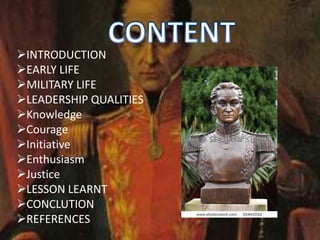
INTRODUCTION
EARLY LIFE
MILITARY LIFE
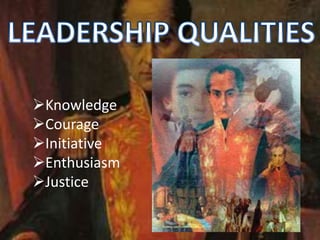
LEADERSHIP QUALITIES
Knowledge
Courage
Initiative
Enthusiasm
Justice
LESSON LEARNT
CONCLUTION
REFERENCES
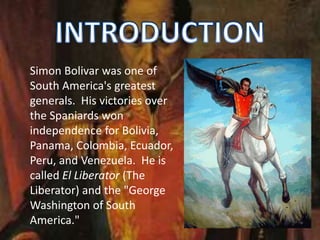
Simon Bolivar was one of
South America's greatest
generals. His victories over
the Spaniards won
independence for Bolivia,
Panama, Colombia, Ecuador,
Peru, and Venezuela. He is
called El Liberator (The
Liberator) and the "George
Washington of South
America."
Simón Bolívar was born in July 24, He
had two older sisters and a brother:
María Antonia, Juana, and Juan
Vicente. Another sister, María del
Carmen, died at birth.[6]
Bolívar's father died when Bolívar
was two and a half years old. Bolívar's
mother died when he was
approaching nine years of age. In an
effort to give Bolívar the best
education possible, he received
private lessons from the renowned
professor Don Simón Rodríguez.
 Don Simón Rodriguez was later
to become Bolívar's friend and
mentor, and he instilled in the
young man the ideas of liberty,
enlightenment, and freedom.[7]
In the meantime, all the love,
affection, and attention given to
Bolívar was from his nanny,
Hipólita. Hipólita gave the young
Bolívar all the affection he needed
and indulged him in all his wishes
and desires.
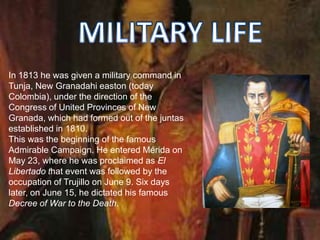
In 1813 he was given a military command in
Tunja, New Granadahi easton (today
Colombia), under the direction of the
Congress of United Provinces of New
Granada, which had formed out of the juntas
established in 1810.
This was the beginning of the famous
Admirable Campaign. He entered Mérida on
May 23, where he was proclaimed as El
Libertado that event was followed by the
occupation of Trujillo on June 9. Six days
later, on June 15, he dictated his famous
Decree of War to the Death.
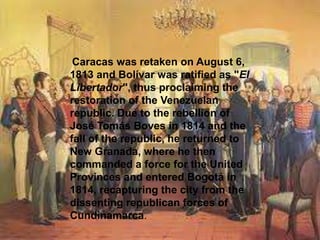
Caracas was retaken on August 6,
1813 and Bolívar was ratified as "El
Libertador", thus proclaiming the
restoration of the Venezuelan
republic. Due to the rebellion of
José Tomás Boves in 1814 and the
fall of the republic, he returned to
New Granada, where he then
commanded a force for the United
Provinces and entered Bogotá in
1814, recapturing the city from the
dissenting republican forces of
Cundinamarca.
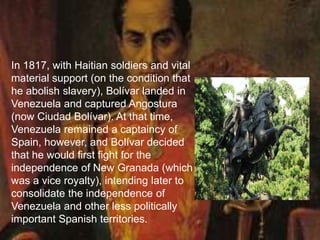
In 1817, with Haitian soldiers and vital
material support (on the condition that
he abolish slavery), Bolívar landed in
Venezuela and captured Angostura
(now Ciudad Bolívar). At that time,
Venezuela remained a captaincy of
Spain, however, and Bolívar decided
that he would first fight for the
independence of New Granada (which
was a vice royalty), intending later to
consolidate the independence of
Venezuela and other less politically
important Spanish territories.
Knowledge
Courage
Initiative
Enthusiasm
Justice
•It’s acquired information including professional
knowledge &an understanding of you subordinates
.nothing inspires confidence & respect more quickly
than demonstrating this knowledge.
•The individual who knows his job builds confidence
in him as well as others. Lack of knowledge can’t be
concealed. We can’t bluff our men. If we do not
know the answer to a particular question, admit it,
than get the information & pass it to those
concerned
•Courage is a mental quality that recognizes fear or
danger or criticism, but enable a man to proceed in
the face of it with calmness & firmness. In simple
terms, courage is the control of fear. It is a quality of
mind that gives a man control over him-self
enabling him to accept responsibility & to act
properly into a threatening situation. It’s vital to
leadership.
•Leader must have moral as well as physical
courage, Moral courage means knowing & standing
for what is right in the face of disfavor.
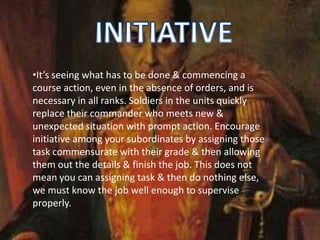
•It’s seeing what has to be done & commencing a
course action, even in the absence of orders, and is
necessary in all ranks. Soldiers in the units quickly
replace their commander who meets new &
unexpected situation with prompt action. Encourage
initiative among your subordinates by assigning those
task commensurate with their grade & then allowing
them out the details & finish the job. This does not
mean you can assigning task & then do nothing else,
we must know the job well enough to supervise
properly.
•It’s the display of sincere interest
and zeal in the performance of
duties. It implies that you work
with a cheerful & optimistic
attitude, determined to do a good
job. Thus it will be an example
which will be emulated by those
you lead. Enthusiasm is
particularly important &
instructing & training where,
through example your interest
and enthusiasm are reflected by
our men.
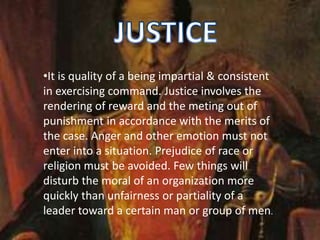
•It is quality of a being impartial & consistent
in exercising command. Justice involves the
rendering of reward and the meting out of
punishment in accordance with the merits of
the case. Anger and other emotion must not
enter into a situation. Prejudice of race or
religion must be avoided. Few things will
disturb the moral of an organization more
quickly than unfairness or partiality of a
leader toward a certain man or group of men.
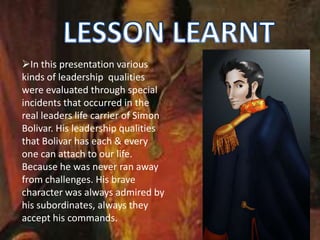
In this presentation various
kinds of leadership qualities
were evaluated through special
incidents that occurred in the
real leaders life carrier of Simon
Bolivar. His leadership qualities
that Bolivar has each & every
one can attach to our life.
Because he was never ran away
from challenges. His brave
character was always admired by
his subordinates, always they
accept his commands.
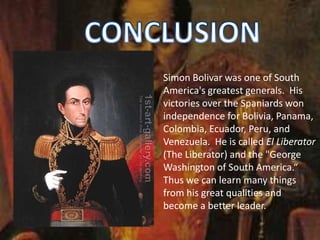
Simon Bolivar was one of South
America's greatest generals. His
victories over the Spaniards won
independence for Bolivia, Panama,
Colombia, Ecuador, Peru, and
Venezuela. He is called El Liberator
(The Liberator) and the "George
Washington of South America.“
Thus we can learn many things
from his great qualities and
become a better leader.
Simon bolivar
Simon bolivar

Simon bolivar

  • 2.
    The aim ofthis presentation is to highlight the leadership qualities of Simon Bolivar and analyze the lesson learnt from his character.
  • 3.
    •24 Jul 1783CE - Simon Bolivar was born in Caracas •1810 CE -Simon Bolivar joined the group of patriots that seized Caracas in Venuzuela. •1813 CE -took command of a patriot army, recapturing Caracas from the Spaniards. • 1814 CE -Royalist forces defeated Simon Bolivar, and he went into exile in Jamaica • Dec 1815 CE -Simon Bolivar took refuge in Haiti's southern territories. He received a hero's welcome by General Marion, the military commander of the South. • 1817 CE -Simon Bolivar again invaded Venezuela. He established a revolutionary government at Angostura (now Ciudad Bolivar), and he was elected president of Venezuela.
  • 4.
    •7 Aug 1819CE -Battle of Boyaca, when Simon Bolivar defeats Spanish in New Granada (now Colombia), liberating the territory. •17 Dec 1819 CE -Simon Bolivar returned to Angostura and became the first president of the original republic of Colombia (now Ecuador, Colombia, Panama, and Venezuela •24 Jun 1821 CE -Simon Bolivar crushed the Spanish army at Carabobo in Venezuela. • 1821 CE -Simon Bolivar marched into Educador and added that territory to the new Colombian republic •1824 CE -Simon Bolivar led the revolutionary forces of Peru in their fight for independence and won a victory over the Spaniards at Auacucho. •1825 CE -Upper Peru became a separate state, named Bolivia in Simon Bolivar's honor •1825 CE -After a meeting in 1822 with another great liberator, Simon Bolivar became was elected president of Peru
  • 5.
    INTRODUCTION EARLY LIFE MILITARY LIFE LEADERSHIPQUALITIES Knowledge Courage Initiative Enthusiasm Justice LESSON LEARNT CONCLUTION REFERENCES
  • 6.
    Simon Bolivar wasone of South America's greatest generals. His victories over the Spaniards won independence for Bolivia, Panama, Colombia, Ecuador, Peru, and Venezuela. He is called El Liberator (The Liberator) and the "George Washington of South America."
  • 7.
    Simón Bolívar wasborn in July 24, He had two older sisters and a brother: María Antonia, Juana, and Juan Vicente. Another sister, María del Carmen, died at birth.[6] Bolívar's father died when Bolívar was two and a half years old. Bolívar's mother died when he was approaching nine years of age. In an effort to give Bolívar the best education possible, he received private lessons from the renowned professor Don Simón Rodríguez.
  • 8.
     Don SimónRodriguez was later to become Bolívar's friend and mentor, and he instilled in the young man the ideas of liberty, enlightenment, and freedom.[7] In the meantime, all the love, affection, and attention given to Bolívar was from his nanny, Hipólita. Hipólita gave the young Bolívar all the affection he needed and indulged him in all his wishes and desires.
  • 9.
    In 1813 hewas given a military command in Tunja, New Granadahi easton (today Colombia), under the direction of the Congress of United Provinces of New Granada, which had formed out of the juntas established in 1810. This was the beginning of the famous Admirable Campaign. He entered Mérida on May 23, where he was proclaimed as El Libertado that event was followed by the occupation of Trujillo on June 9. Six days later, on June 15, he dictated his famous Decree of War to the Death.
  • 10.
    Caracas was retakenon August 6, 1813 and Bolívar was ratified as "El Libertador", thus proclaiming the restoration of the Venezuelan republic. Due to the rebellion of José Tomás Boves in 1814 and the fall of the republic, he returned to New Granada, where he then commanded a force for the United Provinces and entered Bogotá in 1814, recapturing the city from the dissenting republican forces of Cundinamarca.
  • 11.
    In 1817, withHaitian soldiers and vital material support (on the condition that he abolish slavery), Bolívar landed in Venezuela and captured Angostura (now Ciudad Bolívar). At that time, Venezuela remained a captaincy of Spain, however, and Bolívar decided that he would first fight for the independence of New Granada (which was a vice royalty), intending later to consolidate the independence of Venezuela and other less politically important Spanish territories.
  • 12.
  • 13.
    •It’s acquired informationincluding professional knowledge &an understanding of you subordinates .nothing inspires confidence & respect more quickly than demonstrating this knowledge. •The individual who knows his job builds confidence in him as well as others. Lack of knowledge can’t be concealed. We can’t bluff our men. If we do not know the answer to a particular question, admit it, than get the information & pass it to those concerned
  • 14.
    •Courage is amental quality that recognizes fear or danger or criticism, but enable a man to proceed in the face of it with calmness & firmness. In simple terms, courage is the control of fear. It is a quality of mind that gives a man control over him-self enabling him to accept responsibility & to act properly into a threatening situation. It’s vital to leadership. •Leader must have moral as well as physical courage, Moral courage means knowing & standing for what is right in the face of disfavor.
  • 15.
    •It’s seeing whathas to be done & commencing a course action, even in the absence of orders, and is necessary in all ranks. Soldiers in the units quickly replace their commander who meets new & unexpected situation with prompt action. Encourage initiative among your subordinates by assigning those task commensurate with their grade & then allowing them out the details & finish the job. This does not mean you can assigning task & then do nothing else, we must know the job well enough to supervise properly.
  • 16.
    •It’s the displayof sincere interest and zeal in the performance of duties. It implies that you work with a cheerful & optimistic attitude, determined to do a good job. Thus it will be an example which will be emulated by those you lead. Enthusiasm is particularly important & instructing & training where, through example your interest and enthusiasm are reflected by our men.
  • 17.
    •It is qualityof a being impartial & consistent in exercising command. Justice involves the rendering of reward and the meting out of punishment in accordance with the merits of the case. Anger and other emotion must not enter into a situation. Prejudice of race or religion must be avoided. Few things will disturb the moral of an organization more quickly than unfairness or partiality of a leader toward a certain man or group of men.
  • 18.
    In this presentationvarious kinds of leadership qualities were evaluated through special incidents that occurred in the real leaders life carrier of Simon Bolivar. His leadership qualities that Bolivar has each & every one can attach to our life. Because he was never ran away from challenges. His brave character was always admired by his subordinates, always they accept his commands.
  • 19.
    Simon Bolivar wasone of South America's greatest generals. His victories over the Spaniards won independence for Bolivia, Panama, Colombia, Ecuador, Peru, and Venezuela. He is called El Liberator (The Liberator) and the "George Washington of South America.“ Thus we can learn many things from his great qualities and become a better leader.