M          M


Signature and Name of Invigilator                                                Answer Sheet No. : ......................................................
                                                                                                                  (To be filled by the Candidate)
1. (Signature)
                                                                                          Roll No.
     (Name)
                                                                                                           (In figures as per admission card)

2. (Signature)                                                                   Roll No.
                                                                                                                      (In words)
     (Name)
                                                                                 Test Booklet No.                           W X Y Z
 D—0 0 0 7
Time : 1¼ hours]
                                                           PAPER—I                                                [Maximum Marks : 100
Number of Pages in this Booklet : 24                                               Number of Questions in this Booklet : 50
        Instructions for the Candidates                                                            ÂÚUèÿææçÍüØô¢ ·ð¤ çܰ çÙÎðüàæ
1.   Write your roll number in the space provided on the top of            1. ÂãÜðU ÂëDU ·ð¤ ª¤ÂÚU çÙØÌ SÍæÙ ÂÚU ¥ÂÙæ ÚUôÜU ِÕÚU çÜç¹°Ð
     this page.                                                            2. §â ÂýàÙ-˜æ ×𢠿æâ Õãéçß·¤ËÂèØ ÂýàÙ ãñ¢Ð
2.   This paper consists of fifty multiple-choice type of questions.
                                                                           3. ÂÚUèÿææ ÂýæÚUÖ ãôÙð ÂÚU, ÂýàÙ-ÂéçSÌ·¤æ ¥æÂ·¤ô Îð Îè ÁæØð»èÐ ÂãÜðU ÂUæ¡¿ ç×ÙÅU
3.   At the commencement of examination, the question booklet
                                                                                 ¥æÂ·¤ô ÂýàÙ-ÂéçSÌ·¤æ ¹ôÜÙð ÌÍæ ©â·¤è çِÙçÜç¹Ì Áæ¡¿ ·ð¤ çܰ çÎØð
     will be given to you. In the first 5 minutes, you are
     requested to open the booklet and compulsorily examine it
                                                                                 ÁæØð¢»ð çÁâ·¤è Áæ¡¿ ¥æÂ·¤ô ¥ßàØ ·¤ÚUÙè ãñ Ñ
     as below :                                                                  (i)    ÂýàÙ-ÂéçSÌ·¤æ ¹ôÜÙð ·ð¤ çܰ ©â·ð¤ ·¤ßÚU ÂðÁ¤ÂÚU Ü»è ·¤æ»Á ·¤è
     (i)   To have access to the Question Booklet, tear off the                         âèÜ ·¤ô ȤæÇ¸U Üð¢UÐ ¹éÜè ãé§ü Øæ çÕÙæ SÅUè·¤ÚU-âèÜU ·¤è ÂéçSÌ·¤æ
           paper seal on the edge of this cover page. Do not                            Sßè·¤æÚU Ù ·¤Úð¢UÐ
           accept a booklet without sticker-seal and do not accept
                                                                                 (ii)   ·¤ßÚU ÂëDU ÂÚU ÀUÂð çÙÎðüàææÙéâæÚU ÂýàÙ-ÂéçSÌ·¤æ ·ð¤ ÂëDU ÌÍæ ÂýàÙô¢ ·¤è
           an open booklet.
                                                                                        â¢Øæ ·¤ô ¥‘ÀUè ÌÚUã ¿ñ·¤ ·¤ÚU Üð¢U ç·¤ Øð ÂêÚðU ãñ¢UÐ ÎôáÂê‡æü ÂéçSÌ·¤æ
     (ii) Tally the number of pages and number of questions
           in the booklet with the information printed on the                           çÁÙ×ð¢ ÂëDU / ÂýàÙ ·¤× ãô¢ Øæ ÎéÕæÚUæ ¥æ »Øð ãô¢ Øæ âèçÚUØÜU ×ð¢ Ù ãô¢
           cover page. Faulty booklets due to pages/questions                           ¥ÍæüÌ ç·¤âè Öè Âý·¤æÚU ·¤è ˜æéçÅUÂê‡æü ÂéçSÌ·¤æ Sßè·¤æÚU Ù ·¤Úð¢U ÌÍæ
           missing or duplicate or not in serial order or any                           ©âè âר ©âð ÜUõÅUæ·¤ÚU ©â·ð¤ SÍæÙ ÂÚU ÎêâÚUè âãè ÂýàÙ-ÂéçSÌ·¤æ
           other discrepancy should be got replaced immediately                         Üð Üð¢Ð U §â·ð¤ çܰ ¥æÂ·¤ô Âæ¡¿ ç×ÙÅU çÎØð ÁæØð¢»ðÐ ©â·ð¤ ÕæÎ Ù
           by a correct booklet from the invigilator within the                         Ìô ¥æÂ·¤è ÂýàÙ-ÂéçSÌ·¤æ ßæÂâ Üè ÁæØð»è ¥õÚU Ù ãè ¥æÂ·¤ô
           period of 5 minutes. Afterwards, neither the
                                                                                        ¥çÌçÚUQ¤ âר çÎØæ ÁæØð»æÐ
           Question Booklet will be replaced nor any extra time
           will be given.                                                        (iii) §â Áæ¡¿ ·ð¤ ÕæÎ ÂýàÙ-ÂéçSÌ·¤æ ·¤è R¤× â¢Øæ ©žæÚU-˜淤 ÂÚU ¥¢ç·¤Ì
     (iii) After this verification is over, the Serial No. of the                       ·¤Úð¢U ¥UõÚU ©žæÚU-˜淤 ·¤è R¤×¤â¢Øæ §â ÂýàÙ-ÂéçSÌ·¤æ ÂÚU ¥¢ç·¤Ì ·¤ÚU
           booklet should be entered in the Answer-sheets and                           ÎðÐ
                                                                                          ¢
           the Serial No. of Answer Sheet should be entered on             4. ÂýˆØð·¤ ÂýàÙ ·ð¤ çܰ ¿æÚU ©žæÚU çß·¤Ë (A), (B), (C) ÌÍæ (D) çÎØð »Øð ãñ¢Ð
           this Booklet.
                                                                                 ¥æÂ·¤ô âãè ©žæÚU ·ð¤ Îèƒæüßëžæ ·¤ô ÂðÙ âð ÖÚU·¤ÚU ·¤æÜæ ·¤ÚUÙæ ãñ Áñâæ ç·¤ Ùè¿ð
4.   Each item has four alternative responses marked (A), (B),
                                                                                 çÎ¹æØæ »Øæ ãñÐ
     (C) and (D). You have to darken the oval as indicated
     below on the correct response against each item.                            ©ÎæãÚU‡æ Ñ      A          B           C          D
                                                                                 ÁÕç·¤ (C) âãè ©žæÚU ãñÐ
     Example :     A        B        C        D
                                                                           5.    Âýà٠˜æ I ¥õÚU Âýà٠˜æ II ·ð¤ çܰ °·¤ ãè ©žæÚU ˜淤 ãñ Áô §â ÂýàÙ
    where (C) is the correct response.
                                                                                 ÂéçSÌ·¤æ ·ð¤ ¥‹ÎÚU çÎØæ »Øæ ãñÐ ÂýàÙô¢ ·ð¤ ©žæÚU ·ð¤ßÜU ©žæÚU-˜淤 ÂÚU ãè
5. Your responses to the items are to be indicated in the Answer
    Sheet given inside this Booklet, which is common for                      ¥¢ç·¤Ì ·¤ÚUÙð ãñ¢Ð ØçÎ ¥æÂ ©žæÚU ˜淤 ÂÚU çÎØð »Øð Îèƒæüßëžæ ·ð¤ ¥Üæßæ ç·¤âè
    Paper I and Paper II. If you mark at any place other than                 ¥‹Ø SÍæÙ ÂÚU ©žæÚU ç¿‹ãæ¢ç·¤Ì ·¤ÚUÌð ãñ, Ìô ©â·¤æ ×êËUØæ¢·¤Ù Ùãè¢ ãô»æÐ
    in the ovals in the Answer Sheet, it will not be evaluated.            6. ¥‹ÎÚU çÎØð »Øð çÙÎðüàæô¢ ·¤ô ŠØæÙÂêßü·¤ Âɸð¢UÐ
6. Read instructions given inside carefully.                               7. ·¤“ææ ·¤æ× (Rough Work) §â ÂéçSÌ·¤æ ·ð¤ ¥ç‹Ì× ÂëDU ÂÚU ·¤Úð¢UÐ
7. Rough Work is to be done in the end of this booklet.
                                                                           8. ØçÎ ¥æÂ ©žæÚU-ÂéçSÌ·¤æ ÂÚU ¥ÂÙæ Ùæ× Øæ °ðâæ ·¤ô§ü Öè çÙàææÙ çÁââð ¥æÂ·¤è
8. If you write your name or put any mark on any part of the
                                                                                 Âã¿æÙ ãô â·ð¤, ¤ç·¤âè Öè Öæ» ÂÚU ÎàææüÌð Øæ ¥¢ç·¤Ì ·¤ÚUÌð ãñ¢ Ìô ÂÚUèÿææ ·ð¤
    Answer Sheet, except for the space allotted for the relevant
    entries, which may disclose your identity, you will render                   çÜØð ¥Øô‚Ø ƒæôçáÌ ·¤ÚU çÎØð ÁæØð¢»ðÐ
    yourself liable to disqualification.                                   9. ¥æÂ·¤ô ÂÚUèÿææ â׿# ãôÙð ¤ÂÚU ©žæÚU-ÂéçSÌ·¤æ çÙÚUèÿæ·¤ ×ãôÎØ ·¤ô ÜUõÅUæÙæ
9. You have to return the test question booklet to the                         ¥æßàØ·¤ ãñ ¥õÚU ÂÚUèÿææ â׿ç# ·ð¤ ÕæÎ ¥ÂÙð âæÍ ÂÚUèÿææ ÖßÙ âð ÕæãÚU Ù
    invigilators at the end of the examination compulsorily                    Üð·¤ÚU ÁæØð¢Ð
    and must not carry it with you outside the Examination
                                                                           10. ·ð¤ßÜ ÙèÜð / ·¤æÜð ÕæÜU Œßæ§ZÅU ÂñÙ ·¤æ ãè §SÌð×æÜ ·¤Úð¢UÐ
    Hall.
10. Use only Blue/Black Ball point pen.                                    11. ç·¤âè Öè Âý·¤æÚU ·¤æ ⢻‡æ·¤ (·ñ¤Ü·é¤ÜðÅUÚU) UØæ Üæ» ÅðUÕÜ ¥æçÎ ·¤æ
11. Use of any calculator or log table etc., is prohibited.                    ÂýØô» ßçÁüÌ ãñÐ
12. There is NO negative marking.                                          12. »ÜÌ ©žæÚU ·ð¤ çܰ ¥¢·¤ Ùãè¢ ·¤æÅðU ÁæØð¢»ðÐ

M—00                                                                   1                                                                           P.T.O.


                                                                M          M
M        M


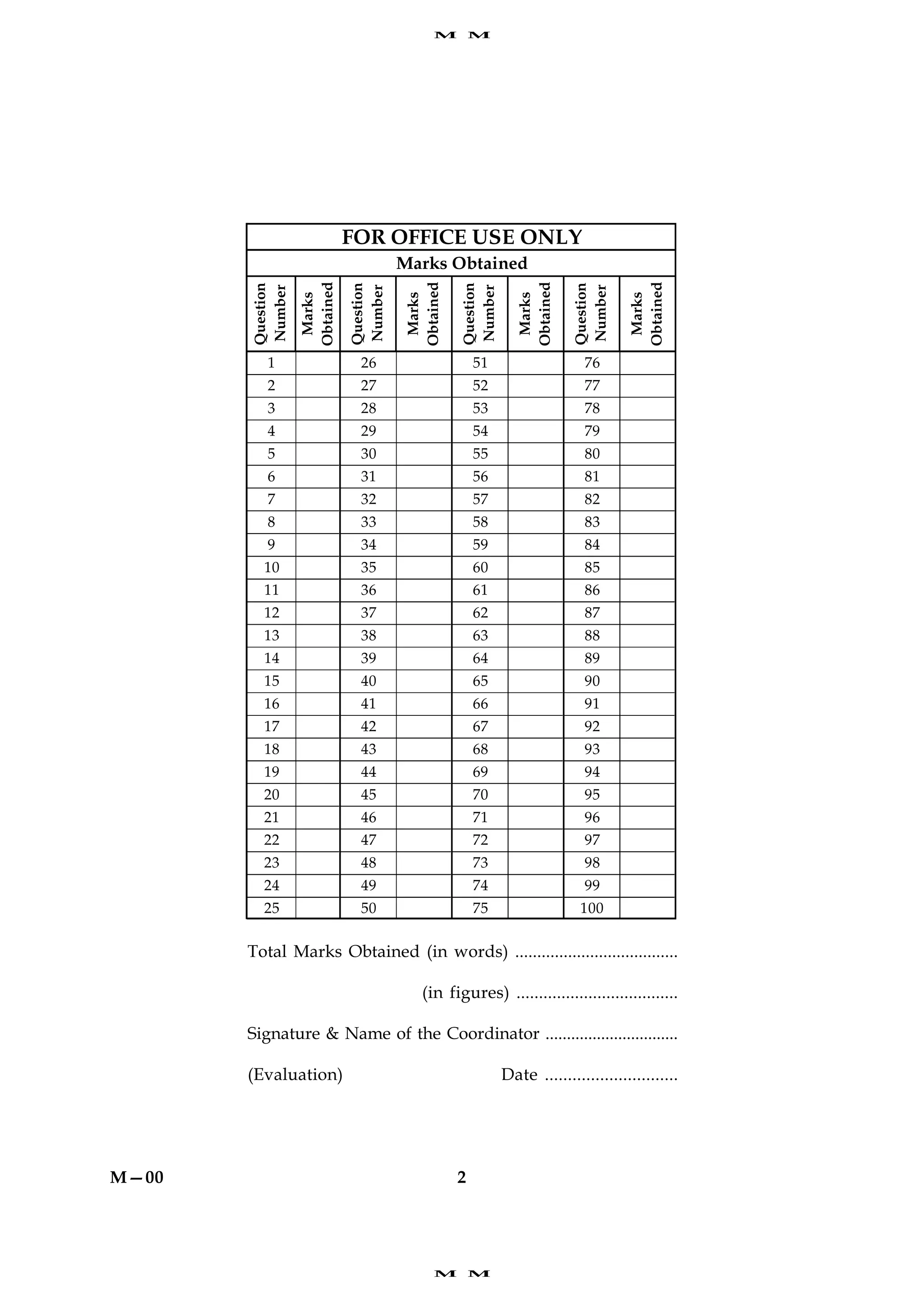
                             FOR OFFICE USE ONLY
                                        Marks Obtained


                  Obtained


                                        Obtained


                                                                Obtained


                                                                                      Obtained
       Question


                             Question


                                                   Question


                                                                           Question
       Number


                             Number


                                                   Number


                                                                           Number
                   Marks


                                         Marks


                                                                 Marks


                                                                                       Marks
          1                    26                      51                     76
          2                    27                      52                     77
          3                    28                      53                     78
          4                    29                      54                     79
          5                    30                      55                     80
          6                    31                      56                     81
          7                    32                      57                     82
          8                    33                      58                     83
          9                    34                      59                     84
         10                    35                      60                     85
         11                    36                      61                     86
         12                    37                      62                     87
         13                    38                      63                     88
         14                    39                      64                     89
         15                    40                      65                     90
         16                    41                      66                     91
         17                    42                      67                     92
         18                    43                      68                     93
         19                    44                      69                     94
         20                    45                      70                     95
         21                    46                      71                     96
         22                    47                      72                     97
         23                    48                      73                     98
         24                    49                      74                     99
         25                    50                      75                    100

       Total Marks Obtained (in words) .....................................

                                           (in figures) ....................................

       Signature & Name of the Coordinator ...............................

       (Evaluation)                                           Date .............................


M—00                                               2


                                              M        M
M       M


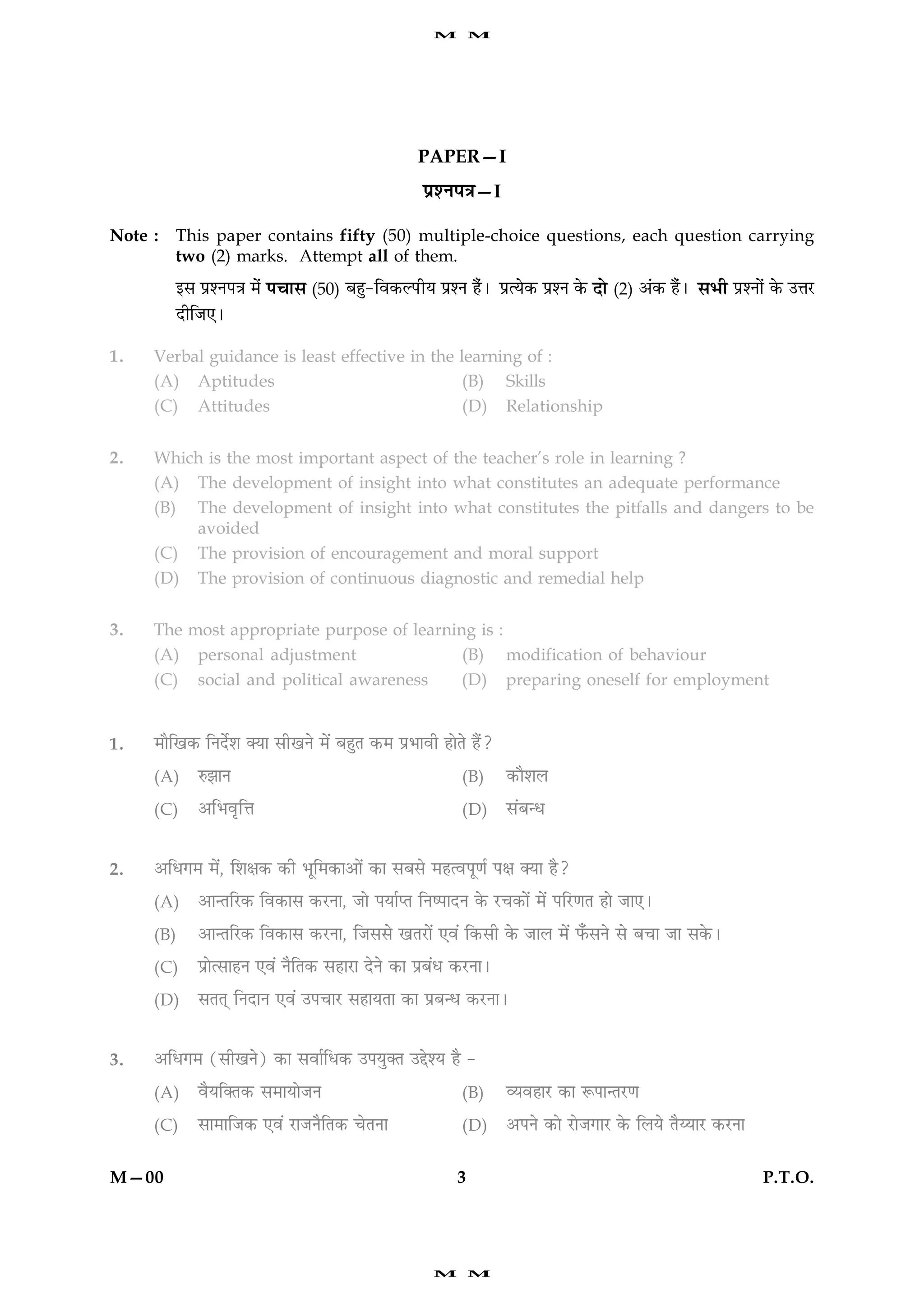
                                                 PAPER—I
                                                  ÂýàÙ˜æ—I

Note :   This paper contains fifty (50) multiple-choice questions, each question carrying
         two (2) marks. Attempt all of them.
         §â ÂýàÙ˜æ ×ð¢   ¿æâ (50) Õãé-çß·¤ËÂUèØ ÂýàÙ ãñ¢Ð      ÂýˆØð·¤ ÂýàÙ ·ð¤   Îô (2) ¥¢·¤ ãñ¢Ð âÖè ÂýàÙô¢ ·ð¤ ©žæÚU
         ÎèçÁ°Ð

1.   Verbal guidance is least effective in the learning of :
     (A) Aptitudes                              (B) Skills
     (C) Attitudes                              (D) Relationship


2.   Which is the most important aspect of the teacher’s role in learning ?
     (A) The development of insight into what constitutes an adequate performance
     (B) The development of insight into what constitutes the pitfalls and dangers to be
         avoided
     (C) The provision of encouragement and moral support
     (D) The provision of continuous diagnostic and remedial help


3.   The most appropriate purpose of learning is :
     (A) personal adjustment                (B) modification of behaviour
     (C) social and political awareness     (D) preparing oneself for employment


1.   ׿ñç¹·¤ çÙÎðüàæ €Øæ âè¹Ùð ×ð´ ÕãéÌ ·¤× ÂýÖæßè ãæðÌð ãñ´?

     (A)    L¤ÛææÙ                                       (B)      ·¤æñàæÜ

     (C)    ¥çÖßëçžæ                                     (D)      â´Õ‹Ï


2.   ¥çÏ»× ×ð´, çàæÿæ·¤ ·¤è Öêç×·¤æ¥æð´ ·¤æ âÕâð ×ãˆßÂê‡æü Âÿæ €Øæ ãñ?

     (A)    ¥æ‹ÌçÚU·¤ çß·¤æâ ·¤ÚUÙæ, Áæð ÂØæüŒÌ çÙcÂæÎÙ ·ð¤ ÚU¿·¤æð´ ×ð´ ÂçÚU‡æÌ ãæð Áæ°Ð

     (B)    ¥æ‹ÌçÚU·¤ çß·¤æâ ·¤ÚUÙæ, çÁââð ¹ÌÚUæð´ °ß´ ç·¤âè ·ð¤ ÁæÜ ×ð´ È¡¤âÙð âð Õ¿æ Áæ â·ð¤Ð

     (C)    ÂýæðˆâæãÙ °ß´ ÙñçÌ·¤ âãæÚUæ ÎðÙð ·¤æ ÂýÕ´Ï ·¤ÚUÙæÐ

     (D)    âÌÌ÷ çÙÎæÙ °ß´ ©Â¿æÚU âãæØÌæ ·¤æ ÂýÕ‹Ï ·¤ÚUÙæÐ


3.   ¥çÏ»× (âè¹Ùð) ·¤æ âßæüçÏ·¤ ©ÂØé€Ì ©gðàØ ãñ -

     (A)    ßñØç€Ì·¤ â×æØæðÁÙ                            (B)      ÃØßãæÚU ·¤æ M¤Âæ‹ÌÚU‡æ

     (C)    âæ×æçÁ·¤ °ß´ ÚUæÁÙñçÌ·¤ ¿ðÌÙæ                (D)      ¥ÂÙð ·¤æð ÚUæðÁ»æÚU ·ð¤ çÜØð ÌñÄØæÚU ·¤ÚUÙæ


M—00                                                    3                                                       P.T.O.


                                                    M       M
M       M


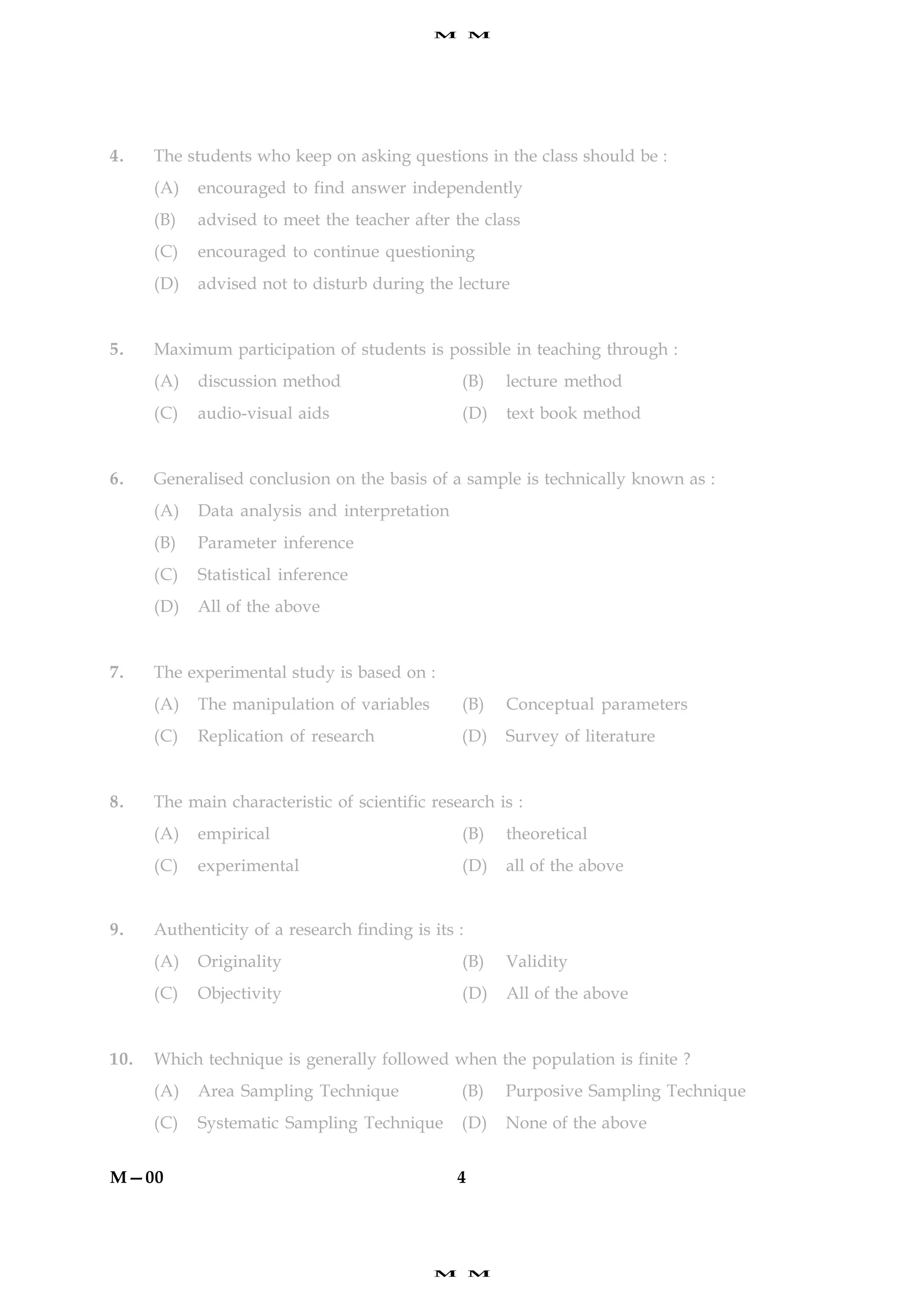
4.    The students who keep on asking questions in the class should be :
      (A)   encouraged to find answer independently
      (B)   advised to meet the teacher after the class
      (C)   encouraged to continue questioning
      (D)   advised not to disturb during the lecture


5.    Maximum participation of students is possible in teaching through :
      (A)   discussion method                   (B)     lecture method
      (C)   audio-visual aids                   (D)     text book method


6.    Generalised conclusion on the basis of a sample is technically known as :
      (A)   Data analysis and interpretation
      (B)   Parameter inference
      (C)   Statistical inference
      (D)   All of the above


7.    The experimental study is based on :
      (A)   The manipulation of variables       (B)     Conceptual parameters
      (C)   Replication of research             (D)     Survey of literature


8.    The main characteristic of scientific research is :
      (A)   empirical                           (B)     theoretical
      (C)   experimental                        (D)     all of the above


9.    Authenticity of a research finding is its :
      (A)   Originality                         (B)     Validity
      (C)   Objectivity                         (D)     All of the above


10.   Which technique is generally followed when the population is finite ?
      (A)   Area Sampling Technique             (B)     Purposive Sampling Technique
      (C)   Systematic Sampling Technique       (D)     None of the above


M—00                                            4


                                            M       M
M       M


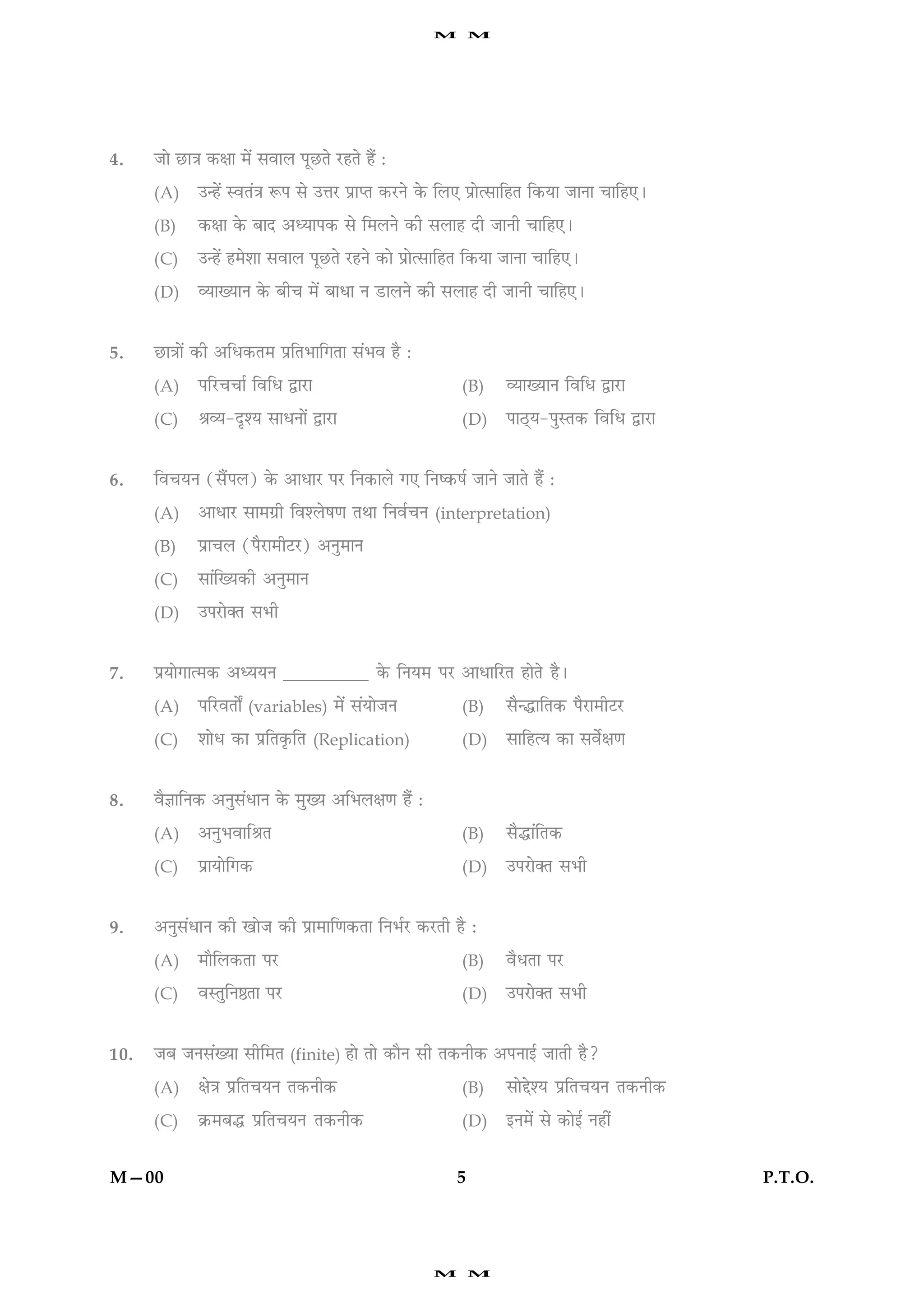
4.    Áæð ÀUæ˜æ ·¤ÿææ ×ð´ âᑚ ÂêÀUÌð ÚUãÌð ãñ´ Ñ

      (A)     ©‹ãð´ SßÌ´˜æ M¤Â âð ©žæÚU ÂýæŒÌ ·¤ÚUÙð ·ð¤ çܰ ÂýæðˆâæçãÌ ç·¤Øæ ÁæÙæ ¿æçã°Ð

      (B)     ·¤ÿææ ·ð¤ ÕæÎ ¥ŠØæÂ·¤ âð ç×ÜÙð ·¤è âÜæã Îè ÁæÙè ¿æçã°Ð

      (C)     ©‹ãð´ ã×ðàææ âᑚ ÂêÀUÌð ÚUãÙð ·¤æð ÂýæðˆâæçãÌ ç·¤Øæ ÁæÙæ ¿æçã°Ð

      (D)     ÃØæØæÙ ·ð¤ Õè¿ ×ð´ ÕæÏæ Ù ÇUæÜÙð ·¤è âÜæã Îè ÁæÙè ¿æçã°Ð


5.    ÀUæ˜ææð´ ·¤è ¥çÏ·¤Ì× ÂýçÌÖæç»Ìæ â´Öß ãñ Ñ

      (A)     ÂçÚU¿¿æü çßçÏ mæÚUæ                         (B)     ÃØæØæÙ çßçÏ mæÚUæ

      (C)     ŸæÃØ-ÎëàØ âæÏÙæð´ mæÚUæ                     (D)     ÂæÆ÷UØ-ÂéSÌ·¤ çßçÏ mæÚUæ


6.    çß¿ØÙ (âñ´ÂÜ) ·ð¤ ¥æÏæÚU ÂÚU çÙ·¤æÜð »° çÙc·¤áü ÁæÙð ÁæÌð ãñ´ Ñ

      (A)     ¥æÏæÚU âæ×»ýè çßàÜðá‡æ ÌÍæ çÙßü¿Ù (interpretation)

      (B)     Âýæ¿Ü (ÂñÚUæ×èÅUÚU) ¥Ùé׿Ù

      (C)     âæ´çØ·¤è ¥Ùé׿Ù

      (D)     ©ÂÚUæð€Ì âÖè


7.    ÂýØæð»æˆ×·¤ ¥ŠØØÙ __________ ·ð¤ çÙØ× ÂÚU ¥æÏæçÚUÌ ãæðÌð ãñÐ

      (A)     ÂçÚUßÌæðZ (variables) ×ð´ â´ØæðÁÙ           (B)     âñ‹hæçÌ·¤ ÂñÚUæ×èÅUÚU

      (C)     àææðÏ ·¤æ ÂýçÌ·ë¤çÌ (Replication)           (D)     âæçãˆØ ·¤æ âßðüÿæ‡æ


8.    ßñ™ææçÙ·¤ ¥Ùéâ´ÏæÙ ·ð¤ ×遨 ¥çÖÜÿæ‡æ ãñ´ Ñ

      (A)     ¥ÙéÖßæçŸæÌ                                  (B)     âñhæ´çÌ·¤

      (C)     ÂýæØæðç»·¤                                  (D)     ©ÂÚUæð€Ì âÖè


9.    ¥Ùéâ´ÏæÙ ·¤è ¹æðÁ ·¤è Âýæ×æç‡æ·¤Ìæ çÙÖüÚU ·¤ÚUÌè ãñ Ñ

      (A)     ׿ñçÜ·¤Ìæ ÂÚU                               (B)     ßñÏÌæ ÂÚU

      (C)     ßSÌéçÙDÌæ ÂÚU                               (D)     ©ÂÚUæð€Ì âÖè


10.   ÁÕ ÁÙâ´Øæ âèç×Ì (finite) ãæð Ìæð ·¤æñÙ âè Ì·¤Ùè·¤ ¥ÂÙæ§ü ÁæÌè ãñ?

      (A)     ÿæð˜æ ÂýçÌ¿ØÙ Ì·¤Ùè·¤                       (B)     âæðgðàØ ÂýçÌ¿ØÙ Ì·¤Ùè·¤

      (C)     ·ý¤×Õh ÂýçÌ¿ØÙ Ì·¤Ùè·¤                      (D)     §Ù×ð´ âð ·¤æð§ü Ùãè´


M—00                                                     5                                   P.T.O.


                                                     M       M
M       M


      Read the following passage and answer the questions 11 to 15 :

            Gandhi’s overall social and environmental philosophy is based on what human
      beings need rather than what they want. His early introduction to the teachings of
      Jains, Theosophists, Christian sermons, Ruskin and Tolstoy, and most significantly the
      Bhagavad Gita, were to have profound impact on the development of Gandhi’s holistic
      thinking on humanity, nature and their ecological interrelation. His deep concern for
      the disadvantaged, the poor and rural population created an ambience for an alternative
      social thinking that was at once far-sighted, local and immediate. For Gandhi was
      acutely aware that the demands generated by the need to feed and sustain human life,
      compounded by the growing industrialization of India, far outstripped the finite
      resources of nature. This might nowadays appear naïve or commonplace, but such
      pronouncements were as rare as they were heretical a century ago. Gandhi was also
      concerned about the destruction, under colonial and modernist designs, of the existing
      infrastructures which had more potential for keeping a community flourishing within
      ecologically-sensitive traditional patterns of subsistence, especially in the rural areas,
      than did the incoming Western alternatives based on nature-blind technology and the
      enslavement of human spirit and energies.

            Perhaps the moral principle for which Gandhi is best known is that of active
      non-violence, derived from the traditional moral restraint of not injuring another being.
      The most refined expression of this value is in the great epic of the Mahabharata,
      (c. 100 BCE to 200 CE), where moral development proceeds through placing constraints
      on the liberties, desires and acquisitiveness endemic to human life. One’s action is
      judged in terms of consequences and the impact it is likely to have on another. Jainas
      had generalized this principle to include all sentient creatures and biocommunities
      alike. Advanced Jaina monks and nuns will sweep their path to avoid harming insects
      and even bacteria. Non-injury is a non-negotiable universal prescription.


11.   Which one of the following have a profound impact on the development of Gandhi’s
      holistic thinking on humanity, nature and their ecological interrelations ?
      (A)   Jain teachings                      (B)     Christian sermons
      (C)   Bhagavad Gita                       (D)     Ruskin and Tolstoy


M—00                                            6


                                            M       M
M       M


      Ùè¿ð çܹð »læ´àæ ·¤æð Âçɸ° ¥æñÚU 11 âð 15 Ì·¤ ·ð¤ ÂýàÙæð´ ·¤æ ©žæÚU ÎèçÁ°Ð

             »æ¡ÏèÁè ·¤æ âæ×æçÁ·¤ ß ÂØæüßÚU‡æ ÎàæüÙ âßü»ýæãè M¤Â âð, ×ÙécØ €Øæ ¿æãÌð ãñ´ ÂÚU ¥æÏæçÚUÌ Ù ãæð·¤ÚU,

      ©Ù·¤è ¥æßàØ·¤Ìæ¥æð´ ÂÚU ¥æÏæçÚUÌ ãñÐ ÁèßÙ ·ð¤ ¥æÚ´UÖ ×ð´ ÁñçÙØæð´, çÍØæðâæòçȤSÅUæð´, §üâæ ·ð¤ ©ÂÎðàææð´, ÚUçS·¤Ù

      ¥æñÚU ÅUæËâÅUæØ ¥æñÚU âÕâð ×ãˆßÂê‡æü       Ö»ßÎ÷»èÌæ      ·ð¤ ÂçÚU¿Ø Ùð ©Ù·¤è âßüßæÎè ׿ÙßÌæ, Âý·ë¤çÌ ©â·ð¤

      ÂØæüßÚU‡æèØ ¥‹ÌSâ´Õ´Ï ·ð¤ ç¿´ÌÙ ÂÚU »ãÚUæ ÂýÖæß ÇUæÜæÐ âæÏÙãèÙ »ýæ×è‡æ ÁÙÌæ ·ð¤ ÂýçÌ ©Ù·ð¤ ×Ù ×ð´ °·¤

      ßñ·¤çË·¤ âæ×æçÁ·¤ ç¿´ÌÙ ·¤æ çß¿æÚU ÂÙÂæ, Áæð ÎêÚUÎàæèü, SÍæÙèØ ¥æñÚU Ìæˆ·¤æçÜ·¤ ÍæÐ »æ¡ÏèÁè §â ÕæÌ âð

      ÂêÚUè ÌÚUã Áæ»L¤·¤ Íð ç·¤ Âýæ·ë¤çÌ·¤ â´âæÏÙæð´ ·¤è ÌéÜÙæ ×ð´, ÁÙÌæ ·ð¤ çܰ ÖæðÁÙ ÁéÅUæÙð ·¤è ׿´» ·¤ãè´ ’ØæÎæ Íè,

      ¥æñÚU ¥æñlæð»è·¤ÚU‡æ Ùð §âð ¥æñÚU ÁçÅUÜ ÕÙæ çÎØæ ÍæÐ Øã ÕæÌ ¥æÁ çÁÌÙè âæ×æ‹Ø ¥æñÚU ÖæðÜè Ü»Ìè ãñ Üðç·¤Ù

      °·¤ àæÌæçŽÎ ÂãÜð Øã ©Î÷ƒææðá‡ææ Ï×üÎýæðã Áñâè çßÚUÜ ÍèÐ »æ¡ÏèÁè ¥æÏéçÙ·¤ÌæßæÎè, ¥æñÂçÙßðçàæ·¤ áÇUØ´˜æ ·ð¤

      ¥´Ì»üÌ, ÂØæüßÚU‡æ ·ð¤ ÂýçÌ â´ßðÎÙàæèÜ ×æñÁêÎæ ÉUæ¡¿ð ·ð¤ çßÙæàæ ·¤è ¥æàæ´·¤æ âð ç¿´çÌÌ ÍðÐ §Ù ׿ñÁêÎæ ÉUæ¡¿æð´ ×ð´

      ÖÚU‡æ Âæðá‡æ ·¤è ÂæÚ´UÂçÚU·¤ ÚUèçÌ âð â´Âóæ ÕÙæÙð ·¤è ¥ÂæÚ â´ÖæßÙæ°¡ Íè çßàæðá L¤Â âð »ýæ×è‡æ ÿæð˜ææð´ ×ð´; ÕÁæØ

      ׿Ùß ¥æˆ×æ °ß´ àæç€Ì ·¤æð Îæâ ÕÙæÙðßæÜè ßñ·¤çË·¤ ¥´Ïè Âçà¿×è ÅðU€ÙæðÜæòÁè ·ð¤Ð


             àææØÎ »æ¡ÏèÁè ·¤æ Áæð ÙñçÌ·¤ çâhæ´Ì âÕâð ¥çÏ·¤ ÁæÙæ ÁæÌæ ãñ, ßã ãñ âç·ý¤Ø ¥çã´âæ, ÎêâÚðU Áèßæð´ ·¤æð

      Îéѹ Ù Âãé¡¿æÙæ, ÂæÚ´UÂçÚU·¤ ÙñçÌ·¤ â´Ø× âð ÃØéˆÂóæÐ §â ×êËØ ·¤è âßæüçÏ·¤ ÂçÚUc·ë¤Ì ¥çÖÃØç€Ì                 ×ãæÖæÚUÌ
      ×ãæ·¤æÃØ (100 âð 200 §ü.Âê.) ×ð´ ç×ÜÌè ãñ Áãæ¡ ׿Ùß ÁèßÙ ·¤è çÙÚ´UÌÚU SßÌ´˜æÌæ¥æð´, §‘ÀUæ¥æð´ ¥æñÚU â´»ýã ·ð¤

      ª¤ÂÚU çÙØ´˜æ‡æ Ü»æÙð âð ÙñçÌ·¤ çß·¤æâ ãæðÌæ ãñÐ ×ÙécØ ·ð¤ ·¤æØæðZ ·¤æ ×êËØæ´·¤Ù, ÎêâÚUæð´ ·ð¤ ª¤ÂÚU ©â·¤æ €Øæ ÂýÖæß

      ÂÇ¸ð»æ §ââð ×æÂæ ÁæÌæ ãñÐ ÁñçÙØæð´ Ùð §â çâhæ´Ì ·¤æð â×SÌ ¿ñÌ‹Ø ÌÍæ ÁèßÁ´Ì饿ð´ ÂÚU â×æÙ M¤Â âð Üæ»ê

      ç·¤Øæ ãñÐ ¥»ý‡æè ÁñÙ ×éçÙ ¥æñÚU çÖÿæéç‡æØæ¡ Áèßæð´ ß ·ë¤çרæð´ ·¤è ãˆØæ Ù ãæð §âçܰ ÚUæSÌð ·¤æð ÛææÇêU âð ÕéãæÚUÌð ãñ´Ð

      ¥çã´âæ âæßüÖæñ× ¥æÎðàæ ãñ, çÁâ ÂÚU ·¤æð§ü â×ÛææñÌæ Ùãè´ ãæð â·¤ÌæÐ


11.   çِÙçÜç¹Ì ×ð´ âð »æ¡ÏèÁè ·¤è ׿ÙßÌæ, Âý·ë¤çÌ ¥æñÚU ©â·ð¤ ÂØæüßÚU‡æ âð ¥´ÌSâ´Õ´Ïæð´ ·¤è âßüßæÎè çß¿æÚUÏæÚUæ ·ð¤
      çß·¤æâ ·ð¤ ª¤ÂÚU ç·¤â·¤æ »ãÚUæ ÂýÖæß ÂǸæ ãñ?

      (A)    ÁñÙ çàæÿææ¥æð´ ·¤æ                              (B)     §üâæ§ü Âýß¿Ùæð´ ·¤æ

      (C)    Ö»ßÎ÷»èÌæ ·¤æ                                   (D)     ÚUçS·¤Ù ¥æñÚU ÅUæËâÅUæØ ·¤æ


M—00                                                        7                                                      P.T.O.


                                                        M       M
M       M


12.   Gandhi’s overall social and environmental philosophy is based on human beings’ :

      (A)   need                               (B)     desire

      (C)   wealth                             (D)     welfare


13.   Gandhiji’s deep concern for the disadvantaged, the poor and rural population created
      an ambience for an alternative :

      (A)   rural policy                       (B)     social thinking

      (C)   urban policy                       (D)     economic thinking


14.   Colonial policy and modernisation led to the destruction of :

      (A)   major industrial infrastructure

      (B)   irrigation infrastructure

      (C)   urban infrastructure

      (D)   rural infrastructure


15.   Gandhi’s active non-violence is derived from :

      (A)   Moral restraint of not injuring another being

      (B)   Having liberties, desires and acquisitiveness

      (C)   Freedom of action

      (D)   Nature-blind technology and enslavement of human spirit and energies


16.   DTH service was started in the year :

      (A)   2000                               (B)     2002

      (C)   2004                               (D)     2006

M—00                                           8


                                           M       M
M         M


12.   »æ¡ÏèÁè ·¤æ âßü»ýæãè âæ×æçÁ·¤ ß ÂØæüßÚU‡æèØ ÎàæüÙ ×ÙécØæð´ ·¤è __________ ÂÚU ¥æÏæçÚUÌ ãñÐ


      (A)    ¥æßàØ·¤ÌæØð´                                      (B)     §‘ÀUæØð´


      (C)    ÏÙ                                                (D)     ·¤ËØæ‡æ


13.   »æ¡ÏèÁè ·¤è âæÏÙãèÙ Üæð»æð´, »ÚUèÕæð´ °ß´ »ýæ×è‡æ ÁÙÌæ ·ð¤ ÂýçÌ »ãÚUè ç¿´Ìæ âð ç·¤â ßñ·¤çË·¤ ÃØßSÍæ ·¤æ
      çß¿æÚU ÂÙÂæ?


      (A)    »ýæ×è‡æ ÙèçÌ                                      (B)     âæ×æçÁ·¤ ç¿´ÌÙ


      (C)    àæãÚUè ÙèçÌ                                       (D)     ¥æçÍü·¤ ç¿´ÌÙ


14.   ¥æñÂçÙßðçàæ·¤ ÙèçÌ ¥æñÚU ¥æÏéçÙ·¤è·¤ÚU‡æ __________ ·¤æð çßÙæàæ ·¤è ¥æðÚU Üð »§üÐ


      (A)    çßàææÜ ¥æñlæðç»·¤ ¥æÏæçÚU·¤ â´Ú¿Ùæ                (B)     çâ´¿æ§ü ¥æÏæçÚU·¤ â´ÚU¿Ùæ


      (C)    àæãÚUè ¥æÏæçÚU·¤ â´ÚU¿Ùæ                          (D)     »ýæ×è‡æ ¥æÏæçÚU·¤ â´ÚU¿Ùæ


15.   »æ¡ÏèÁè ·¤è âç·ý¤Ø ¥çã´âæ __________ âð ÃØéˆÂóæ ãñÐ


      (A)    ÎêâÚðU ÃØç€Ì ·¤æð ¿æðÅU Ù Âãé¡¿æÙð ·¤æ ÙñçÌ·¤ çÙ»ýã


      (B)    SßÌ´˜æÌæ, §‘ÀUæØð´ ¥æñÚU â´ÂýæçŒÌØæð´ ·¤æ ãæðÙæ


      (C)    ·¤æØü ·¤ÚUÙð ·¤è SßÌ´˜æÌæ


      (D)    Âý·ë¤çÌ ·ð¤ çßL¤h ¥´Ïè ÅðU€ÙæðÜæòÁè ÌÍæ ׿Ùß ¥æˆ×æ °ß´ àæç€ÌØæð´ ·¤æð Îæâ ÕÙæÙæ


16.   ÇUè.ÅUè.°¿. âðßæ ·¤æ ¥æÚ´UÖ çِ٠ßáü ×ð´ ã饿Ð

      (A)    2000                                              (B)     2002

      (C)    2004                                              (D)     2006


M—00                                                           9                                      P.T.O.


                                                         M         M
M   M


17.   National Press day is celebrated on :

      (A)   16th November                         (B)   19th November

      (C)   21st November                         (D)   30th November


18.   The total number of members in the Press Council of India are :

      (A)   28                                    (B)   14

      (C)   17                                    (D)   20


19.   The right to impart and receive information is guaranteed in the Constitution of India
      by Article :

      (A)   19 (2) (a)                            (B)   19 (16)

      (C)   19 (2)                                (D)   19 (1) (a)


20.   Use of radio for higher education is based on the presumption of :

      (A)   Enriching curriculum based instruction

      (B)   Replacing teacher in the long run

      (C)   Everybody having access to a radio set

      (D)   Other means of instruction getting outdated


21.   Find out the number which should come at the place of question mark which will
      complete the following series :

      5, 4, 9, 17, 35, ? 5 139

      (A)   149                                   (B)   79

      (C)   49                                    (D)   69


M—00                                          10


                                              M   M
M      M


17.   ÚUæcÅþUèØ Âýðâ çÎßâ ×ÙæØæ ÁæÌæ ãñ Ñ


      (A)    16 Ùß´ÕÚU ·¤æð                                      (B)   19 Ùß´ÕÚU ·¤æð

      (C)    21 Ùß´ÕÚU ·¤æð                                      (D)   30 Ùß´ÕÚU ·¤æð


18.   Âýýðâ ·¤æò©ç‹âÜ ¥æòȤ §´çÇUØæ ×ð´ ·é¤Ü âÎSØ ãæðÌð ãñ Ñ

      (A)    28                                                  (B)   14

      (C)    17                                                  (D)   20


19.   âê¿Ùæ ÎðÙð ¥æñÚU ÂýæŒÌ ·¤ÚUÙð ·¤æ ¥çÏ·¤æÚU ·¤è »æÚ´UÅUè ÖæÚUÌ ·ð¤ â´çßÏæÙ ·¤è ÏæÚUæ ×ð´ Îè »§ü ãñ Ñ

      (A)    19 (2) (a)                                          (B)   19 (16)

      (C)    19 (2)                                              (D)   19 (1) (a)


20.   ©“æ çàæÿææ ×ð´ ÚðUçÇUØæð ·¤æ ©ÂØæð» çِÙçÜç¹Ì ¥æÏæçÚU·¤æ ÂÚU ãñÐ


      (A)    ÂæÆU¿Øæü ÂÚU ¥æÏæçÚUÌ ¥ÙéÎðàææð´ ·¤æð ÂécÅU ·¤ÚUÙæÐ


      (B)    ¥´ÌÌÑ ¥ŠØæÂ·¤ ·¤æð SÍæÙæÂóæ ·¤ÚUÙæÐ


      (C)    ÂýˆØð·¤ ·ð¤ Âæâ ÚðUçÇUØæð âðÅU ãñÐ


      (D)    ¥ÙéÎðàææð´ ·ð¤ ÎêâÚðU âæÏÙ ÂéÚUæÙð ÂǸ ¿é·ð¤ ãñ´Ð


21.   Ùè¿ð Îè »§ü âèÚUèÁ ×ð´ ÂýàÙ ßæ¿·¤ (?) ·ð¤ SÍæÙ ÂÚU âãè ¥´·¤ çÜç¹° Ñ

      5, 4, 9, 17, 35, ? 5 139

      (A)    149                                                 (B)   79

      (C)    49                                                  (D)   69

M—00                                                         11                                             P.T.O.


                                                          M      M
M    M


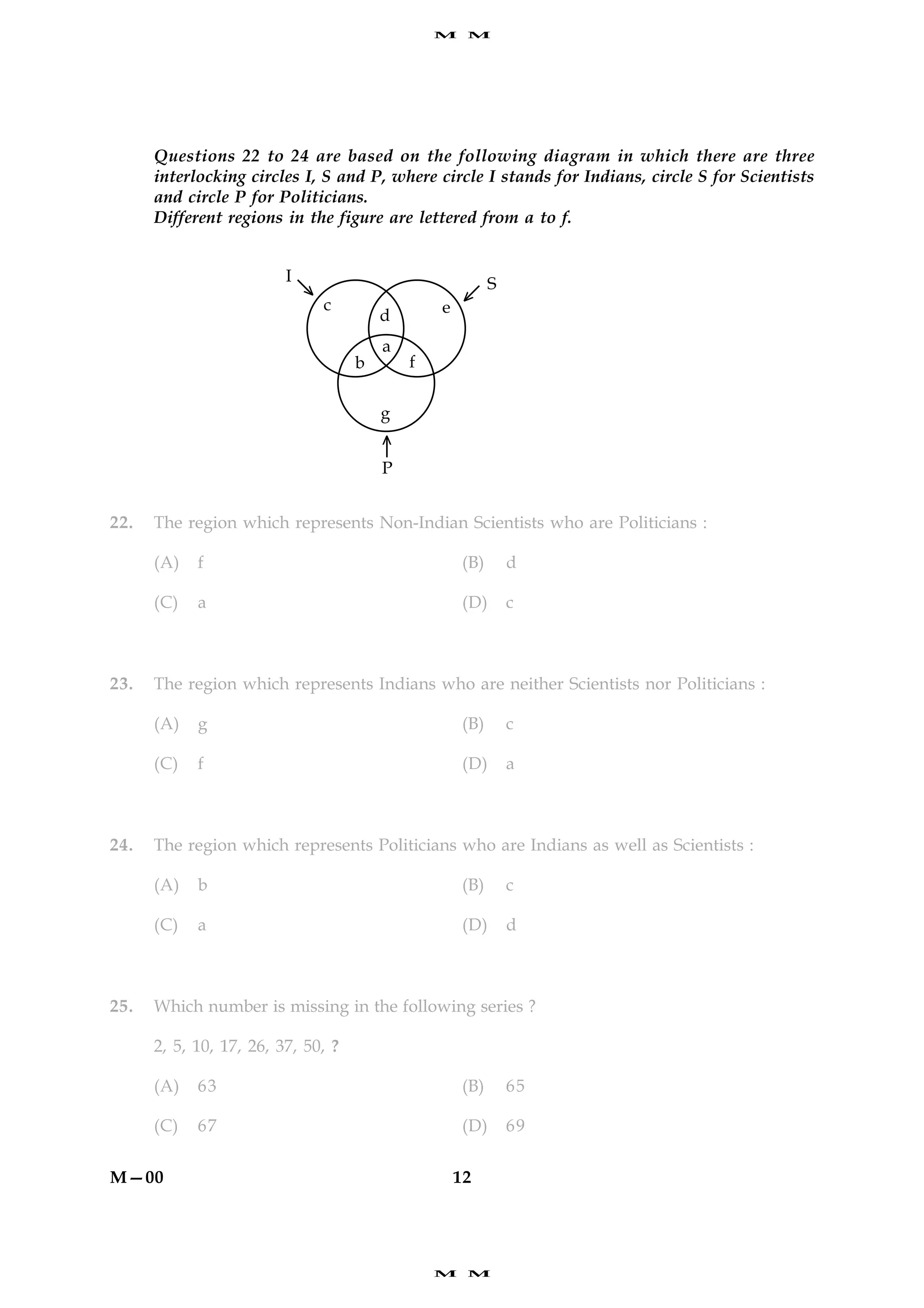
      Questions 22 to 24 are based on the following diagram in which there are three
      interlocking circles I, S and P, where circle I stands for Indians, circle S for Scientists
      and circle P for Politicians.
      Different regions in the figure are lettered from a to f.


22.   The region which represents Non-Indian Scientists who are Politicians :

      (A)   f                                   (B)   d

      (C)   a                                   (D)   c


23.   The region which represents Indians who are neither Scientists nor Politicians :

      (A)   g                                   (B)   c

      (C)   f                                   (D)   a


24.   The region which represents Politicians who are Indians as well as Scientists :

      (A)   b                                   (B)   c

      (C)   a                                   (D)   d


25.   Which number is missing in the following series ?

      2, 5, 10, 17, 26, 37, 50, ?

      (A)   63                                  (B)   65

      (C)   67                                  (D)   69


M—00                                           12


                                            M    M
M     M


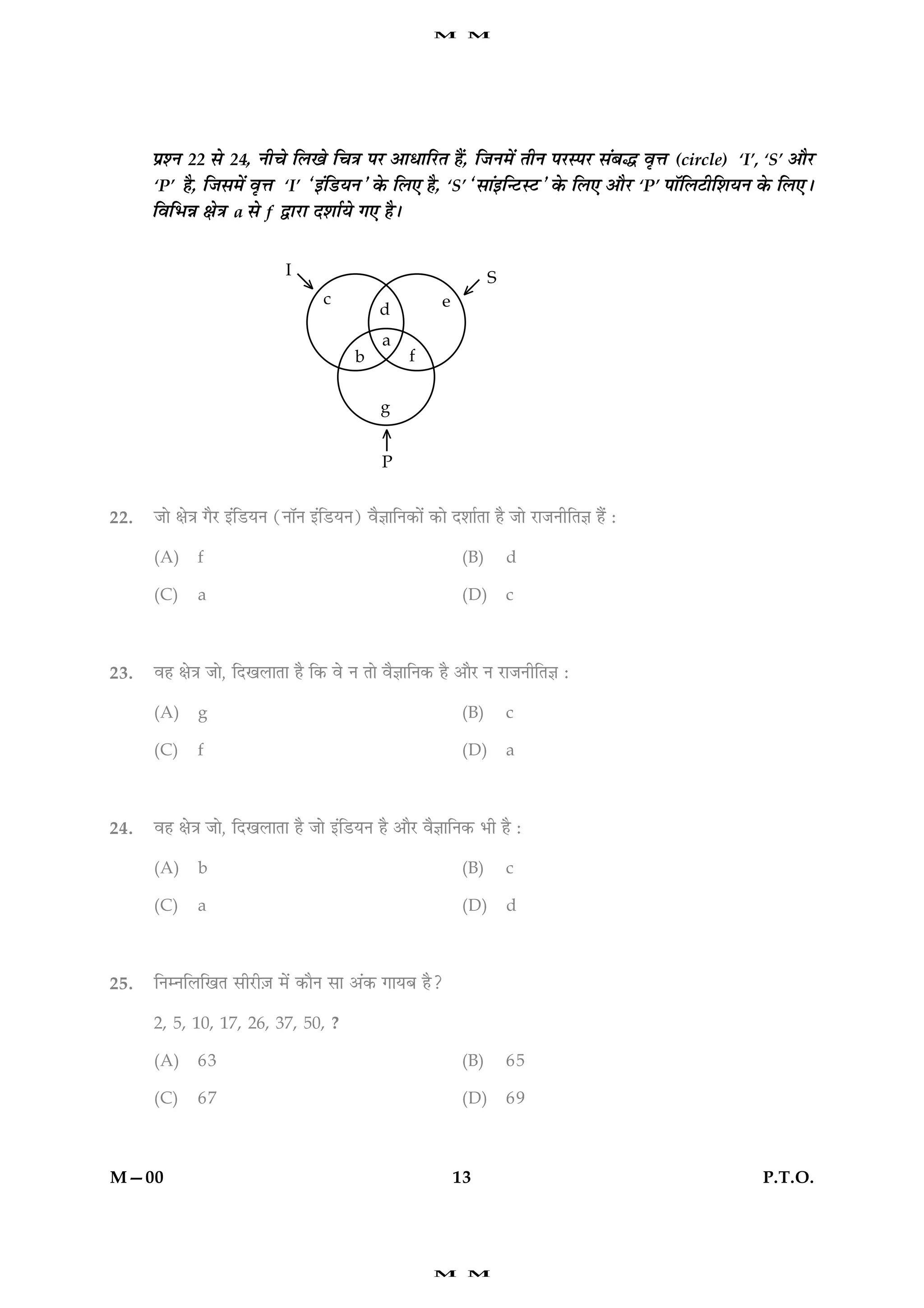
      ÂýàÙ 22 âð 24, Ùè¿ð çܹð 翘æ ÂÚU ¥æÏæçÚUÌ ãñ´, çÁÙ×ð´ ÌèÙ ÂÚUSÂÚU â´Õh ßëžæ (circle) ‘I’, ‘S’ ¥æñÚ
      ‘P’ ãñ, çÁâ×ð´ ßëžæ ‘I’ Ò§´çÇUØÙÓ ·ð¤ çܰ ãñ, ‘S’ Òâæ´§ç‹ÅUSÅUÓ ·ð¤ çܰ ¥æñÚU ‘P’ ÂæòçÜÅèçàæØÙ ·ð¤ çܰÐ
      çßçÖóæ ÿæð˜æ a âð f mæÚUæ ÎàææüØð »° ãñÐ


22.   Áæð ÿæð˜æ »ñÚU §´çÇUØÙ (ÙæòÙ §´çÇUØÙ) ßñ™ææçÙ·¤æð´ ·¤æð ÎàææüÌæ ãñ Áæð ÚUæÁÙèçÌ™æ ãñ´ Ñ

      (A)     f                                                (B)      d

      (C)     a                                                (D)      c


23.   ßã ÿæð˜æ Áæð, çÎ¹ÜæÌæ ãñ ç·¤ ßð Ù Ìæð ßñ™ææçÙ·¤ ãñ ¥æñÚU Ù ÚUæÁÙèçÌ™æ Ñ

      (A)     g                                                (B)      c

      (C)     f                                                (D)      a


24.   ßã ÿæð˜æ Áæð, çÎ¹ÜæÌæ ãñ Áæð §´çÇUØÙ ãñ ¥æñÚU ßñ™ææçÙ·¤ Öè ãñ Ñ

      (A)     b                                                (B)      c

      (C)     a                                                (D)      d


25.   çِÙçÜç¹Ì âèÚUè$Á ×ð´ ·¤æñÙ âæ ¥´·¤ »æØÕ ãñ?

      2, 5, 10, 17, 26, 37, 50, ?

      (A)     63                                               (B)      65

      (C)     67                                               (D)      69


M—00                                                          13                                    P.T.O.


                                                          M     M
M    M


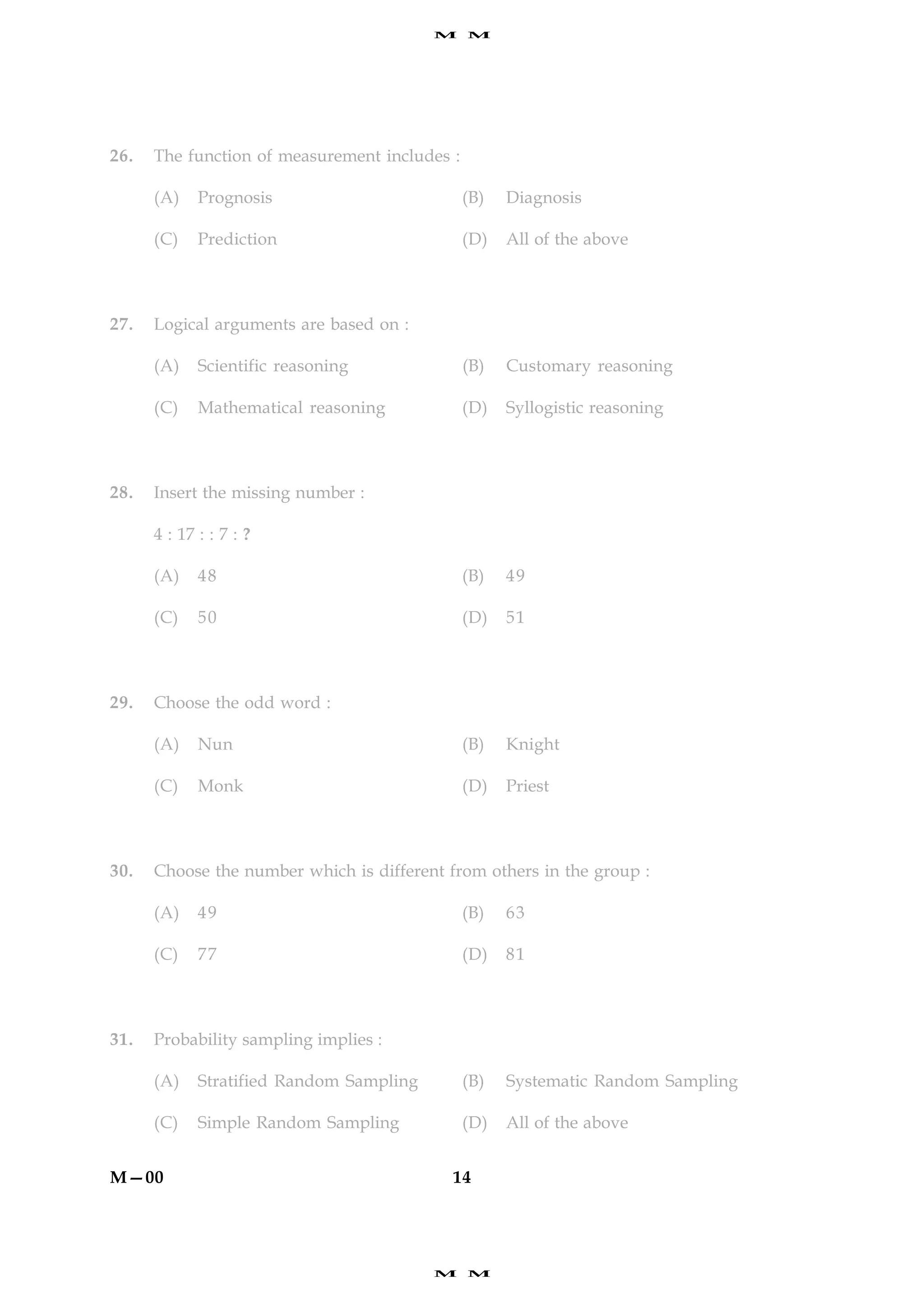
26.   The function of measurement includes :

      (A)    Prognosis                         (B)   Diagnosis

      (C)    Prediction                        (D)   All of the above


27.   Logical arguments are based on :

      (A)    Scientific reasoning              (B)   Customary reasoning

      (C)    Mathematical reasoning            (D)   Syllogistic reasoning


28.   Insert the missing number :

      4 : 17 : : 7 : ?

      (A)    48                                (B)   49

      (C)    50                                (D)   51


29.   Choose the odd word :

      (A)    Nun                               (B)   Knight

      (C)    Monk                              (D)   Priest


30.   Choose the number which is different from others in the group :

      (A)    49                                (B)   63

      (C)    77                                (D)   81


31.   Probability sampling implies :

      (A)    Stratified Random Sampling        (B)   Systematic Random Sampling

      (C)    Simple Random Sampling            (D)   All of the above


M—00                                        14


                                          M    M
M   M


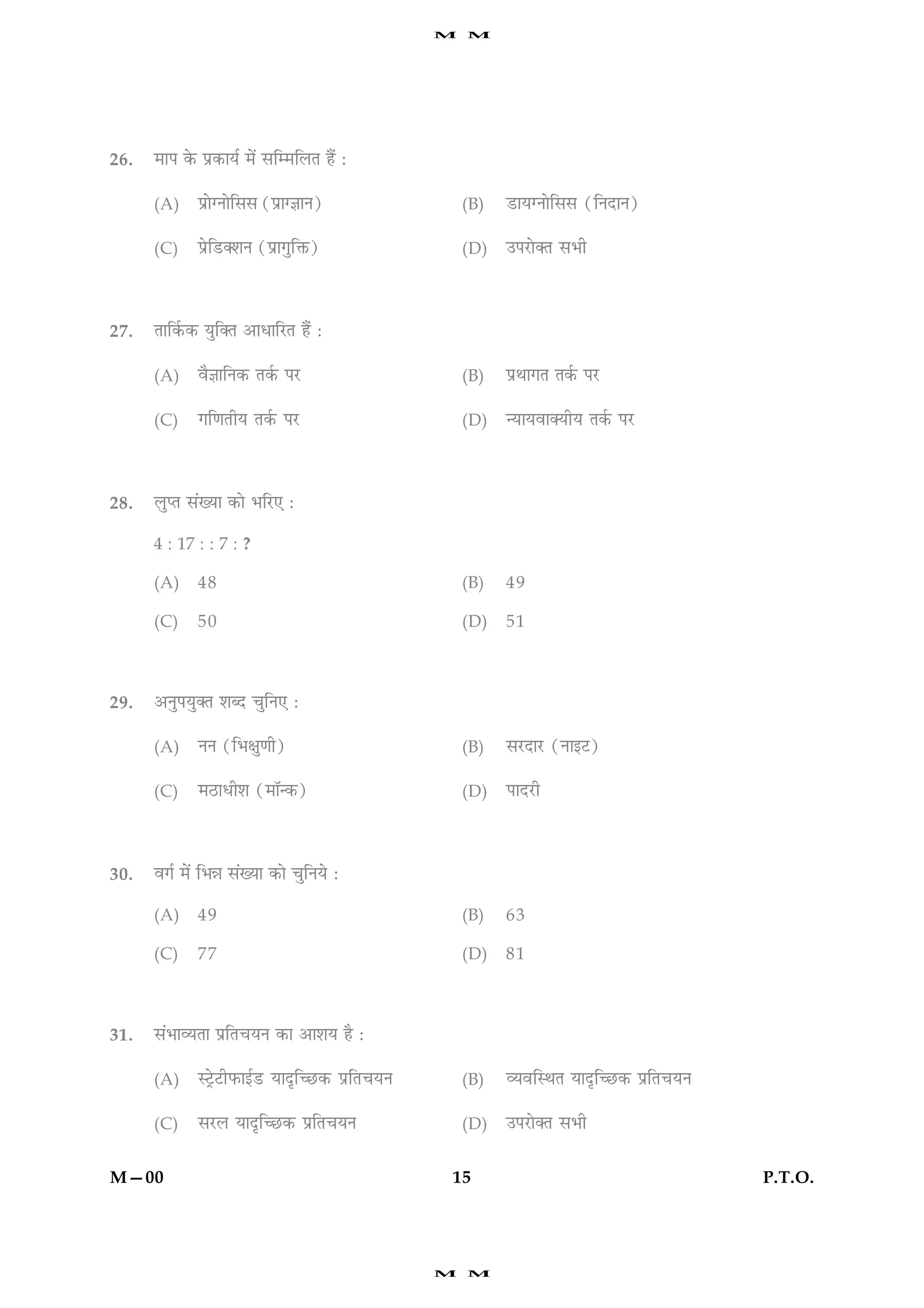
26.   ×æÂ ·ð¤ Âý·¤æØü ×ð´ âç×çÜÌ ãñ´ Ñ

      (A)    Âýæð‚Ùæðçââ (Âýæ‚™ææÙ)                   (B)   ÇUæØ‚Ùæðçââ (çÙÎæÙ)

      (C)    ÂýðçÇU€àæÙ (Âýæ»éçQ¤)                    (D)   ©ÂÚUæð€Ì âÖè


27.   Ìæç·ü¤·¤ Øéç€Ì ¥æÏæçÚUÌ ãñ´ Ñ

      (A)    ßñ™ææçÙ·¤ Ì·ü¤ ÂÚU                       (B)   ÂýÍæ»Ì Ì·ü¤ ÂÚU

      (C)    »ç‡æÌèØ Ì·ü¤ ÂÚU                         (D)   ‹ØæØßæ€ØèØ Ì·ü¤ ÂÚU


28.   ÜéŒÌ â´Øæ ·¤æð ÖçÚU° Ñ

      4 : 17 : : 7 : ?

      (A)    48                                       (B)   49

      (C)    50                                       (D)   51


29.   ¥ÙéÂØé€Ì àæŽÎ ¿éçÙ° Ñ

      (A)    ÙÙ (çÖÿæé‡æè)                            (B)   âÚUÎæÚU (Ùæ§ÅU)

      (C)    ׯUæÏèàæ (׿ò‹·¤)                        (D)   ÂæÎÚUè


30.   ß»ü ×ð´ çÖóæ â´Øæ ·¤æð ¿éçÙØð Ñ

      (A)    49                                       (B)   63

      (C)    77                                       (D)   81


31.   â´ÖæÃØÌæ ÂýçÌ¿ØÙ ·¤æ ¥æàæØ ãñ Ñ

      (A)    SÅþðUÅUèȤæ§üÇU ØæÎëç‘ÀU·¤ ÂýçÌ¿ØÙ       (B)   ÃØßçSÍÌ ØæÎëç‘ÀU·¤ ÂýçÌ¿ØÙ

      (C)    âÚUÜ ØæÎëç‘ÀU·¤ ÂýçÌ¿ØÙ                  (D)   ©ÂÚUæð€Ì âÖè


M—00                                              15                                     P.T.O.


                                                  M   M
M   M


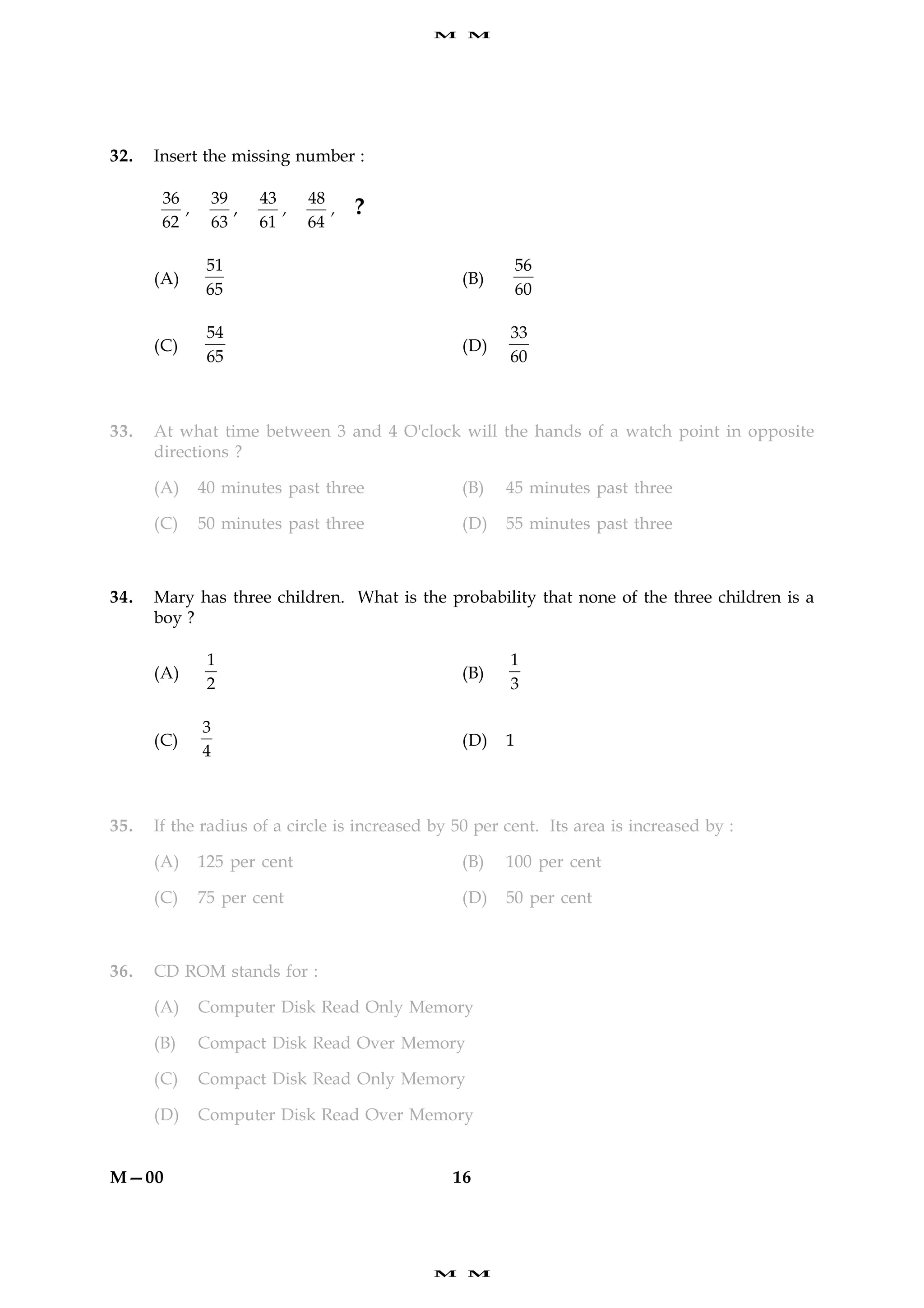
32.   Insert the missing number :

       36         39     43     48
          ,          ,      ,      ,   ?
       62         63     61     64

               51                                          56
      (A)                                        (B)
               65                                          60

               54                                      33
      (C)                                        (D)
               65                                      60


33.   At what time between 3 and 4 O'clock will the hands of a watch point in opposite
      directions ?

      (A)     40 minutes past three              (B)   45 minutes past three

      (C)     50 minutes past three              (D)   55 minutes past three


34.   Mary has three children. What is the probability that none of the three children is a
      boy ?

               1                                       1
      (A)                                        (B)
               2                                       3

              3
      (C)                                        (D)   1
              4


35.   If the radius of a circle is increased by 50 per cent. Its area is increased by :

      (A)     125 per cent                       (B)   100 per cent

      (C)     75 per cent                        (D)   50 per cent


36.   CD ROM stands for :

      (A)     Computer Disk Read Only Memory

      (B)     Compact Disk Read Over Memory

      (C)     Compact Disk Read Only Memory

      (D)     Computer Disk Read Over Memory


M—00                                           16


                                             M   M
M    M


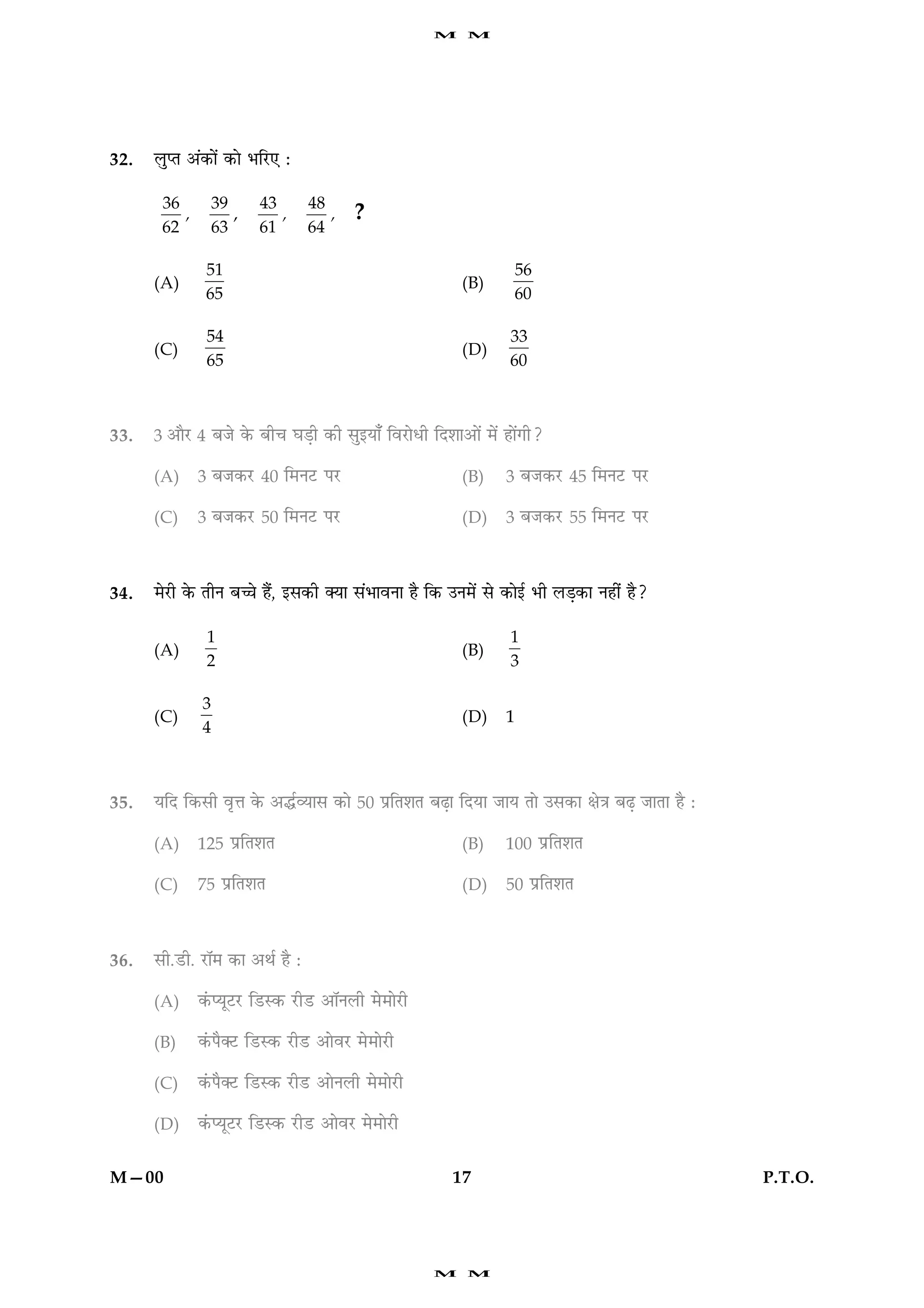
32.   ÜéŒÌ ¥´·¤æð´ ·¤æð ÖçÚU° Ñ

       36         39      43       48
          ,          ,       ,        ,     ?
       62         63      61       64

               51                                                       56
      (A)                                                   (B)
               65                                                       60

               54                                                    33
      (C)                                                   (D)
               65                                                    60


33.   3 ¥æñÚU 4 ÕÁð ·ð¤ Õè¿ ƒæÇ¸è ·¤è âé§Øæ¡ çßÚUæðÏè çÎàææ¥æð´ ×ð´ ãæð´»è?

      (A)     3 ÕÁ·¤ÚU 40 ç×ÙÅU ÂÚU                         (B)     3 ÕÁ·¤ÚU 45 ç×ÙÅU ÂÚU

      (C)     3 ÕÁ·¤ÚU 50 ç×ÙÅU ÂÚ                          (D)     3 ÕÁ·¤ÚU 55 ç×ÙÅU ÂÚU


34.   ×ðÚUè ·ð¤ ÌèÙ Õ“æð ãñ´, §â·¤è €Øæ â´ÖæßÙæ ãñ ç·¤ ©Ù×ð´ âð ·¤æð§ü Öè ÜǸ·¤æ Ùãè´ ãñ?

               1                                                     1
      (A)                                                   (B)
               2                                                     3

              3
      (C)                                                   (D)     1
              4


35.   ØçÎ ç·¤âè ßëžæ ·ð¤ ¥hüÃØæâ ·¤æð 50 ÂýçÌàæÌ Õɸæ çÎØæ ÁæØ Ìæð ©â·¤æ ÿæð˜æ Õɸ ÁæÌæ ãñ Ñ

      (A)     125 ÂýçÌàæÌ                                   (B)     100 ÂýçÌàæÌ

      (C)     75 ÂýçÌàæÌ                                    (D)     50 ÂýçÌàæÌ


36.   âè.ÇUè. ÚUæò× ·¤æ ¥Íü ãñ Ñ

      (A)     ·´¤ŒØêÅUÚU çÇUS·¤ ÚUèÇU ¥æòÙÜè ×ð׿ðÚUè

      (B)     ·´¤Âñ€ÅU çÇUS·¤ ÚUèÇU ¥æðßÚU ×ð׿ðÚUè

      (C)     ·´¤Âñ€ÅU çÇUS·¤ ÚUèÇU ¥æðÙÜè ×ð׿ðÚUè

      (D)     ·´¤ŒØêÅUÚU çÇUS·¤ ÚUèÇU ¥æðßÚU ×ð׿ðÚUè


M—00                                                       17                                  P.T.O.


                                                        M    M
M    M


37.   The ‘brain’ of a computer which keeps peripherals under its control is called :

      (A)   Common Power Unit                 (B)   Common Processing Unit

      (C)   Central Power Unit                (D)   Central Processing Unit


38.   Data can be saved on backing storage medium known as :

      (A)   Compact Disk Recordable           (B)   Computer Disk Rewritable

      (C)   Compact Disk Rewritable           (D)   Computer Data Rewritable


39.   RAM means :

      (A)   Random Access Memory              (B)   Rigid Access Memory

      (C)   Rapid Access Memory               (D)   Revolving Access Memory


40.   www represents :

      (A)   who what and where                (B)   weird wide web

      (C)   word wide web                     (D)   world wide web


41.   Deforestation during the recent decades has led to :

      (A)   Soil erosion                      (B)   Landslides

      (C)   Loss of bio-diversity             (D)   All the above


42.   Which one of the following natural hazards is responsible for causing highest human
      disaster ?

      (A)   Earthquakes                       (B)   Volcanic eruptions

      (C)   Snow-storms                       (D)   Tsunami


M—00                                         18


                                          M    M
M      M


37.   ·´¤ŒØêÅUÚU ·¤æ ×çSÌc·¤ Áæð ÂçÚUÏèØ (ÂðÚUèÈð¤çÚUØËâ) ·¤æð çÙØ´˜æ‡æ ×ð´ ÚU¹Ìæ ãñ ©âð ·¤ãÌð ãñ´ Ñ

      (A)    ·¤æò×Ù ÂæßÚU ØêçÙÅU                             (B)    ·¤æò×Ù Âýæðâðçâ´» ØêçÙÅU

      (C)    âð‹ÅþUÜ ÂæßÚU ØêçÙÅU                            (D)    âð‹ÅþUÜ Âýæðâðçâ´» ØêçÙÅU


38.   ÇðUÅUæ ·¤æð âéÚUçÿæÌ SÅUæðÚU ·¤ÚUÙð ·ð¤ çܰ çÁâ ×æŠØ× ·¤æð §SÌð×æÜ ·¤ÚUÌð ãñ´ ©âð ·¤ãÌð ãñ´ Ñ

      (A)    ·´¤Âñ€ÅU çÇUS·¤ çÚU·¤æòÇðüUÕÜ                   (B)    ·´¤ŒØêÅUÚU çÇUS·¤ çÚUÚUæ§ÅðUÕÜ

      (C)    ·´¤Âñ€ÅU çÇUS·¤ çÚUÚUæ§ÅðUÕÜ                    (D)    ·´¤ŒØêÅUÚU ÇðUÅUæ çÚUÚUæ§ÅðUÕÜ


39.   ÚñU× (¥æÚU.°.°×.) ·¤æ ¥Íü ãñ Ñ

      (A)    ÚñU‹ÇU× °ð€âðâ ×ð׿ðÚUè                         (B)    çÚUçÁÇU °ð€âðâ ×ð׿ðÚUè

      (C)    ÚñUçÂÇU °ð€âðâ ×ð׿ðÚUè                         (D)    çÚUßæçËß´» °ð€âðâ ×ð׿ðÚUè


40.   ÇUŽÜé ÇUŽÜé ÇUŽÜé ·¤æ ¥Íü ãñ Ñ

      (A)    ãê uæÅU °ð‡ÇU uñÚU                              (B)    çߨÇü ßæ§ÇU ßðÕ

      (C)    ßÇüU ßæ§ÇU ßðÕ                                  (D)    ßËÇüU ßæ§ÇU ßðÕ


41.   ãæÜ ·ð¤ Îàæ·¤æð´ ×ð´ Á´»Üæð´ ·ð¤ ·¤ÅUæÙ ·¤æ ÂçÚU‡ææ× çِÙçÜç¹Ì ã饿 ãñ Ñ

      (A)    Öê-ÿæÚU‡æ                                       (B)    Öê-S¹ÜÙ

      (C)    ÁñßçßçßÏÌæ ·¤è ÿæçÌ                             (D)    ©ÂÚUæð€Ì âÖè


42.   Ùè¿ð çܹð Âýæ·ë¤çÌ·¤ ¹ÌÚUæð´ ×ð´ ×ÙécØæð´ ·ð¤ âßæüçÏ·¤ ÿæçÌ ·ð¤ çܰ ©žæÚUÎæØè ãñÐ

      (A)    Öê·´¤Â                                          (B)    ’߿ܿ×é¹è ·¤æ Èê¤ÅUÙæ

      (C)    ÕȤèüÜð ÌêȤæÙ                                  (D)    âéÙæ×è


M—00                                                       19                                          P.T.O.


                                                       M      M
M    M


43.   Which one of the following is appropriate for natural hazard mitigation ?

      (A)   International AID                   (B)    Timely Warning System

      (C)   Rehabilitation                       (D)   Community Participation


44.   Slums in metro-city are the result of :

      (A)   Rural to urban migration            (B)    Poverty of the city-scape

      (C)   Lack of urban infrastructure        (D)    Urban-governance


45.   The great Indian Bustard bird is found in :

      (A)   Thar Desert of India

      (B)   Coastal regions of India

      (C)   Temperate Forests in the Himalaya

      (D)   Tarai zones of the Himalayan Foot


46.   The first Indian Satellite for serving the educational sector is known as :

      (A)   SATEDU                              (B)    INSAT - B

      (C)   EDUSAT                              (D)    INSAT - C


47.   Exclusive educational channel of IGNOU is known as :

      (A)   Gyan Darshan                        (B)    Gyan Vani

      (C)   Door Darshan                        (D)    Prasar Bharati


48.   The head quarter of Mahatma Gandhi Antarrashtriya Hindi Vishwavidyalaya is situated
      in :

      (A)   Sevagram                            (B)    New Delhi

      (C)   Wardha                              (D)    Ahmedabad


M—00                                            20


                                            M    M
M      M


43.   Ùè¿ð çܹð ×ð´ âð Âýæ·ë¤çÌ·¤ ¥æÂÎæ âð Õ¿Ùð ·ð¤ çܰ ·¤æñÙ âÕâð ©ÂØé€Ì ãñ?

      (A)     ¥´ÌÚUæücÅþUèØ âãæØÌæ                             (B)   âר ÂÚU ¿ðÌæßÙè

      (C)     ÂéÙßæüâ                                          (D)   âæ×éÎæçØ·¤ âãÖæç»Ìæ


44.   ×ãæÙ»ÚUæð´ ×ð´ Ûæé‚»è-ÛææðÂçÇ¸Øæ¡ 緤ⷤæ ÂçÚU‡ææ× ãñ?

      (A)     »æ¡ßæð´ âð àæãÚUæð´ ·¤è ¥æðÚU ÂÜæØÙ              (B)   àæãÚUæð´ ·ð¤ ·é¤ÀU ÿæð˜ææð´ ×ð´ »ÚUèÕè

      (C)     àæãÚUæð´ ×ð´ ¥çÖÚU¿Ùæ ·¤æ ¥Öæß                   (D)   àæãÚUè-¥çÖàææâÙ


45.   ÒÒ»ýðÅU §´çÇUØÙ ÕSÅUæÇüUÓÓ Âÿæè ÂæØæ ÁæÌæ ãñ Ñ

      (A)     ÖæÚUÌ ·ð¤ ÍæÚ ×L¤SÍÜ ×ð´                         (B)   ÖæÚUÌ ·ð¤ â×éÎý ÌÅUèØ ÿæð˜ææð´ ×ð´

      (C)     çã׿ܨ ·ð¤ â×àæèÌæðc‡æ ÿæð˜ææð´ ×ð´              (D)   çã׿ܨ ·¤è ÌÚUæ§ü ÿæð˜ææð´ ×ð´


46.   ÖæÚUÌ ×ð´ çàæÿææ ·ð¤ ÿæð˜æ ×ð´ âðßæ ×ð´ ÂýØé€Ì ÂãÜæ ÒâðÅUæÜæ§ÅUÓ ·¤æñÙ ãñ?

      (A)     °â.°.ÅUè.§ü.ÇUè.Øê.                              (B)   §‹âñÅU - Õè

      (C)     §ü.Çè.Øê.°â.°.ÅUè.                               (D)   §‹âñÅU - âè


47.   Ò§‚ÙêÓ ·¤æ °·¤×æ˜æ ÅðUÜèçß$ÁÙ àæñçÿæ·¤ ¿ñÙÜ ·¤æ Ùæ× ãñ Ñ

      (A)     ™ææÙ ÎàæüÙ                                       (B)   ™ææÙ ßæ‡æè

      (C)     ÎêÚUÎàæüÙ                                        (D)   ÂýâæÚU ÖæÚUÌè


48.   ×ãæˆ×æ »æ¡Ïè ¥‹ÌÚUæücÅþUèØ çã‹Îè çßàß çßlæÜØ ·¤æ ×遨æÜØ ·¤ãæ¡ çSÍÌ ãñ?

      (A)     âðßæ»ýæ×                                         (B)   Ù§ü çÎËÜè

      (C)     ßÏæü                                             (D)   ¥ã×ÎæÕæÎ


M—00                                                           21                                             P.T.O.


                                                         M      M
M    M


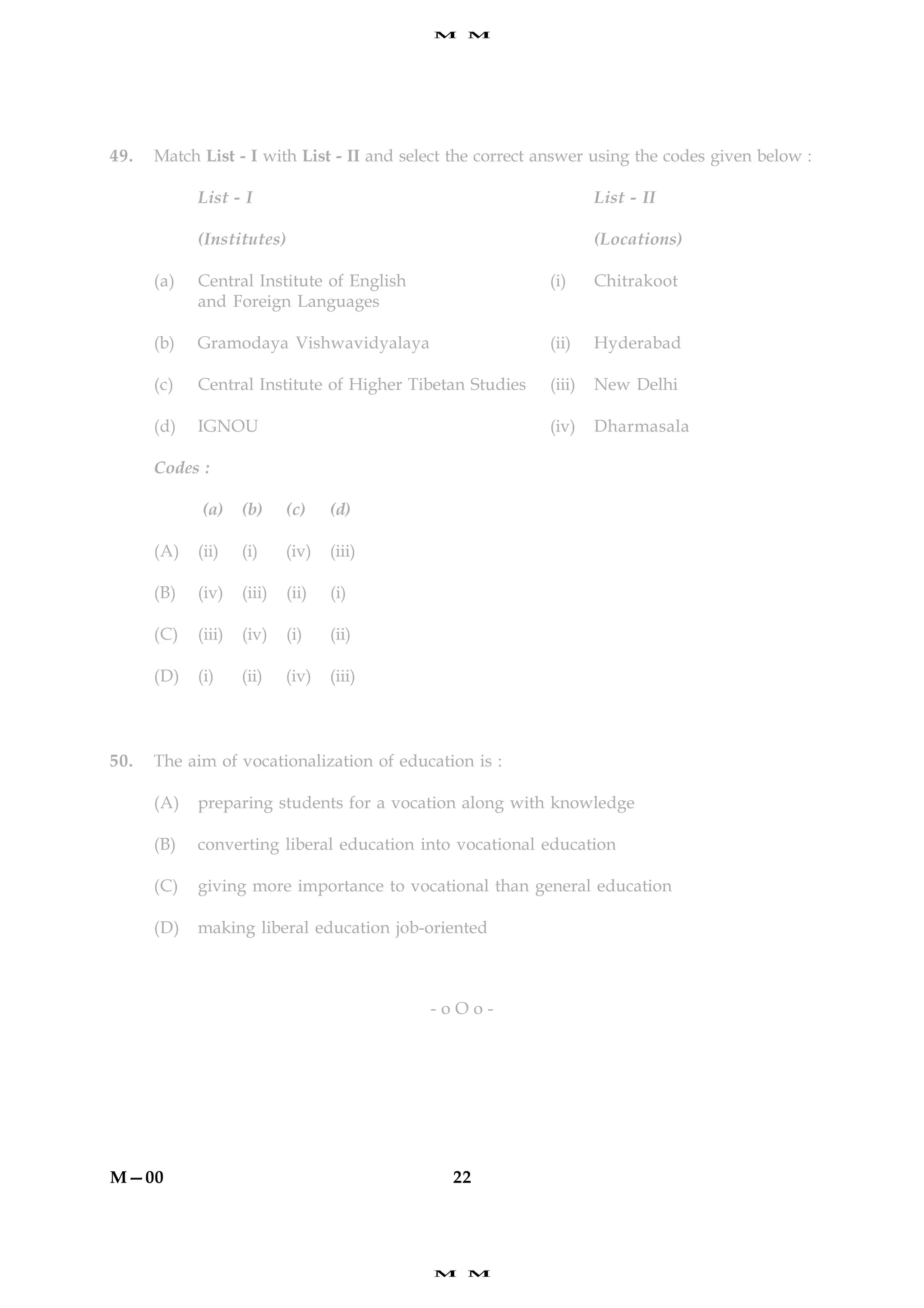
49.   Match List - I with List - II and select the correct answer using the codes given below :

            List - I                                               List - II

            (Institutes)                                           (Locations)

      (a)   Central Institute of English                   (i)     Chitrakoot
            and Foreign Languages

      (b)   Gramodaya Vishwavidyalaya                      (ii)    Hyderabad

      (c)   Central Institute of Higher Tibetan Studies    (iii)   New Delhi

      (d)   IGNOU                                          (iv)    Dharmasala

      Codes :

            (a)     (b)     (c)    (d)

      (A)   (ii)    (i)     (iv)   (iii)

      (B)   (iv)    (iii)   (ii)   (i)

      (C)   (iii)   (iv)    (i)    (ii)

      (D)   (i)     (ii)    (iv)   (iii)


50.   The aim of vocationalization of education is :

      (A)   preparing students for a vocation along with knowledge

      (B)   converting liberal education into vocational education

      (C)   giving more importance to vocational than general education

      (D)   making liberal education job-oriented


                                           -oOo-


M—00                                          22


                                           M    M
M     M


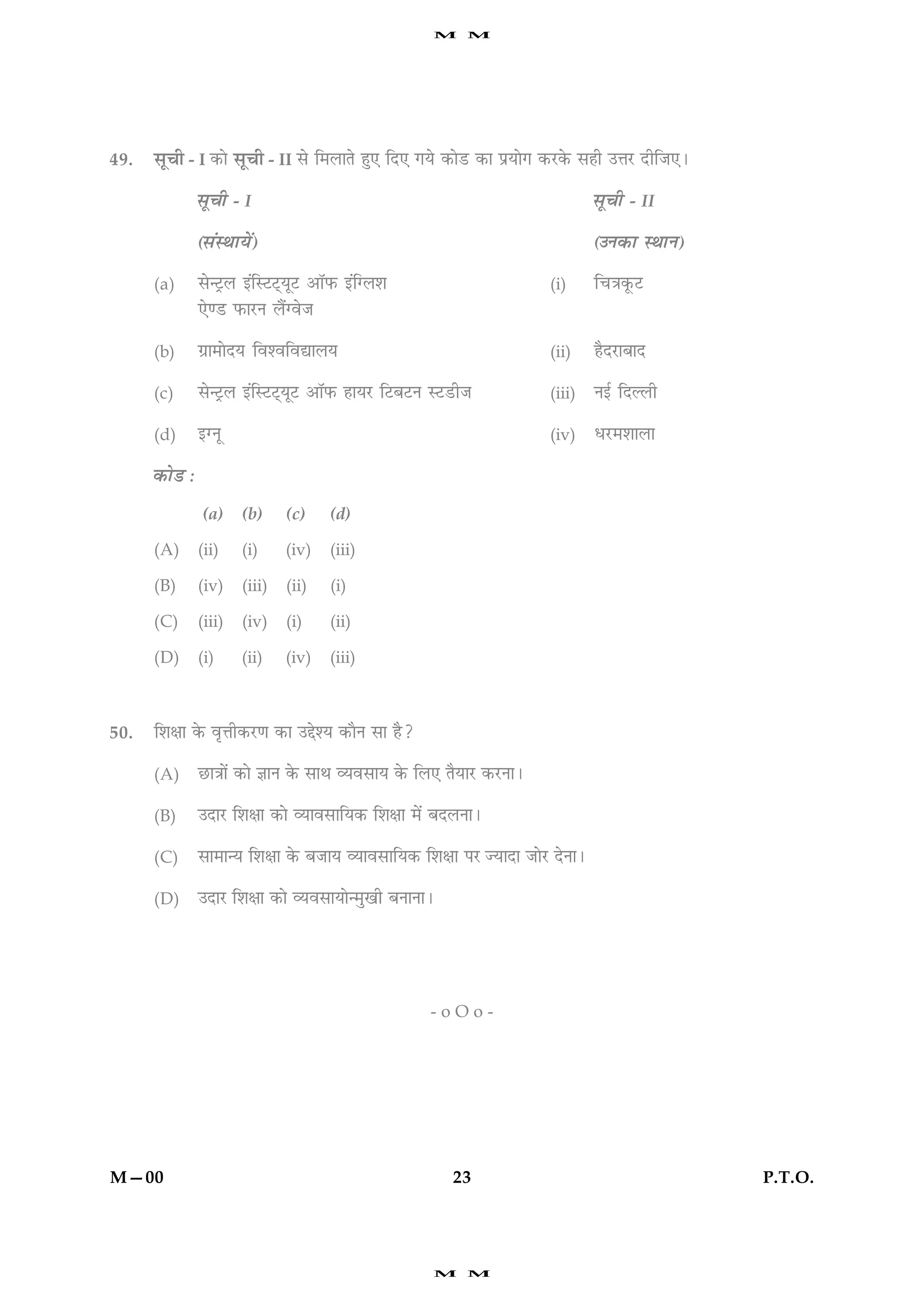
49.   âê¿è - I ·¤æð âê¿è - II âð        ç×ÜæÌð ãé° çΰ »Øð ·¤æðÇU ·¤æ ÂýØæð» ·¤ÚU·ð¤ âãè ©žæÚU ÎèçÁ°Ð

                 âê¿è - I                                                             âê¿è - II

                 (â´SÍæØð´)                                                           (©Ù·¤æ SÍæÙ)

      (a)        âð‹ÅþUÜ §´çSÅUÅ÷UØêÅU ¥æòȤ §´ç‚Üàæ                          (i)     翘æ·ê¤ÅU
                 °ð‡ÇU ȤæÚUÙ Üñ´‚ßðÁ

      (b)        »ýæ×æðÎØ çßàßçßlæÜØ                                          (ii)    ãñÎÚUæÕæÎ

      (c)        âð‹ÅþUÜ §´çSÅUÅ÷UØêÅU ¥æòȤ ãæØÚU çÅUÕÅUÙ SÅUÇUèÁ            (iii)   Ù§ü çÎËÜè

      (d)        §‚Ùê                                                         (iv)    ÏÚU×àææÜæ

      ·¤æðÇU :
                 (a)     (b)     (c)      (d)

      (A)        (ii)    (i)     (iv)     (iii)

      (B)        (iv)    (iii)   (ii)     (i)

      (C)        (iii)   (iv)    (i)      (ii)

      (D)        (i)     (ii)    (iv)     (iii)


50.   çàæÿææ ·ð¤ ßëžæè·¤ÚU‡æ ·¤æ ©gðàØ ·¤æñÙ âæ ãñ?

      (A)        ÀUæ˜ææð´ ·¤æð ™ææÙ ·ð¤ âæÍ ÃØßâæØ ·ð¤ çܰ ÌñØæÚU ·¤ÚUÙæÐ

      (B)        ©ÎæÚU çàæÿææ ·¤æð ÃØæßâæçØ·¤ çàæÿææ ×ð´ ÕÎÜÙæÐ

      (C)        âæ×æ‹Ø çàæÿææ ·ð¤ ÕÁæØ ÃØæßâæçØ·¤ çàæÿææ ÂÚU ’ØæÎæ ÁæðÚU ÎðÙæÐ

      (D)        ©ÎæÚU çàæÿææ ·¤æð ÃØßâæØæð‹×é¹è ÕÙæÙæÐ


                                                           -oOo-


M—00                                                          23                                        P.T.O.


                                                           M     M
M   M


       Space For Rough Work


M—00            24


             M   M

D 0007 paper i master

  • 1.
    M M Signature and Name of Invigilator Answer Sheet No. : ...................................................... (To be filled by the Candidate) 1. (Signature) Roll No. (Name) (In figures as per admission card) 2. (Signature) Roll No. (In words) (Name) Test Booklet No. W X Y Z D—0 0 0 7 Time : 1¼ hours] PAPER—I [Maximum Marks : 100 Number of Pages in this Booklet : 24 Number of Questions in this Booklet : 50 Instructions for the Candidates ÂÚUèÿææçÍüØô¢ ·ð¤ çܰ çÙÎðüàæ 1. Write your roll number in the space provided on the top of 1. ÂãÜðU ÂëDU ·ð¤ ª¤ÂÚU çÙØÌ SÍæÙ ÂÚU ¥ÂÙæ ÚUôÜU ِÕÚU çÜç¹°Ð this page. 2. §â ÂýàÙ-˜æ ×𢠿æâ Õãéçß·¤ËÂèØ ÂýàÙ ãñ¢Ð 2. This paper consists of fifty multiple-choice type of questions. 3. ÂÚUèÿææ ÂýæÚUÖ ãôÙð ÂÚU, ÂýàÙ-ÂéçSÌ·¤æ ¥æÂ·¤ô Îð Îè ÁæØð»èÐ ÂãÜðU ÂUæ¡¿ ç×ÙÅU 3. At the commencement of examination, the question booklet ¥æÂ·¤ô ÂýàÙ-ÂéçSÌ·¤æ ¹ôÜÙð ÌÍæ ©â·¤è çِÙçÜç¹Ì Áæ¡¿ ·ð¤ çܰ çÎØð will be given to you. In the first 5 minutes, you are requested to open the booklet and compulsorily examine it ÁæØð¢»ð çÁâ·¤è Áæ¡¿ ¥æÂ·¤ô ¥ßàØ ·¤ÚUÙè ãñ Ñ as below : (i) ÂýàÙ-ÂéçSÌ·¤æ ¹ôÜÙð ·ð¤ çܰ ©â·ð¤ ·¤ßÚU ÂðÁ¤ÂÚU Ü»è ·¤æ»Á ·¤è (i) To have access to the Question Booklet, tear off the âèÜ ·¤ô ȤæÇ¸U Üð¢UÐ ¹éÜè ãé§ü Øæ çÕÙæ SÅUè·¤ÚU-âèÜU ·¤è ÂéçSÌ·¤æ paper seal on the edge of this cover page. Do not Sßè·¤æÚU Ù ·¤Úð¢UÐ accept a booklet without sticker-seal and do not accept (ii) ·¤ßÚU ÂëDU ÂÚU ÀUÂð çÙÎðüàææÙéâæÚU ÂýàÙ-ÂéçSÌ·¤æ ·ð¤ ÂëDU ÌÍæ ÂýàÙô¢ ·¤è an open booklet. â¢Øæ ·¤ô ¥‘ÀUè ÌÚUã ¿ñ·¤ ·¤ÚU Üð¢U ç·¤ Øð ÂêÚðU ãñ¢UÐ ÎôáÂê‡æü ÂéçSÌ·¤æ (ii) Tally the number of pages and number of questions in the booklet with the information printed on the çÁÙ×ð¢ ÂëDU / ÂýàÙ ·¤× ãô¢ Øæ ÎéÕæÚUæ ¥æ »Øð ãô¢ Øæ âèçÚUØÜU ×ð¢ Ù ãô¢ cover page. Faulty booklets due to pages/questions ¥ÍæüÌ ç·¤âè Öè Âý·¤æÚU ·¤è ˜æéçÅUÂê‡æü ÂéçSÌ·¤æ Sßè·¤æÚU Ù ·¤Úð¢U ÌÍæ missing or duplicate or not in serial order or any ©âè âר ©âð ÜUõÅUæ·¤ÚU ©â·ð¤ SÍæÙ ÂÚU ÎêâÚUè âãè ÂýàÙ-ÂéçSÌ·¤æ other discrepancy should be got replaced immediately Üð Üð¢Ð U §â·ð¤ çܰ ¥æÂ·¤ô Âæ¡¿ ç×ÙÅU çÎØð ÁæØð¢»ðÐ ©â·ð¤ ÕæÎ Ù by a correct booklet from the invigilator within the Ìô ¥æÂ·¤è ÂýàÙ-ÂéçSÌ·¤æ ßæÂâ Üè ÁæØð»è ¥õÚU Ù ãè ¥æÂ·¤ô period of 5 minutes. Afterwards, neither the ¥çÌçÚUQ¤ âר çÎØæ ÁæØð»æÐ Question Booklet will be replaced nor any extra time will be given. (iii) §â Áæ¡¿ ·ð¤ ÕæÎ ÂýàÙ-ÂéçSÌ·¤æ ·¤è R¤× â¢Øæ ©žæÚU-˜淤 ÂÚU ¥¢ç·¤Ì (iii) After this verification is over, the Serial No. of the ·¤Úð¢U ¥UõÚU ©žæÚU-˜淤 ·¤è R¤×¤â¢Øæ §â ÂýàÙ-ÂéçSÌ·¤æ ÂÚU ¥¢ç·¤Ì ·¤ÚU booklet should be entered in the Answer-sheets and ÎðÐ ¢ the Serial No. of Answer Sheet should be entered on 4. ÂýˆØð·¤ ÂýàÙ ·ð¤ çܰ ¿æÚU ©žæÚU çß·¤Ë (A), (B), (C) ÌÍæ (D) çÎØð »Øð ãñ¢Ð this Booklet. ¥æÂ·¤ô âãè ©žæÚU ·ð¤ Îèƒæüßëžæ ·¤ô ÂðÙ âð ÖÚU·¤ÚU ·¤æÜæ ·¤ÚUÙæ ãñ Áñâæ ç·¤ Ùè¿ð 4. Each item has four alternative responses marked (A), (B), çÎ¹æØæ »Øæ ãñÐ (C) and (D). You have to darken the oval as indicated below on the correct response against each item. ©ÎæãÚU‡æ Ñ A B C D ÁÕç·¤ (C) âãè ©žæÚU ãñÐ Example : A B C D 5. Âýà٠˜æ I ¥õÚU Âýà٠˜æ II ·ð¤ çܰ °·¤ ãè ©žæÚU ˜淤 ãñ Áô §â ÂýàÙ where (C) is the correct response. ÂéçSÌ·¤æ ·ð¤ ¥‹ÎÚU çÎØæ »Øæ ãñÐ ÂýàÙô¢ ·ð¤ ©žæÚU ·ð¤ßÜU ©žæÚU-˜淤 ÂÚU ãè 5. Your responses to the items are to be indicated in the Answer Sheet given inside this Booklet, which is common for ¥¢ç·¤Ì ·¤ÚUÙð ãñ¢Ð ØçÎ ¥æÂ ©žæÚU ˜淤 ÂÚU çÎØð »Øð Îèƒæüßëžæ ·ð¤ ¥Üæßæ ç·¤âè Paper I and Paper II. If you mark at any place other than ¥‹Ø SÍæÙ ÂÚU ©žæÚU ç¿‹ãæ¢ç·¤Ì ·¤ÚUÌð ãñ, Ìô ©â·¤æ ×êËUØæ¢·¤Ù Ùãè¢ ãô»æÐ in the ovals in the Answer Sheet, it will not be evaluated. 6. ¥‹ÎÚU çÎØð »Øð çÙÎðüàæô¢ ·¤ô ŠØæÙÂêßü·¤ Âɸð¢UÐ 6. Read instructions given inside carefully. 7. ·¤“ææ ·¤æ× (Rough Work) §â ÂéçSÌ·¤æ ·ð¤ ¥ç‹Ì× ÂëDU ÂÚU ·¤Úð¢UÐ 7. Rough Work is to be done in the end of this booklet. 8. ØçÎ ¥æÂ ©žæÚU-ÂéçSÌ·¤æ ÂÚU ¥ÂÙæ Ùæ× Øæ °ðâæ ·¤ô§ü Öè çÙàææÙ çÁââð ¥æÂ·¤è 8. If you write your name or put any mark on any part of the Âã¿æÙ ãô â·ð¤, ¤ç·¤âè Öè Öæ» ÂÚU ÎàææüÌð Øæ ¥¢ç·¤Ì ·¤ÚUÌð ãñ¢ Ìô ÂÚUèÿææ ·ð¤ Answer Sheet, except for the space allotted for the relevant entries, which may disclose your identity, you will render çÜØð ¥Øô‚Ø ƒæôçáÌ ·¤ÚU çÎØð ÁæØð¢»ðÐ yourself liable to disqualification. 9. ¥æÂ·¤ô ÂÚUèÿææ â׿# ãôÙð ¤ÂÚU ©žæÚU-ÂéçSÌ·¤æ çÙÚUèÿæ·¤ ×ãôÎØ ·¤ô ÜUõÅUæÙæ 9. You have to return the test question booklet to the ¥æßàØ·¤ ãñ ¥õÚU ÂÚUèÿææ â׿ç# ·ð¤ ÕæÎ ¥ÂÙð âæÍ ÂÚUèÿææ ÖßÙ âð ÕæãÚU Ù invigilators at the end of the examination compulsorily Üð·¤ÚU ÁæØð¢Ð and must not carry it with you outside the Examination 10. ·ð¤ßÜ ÙèÜð / ·¤æÜð ÕæÜU Œßæ§ZÅU ÂñÙ ·¤æ ãè §SÌð×æÜ ·¤Úð¢UÐ Hall. 10. Use only Blue/Black Ball point pen. 11. ç·¤âè Öè Âý·¤æÚU ·¤æ ⢻‡æ·¤ (·ñ¤Ü·é¤ÜðÅUÚU) UØæ Üæ» ÅðUÕÜ ¥æçÎ ·¤æ 11. Use of any calculator or log table etc., is prohibited. ÂýØô» ßçÁüÌ ãñÐ 12. There is NO negative marking. 12. »ÜÌ ©žæÚU ·ð¤ çܰ ¥¢·¤ Ùãè¢ ·¤æÅðU ÁæØð¢»ðÐ M—00 1 P.T.O. M M
  • 2.
    M M FOR OFFICE USE ONLY Marks Obtained Obtained Obtained Obtained Obtained Question Question Question Question Number Number Number Number Marks Marks Marks Marks 1 26 51 76 2 27 52 77 3 28 53 78 4 29 54 79 5 30 55 80 6 31 56 81 7 32 57 82 8 33 58 83 9 34 59 84 10 35 60 85 11 36 61 86 12 37 62 87 13 38 63 88 14 39 64 89 15 40 65 90 16 41 66 91 17 42 67 92 18 43 68 93 19 44 69 94 20 45 70 95 21 46 71 96 22 47 72 97 23 48 73 98 24 49 74 99 25 50 75 100 Total Marks Obtained (in words) ..................................... (in figures) .................................... Signature & Name of the Coordinator ............................... (Evaluation) Date ............................. M—00 2 M M
  • 3.
    M M PAPER—I ÂýàÙ˜æ—I Note : This paper contains fifty (50) multiple-choice questions, each question carrying two (2) marks. Attempt all of them. §â ÂýàÙ˜æ ×𢠿æâ (50) Õãé-çß·¤ËÂUèØ ÂýàÙ ãñ¢Ð ÂýˆØð·¤ ÂýàÙ ·ð¤ Îô (2) ¥¢·¤ ãñ¢Ð âÖè ÂýàÙô¢ ·ð¤ ©žæÚU ÎèçÁ°Ð 1. Verbal guidance is least effective in the learning of : (A) Aptitudes (B) Skills (C) Attitudes (D) Relationship 2. Which is the most important aspect of the teacher’s role in learning ? (A) The development of insight into what constitutes an adequate performance (B) The development of insight into what constitutes the pitfalls and dangers to be avoided (C) The provision of encouragement and moral support (D) The provision of continuous diagnostic and remedial help 3. The most appropriate purpose of learning is : (A) personal adjustment (B) modification of behaviour (C) social and political awareness (D) preparing oneself for employment 1. ׿ñç¹·¤ çÙÎðüàæ €Øæ âè¹Ùð ×ð´ ÕãéÌ ·¤× ÂýÖæßè ãæðÌð ãñ´? (A) L¤ÛææÙ (B) ·¤æñàæÜ (C) ¥çÖßëçžæ (D) â´Õ‹Ï 2. ¥çÏ»× ×ð´, çàæÿæ·¤ ·¤è Öêç×·¤æ¥æð´ ·¤æ âÕâð ×ãˆßÂê‡æü Âÿæ €Øæ ãñ? (A) ¥æ‹ÌçÚU·¤ çß·¤æâ ·¤ÚUÙæ, Áæð ÂØæüŒÌ çÙcÂæÎÙ ·ð¤ ÚU¿·¤æð´ ×ð´ ÂçÚU‡æÌ ãæð Áæ°Ð (B) ¥æ‹ÌçÚU·¤ çß·¤æâ ·¤ÚUÙæ, çÁââð ¹ÌÚUæð´ °ß´ ç·¤âè ·ð¤ ÁæÜ ×ð´ È¡¤âÙð âð Õ¿æ Áæ â·ð¤Ð (C) ÂýæðˆâæãÙ °ß´ ÙñçÌ·¤ âãæÚUæ ÎðÙð ·¤æ ÂýÕ´Ï ·¤ÚUÙæÐ (D) âÌÌ÷ çÙÎæÙ °ß´ ©Â¿æÚU âãæØÌæ ·¤æ ÂýÕ‹Ï ·¤ÚUÙæÐ 3. ¥çÏ»× (âè¹Ùð) ·¤æ âßæüçÏ·¤ ©ÂØé€Ì ©gðàØ ãñ - (A) ßñØç€Ì·¤ â×æØæðÁÙ (B) ÃØßãæÚU ·¤æ M¤Âæ‹ÌÚU‡æ (C) âæ×æçÁ·¤ °ß´ ÚUæÁÙñçÌ·¤ ¿ðÌÙæ (D) ¥ÂÙð ·¤æð ÚUæðÁ»æÚU ·ð¤ çÜØð ÌñÄØæÚU ·¤ÚUÙæ M—00 3 P.T.O. M M
  • 4.
    M M 4. The students who keep on asking questions in the class should be : (A) encouraged to find answer independently (B) advised to meet the teacher after the class (C) encouraged to continue questioning (D) advised not to disturb during the lecture 5. Maximum participation of students is possible in teaching through : (A) discussion method (B) lecture method (C) audio-visual aids (D) text book method 6. Generalised conclusion on the basis of a sample is technically known as : (A) Data analysis and interpretation (B) Parameter inference (C) Statistical inference (D) All of the above 7. The experimental study is based on : (A) The manipulation of variables (B) Conceptual parameters (C) Replication of research (D) Survey of literature 8. The main characteristic of scientific research is : (A) empirical (B) theoretical (C) experimental (D) all of the above 9. Authenticity of a research finding is its : (A) Originality (B) Validity (C) Objectivity (D) All of the above 10. Which technique is generally followed when the population is finite ? (A) Area Sampling Technique (B) Purposive Sampling Technique (C) Systematic Sampling Technique (D) None of the above M—00 4 M M
  • 5.
    M M 4. Áæð ÀUæ˜æ ·¤ÿææ ×ð´ âᑚ ÂêÀUÌð ÚUãÌð ãñ´ Ñ (A) ©‹ãð´ SßÌ´˜æ M¤Â âð ©žæÚU ÂýæŒÌ ·¤ÚUÙð ·ð¤ çܰ ÂýæðˆâæçãÌ ç·¤Øæ ÁæÙæ ¿æçã°Ð (B) ·¤ÿææ ·ð¤ ÕæÎ ¥ŠØæÂ·¤ âð ç×ÜÙð ·¤è âÜæã Îè ÁæÙè ¿æçã°Ð (C) ©‹ãð´ ã×ðàææ âᑚ ÂêÀUÌð ÚUãÙð ·¤æð ÂýæðˆâæçãÌ ç·¤Øæ ÁæÙæ ¿æçã°Ð (D) ÃØæØæÙ ·ð¤ Õè¿ ×ð´ ÕæÏæ Ù ÇUæÜÙð ·¤è âÜæã Îè ÁæÙè ¿æçã°Ð 5. ÀUæ˜ææð´ ·¤è ¥çÏ·¤Ì× ÂýçÌÖæç»Ìæ â´Öß ãñ Ñ (A) ÂçÚU¿¿æü çßçÏ mæÚUæ (B) ÃØæØæÙ çßçÏ mæÚUæ (C) ŸæÃØ-ÎëàØ âæÏÙæð´ mæÚUæ (D) ÂæÆ÷UØ-ÂéSÌ·¤ çßçÏ mæÚUæ 6. çß¿ØÙ (âñ´ÂÜ) ·ð¤ ¥æÏæÚU ÂÚU çÙ·¤æÜð »° çÙc·¤áü ÁæÙð ÁæÌð ãñ´ Ñ (A) ¥æÏæÚU âæ×»ýè çßàÜðá‡æ ÌÍæ çÙßü¿Ù (interpretation) (B) Âýæ¿Ü (ÂñÚUæ×èÅUÚU) ¥Ùé×æÙ (C) âæ´çØ·¤è ¥Ùé×æÙ (D) ©ÂÚUæð€Ì âÖè 7. ÂýØæð»æˆ×·¤ ¥ŠØØÙ __________ ·ð¤ çÙØ× ÂÚU ¥æÏæçÚUÌ ãæðÌð ãñÐ (A) ÂçÚUßÌæðZ (variables) ×ð´ â´ØæðÁÙ (B) âñ‹hæçÌ·¤ ÂñÚUæ×èÅUÚU (C) àææðÏ ·¤æ ÂýçÌ·ë¤çÌ (Replication) (D) âæçãˆØ ·¤æ âßðüÿæ‡æ 8. ßñ™ææçÙ·¤ ¥Ùéâ´ÏæÙ ·ð¤ ×遨 ¥çÖÜÿæ‡æ ãñ´ Ñ (A) ¥ÙéÖßæçŸæÌ (B) âñhæ´çÌ·¤ (C) ÂýæØæðç»·¤ (D) ©ÂÚUæð€Ì âÖè 9. ¥Ùéâ´ÏæÙ ·¤è ¹æðÁ ·¤è Âýæ×æç‡æ·¤Ìæ çÙÖüÚU ·¤ÚUÌè ãñ Ñ (A) ׿ñçÜ·¤Ìæ ÂÚU (B) ßñÏÌæ ÂÚU (C) ßSÌéçÙDÌæ ÂÚU (D) ©ÂÚUæð€Ì âÖè 10. ÁÕ ÁÙâ´Øæ âèç×Ì (finite) ãæð Ìæð ·¤æñÙ âè Ì·¤Ùè·¤ ¥ÂÙæ§ü ÁæÌè ãñ? (A) ÿæð˜æ ÂýçÌ¿ØÙ Ì·¤Ùè·¤ (B) âæðgðàØ ÂýçÌ¿ØÙ Ì·¤Ùè·¤ (C) ·ý¤×Õh ÂýçÌ¿ØÙ Ì·¤Ùè·¤ (D) §Ù×ð´ âð ·¤æð§ü Ùãè´ M—00 5 P.T.O. M M
  • 6.
    M M Read the following passage and answer the questions 11 to 15 : Gandhi’s overall social and environmental philosophy is based on what human beings need rather than what they want. His early introduction to the teachings of Jains, Theosophists, Christian sermons, Ruskin and Tolstoy, and most significantly the Bhagavad Gita, were to have profound impact on the development of Gandhi’s holistic thinking on humanity, nature and their ecological interrelation. His deep concern for the disadvantaged, the poor and rural population created an ambience for an alternative social thinking that was at once far-sighted, local and immediate. For Gandhi was acutely aware that the demands generated by the need to feed and sustain human life, compounded by the growing industrialization of India, far outstripped the finite resources of nature. This might nowadays appear naïve or commonplace, but such pronouncements were as rare as they were heretical a century ago. Gandhi was also concerned about the destruction, under colonial and modernist designs, of the existing infrastructures which had more potential for keeping a community flourishing within ecologically-sensitive traditional patterns of subsistence, especially in the rural areas, than did the incoming Western alternatives based on nature-blind technology and the enslavement of human spirit and energies. Perhaps the moral principle for which Gandhi is best known is that of active non-violence, derived from the traditional moral restraint of not injuring another being. The most refined expression of this value is in the great epic of the Mahabharata, (c. 100 BCE to 200 CE), where moral development proceeds through placing constraints on the liberties, desires and acquisitiveness endemic to human life. One’s action is judged in terms of consequences and the impact it is likely to have on another. Jainas had generalized this principle to include all sentient creatures and biocommunities alike. Advanced Jaina monks and nuns will sweep their path to avoid harming insects and even bacteria. Non-injury is a non-negotiable universal prescription. 11. Which one of the following have a profound impact on the development of Gandhi’s holistic thinking on humanity, nature and their ecological interrelations ? (A) Jain teachings (B) Christian sermons (C) Bhagavad Gita (D) Ruskin and Tolstoy M—00 6 M M
  • 7.
    M M Ùè¿ð çܹð »læ´àæ ·¤æð Âçɸ° ¥æñÚU 11 âð 15 Ì·¤ ·ð¤ ÂýàÙæð´ ·¤æ ©žæÚU ÎèçÁ°Ð »æ¡ÏèÁè ·¤æ âæ×æçÁ·¤ ß ÂØæüßÚU‡æ ÎàæüÙ âßü»ýæãè M¤Â âð, ×ÙécØ €Øæ ¿æãÌð ãñ´ ÂÚU ¥æÏæçÚUÌ Ù ãæð·¤ÚU, ©Ù·¤è ¥æßàØ·¤Ìæ¥æð´ ÂÚU ¥æÏæçÚUÌ ãñÐ ÁèßÙ ·ð¤ ¥æÚ´UÖ ×ð´ ÁñçÙØæð´, çÍØæðâæòçȤSÅUæð´, §üâæ ·ð¤ ©ÂÎðàææð´, ÚUçS·¤Ù ¥æñÚU ÅUæËâÅUæØ ¥æñÚU âÕâð ×ãˆßÂê‡æü Ö»ßÎ÷»èÌæ ·ð¤ ÂçÚU¿Ø Ùð ©Ù·¤è âßüßæÎè ׿ÙßÌæ, Âý·ë¤çÌ ©â·ð¤ ÂØæüßÚU‡æèØ ¥‹ÌSâ´Õ´Ï ·ð¤ ç¿´ÌÙ ÂÚU »ãÚUæ ÂýÖæß ÇUæÜæÐ âæÏÙãèÙ »ýæ×è‡æ ÁÙÌæ ·ð¤ ÂýçÌ ©Ù·ð¤ ×Ù ×ð´ °·¤ ßñ·¤çË·¤ âæ×æçÁ·¤ ç¿´ÌÙ ·¤æ çß¿æÚU ÂÙÂæ, Áæð ÎêÚUÎàæèü, SÍæÙèØ ¥æñÚU Ìæˆ·¤æçÜ·¤ ÍæÐ »æ¡ÏèÁè §â ÕæÌ âð ÂêÚUè ÌÚUã Áæ»L¤·¤ Íð ç·¤ Âýæ·ë¤çÌ·¤ â´âæÏÙæð´ ·¤è ÌéÜÙæ ×ð´, ÁÙÌæ ·ð¤ çܰ ÖæðÁÙ ÁéÅUæÙð ·¤è ׿´» ·¤ãè´ ’ØæÎæ Íè, ¥æñÚU ¥æñlæð»è·¤ÚU‡æ Ùð §âð ¥æñÚU ÁçÅUÜ ÕÙæ çÎØæ ÍæÐ Øã ÕæÌ ¥æÁ çÁÌÙè âæ×æ‹Ø ¥æñÚU ÖæðÜè Ü»Ìè ãñ Üðç·¤Ù °·¤ àæÌæçŽÎ ÂãÜð Øã ©Î÷ƒææðá‡ææ Ï×üÎýæðã Áñâè çßÚUÜ ÍèÐ »æ¡ÏèÁè ¥æÏéçÙ·¤ÌæßæÎè, ¥æñÂçÙßðçàæ·¤ áÇUØ´˜æ ·ð¤ ¥´Ì»üÌ, ÂØæüßÚU‡æ ·ð¤ ÂýçÌ â´ßðÎÙàæèÜ ×æñÁêÎæ ÉUæ¡¿ð ·ð¤ çßÙæàæ ·¤è ¥æàæ´·¤æ âð ç¿´çÌÌ ÍðÐ §Ù ׿ñÁêÎæ ÉUæ¡¿æð´ ×ð´ ÖÚU‡æ Âæðá‡æ ·¤è ÂæÚ´UÂçÚU·¤ ÚUèçÌ âð â´Âóæ ÕÙæÙð ·¤è ¥ÂæÚ â´ÖæßÙæ°¡ Íè çßàæðá L¤Â âð »ýæ×è‡æ ÿæð˜ææð´ ×ð´; ÕÁæØ ×æÙß ¥æˆ×æ °ß´ àæç€Ì ·¤æð Îæâ ÕÙæÙðßæÜè ßñ·¤çË·¤ ¥´Ïè Âçà¿×è ÅðU€ÙæðÜæòÁè ·ð¤Ð àææØÎ »æ¡ÏèÁè ·¤æ Áæð ÙñçÌ·¤ çâhæ´Ì âÕâð ¥çÏ·¤ ÁæÙæ ÁæÌæ ãñ, ßã ãñ âç·ý¤Ø ¥çã´âæ, ÎêâÚðU Áèßæð´ ·¤æð Îéѹ Ù Âãé¡¿æÙæ, ÂæÚ´UÂçÚU·¤ ÙñçÌ·¤ â´Ø× âð ÃØéˆÂóæÐ §â ×êËØ ·¤è âßæüçÏ·¤ ÂçÚUc·ë¤Ì ¥çÖÃØç€Ì ×ãæÖæÚUÌ ×ãæ·¤æÃØ (100 âð 200 §ü.Âê.) ×ð´ ç×ÜÌè ãñ Áãæ¡ ׿Ùß ÁèßÙ ·¤è çÙÚ´UÌÚU SßÌ´˜æÌæ¥æð´, §‘ÀUæ¥æð´ ¥æñÚU â´»ý㠷𤠪¤ÂÚU çÙØ´˜æ‡æ Ü»æÙð âð ÙñçÌ·¤ çß·¤æâ ãæðÌæ ãñÐ ×ÙécØ ·ð¤ ·¤æØæðZ ·¤æ ×êËØæ´·¤Ù, ÎêâÚUæð´ ·ð¤ ª¤ÂÚU ©â·¤æ €Øæ ÂýÖæß ÂÇ¸ð»æ §ââð ×æÂæ ÁæÌæ ãñÐ ÁñçÙØæð´ Ùð §â çâhæ´Ì ·¤æð â×SÌ ¿ñÌ‹Ø ÌÍæ ÁèßÁ´Ì饿ð´ ÂÚU â×æÙ M¤Â âð Üæ»ê ç·¤Øæ ãñÐ ¥»ý‡æè ÁñÙ ×éçÙ ¥æñÚU çÖÿæéç‡æØæ¡ Áèßæð´ ß ·ë¤çרæð´ ·¤è ãˆØæ Ù ãæð §âçܰ ÚUæSÌð ·¤æð ÛææÇêU âð ÕéãæÚUÌð ãñ´Ð ¥çã´âæ âæßüÖæñ× ¥æÎðàæ ãñ, çÁâ ÂÚU ·¤æð§ü â×ÛææñÌæ Ùãè´ ãæð â·¤ÌæÐ 11. çِÙçÜç¹Ì ×ð´ âð »æ¡ÏèÁè ·¤è ׿ÙßÌæ, Âý·ë¤çÌ ¥æñÚU ©â·ð¤ ÂØæüßÚU‡æ âð ¥´ÌSâ´Õ´Ïæð´ ·¤è âßüßæÎè çß¿æÚUÏæÚUæ ·ð¤ çß·¤æâ ·ð¤ ª¤ÂÚU ç·¤â·¤æ »ãÚUæ ÂýÖæß ÂǸæ ãñ? (A) ÁñÙ çàæÿææ¥æð´ ·¤æ (B) §üâæ§ü Âýß¿Ùæð´ ·¤æ (C) Ö»ßÎ÷»èÌæ ·¤æ (D) ÚUçS·¤Ù ¥æñÚU ÅUæËâÅUæØ ·¤æ M—00 7 P.T.O. M M
  • 8.
    M M 12. Gandhi’s overall social and environmental philosophy is based on human beings’ : (A) need (B) desire (C) wealth (D) welfare 13. Gandhiji’s deep concern for the disadvantaged, the poor and rural population created an ambience for an alternative : (A) rural policy (B) social thinking (C) urban policy (D) economic thinking 14. Colonial policy and modernisation led to the destruction of : (A) major industrial infrastructure (B) irrigation infrastructure (C) urban infrastructure (D) rural infrastructure 15. Gandhi’s active non-violence is derived from : (A) Moral restraint of not injuring another being (B) Having liberties, desires and acquisitiveness (C) Freedom of action (D) Nature-blind technology and enslavement of human spirit and energies 16. DTH service was started in the year : (A) 2000 (B) 2002 (C) 2004 (D) 2006 M—00 8 M M
  • 9.
    M M 12. »æ¡ÏèÁè ·¤æ âßü»ýæãè âæ×æçÁ·¤ ß ÂØæüßÚU‡æèØ ÎàæüÙ ×ÙécØæð´ ·¤è __________ ÂÚU ¥æÏæçÚUÌ ãñÐ (A) ¥æßàØ·¤ÌæØð´ (B) §‘ÀUæØð´ (C) ÏÙ (D) ·¤ËØæ‡æ 13. »æ¡ÏèÁè ·¤è âæÏÙãèÙ Üæð»æð´, »ÚUèÕæð´ °ß´ »ýæ×è‡æ ÁÙÌæ ·ð¤ ÂýçÌ »ãÚUè ç¿´Ìæ âð ç·¤â ßñ·¤çË·¤ ÃØßSÍæ ·¤æ çß¿æÚU ÂÙÂæ? (A) »ýæ×è‡æ ÙèçÌ (B) âæ×æçÁ·¤ ç¿´ÌÙ (C) àæãÚUè ÙèçÌ (D) ¥æçÍü·¤ ç¿´ÌÙ 14. ¥æñÂçÙßðçàæ·¤ ÙèçÌ ¥æñÚU ¥æÏéçÙ·¤è·¤ÚU‡æ __________ ·¤æð çßÙæàæ ·¤è ¥æðÚU Üð »§üÐ (A) çßàææÜ ¥æñlæðç»·¤ ¥æÏæçÚU·¤ â´Ú¿Ùæ (B) çâ´¿æ§ü ¥æÏæçÚU·¤ â´ÚU¿Ùæ (C) àæãÚUè ¥æÏæçÚU·¤ â´ÚU¿Ùæ (D) »ýæ×è‡æ ¥æÏæçÚU·¤ â´ÚU¿Ùæ 15. »æ¡ÏèÁè ·¤è âç·ý¤Ø ¥çã´âæ __________ âð ÃØéˆÂóæ ãñÐ (A) ÎêâÚðU ÃØç€Ì ·¤æð ¿æðÅU Ù Âãé¡¿æÙð ·¤æ ÙñçÌ·¤ çÙ»ýã (B) SßÌ´˜æÌæ, §‘ÀUæØð´ ¥æñÚU â´ÂýæçŒÌØæð´ ·¤æ ãæðÙæ (C) ·¤æØü ·¤ÚUÙð ·¤è SßÌ´˜æÌæ (D) Âý·ë¤çÌ ·ð¤ çßL¤h ¥´Ïè ÅðU€ÙæðÜæòÁè ÌÍæ ׿Ùß ¥æˆ×æ °ß´ àæç€ÌØæð´ ·¤æð Îæâ ÕÙæÙæ 16. ÇUè.ÅUè.°¿. âðßæ ·¤æ ¥æÚ´UÖ çِ٠ßáü ×ð´ ãé¥æÐ (A) 2000 (B) 2002 (C) 2004 (D) 2006 M—00 9 P.T.O. M M
  • 10.
    M M 17. National Press day is celebrated on : (A) 16th November (B) 19th November (C) 21st November (D) 30th November 18. The total number of members in the Press Council of India are : (A) 28 (B) 14 (C) 17 (D) 20 19. The right to impart and receive information is guaranteed in the Constitution of India by Article : (A) 19 (2) (a) (B) 19 (16) (C) 19 (2) (D) 19 (1) (a) 20. Use of radio for higher education is based on the presumption of : (A) Enriching curriculum based instruction (B) Replacing teacher in the long run (C) Everybody having access to a radio set (D) Other means of instruction getting outdated 21. Find out the number which should come at the place of question mark which will complete the following series : 5, 4, 9, 17, 35, ? 5 139 (A) 149 (B) 79 (C) 49 (D) 69 M—00 10 M M
  • 11.
    M M 17. ÚUæcÅþUèØ Âýðâ çÎßâ ×ÙæØæ ÁæÌæ ãñ Ñ (A) 16 Ùß´ÕÚU ·¤æð (B) 19 Ùß´ÕÚU ·¤æð (C) 21 Ùß´ÕÚU ·¤æð (D) 30 Ùß´ÕÚU ·¤æð 18. Âýýðâ ·¤æò©ç‹âÜ ¥æòȤ §´çÇUØæ ×ð´ ·é¤Ü âÎSØ ãæðÌð ãñ Ñ (A) 28 (B) 14 (C) 17 (D) 20 19. âê¿Ùæ ÎðÙð ¥æñÚU ÂýæŒÌ ·¤ÚUÙð ·¤æ ¥çÏ·¤æÚU ·¤è »æÚ´UÅUè ÖæÚUÌ ·ð¤ â´çßÏæÙ ·¤è ÏæÚUæ ×ð´ Îè »§ü ãñ Ñ (A) 19 (2) (a) (B) 19 (16) (C) 19 (2) (D) 19 (1) (a) 20. ©“æ çàæÿææ ×ð´ ÚðUçÇUØæð ·¤æ ©ÂØæð» çِÙçÜç¹Ì ¥æÏæçÚU·¤æ ÂÚU ãñÐ (A) ÂæÆU¿Øæü ÂÚU ¥æÏæçÚUÌ ¥ÙéÎðàææð´ ·¤æð ÂécÅU ·¤ÚUÙæÐ (B) ¥´ÌÌÑ ¥ŠØæÂ·¤ ·¤æð SÍæÙæÂóæ ·¤ÚUÙæÐ (C) ÂýˆØð·¤ ·ð¤ Âæâ ÚðUçÇUØæð âðÅU ãñÐ (D) ¥ÙéÎðàææð´ ·ð¤ ÎêâÚðU âæÏÙ ÂéÚUæÙð ÂǸ ¿é·ð¤ ãñ´Ð 21. Ùè¿ð Îè »§ü âèÚUèÁ ×ð´ ÂýàÙ ßæ¿·¤ (?) ·ð¤ SÍæÙ ÂÚU âãè ¥´·¤ çÜç¹° Ñ 5, 4, 9, 17, 35, ? 5 139 (A) 149 (B) 79 (C) 49 (D) 69 M—00 11 P.T.O. M M
  • 12.
    M M Questions 22 to 24 are based on the following diagram in which there are three interlocking circles I, S and P, where circle I stands for Indians, circle S for Scientists and circle P for Politicians. Different regions in the figure are lettered from a to f. 22. The region which represents Non-Indian Scientists who are Politicians : (A) f (B) d (C) a (D) c 23. The region which represents Indians who are neither Scientists nor Politicians : (A) g (B) c (C) f (D) a 24. The region which represents Politicians who are Indians as well as Scientists : (A) b (B) c (C) a (D) d 25. Which number is missing in the following series ? 2, 5, 10, 17, 26, 37, 50, ? (A) 63 (B) 65 (C) 67 (D) 69 M—00 12 M M
  • 13.
    M M ÂýàÙ 22 âð 24, Ùè¿ð çܹð 翘æ ÂÚU ¥æÏæçÚUÌ ãñ´, çÁÙ×ð´ ÌèÙ ÂÚUSÂÚU â´Õh ßëžæ (circle) ‘I’, ‘S’ ¥æñÚ ‘P’ ãñ, çÁâ×ð´ ßëžæ ‘I’ Ò§´çÇUØÙÓ ·ð¤ çܰ ãñ, ‘S’ Òâæ´§ç‹ÅUSÅUÓ ·ð¤ çܰ ¥æñÚU ‘P’ ÂæòçÜÅèçàæØÙ ·ð¤ çܰРçßçÖóæ ÿæð˜æ a âð f mæÚUæ ÎàææüØð »° ãñÐ 22. Áæð ÿæð˜æ »ñÚU §´çÇUØÙ (ÙæòÙ §´çÇUØÙ) ßñ™ææçÙ·¤æð´ ·¤æð ÎàææüÌæ ãñ Áæð ÚUæÁÙèçÌ™æ ãñ´ Ñ (A) f (B) d (C) a (D) c 23. ßã ÿæð˜æ Áæð, çÎ¹ÜæÌæ ãñ ç·¤ ßð Ù Ìæð ßñ™ææçÙ·¤ ãñ ¥æñÚU Ù ÚUæÁÙèçÌ™æ Ñ (A) g (B) c (C) f (D) a 24. ßã ÿæð˜æ Áæð, çÎ¹ÜæÌæ ãñ Áæð §´çÇUØÙ ãñ ¥æñÚU ßñ™ææçÙ·¤ Öè ãñ Ñ (A) b (B) c (C) a (D) d 25. çِÙçÜç¹Ì âèÚUè$Á ×ð´ ·¤æñÙ âæ ¥´·¤ »æØÕ ãñ? 2, 5, 10, 17, 26, 37, 50, ? (A) 63 (B) 65 (C) 67 (D) 69 M—00 13 P.T.O. M M
  • 14.
    M M 26. The function of measurement includes : (A) Prognosis (B) Diagnosis (C) Prediction (D) All of the above 27. Logical arguments are based on : (A) Scientific reasoning (B) Customary reasoning (C) Mathematical reasoning (D) Syllogistic reasoning 28. Insert the missing number : 4 : 17 : : 7 : ? (A) 48 (B) 49 (C) 50 (D) 51 29. Choose the odd word : (A) Nun (B) Knight (C) Monk (D) Priest 30. Choose the number which is different from others in the group : (A) 49 (B) 63 (C) 77 (D) 81 31. Probability sampling implies : (A) Stratified Random Sampling (B) Systematic Random Sampling (C) Simple Random Sampling (D) All of the above M—00 14 M M
  • 15.
    M M 26. ×æÂ ·ð¤ Âý·¤æØü ×ð´ âç×çÜÌ ãñ´ Ñ (A) Âýæð‚Ùæðçââ (Âýæ‚™ææÙ) (B) ÇUæØ‚Ùæðçââ (çÙÎæÙ) (C) ÂýðçÇU€àæÙ (Âýæ»éçQ¤) (D) ©ÂÚUæð€Ì âÖè 27. Ìæç·ü¤·¤ Øéç€Ì ¥æÏæçÚUÌ ãñ´ Ñ (A) ßñ™ææçÙ·¤ Ì·ü¤ ÂÚU (B) ÂýÍæ»Ì Ì·ü¤ ÂÚU (C) »ç‡æÌèØ Ì·ü¤ ÂÚU (D) ‹ØæØßæ€ØèØ Ì·ü¤ ÂÚU 28. ÜéŒÌ â´Øæ ·¤æð ÖçÚU° Ñ 4 : 17 : : 7 : ? (A) 48 (B) 49 (C) 50 (D) 51 29. ¥ÙéÂØé€Ì àæŽÎ ¿éçÙ° Ñ (A) ÙÙ (çÖÿæé‡æè) (B) âÚUÎæÚU (Ùæ§ÅU) (C) ׯUæÏèàæ (׿ò‹·¤) (D) ÂæÎÚUè 30. ß»ü ×ð´ çÖóæ â´Øæ ·¤æð ¿éçÙØð Ñ (A) 49 (B) 63 (C) 77 (D) 81 31. â´ÖæÃØÌæ ÂýçÌ¿ØÙ ·¤æ ¥æàæØ ãñ Ñ (A) SÅþðUÅUèȤæ§üÇU ØæÎëç‘ÀU·¤ ÂýçÌ¿ØÙ (B) ÃØßçSÍÌ ØæÎëç‘ÀU·¤ ÂýçÌ¿ØÙ (C) âÚUÜ ØæÎëç‘ÀU·¤ ÂýçÌ¿ØÙ (D) ©ÂÚUæð€Ì âÖè M—00 15 P.T.O. M M
  • 16.
    M M 32. Insert the missing number : 36 39 43 48 , , , , ? 62 63 61 64 51 56 (A) (B) 65 60 54 33 (C) (D) 65 60 33. At what time between 3 and 4 O'clock will the hands of a watch point in opposite directions ? (A) 40 minutes past three (B) 45 minutes past three (C) 50 minutes past three (D) 55 minutes past three 34. Mary has three children. What is the probability that none of the three children is a boy ? 1 1 (A) (B) 2 3 3 (C) (D) 1 4 35. If the radius of a circle is increased by 50 per cent. Its area is increased by : (A) 125 per cent (B) 100 per cent (C) 75 per cent (D) 50 per cent 36. CD ROM stands for : (A) Computer Disk Read Only Memory (B) Compact Disk Read Over Memory (C) Compact Disk Read Only Memory (D) Computer Disk Read Over Memory M—00 16 M M
  • 17.
    M M 32. ÜéŒÌ ¥´·¤æð´ ·¤æð ÖçÚU° Ñ 36 39 43 48 , , , , ? 62 63 61 64 51 56 (A) (B) 65 60 54 33 (C) (D) 65 60 33. 3 ¥æñÚU 4 ÕÁð ·ð¤ Õè¿ ƒæÇ¸è ·¤è âé§Øæ¡ çßÚUæðÏè çÎàææ¥æð´ ×ð´ ãæð´»è? (A) 3 ÕÁ·¤ÚU 40 ç×ÙÅU ÂÚU (B) 3 ÕÁ·¤ÚU 45 ç×ÙÅU ÂÚU (C) 3 ÕÁ·¤ÚU 50 ç×ÙÅU ÂÚ (D) 3 ÕÁ·¤ÚU 55 ç×ÙÅU ÂÚU 34. ×ðÚUè ·ð¤ ÌèÙ Õ“æð ãñ´, §â·¤è €Øæ â´ÖæßÙæ ãñ ç·¤ ©Ù×ð´ âð ·¤æð§ü Öè ÜǸ·¤æ Ùãè´ ãñ? 1 1 (A) (B) 2 3 3 (C) (D) 1 4 35. ØçÎ ç·¤âè ßëžæ ·ð¤ ¥hüÃØæâ ·¤æð 50 ÂýçÌàæÌ Õɸæ çÎØæ ÁæØ Ìæð ©â·¤æ ÿæð˜æ Õɸ ÁæÌæ ãñ Ñ (A) 125 ÂýçÌàæÌ (B) 100 ÂýçÌàæÌ (C) 75 ÂýçÌàæÌ (D) 50 ÂýçÌàæÌ 36. âè.ÇUè. ÚUæò× ·¤æ ¥Íü ãñ Ñ (A) ·´¤ŒØêÅUÚU çÇUS·¤ ÚUèÇU ¥æòÙÜè ×ð׿ðÚUè (B) ·´¤Âñ€ÅU çÇUS·¤ ÚUèÇU ¥æðßÚU ×ð׿ðÚUè (C) ·´¤Âñ€ÅU çÇUS·¤ ÚUèÇU ¥æðÙÜè ×ð׿ðÚUè (D) ·´¤ŒØêÅUÚU çÇUS·¤ ÚUèÇU ¥æðßÚU ×ð׿ðÚUè M—00 17 P.T.O. M M
  • 18.
    M M 37. The ‘brain’ of a computer which keeps peripherals under its control is called : (A) Common Power Unit (B) Common Processing Unit (C) Central Power Unit (D) Central Processing Unit 38. Data can be saved on backing storage medium known as : (A) Compact Disk Recordable (B) Computer Disk Rewritable (C) Compact Disk Rewritable (D) Computer Data Rewritable 39. RAM means : (A) Random Access Memory (B) Rigid Access Memory (C) Rapid Access Memory (D) Revolving Access Memory 40. www represents : (A) who what and where (B) weird wide web (C) word wide web (D) world wide web 41. Deforestation during the recent decades has led to : (A) Soil erosion (B) Landslides (C) Loss of bio-diversity (D) All the above 42. Which one of the following natural hazards is responsible for causing highest human disaster ? (A) Earthquakes (B) Volcanic eruptions (C) Snow-storms (D) Tsunami M—00 18 M M
  • 19.
    M M 37. ·´¤ŒØêÅUÚU ·¤æ ×çSÌc·¤ Áæð ÂçÚUÏèØ (ÂðÚUèÈð¤çÚUØËâ) ·¤æð çÙØ´˜æ‡æ ×ð´ ÚU¹Ìæ ãñ ©âð ·¤ãÌð ãñ´ Ñ (A) ·¤æò×Ù ÂæßÚU ØêçÙÅU (B) ·¤æò×Ù Âýæðâðçâ´» ØêçÙÅU (C) âð‹ÅþUÜ ÂæßÚU ØêçÙÅU (D) âð‹ÅþUÜ Âýæðâðçâ´» ØêçÙÅU 38. ÇðUÅUæ ·¤æð âéÚUçÿæÌ SÅUæðÚU ·¤ÚUÙð ·ð¤ çܰ çÁâ ×æŠØ× ·¤æð §SÌð×æÜ ·¤ÚUÌð ãñ´ ©âð ·¤ãÌð ãñ´ Ñ (A) ·´¤Âñ€ÅU çÇUS·¤ çÚU·¤æòÇðüUÕÜ (B) ·´¤ŒØêÅUÚU çÇUS·¤ çÚUÚUæ§ÅðUÕÜ (C) ·´¤Âñ€ÅU çÇUS·¤ çÚUÚUæ§ÅðUÕÜ (D) ·´¤ŒØêÅUÚU ÇðUÅUæ çÚUÚUæ§ÅðUÕÜ 39. ÚñU× (¥æÚU.°.°×.) ·¤æ ¥Íü ãñ Ñ (A) ÚñU‹ÇU× °ð€âðâ ×ð׿ðÚUè (B) çÚUçÁÇU °ð€âðâ ×ð׿ðÚUè (C) ÚñUçÂÇU °ð€âðâ ×ð׿ðÚUè (D) çÚUßæçËß´» °ð€âðâ ×ð׿ðÚUè 40. ÇUŽÜé ÇUŽÜé ÇUŽÜé ·¤æ ¥Íü ãñ Ñ (A) ãê uæÅU °ð‡ÇU uñÚU (B) çߨÇü ßæ§ÇU ßðÕ (C) ßÇüU ßæ§ÇU ßðÕ (D) ßËÇüU ßæ§ÇU ßðÕ 41. ãæÜ ·ð¤ Îàæ·¤æð´ ×ð´ Á´»Üæð´ ·ð¤ ·¤ÅUæÙ ·¤æ ÂçÚU‡ææ× çِÙçÜç¹Ì ã饿 ãñ Ñ (A) Öê-ÿæÚU‡æ (B) Öê-S¹ÜÙ (C) ÁñßçßçßÏÌæ ·¤è ÿæçÌ (D) ©ÂÚUæð€Ì âÖè 42. Ùè¿ð çܹð Âýæ·ë¤çÌ·¤ ¹ÌÚUæð´ ×ð´ ×ÙécØæð´ ·ð¤ âßæüçÏ·¤ ÿæçÌ ·ð¤ çܰ ©žæÚUÎæØè ãñÐ (A) Öê·´¤Â (B) ’߿ܿ×é¹è ·¤æ Èê¤ÅUÙæ (C) ÕȤèüÜð ÌêȤæÙ (D) âéÙæ×è M—00 19 P.T.O. M M
  • 20.
    M M 43. Which one of the following is appropriate for natural hazard mitigation ? (A) International AID (B) Timely Warning System (C) Rehabilitation (D) Community Participation 44. Slums in metro-city are the result of : (A) Rural to urban migration (B) Poverty of the city-scape (C) Lack of urban infrastructure (D) Urban-governance 45. The great Indian Bustard bird is found in : (A) Thar Desert of India (B) Coastal regions of India (C) Temperate Forests in the Himalaya (D) Tarai zones of the Himalayan Foot 46. The first Indian Satellite for serving the educational sector is known as : (A) SATEDU (B) INSAT - B (C) EDUSAT (D) INSAT - C 47. Exclusive educational channel of IGNOU is known as : (A) Gyan Darshan (B) Gyan Vani (C) Door Darshan (D) Prasar Bharati 48. The head quarter of Mahatma Gandhi Antarrashtriya Hindi Vishwavidyalaya is situated in : (A) Sevagram (B) New Delhi (C) Wardha (D) Ahmedabad M—00 20 M M
  • 21.
    M M 43. Ùè¿ð çܹð ×ð´ âð Âýæ·ë¤çÌ·¤ ¥æÂÎæ âð Õ¿Ùð ·ð¤ çܰ ·¤æñÙ âÕâð ©ÂØé€Ì ãñ? (A) ¥´ÌÚUæücÅþUèØ âãæØÌæ (B) âר ÂÚU ¿ðÌæßÙè (C) ÂéÙßæüâ (D) âæ×éÎæçØ·¤ âãÖæç»Ìæ 44. ×ãæÙ»ÚUæð´ ×ð´ Ûæé‚»è-ÛææðÂçÇ¸Øæ¡ 緤ⷤæ ÂçÚU‡ææ× ãñ? (A) »æ¡ßæð´ âð àæãÚUæð´ ·¤è ¥æðÚU ÂÜæØÙ (B) àæãÚUæð´ ·ð¤ ·é¤ÀU ÿæð˜ææð´ ×ð´ »ÚUèÕè (C) àæãÚUæð´ ×ð´ ¥çÖÚU¿Ùæ ·¤æ ¥Öæß (D) àæãÚUè-¥çÖàææâÙ 45. ÒÒ»ýðÅU §´çÇUØÙ ÕSÅUæÇüUÓÓ Âÿæè ÂæØæ ÁæÌæ ãñ Ñ (A) ÖæÚUÌ ·ð¤ ÍæÚ ×L¤SÍÜ ×ð´ (B) ÖæÚUÌ ·ð¤ â×éÎý ÌÅUèØ ÿæð˜ææð´ ×ð´ (C) çã׿ܨ ·ð¤ â×àæèÌæðc‡æ ÿæð˜ææð´ ×ð´ (D) çã׿ܨ ·¤è ÌÚUæ§ü ÿæð˜ææð´ ×ð´ 46. ÖæÚUÌ ×ð´ çàæÿææ ·ð¤ ÿæð˜æ ×ð´ âðßæ ×ð´ ÂýØé€Ì ÂãÜæ ÒâðÅUæÜæ§ÅUÓ ·¤æñÙ ãñ? (A) °â.°.ÅUè.§ü.ÇUè.Øê. (B) §‹âñÅU - Õè (C) §ü.Çè.Øê.°â.°.ÅUè. (D) §‹âñÅU - âè 47. Ò§‚ÙêÓ ·¤æ °·¤×æ˜æ ÅðUÜèçß$ÁÙ àæñçÿæ·¤ ¿ñÙÜ ·¤æ Ùæ× ãñ Ñ (A) ™ææÙ ÎàæüÙ (B) ™ææÙ ßæ‡æè (C) ÎêÚUÎàæüÙ (D) ÂýâæÚU ÖæÚUÌè 48. ×ãæˆ×æ »æ¡Ïè ¥‹ÌÚUæücÅþUèØ çã‹Îè çßàß çßlæÜØ ·¤æ ×遨æÜØ ·¤ãæ¡ çSÍÌ ãñ? (A) âðßæ»ýæ× (B) Ù§ü çÎËÜè (C) ßÏæü (D) ¥ã×ÎæÕæÎ M—00 21 P.T.O. M M
  • 22.
    M M 49. Match List - I with List - II and select the correct answer using the codes given below : List - I List - II (Institutes) (Locations) (a) Central Institute of English (i) Chitrakoot and Foreign Languages (b) Gramodaya Vishwavidyalaya (ii) Hyderabad (c) Central Institute of Higher Tibetan Studies (iii) New Delhi (d) IGNOU (iv) Dharmasala Codes : (a) (b) (c) (d) (A) (ii) (i) (iv) (iii) (B) (iv) (iii) (ii) (i) (C) (iii) (iv) (i) (ii) (D) (i) (ii) (iv) (iii) 50. The aim of vocationalization of education is : (A) preparing students for a vocation along with knowledge (B) converting liberal education into vocational education (C) giving more importance to vocational than general education (D) making liberal education job-oriented -oOo- M—00 22 M M
  • 23.
    M M 49. âê¿è - I ·¤æð âê¿è - II âð ç×ÜæÌð ãé° çΰ »Øð ·¤æðÇU ·¤æ ÂýØæð» ·¤ÚU·ð¤ âãè ©žæÚU ÎèçÁ°Ð âê¿è - I âê¿è - II (â´SÍæØð´) (©Ù·¤æ SÍæÙ) (a) âð‹ÅþUÜ §´çSÅUÅ÷UØêÅU ¥æòȤ §´ç‚Üàæ (i) 翘æ·ê¤ÅU °ð‡ÇU ȤæÚUÙ Üñ´‚ßðÁ (b) »ýæ×æðÎØ çßàßçßlæÜØ (ii) ãñÎÚUæÕæÎ (c) âð‹ÅþUÜ §´çSÅUÅ÷UØêÅU ¥æòȤ ãæØÚU çÅUÕÅUÙ SÅUÇUèÁ (iii) Ù§ü çÎËÜè (d) §‚Ùê (iv) ÏÚU×àææÜæ ·¤æðÇU : (a) (b) (c) (d) (A) (ii) (i) (iv) (iii) (B) (iv) (iii) (ii) (i) (C) (iii) (iv) (i) (ii) (D) (i) (ii) (iv) (iii) 50. çàæÿææ ·ð¤ ßëžæè·¤ÚU‡æ ·¤æ ©gðàØ ·¤æñÙ âæ ãñ? (A) ÀUæ˜ææð´ ·¤æð ™ææÙ ·ð¤ âæÍ ÃØßâæØ ·ð¤ çܰ ÌñØæÚU ·¤ÚUÙæÐ (B) ©ÎæÚU çàæÿææ ·¤æð ÃØæßâæçØ·¤ çàæÿææ ×ð´ ÕÎÜÙæÐ (C) âæ×æ‹Ø çàæÿææ ·ð¤ ÕÁæØ ÃØæßâæçØ·¤ çàæÿææ ÂÚU ’ØæÎæ ÁæðÚU ÎðÙæÐ (D) ©ÎæÚU çàæÿææ ·¤æð ÃØßâæØæð‹×é¹è ÕÙæÙæÐ -oOo- M—00 23 P.T.O. M M
  • 24.
    M M Space For Rough Work M—00 24 M M