Dr. Zaher Nazzal, MD,ABCM
Assistant Professor in Community Medicine
Head of An-Najah Child Institute
znazzal@najah.edu
General Approaches to Prevent and
Control NCDs
Introduction to NCDs Risk Factors
9/24/2016
Research Methodology 2016-2017
2
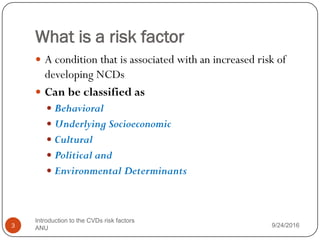
What is a risk factor
 A condition that is associated with an increased risk of
developing NCDs
 Can be classified as
 Behavioral
 Underlying Socioeconomic
 Cultural
 Political and
 Environmental Determinants
9/24/2016
3
Introduction to the CVDs risk factors
ANU
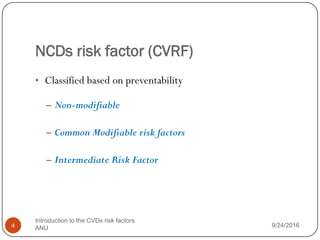
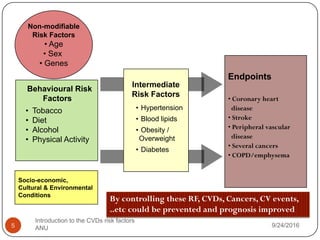
NCDs risk factor (CVRF)
• Classified based on preventability
– Non-modifiable
– Common Modifiable risk factors
– Intermediate Risk Factor
9/24/2016
4
Introduction to the CVDs risk factors
ANU
• Coronary heart
disease
• Stroke
• Peripheral vascular
disease
• Several cancers
• COPD/emphysema
Endpoints
Intermediate
Risk Factors
• Hypertension
• Blood lipids
• Obesity /
Overweight
• Diabetes
• Tobacco
• Diet
• Alcohol
• Physical Activity
Behavioural Risk
Factors
Non-modifiable
Risk Factors
• Age
• Sex
• Genes
Socio-economic,
Cultural & Environmental
Conditions
9/24/2016
5
Introduction to the CVDs risk factors
ANU
By controlling these RF, CVDs, Cancers, CV events,
..etc could be prevented and prognosis improved
Smoking
Cardiovascul
ar Disease
Unhealthy
diet
Overweight
Alcohol
abuse
Pyschosocial
stress
Sedentary
lifestyle
Mental Ill-
health
Chronic
Respiratory
Disease
Diabetes
Cancer
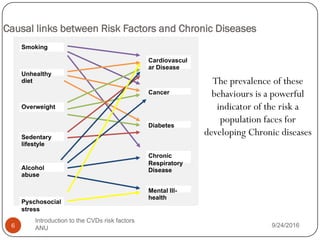
Causal links between Risk Factors and Chronic Diseases
The prevalence of these
behaviours is a powerful
indicator of the risk a
population faces for
developing Chronic diseases
9/24/2016
6
Introduction to the CVDs risk factors
ANU
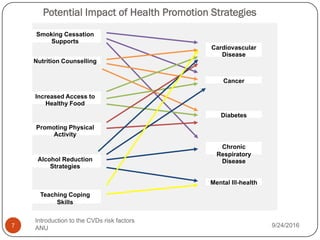
Potential Impact of Health Promotion Strategies
Smoking Cessation
Supports
Cardiovascular
Disease
Nutrition Counselling
Increased Access to
Healthy Food
Alcohol Reduction
Strategies
Teaching Coping
Skills
Promoting Physical
Activity
Mental Ill-health
Chronic
Respiratory
Disease
Diabetes
Cancer
9/24/2016
7
Introduction to the CVDs risk factors
ANU
Levels of Prevention
9/24/2016
Research Methodology 2016-2017
8
General Approaches in Delivery of NCD
Preventive and Control Services
Primary prevention
 Interventions targeting people who do not have the disease (NCD),
mainly by reducing the major related risk factors at community level.
 Prevention of onset of disease in persons without symptoms.
 The treatment of NCDs is lifelong and costly.,
 Reducing the exposure to risk factors and thereby impeding the
development of disease is the primary and most cost-effective strategy.
9/24/2016
9 NCDs Integrated Aproach Overview ANU
Important strategies under this category include
– Health education,
– Immunization,
– Environmental measures and
– Social policy
General Approaches in Delivery of NCD
Preventive and Control Services
Primary prevention
 The involvement of sectors other than health has a major
impact on shaping the physical and social environments that
determine “risk” behaviors.
 Therefore,interventions for NCD prevention and control have to be multi-
sectoral and multidisciplinary and act at multiple levels.
 Guidelines for the prevention and control of the most prevalent
NCD and risk factors should be developed and regularly updated
at the national level.
9/24/2016
10 NCDs Integrated Aproach Overview ANU
General Approaches in Delivery of NCD
Preventive and Control Services
Primary prevention:Examples
 Promotion of consumption of local fruits and vegetables
 Reduction of salt, refined sugars and animal fat.
 Control of diet and increase of physical activity
 All of these will result in reduction of obesity,
hypertension, high cholesterol and diabetes.
9/24/2016
11 NCDs Integrated Aproach Overview ANU
General Approaches in Delivery of NCD
Preventive and Control Services
Secondary prevention
 All interventions aimed at reducing the risk of recurrent
NCD events in patients with established NCD.
 Refers to the prevention of death or recurrence of disease in
those who are already symptomatic
 The most effective
 Early diagnosis (Screening)
 Early management of an established NCD and
 A full-risk assessment of the individual.
9/24/2016
12 NCDs Integrated Aproach Overview ANU
General Approaches in Delivery of NCD
Preventive and Control Services
Secondary prevention:Examples
 Health check is to detect diseases at an earlier stage
 Counseling smokers to quit smoking after a heart attack
 Telling people to take daily, low-dose aspirin to prevent a
second heart attack or stroke
 Providing suitably modified work for injured workers
9/24/2016
13 NCDs Integrated Aproach Overview ANU
General Approaches in Delivery of NCD
Preventive and Control Services
Tertiary prevention
 Clinical activities as well as treatment that deters further
deterioration or complication after a disease has been diagnosed.
 Due to the current situation of NCD prevention and control in
the Region, 1o & 2o prevention should be given priority because
of their cost-effectiveness.
9/24/2016
14 NCDs Integrated Aproach Overview ANU
Integrated Approach
 For NCDs prevention activities to achieve the greatest impact, a
paradigm shift is required;
 away from the treatment of risk factors in isolation, to a
comprehensive cardiovascular risk management approach.
 Development of an integrated approach targeting all major common
risk factors of NCDs is the most cost-effective way to prevent and
control them.
9/24/2016
15 NCDs Integrated Aproach Overview ANU
Integrated Approach:
Key Elements
 Addressing the set of common risk factors
 Integrated strategies will target the set of common risk factors for
major chronic diseases simultaneously
 Recognizing and addressing the relationship between lifestyle
choices and social conditions
 The most promising way for effective prevention focus on
supporting healthy living in healthy conditions.
9/24/2016
16 NCDs Integrated Aproach Overview ANU
Integrated Approach:
Key Elements
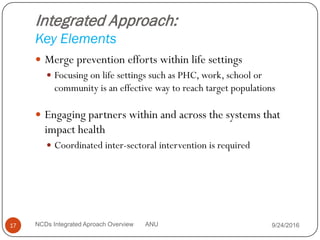
 Merge prevention efforts within life settings
 Focusing on life settings such as PHC, work, school or
community is an effective way to reach target populations
 Engaging partners within and across the systems that
impact health
 Coordinated inter-sectoral intervention is required
9/24/2016
17 NCDs Integrated Aproach Overview ANU
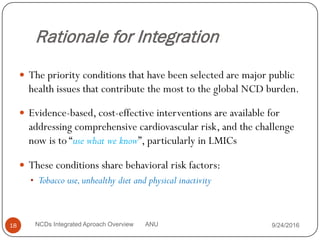
Rationale for Integration
 The priority conditions that have been selected are major public
health issues that contribute the most to the global NCD burden.
 Evidence-based, cost-effective interventions are available for
addressing comprehensive cardiovascular risk, and the challenge
now is to “use what we know”, particularly in LMICs
 These conditions share behavioral risk factors:
• Tobacco use,unhealthy diet and physical inactivity
9/24/2016
18 NCDs Integrated Aproach Overview ANU
Evidence Based Interventions
9/24/2016
19 NCDs Integrated Aproach Overview ANU
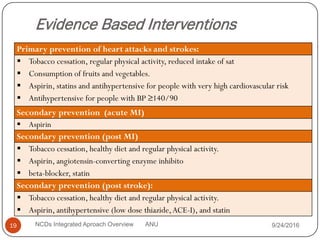
Primary prevention of heart attacks and strokes:
 Tobacco cessation, regular physical activity, reduced intake of sat
 Consumption of fruits and vegetables.
 Aspirin, statins and antihypertensive for people with very high cardiovascular risk
 Antihypertensive for people with BP ≥140/90
Secondary prevention (acute MI)
 Aspirin
Secondary prevention (post MI)
 Tobacco cessation, healthy diet and regular physical activity.
 Aspirin, angiotensin-converting enzyme inhibito
 beta-blocker, statin
Secondary prevention (post stroke):
 Tobacco cessation, healthy diet and regular physical activity.
 Aspirin, antihypertensive (low dose thiazide,ACE-I), and statin
Evidence Based Interventions
9/24/2016
20 NCDs Integrated Aproach Overview ANU
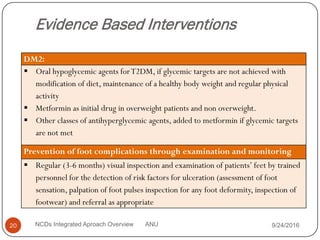
DM2:
 Oral hypoglycemic agents forT2DM, if glycemic targets are not achieved with
modification of diet, maintenance of a healthy body weight and regular physical
activity
 Metformin as initial drug in overweight patients and non overweight.
 Other classes of antihyperglycemic agents, added to metformin if glycemic targets
are not met
Prevention of foot complications through examination and monitoring
 Regular (3-6 months) visual inspection and examination of patients’ feet by trained
personnel for the detection of risk factors for ulceration (assessment of foot
sensation, palpation of foot pulses inspection for any foot deformity, inspection of
footwear) and referral as appropriate
Evidence Based Interventions
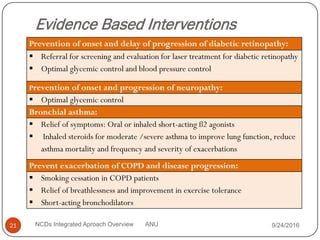
Prevention of onset and delay of progression of diabetic retinopathy:
 Referral for screening and evaluation for laser treatment for diabetic retinopathy
 Optimal glycemic control and blood pressure control
Prevention of onset and progression of neuropathy:
 Optimal glycemic control
Bronchial asthma:
 Relief of symptoms: Oral or inhaled short-acting ß2 agonists
 Inhaled steroids for moderate /severe asthma to improve lung function, reduce
asthma mortality and frequency and severity of exacerbations
Prevent exacerbation of COPD and disease progression:
 Smoking cessation in COPD patients
 Relief of breathlessness and improvement in exercise tolerance
 Short-acting bronchodilators
9/24/2016
21 NCDs Integrated Aproach Overview ANU
The Health Iceberg
24 September 2016
22 Health and it's Determinants
The Health Iceberg
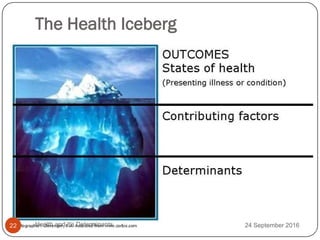
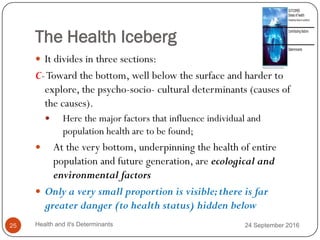
 It divides in three sections:
A-The top section refers to what is apparent; the measurable
state of health or health outcomes.
 This refers to the small section that is visible above the
waterline.
 These could be either positive or negative states of health
 These observable state of health could include mortality and
morbidity measures, and the prevalence of known risk
factors.
24 September 2016
23 Health and it's Determinants
The Health Iceberg
 It divides in three sections:
B-The section immediately below the iceberg waterline is
connected to the visible state of health and can be identified
and measured without too much difficulty.
 It refers to individuals’ lifestyle choices and behavioural risk
factors;
A. Eg: the link between smoking and lung cancer, poor nutrition and
heart disease
 Screening tools are readily available to identify specific risks.
24 September 2016
24 Health and it's Determinants
The Health Iceberg
 It divides in three sections:
C-Toward the bottom, well below the surface and harder to
explore, the psycho-socio- cultural determinants (causes of
the causes).
 Here the major factors that influence individual and
population health are to be found;
 At the very bottom, underpinning the health of entire
population and future generation, are ecological and
environmental factors
 Only a very small proportion is visible;there is far
greater danger (to health status) hidden below
24 September 2016
25 Health and it's Determinants
24 September 2016
26 Health and it's Determinants
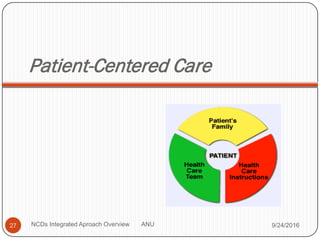
Patient-Centered Care
9/24/2016
27 NCDs Integrated Aproach Overview ANU
Concepts of patient- centered care
 It is health care that is respectful of, and responsive to, the
preferences, needs and values of patients and consumers.
Core elements in the Patient- centered care concept
 Education and shared knowledge
 Involvement of family and friends
 Collaboration and team management
 Sensitivity to nonmedical and spiritual dimensions of care
 Respect for patient needs and preferences
 The free flow and accessibility of information.
9/24/2016
28 NCDs Integrated Aproach Overview ANU
Concepts of patient- centered care
 Research demonstrates that patient-centered care improves
patient care experience and creates public value for services.
 When healthcare administrators, providers, patients and
families work in partnership,
 the quality and safety of health care rise,
 costs decrease,
 provider satisfaction increases
9/24/2016
29 NCDs Integrated Aproach Overview ANU
9/24/2016
NCDs Integrated Aproach Overview ANU
30
How to promote patient-centered care
 Consultation styles and communication training
 Patient feedback reporting
 Patient and carer engagement in personal care
 Patient and carer access to information and education
General Approaches to Prevent and Control NCDs.pdf

General Approaches to Prevent and Control NCDs.pdf

  • 1.
    Dr. Zaher Nazzal,MD,ABCM Assistant Professor in Community Medicine Head of An-Najah Child Institute znazzal@najah.edu General Approaches to Prevent and Control NCDs
  • 2.
    Introduction to NCDsRisk Factors 9/24/2016 Research Methodology 2016-2017 2
  • 3.
    What is arisk factor  A condition that is associated with an increased risk of developing NCDs  Can be classified as  Behavioral  Underlying Socioeconomic  Cultural  Political and  Environmental Determinants 9/24/2016 3 Introduction to the CVDs risk factors ANU
  • 4.
    NCDs risk factor(CVRF) • Classified based on preventability – Non-modifiable – Common Modifiable risk factors – Intermediate Risk Factor 9/24/2016 4 Introduction to the CVDs risk factors ANU
  • 5.
    • Coronary heart disease •Stroke • Peripheral vascular disease • Several cancers • COPD/emphysema Endpoints Intermediate Risk Factors • Hypertension • Blood lipids • Obesity / Overweight • Diabetes • Tobacco • Diet • Alcohol • Physical Activity Behavioural Risk Factors Non-modifiable Risk Factors • Age • Sex • Genes Socio-economic, Cultural & Environmental Conditions 9/24/2016 5 Introduction to the CVDs risk factors ANU By controlling these RF, CVDs, Cancers, CV events, ..etc could be prevented and prognosis improved
  • 6.
    Smoking Cardiovascul ar Disease Unhealthy diet Overweight Alcohol abuse Pyschosocial stress Sedentary lifestyle Mental Ill- health Chronic Respiratory Disease Diabetes Cancer Causallinks between Risk Factors and Chronic Diseases The prevalence of these behaviours is a powerful indicator of the risk a population faces for developing Chronic diseases 9/24/2016 6 Introduction to the CVDs risk factors ANU
  • 7.
    Potential Impact ofHealth Promotion Strategies Smoking Cessation Supports Cardiovascular Disease Nutrition Counselling Increased Access to Healthy Food Alcohol Reduction Strategies Teaching Coping Skills Promoting Physical Activity Mental Ill-health Chronic Respiratory Disease Diabetes Cancer 9/24/2016 7 Introduction to the CVDs risk factors ANU
  • 8.
  • 9.
    General Approaches inDelivery of NCD Preventive and Control Services Primary prevention  Interventions targeting people who do not have the disease (NCD), mainly by reducing the major related risk factors at community level.  Prevention of onset of disease in persons without symptoms.  The treatment of NCDs is lifelong and costly.,  Reducing the exposure to risk factors and thereby impeding the development of disease is the primary and most cost-effective strategy. 9/24/2016 9 NCDs Integrated Aproach Overview ANU Important strategies under this category include – Health education, – Immunization, – Environmental measures and – Social policy
  • 10.
    General Approaches inDelivery of NCD Preventive and Control Services Primary prevention  The involvement of sectors other than health has a major impact on shaping the physical and social environments that determine “risk” behaviors.  Therefore,interventions for NCD prevention and control have to be multi- sectoral and multidisciplinary and act at multiple levels.  Guidelines for the prevention and control of the most prevalent NCD and risk factors should be developed and regularly updated at the national level. 9/24/2016 10 NCDs Integrated Aproach Overview ANU
  • 11.
    General Approaches inDelivery of NCD Preventive and Control Services Primary prevention:Examples  Promotion of consumption of local fruits and vegetables  Reduction of salt, refined sugars and animal fat.  Control of diet and increase of physical activity  All of these will result in reduction of obesity, hypertension, high cholesterol and diabetes. 9/24/2016 11 NCDs Integrated Aproach Overview ANU
  • 12.
    General Approaches inDelivery of NCD Preventive and Control Services Secondary prevention  All interventions aimed at reducing the risk of recurrent NCD events in patients with established NCD.  Refers to the prevention of death or recurrence of disease in those who are already symptomatic  The most effective  Early diagnosis (Screening)  Early management of an established NCD and  A full-risk assessment of the individual. 9/24/2016 12 NCDs Integrated Aproach Overview ANU
  • 13.
    General Approaches inDelivery of NCD Preventive and Control Services Secondary prevention:Examples  Health check is to detect diseases at an earlier stage  Counseling smokers to quit smoking after a heart attack  Telling people to take daily, low-dose aspirin to prevent a second heart attack or stroke  Providing suitably modified work for injured workers 9/24/2016 13 NCDs Integrated Aproach Overview ANU
  • 14.
    General Approaches inDelivery of NCD Preventive and Control Services Tertiary prevention  Clinical activities as well as treatment that deters further deterioration or complication after a disease has been diagnosed.  Due to the current situation of NCD prevention and control in the Region, 1o & 2o prevention should be given priority because of their cost-effectiveness. 9/24/2016 14 NCDs Integrated Aproach Overview ANU
  • 15.
    Integrated Approach  ForNCDs prevention activities to achieve the greatest impact, a paradigm shift is required;  away from the treatment of risk factors in isolation, to a comprehensive cardiovascular risk management approach.  Development of an integrated approach targeting all major common risk factors of NCDs is the most cost-effective way to prevent and control them. 9/24/2016 15 NCDs Integrated Aproach Overview ANU
  • 16.
    Integrated Approach: Key Elements Addressing the set of common risk factors  Integrated strategies will target the set of common risk factors for major chronic diseases simultaneously  Recognizing and addressing the relationship between lifestyle choices and social conditions  The most promising way for effective prevention focus on supporting healthy living in healthy conditions. 9/24/2016 16 NCDs Integrated Aproach Overview ANU
  • 17.
    Integrated Approach: Key Elements Merge prevention efforts within life settings  Focusing on life settings such as PHC, work, school or community is an effective way to reach target populations  Engaging partners within and across the systems that impact health  Coordinated inter-sectoral intervention is required 9/24/2016 17 NCDs Integrated Aproach Overview ANU
  • 18.
    Rationale for Integration The priority conditions that have been selected are major public health issues that contribute the most to the global NCD burden.  Evidence-based, cost-effective interventions are available for addressing comprehensive cardiovascular risk, and the challenge now is to “use what we know”, particularly in LMICs  These conditions share behavioral risk factors: • Tobacco use,unhealthy diet and physical inactivity 9/24/2016 18 NCDs Integrated Aproach Overview ANU
  • 19.
    Evidence Based Interventions 9/24/2016 19NCDs Integrated Aproach Overview ANU Primary prevention of heart attacks and strokes:  Tobacco cessation, regular physical activity, reduced intake of sat  Consumption of fruits and vegetables.  Aspirin, statins and antihypertensive for people with very high cardiovascular risk  Antihypertensive for people with BP ≥140/90 Secondary prevention (acute MI)  Aspirin Secondary prevention (post MI)  Tobacco cessation, healthy diet and regular physical activity.  Aspirin, angiotensin-converting enzyme inhibito  beta-blocker, statin Secondary prevention (post stroke):  Tobacco cessation, healthy diet and regular physical activity.  Aspirin, antihypertensive (low dose thiazide,ACE-I), and statin
  • 20.
    Evidence Based Interventions 9/24/2016 20NCDs Integrated Aproach Overview ANU DM2:  Oral hypoglycemic agents forT2DM, if glycemic targets are not achieved with modification of diet, maintenance of a healthy body weight and regular physical activity  Metformin as initial drug in overweight patients and non overweight.  Other classes of antihyperglycemic agents, added to metformin if glycemic targets are not met Prevention of foot complications through examination and monitoring  Regular (3-6 months) visual inspection and examination of patients’ feet by trained personnel for the detection of risk factors for ulceration (assessment of foot sensation, palpation of foot pulses inspection for any foot deformity, inspection of footwear) and referral as appropriate
  • 21.
    Evidence Based Interventions Preventionof onset and delay of progression of diabetic retinopathy:  Referral for screening and evaluation for laser treatment for diabetic retinopathy  Optimal glycemic control and blood pressure control Prevention of onset and progression of neuropathy:  Optimal glycemic control Bronchial asthma:  Relief of symptoms: Oral or inhaled short-acting ß2 agonists  Inhaled steroids for moderate /severe asthma to improve lung function, reduce asthma mortality and frequency and severity of exacerbations Prevent exacerbation of COPD and disease progression:  Smoking cessation in COPD patients  Relief of breathlessness and improvement in exercise tolerance  Short-acting bronchodilators 9/24/2016 21 NCDs Integrated Aproach Overview ANU
  • 22.
    The Health Iceberg 24September 2016 22 Health and it's Determinants
  • 23.
    The Health Iceberg It divides in three sections: A-The top section refers to what is apparent; the measurable state of health or health outcomes.  This refers to the small section that is visible above the waterline.  These could be either positive or negative states of health  These observable state of health could include mortality and morbidity measures, and the prevalence of known risk factors. 24 September 2016 23 Health and it's Determinants
  • 24.
    The Health Iceberg It divides in three sections: B-The section immediately below the iceberg waterline is connected to the visible state of health and can be identified and measured without too much difficulty.  It refers to individuals’ lifestyle choices and behavioural risk factors; A. Eg: the link between smoking and lung cancer, poor nutrition and heart disease  Screening tools are readily available to identify specific risks. 24 September 2016 24 Health and it's Determinants
  • 25.
    The Health Iceberg It divides in three sections: C-Toward the bottom, well below the surface and harder to explore, the psycho-socio- cultural determinants (causes of the causes).  Here the major factors that influence individual and population health are to be found;  At the very bottom, underpinning the health of entire population and future generation, are ecological and environmental factors  Only a very small proportion is visible;there is far greater danger (to health status) hidden below 24 September 2016 25 Health and it's Determinants
  • 26.
    24 September 2016 26Health and it's Determinants
  • 27.
    Patient-Centered Care 9/24/2016 27 NCDsIntegrated Aproach Overview ANU
  • 28.
    Concepts of patient-centered care  It is health care that is respectful of, and responsive to, the preferences, needs and values of patients and consumers. Core elements in the Patient- centered care concept  Education and shared knowledge  Involvement of family and friends  Collaboration and team management  Sensitivity to nonmedical and spiritual dimensions of care  Respect for patient needs and preferences  The free flow and accessibility of information. 9/24/2016 28 NCDs Integrated Aproach Overview ANU
  • 29.
    Concepts of patient-centered care  Research demonstrates that patient-centered care improves patient care experience and creates public value for services.  When healthcare administrators, providers, patients and families work in partnership,  the quality and safety of health care rise,  costs decrease,  provider satisfaction increases 9/24/2016 29 NCDs Integrated Aproach Overview ANU
  • 30.
    9/24/2016 NCDs Integrated AproachOverview ANU 30 How to promote patient-centered care  Consultation styles and communication training  Patient feedback reporting  Patient and carer engagement in personal care  Patient and carer access to information and education