Ministry of Health 
Malaysia 
Overview of 
Non-Communicable Diseases 
Feisul Idzwan Mustapha MBBS, MPH, AM(M) 
Public Health Physician, NCD Section, Disease Control Division 
Ministry of Health, Malaysia 
LeAd-NCD-MAL Workshop 
1 December 2014 
Klang 
dr.feisul@moh.gov.my
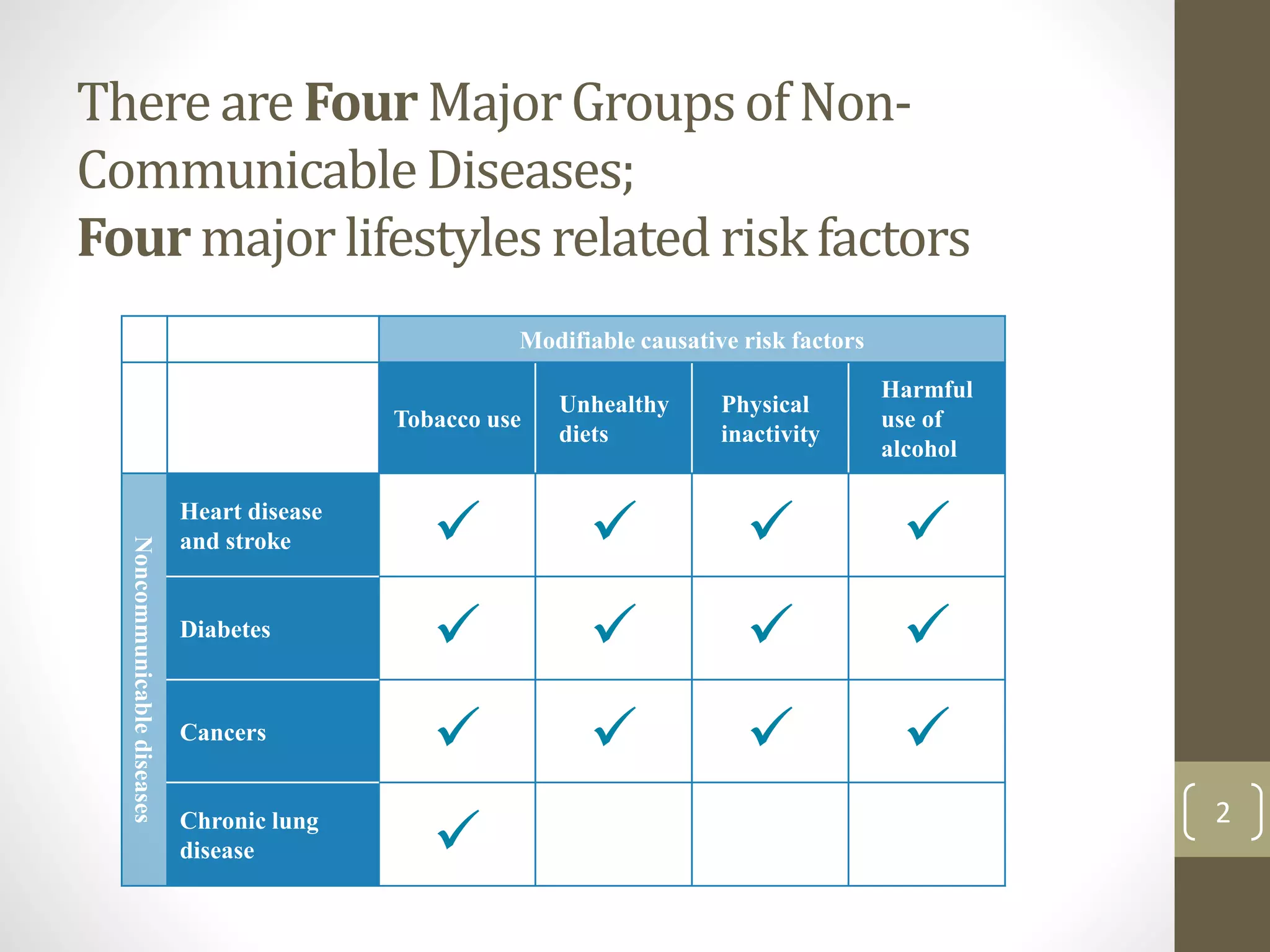
There are FourMajor Groups of Non- 
Communicable Diseases; 
Fourmajor lifestyles related risk factors 
Modifiable causative risk factors 
Tobacco use 
Unhealthy 
diets 
Physical 
inactivity 
Harmful 
use of 
alcohol 
Noncommunicable diseases 
Heart disease 
and stroke 
    
Diabetes     
Cancers     
Chronic lung 
disease 
 2
3 
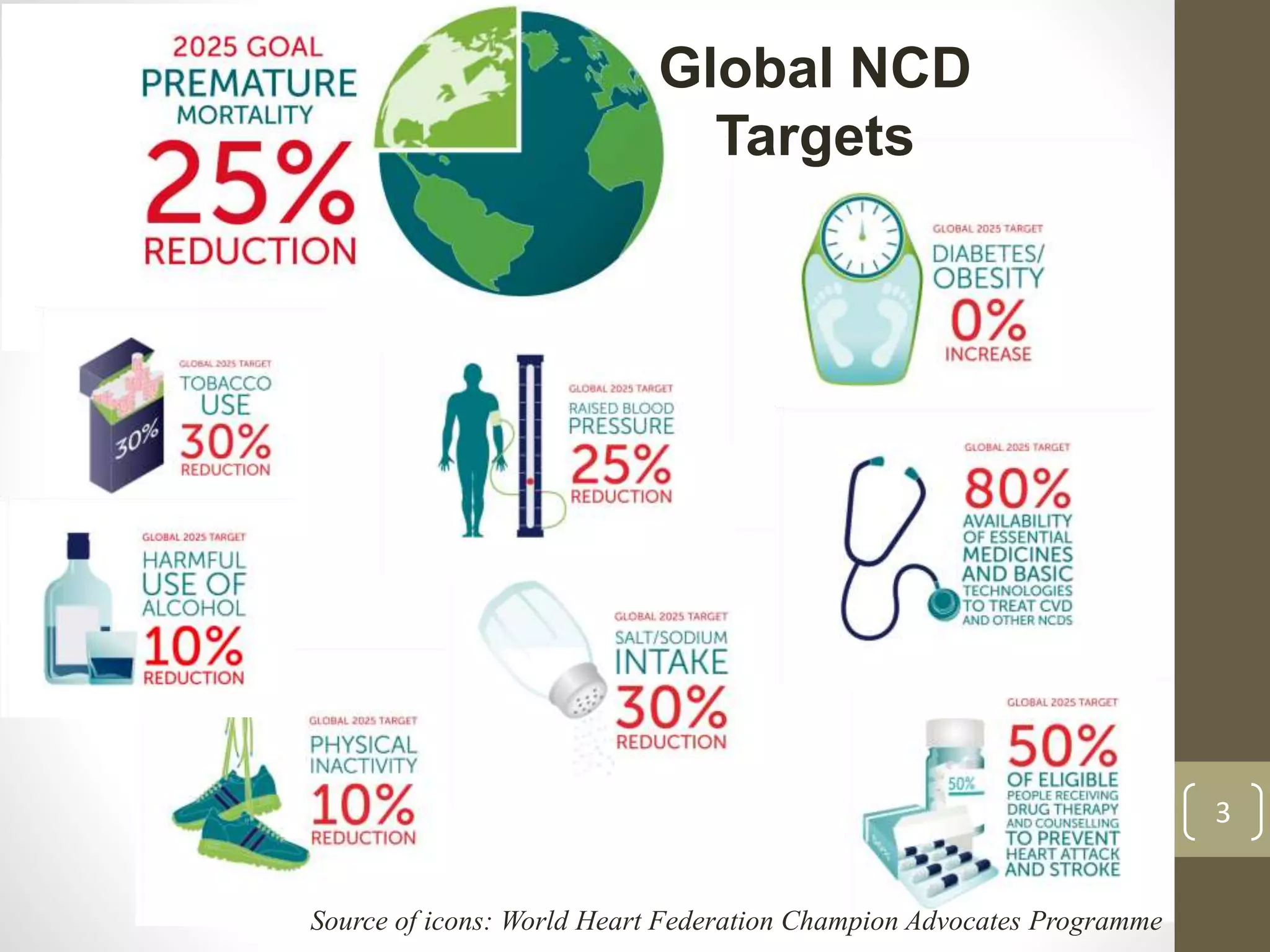
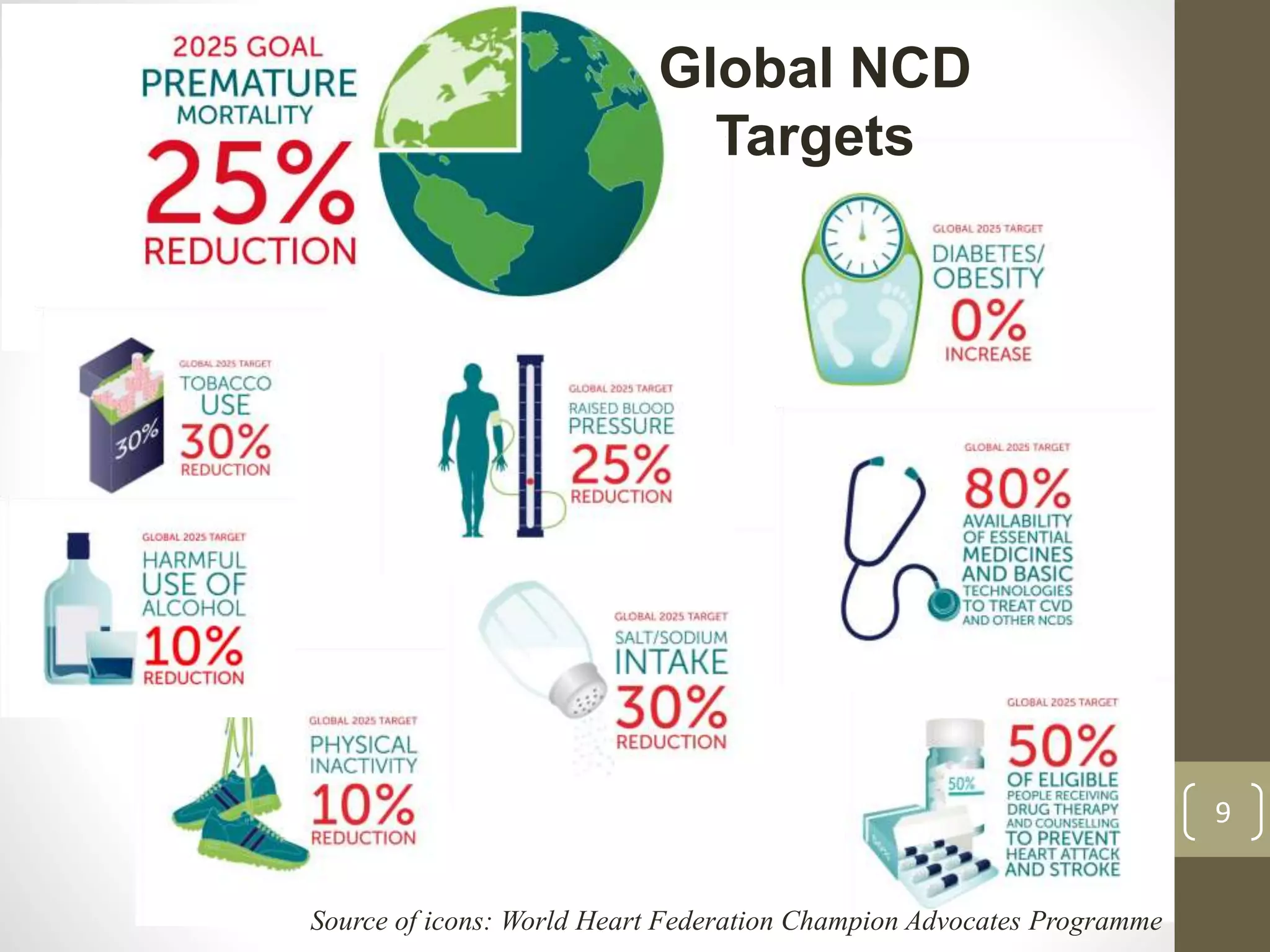
Global NCD 
Targets 
Source of icons: World Heart Federation Champion Advocates Programme
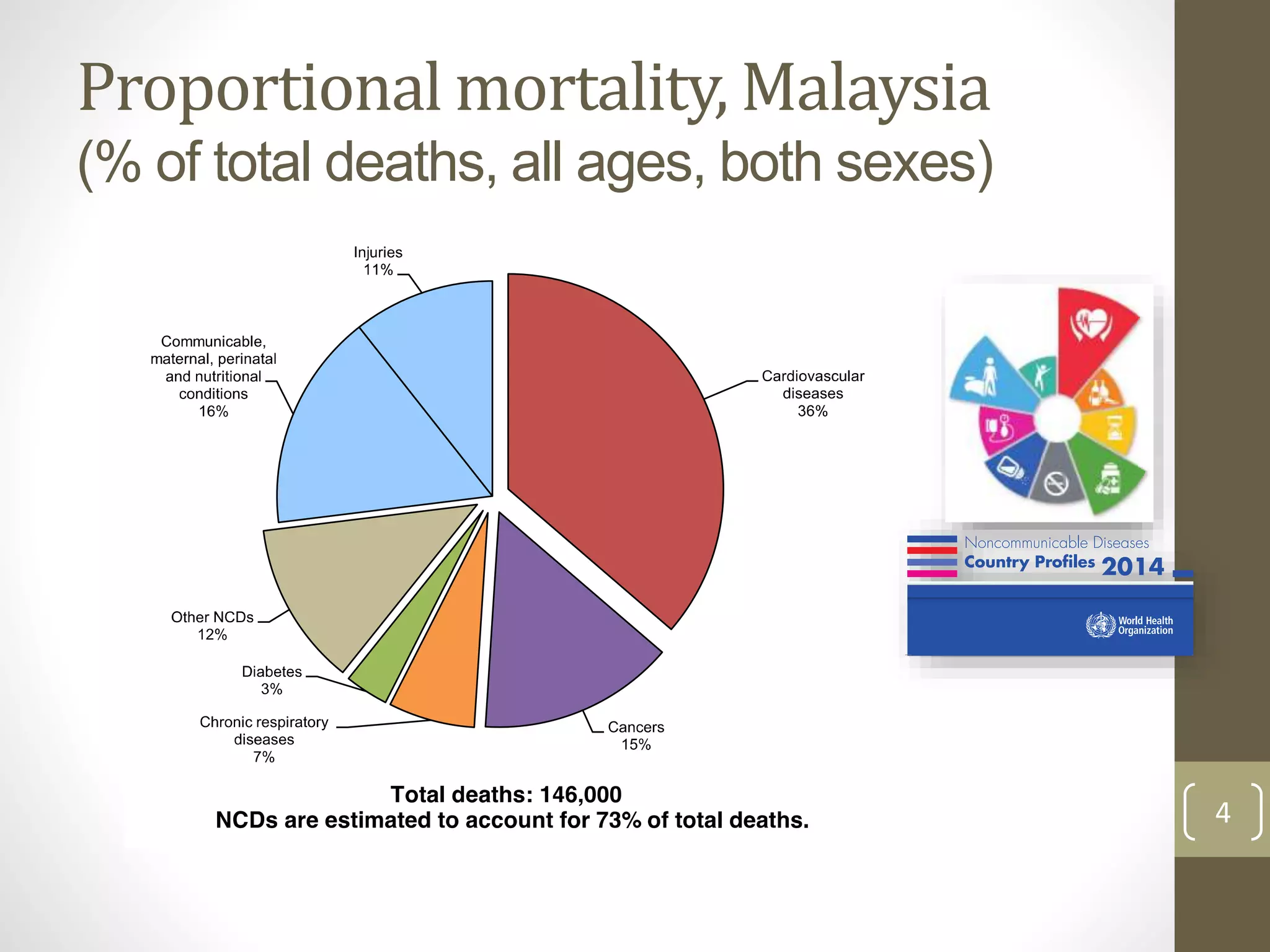
Proportional mortality, Malaysia 
(% of total deaths, all ages, both sexes) 
4
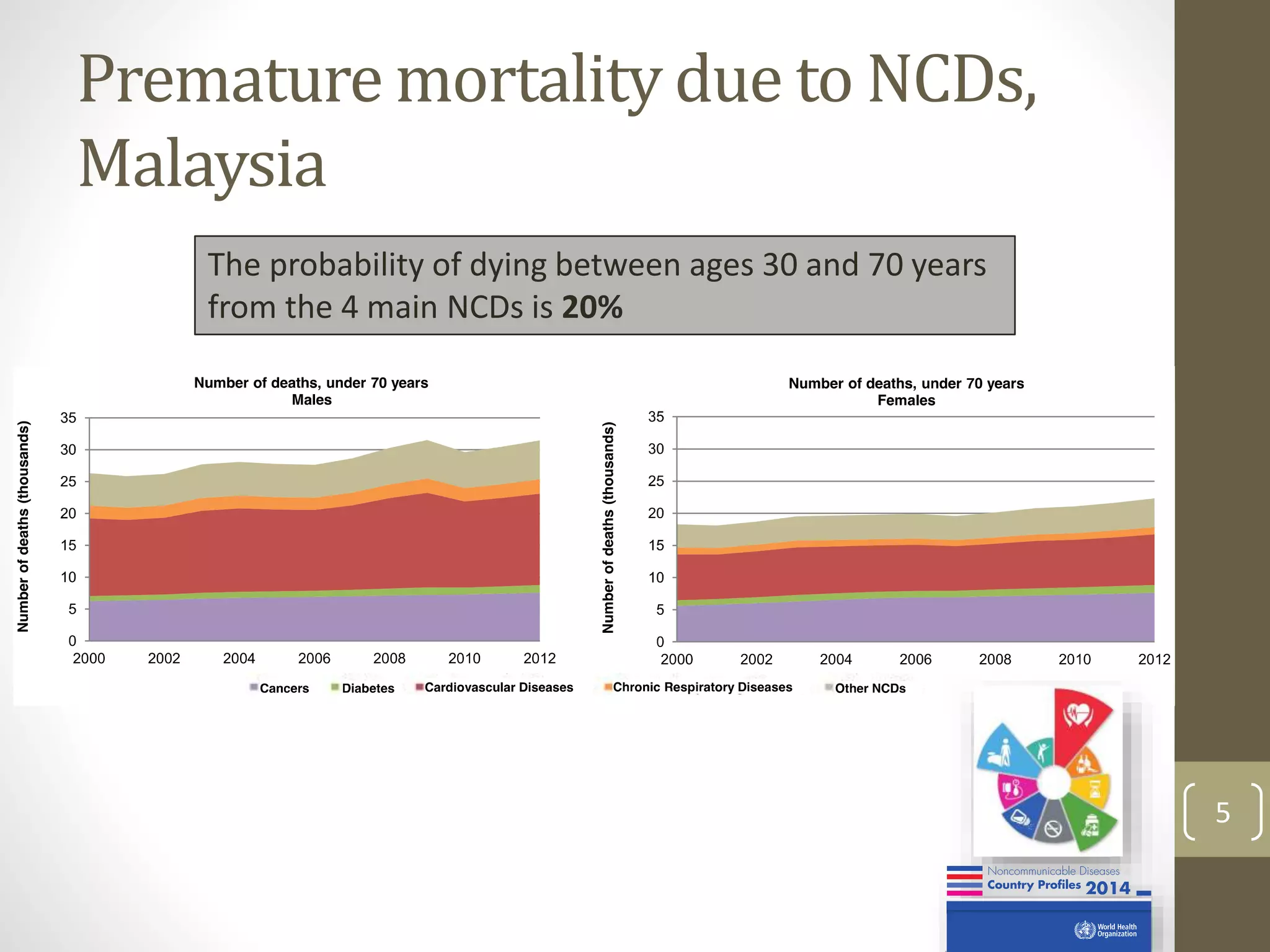
Premature mortality due to NCDs, 
Malaysia 
5 
The probability of dying between ages 30 and 70 years 
from the 4 main NCDs is 20%
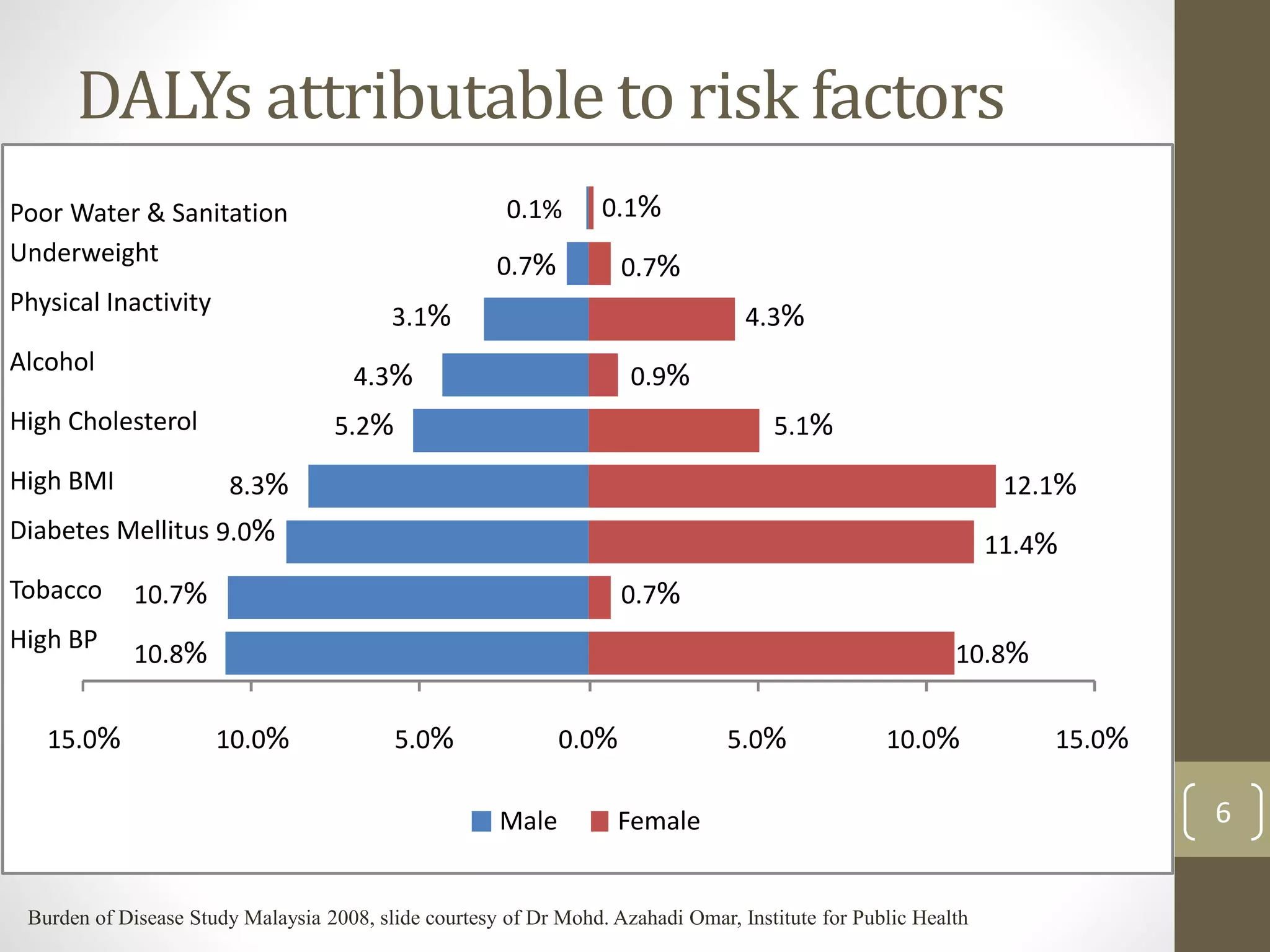
DALYs attributable to risk factors 
6 
Poor Water & Sanitation 
Underweight 
Physical Inactivity 
Alcohol 
High Cholesterol 
High BMI 
Diabetes Mellitus 
10.7% 
10.8% 
8.3% 
9.0% 
3.1% 
4.3% 
5.2% 
0.1% 
0.7% 
12.1% 
10.8% 
0.1% 
0.7% 
11.4% 
5.1% 
0.9% 
4.3% 
0.7% 
Tobacco 
High BP 
15.0% 10.0% 5.0% 0.0% 5.0% 10.0% 15.0% 
Male Female 
Burden of Disease Study Malaysia 2008, slide courtesy of Dr Mohd. Azahadi Omar, Institute for Public Health
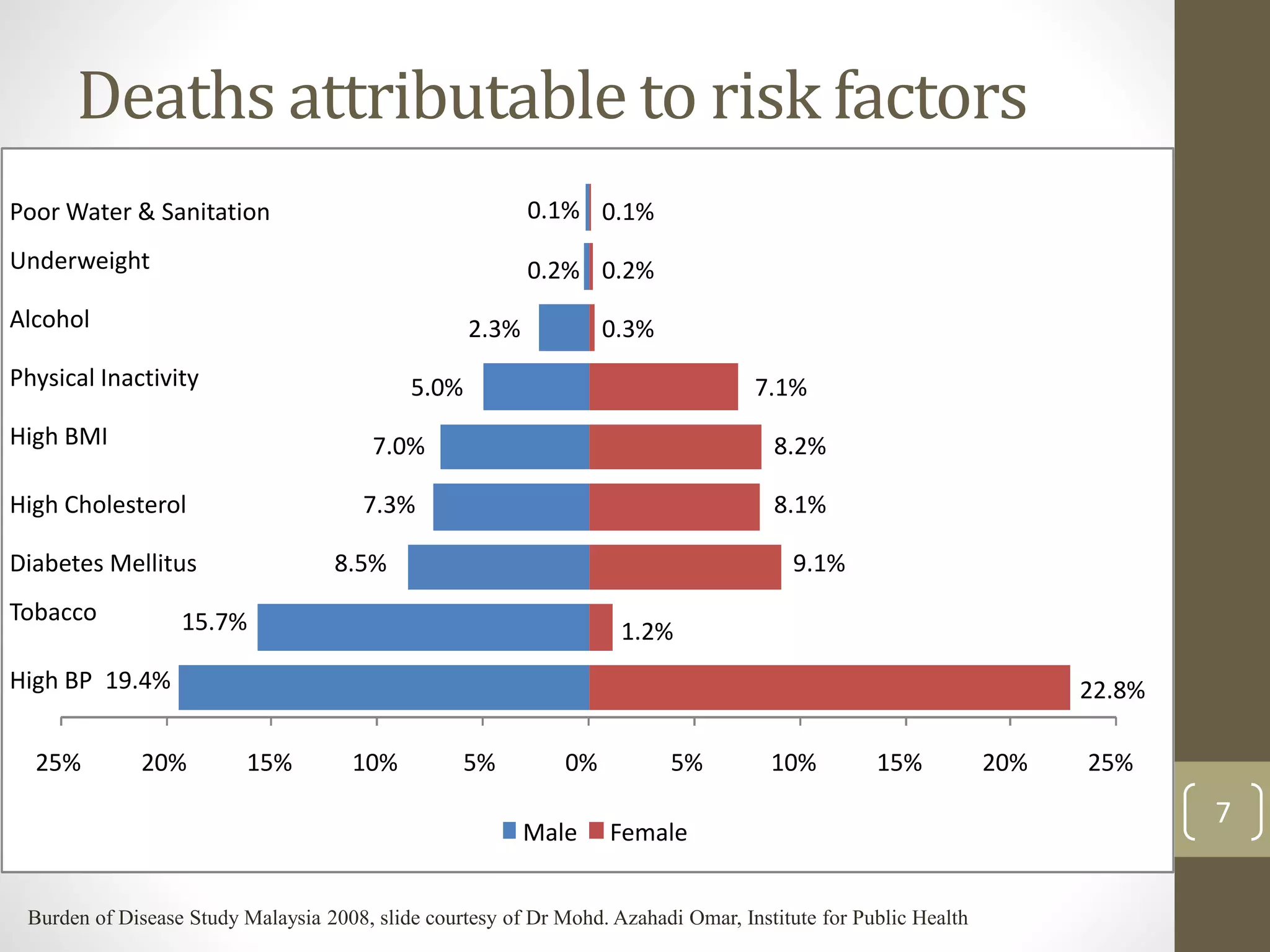
Deaths attributable to risk factors 
Poor Water & Sanitation 
Underweight 
Alcohol 
Physical Inactivity 
High BMI 
High Cholesterol 
Diabetes Mellitus 
19.4% 
15.7% 
7.0% 
7.3% 
8.5% 
5.0% 
2.3% 
0.1% 
0.2% 
22.8% 
0.1% 
0.2% 
1.2% 
7.1% 
8.2% 
8.1% 
9.1% 
0.3% 
Tobacco 
High BP 
25% 20% 15% 10% 5% 0% 5% 10% 15% 20% 25% 
Male Female 
Burden of Disease Study Malaysia 2008, slide courtesy of Dr Mohd. Azahadi Omar, Institute for Public Health 
7
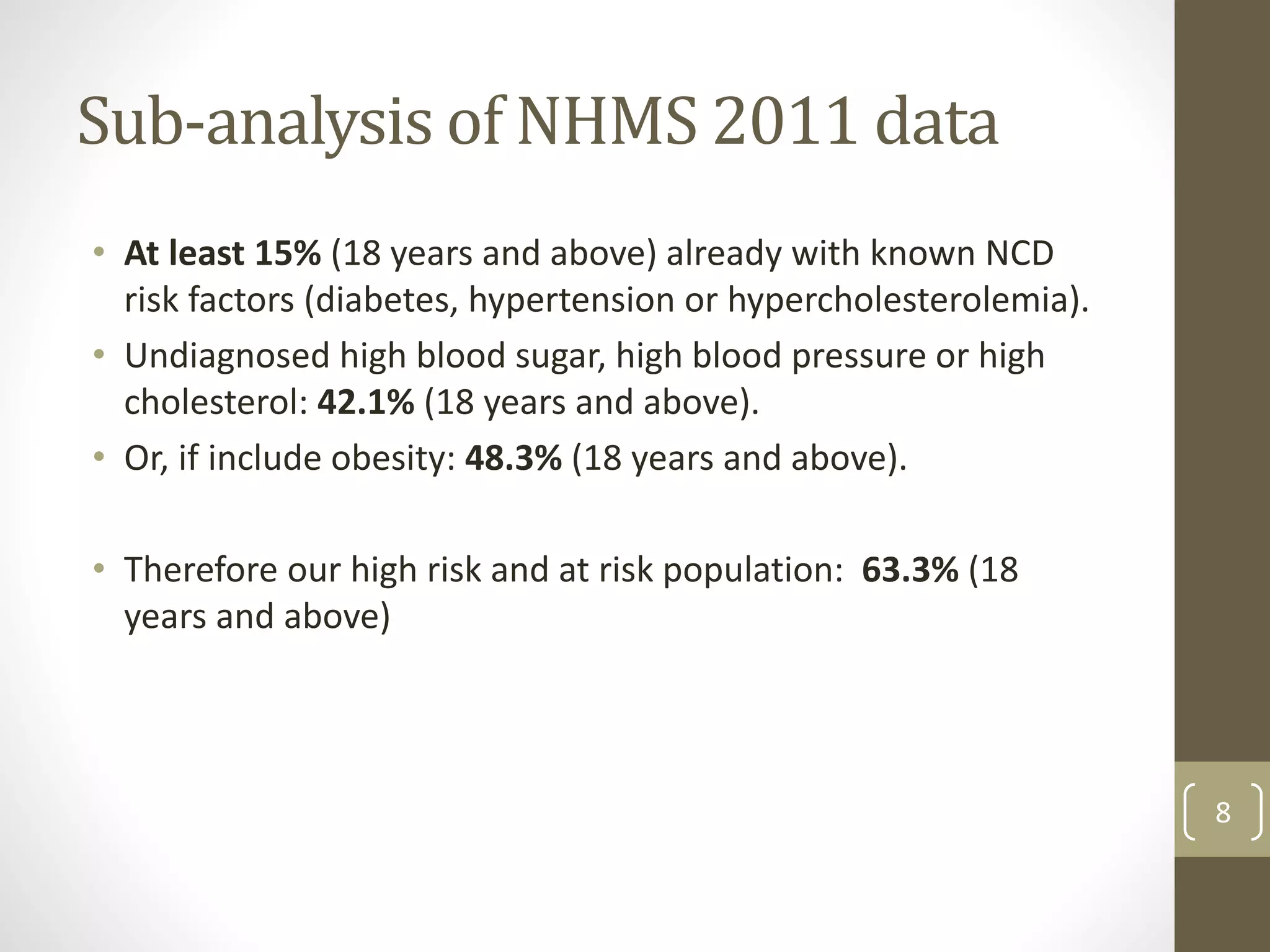
Sub-analysis of NHMS 2011 data 
• At least 15% (18 years and above) already with known NCD 
risk factors (diabetes, hypertension or hypercholesterolemia). 
• Undiagnosed high blood sugar, high blood pressure or high 
cholesterol: 42.1% (18 years and above). 
• Or, if include obesity: 48.3% (18 years and above). 
• Therefore our high risk and at risk population: 63.3% (18 
years and above) 
8
9 
Global NCD 
Targets 
Source of icons: World Heart Federation Champion Advocates Programme
10
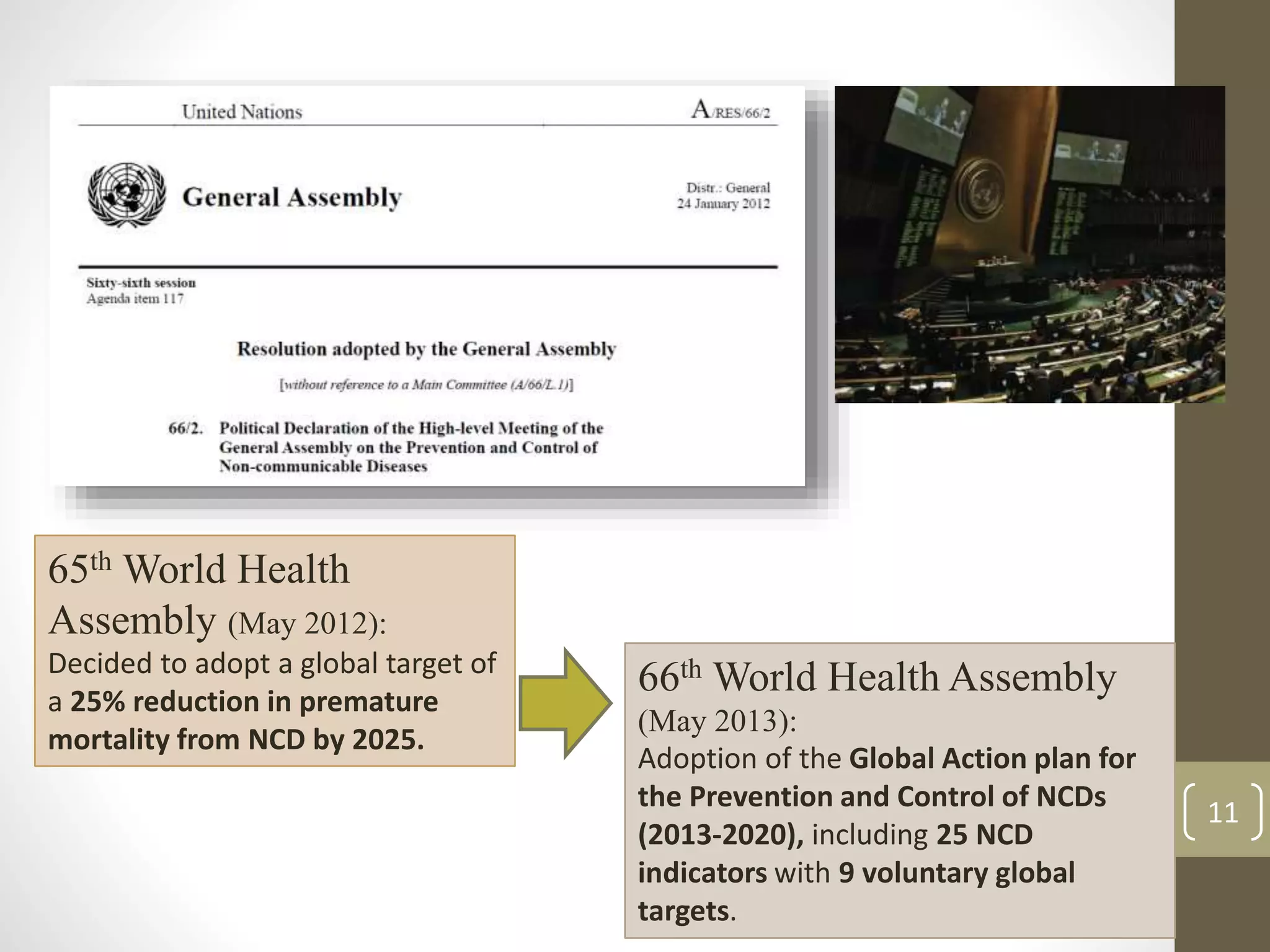
65th World Health 
Assembly (May 2012): 
Decided to adopt a global target of 
a 25% reduction in premature 
mortality from NCD by 2025. 
66th World Health Assembly 
(May 2013): 
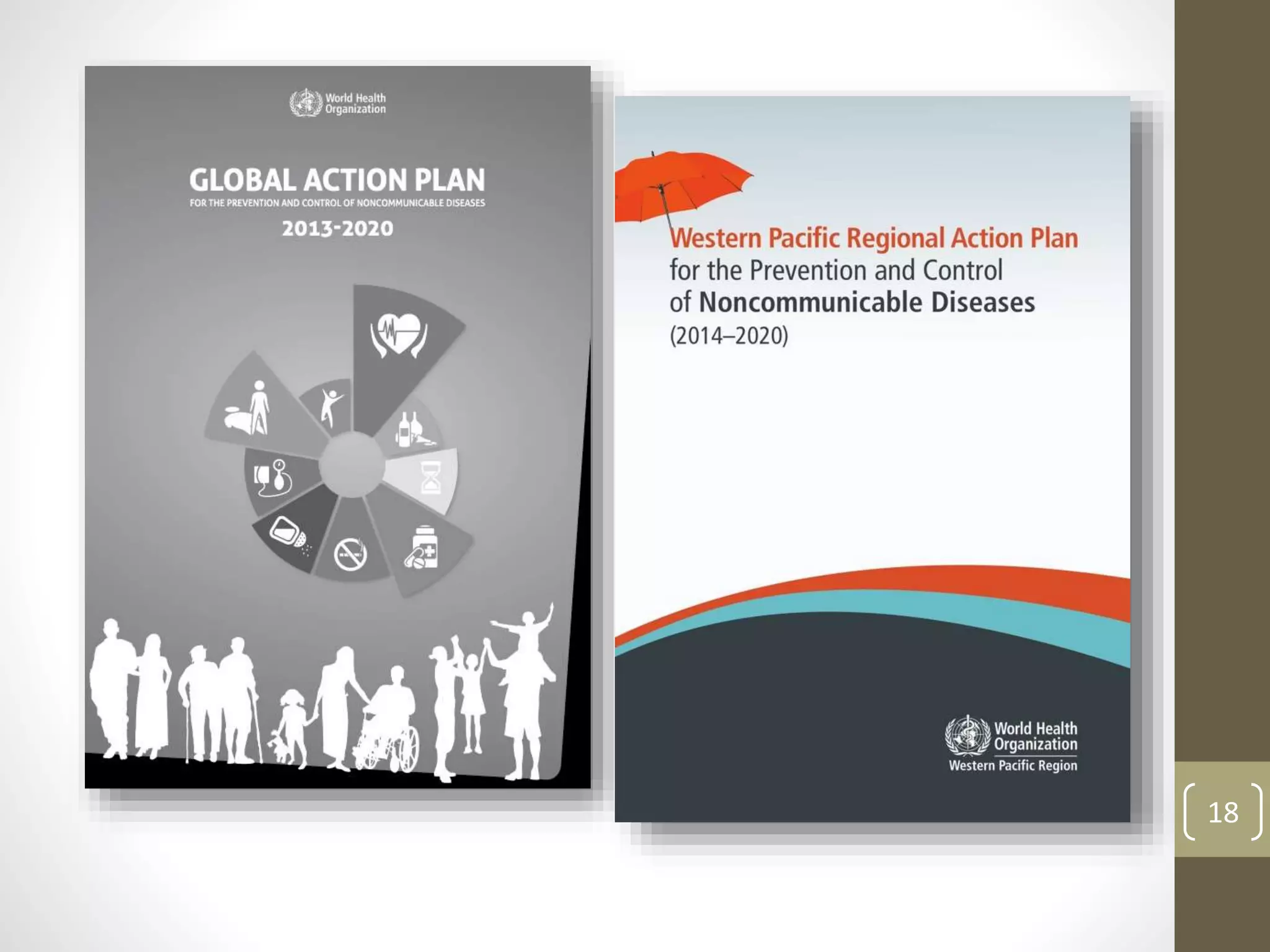
Adoption of the Global Action plan for 
the Prevention and Control of NCDs 
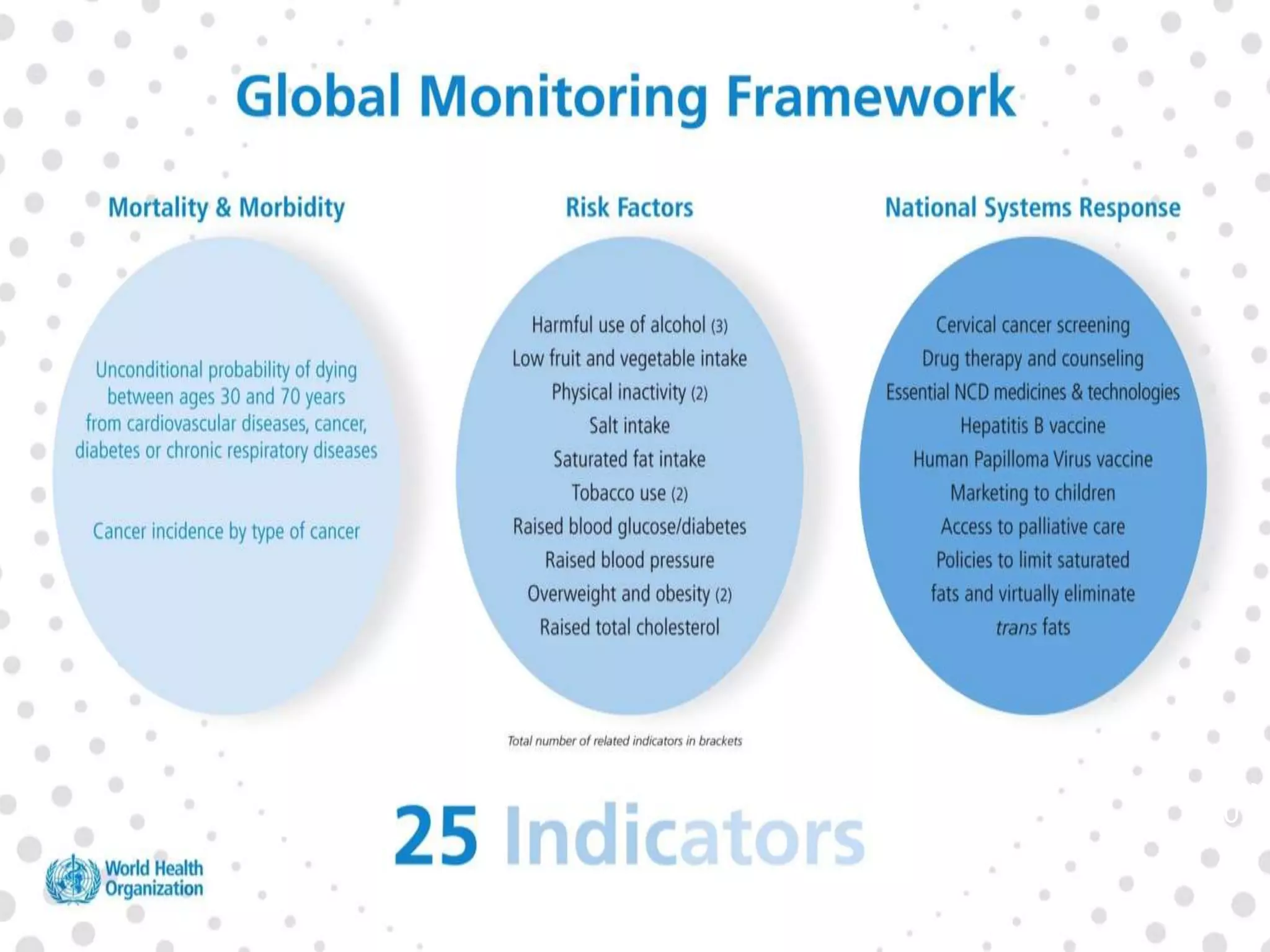
(2013-2020), including 25 NCD 
indicators with 9 voluntary global 
targets. 
11
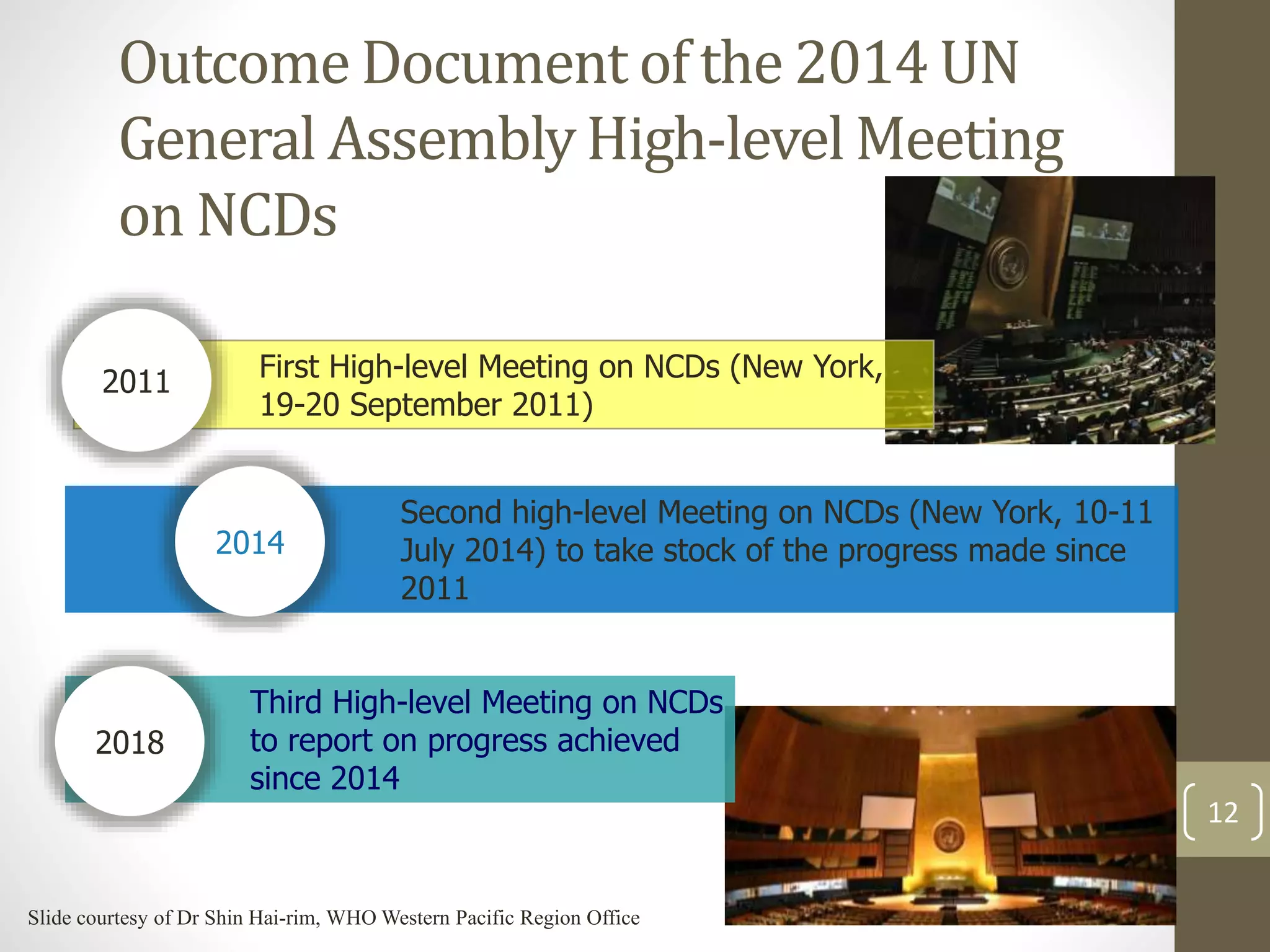
Outcome Document of the 2014 UN 
General Assembly High-level Meeting 
on NCDs 
First High-level Meeting on NCDs (New York, 
19-20 September 2011) 
2011 
Second high-level Meeting on NCDs (New York, 10-11 
July 2014) to take stock of the progress made since 
2011 
2014 
Third High-level Meeting on NCDs 
to report on progress achieved 
since 2014 
2018 
12 
Slide courtesy of Dr Shin Hai-rim, WHO Western Pacific Region Office
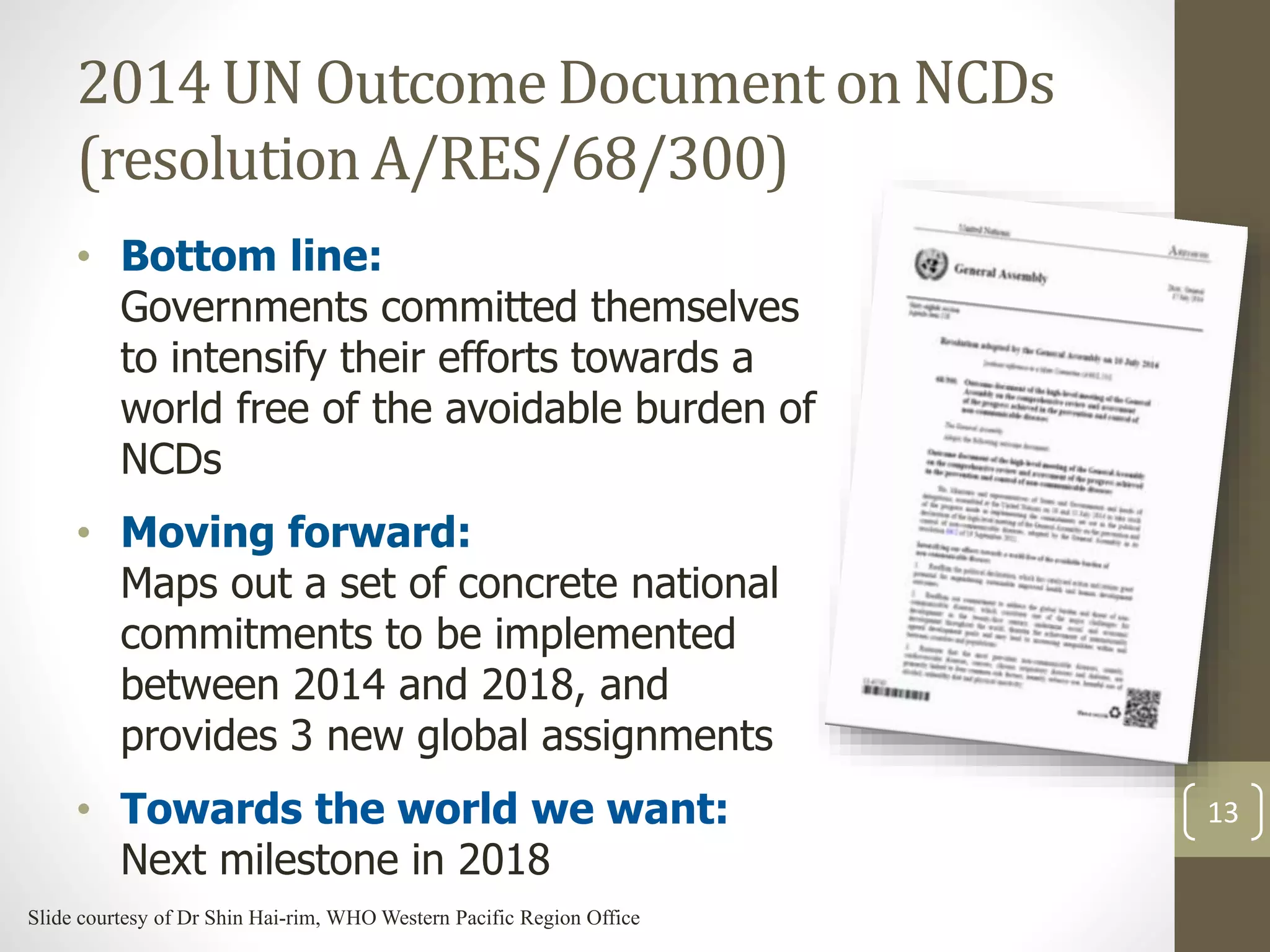
2014 UN Outcome Document on NCDs 
(resolution A/RES/68/300) 
• Bottom line: 
Governments committed themselves 
to intensify their efforts towards a 
world free of the avoidable burden of 
NCDs 
• Moving forward: 
Maps out a set of concrete national 
commitments to be implemented 
between 2014 and 2018, and 
provides 3 new global assignments 
• Towards the world we want: 
Next milestone in 2018 
13 
Slide courtesy of Dr Shin Hai-rim, WHO Western Pacific Region Office
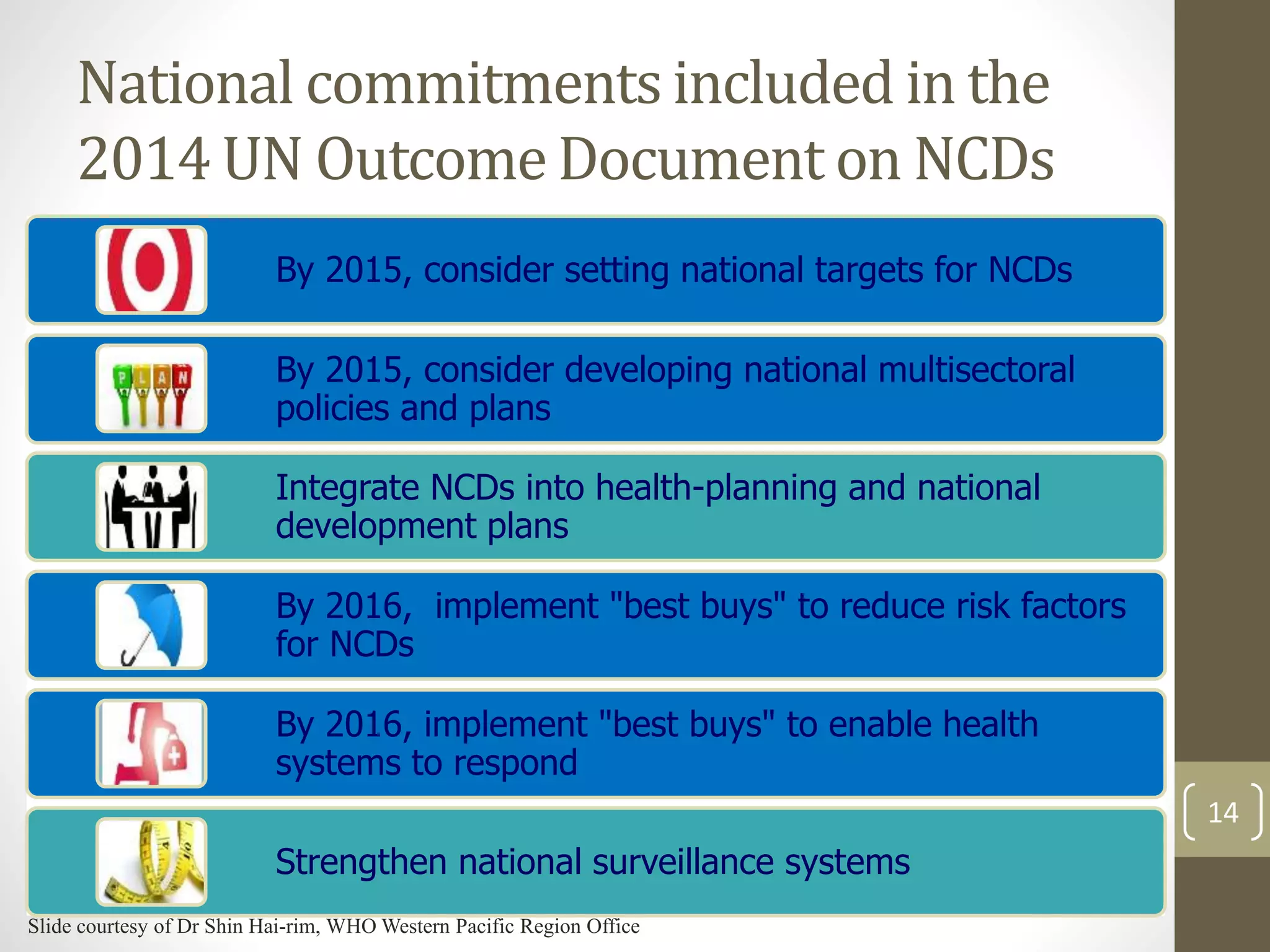
National commitments included in the 
2014 UN Outcome Document on NCDs 
By 2015, consider setting national targets for NCDs 
By 2015, consider developing national multisectoral 
policies and plans 
Integrate NCDs into health-planning and national 
development plans 
By 2016, implement "best buys" to reduce risk factors 
for NCDs 
By 2016, implement "best buys" to enable health 
systems to respond 
Strengthen national surveillance systems 
14 
Slide courtesy of Dr Shin Hai-rim, WHO Western Pacific Region Office
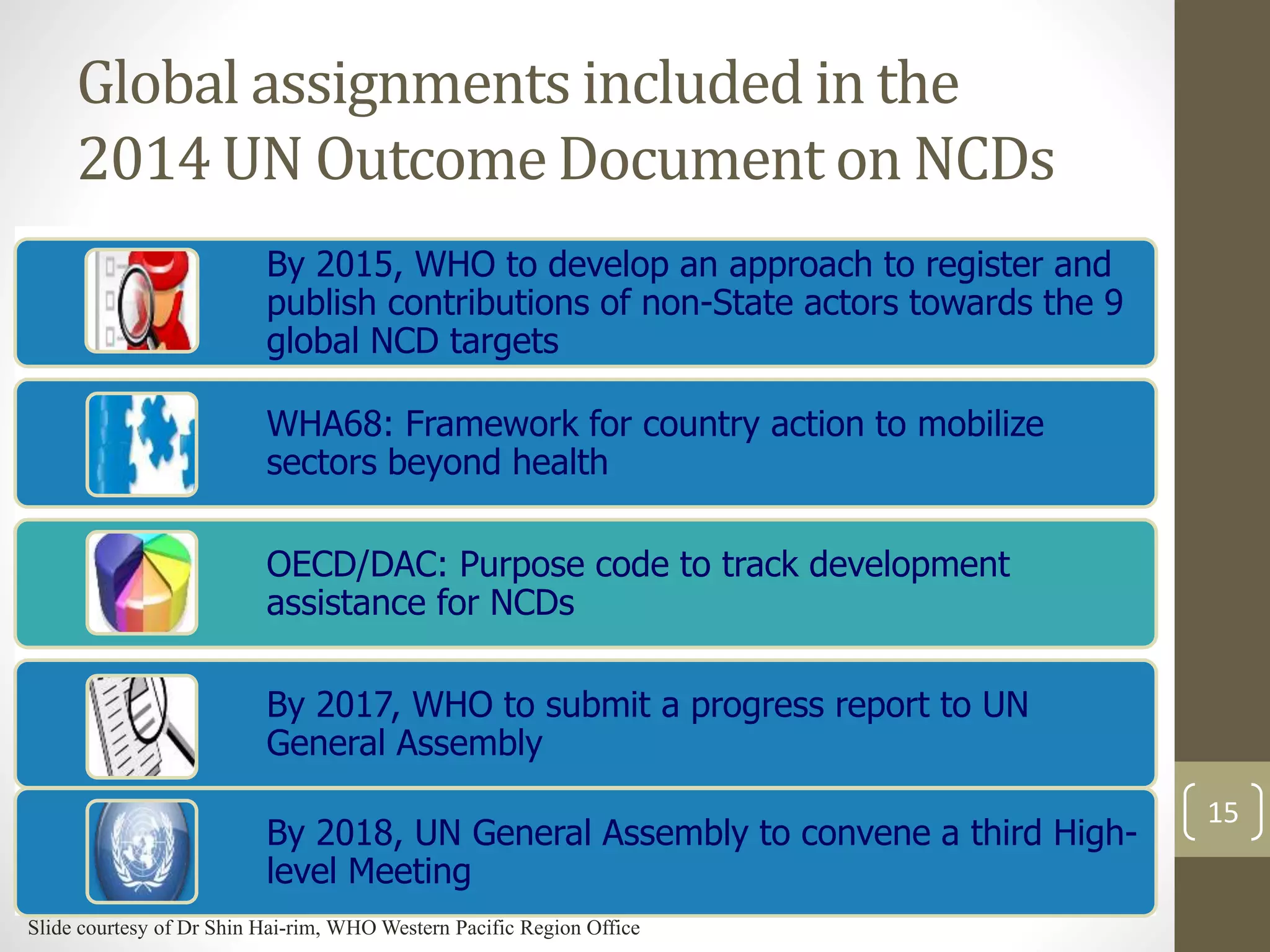
Global assignments included in the 
2014 UN Outcome Document on NCDs 
By 2015, WHO to develop an approach to register and 
publish contributions of non-State actors towards the 9 
global NCD targets 
WHA68: Framework for country action to mobilize 
sectors beyond health 
OECD/DAC: Purpose code to track development 
assistance for NCDs 
By 2017, WHO to submit a progress report to UN 
General Assembly 
By 2018, UN General Assembly to convene a third High-level 
Meeting 
15 
Slide courtesy of Dr Shin Hai-rim, WHO Western Pacific Region Office
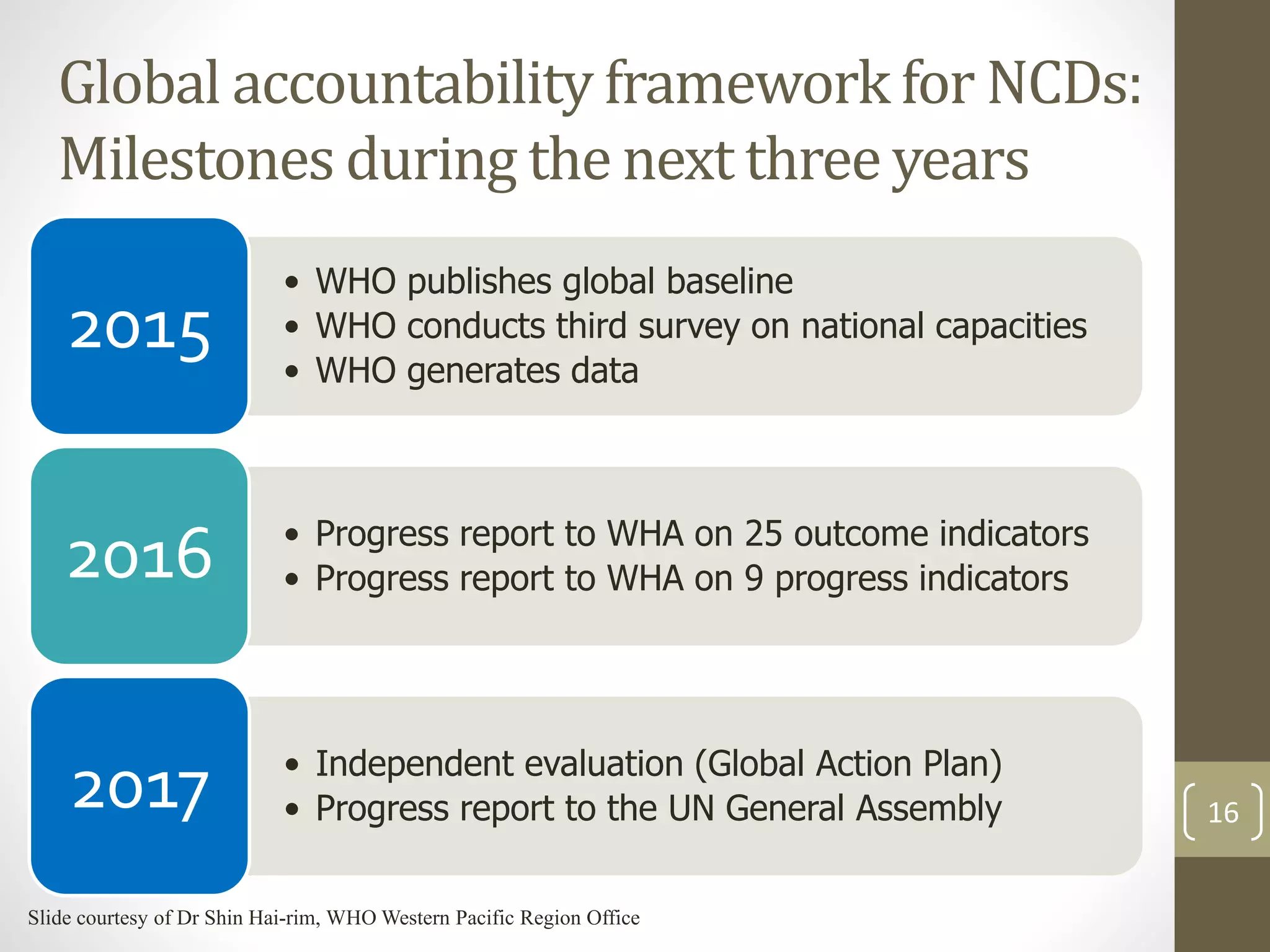
Global accountability framework for NCDs: 
Milestones during the next three years 
• WHO publishes global baseline 
• WHO conducts third survey on national capacities 
• WHO generates data 
2015 
• Progress report to WHA on 25 outcome indicators 
• Progress report to WHA on 9 progress indicators 2016 
• Independent evaluation (Global Action Plan) 
• Progress report to the UN General Assembly 2017 16 
Slide courtesy of Dr Shin Hai-rim, WHO Western Pacific Region Office
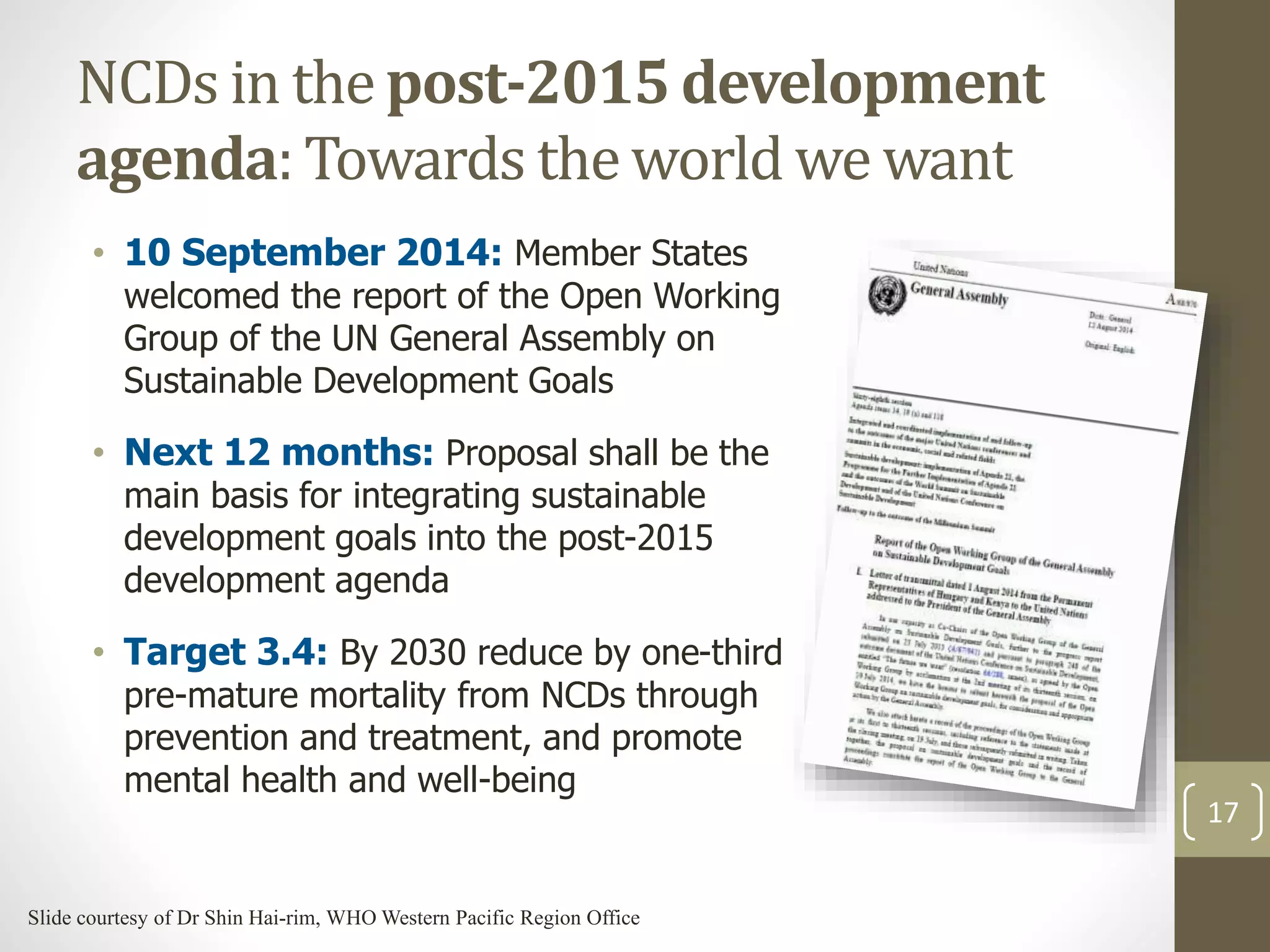
NCDs in the post-2015 development 
agenda: Towards the world we want 
• 10 September 2014: Member States 
welcomed the report of the Open Working 
Group of the UN General Assembly on 
Sustainable Development Goals 
• Next 12 months: Proposal shall be the 
main basis for integrating sustainable 
development goals into the post-2015 
development agenda 
• Target 3.4: By 2030 reduce by one-third 
pre-mature mortality from NCDs through 
prevention and treatment, and promote 
mental health and well-being 
17 
Slide courtesy of Dr Shin Hai-rim, WHO Western Pacific Region Office
18
Cost effective interventions to address 
NCDs 
Population-based 
interventions 
addressing 
NCD 
risk factors 
Tobacco use - Excise tax increases 
- Smoke-free indoor workplaces and public places 
- Health information and warnings about tobacco 
- Bans on advertising and promotion 
Harmful use 
of alcohol 
- Excise tax increases on alcoholic beverages 
- Comprehensive restrictions and bans on alcohol marketing 
- Restrictions on the availability of retailed alcohol 
Unhealthy 
diet and 
physical 
inactivity 
- Salt reduction through mass media campaigns and reduced salt 
content in processed foods 
- Replacement of trans-fats with polyunsaturated fats 
- Public awareness programme about diet and physical activity 
Individual-based 
interventions 
addressing 
NCDs in 
primary care 
Cancer - Prevention of liver cancer through hepatitis B immunization 
- Prevention of cervical cancer through screening (visual 
inspection with acetic acid [VIA]) and treatment of pre-cancerous 
lesions 
CVD and 
diabetes 
- Multi-drug therapy (including glycaemic control for diabetes 
mellitus) for individuals who have had a heart attack or stroke, 
and to persons at high risk (> 30%) of a cardiovascular event 
within 10 years 
- Providing aspirin to people having an acute heart attack 
19
Cost effective NCD interventions… 
• What works, what can we afford, and what should we 
adopt? 
• The challenge? Identify interventions that: 
• are effective; 
• can lead to measurable declines in NCD death rates 
quickly (e.g. over 10 years); 
• are affordable; and 
• can easily be implemented and sustained. 
The Lancet. December 8, 2007 Volume 370: 
Gaziano T, Galea G and Reddy K. Scaling up interventions for chronic disease prevention: the evidence. 
pp 1939-1946. 
The Lancet. December 15, 2007. Volume 370: 
Asaria P, Crisholm D, Mathers C, Ezzati M, Beaglehole R. Chronic disease prevention: health effects and 
financial costs of strategies to reduce salt intake and control tobacco use. pp 2044-2053. 
Lim S, et. al. Prevention of cardiovascular disease in high-risk individuals in low-income and middle-income 
countries: health effects and costs. pp 2054-2061. 
20
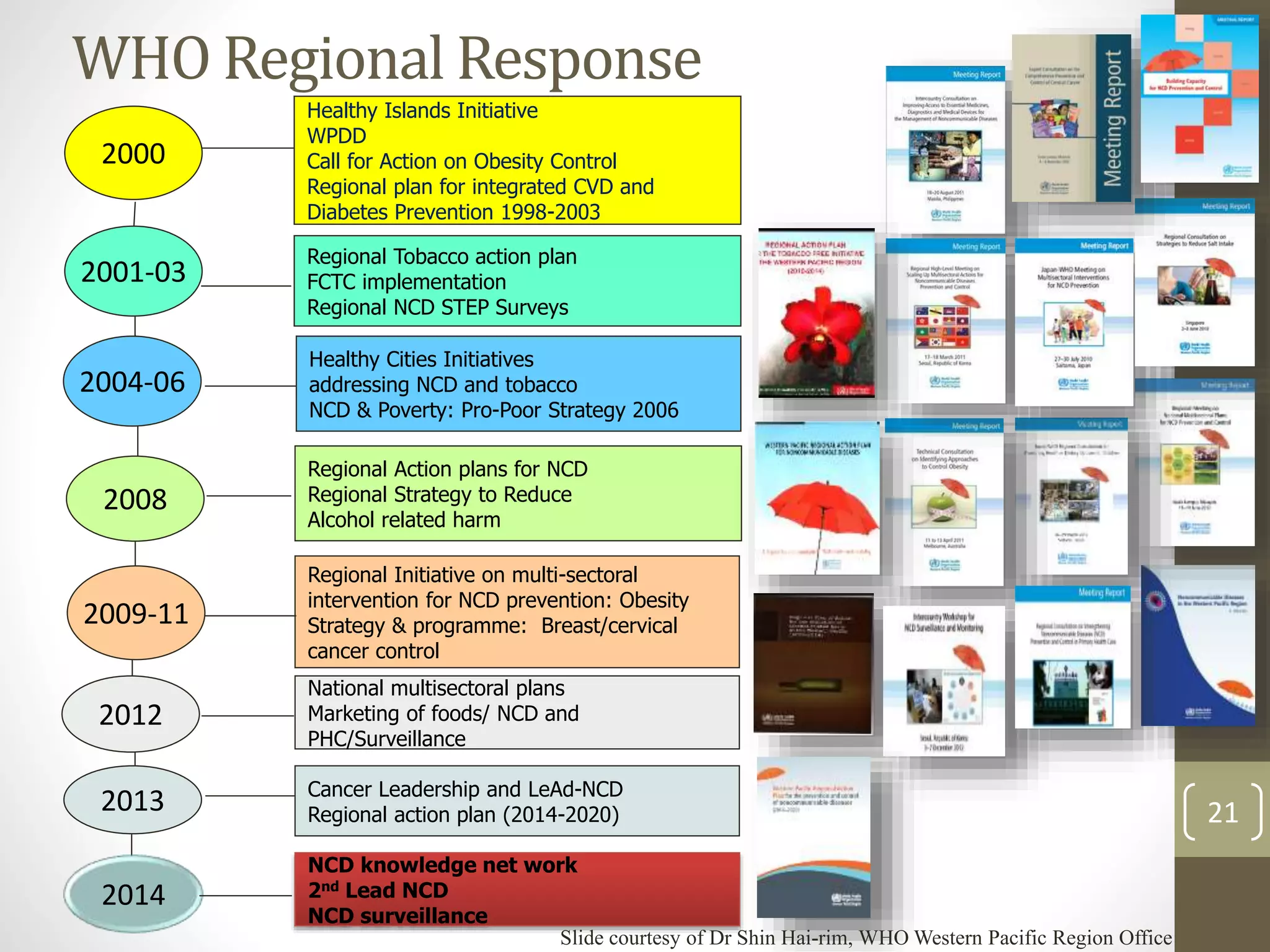
WHO Regional Response 
2000 
2001-03 
2004-06 
2008 
2009-11 
Healthy Islands Initiative 
WPDD 
Call for Action on Obesity Control 
Regional plan for integrated CVD and 
Diabetes Prevention 1998-2003 
Regional Tobacco action plan 
FCTC implementation 
Regional NCD STEP Surveys 
Healthy Cities Initiatives 
addressing NCD and tobacco 
NCD & Poverty: Pro-Poor Strategy 2006 
Regional Action plans for NCD 
Regional Strategy to Reduce 
Alcohol related harm 
Regional Initiative on multi-sectoral 
intervention for NCD prevention: Obesity 
Strategy & programme: Breast/cervical 
cancer control 
2012 
National multisectoral plans 
Marketing of foods/ NCD and 
PHC/Surveillance 
2013 Cancer Leadership and LeAd-NCD 
Regional action plan (2014-2020) 
2014 
NCD knowledge net work 
2nd Lead NCD 
NCD surveillance 
21 
Slide courtesy of Dr Shin Hai-rim, WHO Western Pacific Region Office
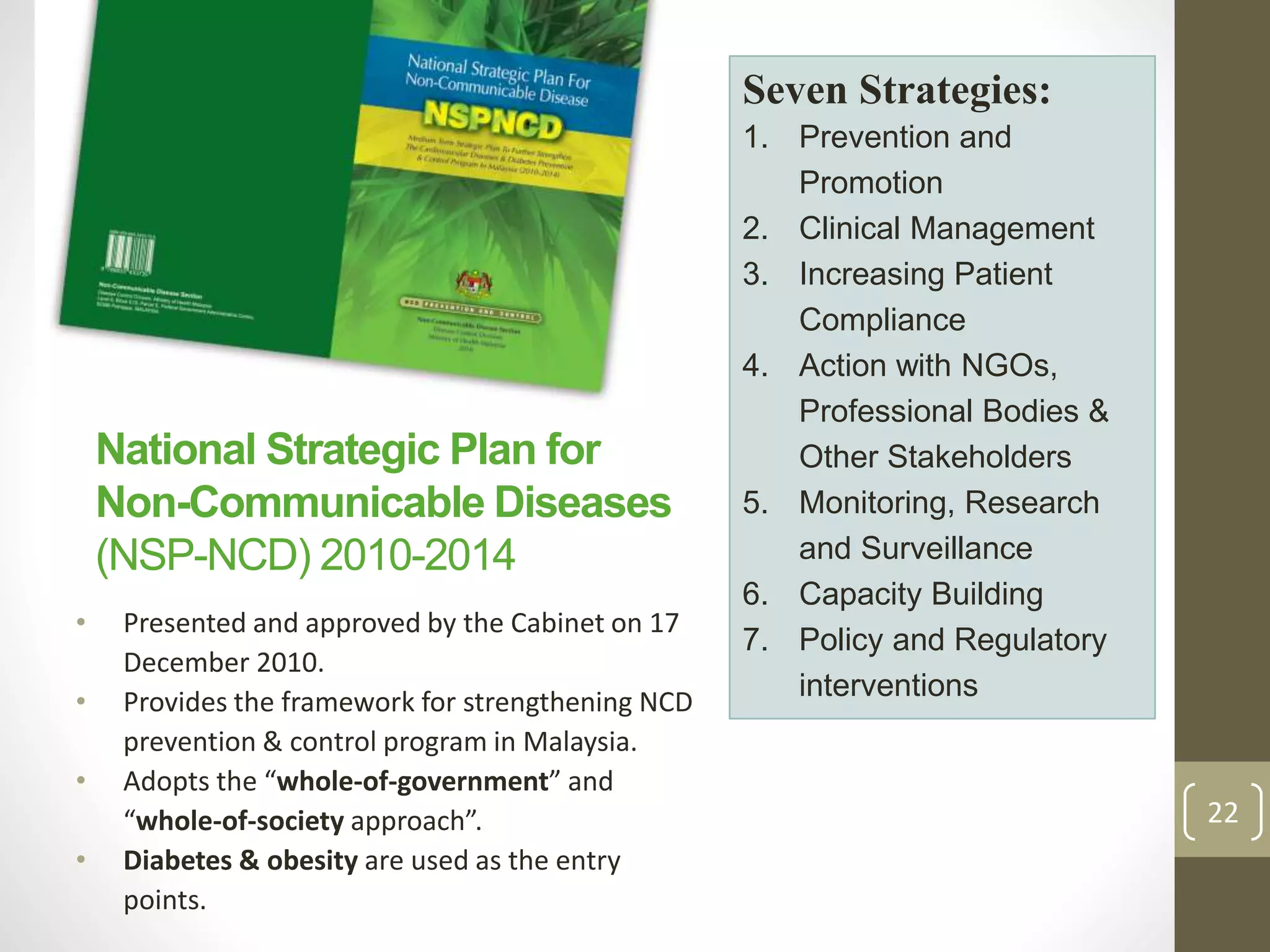
National Strategic Plan for 
Non-Communicable Diseases 
(NSP-NCD) 2010-2014 
• Presented and approved by the Cabinet on 17 
December 2010. 
• Provides the framework for strengthening NCD 
prevention & control program in Malaysia. 
• Adopts the “whole-of-government” and 
“whole-of-society approach”. 
• Diabetes & obesity are used as the entry 
points. 
Seven Strategies: 
1. Prevention and 
Promotion 
2. Clinical Management 
3. Increasing Patient 
Compliance 
4. Action with NGOs, 
Professional Bodies & 
Other Stakeholders 
5. Monitoring, Research 
and Surveillance 
6. Capacity Building 
7. Policy and Regulatory 
interventions 
22
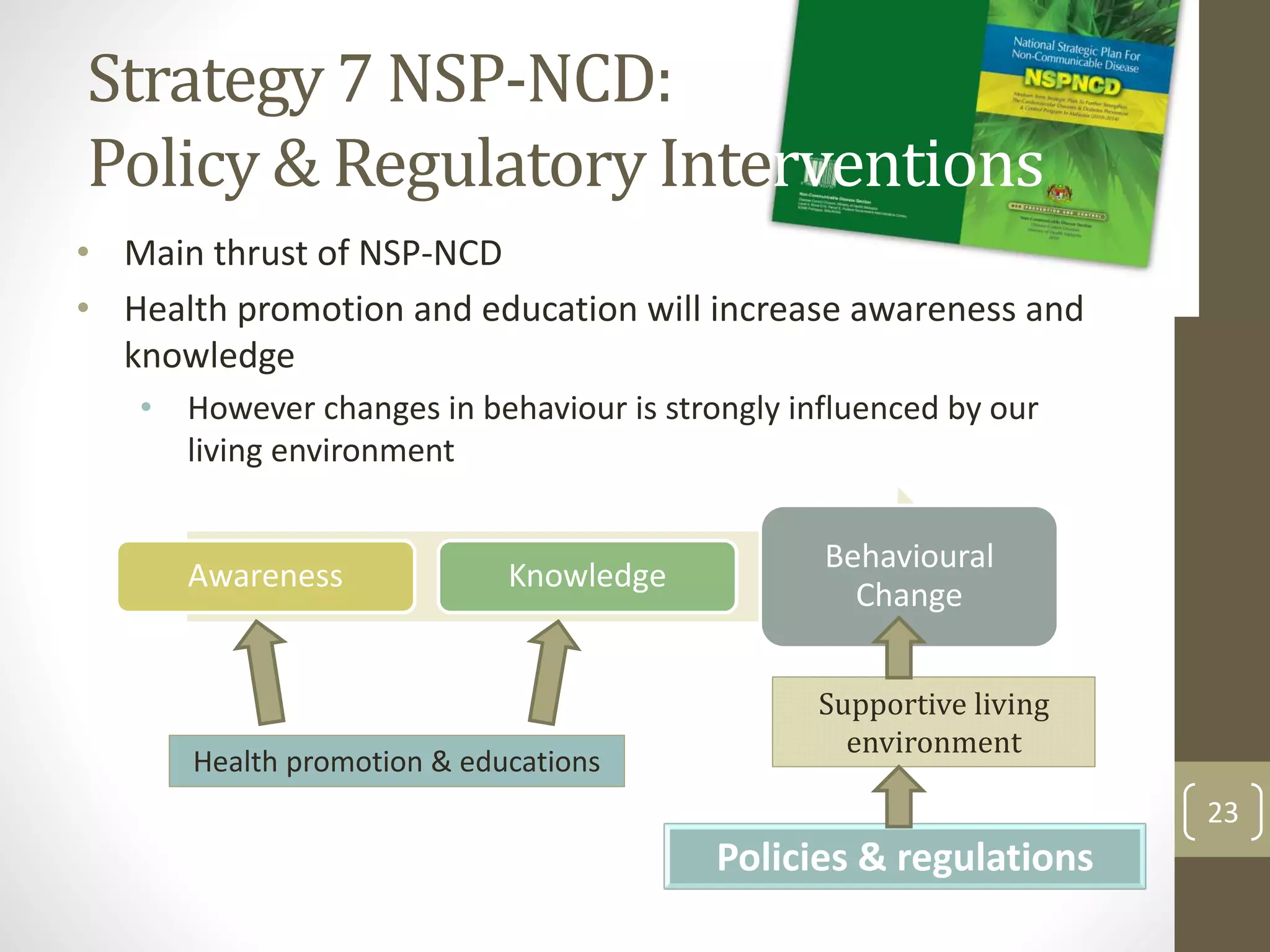
Strategy 7 NSP-NCD: 
Policy & Regulatory Interventions 
• Main thrust of NSP-NCD 
• Health promotion and education will increase awareness and 
knowledge 
• However changes in behaviour is strongly influenced by our 
living environment 
Awareness Knowledge 
Behavioural 
Change 
Supportive living 
environment 
Health promotion & educations 
Policies & regulations 
23
24
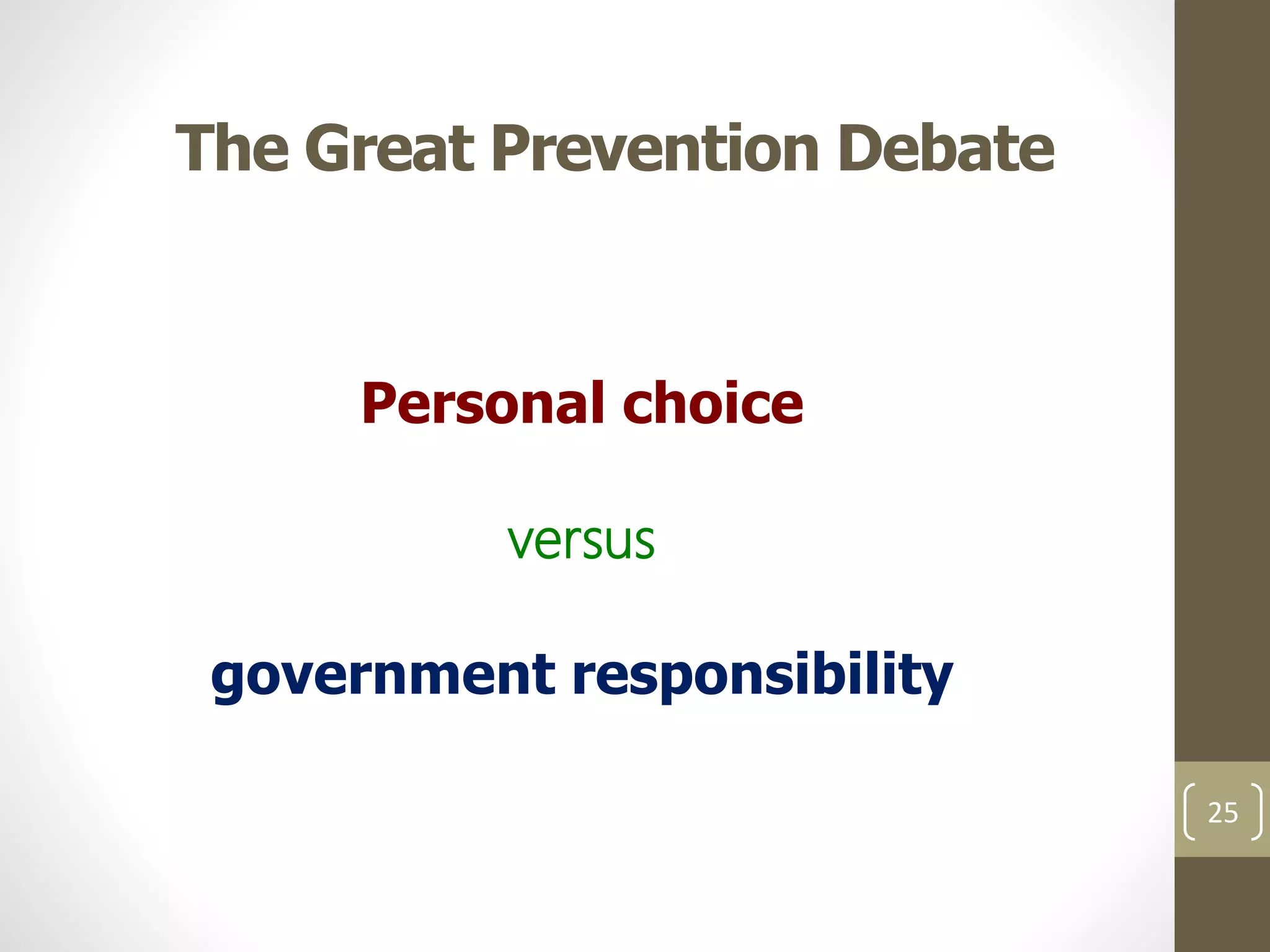
The Great Prevention Debate 
Personal choice 
versus 
government responsibility 
25
Personal Choice is Important 
26
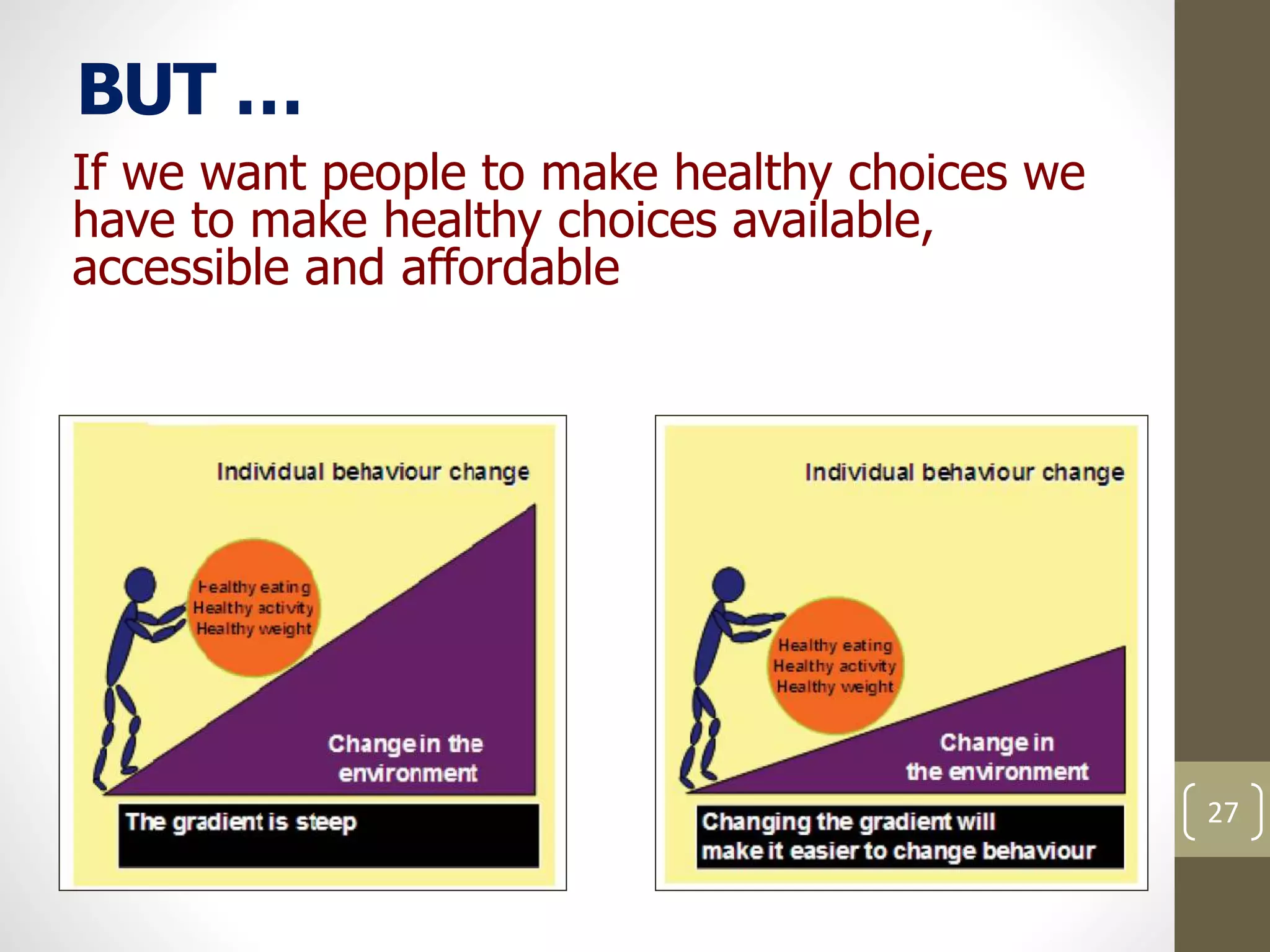
BUT … 
If we want people to make healthy choices we 
have to make healthy choices available, 
accessible and affordable 
27
Prevention is BOTH a personal and 
government responsibility 
28
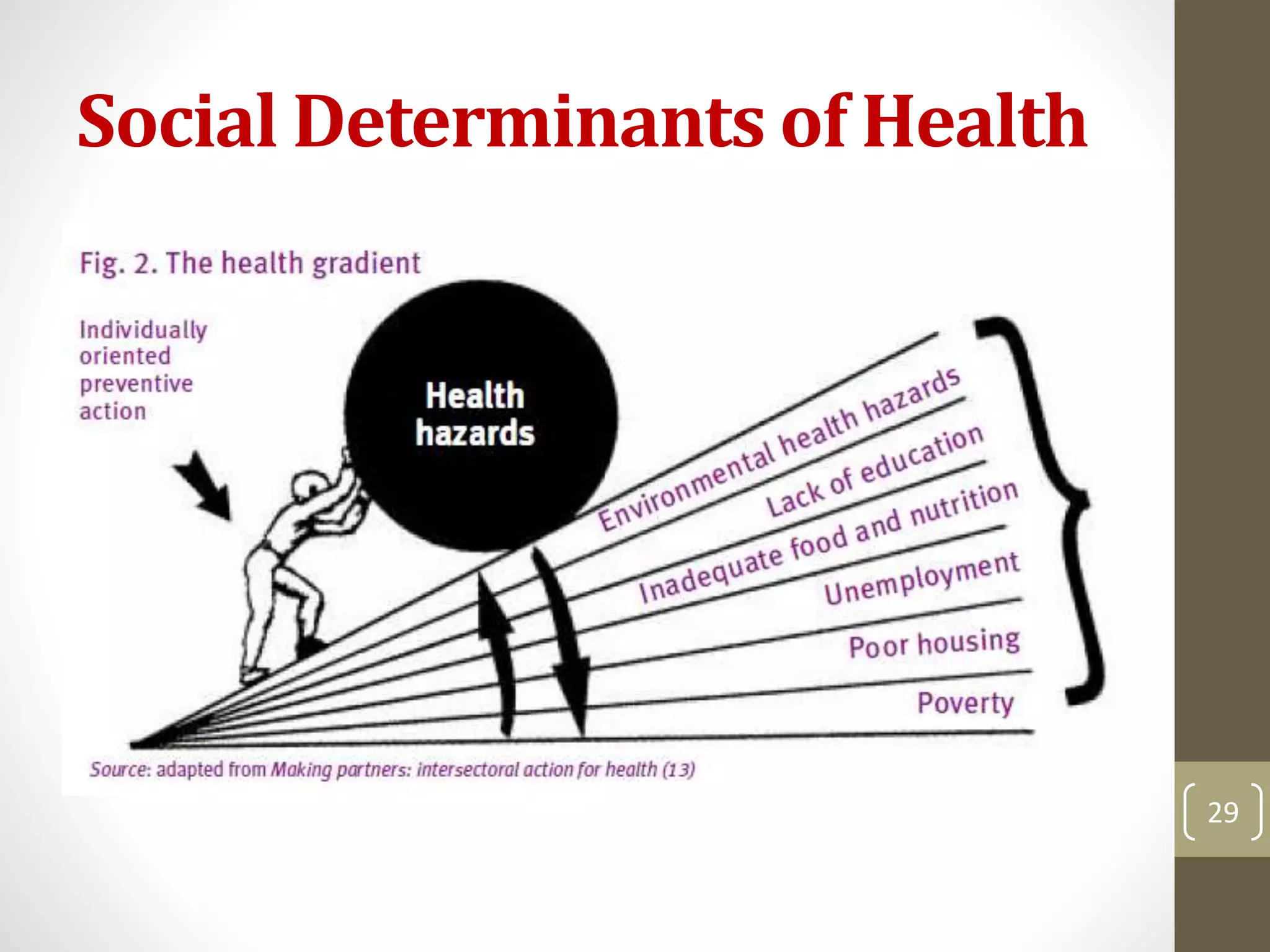
Social Determinants of Health 
29
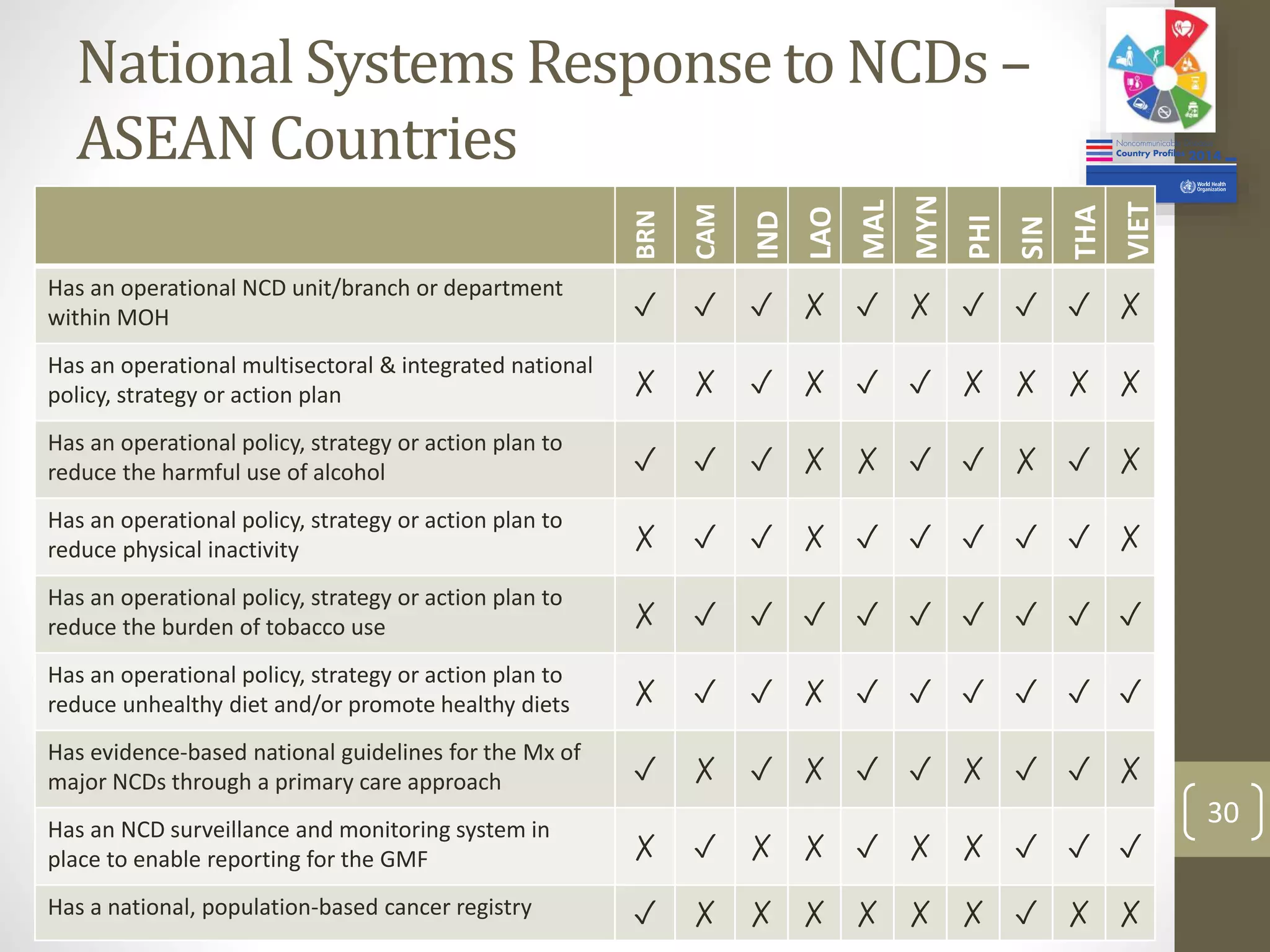
National Systems Response to NCDs – 
ASEAN Countries 
BRN 
CAM 
IND 
LAO 
MAL 
MYN 
PHI 
SIN 
THA 
VIET 
Has an operational NCD unit/branch or department 
within MOH ✓ ✓ ✓ ✗ ✓ ✗ ✓ ✓ ✓ ✗ 
Has an operational multisectoral & integrated national 
policy, strategy or action plan ✗ ✗ ✓ ✗ ✓ ✓ ✗ ✗ ✗ ✗ 
Has an operational policy, strategy or action plan to 
reduce the harmful use of alcohol ✓ ✓ ✓ ✗ ✗ ✓ ✓ ✗ ✓ ✗ 
Has an operational policy, strategy or action plan to 
reduce physical inactivity ✗ ✓ ✓ ✗ ✓ ✓ ✓ ✓ ✓ ✗ 
Has an operational policy, strategy or action plan to 
reduce the burden of tobacco use ✗ ✓ ✓ ✓ ✓ ✓ ✓ ✓ ✓ ✓ 
Has an operational policy, strategy or action plan to 
reduce unhealthy diet and/or promote healthy diets ✗ ✓ ✓ ✗ ✓ ✓ ✓ ✓ ✓ ✓ 
Has evidence-based national guidelines for the Mx of 
major NCDs through a primary care approach ✓ ✗ ✓ ✗ ✓ ✓ ✗ ✓ ✓ ✗ 
Has an NCD surveillance and monitoring system in 
place to enable reporting for the GMF ✗ ✓ ✗ ✗ ✓ ✗ ✗ ✓ ✓ ✓ 
Has a national, population-based cancer registry ✓ ✗ ✗ ✗ ✗ ✗ ✗ ✓ ✗ ✗ 
30
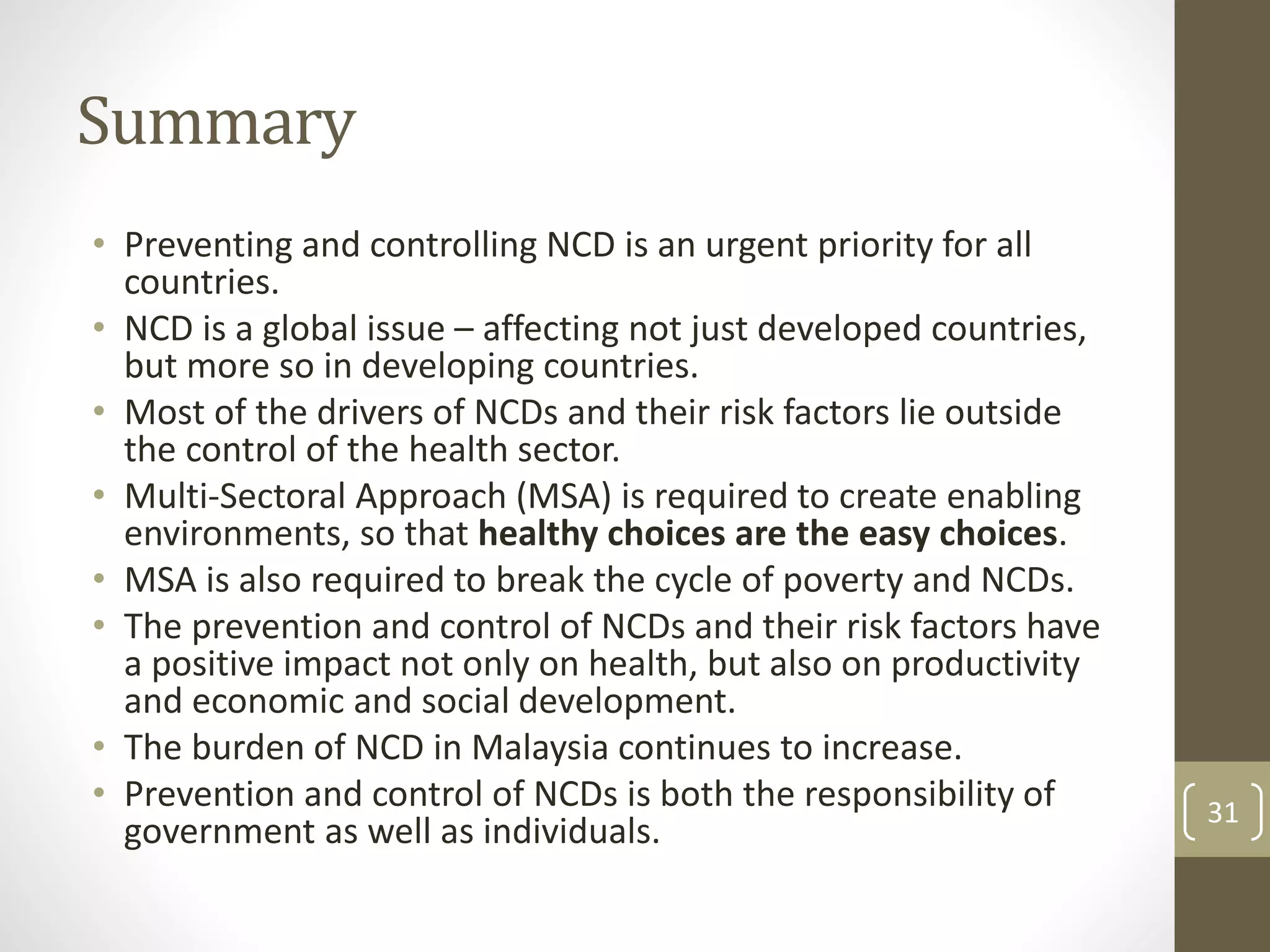
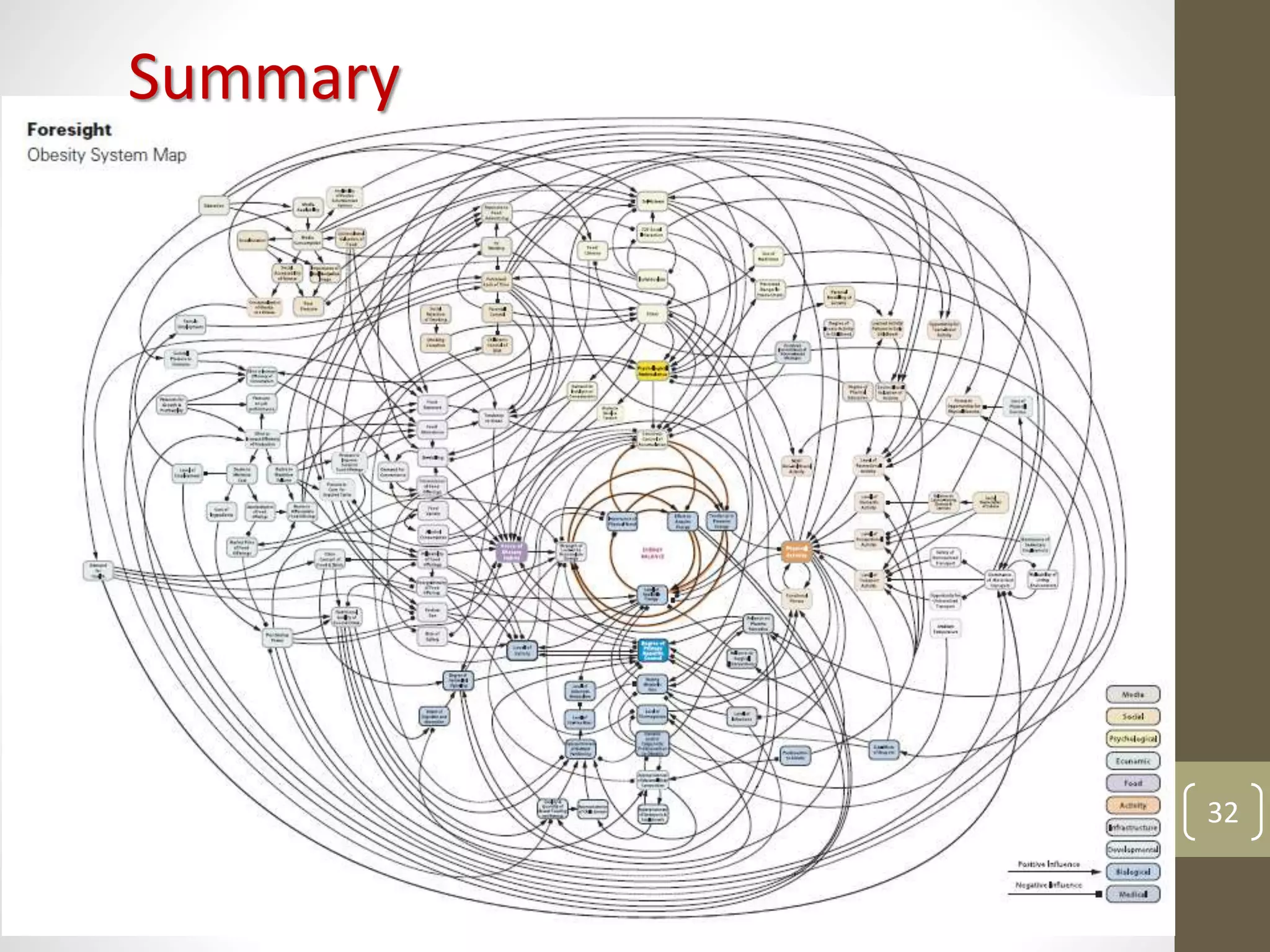
Summary 
• Preventing and controlling NCD is an urgent priority for all 
countries. 
• NCD is a global issue – affecting not just developed countries, 
but more so in developing countries. 
• Most of the drivers of NCDs and their risk factors lie outside 
the control of the health sector. 
• Multi-Sectoral Approach (MSA) is required to create enabling 
environments, so that healthy choices are the easy choices. 
• MSA is also required to break the cycle of poverty and NCDs. 
• The prevention and control of NCDs and their risk factors have 
a positive impact not only on health, but also on productivity 
and economic and social development. 
• The burden of NCD in Malaysia continues to increase. 
• Prevention and control of NCDs is both the responsibility of 
government as well as individuals. 31
32 
Summary
Thank you 
dr.feisul@moh.gov.my 
Facebook: Feisul Mustapha 
33

Overview of Non-Communicable Diseases

  • 1.
    Ministry of Health Malaysia Overview of Non-Communicable Diseases Feisul Idzwan Mustapha MBBS, MPH, AM(M) Public Health Physician, NCD Section, Disease Control Division Ministry of Health, Malaysia LeAd-NCD-MAL Workshop 1 December 2014 Klang dr.feisul@moh.gov.my
  • 2.
    There are FourMajorGroups of Non- Communicable Diseases; Fourmajor lifestyles related risk factors Modifiable causative risk factors Tobacco use Unhealthy diets Physical inactivity Harmful use of alcohol Noncommunicable diseases Heart disease and stroke     Diabetes     Cancers     Chronic lung disease  2
  • 3.
    3 Global NCD Targets Source of icons: World Heart Federation Champion Advocates Programme
  • 4.
    Proportional mortality, Malaysia (% of total deaths, all ages, both sexes) 4
  • 5.
    Premature mortality dueto NCDs, Malaysia 5 The probability of dying between ages 30 and 70 years from the 4 main NCDs is 20%
  • 6.
    DALYs attributable torisk factors 6 Poor Water & Sanitation Underweight Physical Inactivity Alcohol High Cholesterol High BMI Diabetes Mellitus 10.7% 10.8% 8.3% 9.0% 3.1% 4.3% 5.2% 0.1% 0.7% 12.1% 10.8% 0.1% 0.7% 11.4% 5.1% 0.9% 4.3% 0.7% Tobacco High BP 15.0% 10.0% 5.0% 0.0% 5.0% 10.0% 15.0% Male Female Burden of Disease Study Malaysia 2008, slide courtesy of Dr Mohd. Azahadi Omar, Institute for Public Health
  • 7.
    Deaths attributable torisk factors Poor Water & Sanitation Underweight Alcohol Physical Inactivity High BMI High Cholesterol Diabetes Mellitus 19.4% 15.7% 7.0% 7.3% 8.5% 5.0% 2.3% 0.1% 0.2% 22.8% 0.1% 0.2% 1.2% 7.1% 8.2% 8.1% 9.1% 0.3% Tobacco High BP 25% 20% 15% 10% 5% 0% 5% 10% 15% 20% 25% Male Female Burden of Disease Study Malaysia 2008, slide courtesy of Dr Mohd. Azahadi Omar, Institute for Public Health 7
  • 8.
    Sub-analysis of NHMS2011 data • At least 15% (18 years and above) already with known NCD risk factors (diabetes, hypertension or hypercholesterolemia). • Undiagnosed high blood sugar, high blood pressure or high cholesterol: 42.1% (18 years and above). • Or, if include obesity: 48.3% (18 years and above). • Therefore our high risk and at risk population: 63.3% (18 years and above) 8
  • 9.
    9 Global NCD Targets Source of icons: World Heart Federation Champion Advocates Programme
  • 10.
  • 11.
    65th World Health Assembly (May 2012): Decided to adopt a global target of a 25% reduction in premature mortality from NCD by 2025. 66th World Health Assembly (May 2013): Adoption of the Global Action plan for the Prevention and Control of NCDs (2013-2020), including 25 NCD indicators with 9 voluntary global targets. 11
  • 12.
    Outcome Document ofthe 2014 UN General Assembly High-level Meeting on NCDs First High-level Meeting on NCDs (New York, 19-20 September 2011) 2011 Second high-level Meeting on NCDs (New York, 10-11 July 2014) to take stock of the progress made since 2011 2014 Third High-level Meeting on NCDs to report on progress achieved since 2014 2018 12 Slide courtesy of Dr Shin Hai-rim, WHO Western Pacific Region Office
  • 13.
    2014 UN OutcomeDocument on NCDs (resolution A/RES/68/300) • Bottom line: Governments committed themselves to intensify their efforts towards a world free of the avoidable burden of NCDs • Moving forward: Maps out a set of concrete national commitments to be implemented between 2014 and 2018, and provides 3 new global assignments • Towards the world we want: Next milestone in 2018 13 Slide courtesy of Dr Shin Hai-rim, WHO Western Pacific Region Office
  • 14.
    National commitments includedin the 2014 UN Outcome Document on NCDs By 2015, consider setting national targets for NCDs By 2015, consider developing national multisectoral policies and plans Integrate NCDs into health-planning and national development plans By 2016, implement "best buys" to reduce risk factors for NCDs By 2016, implement "best buys" to enable health systems to respond Strengthen national surveillance systems 14 Slide courtesy of Dr Shin Hai-rim, WHO Western Pacific Region Office
  • 15.
    Global assignments includedin the 2014 UN Outcome Document on NCDs By 2015, WHO to develop an approach to register and publish contributions of non-State actors towards the 9 global NCD targets WHA68: Framework for country action to mobilize sectors beyond health OECD/DAC: Purpose code to track development assistance for NCDs By 2017, WHO to submit a progress report to UN General Assembly By 2018, UN General Assembly to convene a third High-level Meeting 15 Slide courtesy of Dr Shin Hai-rim, WHO Western Pacific Region Office
  • 16.
    Global accountability frameworkfor NCDs: Milestones during the next three years • WHO publishes global baseline • WHO conducts third survey on national capacities • WHO generates data 2015 • Progress report to WHA on 25 outcome indicators • Progress report to WHA on 9 progress indicators 2016 • Independent evaluation (Global Action Plan) • Progress report to the UN General Assembly 2017 16 Slide courtesy of Dr Shin Hai-rim, WHO Western Pacific Region Office
  • 17.
    NCDs in thepost-2015 development agenda: Towards the world we want • 10 September 2014: Member States welcomed the report of the Open Working Group of the UN General Assembly on Sustainable Development Goals • Next 12 months: Proposal shall be the main basis for integrating sustainable development goals into the post-2015 development agenda • Target 3.4: By 2030 reduce by one-third pre-mature mortality from NCDs through prevention and treatment, and promote mental health and well-being 17 Slide courtesy of Dr Shin Hai-rim, WHO Western Pacific Region Office
  • 18.
  • 19.
    Cost effective interventionsto address NCDs Population-based interventions addressing NCD risk factors Tobacco use - Excise tax increases - Smoke-free indoor workplaces and public places - Health information and warnings about tobacco - Bans on advertising and promotion Harmful use of alcohol - Excise tax increases on alcoholic beverages - Comprehensive restrictions and bans on alcohol marketing - Restrictions on the availability of retailed alcohol Unhealthy diet and physical inactivity - Salt reduction through mass media campaigns and reduced salt content in processed foods - Replacement of trans-fats with polyunsaturated fats - Public awareness programme about diet and physical activity Individual-based interventions addressing NCDs in primary care Cancer - Prevention of liver cancer through hepatitis B immunization - Prevention of cervical cancer through screening (visual inspection with acetic acid [VIA]) and treatment of pre-cancerous lesions CVD and diabetes - Multi-drug therapy (including glycaemic control for diabetes mellitus) for individuals who have had a heart attack or stroke, and to persons at high risk (> 30%) of a cardiovascular event within 10 years - Providing aspirin to people having an acute heart attack 19
  • 20.
    Cost effective NCDinterventions… • What works, what can we afford, and what should we adopt? • The challenge? Identify interventions that: • are effective; • can lead to measurable declines in NCD death rates quickly (e.g. over 10 years); • are affordable; and • can easily be implemented and sustained. The Lancet. December 8, 2007 Volume 370: Gaziano T, Galea G and Reddy K. Scaling up interventions for chronic disease prevention: the evidence. pp 1939-1946. The Lancet. December 15, 2007. Volume 370: Asaria P, Crisholm D, Mathers C, Ezzati M, Beaglehole R. Chronic disease prevention: health effects and financial costs of strategies to reduce salt intake and control tobacco use. pp 2044-2053. Lim S, et. al. Prevention of cardiovascular disease in high-risk individuals in low-income and middle-income countries: health effects and costs. pp 2054-2061. 20
  • 21.
    WHO Regional Response 2000 2001-03 2004-06 2008 2009-11 Healthy Islands Initiative WPDD Call for Action on Obesity Control Regional plan for integrated CVD and Diabetes Prevention 1998-2003 Regional Tobacco action plan FCTC implementation Regional NCD STEP Surveys Healthy Cities Initiatives addressing NCD and tobacco NCD & Poverty: Pro-Poor Strategy 2006 Regional Action plans for NCD Regional Strategy to Reduce Alcohol related harm Regional Initiative on multi-sectoral intervention for NCD prevention: Obesity Strategy & programme: Breast/cervical cancer control 2012 National multisectoral plans Marketing of foods/ NCD and PHC/Surveillance 2013 Cancer Leadership and LeAd-NCD Regional action plan (2014-2020) 2014 NCD knowledge net work 2nd Lead NCD NCD surveillance 21 Slide courtesy of Dr Shin Hai-rim, WHO Western Pacific Region Office
  • 22.
    National Strategic Planfor Non-Communicable Diseases (NSP-NCD) 2010-2014 • Presented and approved by the Cabinet on 17 December 2010. • Provides the framework for strengthening NCD prevention & control program in Malaysia. • Adopts the “whole-of-government” and “whole-of-society approach”. • Diabetes & obesity are used as the entry points. Seven Strategies: 1. Prevention and Promotion 2. Clinical Management 3. Increasing Patient Compliance 4. Action with NGOs, Professional Bodies & Other Stakeholders 5. Monitoring, Research and Surveillance 6. Capacity Building 7. Policy and Regulatory interventions 22
  • 23.
    Strategy 7 NSP-NCD: Policy & Regulatory Interventions • Main thrust of NSP-NCD • Health promotion and education will increase awareness and knowledge • However changes in behaviour is strongly influenced by our living environment Awareness Knowledge Behavioural Change Supportive living environment Health promotion & educations Policies & regulations 23
  • 24.
  • 25.
    The Great PreventionDebate Personal choice versus government responsibility 25
  • 26.
    Personal Choice isImportant 26
  • 27.
    BUT … Ifwe want people to make healthy choices we have to make healthy choices available, accessible and affordable 27
  • 28.
    Prevention is BOTHa personal and government responsibility 28
  • 29.
  • 30.
    National Systems Responseto NCDs – ASEAN Countries BRN CAM IND LAO MAL MYN PHI SIN THA VIET Has an operational NCD unit/branch or department within MOH ✓ ✓ ✓ ✗ ✓ ✗ ✓ ✓ ✓ ✗ Has an operational multisectoral & integrated national policy, strategy or action plan ✗ ✗ ✓ ✗ ✓ ✓ ✗ ✗ ✗ ✗ Has an operational policy, strategy or action plan to reduce the harmful use of alcohol ✓ ✓ ✓ ✗ ✗ ✓ ✓ ✗ ✓ ✗ Has an operational policy, strategy or action plan to reduce physical inactivity ✗ ✓ ✓ ✗ ✓ ✓ ✓ ✓ ✓ ✗ Has an operational policy, strategy or action plan to reduce the burden of tobacco use ✗ ✓ ✓ ✓ ✓ ✓ ✓ ✓ ✓ ✓ Has an operational policy, strategy or action plan to reduce unhealthy diet and/or promote healthy diets ✗ ✓ ✓ ✗ ✓ ✓ ✓ ✓ ✓ ✓ Has evidence-based national guidelines for the Mx of major NCDs through a primary care approach ✓ ✗ ✓ ✗ ✓ ✓ ✗ ✓ ✓ ✗ Has an NCD surveillance and monitoring system in place to enable reporting for the GMF ✗ ✓ ✗ ✗ ✓ ✗ ✗ ✓ ✓ ✓ Has a national, population-based cancer registry ✓ ✗ ✗ ✗ ✗ ✗ ✗ ✓ ✗ ✗ 30
  • 31.
    Summary • Preventingand controlling NCD is an urgent priority for all countries. • NCD is a global issue – affecting not just developed countries, but more so in developing countries. • Most of the drivers of NCDs and their risk factors lie outside the control of the health sector. • Multi-Sectoral Approach (MSA) is required to create enabling environments, so that healthy choices are the easy choices. • MSA is also required to break the cycle of poverty and NCDs. • The prevention and control of NCDs and their risk factors have a positive impact not only on health, but also on productivity and economic and social development. • The burden of NCD in Malaysia continues to increase. • Prevention and control of NCDs is both the responsibility of government as well as individuals. 31
  • 32.
  • 33.
    Thank you dr.feisul@moh.gov.my Facebook: Feisul Mustapha 33