Surveillance of the risk factors
for non-communicable diseases (NCDs)
IDSP training module for state and
district surveillance officers
Module 14
Learning objectives (1/2)
• Describe the importance and the need for
surveillance of risk factors for non
communicable diseases
• Enumerate the differences between
surveillance for communicable diseases and
risk factors for non communicable diseases
• List non communicable disease risk factors
under surveillance
Learning objectives (1/2)
• List steps involved in organization and
conduct of surveillance of risk factors for
non communicable diseases
• Describe the role of the district surveillance
officer in surveillance of risk factors for non
communicable diseases
Communicable versus
non-communicable diseases
Communicable diseases
• Sudden onset
• Single cause
• Short natural history
• Short treatment schedule
• Cure is achieved
• Single discipline
• Short follow up
• Back to normalcy
Non-communicable diseases
• Gradual onset
• Multiple causes
• Long natural history
• Prolonged treatment
• Care predominates
• Multidisciplinary
• Prolonged follow up
• Quality of life after
treatment
Social Determinants of Health Inequalities, Marmot M, Lancet 2005
Projected proportional increase in
population > 65 years age, 2000-2030
0% 50% 100% 150% 200% 250%
Mexico
Chile
India
China
USA
UK
Japan
Italy
Proportion (%)
Projected population pyramid of India
Estimated and projected proportion of
deaths due to non-communicable
diseases, India, 1990-2010
0%
10%
20%
30%
40%
50%
60%
70%
80%
90%
100%
1990 2000 2010
Year
Proportion
(%)
Injuries
Communicable diseases
Non communicable diseases
Source : World Bank Health Sectorial Priorities Review
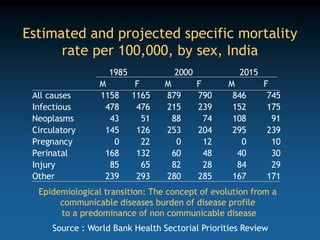
Estimated and projected specific mortality
rate per 100,000, by sex, India
1985 2000 2015
M F M F M F
All causes 1158 1165 879 790 846 745
Infectious 478 476 215 239 152 175
Neoplasms 43 51 88 74 108 91
Circulatory 145 126 253 204 295 239
Pregnancy 0 22 0 12 0 10
Perinatal 168 132 60 48 40 30
Injury 85 65 82 28 84 29
Other 239 293 280 285 167 171
Epidemiological transition: The concept of evolution from a
communicable diseases burden of disease profile
to a predominance of non communicable disease
Ischemic heart diseases Stroke
Diabetes
Burden of major non-communicable
diseases, India, 2004
Non communicable disease
programmes in India
A. National cancer control programme
B. National mental health programme
C. National blindness control programme
D. Cardiovascular diseases, stroke and diabetes
programme
E. Trauma and accident programme
F. Oral health programme
G. Rehabilitation programme
H. Geriatric care programme
Existing reporting systems for non
communicable diseases in India
• Sentinel surveillance systems
 National Cancer Registry Programme
• Periodic surveys/studies
 Census of India
 Sample registration systems
 National sample surveys
 National family health survey
 National nutrition monitoring programme
Sources of data collection for non
communicable diseases in India
• Mortality data
 Medical certificates for death
 Cause of death surveys
 Hospital records
• Morbidity data
 Registry (Cancer)
 Special surveys
 Hospital reports
• Risk factors
 Special surveys
• Registries
 Cancer (Shift from hospital to community based)
 RF/RHD (Jai Vigyan Mission)
 Thalasemia (Jai Vigyan Mission)
Countries Tobacco control Cardio
vascular
diseases
Cancer Diabetes Integrated
control
Bangladesh 1982 1978
Bhutan
DPR Korea 2000 2000
India 2000 1975
Indonesia 1989 1995
Maldives 2001
Myanmar 1982 1982 1996 1993
Nepal 1999 1998
Sri Lanka 1999 2000 2000
Thailand 1988 1988 1988 1988 1993
Source:Non-Communicable Diseases in South-East Asia Region, A Profile, WHO, 2002
Implementation of non communicable
diseases programmes in countries of the
WHO South East Asia region
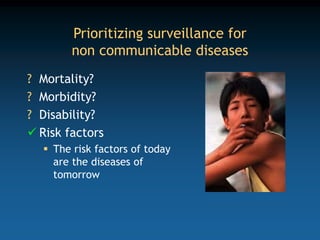
Prioritizing surveillance for
non communicable diseases
? Mortality?
? Morbidity?
? Disability?
 Risk factors
 The risk factors of today
are the diseases of
tomorrow
Age
Foetal
life
Adult Life
Adolescence
Infancy and
childhood
•SES
•Nutrition
•Diseases
•Linear
growth
•Obesity
•Obesity
•Lack of
activity
•Diet
•Alcohol,
•Smoking
•SE potential
•Established adult risk factors
(behavioural/biological)
•SES
•Maternal
nutritional
status &
obesity,
•Fetal
growth
Accumulated
risk
Range of
individual
risk
Accumulated
risk
Life course approach for the prevention
of non communicable diseases
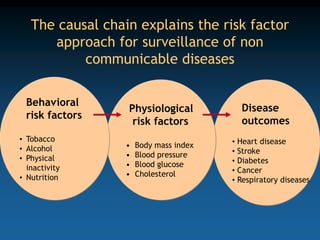
Disease
outcomes
• Heart disease
• Stroke
• Diabetes
• Cancer
• Respiratory diseases
Physiological
risk factors
• Body mass index
• Blood pressure
• Blood glucose
• Cholesterol
Behavioral
risk factors
• Tobacco
• Alcohol
• Physical
inactivity
• Nutrition
The causal chain explains the risk factor
approach for surveillance of non
communicable diseases
Rationale of the risk factor approach for
non communicable diseases
• Non communicable diseases are slowly evolving
 Early recognition difficult
• A number of risk factors influence one or more non
communicable diseases
• Risk factors have the greatest impact on non
communicable diseases mortality and morbidity
• Effective modification of risk factors is possible
through primary prevention
• Projections may be used to estimate burden
• Simple surveillance systems can be used
• Measurements standardized and validated and
obtainable within ethical limits
Step 3
(Biological)
Complexity
Step 2
(Physical)
Step 1
(Verbal)
Core
Expanded
Optional
At each step
The WHO STEPwise approach to
surveillance of non-communicable
disease risk factors
Sequential approach, step by step
Kerala
Delhi
Jammu &
Kashmir
Nagaland
Bihar
High literacy rate, developed
Metropolitan city, highly
urbanized, heterogeneous
population
Nested population
Terrain, relatively
underdeveloped
Nested population
Underdeveloped, Tribes and
Terrain
Illiterate, Poor population
Rural, Agricultural, Tribals
Different
dietary
patterns
Different
body
composition
Different
habits
Heterogeneity of non-communicable
risk factors in India
Risk factors under surveillance
• Tobacco use
• Alcohol consumption
• Raised blood pressure
 Systolic and diastolic
• Obesity
 Height, weight, body mass index, waist circumference
• Diet
 Low fruit, high fat, added salt to served food
• Physical inactivity
• Diabetes mellitus
 Fasting plasma glucose
• High serum cholesterol
How surveillance for non-communicable
diseases differs
• Surveillance methods:
 Estimating the prevalence of risk factors
 Periodic sample surveys in each state every five
years
• Data generated:
 Prevalence of risk factors and unhealthy life style
 Time trends
 Geographical distribution
 Distribution among various populations
Type and frequency of surveys
• Periodic sample surveys conducted in states
once in five years
• 20% of districts surveyed each year
• Whole population covered in 5 years
• Survey conducted every year in randomly
selected districts in a five-year cycle
Organization of the surveys
• Practical implementation
 Institution with sufficient epidemiological
capacity
 Best bidders
• Coordination and supervision
 State directorate of public health
 State surveillance unit
 District surveillance unit
Target population for survey
• Population of 15 years to 64 years.
• 10-year age groups
 15-24
 25-34
 35-44
 45-54
 55-64
• Sampling technique
 National Family Health Survey
• Cluster sample survey
Sample size
• 2500 persons across the 15-64 years age
range
 250 participants in each 10-years age group
• Two strata
 2500 individuals in urban area
 2500 individuals from rural area
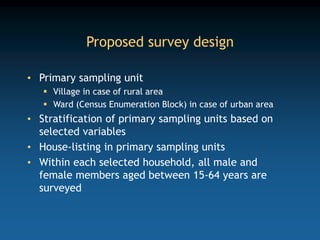
Proposed survey design
• Primary sampling unit
 Village in case of rural area
 Ward (Census Enumeration Block) in case of urban area
• Stratification of primary sampling units based on
selected variables
• House-listing in primary sampling units
• Within each selected household, all male and
female members aged between 15-64 years are
surveyed
Survey instrument
• A pre-tested simple questionnaire
• Developed on the basis of the WHO (STEPS)
• Modified for the Indian context
• Already in use for sentinel surveillance for
cardiovascular risk factors in 10 selected
industrial populations all over India
Information collection
• Questionnaire
• Measurement
 Height
 Weight
 Blood pressure
• Biochemical results
 Fasting blood glucose
 Serum cholesterol
Step 1: Individual questionnaire (1/2)
• Baseline demography
 Identification, age, sex, education, occupation
• Alcohol consumption
 Current drinkers, frequency, quantity
• Tobacco (Smoking and smokeless)
 Age at initiation, usage, cessation
Step 1: Individual questionnaire (2/2)
• Diet, fruits and vegetables
 In a typical week, frequency and quantity
• Physical activity
 At work, transportation and leisure
• History of diagnosis and treatment
 Hypertension and diabetes
Data collection instrument and analysis
• Computer friendly data collection
instrument
• Easy data entry
• Automated data analysis through programme
• Generation of information on trends and
patterns of non communicable disease risk
factors
Findings and their uses
• Information generated on non communicable
disease risk factors:
 Trends
 Prevalence in various areas
 Distribution in the populations
• Uses:
 Document the need for prevention and control
programmes in the community
 Influence policy makers
 Guide financial allocation
Ensuring validity
• Maximize response fraction
• Use valid and reliable instruments
• Calibrate instruments
• Train staff
• Ensure participation of individuals selected
 Reduces the probability that those who do attend are
unrepresentative of the sample
• Engage district surveillance officer and other health
personnel
• Use existing local public health infrastructure
Role of the district public health
laboratories
• Conduct tests:
 Blood sugar
 Cholesterol
• Co-ordinate collection, transport and receipt
of the samples from the periphery
• Plan capacity to carry out analyses quickly
• Ensure quality control of biochemical assays
 Key factor to ensure useful results
Quality assurance
• Common protocol
• Standardized training
• Standardized survey methods
• Monitoring and coordinating set ups
• Advisory group and resources
• Site visits
• Common data management mechanisms
• Critical appraisal
Ethical considerations
• Questionnaires dealing with lifestyle issues and
simple non-invasive measurements
 Verbal consent
• Blood pressure
 Need to clarify whether persons with elevated readings
would be followed up and treatment provided
 Written consent needed
• Collection of blood
 Requires prior ethical clearance
 Built-in plans for treatment of those with raised levels
• Built-in consent form in the questionnaire
Promise to care
• Referral, diagnostic and treatment support
to persons identified with non communicable
disease risk factor will be built into the
system
• Patients identified with hypertension,
diabetes will be referred to the next level
for treatment
Timing of the survey
• Physiological and cultural considerations
• Overnight fasting needed
 Start early in the morning (6:00 am)
 Finish early in the afternoon (1:00 pm)
• Rest of the day
 Coding forms
 Dealing with the laboratory specimens and other
documentation
 Preparations for the next day
Follow up action
• Coordinated approach for community level
interventions
• Partnerships
 Medical colleges, state health departments,
primary health care services and non-
governmental organisations
• Dissemination of health education material
on causes, prevention and incentives to
enhance public awareness
Truncate high risk end of
exposure distribution (e.g.,
organize an obesity clinic).
Clinical approach to disease
prevention
Reduce a small amount of risk in a
large number of people (e.g., reduce
fat a little in fast-food outlets).
Lifestyle change plus environmental
approach
High risk and population approaches to
prevention
More burden from a large proportion of the population exposed to moderate
risk factors than from a small segment exposed to a high risk factor
Intervention strategies
• Population based strategy
 Prevent non-communicable diseases in the whole
population
• High-risk strategy
 Target people with identified risk factors
Public health interventions
Policy interventions Educational interventions
Health beliefs and behaviours
(Community; Individual)
Desired change
Enabling environment
(Financial, Social, Physical)
Challenges
• Huge population
• Many programmes
• Rural population
• Emerging epidemics
• Unemployed youth
• Burden of non
communicable diseases
Opportunity
• Good sample size
• Different strategies
• Complex exposures
• Interventions
• Trained workforce
• Feasible intervention
Challenges and opportunities
Points to remember (1/3)
• The burden of diseases due to non communicable
diseases in India became almost equal to that due
to communicable diseases in 1990
• The burden of non communicable diseases is
increasing while it is declining in developed
countries because of surveillance and interventions
• The life style related modifiable risk factors for
non communicable diseases have been identified
and the magnitude of their impact is documented
Points to remember (2/3)
• The major non communicable diseases share
common, preventable life style risk factors
• There is sound evidence that non
communicable diseases can be reduced
through a package of simple, effective and
feasible life style changes
• The treatment of non communicable
diseases is expensive and therefore the key
to control is in its primary prevention
Points to remember (3/3)
• Non communicable diseases surveillance is therefore
considered an important component of the
integrated disease surveillance project
• Non communicable diseases surveillance will be
done by periodic surveys of selected risk factors and
will be independent of regular surveillance for other
conditions
• The Non communicable disease risk factors to be
measured in include: tobacco use, alcohol
consumption, high blood pressure, obesity, diet,
physical inactivity, fasting plasma glucose and serum
cholesterol

Mod14NCDSur.ppt

  • 1.
    Surveillance of therisk factors for non-communicable diseases (NCDs) IDSP training module for state and district surveillance officers Module 14
  • 2.
    Learning objectives (1/2) •Describe the importance and the need for surveillance of risk factors for non communicable diseases • Enumerate the differences between surveillance for communicable diseases and risk factors for non communicable diseases • List non communicable disease risk factors under surveillance
  • 3.
    Learning objectives (1/2) •List steps involved in organization and conduct of surveillance of risk factors for non communicable diseases • Describe the role of the district surveillance officer in surveillance of risk factors for non communicable diseases
  • 4.
    Communicable versus non-communicable diseases Communicablediseases • Sudden onset • Single cause • Short natural history • Short treatment schedule • Cure is achieved • Single discipline • Short follow up • Back to normalcy Non-communicable diseases • Gradual onset • Multiple causes • Long natural history • Prolonged treatment • Care predominates • Multidisciplinary • Prolonged follow up • Quality of life after treatment
  • 5.
    Social Determinants ofHealth Inequalities, Marmot M, Lancet 2005 Projected proportional increase in population > 65 years age, 2000-2030 0% 50% 100% 150% 200% 250% Mexico Chile India China USA UK Japan Italy Proportion (%)
  • 6.
  • 7.
    Estimated and projectedproportion of deaths due to non-communicable diseases, India, 1990-2010 0% 10% 20% 30% 40% 50% 60% 70% 80% 90% 100% 1990 2000 2010 Year Proportion (%) Injuries Communicable diseases Non communicable diseases
  • 8.
    Source : WorldBank Health Sectorial Priorities Review Estimated and projected specific mortality rate per 100,000, by sex, India 1985 2000 2015 M F M F M F All causes 1158 1165 879 790 846 745 Infectious 478 476 215 239 152 175 Neoplasms 43 51 88 74 108 91 Circulatory 145 126 253 204 295 239 Pregnancy 0 22 0 12 0 10 Perinatal 168 132 60 48 40 30 Injury 85 65 82 28 84 29 Other 239 293 280 285 167 171 Epidemiological transition: The concept of evolution from a communicable diseases burden of disease profile to a predominance of non communicable disease
  • 9.
    Ischemic heart diseasesStroke Diabetes Burden of major non-communicable diseases, India, 2004
  • 10.
    Non communicable disease programmesin India A. National cancer control programme B. National mental health programme C. National blindness control programme D. Cardiovascular diseases, stroke and diabetes programme E. Trauma and accident programme F. Oral health programme G. Rehabilitation programme H. Geriatric care programme
  • 11.
    Existing reporting systemsfor non communicable diseases in India • Sentinel surveillance systems  National Cancer Registry Programme • Periodic surveys/studies  Census of India  Sample registration systems  National sample surveys  National family health survey  National nutrition monitoring programme
  • 12.
    Sources of datacollection for non communicable diseases in India • Mortality data  Medical certificates for death  Cause of death surveys  Hospital records • Morbidity data  Registry (Cancer)  Special surveys  Hospital reports • Risk factors  Special surveys • Registries  Cancer (Shift from hospital to community based)  RF/RHD (Jai Vigyan Mission)  Thalasemia (Jai Vigyan Mission)
  • 13.
    Countries Tobacco controlCardio vascular diseases Cancer Diabetes Integrated control Bangladesh 1982 1978 Bhutan DPR Korea 2000 2000 India 2000 1975 Indonesia 1989 1995 Maldives 2001 Myanmar 1982 1982 1996 1993 Nepal 1999 1998 Sri Lanka 1999 2000 2000 Thailand 1988 1988 1988 1988 1993 Source:Non-Communicable Diseases in South-East Asia Region, A Profile, WHO, 2002 Implementation of non communicable diseases programmes in countries of the WHO South East Asia region
  • 14.
    Prioritizing surveillance for noncommunicable diseases ? Mortality? ? Morbidity? ? Disability?  Risk factors  The risk factors of today are the diseases of tomorrow
  • 15.
    Age Foetal life Adult Life Adolescence Infancy and childhood •SES •Nutrition •Diseases •Linear growth •Obesity •Obesity •Lackof activity •Diet •Alcohol, •Smoking •SE potential •Established adult risk factors (behavioural/biological) •SES •Maternal nutritional status & obesity, •Fetal growth Accumulated risk Range of individual risk Accumulated risk Life course approach for the prevention of non communicable diseases
  • 16.
    Disease outcomes • Heart disease •Stroke • Diabetes • Cancer • Respiratory diseases Physiological risk factors • Body mass index • Blood pressure • Blood glucose • Cholesterol Behavioral risk factors • Tobacco • Alcohol • Physical inactivity • Nutrition The causal chain explains the risk factor approach for surveillance of non communicable diseases
  • 17.
    Rationale of therisk factor approach for non communicable diseases • Non communicable diseases are slowly evolving  Early recognition difficult • A number of risk factors influence one or more non communicable diseases • Risk factors have the greatest impact on non communicable diseases mortality and morbidity • Effective modification of risk factors is possible through primary prevention • Projections may be used to estimate burden • Simple surveillance systems can be used • Measurements standardized and validated and obtainable within ethical limits
  • 18.
    Step 3 (Biological) Complexity Step 2 (Physical) Step1 (Verbal) Core Expanded Optional At each step The WHO STEPwise approach to surveillance of non-communicable disease risk factors Sequential approach, step by step
  • 19.
    Kerala Delhi Jammu & Kashmir Nagaland Bihar High literacyrate, developed Metropolitan city, highly urbanized, heterogeneous population Nested population Terrain, relatively underdeveloped Nested population Underdeveloped, Tribes and Terrain Illiterate, Poor population Rural, Agricultural, Tribals Different dietary patterns Different body composition Different habits Heterogeneity of non-communicable risk factors in India
  • 20.
    Risk factors undersurveillance • Tobacco use • Alcohol consumption • Raised blood pressure  Systolic and diastolic • Obesity  Height, weight, body mass index, waist circumference • Diet  Low fruit, high fat, added salt to served food • Physical inactivity • Diabetes mellitus  Fasting plasma glucose • High serum cholesterol
  • 21.
    How surveillance fornon-communicable diseases differs • Surveillance methods:  Estimating the prevalence of risk factors  Periodic sample surveys in each state every five years • Data generated:  Prevalence of risk factors and unhealthy life style  Time trends  Geographical distribution  Distribution among various populations
  • 22.
    Type and frequencyof surveys • Periodic sample surveys conducted in states once in five years • 20% of districts surveyed each year • Whole population covered in 5 years • Survey conducted every year in randomly selected districts in a five-year cycle
  • 23.
    Organization of thesurveys • Practical implementation  Institution with sufficient epidemiological capacity  Best bidders • Coordination and supervision  State directorate of public health  State surveillance unit  District surveillance unit
  • 24.
    Target population forsurvey • Population of 15 years to 64 years. • 10-year age groups  15-24  25-34  35-44  45-54  55-64 • Sampling technique  National Family Health Survey • Cluster sample survey
  • 25.
    Sample size • 2500persons across the 15-64 years age range  250 participants in each 10-years age group • Two strata  2500 individuals in urban area  2500 individuals from rural area
  • 26.
    Proposed survey design •Primary sampling unit  Village in case of rural area  Ward (Census Enumeration Block) in case of urban area • Stratification of primary sampling units based on selected variables • House-listing in primary sampling units • Within each selected household, all male and female members aged between 15-64 years are surveyed
  • 27.
    Survey instrument • Apre-tested simple questionnaire • Developed on the basis of the WHO (STEPS) • Modified for the Indian context • Already in use for sentinel surveillance for cardiovascular risk factors in 10 selected industrial populations all over India
  • 28.
    Information collection • Questionnaire •Measurement  Height  Weight  Blood pressure • Biochemical results  Fasting blood glucose  Serum cholesterol
  • 29.
    Step 1: Individualquestionnaire (1/2) • Baseline demography  Identification, age, sex, education, occupation • Alcohol consumption  Current drinkers, frequency, quantity • Tobacco (Smoking and smokeless)  Age at initiation, usage, cessation
  • 30.
    Step 1: Individualquestionnaire (2/2) • Diet, fruits and vegetables  In a typical week, frequency and quantity • Physical activity  At work, transportation and leisure • History of diagnosis and treatment  Hypertension and diabetes
  • 31.
    Data collection instrumentand analysis • Computer friendly data collection instrument • Easy data entry • Automated data analysis through programme • Generation of information on trends and patterns of non communicable disease risk factors
  • 32.
    Findings and theiruses • Information generated on non communicable disease risk factors:  Trends  Prevalence in various areas  Distribution in the populations • Uses:  Document the need for prevention and control programmes in the community  Influence policy makers  Guide financial allocation
  • 33.
    Ensuring validity • Maximizeresponse fraction • Use valid and reliable instruments • Calibrate instruments • Train staff • Ensure participation of individuals selected  Reduces the probability that those who do attend are unrepresentative of the sample • Engage district surveillance officer and other health personnel • Use existing local public health infrastructure
  • 34.
    Role of thedistrict public health laboratories • Conduct tests:  Blood sugar  Cholesterol • Co-ordinate collection, transport and receipt of the samples from the periphery • Plan capacity to carry out analyses quickly • Ensure quality control of biochemical assays  Key factor to ensure useful results
  • 35.
    Quality assurance • Commonprotocol • Standardized training • Standardized survey methods • Monitoring and coordinating set ups • Advisory group and resources • Site visits • Common data management mechanisms • Critical appraisal
  • 36.
    Ethical considerations • Questionnairesdealing with lifestyle issues and simple non-invasive measurements  Verbal consent • Blood pressure  Need to clarify whether persons with elevated readings would be followed up and treatment provided  Written consent needed • Collection of blood  Requires prior ethical clearance  Built-in plans for treatment of those with raised levels • Built-in consent form in the questionnaire
  • 37.
    Promise to care •Referral, diagnostic and treatment support to persons identified with non communicable disease risk factor will be built into the system • Patients identified with hypertension, diabetes will be referred to the next level for treatment
  • 38.
    Timing of thesurvey • Physiological and cultural considerations • Overnight fasting needed  Start early in the morning (6:00 am)  Finish early in the afternoon (1:00 pm) • Rest of the day  Coding forms  Dealing with the laboratory specimens and other documentation  Preparations for the next day
  • 39.
    Follow up action •Coordinated approach for community level interventions • Partnerships  Medical colleges, state health departments, primary health care services and non- governmental organisations • Dissemination of health education material on causes, prevention and incentives to enhance public awareness
  • 40.
    Truncate high riskend of exposure distribution (e.g., organize an obesity clinic). Clinical approach to disease prevention Reduce a small amount of risk in a large number of people (e.g., reduce fat a little in fast-food outlets). Lifestyle change plus environmental approach High risk and population approaches to prevention More burden from a large proportion of the population exposed to moderate risk factors than from a small segment exposed to a high risk factor
  • 41.
    Intervention strategies • Populationbased strategy  Prevent non-communicable diseases in the whole population • High-risk strategy  Target people with identified risk factors
  • 42.
    Public health interventions Policyinterventions Educational interventions Health beliefs and behaviours (Community; Individual) Desired change Enabling environment (Financial, Social, Physical)
  • 43.
    Challenges • Huge population •Many programmes • Rural population • Emerging epidemics • Unemployed youth • Burden of non communicable diseases Opportunity • Good sample size • Different strategies • Complex exposures • Interventions • Trained workforce • Feasible intervention Challenges and opportunities
  • 44.
    Points to remember(1/3) • The burden of diseases due to non communicable diseases in India became almost equal to that due to communicable diseases in 1990 • The burden of non communicable diseases is increasing while it is declining in developed countries because of surveillance and interventions • The life style related modifiable risk factors for non communicable diseases have been identified and the magnitude of their impact is documented
  • 45.
    Points to remember(2/3) • The major non communicable diseases share common, preventable life style risk factors • There is sound evidence that non communicable diseases can be reduced through a package of simple, effective and feasible life style changes • The treatment of non communicable diseases is expensive and therefore the key to control is in its primary prevention
  • 46.
    Points to remember(3/3) • Non communicable diseases surveillance is therefore considered an important component of the integrated disease surveillance project • Non communicable diseases surveillance will be done by periodic surveys of selected risk factors and will be independent of regular surveillance for other conditions • The Non communicable disease risk factors to be measured in include: tobacco use, alcohol consumption, high blood pressure, obesity, diet, physical inactivity, fasting plasma glucose and serum cholesterol