Libraries Networking for National
             Development
                           .
              National Library of Jamaica
                  23 November 2007


Isidro Fernandez-Aballi
Adviser on Communication and Information
for the Caribbean
UNESCO
i.fernandez-aballi@unesco.org
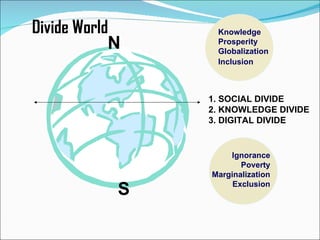
Divide World     Knowledge
            N    Prosperity
                 Globalization
                 Inclusion


                1. SOCIAL DIVIDE
                2. KNOWLEDGE DIVIDE
                3. DIGITAL DIVIDE


                    Ignorance
                       Poverty
                Marginalization

            S        Exclusion
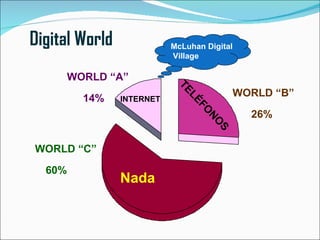
Digital World              McLuhan Digital
                           Village

        WORLD “A”


                            TE
                                           WORLD “B”
          14%


                               LÉ
                INTERNET


                                  FO
                                             26%


                                   NO
                                       S
WORLD “C”

  60%
                Nada
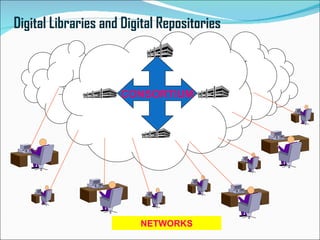
Digital Libraries and Digital Repositories


                     CONSORTIUM


                         NETWORKS
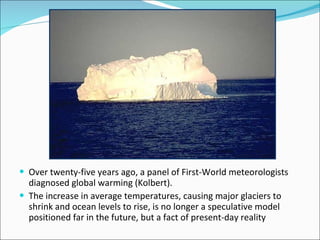
 Over twenty-five years ago, a panel of First-World meteorologists
  diagnosed global warming (Kolbert).
 The increase in average temperatures, causing major glaciers to
  shrink and ocean levels to rise, is no longer a speculative model
  positioned far in the future, but a fact of present-day reality
World Digital Memory : 93%
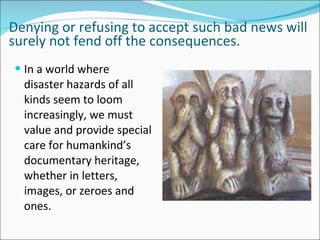
Denying or refusing to accept such bad news will
surely not fend off the consequences.
 In a world where
  disaster hazards of all
  kinds seem to loom
  increasingly, we must
  value and provide special
  care for humankind’s
  documentary heritage,
  whether in letters,
  images, or zeroes and
  ones.
DIGITAL DEATH
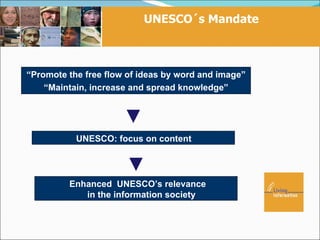
UNESCO´s Mandate


“Promote the free flow of ideas by word and image”
    “Maintain, increase and spread knowledge”


           UNESCO: focus on content


         Enhanced UNESCO’s relevance
            in the information society
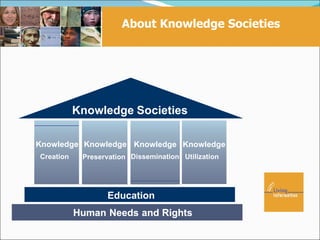
About Knowledge Societies


           Knowledge Societies

Knowledge Knowledge Knowledge Knowledge
Creation    Preservation Dissemination Utilization


                  Pluralism
                  Education
           Human Needs and Rights
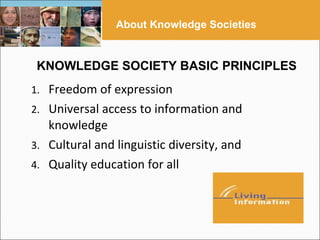
About Knowledge Societies


 KNOWLEDGE SOCIETY BASIC PRINCIPLES
1. Freedom of expression
2. Universal access to information and
   knowledge
3. Cultural and linguistic diversity, and
4. Quality education for all
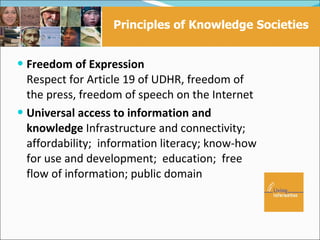
Principles of Knowledge Societies


 Freedom of Expression
  Respect for Article 19 of UDHR, freedom of
  the press, freedom of speech on the Internet
 Universal access to information and
  knowledge Infrastructure and connectivity;
  affordability; information literacy; know-how
  for use and development; education; free
  flow of information; public domain
Principles of Knowledge Societies


 Cultural and linguistic diversity
  Understanding and respect for other
  cultures; plurality and diversity of content
  and languages; importance of locally
  relevant content
 Quality education for all
  Access to education as a fundamental
  right; education as a tool for combating
  illiteracy, marginalization, poverty and
  exclusion
Building Knowledge Societies

Mandate and functions of
UNESCO’s


                               Living information


       IFAP Information for All
             Programme
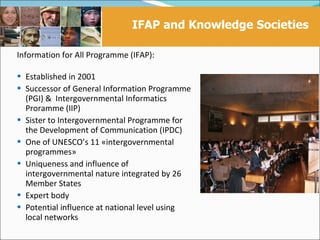
IFAP and Knowledge Societies
                              Mandate and functions
Information for All Programme (IFAP):

 Established in 2001
 Successor of General Information Programme
    (PGI) & Intergovernmental Informatics
    Proramme (IIP)
   Sister to Intergovernmental Programme for
    the Development of Communication (IPDC)
   One of UNESCO’s 11 «intergovernmental
    programmes»
   Uniqueness and influence of
    intergovernmental nature integrated by 26
    Member States
   Expert body
   Potential influence at national level using
    local networks
IFAP and Knowledge Societies


IFAP exists to be an advocate for all
 people on the wrong side of the
 information divide, whether they be
 in developed or developing
 countries. Of special concern are the
 needs of women, youth and the
 elderly, as well as persons with
 disabilities.
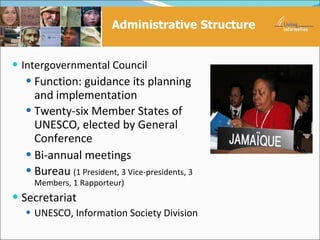
Administrative Structure


 Intergovernmental Council
    Function: guidance its planning
    and implementation
   Twenty-six Member States of
    UNESCO, elected by General
    Conference
   Bi-annual meetings
   Bureau (1 President, 3 Vice-presidents, 3
    Members, 1 Rapporteur)
 Secretariat
   UNESCO, Information Society Division
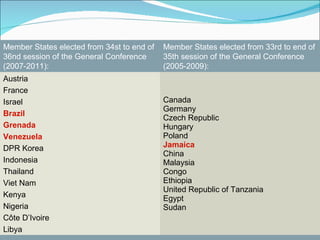
Member States elected from 34st to end of   Member States elected from 33rd to end of
36nd session of the General Conference      35th session of the General Conference
(2007-2011):                                (2005-2009):
Austria
France
Israel                                      Canada
                                            Germany
Brazil
                                            Czech Republic
Grenada                                     Hungary
Venezuela                                   Poland
DPR Korea                                   Jamaica
                                            China
Indonesia                                   Malaysia
Thailand                                    Congo
Viet Nam                                    Ethiopia
                                            United Republic of Tanzania
Kenya                                       Egypt
Nigeria                                     Sudan
Côte D’Ivoire
Libya
IFAP objectives


 promote international reflection and debate on the ethical, legal and societal
   challenges of the information society;

 promote and widen access to information in the public domain through the
   organization, digitization and preservation of information;

 support training, continuing education and lifelong learning in the fields of
   communication, information and informatics;

 support the production of local content and foster the availability of indigenous
   knowledge through basic literacy and ICT literacy training;

 promote the use of international standards and best practices in communication,
   information and informatics in UNESCO's fields of competence; and

 promote information and knowledge networking at local, national, regional and
   international levels.
IFAP Methods & Tools


 Establishing a framework for international co-
  operation and partnerships
 Facilitating reflection and debate (Think tank
  function, upstream work)
 Developing standards, methods and tools
Creation IFAP National Committees
 Promoting networks
 Acting as a Clearing House
 Initiating pilot projects
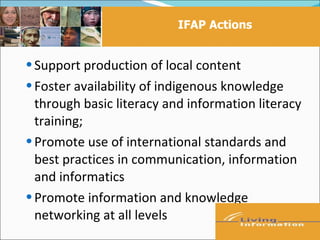
IFAP Actions


 Support production of local content
 Foster availability of indigenous knowledge
  through basic literacy and information literacy
  training;
 Promote use of international standards and
  best practices in communication, information
  and informatics
 Promote information and knowledge
  networking at all levels
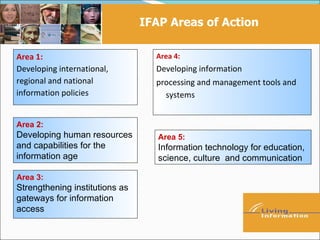
IFAP Areas of Action

Area 1:                           Area 4:
Developing international,         Developing information
regional and national             processing and management tools and
information policies                systems


Area 2:
Developing human resources         Area 5:
and capabilities for the           Information technology for education,
information age                    science, culture and communication

Area 3:
Strengthening institutions as
gateways for information
access
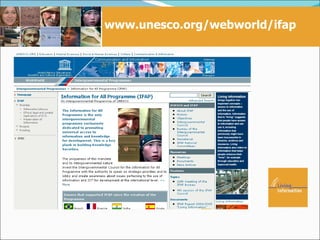
www.unesco.org/webworld/ifap
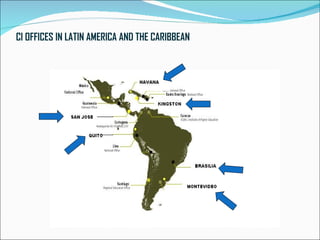
CI OFFICES IN LATIN AMERICA AND THE CARIBBEAN
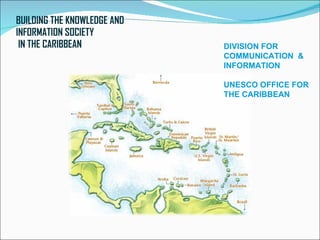
BUILDING THE KNOWLEDGE AND
INFORMATION SOCIETY
 IN THE CARIBBEAN            DIVISION FOR
                             COMMUNICATION &
                             INFORMATION

                             UNESCO OFFICE FOR
                             THE CARIBBEAN
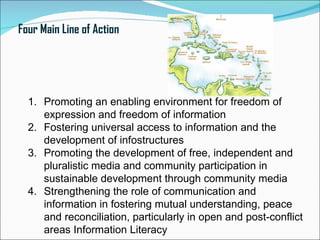
Four Main Line of Action


  1. Promoting an enabling environment for freedom of
     expression and freedom of information
  2. Fostering universal access to information and the
     development of infostructures
  3. Promoting the development of free, independent and
     pluralistic media and community participation in
     sustainable development through community media
  4. Strengthening the role of communication and
     information in fostering mutual understanding, peace
     and reconciliation, particularly in open and post-conflict
     areas Information Literacy
Promoting an enabling environment for freedom of
 expression and freedom of information

 WPFD 2008 Launching of Caribbean Media
  Summit on the " Caribbean Single Market and
  Economy (CSME)"
 WPFD 2009 Caribbean Media Summit:
  "Toward Harmonising Freedom of the Press
  and Broadcasting Legislation in the Caribbean"
Fostering universal access to information and the development
of infostructures
 Strategic alliance with ECLAC and ITU to follow up WSIS Action Plan,
  prepared by ECLAC, ELAC 2010 and strengthen INFOLAC participation in
  the process.

 Identification, preservation and access of Latin American and the
  Caribbean heritage collections in the framework of MOW programme.

 Promoting Caribbean information, preservation and access initiatives
  (Caribbean Digital Library Initiative, Caribbean e-Librarian Iniitiative and
  Caribbean IFAP National Committees)

 Production and distribution of INFOLAC's quarterly journal (volumes 21
  and 22 ) and INFOLAC/MOWLAC website (http://infolac.ucol.mx)
Promoting the development of free, independent and pluralistic media and
community participation in sustainable development through community
media
 Strengthening of the Caribbean Network of Media/ Information Literacy
   Clubs Strengthening of the Caribbean Internet Radio Portal (CIRP)

 Strengthening of the Caribbean Network of Young Journalists dealing with
   specific sustainable development areas.

 Promoting values of free, independent and pluralistic media and
   community participation for development among Latin America and the
   Caribbean young people by improving Caribbean participation in the Youth
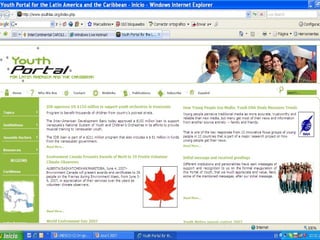
   Portals (www.joveneslac.org and www.youthlac.org)

 Promoting the adaptation of Model Journalism Curricula in Caribbean
   institutions.
Strengthening the role of communication and information in fostering
mutual understanding, peace and reconciliation, particularly in open and
post-conflict areas

 Behaviour Change Communication for Crime Mitigation
  through Community Mulitmedia Centres.
 Promoting Preservation of Caribbean Indigenous and
  Endangered Languages
 Support to set up information literacy clubs in schools and
  facilitate the participation of students from Jamaica in the
  Caribbean Network of Information Literacy Clubs
 Creation of the Caribbean Internet Radio Portal (CIRP) with
  ROOTS FM and Container Project in Jamaica playing lead roles;
SOME ON-GOING PROJECTS IN
        JAMAICA
Prison Radio Network
 Setting up of to facilitate prisoner rehabilitation and promote reintegration
  into society in partnership with the Department of Correctional Services
  (Ministry of Security). This is being done for the First time in the Caribbean.
  Results when completed:
    200 Inmates and officers trained in broadcasting and communications and
       related multimedia skills;
      Improved morale, as a significant part of the inmate population will be engaged
       on a daily basis in something meaningful and positive;
      DCS monthly newspaper established and articles produced and published;
      A Guide on the use of mass media for rehabilitation in correctional facilities of
       the Caribbean;
      Training manual (CD or on Internet) on community broadcasting, tailored to
       penal communities; This manual can be used to share the experiences with
       other institutions within and outside Jamaica; local content developed (radio
       programmes and digital stories)
National Workshop on ICT in
Education Toolkit
 In collaboration with the Ministries of
 Education and Technology; This will be
 linked to the EduVision 2007, 3rd
 International Conference on Teacher
 Education and Technology, December 4-7
 2007;
Strengthen of the Caribbean Indigenous
and Endangered Language Website
 in collaboration with the Jamaica language Unit of the
  University of the West Indies;
    Authoritative documentation of 28 indigenous and
     endangered languages;
    Increased awareness of and importance of preserving
     Caribbean indigenous languages;
    Over 30 Caribbean indigenous communities benefiting
     from access to information on other indigenous languages;
     Website: Caribbean Indigenous Languages
Strengthening of networking among media professionals through the
development of an online Caribbean Media and Communication Resource
                       Centre (CARIMAC.COM).
   An online resource centre and clearing house for owners, managers
    and practitioners in the Caribbean media and communication industry.

   Development of a comprehensive Caribbean Media Directory (CMD)


   The online resource centre will include: an online trade journal;
    searchable, dynamic database of media and communication
    companies; training modules (in audio, video and print formats); online
    access to CARIMAC research and instructional materials; a repository of
    relevant research papers and policy documents, including conference
    papers, reports and industry presentations, codes of conduct, relevant
    legislation
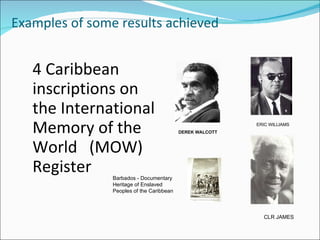
Examples of some results achieved


   4 Caribbean
   inscriptions on
   the International
   Memory of the                           DEREK WALCOTT
                                                           ERIC WILLIAMS


   World (MOW)
   Register     Barbados - Documentary
                Heritage of Enslaved
                Peoples of the Caribbean


                                                             CLR JAMES
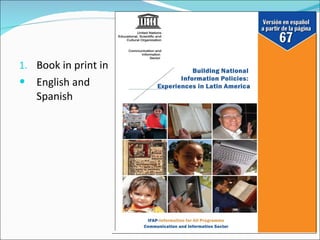
1. Book in print in
   English and
    Spanish
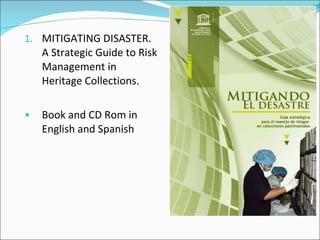
1. MITIGATING DISASTER.
    A Strategic Guide to Risk
    Management in
    Heritage Collections.

•   Book and CD Rom in
    English and Spanish

Isidro Fernandez Aballi

  • 1.
    Libraries Networking forNational Development . National Library of Jamaica 23 November 2007 Isidro Fernandez-Aballi Adviser on Communication and Information for the Caribbean UNESCO i.fernandez-aballi@unesco.org
  • 2.
    Divide World Knowledge N Prosperity Globalization Inclusion 1. SOCIAL DIVIDE 2. KNOWLEDGE DIVIDE 3. DIGITAL DIVIDE Ignorance Poverty Marginalization S Exclusion
  • 3.
    Digital World McLuhan Digital Village WORLD “A” TE WORLD “B” 14% LÉ INTERNET FO 26% NO S WORLD “C” 60% Nada
  • 4.
    Digital Libraries andDigital Repositories CONSORTIUM NETWORKS
  • 5.
     Over twenty-fiveyears ago, a panel of First-World meteorologists diagnosed global warming (Kolbert).  The increase in average temperatures, causing major glaciers to shrink and ocean levels to rise, is no longer a speculative model positioned far in the future, but a fact of present-day reality
  • 6.
  • 7.
    Denying or refusingto accept such bad news will surely not fend off the consequences.  In a world where disaster hazards of all kinds seem to loom increasingly, we must value and provide special care for humankind’s documentary heritage, whether in letters, images, or zeroes and ones.
  • 8.
  • 9.
    UNESCO´s Mandate “Promote thefree flow of ideas by word and image” “Maintain, increase and spread knowledge” UNESCO: focus on content Enhanced UNESCO’s relevance in the information society
  • 10.
    About Knowledge Societies Knowledge Societies Knowledge Knowledge Knowledge Knowledge Creation Preservation Dissemination Utilization Pluralism Education Human Needs and Rights
  • 11.
    About Knowledge Societies KNOWLEDGE SOCIETY BASIC PRINCIPLES 1. Freedom of expression 2. Universal access to information and knowledge 3. Cultural and linguistic diversity, and 4. Quality education for all
  • 12.
    Principles of KnowledgeSocieties  Freedom of Expression Respect for Article 19 of UDHR, freedom of the press, freedom of speech on the Internet  Universal access to information and knowledge Infrastructure and connectivity; affordability; information literacy; know-how for use and development; education; free flow of information; public domain
  • 13.
    Principles of KnowledgeSocieties  Cultural and linguistic diversity Understanding and respect for other cultures; plurality and diversity of content and languages; importance of locally relevant content  Quality education for all Access to education as a fundamental right; education as a tool for combating illiteracy, marginalization, poverty and exclusion
  • 14.
    Building Knowledge Societies Mandateand functions of UNESCO’s Living information IFAP Information for All Programme
  • 15.
    IFAP and KnowledgeSocieties Mandate and functions Information for All Programme (IFAP):  Established in 2001  Successor of General Information Programme (PGI) & Intergovernmental Informatics Proramme (IIP)  Sister to Intergovernmental Programme for the Development of Communication (IPDC)  One of UNESCO’s 11 «intergovernmental programmes»  Uniqueness and influence of intergovernmental nature integrated by 26 Member States  Expert body  Potential influence at national level using local networks
  • 16.
    IFAP and KnowledgeSocieties IFAP exists to be an advocate for all people on the wrong side of the information divide, whether they be in developed or developing countries. Of special concern are the needs of women, youth and the elderly, as well as persons with disabilities.
  • 17.
    Administrative Structure  IntergovernmentalCouncil  Function: guidance its planning and implementation  Twenty-six Member States of UNESCO, elected by General Conference  Bi-annual meetings  Bureau (1 President, 3 Vice-presidents, 3 Members, 1 Rapporteur)  Secretariat  UNESCO, Information Society Division
  • 18.
    Member States electedfrom 34st to end of Member States elected from 33rd to end of 36nd session of the General Conference 35th session of the General Conference (2007-2011): (2005-2009): Austria France Israel Canada Germany Brazil Czech Republic Grenada Hungary Venezuela Poland DPR Korea Jamaica China Indonesia Malaysia Thailand Congo Viet Nam Ethiopia United Republic of Tanzania Kenya Egypt Nigeria Sudan Côte D’Ivoire Libya
  • 19.
    IFAP objectives  promoteinternational reflection and debate on the ethical, legal and societal challenges of the information society;  promote and widen access to information in the public domain through the organization, digitization and preservation of information;  support training, continuing education and lifelong learning in the fields of communication, information and informatics;  support the production of local content and foster the availability of indigenous knowledge through basic literacy and ICT literacy training;  promote the use of international standards and best practices in communication, information and informatics in UNESCO's fields of competence; and  promote information and knowledge networking at local, national, regional and international levels.
  • 20.
    IFAP Methods &Tools  Establishing a framework for international co- operation and partnerships  Facilitating reflection and debate (Think tank function, upstream work)  Developing standards, methods and tools Creation IFAP National Committees  Promoting networks  Acting as a Clearing House  Initiating pilot projects
  • 21.
    IFAP Actions  Supportproduction of local content  Foster availability of indigenous knowledge through basic literacy and information literacy training;  Promote use of international standards and best practices in communication, information and informatics  Promote information and knowledge networking at all levels
  • 22.
    IFAP Areas ofAction Area 1: Area 4: Developing international, Developing information regional and national processing and management tools and information policies systems Area 2: Developing human resources Area 5: and capabilities for the Information technology for education, information age science, culture and communication Area 3: Strengthening institutions as gateways for information access
  • 23.
  • 25.
    CI OFFICES INLATIN AMERICA AND THE CARIBBEAN
  • 26.
    BUILDING THE KNOWLEDGEAND INFORMATION SOCIETY IN THE CARIBBEAN DIVISION FOR COMMUNICATION & INFORMATION UNESCO OFFICE FOR THE CARIBBEAN
  • 27.
    Four Main Lineof Action 1. Promoting an enabling environment for freedom of expression and freedom of information 2. Fostering universal access to information and the development of infostructures 3. Promoting the development of free, independent and pluralistic media and community participation in sustainable development through community media 4. Strengthening the role of communication and information in fostering mutual understanding, peace and reconciliation, particularly in open and post-conflict areas Information Literacy
  • 28.
    Promoting an enablingenvironment for freedom of expression and freedom of information  WPFD 2008 Launching of Caribbean Media Summit on the " Caribbean Single Market and Economy (CSME)"  WPFD 2009 Caribbean Media Summit: "Toward Harmonising Freedom of the Press and Broadcasting Legislation in the Caribbean"
  • 29.
    Fostering universal accessto information and the development of infostructures  Strategic alliance with ECLAC and ITU to follow up WSIS Action Plan, prepared by ECLAC, ELAC 2010 and strengthen INFOLAC participation in the process.  Identification, preservation and access of Latin American and the Caribbean heritage collections in the framework of MOW programme.  Promoting Caribbean information, preservation and access initiatives (Caribbean Digital Library Initiative, Caribbean e-Librarian Iniitiative and Caribbean IFAP National Committees)  Production and distribution of INFOLAC's quarterly journal (volumes 21 and 22 ) and INFOLAC/MOWLAC website (http://infolac.ucol.mx)
  • 30.
    Promoting the developmentof free, independent and pluralistic media and community participation in sustainable development through community media  Strengthening of the Caribbean Network of Media/ Information Literacy Clubs Strengthening of the Caribbean Internet Radio Portal (CIRP)  Strengthening of the Caribbean Network of Young Journalists dealing with specific sustainable development areas.  Promoting values of free, independent and pluralistic media and community participation for development among Latin America and the Caribbean young people by improving Caribbean participation in the Youth Portals (www.joveneslac.org and www.youthlac.org)  Promoting the adaptation of Model Journalism Curricula in Caribbean institutions.
  • 31.
    Strengthening the roleof communication and information in fostering mutual understanding, peace and reconciliation, particularly in open and post-conflict areas  Behaviour Change Communication for Crime Mitigation through Community Mulitmedia Centres.  Promoting Preservation of Caribbean Indigenous and Endangered Languages  Support to set up information literacy clubs in schools and facilitate the participation of students from Jamaica in the Caribbean Network of Information Literacy Clubs  Creation of the Caribbean Internet Radio Portal (CIRP) with ROOTS FM and Container Project in Jamaica playing lead roles;
  • 32.
  • 33.
    Prison Radio Network Setting up of to facilitate prisoner rehabilitation and promote reintegration into society in partnership with the Department of Correctional Services (Ministry of Security). This is being done for the First time in the Caribbean. Results when completed:  200 Inmates and officers trained in broadcasting and communications and related multimedia skills;  Improved morale, as a significant part of the inmate population will be engaged on a daily basis in something meaningful and positive;  DCS monthly newspaper established and articles produced and published;  A Guide on the use of mass media for rehabilitation in correctional facilities of the Caribbean;  Training manual (CD or on Internet) on community broadcasting, tailored to penal communities; This manual can be used to share the experiences with other institutions within and outside Jamaica; local content developed (radio programmes and digital stories)
  • 34.
    National Workshop onICT in Education Toolkit  In collaboration with the Ministries of Education and Technology; This will be linked to the EduVision 2007, 3rd International Conference on Teacher Education and Technology, December 4-7 2007;
  • 35.
    Strengthen of theCaribbean Indigenous and Endangered Language Website  in collaboration with the Jamaica language Unit of the University of the West Indies;  Authoritative documentation of 28 indigenous and endangered languages;  Increased awareness of and importance of preserving Caribbean indigenous languages;  Over 30 Caribbean indigenous communities benefiting from access to information on other indigenous languages; Website: Caribbean Indigenous Languages
  • 36.
    Strengthening of networkingamong media professionals through the development of an online Caribbean Media and Communication Resource Centre (CARIMAC.COM).  An online resource centre and clearing house for owners, managers and practitioners in the Caribbean media and communication industry.  Development of a comprehensive Caribbean Media Directory (CMD)  The online resource centre will include: an online trade journal; searchable, dynamic database of media and communication companies; training modules (in audio, video and print formats); online access to CARIMAC research and instructional materials; a repository of relevant research papers and policy documents, including conference papers, reports and industry presentations, codes of conduct, relevant legislation
  • 37.
    Examples of someresults achieved 4 Caribbean inscriptions on the International Memory of the DEREK WALCOTT ERIC WILLIAMS World (MOW) Register Barbados - Documentary Heritage of Enslaved Peoples of the Caribbean CLR JAMES
  • 39.
    1. Book inprint in  English and Spanish
  • 40.
    1. MITIGATING DISASTER. A Strategic Guide to Risk Management in Heritage Collections. • Book and CD Rom in English and Spanish