
National e-Strategies
  for Development
     Global Status and
       Perspectives
           2010
Acknowledgements
This report on National e-Strategies for Development: Global Status and Perspectives, 2010 is a joint
effort between the ITU Telecommunication Development Bureau and the ITU General Secretariat. It
was prepared by Monika Muylkens, a consultant to ITU, under the direction of Hani Eskandar,
Technical Officer for ICT Applications, ICT Applications and Cybersecurity Division (CYB), and the
overall direction of Souheil Marine, Head, ICT Applications and Cybersecurity Division, and Mario
Maniewicz, Chief, Policies and Strategies, Telecommunication Development Bureau (BDT).

The author is grateful to Jaroslaw Ponder, Strategy and Policy Advisor (ITU) for his active involvement
and invaluable guidance and to Agata Maria Nowicka (ITU) for her support in collecting national and
sectoral e-strategies, Poverty Reduction Strategy Papers (PRSPs), and conducting invaluable
background research on the evolution of ICT strategies for selected countries. The report was edited
by Lilia Perez-Chavolla.

Further, the author acknowledges the material, comments and suggestions received from the UN
Regional Commissions namely: The United Nations Economic Commission for Europe (ECE), United
Nations Economic Commission for Africa (ECA), United Nations Economic Commission for Latin
America and the Caribbean (ECLAC), United Nations Economic and Social Commission for Asia and
the Pacific (ESCAP), and the United Nations Economic and Social Commission for Western Asia
(ESCWA).

The report includes data sourced from BDT’s Market Information and Statistics Division (STAT).


All rights reserved. No part of this publication may be reproduced, by any means whatsoever,
without the prior written permission of ITU.

Denominations and classifications employed in this publication do not imply any opinion on the part
of the International Telecommunication Union concerning the legal or other status of any territory or
any endorsement or acceptance of any boundary. Where the designation “country” appears in this
publication, it covers countries and territories.

The views expressed in this paper are those of the authors and do not necessarily reflect the opinions
of ITU or of its membership.

                                           © ITU, 2010
                       International Telecommunication Union (ITU), Geneva
Message from the
Secretary-General of
the International
Telecommunication Union
In today's world, information and communication technologies (ICT)
have a profound effect on most socio-economic, political and cultural
aspects of society; they have become indispensable tools in the
implementation of national development plans in many countries,
supporting their efforts to secure the welfare and prosperity of their
citizens. Yet, the prevalence of digital divisions worldwide hinders the application of ICT capabilities
in areas vital for development, such as agriculture, health and education, impeding progress towards
the achievement of an inclusive digital society.

With this in mind, nine years ago, the UN General Assembly endorsed the World Summit on the
Information Society, held in two phases, in Geneva 2003 and Tunis 2005. In particular, it encouraged
governments, as part of the implementation of its Tunis Agenda for the Information Society, to
establish before 2010, “comprehensive, forward-looking and sustainable national e-strategies,
including ICT strategies and sectoral e-strategies, as an integral part of national development plans
and poverty reduction strategies” (Para. 85), in order to unleash the full potential of ICT for
development.

On the occasion of the fifth anniversary of the WSIS’ Tunis phase, and having reached the 2010
deadline proposed in the Tunis Agenda, ITU is especially glad to publish the “National e-Strategies for
Development: Global Status and Perspectives, 2010” report, in the framework of the WSIS Forum.
This publication reports on the excellent work accomplished so far in the development of national
e-strategies, while pointing out areas where there is room for improvement. I encourage all WSIS
stakeholders to persevere in their endeavours to develop sustainable national e-strategies and
improve those already in existence by addressing some of the gaps identified in this report.

ITU remains committed to supporting the efforts of its Member States in this area, facilitating the
adoption of ICT strategies and applications that will allow us to move together towards a better,
more inclusive, future.


                                                                                 Dr Hamadoun I. Touré
                                                                                     Secretary-General
                                                               International Telecommunication Union
                                                                                    Geneva, May 2010


                                                                                                           iii
Foreword
For many years, the Telecommunication Development
Bureau of the International Telecommunication Union
(ITU-D) has undertaken various activities related to the
study of the potential benefits of ICT solutions for
developing countries, as well as to the implementation of
these applications through pilot projects in different
countries. ITU-D is also constantly engaged in assisting
Member States in the elaboration of national e-strategies.

Many Member States have succeeded in meeting the
targets set forward by the World Summit on the Information Society (WSIS), and have incorporated
WSIS’ recommendations into their own policies. I am pleased to observe that at least 84 percent of
all economies have fulfilled the WSIS target of having a national ICT strategy in place by 2010, and at
least another 7 percent are in the process of developing such a strategy. Moreover, there is a
consensus among stakeholders that areas like health care, agriculture and environmental protection,
among others, could benefit from the adoption of ICT. I am reassured by our collective capacity to
make real changes in our lives through increased ICT use. This is great news for all of us.

The analysis of national e-strategies included in this report indicates the need to revisit the plans
relating to the vision, strategic orientation and ethical dimension of the Information Society. Many
countries would benefit also from the formulation of more comprehensive sectoral e-strategies,
based on the useful lessons learnt from implementation of scalable pilot projects.

The findings of this report illustrate that a lot has been accomplished already by the 2010 deadline.
Yet, we have to continue our work to move forward towards the digital future and the
knowledge-based economy. I hope that this report will provide useful insights on how best to
strategically use ICT to reach this goal.


                                                                      Mr. Sami Al Basheer Al Morshid
                                                   Director, Telecommunication Development Bureau
                                                              International Telecommunication Union
                                                                                   Geneva, May 2010


                                                                                                     v
Abstract
In its Paragraph 85, the Tunis Agenda for the Information Society denotes the leading role that
governments, in partnership with other stakeholders implementing the outcomes of the World
Summit on the Information Society (WSIS), have in the elaboration of “comprehensive,
forward-looking and sustainable national e-strategies, including ICT strategies and sectoral
e-strategies […], as an integral part of national development plans and poverty reduction strategies,
[…] before 2010”.1

The report “National e-Strategies for Development: Global Status and Perspectives, 2010” provides a
high-level update and an overview of the progress countries have made in their effort to develop
national e-strategies, ICT strategies and sectoral e-strategies, analyzing as well the extent into which
ICT have been incorporated into poverty reduction strategies and other national development plans.

In order to provide a broad analysis of ICT strategies, this report describes strategic approaches of
national e-strategies and provides three examples of national ICT strategies, detailing their evolution
over time.

The report identifies at least 161 economies (84 percent) that have already met the WSIS target of
having a national ICT strategy in place by 2010. It also indicates areas where existing national
e-strategies could be improved, such as their strategic orientation and their integration into national
development plans and poverty reduction strategies. Based on the analysis of sectoral e-strategies,
the report also emphasises the need for more comprehensive sectoral e-strategies that take full
advantage of the potential ICT have for the economy and society. Finally, the appendix provides the
reader a comprehensive list of national ICT strategies developed by ITU Member States.

The information presented in this report comes largely from the WSIS stocktaking,2 an extensive
online research initiative conducted by the International Telecommunication Union (ITU), which
brings together national ICT and sectoral e-strategies of ITU’s Member States, as well as publications
by the five UN Regional Commissions.


1
     ITU. (2005). Paragraph 85.
2
     The WSIS Stocktaking database is available through ITU at http://www.itu.int/wsis/stocktaking/index.html.


vi
Table of contents
                                                                                                                                                       page
Message from the Secretary-General of the International Telecommunication Union ......................... iii
Foreword ..................................................................................................................................................v
Abstract ................................................................................................................................................... vi
1 Introduction ..................................................................................................................................... 1
2 General Overview ............................................................................................................................ 4
     2.1       Global status of national e-strategies ................................................................................. 4
     2.2       Regional perspectives ......................................................................................................... 5
3 Analysis ............................................................................................................................................ 8
     3.1       ICT Strategies ...................................................................................................................... 8
               WSIS Action Line C2: Information and communication infrastructure .............................. 8
               WSIS Action Line C3: Access to information and knowledge ............................................. 8
               WSIS Action Line C4: Capacity building .............................................................................. 9
               WSIS Action Line C5: Building confidence and security in the use of ICTs ....................... 10
               WSIS Action Line C6: Enabling environment .................................................................... 11
               WSIS Action Line C7: ICT applications — benefits in all aspects of life ............................ 11
               WSIS Action Line C8: Cultural diversity and identity, linguistic diversity
               and local content .............................................................................................................. 13
               WSIS Action Line C9: Media .............................................................................................. 13
               WSIS Action Line C10: Ethical dimension of the Information Society .............................. 13
               WSIS Action Line C11: International and regional cooperation ....................................... 14
     3.2       Sectoral e-Strategies ......................................................................................................... 16
               3.3         Integration of national e-strategies into poverty reduction strategies and national
     development plans ........................................................................................................................ 23
     3.4       Strategic approaches and trends ...................................................................................... 28
     3.5       Evolution of national e-strategy plans .............................................................................. 34
4 Conclusion ..................................................................................................................................... 42
References ............................................................................................................................................. 44
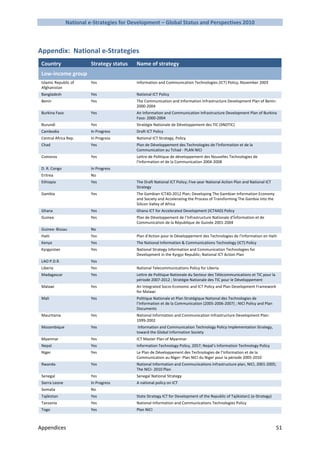
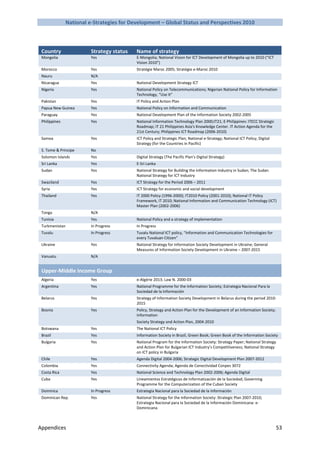
Appendix................................................................................................................................................ 51


                                                                                                                                                           vii
Figures

                                                                                                                                    page
Figure 2.1:      ITU’s WSIS stocktaking on ICT strategies and national e-strategies ............................... 4
Figure 2.2:      Global status of ICT Strategies......................................................................................... 6


                                                               Boxes

Box 1.1:      Call for national e-Strategies in WSIS documents ............................................................... 1
Box 1.2:      Sample of ICT strategies analysed ....................................................................................... 2
Box 3.1:      Finland – Educating children and young people as informed consumers ........................ 13
Box 3.2:      Mozambique – Multi-stakeholder approach..................................................................... 14
Box 3.3:      Guyana – e-Business in the National Development Strategy............................................ 17
Box 3.4:      Lithuania’s e-Health strategy ............................................................................................ 19
Box 3.5:      Rwanda sets precise and measurable targets for activities promoting the
              cross-sectoral use of ICT in its PRSP .................................................................................. 24
Box 3.6:      Bosnia and Herzegovina to develop its rural areas through ICT ....................................... 25
Box 3.7:      Bahrain — Regulatory approach of the Telecommunication Authority ........................... 29
Box 3.8:      Trinidad & Tobago — ICT driven innovations.................................................................... 32
Box 3.9:      The development of national e-strategies in Japan .......................................................... 35
Box 3.10:     Egyptian’s ICT strategy – Key documents.......................................................................... 36
Box 3.11:     Poland’s ICT strategy – Key documents ............................................................................ 38


viii
National e-Strategies for Development – Global Status and Perspectives 2010


1            Introduction
The report “National e-Strategies for Development: Global Status and Perspectives, 2010” is
published in the framework of the World Summit on the Information Society (WSIS), on the occasion
of the fifth anniversary of its Tunis phase and of the adoption of the Tunis Agenda for the Information
Society. The report was launched by ITU in May 2010, in Geneva, Switzerland.

The interest of this report on the status of national e-strategies stems from their fundamental role as
preconditions for bridging the digital divide, that is, the gap between people with access to ICT and
those with limited or no access to them. Further, e-strategies are believed to enable socio-economic
development. For this reason, as illustrated in Box 1.1 below, the WSIS outcomes encourage
countries to incorporate ICT into their national development plans and, in the particular case of
lower income economies, to integrate national e-strategies into their poverty reduction plans.

    Box 1.1:             Call for national e-Strategies in WSIS documents
                         Call for e-strategies in the Tunis Agenda and the Geneva Plan of Action

    Call for e-strategies in the Tunis Agenda and the Geneva Plan of Action
    The Tunis Agenda for the Information Society encourages governments, in particular, to elaborate national
    e-strategies.

    Tunis Agenda for the Information Society (2005)Paragraph 85
    “Taking into consideration the leading role of governments in partnership with other stakeholders in
    implementing the WSIS outcomes, including the Geneva Plan of Action, at the national level, we encourage
    those governments that have not yet done so to elaborate, as appropriate, comprehensive, forward-looking
    and sustainable national e-strategies, including ICT strategies and sectoral e-strategies as appropriate, as an
    integral part of national development plans and poverty reduction strategies, as soon as possible and before
    2010.”

    Geneva Plan of Action (2003)
    Action Line C1. The role of governments and all stakeholders in the promotion of ICTs for development.
    8a. “Development of national e-strategies, including the necessary human capacity building, should be
    encouraged by all countries by 2005, taking into account different national circumstances.”

    Source: ITU (2003) and (2005).


This report uses three related concepts that need to be distinguished: An ICT strategy is a general
plan on how to bring a society and its economy forward through the use of ICT; sectoral e-strategies,
on the other hand, break down the general ICT strategy into policies for specific sectors, such as
health, education or administration. Sectoral strategies are called “e” for electronic, followed by the
name of the area the strategy applies to, for instance, e-health, e-learning or e-government.
Together, ICT strategies and sectoral e-strategies constitute national e-strategies,3 which is the
super-ordinate concept.


3
        The Tunis Agenda states in this respect: “Throughout this text, further references to "e-strategies" are interpreted as including also
        ICT strategies and sectoral e-strategies, as appropriate.” ITU. (2005). Footnote 1.


Introduction                                                                                                                                1
National e-Strategies for Development – Global Status and Perspectives 2010


The purpose of this report is to address the following questions:

        •   What is the status of national e-strategies worldwide in 2010?
        •   What strategic approaches or trends can be identified in current Information and
            Communication Technologies (ICT) strategies? How can they be explained?
     •      What is the status of sectoral e-strategies in particular? Which common trends can be
            observed?
     •      Have national e-strategies been integrated into poverty reduction strategies?
     •      How have ICT strategies evolved over time?
To attend to these questions, ITU, in close collaboration with the five UN Regional Commissions,4
collected information on national e-strategies for all its Member States to provide a comprehensive
global overview. General findings on the current status of and a regional perspective on national
e-strategies are discussed in Chapter 2.

The Tunis Agenda calls for the development of “appropriate, comprehensive, forward-looking and
sustainable” e-strategies.5 To obtain evidence on the quality of current ICT strategies, Chapter 3, in
Section 3.1 of the report, analyses the extent to which the content of a sample of strategies reflect
the action lines defined in the Geneva Plan of Action of the WSIS.6 The analysis is based on a random
sample of 32 economies from the four income groups defined by the World Bank: low, lower-middle,
upper-middle and high.7 Box 1.2 below lists the economies from each income group that were used
in the analysis.

    Box 1.2:              Sample of ICT strategies analysed
                          As described in Section 3.1, by income group

    Low income group:                               Gambia, Ghana, Kenya, Kyrgyzstan, Malawi, Mozambique, Nepal,
                                                    Tanzania

    Lower-middle income group:                      Albania, Azerbaijan, Bhutan, Egypt, Jordan, Lesotho, Moldova, Nigeria

    Upper-middle income group:                      Fiji, Jamaica, Lithuania, Macedonia, Malaysia, Mauritius, Poland, Turkey

    High income group:                              Finland, Iceland, Ireland, Malta, Oman, Saudi Arabia, Trinidad & Tobago,
                                                    the State of the United Arab Emirates

    Source: ITU.


4
        The UN regional commissions include the United Nations Economic Commission for Europe (ECE), the United Nations Economic
        Commission for Africa (ECA), the United Nations Economic Commission for Latin America and the Caribbean (ECLAC), the United
        Nations Economic and Social Commission for Asia and the Pacific (ESCAP) and the United Nations Economic and Social Commission
        for Western Asia (ESCWA).
5
        ITU. (2005). Paragraph 85.
6
        See ITU. (2003). Section C. Action Lines.
7
        Regarding its method for allocating economies into income groups, the World Bank states: “Economies are divided according to 2008
        GNI per capita, calculated using the World Bank Atlas method. The groups are: low income, $975 or less; lower middle income, $976
        - $3,855; upper middle income, $3,856 - $11,905; and high income, $11,906 or more.” World Bank. (n.d.). Income Group.


2                                                                                                                       Introduction
National e-Strategies for Development – Global Status and Perspectives 2010


The analysis of sectoral e-strategies included in this report is based on a random selection of
strategies for each of the eight fields of ICT applications, as listed in Action Line C7 of the Geneva
Plan of Action. 8 Section 3.2 of the report provides some examples of well-elaborated and
forward-looking strategies for each e-sector.

Section 3.3 provides an analysis of the integration of e-strategies into poverty reduction strategies.
The author analysed twenty-four Poverty Reduction Strategy Papers (PRSPs),9 developed by the
World Bank, from which four examples were selected for discussion: Two exemplify cases of
forward-looking and comprehensive integration of ICT strategies, while the other two are examples
of PRSPs with potential for improvement.

Section 3.4 describes strategic approaches and trends identified in national e-strategies, illustrating
the findings with concrete examples.

Finally, section 3.5 examines the evolution of national e-strategy plans in three countries, namely
Japan, Egypt and Poland, as examples of how strategy development can adapt to a changing
environment.

The ITU WSIS stocktaking database was used as the primary source for the analysis of Member
States’ achievements in meeting the Tunis Agenda’s target for national e-strategies.10 Moreover, for
the purpose of this paper and to present a comprehensive overview of the status of national
e-strategy development, ITU searched for and collected ICT strategies and some sectoral e-strategies
for its 191 Member States, using government Internet sites and search engines. The list of identified
strategies is presented in Appendix A1.


8
     ICT Applications include E-government, E-business, E-learning, E-health, E-employment, E-environment, E-agriculture and E-science.
     See ITU. (2003). Action Line C7, para. 14-22.
9
     World Bank. (n.d.). Country Papers and JSANs/JSAs.
10
     ITU invited governments and other WSIS stakeholders to provide updated information for the WSIS stocktaking database from 15th
     January to 30th March 2010. National reports on WSIS implementation are available through ITU at http://www.itu.int/wsis-
     implementation/national/flash/index.html.


Introduction                                                                                                                         3
National e-Strategies for Development – Global Status and Perspectives 2010


2          General Overview
2.1        Global status of national e-strategies
Most countries have met the WSIS target of developing national e-strategies by 2010. At least 84
percent of all economies have a national e-strategy in place, and at least 14 economies are in the
process of developing such a strategy.

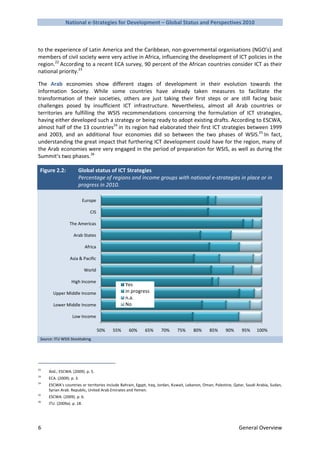
As of April 2010, 161 countries and territories, that is, 84.3 percent of all ITU Member States, already
had a national e-strategy in place, while another 14 countries and territories (7.3%) are currently
formulating and adopting one. As illustrated in Figures 2.1 and 2.2 below, six countries (3.1%) do not
have a national e-strategy in place, and the status of ICT strategy formulation in the remaining 10
economies (5.2%) is unknown, due to lack of information. It is possible, however, that some of the
economies in the latter group (Belgium, Italy, Lichtenstein, Marshall Islands, Monaco, Nauru, Tonga,
San Marino, Vanuatu and the Vatican) have also formulated an ICT strategy or are in the preparatory
process. Some European countries, for instance, follow the regional ICT strategy “iD2010”11 of the
European Union.

 Figure 2.1:           ITU’s WSIS stocktaking on ICT strategies and national e-strategies


              National e-strategy in place               In progress   No national e-strategy in place or N/A
 Source: ITU WSIS Stocktaking.


Lichtenstein, Monaco and the Vatican, small economies strongly connected to their neighbouring
countries, might have no need for developing their own national e-strategies. Finally, there is no data
available on national e-strategies for the Marshall Islands, Nauru, Tonga and Vanuatu. Nevertheless,
the Pacific Plan for Strengthening Regional Cooperation and Integration and its Pacific Regional
Digital Strategy are encouraging countries in the Pacific region to develop ICT strategies.12 Therefore,
it is possible that these island states are already in the process of formulating such strategies.


11
      European Commission. (n.d.). The European Broadband Portal.
12
      Pacific Island Forum Secretariat. (2009). p. 6.


4                                                                                                     General Overview
National e-Strategies for Development – Global Status and Perspectives 2010


2.2           Regional perspectives
There are similarities among ICT strategies from the same world region.

The ICT strategies of the Asia-Pacific economies share a focus on policies relating to the regulatory
regime, as well as an interest in promoting ICT infrastructure, cybersecurity and the creation and
control of local content. Following the recommendations of the Regional Action Plan towards the
Information Society in Asia and the Pacific,13 many Asian-Pacific countries have formulated ICT
policies to establish enabling regulatory environments. In
doing so, many countries dissolved their telecommunica-
tion monopolies and established independent regulatory
                                                              As of April 2010, 161 countries
             14
authorities, facilitating the introduction of liberalisation, and territories, that is, 84.3
privatisation and competitive practices in the region’s ICT
sector.15 The new strategies covered not only traditional
                                                              percent of all ITU Member
regulatory topics, such as universal service, unbundling of   States, already had a national
the local loop, frequency allocation and number
portability, but also set regulations for cyberspace, such as
                                                              e-strategy in place, while
digital rights management and spam controls.16                another 14 countries and
In Latin America and the Caribbean, several countries,         territories (7.3%) are currently
including Brazil, Canada and Mexico, had developed ICT         formulating and adopting one.
policies during the 1960 and 1970s.17 By the time of the
first WSIS phase, most economies in the region had
already an overall ICT vision in place and were working on
the formulation of their strategies. ICT were high up on the agenda of the heads of state of countries
like Chile, Colombia, Mexico and Trinidad and Tobago, resulting in the development of ICT strategies
that address issues of infrastructure, e-government and education.18

The Caribbean region, in particular, is considered to have potential “for becoming an international
hub of Information and Communications Technologies (ICT) services hosting, outsourcing and
delivery”19 for North, Central and South America. Some of the regional characteristics, such as its
native languages (Spanish and English) and its time zone, are considered advantageous “for
‘near-shore’ business”.20

In general, Africa is the continent with the lowest penetration of ICT, as well as the region where the
formulation of ICT strategies has taken place at the slowest pace. By the first phase of WSIS in 2003,
only 17 African countries had developed ICT strategies.21 The existing ICT policies are characterized
by their emphasis on addressing the lack of infrastructure, as well as the poor regulatory
environment and financing mechanisms. In terms of infrastructure and the regulatory environment,
many African countries have favoured privatisation. Some countries have also addressed in their
policies issues of access for all and poverty reduction through employment opportunities. In contrast

13
      ESCAP. (2009a). p. 17.
14
      Ibid.
15
      ESCAP. (2008). p. 4.
16
      Ibid.
17
      ITU Regulators Knowledge Centre, http://www.itu.int/ITU-D/ICTEYE/Regulators/Regulators.aspx; T. Unwin. (2009). pp. 153.
18
      Ibid.
19
      ECLAC (2010). p. 1.
20
      Ibid.
21
      T. Unwin. (2009). p. 158.


General Overview                                                                                                                5
National e-Strategies for Development – Global Status and Perspectives 2010


to the experience of Latin America and the Caribbean, non-governmental organisations (NGO’s) and
members of civil society were very active in Africa, influencing the development of ICT policies in the
region.22 According to a recent ECA survey, 90 percent of the African countries consider ICT as their
national priority.23

The Arab economies show different stages of development in their evolution towards the
Information Society. While some countries have already taken measures to facilitate the
transformation of their societies, others are just taking their first steps or are still facing basic
challenges posed by insufficient ICT infrastructure. Nevertheless, almost all Arab countries or
territories are fulfilling the WSIS recommendations concerning the formulation of ICT strategies,
having either developed such a strategy or being ready to adopt existing drafts. According to ESCWA,
almost half of the 13 countries24 in its region had elaborated their first ICT strategies between 1999
and 2003, and an additional four economies did so between the two phases of WSIS.25 In fact,
understanding the great impact that furthering ICT development could have for the region, many of
the Arab economies were very engaged in the period of preparation for WSIS, as well as during the
Summit’s two phases.26

 Figure 2.2:          Global status of ICT Strategies
                      Percentage of regions and income groups with national e-strategies in place or in
                      progress in 2010.

                            Europe

                               CIS

                 The Americas

                   Arab States

                             Africa

                 Asia & Pacific

                            World

                  High Income
                                                  Yes
        Upper Middle Income                       in progress
                                                  n.a.
        Lower Middle Income                       No

                   Low Income

                                      50%   55%    60%     65%      70%      75%      80%       85%      90%      95%     100%
 Source: ITU WSIS Stocktaking.


22
     Ibid.; ESCWA. (2009). p. 5.
23
     ECA. (2009). p. 3.
24
     ESCWA’s countries or territories include Bahrain, Egypt, Iraq, Jordan, Kuwait, Lebanon, Oman, Palestine, Qatar, Saudi Arabia, Sudan,
     Syrian Arab. Republic, United Arab Emirates and Yemen.
25
     ESCWA. (2009). p. 6.
26
     ITU. (2009a). p. 18.


6                                                                                                               General Overview
National e-Strategies for Development – Global Status and Perspectives 2010


Finally, in the European and CIS countries, ICT strategies share a common focus on the
knowledge-based economy,27 with many of them including legislations that enable e-business, such
as e-payment or authentication.28 While the digital divide that existed between the countries in
transition and Western Europe is decreasing, the broadband gap seems to be widening. Some of the
strategies proposed to bridge this divide include providing broadband Internet to a larger number of
users and deploying mobile broadband infrastructure.29 Many countries in the region also face the
challenge of promoting digital literacy to close internal digital divides.

The UN Regional Commissions have supported the elaboration of national e-strategies in their
respective regions. To name a few examples, the UN Economic Commission for Latin America and the
Caribbean (ECLAC) assists countries in its region with coordination and sharing of good practices.
Further, in Africa, the United Nations Economic Commission for Africa (ECA) is running the African
Information Society Initiative (AISI) since 1996. ECA also collected information on the priorities of its
Member States through a questionnaire sent to the regional economic communities and to all the
national information and communication infrastructure and WSIS focal points within its region, to
assess their commitment to the implementation of the WSIS Plan of Action.30

Similarly, the UN Economic and Social Commission for Western Asia (ESCWA) has supported several
of its Member States with the development of ICT strategies. In the Asia Pacific region, the United
Nations Economic and Social Commission for Asia and the Pacific (ESCAP) has promoted the
development of “comprehensive and articulated policy […] at the national level in order to enhance
national capacity in building national and regional information societies and to achieve the MDGs.”31
Finally, the United Nations Economic Commission for Europe (ECE), jointly with ESCAP, is supporting
ICT policy development in the economies of Central Asia through the UN Special Programme on the
Economies of Central Asia (SPECA).32


27
     ECE. (2009a). p.2.
28
     ECE. (2009b). p. 1.
29
     ECE. (2009c). p. 3.
30
     ECA. (2009). p. 1.
31
     ESCAP. (2009a). p. 7.
32
     ECE. (2009c). p. 4.


General Overview                                                                                       7
National e-Strategies for Development – Global Status and Perspectives 2010


3          Analysis
3.1        ICT Strategies
The national ICT strategies analysed in this section address diverse aspects of the WSIS action lines
proposed in the Geneva Plan of Action. Several of these strategies follow a future-oriented and
comprehensive approach, as recommended in the Tunis Agenda. Nevertheless, some would
benefit from improving their approach to the vision, strategic orientation and the ethical
dimension of the Information Society.

Paragraph 85 of the Tunis Agenda for the Information Society encourages governments to elaborate
and adopt “appropriate, comprehensive, forward-looking and sustainable” national e-strategies. This
section provides examples of innovative ICT strategies along the WSIS Action Lines.

WSIS Action Line C2: Information and communication infrastructure
WSIS Action Line C2 considers information and communication infrastructure “an essential
foundation for the information society”. Following WSIS’ lead, many countries have included the
improvement of ICT infrastructure among the objectives of their ICT strategies. The ICT Policy for
Lesotho, for instance, proposes a forward-looking approach that targets universal access, encourages
infrastructure sharing, endorses competition and technology neutrality and promotes public-private
partnerships.33 The policy aims at achieving universal access for all. To this end, Lesotho intended to
create a Universal Service Fund to promote the expansion of ICT infrastructure in rural areas.34

Similarly, in Mexico, the digital agenda eMexico intends, among other goals, to provide all the
population universal access to telecommunication means.35 Market forces are expected to drive
broadband deployment,36 and, in remote areas, community telecentres are being used to give the
rural population access to broadband services.37

Bhutan’s Information and Communications Technology Policy and Strategy also follows a
forward-looking approach regarding infrastructure. It explicitly demands the adoption of “the most
up to date open standards that are compatible with foreseeable future technologies”.38

Finland, a country with advanced and far-reaching fixed broadband infrastructure, continues moving
forward its infrastructure by promoting the deployment of wireless broadband and mobile 3G
networks.39

WSIS Action Line C3: Access to information and knowledge
Other factors, beside the availability of infrastructure, can hinder access to and use of ICT. For this
reason, WSIS Action Line C3 aims at increasing access to information and knowledge from a
non-infrastructural perspective. Countries are giving priority to different issues under this action line
in order to respond to their local circumstances.


33
      Lesotho. (2005). p. 27.
34
      Ibid. p. 28.
35
      Mexico, Dirección General de Comercio Interior y Economía Digital. (2010). p. 3.
36
      Ibid. p. 1.
37
      Ibid, p. 2.
38
      Bhutan, Royal Government of. (2004). p. 22.
39
      Finland, Government of. (2008). p. 11.


8                                                                                                 Analysis
National e-Strategies for Development – Global Status and Perspectives 2010


The government of Gambia, for instance, aims at improving access to information and knowledge in
the country, especially for “non-literate, persons with disabilities, disadvantaged and vulnerable
groups”.40 To this end, the government is promoting the development of software and content in
local languages and setting up community-based multipurpose community telecentres.41

ICT education42 and the establishment of public access points at the National Library, as well as at its
branches and post offices43 are also part of Lesotho’s strategy to make ICT accessible to all.

WSIS Action Line C4: Capacity building
The success of ICT policies depends largely on the human factor. Therefore, most countries are
promoting ICT-related capacity building as part of their ICT strategies.

In the case of Jamaica, ICT literacy is not limited to advancing the use of ICT at schools, supporting
teaching and education, but also includes integrating ICT into the curriculum, making it a subject in
itself.44 By the same token, different private and public organisations — among them the Jamaica
Sustainable Development Network Programme (JSDNP) — are taking advantage of existing
telecentres to provide training on the use of ICT.

Albania considers the integration of ICT into the high school curriculum a matter of high strategic
importance. In 2005, the country approved a Master plan for e-schools that aims at installing
computers in all Albanian schools and connecting them through broadband.45

Responding to the demand of the labour market for well-trained and educated multilevel ICT
professionals,46 the government of Kyrgyzstan has made capacity building one of the priorities of its
national ICT strategy.47 This strategy promotes the use of distance learning not only for educational
purposes but also to improve public administration, enhancing staff capabilities at different levels of
government. 48 Kyrgyzstan’s distance learning programme takes advantage of regional and
international experiences, following a multi-stakeholder approach that brings together
representatives from the private sector, civil society and international organisations, such as the UN
Development Programme (UNDP).49

Estonia also intends to increase human capacity in the ICT sector. To advance digital literacy among
its citizens, the government is improving the quality of higher education on technology-oriented
subjects and educating high level IT specialists, in cooperation with the private sector. Among its
goals, the government strategy aims at: Educating IT support staff systematically in a new Vocational
Education and Training (VET) framework; training teachers on ICT to make use of these technologies
in classrooms; improving the use of e-learning, and making scientific documents available online.


40
     Gambia, Government of, Department of State for Communication, Information and Information Technology (DOSCIIT). (2008). p. 80.
41
     Ibid., p. 63.
42
     Lesotho. (2005). p. 30.
43
     Ibid., p. 36.
44
     Jamaica, Central Information Technology Office (CITO). (n.d.). p. 17.
45
     Albania, Republic of, Council of Ministers, Minister of State for Reforms and Relations with the Assembly. (2010), pp. 22-23; UNDP,
     Albania. (2010).
46
     Ibid., p. 5.
47
     Kyrgyz, Republic of. Ministry of Transport and Communication. (2002). p. 3.
48
     Ibid., p. 5.
49
     Ibid., p. 2.


Analysis                                                                                                                              9
National e-Strategies for Development – Global Status and Perspectives 2010


Estonia also participates in EU programmes to support research and development (R&D) activities in
ICT-related areas.50

Similarly, Gambia intends “to develop the human capital base”,51 while Oman wants to transform the
country “by empowering its people, through the eOman initiative, besides opening up thousands of
job opportunities for nationals in the IT sector, within the digital society”.52 Similarly, Mexico plans to
develop its human capacity for software and service production, both in quality and quantity terms.53

WSIS Action Line C5: Building confidence and security in the use of ICTs
Governments are constantly balancing conflicting goals: They promote local cultures, protect privacy
and secure critical information infrastructure, while, at the same time, trying to ensure freedom of
expression, enable international trade laws and further the global information age.

To build confidence in the use of ICT and “not become a haven of cybercrime”,54 the government of
Tanzania, for instance, is planning to develop cybersecurity rules and regulations to protect
electronic transactions “susceptible to electronic criminality”,55 and shield minors from inappropriate
content or from “those that promote behaviour that might endanger minors and society”.56

The governments of Lithuania and Mauritius follow a similar trend. Lithuania “fosters the trust of
customers and enhances social cohesion”,57 while Mauritius plans on “fostering a culture of security
and trust in ICT”58 and “promoting uptake of ICT in economy and society through high levels of trust
and confidence”.59

Malawi also targets “issues related to aspects of the Internet that can potentially damage or corrupt
Malawi’s cultural heritage, national image and national identity”.60 Further, it plans to fend off all
attacks against the “availability, authenticity, integrity and confidentiality”61 of its government IT
network. At the same time, Malawi’s strategy aims at the promotion of e-commerce and the
country’s “participation in the information age and economy”.62

Ireland is an experienced country in the area of cybersecurity. In 2000, the country established an
Internet Advisory Board to monitor a system of self-regulation in relation to illegal and harmful
content by the Internet Service Provider Industry.63 Ireland’s ICT strategy is also exemplary in terms
of the promotion of regional cooperation on the issue of cybercrime.

Regional and international cooperation on cybersecurity is particularly crucial since cybercrime and
the Internet are transboundary by nature. Not surprisingly, cybersecurity is one of the priority


50
     Estonia, Government of. (n.d.). p. 8.
51
     Gambia, Government of, Department of State for Communication, Information and Information Technology (DOSCIIT). (2008). p. 10.
52
     Oman, Sultanate of, Information Technology Authority (ITA). (2007). p. 18.
53
     Mexico, Dirección General de Comercio Interior y Economía Digital.p. 1.
54
     Tanzania, the United Republic of. Ministry of Communications and Transport. (2003). p. 15.
55
     Ibid., p. 16.
56
     Ibid.
57
     Lithuania, Government of the Republic of. (2001). p. 3.
58
     Mauritius, Republic of. (n.d.). p. 6.
59
     Ibid.
60
     Malawi, Republic of. (2003). p. 40.
61
     Ibid.
62
     Ibid., p. 41.
63
     Ireland, Government of. (2002). p. 11.


10                                                                                                                       Analysis
National e-Strategies for Development – Global Status and Perspectives 2010


domains for ITU’s Programme 3 of the Doha Action Plan.64 Under this Programme, ITU facilitates
study groups, as well as regional and inter-regional cooperation initiatives on cybersecurity issues, in
which many of its Member States are actively involved.

WSIS Action Line C6: Enabling environment
“Enabling environment”, the focus of WSIS Action Line C6, refers to the “rules of the game”
governments set for the participation of different actors in the field of ICT. Under this action line,
Saudi Arabia seeks, for example, to “encourage domestic companies to build local ICT industries”65
by establishing Free Zones, which are expected to function as incubators for Small and Medium Sized
Enterprises (SMEs) in the ICT sector. 66 Further, Saudi Arabia intends to set regulations on
e-transactions for both the public and private sectors67 in order to enhance the use of ICT for
business transactions and government services.

In contrast, Iceland’s strategy in this area is focused on eliminating barriers to electronic transactions.
As a result, the country is expected to streamline existing legislation, facilitating the introduction of
“eIDs”, 68 allowing online payment for e-government transactions and enhancing electronic
procurement.69 In Iceland, SMEs should also receive support from the Innovation Centre Iceland.70

Similarly, Ghana’s ICT for Accelerated Development (ICT4AD) Policy seeks to streamline regulation,
while protecting basic rights. The Policy has as a goal to “as far as possible create a flexible and
dynamic legal and regulatory framework and system that restricts regulation to the necessary
minimum, reinforce competition within the industry and sector, while ensuring that the basic rights,
choices and preferences of consumers continue to be protected”.71

Finally, it should be clarified that this action line covers all aspects of telecommunication regulation,
which is at the heart of most ICT strategies. For instance, Saudi Arabia’s National Communication
and Information Technology Plan72 addresses licensing issues, including granting additional licences
for the provision of fixed-line and mobile cellular services.

WSIS Action Line C7: ICT applications — benefits in all aspects of life
WSIS Action Line C7 refers to eight different areas of electronic applications: e-Government,
e-business, e-learning, e-health, e-employment, e-environment, e-agriculture and e-science.

Many ICT strategies include approaches for the adoption of e-government. Mauritius, for instance,
formulated its intention to accelerate e-government in its National ICT Strategic Plan 2007-2011. The
plan focuses on enhancing “citizen convenience” 73 and increasing “internal effectiveness and
efficiency”.74 So far, the government has developed an online portal, and it is seeking to expand its
reach by adopting “multi-channel delivery” in the upcoming years.75 Mauritius’ multi-channel and
transactional approach is a smart plan for the future, in line with up-to-date practices of advanced

64
     For more information on ITU’s cybersecurity activities see http://www.itu.int/ITU-D/cyb/cybersecurity/index.html.
65
     Saudi Arabia, Kingdom of, Ministry of Communications and Information Technology. (n.d,). p. 42.
66
     Ibid., p. 72.
67
     Ibid., p. 65.
68
     Iceland, Government of, Prime Minister’s Office. (2008). p. 10.
69
     Ibid., pp. 10-11.
70
     Ibid., p. 13.
71
     Ghana, Republic of. (2003). p. 69.
72
     Saudi Arabia, Kingdom of, Ministry of Communications and Information Technology. (n.d.). p. 67.
73
     Mauritius, Republic of. (n.d.). p. 34.
74
     Ibid.
75
     Ibid., p. 35.


Analysis                                                                                                                 11
National e-Strategies for Development – Global Status and Perspectives 2010


government electronic services. Additionally, Mauritius recognises the need to create an
“eGovernment Cell”, a monitoring and advising body in charge of overseeing and ensuring the
transparency of different e-government initiatives.76

Hong Kong is among the most advanced economies in terms of the provision of e-government
services. Holders of a smart Identity Card in Hong Kong are able to perform “self-service immigration
clearance at control points installed with e-channels, where the fingerprint verification technology is
deployed for authentification of a person’s identity.”77 In its Digital 21 Strategy, Hong Kong has laid
down its strategy for e-government services, which is based on further integration across
departments.78 In a mid-term perspective, Hong Kong seeks to encourage “increasing interface with
citizens and businesses”.79

Albania pays great attention to e-government in its approach towards the Information Society. Since
2007, for instance, businesses are able to register online, reducing registration time from 42 days to
one.80 Further, the government has set up an electronic procurement system, introduced citizen ID
cards with biometric data and facilitated electronic tax filing.81

Colombia launched its first e-government strategy in 2000, as part of the Colombian Connectivity
Agenda. The Agenda was revised in 2006, focusing it particularly on e-government, and was
re-launched in 2008. Colombia’s current e-government strategy aims to “contribute on building a
more efficient, transparent and participative Government, which provides better services to citizens
and companies by means of taking advantage of the ICT.”82

The ICT strategies of many countries have given particular attention to the introduction of e-business
applications. E-Moldova, for instance, addresses the need to establish a national electronic payment
system, seeking to fulfil international requirements and widen export opportunities for Moldovan
goods.83 Moldova, Mozambique and many other countries are enabling e-business through two
complementary approaches: First, by establishing e-payment systems and secondly, by supporting
SMEs’ adoption of e-business.84

Furthermore, the adoption of ICT by the health sector is a prominent strategy in many countries.
Mozambique, for example, intends to create an ICT infrastructure “capable of interconnecting the
country’s main health units, the electronic management of patients’ profiles and the management of
pharmaceutical stocks”.85

In Hong Kong, for instance, one company is in charge of the majority of hospitals and has a large
share on the whole health care system. This company keeps track of patients’ data through a Clinical
Management System.86


76
     Ibid.
77
     Hong Kong, Government of. (2007). p. 14.
78
     Ibid., p. 8.
79
     Ibid., p. 21.
80
     Albania, Republic of, Council of Ministers, Minister of State for Reforms and Relations with Assembly. (2010), p. 20.
81
     Ibid; Albania, Republic of, Council of Ministers, National Agency for the Information Society. (n.d.), pp. 13-15.
82
     Colombia, Government of. (2010).
83
     Moldova, Republic of. (2005). p. 28.
84
     Ibid; Mozambique, Republic of, The Council of Ministers. (2002). p. 55.
85
     Ibid., p. 47.
86
     Hong Kong, Government of. (2007). p. 60.


12                                                                                                                           Analysis
National e-Strategies for Development – Global Status and Perspectives 2010


WSIS Action Line C8: Cultural diversity and identity, linguistic diversity and local content
Several countries have included this action line into their ICT strategies. As mentioned above,
Gambia is supporting the development of software and content in local language.87

Similarly, Kenya considers the “underdevelopment of local content”88 as a challenge. Kenya aims to
“develop local content in ICTs for greater access and relevance to the citizen. To this end, the
country’s strategy on local content will: “Support locally based development on IT applications and
multimedia content for productivity; [e]ncourage the use of local language in developing content;
[e]ncourage the development of content that captures and preserves knowledge and culture of local
communities; [p]romote electronic publishing, collection and preservation of local materials; and
[e]ncourage the development and management of information and knowledge resources as a
national heritage.”89

WSIS Action Line C9: Media
Due to digital convergence, media are nowadays considered an integral part of ICT. Many countries
no longer address media explicitly in their ICT strategies. The countries that do, tend to limit the issue
to addressing the responsibilities broadcasters have regarding the provision of local content and
space for advertisement, as well as the support of national/local identity. Kenya,90 for instance,
follows such an approach.

Finland, in contrast, considers media, such as broadcasting services, even more relevant in the
Information Society age. In its ICT strategy, Finland emphasises the availability of radio and television
through new compression techniques. As a result, the country’s government is expected to revise its
media legislation in the coming years to address on-demand services.91 Moreover, as illustrated in
Box 3.1 below, Finland follows a future-oriented approach, empowering consumers through media
education.

     Box 3.1:            Finland – Educating children and young people as informed consumers
                         Approach

     “Today’s children and young people are the information society’s new generation. […] For this, they need
     media education, i.e. guidance in perceiving the information environment and responding to the endless
     flow of information, means to protect themselves from harmful, illegal and unwanted content, the
     preparedness to report disquieting or frightening content and actions, as well as the capacity to take
     advantage of the channels of influence and information sharing offered by technology. The objective is to
     promote the development of media literacy in children and young people so that they have the ability and
     skills to process media content critically and from various perspectives.”

     Source: Finland. (2008). Ubiquitous Information Society, p. 15. Available at
     http://www.arjentietoyhteiskunta.fi/files/73/Esite_englanniksi.pdf.


WSIS Action Line C10: Ethical dimension of the Information Society
The ethical dimension of the Information Society, covered by the WSIS Action Line C10, has been at
the heart of the WSIS discussions on bridging the digital divide. According to the Geneva Plan of
Action, the “Information Society should be subject to universally held values and […] [t]ake steps to
promote respect for peace and to uphold the fundamental values of freedom, equality, solidarity,

87
         Gambia, Government of, Department of State for Communication, Information and Information Technology (DOSCIIT). (2008). p. 80.
88
         Kenya, Republic of, Ministry of Information and Communications. (2006). p. 7.
89
         Ibid., p. 13.
90
         Ibid., pp. 16-18.
91
         Finland (2008). Ubiquitous Information Society. p. 13.


Analysis                                                                                                                            13
National e-Strategies for Development – Global Status and Perspectives 2010


tolerance, shared responsibility, and respect for nature.”92 Some of the ICT strategies analysed for
this report are attuned to this approach. As mentioned above, Moldova grants its citizens the right
“to communicate and to be informed by guaranteeing him/her universal access to information and
communication resources”.93

Macedonia’s National Strategy considers legislation a balancing act between information security
and “fundamental human rights, free access to information, [and] protection of personal data”.94
Similarly, Nigeria mentions “freedom of expression”95 and “access and rights to information” in its
National Policy for Information Technology.96 Finally, Lesotho’s ICT Policy reflects “the right to
information, freedom of expression and media pluralism and independence”97 in the context of
media.

WSIS Action Line C11: International and regional cooperation
ITU Member States acknowledge the advantages of international and regional cooperation. Almost
all of the ICT strategies analysed in this section refer to prospective and existing partnerships and
activities. The ICT strategy of Macedonia, for instance, recommends the country’s “participation in
the European institutions for the development of ICT and [the] Information Society”.98 Similarly,
Mozambique considers cooperation with many stakeholders essential for policy implementation, as
discussed in Box 3.2 below.

     Box 3.2:        Mozambique – Multi-stakeholder approach

     Mozambique’s strategy states that “the ICT Policy Implementation Strategy will only be possible with the
     involvement of all interested participants: the public and private sectors, academic and research institutions,
     civil society, and international development organisations. Partnerships will be promoted not only at the
     national level but also within provinces […]. The international development agencies and international
     business will be called upon to coordinate and reinforce their involvement in the implementation of this
     Strategy. Partnerships with the international private sector” will also be needed in order to implement
     Mozambique’s strategy.

     Source: Mozambique, Republic of, The Council of Ministers. (2002). Information and Communication Technology Policy Implementation
     Strategy: Toward the Global Information Society. p.19.


92
         ITU. (2003). Para. 25 & 25a.
93
         Moldova. (2005). p. 8.
94
         Macedonia, Republic of, Ministry of Transport and Communications. (n.d.). p. 33.
95
         Nigeria. (n.d.). p. 33.
96
         Ibid.
97
         Lesotho. (2005). p. 37.
98
         Macedonia, Republic of, Ministry of Transport and Communications. (n.d.). p. 13.


14                                                                                                                           Analysis
National e-Strategies for Development – Global Status and Perspectives 2010


Recommendations
Several ICT strategies are still lacking a real strategic approach. Despite the existence of numerous
good practices and innovative and forward-looking strategies, some plans are merely a collection of
initiatives and projects. Governments, societies and economies would benefit from an overarching
strategic direction and from the formulation of a long-term vision. Further, sectoral e-strategies
should be rooted in these overarching national e-strategies in order to unleash the full potential of
ICT in each sector, making best use of existing synergies.

Many strategies focus on the provision of government services. e-Government is very relevant for
governments, administrations and citizens, but also for businesses, which benefit from increased
transparency in administrative processes. As the example of Finland’s broadband strategy shows, the
Information Society keeps developing further and so should the vision and aims of governments and
other stakeholders. Accordingly, governments should continuously think about their next goals.

Finally, ICT can be considered crosscutting tools that impact many sectors of the economy and
society. Consequently, it would be recommendable for governments to evaluate the possibility of
creating an overarching institution, able to oversee the implementation of the overall national ICT
strategy across sectors, in a sustainable manner.


Analysis                                                                                          15
National e-Strategies for Development – Global Status and Perspectives 2010


3.2           Sectoral e-Strategies
Many e-government, e-business, e-learning and e-health strategies are in place. Other sectors are
still lacking e-strategies. Governments need to ensure more coherence between their ICT and
sectoral e-strategies. Even though there are not always sectoral e-strategies in place, countries are
implementing ICT projects and initiatives in all the eight areas of e-applications.

Sectoral e-strategies are national plans for the strategic application of ICT in specific sectors of the
economy and society. The Tunis Agenda for the Information Society encourages “those governments
that have not yet done so to elaborate, as appropriate, comprehensive, forward-looking and
sustainable national e-strategies, […] and sectoral e-strategies”.99 In its Action Line C7, the Tunis
Agenda mentions eight areas of e-applications: e-Government, e-business, e-learning, e-health,
e-employment, e-environment, e-agriculture and e-science. These policy fields are sectors where a
systematic use of ICT could have great impact. This section describes developments in each of the
eight areas of sectoral e-strategies, providing examples of good practices.

e-Government
e-Government strategies are the most common type of sectoral e-strategies. Many of these sectoral
strategies focus on improving the effectiveness and transparency of public administration activities
by making use of ICT in government-to-government, government-to-citizen and government-to-
business relations.

India provides an example of good practice for the development of a comprehensive e-government
strategy. India’s National e-Governance Plan (NeGP), approved in 2006, aims to interconnect “islands
of e-Governance initiatives in the country at National, State, district and even block level.”100 The
Indian strategy recognises the need for establishing a “common vision, strategy and approach to
objectives”101 to guide activities at all levels of the Indian administration. This common vision seeks
to “make all Government services accessible to the common man in his locality, through common
service delivery outlets and ensure efficiency, transparency & reliability of such services at affordable
costs to realise the basic needs of the common man”.102 This holistic approach and the coordination
of actions are expected to bring about “huge savings in cost, in terms of sharing the core and support
infrastructure, enable interoperability through standards etc, which would result in citizen having a
seamless view of Government”. 103 The e-Governance Plan also includes a project for the
development of the e-government portal www.india.gov.in, to provide citizens a single point of entry
for all government services.

Similarly, Denmark’s e-government strategy 2007-2010 “entails better and more binding
co-operation and emphasises the implementation of specific digitalisation measures to enable
efficiency gains within the public administration. […] The idea embedded in the strategy is therefore
that the public sector should deliver better, more cohesive and efficient digital services to citizens
and businesses. The strategy aims therefore at providing the individual authorities with a new
framework for their digitalization efforts up to 2010.”104


99
      ITU. (2005).
100
      India, Government of, Department of Information Technology, Ministry of Communications & Information Technology. (n.d.). The
      National e- Governance Plan (NeGP): e-Governance initiatives across the country.
101
      Ibid.
102
      India, Government of, Department of Information Technology, Ministry of Communications & Information Technology. (n.d.). The
      National e- Governance Plan (NeGP), NeGP vision.
103
      Ibid.
104
      OECD. (2010). p. 31.


16                                                                                                                     Analysis
National e-Strategies for Development – Global Status and Perspectives 2010


Also Abu Dhabi has developed an ICT strategy. The aim of this strategy is to “to develop a world-class
customer experience for users of government services”105 and to “drive government modernization
through positioning the government as a customer focused service provider”106.

e-Algérie 2010, the ICT strategy of Algeria, also emphasises e-government. According to this strategy,
the implementation of e-government has two aims: to modernise the administration through the use
of ICT and to bring the administration closer to its citizens.107

e-Business
Several countries have formulated sectoral strategies for e-business activities, also called
e-commerce. The prominence of this policy area is influenced in part by the increased use of the
Internet for business transactions. To provide an enabling environment for these commercial
interactions, national e-business strategies are addressing paying modalities and authentication
techniques for these transactions to enhance security and trust in electronic commerce. Further,
governments are encouraging the adoption of ICT applications in the world of business to diversify
their economies by offering e-services that attract foreign direct investment (FDI) and foreign
companies interested in relocating businesses to lower income economies. Finally, economies in low
and middle-income groups can benefit from the application of ICT in the private sector, which may
help generate new export and trade links. Box 3.3 below provides an example of the potential
benefits of e-business identified in Guyana’s National Development Strategy.

  Box 3.3:       Guyana – e-Business in the National Development Strategy
                 Activities

  “[I]nformation technology could extend the scope of our tradeables in the service sector. Through the
  adoption of electronic commerce we could be in a position to provide or receive, for example, a range of
  legal, accounting, medical, educational, financial, data processing, retailing and tourism services. Indeed,
  new types of jobs and new fields of endeavour could become available through access to the information
  economies of the world: software development, translation services, data entry and data housing services,
  and data conversion, to mention only a few of the already available opportunities.”

  Source: Guyana. (2006). National Development Strategy, Chapter 6, para. 6.II.2.7. Downloaded 02.04.2010 from
  http://www.ndsguyana.org/Frames/chapter6.htm.


Moreover, to encourage the development of e-commerce, as established in the broader national
development strategy, the Ministry of Tourism, Industry and Commerce of Guyana published and
opened for discussion a Draft E-Commerce Bill108 in 2005. The bill addresses topics common to many
e-business strategies, such as legal aspects of electronic transactions. The case of Guyana provides
examples of two good practices in sectoral strategies: Linking the sectoral e-strategy to the national
development strategy and submitting the draft bill to a public consultation process.


105
      Abu Dhabi Systems and Information Centre.
106
      Ibid.
107
      République Algérienne Démocratique et Populaire. (2008). p. 13.
108
      Guyana, Ministry of Tourism, Industry and Commerce. (2005).


Analysis                                                                                                         17
National e-Strategies for Development – Global Status and Perspectives 2010


e-Learning
In many countries around the world, e-learning is seen as an enabler for learning and teaching,
offering access to multi-media teaching methods and recent material at lower costs. Perhaps the
“frog green” 100-Dollar-Laptop of the One Laptop per Child (OLPC) Initiative109 is the best-known
example of this approach. Moreover, ICT are increasingly being incorporated into the curricula. This
is true not only for high-income countries, but in particular for developing economies. Teaching ICT
literacy is not only a precondition for participation in the Information Society, but it is also very
relevant for the training and education of skilled and advanced IT-professionals.

Jordan is a good example of a country supporting its educational reform though e-learning. In 2003,
the government formulated the Jordan Education Initiative as a framework to improve teaching and
learning through the adoption of ICT.110 The initiative “was created as pioneer model for developing
education, based on fostering ingenuity, utilizing the power of technology and coupling it with
proven modern teaching tools to transform the school environment into a cradle of discovery and
creativity, allowing Jordan students to imagine and realize the reality they can grow up into.”111

Different activities have been undertaken within this initiative: Teachers and school administrators
were trained in basic IT skills; schools were connected with broadband networks, and thousands of
computers were distributed to schools.112 A centrepiece of the initiative is the e-learning platform
EduWave,113 which is composed of content on different subjects specifically created for the platform.
One factor that contributes to the success of this initiative is Jordan’s emphasis on using a
multi-stakeholder approach. The Initiative was launched in close cooperation with the World
Economic Forum and engaged “more than 17 global corporations, 17 Jordanian entities, and 11
governmental and non-governmental organizations”.114

e-Health
Several governments have also developed e-health strategies. e-Health, also called telemedicine,
describes the use of ICT in the health sector. The variety of uses of ICT in medicine is enormous. It
ranges from IT and telecommunication equipment for hospitals, including Management Information
Systems (MIS), to distance diagnosis and monitoring tools; and from medical information available to
lay persons via the internet to services provided by health insurance companies, such as the patient
smart card, containing personal and medical data. Some of the benefits of e-health include faster and
easier access to medical data; improved delivery of healthcare services, in particular in rural and
remote areas, and the reduction of costs for healthcare services.115

Countries with scarce population in large geographic areas can benefit tremendously from e-health.
Australia, for instance, has consulted an external adviser regarding the adoption of ICT in its health
sector.116 Australia envisions that “E-Health will enable a safer, higher quality, more equitable and
sustainable health system for all Australians by transforming the way information is used to plan,
manage and deliver health care services.”117


109
      One Laptop Per Child (OLPC). (n.d.).
110
      Jordan Education Initiative. (n.d.).; Economic and Social Commission for Western Asia. (2009). p. 92.
111
      Jordan Education Initiative. (n.d.).
112
      The Jordan Times. (2003).
113
      Embassy of Jordan. (n.d.).
114
      ESCWA. (2009). p. 92.
115
      ITU. e-Health (n.d.).; ITU. (2008b).
116
      Deloitte. (2008).
117
      Australian Health Ministries’ Conference. (2008), p. 5.


18                                                                                                            Analysis
National e-Strategies for Development – Global Status and Perspectives 2010


Lithuania also aims at improving the efficiency of its health sector through ICT. With the assistance of
the World Bank, the country developed and adopted an eHealth Strategy for 2005-2010.118 The
e-Health Strategy follows a modern, patient-centred and comprehensive approach that involves
many stakeholders from the health sector, including patients, health care professionals and
government representatives as illustrated in Box 3.4 below.119

  Box 3.4:         Lithuania’s e-Health strategy
                   Activities

              •    “development of the model for resource management system
              •    definition of the e-Health priorities and development plan covering issues of telemedicine,
                   clinical decision support, telecare, monitoring, patient health record, distance learning and
                   patient awareness
              •    proposed model for computerisation and networking of institutions […]
              •    definition of the public health monitoring information system according to the main EU activity
                   areas
              •    integration of the health care registers and databases within the integral health information
                   system
              •    formation of the infrastructure of the e-Health system: safety, technical resources, data
                   transmission infrastructure and data interchange standards.”
  Source: Era Org. (2007). E-Health Priorities and Strategies in European Countries, Fact sheet: Lithuania. pp. 2-3.


e-Employment
e-Employment strategies are less prominent than the sectoral e-strategies described above.
e-Employment initiatives usually cover e-recruitment procedures for the public service, so called
Public Employment Systems (PES). These applications are very helpful for governments because they
allow a timely selection of candidates. Another area e-employment deals with is the reporting of
staff information to social insurance institutions.

During the data collection for this report, there was no e-employment sector strategy accessible.
Nevertheless, many institutions are running e-employment initiatives and projects. For instance
Bangladesh reports the following activity in the WSIS stocktaking:

         The “Bureau of Manpower, Employment and Training (BMET) has automated much of
          the registration process for Bangladeshi overseas job-seekers. It has also developed a
            rich interactive website, which offers various services for job-seekers and also for
           employers. BMET has established a Data bank of Prospective Overseas Job Seekers.
           This Data Bank is web based which offers the facility to search prospective overseas
                            job seekers of Bangladesh through the Internet.”120


118
      EraOrg. (2007). p.1.
119
      Ibid.
120
      ITU. WSIS Stocktaking Database.


Analysis                                                                                                               19
National e-Strategies for Development – Global Status and Perspectives 2010


e-Environment
In the last few years, governments have paid increasing attention to the potential of ICT for dealing
with environmental matters. Consequently, by 2010, several countries had launched initiatives
focusing on e-Environment. ITU played a crucial role in facilitating this process by providing practical
input 121 and a forum for international exchange of ideas among government representatives,
scientists and activists in this area. ITU has identified four major application areas for different ICT
applications in the environmental field: Environmental observation, analysis, planning and
environmental management and protection.122 Remote sensing, the collection of primary data on
environmental changes and IT based environmental modelling are some examples of e-environment
implementations. Other areas where ICT can have direct positive impact on the environment are, for
instance, the production of more energy-efficient devices or of products made from renewable
resources.

Germany, for instance, is implementing an action plan called Germany: Green IT Pioneers.123 The
focus of the initiative is on energy efficient ICT and its “contribution to climate protection through
the development of specialised ICT products and services, through awareness campaigns targeted
toward users, and through the dissemination of best-practice solutions.”124 Some of the measures
under this action plan include targeting the energy consumption of the German government;
promoting energy-efficient solutions for households; encouraging the adoption of energy labelling of
products; launching awareness raising campaigns, and establishing research clusters on energy
efficient software and hardware, among others. 125 The German government, industry and the
research community are implementing the initiative.126

e-Agriculture
Self-supporting countries relying on their agricultural products, as well as countries with an
industrialised farming sector can benefit from the application of ICT in agriculture, that is, from
e-agriculture. One well-known example of this application is the use of cell phones and Short
Messaging (SMS) by farmers to obtain information on the latest prices for their produce. On the basis
of the latest market information, the farmer can take an informed decision and head for the market
offering the best price. Large-scale agricultural industries can also reduce transaction costs and
maximise their profit by applying smart ICT systems, like Global Positioning Systems (GPS), to find the
optimal track to till a field or to find the largest swarm.

While no national e-agriculture strategies were found at the time of this report, several smaller
projects are currently being implemented. Kyrgyzstan, for instance, cooperated with ITU in an
e-agriculture project that enables “rural farmers […] to have access to information on the price of
their products and facilitate the establishment of direct relationships with potential buyers in order
to get a better return for their products”.127 The project required installing “Information technology
solutions to facilitate the collection of agricultural information (e.g., types of produce, volumes of
production and location produced)”128 and establishing a “Multi-media Multi Purpose Community


121
      ITU. ICTs and e-environment. (n.d.).
122
      ITU. (2008a).
123
      Germany, Federal Ministry of Economics and Technology (2008).
124
      Ibid., p.1.
125
      Ibid., pp. 1-3.
126
      Ibid., p. 1.
127
      ITU. (2004).
128
      Ibid.


20                                                                                                Analysis
National e-Strategies for Development – Global Status and Perspectives 2010


Telecentre (MCT) in the village to enhance access to educational, weather and health information […]
and also facilitate communication between the village community and the rest of the world.”129

e-Science
e-Science is another ICT area of great relevance to several countries; yet no e-science strategy had
been reported during the data collection period for this publication. e-Science refers to science that
requires grid computing for the analysis and storage of an immense amount of data sets. The
subjects covered by e-science are diverse, including research projects for the analysis of global
warming, human behaviour, genetics, and particle acceleration. e-Science also includes activities that
attract research institutes and companies’ R&D departments to certain localities. For instance, using
the American Silicon Valley as a model, Saudi Arabia, Singapore and Turkey have established
privileged zones or parks130 in order to turn them into IT-hubs and research clusters.


129
      Ibid.
130
      Ameinfo.com (2006); ida Singapore (n.d.); UNIDO (n.d.).


Analysis                                                                                           21
National e-Strategies for Development – Global Status and Perspectives 2010


Recommendations
Similar to the case of ICT strategies, many sectoral e-strategies consist of a list of projects and
initiatives that lack a comprehensive strategy. This shortfall hinders the unfolding of ICT’s full
potential in the specific sectors. On the other hand, the large number of projects and initiatives
identified in the WSIS Stocktaking database indicates that governments are actively adopting ICT
applications in different economic sectors. Accordingly, countries would benefit from compiling
experiences and analysing the performance of past and ongoing projects from which coherent,
comprehensive and future-oriented sectoral e-strategies could be formulated.

Further, not enough sectoral e-strategies are rooted in their respective national ICT strategy. Good
practices in this regard, like the example of Guyana’s e-business strategy, are rare. While integrating
ICT and sectoral e-strategies is not an easy task, due to the different responsibilities of an
administration and the involvement of diverse stakeholders groups, countries would benefit from
ensuring policy coherence.

Several policy fields still remain to be considered in ICT and sectoral e-strategies. The potential of ICT
use in environmental protection, employment, agriculture and science has not yet been recognized
to its full extent. Further research on these topics would help obtain a better understanding of and
documentation on the potential of ICT in the different sectors. Governments, academia, civil society,
the private sector, as well as regional and international organisations could jointly engage in this
mission. It might also be necessary to review the sectors listed in the 2005 Tunis Agenda for the
Information Society to determine whether they are still the ones with the most potential to benefit
from ICT adoption or whether new sectors should be considered.

Stakeholders should be encouraged also to keep heading for more ambitious targets and not rest
once the targets stated in their current ICT strategies and, particularly, in their more narrow sectoral
e-strategies have been met. The ICT sector, ICT applications and the Information Society are in
continuous evolution and so should the strategies that address them.

Strategic choices have to be made when public and private resources for ICT are very limited.
Governments are well advised to focus first on the sectors where demand for ICT usage exists and
where the potential of ICT use is particularly great.


22                                                                                               Analysis
National e-Strategies for Development – Global Status and Perspectives 2010


3.3        Integration of national e-strategies into poverty reduction strategies and
           national development plans
Several e-strategies have been integrated into national development plans. Many countries have
realised the potential of ICT to enable economic development and poverty reduction through
employment creation and improvements in government services, education and healthcare. Some
national development plans mention ICT, but the strategic integration of both types of strategies
needs to be improved.

The Tunis Agenda for the Information Society encourages governments, in particular, to make
national e-strategies an “integral part of national development plans and poverty reduction
strategies, as soon as possible and before 2010”.131 At the time of the WSIS Summit in Tunis, in 2005,
most high-income countries had already incorporated the ICT sector and the use of ICT in other
sectors into their national development plans.132 Therefore, this section focuses on the progress
made by some developing countries in this respect.

In June 2006, 80 of the 181 developing countries and countries in transition (around 44%) were in the
process of designing a national e-strategy.133 Today, 84 percent of ITU’s 191 Member States have
formulated an ICT strategy. e-Strategies have being integrated into many development plans and
poverty reduction strategies during the past decade134 to fight poverty and foster economic growth
and social development.

This report uses the Poverty Reduction Strategy Papers (PRSPs), developed by the World Bank and
the International Monetary Fund (IMF), as a key resource for the analysis of e-strategy integration
into development strategies and plans.135 The PRSPs are
centrepieces in the relation of the World Bank and the IMF
with developing countries and countries in transition. A      e-Strategies have being
PRSP describes the macroeconomic and social situation of a
country, as well as policies targeting economic growth and    integrated into many
poverty reduction. PRSPs also identify areas where            development plans and poverty
assistance is required and set priorities for the spending of
government and external sources’ funds.136                    reduction strategies during the
This section discusses two examples of e-strategies closely
                                                                                       past decade to fight poverty
integrated into PRSPs: Rwanda’s 2007 Economic and                                      and foster economic growth
Development Poverty Reduction Strategy 2008-2012, and
Bosnia and Herzegovina’s Poverty Reduction Strategy Paper
                                                                                       and social development.
– Mid Term Development Strategy of April 2004.

Rwanda was among the first African economies to make ICT an integral part of its development
agenda. In particular, Rwanda’s president, Paul Kagame, made the promotion of ICT in Rwanda a
major issue. Key objectives of the promotion of ICT in the current PRSP of Rwanda are the creation of
wealth through employment, capacity development and education for productive employment, and

131
      ITU. (2005). para. 85.
132
      R. Labelle. (2005). pp. 11-12.
133
      UNCTAD (2006), p. 168.
134
      Ibid. p. 165; ESCAP. (2009b). p. 31.
135
      International Monetary Fund. (n.d.). Poverty Reduction Strategy Papers (PRSP).
136
      The process intends for governments and Breton Wood Institutions to develop strategies in a participatory manner. The
      implementation of the PRSP is evaluated and adjusted after some years.


Analysis                                                                                                                23
National e-Strategies for Development – Global Status and Perspectives 2010


the improvement of government service provision.137 Like other infrastructural sectors, ICT are
treated in the PRSP as cross-sectoral and are therefore considered shared responsibility of the public
and private sectors.138

Rwanda’s PRSP reflects Rwanda’s National Information and Communication Infrastructure (NICI) Plan
and explicitly interconnects, year by year, the PRSP with the implementation of NICI priorities. The
ICT objectives integrated into the PRSP are congruent with those in the NICI. Other objectives of the
NICI plan that have been adopted in the PRSP include rural community development, private sector
development, legal, regulatory and institutional provisions and standards, as well as national security,
and law and order.

Rwanda’s PRSP is ideal not only because it indicates the degree of systematic integration of the
country’s national e-strategy, but also due to the paper’s analysis of the country’s current situation
and earlier measures. Further, as illustrated in Box 3.5 below, the paper lists precise activities that
should be undertaken within the time frame of the poverty reduction strategy. The PRSP even sets
measurable numerical targets for those activities.

  Box 3.5:            Rwanda sets precise and measurable targets for activities promoting the
                      cross-sectoral use of ICT in its PRSP
                      Targets

             •        The use of ICT in media enterprises is planned to increase from 30% to 80% and the number of
                      media clubs in secondary schools will increase from 120 to 360.
             •        Monitoring and evaluation user manuals and ICT equipment will be supplied to local
                      governments and geographic information systems (GIS) will provide baseline data. Capacity for
                      data collection (e.g. Citizens Report Cards and Community Score Cards), data analysis, and
                      database management will be developed.
             •        Expanding access to Technical and Vocational Education and Training (TVET) and ensuring
                      existing centres are adequately equipped are of strategic importance if Rwanda is to become
                      the ICT hub of the region.
             •        High-level vocational skills for continuing professional education will be developed, such as high
                      level certification courses in ICT.
             •        Specific interventions include the establishment of a Science and Technology capacity-building
                      fund […] to be reinforced in all priority sectors of the economy to foster dissemination of the
                      knowledge that exists outside Rwanda, the adoption of knowledge developed within Rwanda
                      and to ensure that workers have the requisite skills to use new technology.
             •        In keeping with the need to develop Science and Technology programmes, expenditure for
                      science laboratories and equipment is being prioritised in the budget.
             •        It is expected that the number of additional jobs created each year in the ICT Sector will rise
                      from 7,000 in 2008 to 20,000 in 2012. This ambitious programme will be overseen by the
                      regulatory authority, whose institutional capacity will need strengthening over the period of
                      the EDPRS.
             •        The number of telecentres will be increased substantially and the cost of connecting to a
                      telecommunications network will halve by 2011.
  Source: Rwanda, Republic of. (2007), pp. 45, 57, 59, 62-64, 88.


137
      Rwanda, Republic of. (2007). p. 78.
138
      Ibid., p. 76.


24                                                                                                              Analysis
National e-Strategies for Development – Global Status and Perspectives 2010


The macroeconomic and social situation of Bosnia and Herzegovina and Rwanda presented in their
respective PRSPs were quite different, except for the fact that both countries had faced unrest and
civil war quite recently. Yet, there were some interesting parallels between the two PRSPs. Bosnia
and Herzegovina’s employs ICT to develop its rural areas, enhance inexpensive access to government
information and lower the costs of administrative services, improve education in support of ongoing
reform in this sector,139 and to enable e-commerce.140 Regarding planed activities, the country’s
major concern in 2004 was telecommunication regulation, as illustrated in Box 3.6 below. The PRSP
of Bosnia and Herzegovina lists the ICT sector as one of twelve priority areas for the government and
sets up a precise road map for the implementation of activities.

  Box 3.6:        Bosnia and Herzegovina to develop its rural areas through ICT
                  Sound telecommunication regulation as a precondition

  Bosnia and Herzegovina’s Mid-Term Development Strategy for poverty reduction includes the acceleration of
  ICT infrastructure as one of its priorities for national economic development and poverty reduction. To
  strengthen its ICT infrastructure and the government’s capacity to use ICT, the Development Strategy
  proposes, among others, the following measures:

             •     Introduce 2.5G GPRS and EDGE network services in mobile communications, along with WAP
                   and Bluetooth interfaces and protocols in mobile telephony, and prepare for introduction of a
                   3G network.
             •     Expand mobile signal coverage […] to ensure full competition.
             •     Liberalise the global Internet link.
             •     Efficiently enforce the rules of behaviour for large operators, with the special attention to
                   penalties.
             •     Create non-profit organizations, tasked to secure the global Internet link, and ensure equal
                   market conditions for all participants.
             •     Establish an integrated network infrastructure: provide Internet (“government online”).
             •     For a successful development of the telecom sector, an IT bus needs to be built and linked with
                   the neighbouring countries
             •     Penetration in the fixed and mobile telephony needs to be increased, as well as of the Internet;
                   the third generation (3G/UMTS) systems should be introduced in the mobile telephony. The
                   activities of liberalizing the market of telecom will be continued with in this sector.
             •     Initiate a national, all-inclusive drive for teachers to achieve IT literacy; […] provide additional
                   training for IT and non-IT teachers alike.
             •     Training public administrators in the use of ICT […], including training for managers of
                   IT-enabled institutions.
             •     Legal changes to permit modern electronic commerce (ecommerce) will be made.
             •     All levels of government in BiH [Bosnia and Herzegovina] will introduce the system of electronic
                   services to citizens (e-government).
             •     The system of ICT agencies will be established, and the Academic and Research Network of BiH
                   (Arnet) and the Education Network of Elementary and Secondary Schools (EduNet) will be
                   reactivated.
  Source: International Monetary Fund (2004). pp. 18, 263-265.


139
      International Monetary Fund. (2004). p. 254.
140
      Ibid., p. 262.


Analysis                                                                                                             25
National e-Strategies for Development – Global Status and Perspectives 2010


Some national development strategies analysed in this report would benefit from better integration
of ICT applications into socio-economic development plans. For instance, Gabon’s Country Assistance
Strategy (CAS) of May 2005 mentions ICT as a research tool for parliament,141 but it only includes the
following general statement on the potential of ICT to promote economic development:

         “In order to compensate for declining oil production, other economic activity will need
         to be promoted. In medium and longer term, economic diversification will be needed in
           order to address the future gaps in revenue due to oil shortfalls. Promising areas of
          diversification in Gabon are mining, forestry, fisheries, construction, and tourism, and
              new sectors such as information, communication and technology services.”142

The Interim Poverty Reduction and Growth Strategy Paper of the government of Comoros,143
submitted to the Breton Woods Institutions in October 2005, provides another example of a national
development plan that could benefit from the integration of ICT’s potential for socio-economic
development. The paper discusses the telecommunication sector, describing the need for major
investments into this particular infrastructure, among others. It recommends upgrading of
telecommunication infrastructure to reduce transaction costs and stimulate national and foreign
investment. Tourism is the only other sector highlighted in the paper as an area where ICT adoption
would be useful. Otherwise, communication with the rest of the world, with Comorians living abroad,
or communication between the islands is seen as an end in itself. Unfortunately, the paper does not
address the potential impact that technologies like VSAT could have on education through distance
learning, even tough education is a priority for the government of Comoros.


141
      World Bank. (2005). p. 41.
142
      Ibid., p. 8.
143
      Comoros, Government of. (2005).


26                                                                                              Analysis
National e-Strategies for Development – Global Status and Perspectives 2010


Recommendations
ICT strategies are essential to developing countries. The resources available to the private sector
alone might be insufficient to bridge the digital divide and it is indispensable to develop mechanisms
to provide ICT access to unserved and underserved areas. A sound ICT strategy can give private
investors confidence on the soundness of investing in the sector and on the potential to obtain
profits over time. Finally, ICT strategies can provide a forum where civil society can interact with
government representatives to contribute to the implementation of activities.144

In order to unleash the full potential of ICT for development, it is necessary for national e-strategies
to be integrated into national development strategies. As the examples of Bosnia and Herzegovina as
well as Rwanda illustrate, a sound integration of e-strategies requires resource planning and
measurable targets in order to implement the strategy successfully.

The ICT sector is an area of rapid technological change. Comparatively, the processes of policy
formulation, implementation and adjustment are often long and time-consuming. This contrast
makes it difficult for technologies like broadband, which can drive economic and social development,
to be reflected in PRSPs.145146 Therefore, it would be recommendable to formulate development
plans that integrate ICT in a technology-neutral manner, focusing on targeted objectives (e.g.
increasing bandwidth), rather than on a particular technology.


144
      T. Unwin. (2005). p. 150.
145
      UNCTAD. (2009). pp. 35-38.
146
      Two exceptions are the PRSPs of Ghana and Sri Lanka.   Ibid., p. 61.


Analysis                                                                                             27
National e-Strategies for Development – Global Status and Perspectives 2010


3.4        Strategic approaches and trends
The analysis of national e-strategies made evident the existence of trends and common
approaches around the globe for achieving digital inclusion. Many countries use ICT as drivers for
economic growth, innovation and employment, while telecommunication regulation has become a
means to protect consumers and improve infrastructure. National e-strategies are also giving
priority to building ICT capacity. Other common trends include establishing transactional
e-government and e-democracy solutions, enhancing the competitiveness of the national ICT
industry, and following the WSIS multi-stakeholder approach.

Strategic Approaches
The digital divide is closing slowly. According to the ITU Information Telecommunication Index
(ITI),147 ICT access and use has increased in the 159 countries for which relevant data is available148
and the costs of ICT services are decreasing, particularly those for fixed broadband connectivity.149
The developing world has the most dynamic economies in terms of their improvement in ITI rankings
between 2002 and 2008;150 yet, many populations around the world still lack access to ICT. Most of
these developments have been driven in part by national ICT plans, formulated or enhanced in
response to the WSIS. Today, most countries have an ICT strategy in place.

The national e-strategies analysed for this report are following several strategies to accelerate ICT
deployment, improve access and promote capacity building. While many strategies share similar
objectives, the particular approach used to tackle a challenge might differ among countries.

The digital divide that exists between and within countries still poses a great challenge. It is not
surprising then that the goal of connecting the unconnected remains an objective of most national
e-strategies. To deal with this challenge, Poland has established distance-learning centres that
provide access to education opportunities to people in rural areas.151 Egypt created a network of IT
clubs across the country, so that rural and underprivileged areas could have access to computers.152
Azerbaijan’s national e-strategy includes the elimination of the digital divide as an explicit target153
and Moldova even grants its citizens the right “to communicate and to be informed by guaranteeing
him/her universal access to information and communication resources”.154

National ICT plans address both the integration of underserved areas and of other disadvantaged
groups into the Information Society. Azerbaijan’s strategy, for instance, intends to help “invalids and
[the] disabled in their socio-cultural needs through ICT means”.155 Jordan’s strategy, on the other
hand, considers the internal digital divide to be mainly an issue of tariffs, in particular, for broadband
access.156


147
      The ITI captures the level of advancement of ICT in more than 150 countries worldwide and compares progress made within 5 years;
      see http://www.itu.int/ITU-D/ict/publications/idi/2009/index.html.
148
      ITU. (2010). p. 39.
149
      Ibid., p. 53.
150
      Ibid., p. 12.
151
      Poland, Ministry of Interior and Administration. (2008). p. 17.
152
      Egypt, Arab Republic of, Ministry of Communications and Information Technology. (2005). p. 6.
153
      Azerbaijan.(n.d.). p.9.
154
      Moldova. (2005). p.8.
155
      Azerbaijan. (n.d.). p.17.
156
      Jordan. (n.d.). p. 9.


28                                                                                                                         Analysis
National e-Strategies for Development – Global Status and Perspectives 2010


Some governments are using telecommunication regulation and policies as means to stimulate
network deployment and infrastructural upgrades or to control service rates. In Bahrain, the
liberalization of the telecom sector remains a priority. Accordingly, the Second National
Telecommunications Plan of Bahrain, adopted in 2008, aims at improving the institutional framework
of telecommunication regulation in order to make telecommunications services “increasingly
available and internationally more competitive in terms of the range of services offered as well as
prices.”157 For many years, regulation strategies were usually occupied with privatisation and market
liberalisation. Nowadays, as a result of the increasing complexity of the ICT market and technologies,
several countries are shifting the focus of their national e-strategies to customer protection for both
consumers and businesses, as the example of Bahrain illustrates in Box 3.7 below.

  Box 3.7:               Bahrain — Regulatory approach of the Telecommunication Authority

              •      “Involve consumers and businesses in the development of the regulatory framework and
                     policies for the sector, in particular with regard to consumer protection;
              •      Develop competition in telecommunications, including both infrastructure and access services,
                     and enable it by ensuring that barriers to entry for all forms of competitors are minimised and
                     by taking steps to maximise economic efficiency in using scarce resources, in particular the
                     electromagnetic spectrum and access to land;
              •      Promote active investment by the private sector in telecommunications infrastructure;
              •      Enhance the use of the Internet and broadband amongst all users at internationally competitive
                     prices;
              •      Develop the legislative, policy and regulatory environment to take account of convergence in
                     technology and services.”
  Source: Bahrain, the Kingdom of, The Prime Minister. (2008). The Second National Telecommunication Plan. Decision No (8) of 2008,
  Regarding the Second National Telecommunications Plan Approval. p.3.


Bahrain’s national e-strategy states that consumers and businesses should reap the benefits of the
development of telecommunications technologies, both in terms of the services they consume and
the capabilities they need, to realize their personal and business potential.158 Ireland, for its part, has
facilitated a legal and regulatory environment that includes a secure and predictable legal framework
for electronic transactions, providing business and consumers the necessary confidence to use
e-services.159 Fiji is promoting the development of a pro-business and pro-consumer regulatory
framework that is clear and transparent and supports sustainable market competition. 160 This
framework should also secure consumer interests, welfare and rights.161 Similarly, Nigeria intends to
incorporate social and consumer concerns in the deployment of new products and services.162

Infrastructure deployment is another strategic approach used in many national e-strategies. The
type of technology being used depends on national characteristics and needs. Several Asian
economies, for instance, have benefited from mobile connectivity and WiMAX; in contrast, in the
Pacific and in other regions with island states, satellite connectivity is considered highly relevant. In
high-income countries, the rush for fixed broadband deployment has continued for several years.
Regional strategies for equal access, such as the European Union’s Broadband Portal, 163 are

157
      Bahrain, the Kingdom of, The Prime Minister. (2008). p. 3.
158
      Ibid.
159
      Ireland, Department of the Taoiseach. (2002). p. 4.
160
      Fiji, Government of. (n.d.). p. 4.
161
      Ibid. p. 15.
162
      Nigeria. (n.d.). p. 29.
163
      European Commission. (n.d.).


Analysis                                                                                                                         29
National e-Strategies for Development – Global Status and Perspectives 2010


    successfully encouraging the provision of fixed broadband services at competitive prices, even in
    sparsely populated areas. The Czech Republic, for instance, is currently working on the Czech
    national strategy for the development of electronic communications in the next decade. This Digital
    Czech Republic strategy will define the steps for facilitating access to broadband Internet in the
    country.164

    The approach of many governments is to focus on creating an enabling regulatory environment,
    relying on the private sector for infrastructure deployment. Lesotho, for instance, encourages
    infrastructure sharing, competition, technology neutrality and public-private partnerships. 165
                              Governments and regulatory authorities set the environment for
                              competition, trying to ensure access at affordable prices. Bahrain’s ICT
In the context of the strategy, for example, encourages competition in both infrastructure and
   current economic access services. The strategy intends to promote competition by
                              minimizing market entry barriers and maximizing economic efficiency in
 turmoil worldwide, the use of scarce resources, in particular the electromagnetic spectrum
   ICT are seen as a and the access to land.166
way out of the crises          Ireland’s national e-strategy considers the provision of competitive
                               broadband crucial to the success of its industrial promotion efforts. The
                               strategy aims to foster real competition amongst service providers on the
    basis of price and service, accelerating the availability of advanced broadband infrastructure and
    services in a short-term period. 167 Ghana also considers “Rapid ICT and Enabling Physical
    Infrastructure Development”168 as a major objective.

    Further, national e-strategies are considered an instrument to boost the economy. In the context of
    the current economic turmoil worldwide, ICT are seen as a way out of the crises.169 Many countries
    have integrated ICT strategies in their economic stimulus package. e-Business is considered to have
    great potential, particularly for economies with a large informal sector, like many developing
    countries, or with a significant number of small and medium enterprises, where the adoption of ICT
    by the business sector could have positive economic impact.

    Jamaica follows such an approach and plans to “[e]ncourage the increased use of online business to
    business and business to consumer operations”;170 “[b]uild an effective indigenous ICT industry”;171
    “[s]upport Small and Medium Enterprises and NGOs in taking greater advantage of ICTs for strategic
    and operational effectiveness”;172 and “[m]easure the contribution of the use of ICTs and the ICT
    industry to the national economy“.173


    164
          Contribution received directly from the Czech Republic.
    165
          Lesotho. (2005). p. 27.
    166
          Bahrain, the Kingdom of, The Prime Minister. (2008). p. 3.
    167
          Ireland, Department of the Taoiseach. (2002). p. 9.
    168
          Ghana, Republic of. (2003). pp. 63-65.
    169
          ITU. (2009b). p. 103.
    170
          Jamaica, Government of. (n.d.). p. 9. Jamaica, Central Information Technology Office (CITO). p. 9
    171
          Ibid.
    172
          Ibid.
    173
          Ibid.


    30                                                                                                        Analysis
National e-Strategies for Development – Global Status and Perspectives 2010


Additionally, making local ICT industries globally competitive is crucial for many governments. A
strong ICT industry in the country is seen as an enabler for other sectors. For instance, as part of its
national e-strategy, Nepal has established an IT park in Banepa, District of Kavrepalanchok, and is
encouraging companies to develop industries within the park, by charging them “only one percent
customs duty for the import of equipment related to the industry for
up to five years.”174

Similarly, Nigeria has established a high profile National Electronic                             A strong ICT
Commerce Council (NECC) to facilitate international trade through an                              industry in the
e-commerce infrastructure. Moreover, the government encourages
"Made in Nigeria IT products and services", such as software and
                                                                                                  country is seen as an
professional services.175 The government of Ghana176 is committed also                            enabler for other
to creating a highly competitive ICT-lead value-added and export                                  sectors
oriented ICT services sector.

Another approach used in national e-strategies is to encourage
innovation through ICT. The areas targeted for innovation vary. Some ICT strategies focus on
innovation in education; others intend to introduce innovation in environmental aspects,
government service delivery, transportation, health care and so on. Turkey clearly expresses its view
on the correlation between ICT innovation and development:

              “Innovations in Information and Communication Technologies (ICT) have an
              important effect on the development of globalization and influence all areas of
            economic and social life, all segments of the society and deeply affect how public
          services are delivered, businesses function, and citizens lead their daily lives. In other
         words, these innovations cause a social transformation. These technologies already put
              their mark on the twenty-first century and laid the foundation for a new social
                             transformation towards “information society”.177

Trinidad and Tobago has formulated a future-oriented approach focused on innovation, called
FastForward (see Box 3.8 below). This strategy intends to “kick-start the e-Economy. New skills, ideas
and access to new sources of information and global markets will be generated. This will result in
local employment opportunities that will require new skills and ideas. The cycle will have been
completed – and a knowledge-based society created”.178

The Government of Gambia aims at transforming the country into the “Silicon Valley” of Africa, not
only technologically, but also in terms of serving as a hub within the sub-region for the development
and production of high-income earning knowledge products, and the provision of ICT-enabled value-
added services.179


174
      Nepal. (2000). p.3.
175
      Nigeria. (n.d.). p. 34.
176
      Ghana, Republic of. (2003). p. 22.
177
      Turkey, State Planning Organization. (2006). p. 1.
178
      Trinidad and Tobago. (n.d.). p. 14.
179
      Gambia, Government of, Department of State for Communication, Information and Information Technology (DOSCIIT). (2008).


Analysis                                                                                                                        31
National e-Strategies for Development – Global Status and Perspectives 2010


  Box 3.8:               Trinidad & Tobago — ICT driven innovations


                          FastForward on Trinidad & Tobago's ICT Highway


  Source: Trinidad and Tobago. (n.d.). Accelerating into the digital future, Fast Forward, National Information & Communication
  Technology Strategy. p.7. Downloaded 03.04.2010 from http://www.fastforward.tt/files/cms/Fastforward_Summary_Brochure.pdf


There is a global competition for attracting and retaining ICT experts. The fast growing and
changing ICT industry requires a constant influx of well-skilled and qualified specialists. Education
and training of national human resources are means for meeting this demand. But, in the case of
aging societies, such as countries in the global North, attracting foreign ICT experts has also been a
successful approach. For developing countries, where some of these experts come from, the main
concern is establishing policies and creating incentives to avoid “brain drain”. Realising that its highly
educated ICT specialists were prone to leave the country, attracted by higher salaries abroad,
Albania plans to open up its ICT sector to the international market, hoping to create attractive
working conditions in the country, a market for ICT products, and increase salary levels in the ICT
sector.180

Nigeria intends to build and secure its own human resources by prescribing that IT solution providers
in areas such as training, software development and “service” houses must ensure that not less than
30 percent of the values of all ICT contract awards are undertaken using local value-added products,
services or personnel.181 Mozambique intends to “[r]aise the number and quality of ICT professionals
in order to make them competitive in the world market”.182 Governments also hope that ICT will
create more employment and assist in income generation, economic growth and poverty eradication.


180
      Albania, Republic of. (n.d.). p.11.
181
      Nigeria. (n.d.). p. 8.
182
      Mozambique, Republic of, The Council of Ministers. (2002). p. 3.


32                                                                                                                    Analysis
National e-Strategies for Development – Global Status and Perspectives 2010


One of the most common objectives of national e-strategies is the improvement of government
service delivery (e-government). While interaction between citizens and the public administration
via ICT already exists in many countries, governments are intending to establish transaction channels
via ICT. For instance, the Internet Payment Gateway in Oman will enable citizens to engage in
e-commerce transactions with both government departments and other business communities
through a range of electronic channels, primarily the Internet.183 Several government organisations
of Oman are enhancing their Internet presence, improving their web pages and integrating
mechanisms for interaction with citizens.184 Additionally, “the Multi-Party Smart Cards are the latest
technology in chip-based cards being used in various applications in Oman. Currently they hold
driving license information. E-visa and passport details and e-purse capabilities are being considered
to be included with the same chip-based, biometrically secure, smart card.”185

In Malta, more than 60 public services, 90 percent of those between government and citizens or
government and businesses, are now provided online. This has been made possible by “a central
electronic identity framework, which offers a secure, single sign-on authentication mechanism to
every person”.186

ICT not only have the potential to improve government services but also to strengthen democracy.
Several countries formulate their national e-strategies to make ICT an enabler for democracy. Online
participation is one way to employ ICT to enable participation in democratic processes. Malta, for
instance, will consult its citizens to shape legislation, policy and governance through the Internet.187
The same is true for Lithuania,188 Finland,189 and Iceland.190 Estonia will even introduce an e-voting
system.191

The WSIS process has emphasised the importance of following a multi-stakeholder approach in the
formulation and implementation of ICT strategies. Some governments have adopted this approach,
involving many stakeholders in their national e-strategies. The government of Malawi believes that
other stakeholders need to be part of the process to build consensus and encourage national
mobilization and participation. Apart from the private sector, other key national groupings and
stakeholders, including the media, NGOs, labour unions, academia and other sections within the civil
society, are encouraged to contribute to the Malawian ICT-led socio-economic development
process. 192 Similarly, Egypt intends to leverage public-private partnerships (PPP) as an
implementation mechanism wherever possible,193 and Kenya addresses explicitly multi-stakeholder
participation in its national e-strategy.194


183
      Oman, Sultanate of, Information Technology Authority (ITA). (2007). p. 26.
184
      ESCWA. (2009). p. 38.
185
      Oman, Information Technology Authority (ITA). (2007). p. 64.
186
      Malta. (n.d.). p. 8.
187
      Ibid., p. 42.
188
      Lithuania, Government of the Republic of. (2001). p. 4.
189
      Finland. (2008). p. 5.
190
      Iceland, Prime Minister’s Office. (2008). p. 5.
191
      Estonia, Ministry of Economic Affairs and Communications. (n.d.). p. 3.
192
      Malawi, the Republic of. (2003). p. 43.
193
      Egypt, Arab Republic of, Ministry of Communications and Information Technology. (2005). p. 7.
194
      Kenya, Ministry of Information and Communications. (2006). p. 2, p. 43.


Analysis                                                                                              33
National e-Strategies for Development – Global Status and Perspectives 2010


3.5           Evolution of national e-strategy plans
National e-strategies and master plans need to be revised and updated over time. The examples of
Japan, Egypt and Poland show how strategies are being adjusted to changing circumstances.

Japan
An important landmark in the development of Japan’s national e-strategies and their implementation
was the foundation of a central agency, named IT Strategy Headquarters, by the former Prime
Minister, Junichiro Koizumi, in 2001. Since then, the IT Strategy Headquarters has been in charge of
the development and implementation of Japan’s e-strategies. The first e-Japan Strategy, launched in
2001, gave high priority to infrastructure development and the effective use of IT resources.195 After
the development of the IT Policy Package in 2005, the IT New Reform Strategy was launched in 2006,
aiming at the creation of the “ubiquitous network society by 2010”.196 Two driving forces behind the
latest strategy were the increased global competition on ICT products and services, and Japan’s
intention to remain among the group of countries with leading ICT industries.197

In contrast to the initial e-Japan Strategy, the main focus of the IT New Reform Strategy, the latest
overarching e-strategy, is no longer on infrastructure, but on safety issues, as illustrated in Box 3.9
below.198 The focal change among the e-strategies mirrors a transition in the concerns of the
Japanese government and the ICT industry from infrastructure to the protection of intellectual
property rights (IPR).

The Ministry of Internal Affairs and Communication (MIC) and the Ministry of Economy Trade and
Industry (METI) are responsible for implementing the national e-strategy. In 2004, MIC launched, in
accordance with the e-Japan Strategy, the u-Japan Policy, where ““u” stands […] for ubiquitous, “but
also “universal,” “user oriented,” and “unique.””199 The u-Japan Policy initiated research activities on
new-generation networks (NGN) 200 “to realise a ubiquitous network society that enables ICT
infrastructure to be used anytime, anywhere, and by anyone”.201 The Policy has another four
additional objectives, including the “advanced usage of ICT”; 202 enhancing the “enabling
environment”;203 developing an “international strategy”204 on tied relations with Asian countries and
through the participation in international organisations;205, as well as the implementation of a
“technology strategy (to strategically promote R&D and standardisation in priority areas, and to
strengthen international competitiveness through innovations)”.206


195
      Y. Myoken. (2008), p. 6.
196
      Ibid.
197
      Ibid., p. 2, pp. 13-14.
198
      Y. Myoken. (2008). p. 6, based on MIC’s official report, p. 9.
199
      Japan, Ministry of Internal Affairs and Communication (MIC). (n.d.). The u-Japan Concept.
200
      Ibid., p. 2.
201
      Ibid., pp. 2-3.
202
      Y. Myoken. (2008). p. 6, based on MIC’s official report, p. 9.
203
      Ibid.
204
      Ibid.
205
      Japan, MIC. (n.d.). The Potential of ICT to Resolve Social Problems.
206
      Y. Myoken. (2008). p. 6, based on MIC’s official report, p. 9.


34                                                                                                Analysis
National e-Strategies for Development – Global Status and Perspectives 2010


  Box 3.9:              The development of national e-strategies in Japan


  Source: Y. Myoken. (2008). p. 6, based on MIC’s official webpage
  http://www.soumu.go.jp/menu_seisaku/ict/u-japan_en/new_outline01.html.


Following the IT New Reform Strategy in 2006, MIC launched the UNS Strategic Programme (see Box
3.9). UNS stands for “Universal communications, New generation networks, and Security and safety
technology strategies”207 and consists of research projects aiming at ensuring the benefit of the
Information Society anytime, anywhere and for everybody.208

Further, to promote Japan’s international competitiveness in ICT, the MIC implemented a
programme for the years 2006-2007 and established a related Panel in 2007, chaired by the Prime
Minister, called the ICT Committee for International Competitiveness. 209

Meanwhile, METI implemented the Technology Strategy Roadmap, a ten-year strategy “designed to
strengthen international competitiveness in Japan’s ICT industry with increasing safeties and
reliabilities.”210 This roadmap takes into consideration “the opinions of a ‘task force’ composed of
500 researchers and experts from New Energy and Industrial Technology Development Organisation
(NEDO) and National Institute of Advanced Industrial Science and Technology (AIST)”.211 METI is
implementing research on “new energy-saving products, including server storage/non-volatile
memory, as well as organic electric luminescence.”212


207
      Ibid.
208
      Ibid; M. Fujino. (2009). p. 9.
209
      M. Fujino. (2009). p. 11.
210
      Ibid.
211
      Ibid.
212
      Ibid., p. 3.


Analysis                                                                                         35
National e-Strategies for Development – Global Status and Perspectives 2010


Egypt
In the last decade, Egypt has experienced enormous development in its ICT sector and society: Its
telecommunication infrastructure has increased dramatically; the ICT sector has become an
important source of employment and one of the fastest growing sectors, with continued double-digit
growth; the digital divide within society keeps closing down and the use of ICT in companies is
quickly increasing,213 prompted by “continuing research and development in the application of ICT in
industries to allow Egypt to become and remain a world-class competitor”.214

The government of Egypt established its Cabinet Information and Decision Support Center (IDSC) in
1985. The aim of this centre was to build up Egypt’s IT Industry and to provide the government with
additional ICT know-how. The Cabinet has not only provided advice but also implemented many
projects “in legislation reform, public sector reform, human resources development and job creation,
cultural heritage preservation, urban planning, and sectoral development projects at the ministerial
and governorates level (…)”.215 In 1999, President Mubarak founded a new Ministry of ICT matters,
called the Ministry of Communications and Information Technology (MCIT).

Box 3.10 below, provides an overview of the vision presented in three key policy papers of Egypt’s
ICT strategy: Building Digital Bridges - Egypt’s Vision of the Information Society, developed in 2003
and updated in 2004; Egypt’s Information Society of 2005, and Egypt’s ICT Strategy 2007-2010,
published by the MCIT.

  Box 3.10:            Egyptian’s ICT strategy – Key documents
                       Based on a clear vision, Egypt has developed a sound ICT strategy, adjusting
                       measures to changing circumstances

  Building Digital Bridges - Egypt’s Vision of the Information Society (2003)
  “Egypt remains firmly committed to its goal of bridging the digital divide – to ensure that Egypt, its citizens,
  and its business derive the maximum benefit from information and communication technology. This
  commitment to fostering a transition to an Information Society is made not as an end in itself but rather as a
  means to the more fundamental goals of the Egyptian government: improved public services, a stronger
  economy, increased productivity and greater opportunities”.

  Egypt’s Information Society (2005)
  “The Egyptian government has set three main pillars where policy and development are currently
  concentrated, that are interwoven to allow Egypt to present itself as a world class provider of services and
  industry, and at the same time address development issues internally.”

  Egypt’s ICT Strategy 2007-2010
  “Egypt’s 2010 ICT Strategy consolidates and builds on the progress made to date by the government in
  partnership with the private sector and civil society. For Egypt, […] ICT is one of the key drivers of economic
  development and growth. In the coming pages we share with you our vision for restructuring Egypt’s ICT
  sector, maximizing the benefits of ICT for development, and nurturing innovation to support industry
  development, while creating partnerships locally, regionally and globally.”

  Source: Egypt, Ministry of Communications and Information Technology (MCIT). (2003). p.5; Egypt, MCIT. (2005). p.3 ; Egypt, MCIT.
  (n.d.). Egypt’s ICT 2007-2010. pp. 6-7. [Bold added].


213
      Egypt, Ministry of Communications and Information Technology (MCIT). (n.d.). Egypt’s ICT 2007-2010, pp. 4-5.
214
      Ibid.
215
      Egypt, MCIT. (2003). p. 9.


36                                                                                                                        Analysis
National e-Strategies for Development – Global Status and Perspectives 2010


In 2003, Egypt’s government described its vision of building an Information Society and bridging the
digital divide (see Box 3.10). The Building Digital Bridges document provided the base line for further
decisions, describing the situation in the country regarding ICT access and use, and introducing seven
areas of activity or “bridges”, which would be part of the Egyptian Information Society Initiative
(EISI). These bridges addressed the areas of e-readiness, e-learning, e-government, e-business,
e-health, e-culture and an ICT export initiative.216

The government of Egypt has held on to its vision while developing its two following ICT strategies.
Nevertheless, there have been strategic changes between the two ICT strategies to take into
consideration changes that occurred after 2005.

In general, the 2005 strategy is holistic, dealing with all aspects of the Information Society and
focusing on bridging many gaps. The strategy includes many projects dedicated to advancing
progress in the ICT industry and building capacity within the country through the promotion of ICT
literacy, e-learning and access to information. Yet, it also gives priority to other social aspects, such
as employment creation and gender equality.217

To strengthen the competitiveness of its ICT industry on the global market, the government of Egypt
gave precedence to the promotion of economic development and growth in its current ICT strategy
(see Box 3.10). Accordingly, the priorities set up in the 2007-2010 ICT strategy are more industry
oriented, even when referring to capacity building objectives:

      •     “To continue development of state-of-the-art ICT infrastructure that provides an enabling
           environment for government and businesses throughout Egypt and links it globally.
     •     To create a vibrant and export-oriented ICT industry.
     •     To leverage public-private partnerships as an implementation mechanism whenever
           possible.
     •     To enable society to absorb and benefit from expanding sources of information.
     •     To create a learning community whose members have access to all the resources and
           information they require regardless of gender and location, thus allowing all to achieve
           their full potential and play a part in the country’s socioeconomic development.
     •     To support the development of the skills required by the ICT industry.
     •     To support research and innovation in the field of ICT.”218
So far, Egypt has followed a very comprehensive and future-oriented ICT approach, enabling the
development of a global competitive ICT industry that would benefit society and stimulate national
development towards the Information Society.


216
      Egypt, MCIT. (2003). pp. 10-11.
217
      Egypt, MCIT. (2005).
218
      Egypt, MCIT. (n.d.). pp. 6-7.


Analysis                                                                                              37
National e-Strategies for Development – Global Status and Perspectives 2010


Poland
Over the last decade, Poland’s strategy for the ICT sector has evolved through a series of key
documents, discussed in Box 3.11 below, that guide its path towards the Information Society. In
2000, Poland communicated its vision for the Information Society in its first national e-strategy,
called Aims and Directions of the Information Society Development in Poland. This strategy was based
on seven reports conducted in the framework of Poland’s preparation to join the European Union in
2004. Among its objectives, the strategy included strengthening the Polish economy,219enabling
universal access and facilitating the use of ICT by the public sector to ensure greater efficiency and
assist in the establishment of open, transparent and citizen-friendly structures of public
administration.220

  Box 3.11:            Poland’s ICT strategy – Key documents
                       Ten years of national e-strategies.

  Aims and Directions of the Information Society Development in Poland (2000)
  “[T]he strategy for implementing the idea of the information society in Poland should be viewed as a set of
  activities aimed at ensuring the access of all citizens to information on the regulations, procedures,
  government actions, initiatives of private enterprises, possibilities of investment and development, financial
  mechanisms, available technologies and products, possibilities of applying ICT in the workplace and at home,
  as well as statistical information in the field of economy, demographics, living standards, environmental
  protection, etc., and at increasing the competitiveness of the Polish economy on the European and world
  market.”221

  Action Plan for the Information Society Development in Poland for the years 2001-2006, “ePolska”
  Objectives:
            •     “to prepare the Polish society for fast technological, social and economic transformations
                  resulting from the creation of the information society”,
            •     “to adapt the legal framework to requirements of fast technological progress”,
            •     “to prepare the Polish society for challenges of a new labour market and new methods of
                  work”,
            •     “to adapt the national economy to global e-commerce requirements”,
            •     “to create transparent and citizen-friendly public administration”,
            •     “to create conditions for sustainable and balanced regional development”,
            •     “to enhance their innovativeness in order to improve the Polish economy’s competitiveness”,
            •     “to secure support for e-commerce”,

            •     “to promote widely Poland’s culture and its economic achievements.”222


219
      Poland, State Committee for Scientific Research. (2000).
220
      epractice.eu. (2010).
221
      Poland, State Committee for Scientific Research. (2000).
222
      Poland, Government of, Ministry of Economy. (n.d.).


38                                                                                                      Analysis
National e-Strategies for Development – Global Status and Perspectives 2010


  ePolska – Strategy for the Development of the Information Society for the years 2004-2006, adopted by
  the Council of Ministers in 2004
  Strategic goals:
              •    Contribute to the development of the knowledge-based economy;
              •    Improve the citizens’ quality of life.
  Main objectives:
              •    Provide affordable, fast and secure Internet access to all citizens and businesses;
              •    Develop useful on-line content and services;
              •    Achieve widespread ICT literacy.223

  Strategy for the development of the Information Society in Poland until 2013 (2008)
  Vision: “A Pro-active Society that achieves a high quality of life at the personal and social level.”224

  Mission: “To ensure the universal and effective use of information and knowledge for harmonious social,
  economic and personal development.”225

  Within the People area, the Strategy adopted the following objectives:
              •    Improving the level of motivation, awareness, knowledge and skills in the use of ICT solutions;
              •    Improving the level and accessibility of education (pre-school to university) and promote life-
                   long learning by using ICT solutions;
              •    Adjusting the educational offer to the requirements of the labour market, with ICT as one of its
                   vital components;
              •    Increasing the feeling of safety in the society by using ICT solutions;
              •    Increasing Polish citizens’ social, cultural and political activity by using ICT solutions;
              •    Ensuring that the infrastructure for ICT is cost-effective, secure and oriented to the future
                   needs of the citizens, which is required to develop the Polish information society.
  Within the Economy area, the objectives include:
              •    Improving the ability of R&D centres to create innovative solutions to be used by enterprises;
              •    Creating favourable conditions for the development of the ICT sector and e-services in Poland;
              •    Increasing the competitiveness and innovation potential of Polish enterprises by creating
                   conditions that will allow better use of ICT.
  Within the State area, the strategy seeks to:
              •    Provide a broad range of public administration services via electronic channels;
              •    Increase the effectiveness of the public administration by the extensive use of standardized and
                   interoperable IT solutions;
              •    Provide citizens and enterprises access to data from reference registers and other public
                   information sources to ensure its further use for the enhancement of the contents and services
                   of the administrations’ offer;
              •    Support the creation of pan-European services and the mutual recognition of ICT solutions and
                   tools.
  Source: Poland, State Committee for Scientific Research. (2000); Poland, Gov. of. Ministry of Economy. (n.d.); Poland, Government of.
  Ministry of Science and Information Society Technologies. (2004); Poland, Government of. Ministry of Interior and Administration.
  (2008).


223
      Poland, Government of, Ministry of Science and Information Society Technologies (2004).
224
      Poland, Government of, Ministry of Interior and Administration. (2008). p. 8.
225
      Ibid.


Analysis                                                                                                                             39
National e-Strategies for Development – Global Status and Perspectives 2010


To guide the implementation of its e-strategy, Poland developed the Action Plan for the Information
Society Development in Poland for the years 2001-2006, “ePolska”, published by the Ministry of
Economy (see Box 3.11). This action plan focused on six areas, namely: The development of further
telecommunication infrastructure; universal, fast, safe and affordable access to the Internet;
enabling people to participate in the knowledge economy; online services by government and
businesses; the special situation of rural areas, and the development of digital television.226 The
implementation of the Action Plan, coordinated by the Ministry of Communication, took into
consideration the e-strategy of 2000 and sectoral strategies developed by different Ministries.

In 2003, the government established the Ministry of Science and Information Society Technologies,
which became responsible for the Information Society and e-government.227 During this period, the
Action Plan was updated with ePolska - Strategy on the Development of the Information Society for
the years 2004-2006 (see Box 3.11).

Both plans were followed-up with the Plan for the Informatization of the State 2007-2010, which
built upon the previous plans, and sought to face the challenge of dealing with the large inflow of
structural funds that the European Union allocated for the Information Society.

The current Polish e-strategy, called Strategy for the Development of the Information Society in
Poland until 2013, was approved by the Council of Ministers and signed by the Prime Minister in
2008.228 This document was greatly influenced by the European Union’s e-strategy i2010 and the
Lisbon Strategy, which is the EU’s economic development plan. The aim of the strategy is to ensure
the universal and effective use of information and knowledge for harmonious social, economic and
personal development. It provides an analysis of the existing situation and identifies geographical,
educational and economic barriers for participation in the knowledge-based economy.229

The strategy, structured along the areas of “People”, “Economy” and the “State” (See Box 3.11),
proposes the following strategic directions:

      •           “Accelerate the growth of the intellectual and social capital of Polish citizens with the use
                 of ICT solutions”;230
      •           “Increase the productivity, innovation potential and competitiveness of Polish
                 companies, and thus Poland, in the global market, and facilitate B2B communications and
                 cooperation with the use of ICT solutions”;231
      •           “Increase the accessibility and effectiveness of public administration services with the use
                 of ICT solutions to reconstruct internal processes in the administration and the delivery of
                 services.”232


226
      Poland, Government of, Ministry of Economy. (n.d.).
227
      epractice.eu. (2010).
228
      Ibid.
229
      Ibid., p. 5.
230
      Ibid., p. 11.
231
      Ibid.
232
      Ibid.


40                                                                                                    Analysis
National e-Strategies for Development – Global Status and Perspectives 2010


Moving ahead on this strategy, the Council of Ministers established a special inter-ministerial group
in December 2008 to prepare a set of actions, called Digital Poland, and coordinate and monitor their
implementation.233 The programme aims to extend the provision of broadband services in Poland by
2012 by removing obstacles for and promoting ICT investment, among other activities. As part of
Digital Poland, the government will conduct legal, financial and technical analyses to optimise the
implementation of the programme; it will also prepare the necessary legislative amendments to
accomplish these objectives, and promote cooperation with the local authorities.234

More recently, in 8 April 2010, the Sejm, Poland’s lower chamber of the Parliament, passed an act to
support the development of telecommunications services and networks. The act establishes a legal
framework for universal access to telecommunications services, especially broadband. It includes
comprehensive solutions to facilitate telecommunication investments and develop market
competition; it also enables local authorities to stimulate investment. The act is expected to come
into force in mid-2010.


233
      European Commission. (2010).


Analysis                                                                                          41
National e-Strategies for Development – Global Status and Perspectives 2010


4       Conclusion
By 2010, at least 84 percent of economies worldwide already had an ICT strategy in place. Many
other countries are currently in the process of formulating or adopting such a strategy. Accordingly,
the majority of countries have met the target set in Paragraph 85 of the Tunis Agenda for the
Information Society.

Some of the approaches and trends identified in the analysis of ICT strategies were foreseeable.
Infrastructure continues being a key concern, even among countries with high ICT penetration.
Broadband and mobility are the two major technological trends addressed by governments. In most
strategies, the private sector plays a crucial role in deploying ICT infrastructure. Therefore, almost all
countries continue their path towards liberalisation in order to stimulate the market through
competition. Increased competition is expected also to result in reduced rates.

Capacity building is another area of interest shared by most national e-strategies. Governments are
aiming at increasing ICT use in education and developing ICT skills at all educational levels, from
primary school to academic research, in response to their local circumstances. The goal is to produce
and retain larger numbers of IT graduates and skilled IT professionals.

The development of national ICT strategies is being driven in part by growing international
competition in the ICT sector. Many governments are working towards expanding their ICT exports,
attracting outsourcing activities to their countries or protecting their current positions. Not
surprisingly, issues of intellectual property rights, international standards and economic regional
integration are increasingly included in national e-strategies.

Similarly, confidence and security are two topics frequently mentioned in national e-strategies. As
the number of e-government and e-business transactions rises worldwide, governments and other
stakeholders alike are realising the need to take measures for improving the level of trust in those
ICT applications. Both e-sectors are characterised by the conduction of sensitive transactions, and an
uptake in the level of usage by citizens and customers depends largely on their trust in these
technologies.

Many national e-strategies include concrete measures aimed at promoting economic development
through the improvement of national competitiveness in the regional or global ICT market.
Consequently, many countries have integrated ICT into their national development plans and
poverty reduction strategies.

Many initiatives and projects are currently being implemented based on the consensus that policy
areas like health care, agriculture, and environmental protection could benefit from the adoption of
ICT. Nevertheless, many countries still lack a sectoral e-strategy based on these experiences. One
area recommended for further improvement would be, therefore, the strategic integration of ICT
into different sectors.

All the UN Regional Commissions have contributed to the success in the development of national
e-strategies. They have actively supported many countries in the elaboration of e-strategies, as well
as collected and reported on the e-strategies already formulated in their respective regions. The
Commissions also provide a great platform for the regional and interregional exchange of good
practices. The similarities among national e-strategies highlighted in this report emphasise the
usefulness of sharing national experiences and good practices among countries and regions.


42                                                                                               Analysis
National e-Strategies for Development – Global Status and Perspectives 2010


A unique feature of the WSIS process has been its multi-stakeholder approach. Most governments
have mirrored this successful approach at the national level, involving civil society, NGOs, the private
sector, academia, and regional and international organizations in their ICT strategies. The
pervasiveness of ICT in all aspects of the economy and society makes multi-stakeholder participation
an indispensable approach.

ITU will continue tracking the development of national e-strategies worldwide, and remains
committed to supporting its Member States in their efforts to elaborate and improve their national
e-strategies, so as to enable the achievement of a truly digital society.


Analysis                                                                                             43
National e-Strategies for Development – Global Status and Perspectives 2010


References
National e-Strategies
      Albania, Republic of, Council of Ministers, National Agency for Information Society. (n.d.). Cross
      Cutting Strategy on Information Society.

      Albania, Republic of. (n.d.). National Information and Communication Technologies Strategy.
      Downloaded 29.03.2010 from http://www.educationdev.net/educationdev/Docs/al_3.PDF.

      Albania, Republic of, Council of Ministers, Minister of State for Reforms and Relations with the
      Assembly. (2010). Report on Information Society Development in Albania. Prepared for the World
      Summit on the Information Society, 10-14 May 2010.

      Azerbaijan. (n.d.). National Information and Communication Technologies Strategy for the
      Development of the Republic of Azerbaijan, 2003-1212. Downloaded 28.03.2010 from
      http://www.itu.int/wsis-implementation/national/flash/reports/azerbaijan/1175150268-
      National%20Strategy%20(2003-2012)%20(2).pdf.

      Bahrain, the Kingdom of, The Prime Minister. (2008). The Second National Telecommunication Plan.
      Decision No (8) of 2008, Regarding the Second National Telecommunications Plan Approval.
      Downloaded 28.03.2010 from http://www.tra.org.bh/en/pdf/TheSecondNationalTelecommunica
      tionPlanEnglishFinal.pdf.

      Bhutan, Royal Government of. (2004). Bhutan Information and Communications Technology Policy and
      Strategies (BIPS). Available at http://www.dit.gov.bt/guidelines/BIPS%20Final%20Report%20-
      %20v5.1.pdf.

      Egypt, Arab Republic of, Ministry of Communications and Information Technology. (2007). Egypt’s ICT
      Strategy, 2007-2010. Available at http://www.mcit.gov.eg/Brochures/Egypt-ICT-Strategy.pdf.

      Egypt, Arab Republic of, Ministry of Communications and Information Technology. (2005), Egypt’s
      Information Society. Fourth edition. Available at
      http://www.mcit.gov.eg/Brochures/EgyInfo_Society.pdf.

      Estonia, Ministry of Economic Affairs and Communications. (n.d.). Estonian IT Policy: Towards a more
      Service-Centered and Citizen-Friendly State. Principles of the Estonian Information Policy, 2004-2006.
      Tallinn, Estonia. Downloaded 29.03.2010 from http://www.mkm.ee/failid/Information_Policy_04.pdf.

      Fiji, Government of. (n.d.). Policy Directions and Strategies for the Development and Growth of
      Information and Communication technology. Downloaded 29.03.2010 from
      http://www.unapcict.org/ecohub/resources/fiji-ict-policy.

      Finland. (2008). Ubiquitous Information Society. Available at
      http://www.arjentietoyhteiskunta.fi/files/73/Esite_englanniksi.pdf.

      Ghana, Republic of. (2003). The Ghana ICT for Accelerated Development (ICT4AD) Policy. Available at
      http://www.ict.gov.gh/pdf/Ghana%20ICT4AD%20Policy.pdf.

      Gambia, Government of, Department of State for Communication, Information and Information
      Technology (DOSCIIT). (2008). The Gambian ICT4D-2012 Plan, for Developing the Gambian Information
      Economy and Society and Accelerating the Process of Transforming The Gambia into Silicon Valley of
      Africa. Prepared by UNECA. Available at http://www.uneca.org/AISI/docs/GambiaNICI-Summary.pdf.

      Hong Kong, Government of. (2007). 2008 Digital 21 Strategy: Continuing to build our strengths through
      technology across the community. Available at
      http://www.info.gov.hk/digital21/download/2008D21S-booklet-en.pdf.


44                                                                                                 References
National e-Strategies for Development – Global Status and Perspectives 2010


       Iceland, Prime Minister’s Office. (2008). Iceland the e-Nation: Icelandic Government Policy on the
       Information Society, 2008-2012. Downloaded 29.03.2010 from
       http://eng.forsaetisraduneyti.is/media/utgefidefni/Iceland_the_eNation.pdf.

       Ireland, Department of the Taoiseach. (2002). New Connections, A Strategy to relies the potentials of
       Information Society, Government Action Plan. Dublin, Ireland. Downloaded 29.03.2010 from
       http://www.epractice.eu/files/media/media_356.pdf.

       Jordan. (n.d.). National ICT Strategy of Jordan, 2007-2011. Downloaded 28.3.2010 from
       http://www.intaj.net/sites/default/files/National-ICT-Strategy-of-Jordan-2007-2011.pdf.

       Jamaica, Government of. (n.d.). e-Powering Jamaica, Draft Master Implementation Plan, NICT Strategy
       2012. Downloaded 03.04.2010 from http://planipolis.iiep.unesco.org/upload/Jamaica/E-
       Powering_Jamaica_2012_Draft_Master_Implementation_Plan.pdf.

       Kenya, Ministry of Information and Communications. (2006). National Information and
       Communications Technology (ICT) Policy. Downloaded 28.3.2010 from
       http://www.infobridge.org/asp/documents/2651.pdf.

       Kyrgyz, Republic of, Ministry of Transport and Communication. (2002). National Strategy Information
       and Communication Technologies for Development in the Kyrgyz Republic. Available at
       http://unpan1.un.org/intradoc/groups/public/documents/APCITY/UNPAN012317.pdf;
       http://webapps01.un.org/vawdatabase/uploads/Kyrgyzstan%20-
       %20National%20Development%20Strategy%202007-2010.pdf.

       Lesotho. (2005). ICT Policy for Lesotho, Final. Available at
       http://www.lesotho.gov.ls/documents/Policy/Lesotho_ICT_Policy_Final.pdf

       Lithuania, Government of the Republic of. (2001). Resolution No. 229 on the approval of the
       conceptual framework of the national information society development of Lithuania. Downloaded
       29.10.2010 from http://www3.lrs.lt/pls/inter3/dokpaieska.showdoc_bin?p_id=130056, Vilnius,
       Lithuania.

       Macedonia, Republic of, Ministry of Transport and Communications. (n.d.). National Strategy for the
       Development of Electronic Communication with Information Technologies. Downloaded 03.04.2010
       from http://www.mio.gov.mk/files/pdf/na_angliski/NSEKIT_English-
       Parlament%20_2.pdf?http://www.docstoc.com/docs/24676439/INFORMATION-AND-
       COMMUNICATIONS-TECHNOLOGY-(ICT)-ASSESSMENT.

       Malawi, the Republic of. (2003). An integrated ICT-led socio-economic development policy for Malawi:
       A Policy Statement for the Realization of the Aspirations of the Vision 2020 through the Development,
       Deployment and Exploitation of ICTs within the Economy and Society. Available at
       http://www.uneca.org/aisi/NICI/Documents/The%20Malawi%20ICT4D%20Policy.doc.

       Malta. (n.d.). The National ICT Strategy, 2008-2010. TheSmartIsland. Downloaded 29.03.2010 from
       http://www.mita.gov.mt/files/Downloads4.pdf.

       Mauritius, Republic of. (n.d.). National ICT Strategic Plan 2007- 2011. Downloaded 03.04.2010 from
       http://www.gov.mu/portal/goc/telecomit/files/SFR1.pdf.

       México, Dirección General de Comercio Interior y Economía Digital. (n.d.). Economía Digital.

       México, Dirección General de Comercio Interior y Economía Digital. (2010). Contribución de la
       coordinación de la sociedad de la información y el conocimiento al informe titulado “e-Strategias
       Nacionales para el Desarrollo: Estado Global y Perspectivas 2010” de la Unión Internacional de
       Telecomunicaciones. ITU, Geneva, Switzerland.

       Moldova. (2005). National Strategy on Building Information Society - “e-Moldova”. Chisinau, Moldova.
       Downloaded 28.03.2010 from http://en.e-
       moldova.md/Sites/emoldova_en/Uploads/strat_ENG.36370AF841D74D74B3969D0FA3FBE6D2.pdf.


References                                                                                                   45
National e-Strategies for Development – Global Status and Perspectives 2010


      Mozambique, Republic of, The Council of Ministers. (2002). Information and Communication
      Technology Policy Implementation Strategy: Toward the Global Information Society. Available at
      http://www.markle.org/downloadable_assets/mz_final_ict_strategy.pdf.

      Nepal. (2000). Information Technology Policy (2057). Downloaded 29.03.2010 from
      http://www.nitc.gov.np/Admin/downloads/upload_doc/itpolicy2057.pdf.

      Nigeria. (n.d.). Nigerian National Policy for Information Technology (IT), Use It. Downloaded
      29.03.2010 from http://www.uneca.org/aisi/nici/Documents/IT%20policy%20for%20Nigeria.pdf.

      Oman, Sultanate of, Information Technology Authority (ITA). (2007). Digital Oman Strategy. Available
      at http://www.ita.gov.om/ITAPortal/eServices/eoman_strategy.aspx.

      Poland, Ministry of Interior and Administration. (2008). The Strategy for the Development of the
      Information Society in Poland until 2013. Downloaded 29.03.2010 from
      http://www.mswia.gov.pl/portal/en/1/546/The_development_strategy_of_the_information_society_i
      n_Poland_until_2013__in_ord.html.

      Saudi Arabia, Kingdom of, Ministry of Communications and Information Technology. (n.d.). The
      National Communications and Information Technology Plan, The Vision Towards the Information
      Society. Downloaded 03.04.2010 from http://www.mcit.gov.sa/NR/rdonlyres/E8C255A7-E423-4F36-
      B9B3-C5CAAB6AE87A/0/2NICTPEng.pdf.

      Tanzania, the United Republic of, Ministry of Communications and Transport. (2003). National
      Information and Communications Technologies Policy. Available at
      http://www.tanzania.go.tz/pdf/ictpolicy.pdf.

      Trinidad and Tobago. (n.d.). Accelerating into the digital future, Fast Forward, National Information &
      Communication Technology Strategy. Downloaded 03.04.2010 from
      http://www.fastforward.tt/files/cms/Fastforward_Summary_Brochure.pdf.

      Turkey, State Planning Organization (2006). Information Society Strategy. Ankara, Turkey. Downloaded
      29.03.2010 from
      http://www.bilgitoplumu.gov.tr/Documents/5/Documents/060700_InformationSocietyStrategy.pdf.


Sectoral e-Strategies
      Abu Dhabi Systems and Information Centre. (n.d). Available from
      http://adsic.abudhabi.ae/Sites/ADSIC/Navigation/EN/Strategies/e-government-
      strategy,did=22098.html.

      République Algérienne Démocratique et Populaire. (2008). Available from http://www.premier-
      ministre.gov.dz/images/stories/dossier/poste/e-algerie2013.pdf.

      Ameinfo.com. (2006). Microsoft Arabia and SOIETZ for constructing new Riyadh-based technology park.
      Downloaded 02.04.2010 from http://www.ameinfo.com/83174.html.

      Australian Health Ministries’ Conference. (2008). National E-Health Strategy. Melbourne, Australia.
      Available at http://www.ahmac.gov.au/cms_documents/National%20E-Health%20Strategy.pdf.

      Colombia, Government of. (2010). Online Government National Strategy of Colombia. Prepared for the
      report “National e-Strategies for Development: Global Status and Perspectives, 2010”.

      Deloitte. (2008). National E-Health and Information Principal Committee, National E-Health Strategy.
      Available from
      http://www.health.gov.au/internet/main/publishing.nsf/Content/604CF066BE48789DCA25751D000C
      15C7/$File/National%20eHealth%20Strategy%20final.pdf.


46                                                                                                References
National e-Strategies for Development – Global Status and Perspectives 2010


       Embassy of Jordan. (n.d.). EduWave by Integrated Technology Group. Downloaded 02.04.2010 from
       http://www.jordanecb.org/eduwave.shtm.

       Era Org. (2007, March). eHealth Priorities and Strategies in European Countries, Fact sheet: Lithuania.
       Towards the Establishment of a European eHealth Research Area. Downloaded 02.04.2010 from
       http://www.ehealth-era.org/database/documents/factsheets/Lithuania.pdf.

       ESCWA. (2009). Regional Profile of the Information Society in Western Asia. ESCWA, New York, United
       States. Available at http://www.escwa.un.org/information/publications/edit/upload/ictd-09-12.pdf.

       Germany, Federal Ministry of Economics and Technology. (2008). Action plan “Germany: Green IT
       Pioneers”. Downloaded 02.04.2010 from http://www.bmwi.de/English/Redaktion/Pdf/action-plan-
       green-it-pioneer,property=pdf,bereich=bmwi,sprache=en,rwb=true.pdf.

       Guyana. (2006). National Development Strategy, Chapter 6. Downloaded 02.04.2010 from
       http://www.ndsguyana.org/Frames/chapter6.htm.

       Guyana, Ministry of Tourism, Industry and Commerce. (2005). Draft E-Commerce Bill. Available at
       http://www.mintic.gov.gy/documents/Draft_E_Commerce_Bill_2005.pdf.

       ida Singapore. (n.d.). Science Park II- The UWB- Friendly Zone. Downloaded 02.04.2010 from
       http://www.ida.gov.sg/Technology/20061018101750.aspx.

       India, Government of, Department of Information Technology, Ministry of Communications &
       Information Technology. (n.d.). The National e- Governance Plan (NeGP): e-Governance initiatives
       across the country. Downloaded 01.04.2010 from http://www.mit.gov.in/default.aspx?id=839.

       India, Government of, Department of Information Technology, Ministry of Communications &
       Information Technology. (n.d.). The National e- Governance Plan (NeGP), NeGP vision. Downloaded
       01.04.2010 from http://www.mit.gov.in/default.aspx?id=837.

       ITU. (n.d.). e-Health. Downloaded 02.04.2010 from http://www.itu.int/ITU-D/cyb/app/e-health.html.

       ITU. (n.d.). ICTs and e-environment. Downloaded 02.04.2010 from http://www.itu.int/ITU-
       D/cyb/app/e-env.html.

       ITU. (n.d.). WSIS Stocktaking Database, Project ID 1103043762. Downloaded 02.04.2010 from
       http://www.itu.int/wsis/stocktaking/scripts/documents.asp?project=1103043762&lang=en.

       ITU. (2004). E-agriculture Project Implementation for Kyrgyzstan. Available at http://www.itu.int/ITU-
       D/success_story/story_kyrgyz.html.

       ITU. (2008). ICTs for e-Environment - Guidelines for Developing Countries, with a Focus on Climate
       Change. ITU, Geneva, Switzerland. Available at http://www.itu.int/ITU-D/cyb/app/docs/itu-icts-for-e-
       environment.pdf.

       ITU. (2008). Implementing e-Health in Developing Countries. ITU, Geneva, Switzerland. Available at
       http://www.itu.int/ITU-D/cyb/app/docs/e-Health_prefinal_15092008.PDF.

       ITU. (2010). Measuring the Information Society. ITU, Geneva, Switzerland. Available at
       http://www.itu.int/ITU-D/ict/publications/idi/2010/Material/MIS_2010_without%20annex%204-e.pdf.

       Jordan Education Initiative. (n.d.). Jordan Education Initiative. Downloaded 02.04.2010 from
       http://www.jei.org.jo/#/1.

       Jordan Times, The. (2003). Home News. King launches 1st e- Learning Forum. Available at
       http://www.itgsolutions.com/pdf/eLearning_forum_JT.pdf.

       One Laptop Per Child (OLPC). (n.d.). OLPC – One Laptop Per Child. Downloaded 03.04.2010 from
       http://olpc.com/.


References                                                                                                   47
National e-Strategies for Development – Global Status and Perspectives 2010


      Organisation for Economic Co-operation and Development (OECD). (2010). OECD e-Government
      Project, OECD Denmark E-Government Country Study 2010: Smart E-Government for Better Public
      Service Delivery, Draft Report. OECD, Paris, France.

      UNDP. Albania. (2010). E-Schools Project.

      UNIDO. (n.d.). Technology Parks Turkey. Downloaded 02.04.2010 from
      http://www.unido.org/index.php?id=o27162.


National Development and Poverty Reduction Strategies
      Comoros, Government of. (2005). Poverty Reduction and Growth Strategy Paper. Available at
      http://siteresources.worldbank.org/INTPRS1/Resources/Comoros_IPRSP(Oct2005).pdf.

      International Monetary Fund. (n.d.). Poverty Reduction Strategy Papers (PRSP). Downloaded
      11.04.2020 from http://www.imf.org/external/NP/prsp/prsp.asp.

      International Monetary Fund. (2004). Bosnia and Herzegovina: Poverty Reduction Strategy Paper –
      Mid-Term development Strategy. IMF Country Report No. 04/114. Washington, D.C. Available from
      http://planipolis.iiep.unesco.org/upload/Bosnia%20and%20Herzegovina/PRSP/Bosnia%20and%20Herz
      egovina%20PRSP.pdf.

      Rwanda, Republic of (2007.) Economic Development and Poverty Reduction Strategy, 2008-2012.
      Available from http://siteresources.worldbank.org/INTPRS1/Resources/Rawanda_PRSP(March-
      2008).pdf.

      World Bank. (2005). Country Assistance Strategy for the Gabonese Republic, FY05-FY09. Available from
      http://siteresources.worldbank.org/INTGABON/Resources/gabon_CAS.pdf.


Evolution of National e-Strategy Plans
      Egypt, Ministry of Communications and Information Technology (MCIT). (n.d.). Egypt’s ICT 2007-2010,
      Introduction. Downloaded 05.04.2010 from http://www.mcit.gov.eg/ICT_Strategy_Intro.aspx.

      Egypt, Ministry of Communications and Information Technology (MCIT), (2003). Building Digital
      Bridges: Egypt’s Vision of the Information Society. Available at
      http://www.mcit.gov.eg/Brochures/BuildingBridges_all.pdf.

      Egypt, Ministry of Communications and Information Technology (MCIT). (2004). Building the Bridge,
      Egypt’s Vision of the Information Society. 2004 update. Available at
      http://www.mcit.gov.eg/Brochures/BuildingBridges_all.pdf.

      Egypt, Ministry of Communications and Information Technology (MCIT). (2005). Egypt’s Information
      Society. Fourth edition. Available at http://www.mcit.gov.eg/Brochures/BuildingBridges_all.pdf.

      epractice.eu. (2010). eGovernment Factsheet: Poland, History. Downloaded 12.04.2010 from
      http://www.epractice.eu/en/document/288332.

      Fujino, M. (2009). Broadband Policies in Japan. Embassy of Japan. Available at
      http://www.tiaonline.org/gov_affairs/events/Japan's_policies_on_Broadband_deployment.pdf.


48                                                                                            References
National e-Strategies for Development – Global Status and Perspectives 2010


       Japan, Ministry of Internal Affairs and Communication (MIC). (n.d.). The Potential of ICT to Resolve
       Social Problems. Downloaded 04.05.2010 from http://www.soumu.go.jp/menu_seisaku/ict/u-
       japan_en/new_outline02.html.

       Japan, Ministry of Internal Affairs and Communication (MIC). (n.d.). The u-Japan Concept. Downloaded
       04.05.2010 from http://www.soumu.go.jp/menu_seisaku/ict/u-japan_en/new_outline03.html.

       Myoken, Y. (2008), Overview of ICT Strategy in Japan. British Embassy.

       Poland, Government of, Ministry of Economy. (n.d.). Polska, the Action Plan for the Information Society
       Development in Poland for the years 2001-2006. Downloaded 12.05.2010 from
       http://www.epractice.eu/files/media/media_371.pdf.

       Poland, Government of, Ministry of Interior and Administration. (2008). Strategy for the development
       of the Information Society in Poland until 2012. Warsaw, Poland.

       Poland, State Committee for Scientific Research. (2000). Aims and directions of the information society
       development in Poland. Warsaw, Poland. Available at http://kbn.icm.edu.pl/en/cele_en.html.


Others
       ECA. (2009). Implementing the World Summit on the Information Society Action Lines in Africa.
       Analysis of Country Reports.

       ECE. (2009a). Information Notice, 29-30 June 2009. Available at
       http://www.unece.org/ceci/documents/2009/icp/ECE_CECI_CONF.6_2.pdf.

       ECE. (2009b). WSIS Follow-up Forum 2009: Brief Report on the UN Regional Commissions’ Event.
       Available at
       http://www.unece.org/env/pp/WSIS/Report_UN_Regional_Commissions_WSIS_Forum09.pdf.

       ECE. (2009c). UNECE Report on WSIS Implementation. Available at
       http://www.unctad.org/sections/wcmu/docs/ecn232009_c04.pdf.

       ECLAC. (2010). National ICT strategies in the Caribbean region.

       ESCAP. (2008). World Summit on the Information Society Five Years on: Information and
       Communications Technology for Inclusive Development. ESCAP, Bangkok, Thailand.

       ESCAP. (2009a). Regional Progress and Strategies towards Building the Information Society in Asia and
       the Pacific. ESCAP, Bangkok, Thailand

       ESCAP. (2009b). Application of ICT Indicators to Assess the Current Status of ICT and e-Readiness in
       Asia and the Pacific. Available at
       http://www.unescap.org/idd/working%20papers/IDD_TP_09_09_of_WP_7_2_9151.pdf.

       ESCWA. (n.d.). Consultative Committee on Scientific and Technological Development and Technological
       Innovation (ESTIC). Downloaded 22.03.2010 from http://www.escwa.un.org/divisions/ictd/estic/.

       ESCWA. (2009). Regional Profile of the Information Society in Western Asia. ESCWA, New York, United
       States.

       European Commission. (n.d.). The European Broadband Portal. Downloaded 03.04.2010 from
       http://www.broadband-europe.eu/Pages/Home.aspx.

       European Commission. (2010). eGovernment in Poland. eGovernment Factsheets.


References                                                                                                    49
National e-Strategies for Development – Global Status and Perspectives 2010


     ITU. (2003). Geneva Plan of Action. ITU, Geneva, Switzerland. Available at
     http://www.itu.int/wsis/docs/geneva/official/poa.html#c10.

     ITU. (2004). E-agriculture Project Implementation for Kyrgyzstan. Downloaded 02.04.2010 from
     http://www.itu.int/ITU-D/success_story/story_kyrgyz.html.

     ITU. (2005). Tunis Agenda for the Information Society. ITU, Geneva, Switzerland. Available at
     http://www.itu.int/wsis/docs2/tunis/off/6rev1.html.

     ITU. (2008a). ICTs for e-Environment - Guidelines for Developing Countries, with a Focus on Climate
     Change. ITU, Geneva. Available at http://www.itu.int/ITU-D/cyb/app/docs/itu-icts-for-e-
     environment.pdf.

     ITU. (2008b). Implementing e-Health in Developing Countries. ITU, Geneva, Switzerland. Available at
     http://www.itu.int/ITU-D/cyb/app/docs/e-Health_prefinal_15092008.PDF.

     ITU. (2009a). Measuring the Information Society. ITU, Geneva, Switzerland. Available at
     http://www.itu.int/ITU-D/ict/publications/idi/2009/material/IDI2009_w5.pdf.

     ITU. (2009b). Confronting the Crisis, Its Impact on the ICT Industry. ITU, Geneva, Switzerland. Available
     at http://www.itu.int/osg/csd/emerging_trends/crisis/report-low-res.pdf.

     Labelle, R. (2005). ICT Policy Formulation and ICT Strategy Development, A Comprehensive Guide Book.
     UNDP, Bangkok, Thailand.

     Pacific Island Forum Secretariat. The Pacific Plan for Strengthening Regional Cooperation and
     Integration. (2009). Available at
     http://www.forumsec.org.fj/resources/uploads/attachments/documents/Pacific%20Regional%20Digit
     al%20Strategy.pdf.

     UNCTAD. (2006). The Development Perspective. New York, United States.

     UNCTAD. (2009). Information Economy Report 2009: Trends and Outlook in Turbulent Times. UNCTAD,
     New York, United States.

     Unwin, T. (2009). ICT4D - Information and Communication Technology for Development. Cambridge:
     Cambridge University Press.

     World Bank. (n.d.). Country Papers and JSANs/JSAs. Downloaded 15.03.2010 from
     http://web.worldbank.org/WBSITE/EXTERNAL/TOPICS/EXTPOVERTY/EXTPRS/0,,contentMDK:2020060
     8~menuPK:421515~pagePK:148956~piPK:216618~theSitePK:384201,00.html.

     World Bank. (n.d.). Income Group. Downloaded 14.03.2010 from
     http://web.worldbank.org/WBSITE/EXTERNAL/DATASTATISTICS/0,,contentMDK:20420458~menuPK:6
     4133156~pagePK:64133150~piPK:64133175~theSitePK:239419,00.html.


50                                                                                                References
National e-Strategies for Development – Global Status and Perspectives 2010


Appendix: National e-Strategies
 Country                  Strategy status   Name of strategy
 Low-income group
 Islamic Republic of      Yes               Information and Communication Technologies (ICT) Policy, November 2003
 Afghanistan
 Bangladesh               Yes               National ICT Policy
 Benin                    Yes               The Communication and Information Infrastructure Development Plan of Benin:
                                            2000-2004
 Burkina Faso             Yes               An Information and Communication Infrastructure Development Plan of Burkina
                                            Faso: 2000-2004
 Burundi                  Yes               Stratégie Nationale de Développement des TIC (SNDTIC)
 Cambodia                 In Progress       Draft ICT Policy
 Central Africa Rep.      In Progress       National ICT Strategy, Policy
 Chad                     Yes               Plan de Développement des Technologies de l’Information et de la
                                            Communication au Tchad - PLAN NICI
 Comoros                  Yes               Lettre de Politique de développement des Nouvelles Technologies de
                                            l'Information et de la Communication 2004-2008
 D. R. Congo              In Progress
 Eritrea                  No
 Ethiopia                 Yes               The Draft National ICT Policy; Five-year National Action Plan and National ICT
                                            Strategy
 Gambia                   Yes               The Gambian ICT4D-2012 Plan; Developing The Gambian Information Economy
                                            and Society and Accelerating the Process of Transforming The Gambia into the
                                            Silicon Valley of Africa
 Ghana                    Yes               Ghana ICT for Accelerated Development (ICT4AD) Policy
 Guinea                   Yes               Plan de Développement de l’Infrastructure Nationale d’Ínformation et de
                                            Communication de la République de Guinée 2001-2004
 Guinea- Bissau           No
 Haiti                    Yes               Plan d’Action pour le Développement des Technologies de l’Information en Haïti
 Kenya                    Yes               The National Information & Communications Technology (ICT) Policy
 Kyrgyzstan               Yes               National Strategy Information and Communication Technologies for
                                            Development in the Kyrgyz Republic; National ICT Action Plan
 LAO P.D.R.               Yes
 Liberia                  Yes               National Telecommunications Policy for Liberia
 Madagascar               Yes               Lettre de Politique Nationale du Secteur des Télécommunications et TIC pour la
                                            période 2007-2012 ; Stratégie Nationale des TIC pour le Développement
 Malawi                   Yes               An Integrated Socio-Economic and ICT Policy and Plan Development Framework
                                            for Malawi
 Mali                     Yes               Politique Nationale et Plan Stratégique National des Technologies de
                                            l’Information et de la Communication (2005-2006-2007) ; NICI Policy and Plan
                                            Documents
 Mauritania               Yes               National Information and Communication Infrastructure Development Plan:
                                            1999-2002
 Mozambique               Yes                Information and Communication Technology Policy Implementation Strategy,
                                            toward the Global Information Society
 Myanmar                  Yes               ICT Master Plan of Myanmar
 Nepal                    Yes               Information Technology Policy, 2057; Nepal’s Information Technology Policy
 Niger                    Yes               Le Plan de Développement des Technologies de l’Information et de la
                                            Communication au Niger- Plan NICI du Niger pour la période 2005-2010
 Rwanda                   Yes               National Information and Communications Infrastructure plan, NICI, 2001-2005;
                                            The NICI- 2010 Plan
 Senegal                  Yes               Senegal National Strategy
 Sierra Leone             In Progress       A national policy on ICT
 Somalia                  No
 Tajikistan               Yes               State Strategy ICT for Development of the Republic of Tajikistan1 (e-Strategy)
 Tanzania                 Yes               National Information and Communications Technologies Policy
 Togo                     Yes               Plan NICI


Appendices                                                                                                                   51
National e-Strategies for Development – Global Status and Perspectives 2010


 Country                   Strategy status   Name of strategy
 Uganda                    Yes               National ICT Policy
 Uzbekistan                In Progress       In Progress
 Viet Nam                  Yes               Master Plan for Information Technology use and development in Vietnam by
                                             2005; Strategy for Development of Vietnam’s Information and Communication
                                             Technology toward 2010 and orientations toward 2020
 Yemen                     In Progress       Information Technology Master Plan for Yemen
 Zambia                    Yes               Zambia's First Draft National Information and Communication Technology Policy;
                                             ICT Policy, Fifth National Development Plan2006-2010 - a third and final draft
 Zimbabwe                  Yes               National ICT Strategy Document; The Zimbabwe ICT Strategic Plan (2010-2014)

 Lower-Middle Income Group
 Albania                   Yes               National Information and Communication Technologies Strategy
 Angola                    Yes               Strategy for The Development of Information technology 2000-2010
 Armenia                   Yes               ICT Master Strategy for Republic of Armenia
 Azerbaijan                Yes               The National Information and Communication Technologies Strategy for the
                                             Development of the Republic of Azerbaijan for the years 2003-2012; The State
                                             Program (E-Azerbaijan) on the Development of the Communication and
                                             Information Technologies in the Republic of Azerbaijan covering the years of
                                             2005-2008
 Belize                    Yes               The National ICT Policy
 Bhutan                    Yes               Bhutan Information Technology Strategy (BITS); ICT Master Plan for Bhutan;
                                             Bhutan ICT Policy & Strategies (BIPS)
 Bolivia                   Yes               Estrategia Nacional Para la Transición Hacia una Sociedad de la Información
                                             Boliviana; National Plan for Digital Inclusion 2007-2010
 Cameroon                  Yes               The draft NICI plan
 Cape Verde                Yes               Plan National de Développement d'Infrastructures des Technologies
                                             d'Information et Communication
 China                     Yes               Golden Projects’ Strategic Plan for National Information Infrastructure; State
                                             Informatization Strategy (2006-2020)
 Congo Rep.                Yes               Stratégie Nationale pour le Développement des Technologies de l’Information et
                                             de la Communication en République du Congo
 Cote d’Ivoire             Yes               Plan de Développement de l’Infrastructure Nationale de l’Information et de la
                                             Communication 2000 – 2005
 Djibouti                  Yes               ICT Strategy and Action plan with a 20-year horizon; Djibouti National ICT
                                             Strategy and Accompanying Action Plan
 Ecuador                   Yes               National Connectivity Agenda 2002 (Plan of Action 2005-2010); Agenda Nacional
                                             de Conectividad Plan de Acción 2005-2010
 Egypt                     Yes               National Plan for Communications and Information Technology; Egypt's
                                             Information Society; ICT Strategy 2007-2010
 El Salvador               Yes               E-Country Programme 2007-2021; Política Nacional de Informática
 Georgia                   Yes               ICT Development Framework for Georgia
 Guatemala                 Yes               National Agenda for the Information and Knowledge Society 2007-2015
 Guyana                    Yes               ICT4D Guyana, National Strategy, Final Draft, National Strategy 2001-2010
 Honduras                  Yes               WSIS Declaration and Plan of Action within the “Marco Law”
 India                     Yes               IT Action Plan I: Software; IT Action Plan II: Hardware; and IT Action Plan III: Term
                                             National IT Policy; National Informatics Policy
 Indonesia                 Yes               Five Year Action Plan for the Development and Implementation of Information
                                             and Communication Technologies (ICT); E-Indonesia Action Plan; ICT Policy
                                             Framework
 Iran                      Yes               TAKFA- Extension of Application of ICTs in Iran
 Iraq                      In Progress       ICT strategies 2007-2010
 Jordan                    Yes               National ICT Strategy of Jordan 2007-2011
 Kiribati                  No
 Lesotho                   Yes               ICT Policy for Lesotho; Lesotho ICT Implementation Plan
 Maldives                  Yes               Science and Technology Master Plan
 Marshall Islands          N/A
 Micronesia                In Progress
 Moldova                   Yes               National Strategy on Building Information Society- “e- Moldova”


52                                                                                                                 Appendices
National e-Strategies for Development – Global Status and Perspectives 2010


 Country                  Strategy status   Name of strategy
 Mongolia                 Yes               E-Mongolia; National Vision for ICT Development of Mongolia up to 2010 (“ICT
                                            Vision 2010”)
 Morocco                  Yes               Stratégie Maroc 2005; Stratégie e-Maroc 2010
 Nauru                    N/A
 Nicaragua                Yes               National Development Strategy ICT
 Nigeria                  Yes               National Policy on Telecommunications; Nigerian National Policy for Information
                                            Technology, “Use It”
 Pakistan                 Yes               IT Policy and Action Plan
 Papua New Guinea         Yes               National Policy on Information and Communication
 Paraguay                 Yes               National Development Plan of the Information Society 2002-2005
 Philippines              Yes               National Information Technology Plan 2000;IT21; E-Philippines: ITECC Strategic
                                            Roadmap; IT 21 Philippines Asia's Knowledge Center. IT Action Agenda for the
                                            21st Century; Philippines ICT Roadmap (2006-2010)
 Samoa                    Yes               ICT Policy and Strategic Plan; National e-Strategy; National ICT Policy; Digital
                                            Strategy (for the Countries in Pacific)
 S. Tome & Principe       No
 Solomon Islands          Yes               Digital Strategy (The Pacific Plan’s Digital Strategy)
 Sri Lanka                Yes               E-Sri Lanka
 Sudan                    Yes               National Strategy for Building the Information Industry in Sudan; The Sudan
                                            National Strategy for ICT Industry
 Swaziland                Yes               ICT Strategy for the Period 2006 – 2011
 Syria                    Yes               ICT Strategy for economic and social development
 Thailand                 Yes               IT 2000 Policy (1996-2000); IT2010 Policy (2001-2010); National IT Policy
                                            Framework, IT 2010; National Information and Communication Technology (ICT)
                                            Master Plan (2002-2006)
 Tonga                    N/A
 Tunisia                  Yes               National Policy and a strategy of implementation
 Turkmenistan             In Progress       In Progress
 Tuvalu                   In Progress       Tuvalu National ICT policy, “Information and Communication Technologies for
                                            every Tuvaluan Citizen”
 Ukraine                  Yes               National Strategy for Information Society Development in Ukraine; General
                                            Measures of Information Society Development in Ukraine – 2007-2015
 Vanuatu                  N/A


 Upper-Middle Income Group
 Algeria                  Yes               e-Algérie 2013; Law N. 2000-03
 Argentina                Yes               National Programme for the Information Society; Estrategia Nacional Para la
                                            Sociedad de la Información
 Belarus                  Yes               Strategy of Information Society Development in Belarus during the period 2010-
                                            2015
 Bosnia                   Yes               Policy, Strategy and Action Plan for the Development of an Information Society;
                                            Information
                                            Society Strategy and Action Plan, 2004-2010
 Botswana                 Yes               The National ICT Policy
 Brazil                   Yes               Information Society in Brazil, Green Book; Green Book of the Information Society
 Bulgaria                 Yes               National Program for the Information Society: Strategy Paper; National Strategy
                                            and Action Plan for Bulgarian ICT Industry’s Competitiveness; National Strategy
                                            on ICT policy in Bulgaria
 Chile                    Yes               Agenda Digital 2004-2006; Strategic Digital Development Plan 2007-2012
 Colombia                 Yes               Connectivity Agenda; Agenda de Conectividad Conpes 3072
 Costa Rica               Yes               National Science and Technology Plan 2002-2006; Agenda Digital
 Cuba                     Yes               Lineamientos Estratégicos de Informatización de la Sociedad; Governing
                                            Programme for the Computerization of the Cuban Society
 Dominica                 In Progress       Estrategia Nacional para la Sociedad de la Información
 Dominican Rep.           Yes               National Strategy for the Information Society: Strategic Plan 2007-2010;
                                            Estrategia Nacional para la Sociedad de la Información Dominicana: e-
                                            Dominicana


Appendices                                                                                                                     53
National e-Strategies for Development – Global Status and Perspectives 2010


 Country                  Strategy status   Name of strategy
 Fiji                     Yes               Policy Directions and Strategies for the Development and Growth of Information
                                            and Communication Technology, Fiji Information Technology Development
                                            Policy, e-Fiji the future online, Creating Information Economy for Fiji
 Gabon                    In Progress       In Progress
 Grenada                  Yes               ICT Strategy and Action Plan 2001-2005; ICT Strategy and Action Plan 2006-2010
 Jamaica                  Yes               NICT Strategy 2002-2006; A Five Years Strategic Information Technology Plan for
                                            Jamaica; E-Powering Jamaica 2007-2012; National ICT Strategy, Context and
                                            Background, Supporting Document to the e-Powering Jamaica 2012 NICT
                                            Strategy
 Kazakhstan               Yes               State Program of Formation and Development of the National Information
                                            Infrastructure of the Republic of Kazakhstan, 2001
 Latvia                   Yes               Information Society Development Guidelines for 2006 –2013
 Lebanon                  Yes               National ICT Strategy and Action Plan; National e-strategy for Lebanon
 Libya                    No
 Lithuania                Yes               Resolution No.229 on the Approval of the Conceptual Framework of the National
                                            Information Society Development of Lithuania; Information Society Development
                                            Strategy
 TFYR Macedonia           Yes               The Government Programme (2006-2010); National Information Society Policy
                                            document and the National Strategy and Action Plan for Information Society
                                            Development; National Strategy for Information Society Development in FYROM;
                                            National Strategy for the Development of Electronic Communication with
                                            Information Technologies
 Malaysia                 Yes               The National IT Agenda (NITA); The Malaysian Public Sector ICT Strategic Plan
 Mauritius                Yes               National IT Strategy Plan (NITSP); National Telecommunications Policy (NTP -
                                            2004); National ICT Strategic Plan 2007-2011
 Mexico                   Yes               Sistema Nacional e-México; National Development Plan 2001-2006; National
                                            Development Plan 2007-2012
 Montenegro               Yes               National Strategy for Information Society
 Namibia                  Yes               Telecommunications Policy and Regulatory Framework for Namibia; Information
                                            and Communication Technology Policy For the Republic of Namibia (2001, 2002)
 Panama                   Yes               Programa E-Panamá; National Agenda for the Innovation and the Connectivity
 Peru                     Yes               Lineamientos de Políticas Generales Para Promover la Masificación de Internet
                                            en el Perú; e-Perú: Propuestas para un Plan de Acción para el Acceso
                                            Democrático a la Sociedad de la Información y el Conocimiento; Peruvian Digital
                                            Agenda 2005-2014
 Poland                   Yes               The Strategy for Development of the Information Society in Poland until 2013
 Romania                  Yes               National ICT Policy, the "Digital Romania"; National Strategy for the New
                                            Economy and the Implementation of the Information Society
 Russia                   Yes               Electronic Russia. Government Program 2002-2010
 Serbia                   Yes               National Strategy for an Information Society
 Seychelles               Yes               National Strategy on ICT
 South Africa             Yes               The South Africa IT Strategy Project (SAITIS); Strategic Plan 2005-2008; Strategic
                                            Plan 2009-2012
 St. Kitts and Nevis      Yes               National Information and Communications Technology (ICT) Strategic Plan
 St. Lucia                Yes               Pan Caribbean SME ICT Competitiveness; Development Programme 2005-06; ICT
                                            Development Strategy
 St. Vincent and the      Yes               ICT Strategy and Action Plan 2002 to 2006
 Grenadines
 Suriname                 Yes               Road Map to ICT Policy of Suriname
 Turkey                   Yes               The Turkish Information Society Strategy and the related Action Plan for the
                                            period 2006-2010
 Uruguay                  Yes
 Venezuela                Yes               National Information Technology Plan 2001; National Plan for
                                            Telecommunications, Information Technologies and Postal Services 2007-2013

 High Income Group
 Andorra                  In Progress
 Antigua & Barbuda        Yes
 Australia                Yes


54                                                                                                               Appendices
National e-Strategies for Development – Global Status and Perspectives 2010


 Country                   Strategy status   Name of strategy
 Austria                   Yes
 Bahamas                   Yes               Policy Statement on Electronic Commerce and the Bahamian Digital Agenda
 Bahrain                   Yes               The Second National Telecommunications Plan, Decision No. (8) of 2008
                                             Regarding the Second National Telecommunications Plan Approval
 Barbados                  Yes               Mobile Barbados: Building the Networked Nation. Draft Report of the Barbados’
                                             National ICT Strategic Plan
 Belgium                   N/A
 Brunei Darussalam         Yes               National IT Strategic Plan- IT 2000 and Beyond; Brunei Darussalam Information
                                             Society: Strategy Paper
 Canada                    Yes               Canada's eStrategy
 Croatia                   Yes               e-Croatia Programme; Information and Communication Technology- Croatia in
                                             the 21st Century
 Cyprus                    Yes
 Czech Republic            Yes               Information Policy 2000; eStrategy 2003
 Denmark                   Yes
 Estonia                   Yes               IT Policy 2004-2006; Estonian Information Society Strategy 2013
 Equatorial Guinea         Yes               The Equator Guinean Plan of action for the decade (2001 – 2010)
 Finland                   Yes               Ubiquitous Information Society Action Programme 2008-2011
 France                    Yes
 Germany                   Yes               Innovation Policy, Information Society, TelecommunicActions. The Federal
                                             Government’s
                                             Broadband Strategy
 Greece                    Yes               National Digital Strategy 2006-2013
 Hong Kong                 Yes               Digital 21 IT Strategy (1998); Digital 21 IT Strategy (2001); Digital 21 IT Strategy
                                             (2004);
                                             Digital 21 Strategy, Continuing to Build our Strengths through Technology across
                                             the Community
 Hungary                   Yes               The Hungarian Information Society Strategy
 Iceland                   Yes               Policy of the Government of Iceland on the Information Society;
                                             Iceland the e-Nation. Icelandic Government Policy on the Information Society
                                             2008-2012
 Ireland                   Yes               New Connections, A Strategy to Realize the Potential of the Information Society,
                                             Government Action Plan
 Israel                    Yes
 Italy                     N/A
 Japan                     Yes               E-Japan Strategy; IT New Reform Strategy’ and ‘U-Japan’; New IT Reform
                                             Strategy - Realizing Ubiquitous and Universal Network Society Where Everyone
                                             Can Enjoy the Benefits of IT
 Korea (Rep.)              Yes               First Master Plan for Informatization Promotion; Cyber Korea 21 (Second Master
                                             Plan for Informatization); E-Korea Vision 2006 (The Third Master Plan for
                                             Informatization); T 2003: Broadband IT Korea Vision (revision of the third Master
                                             Plan for Informatization); - IT 839 Strategy
 Kuwait                    Yes               National Strategy for Building an Information Society
 Liechtenstein             N/A
 Luxembourg                Yes               Stratégie nationale d’anticipation des compétences TIC (Innosertion)
 Macau, China              Yes
 Malta                     Yes               The National ICT Strategy for Malta 2008-2010, “The Smart Island”
 Monaco                    N/A
 Netherlands               Yes               National ICT Agenda 2008-2011
 New Zealand               Yes               The Digital Strategy: Creating our Digital Future
 Norway                    Yes               An Information Society for All in 2006
 Oman                      Yes               Digital Oman Government Strategy;
                                             Oman Digital Report
 Portugal                  Yes               The Portuguese National Strategy for the Information Society, Ligar Portugal (LP);
                                             Connecting Portugal (Ligar Portugal)
 Qatar                     Yes               Qatar National ICT Strategy
 San Marino                N/A


Appendices                                                                                                                          55
National e-Strategies for Development – Global Status and Perspectives 2010


 Country                   Strategy status   Name of strategy
 Saudi Arabia              Yes               The National Communications and Information Technology Plan, The Vision
                                             Towards the Information Society; National ICT Plan
 Singapore                 Yes               Infocomm 21.Where the Digital Future is; National Computerisation Plan;
                                             National IT Plan; IT2000; INFOCOMM 21;Connected Singapore; iN2010; National
                                             Infocomm Strategy and Policy
 Slovak Republic           Yes               The National Strategy for the Broadband Access to Services of the Information
                                             Society (until the year 2008); Information Society Strategy for 2009-2013
 Slovenia                  Yes               Strategy for the Development of the Information Society in the Republic of
                                             Slovenia until year 2010
                                             (SI2010)
 Spain                     Yes               Plan Avanza: An Information Society Strategy for Spain
 Sweden                    Yes               Innovation Strategy; Broadband Strategy for Sweden
 Trinidad & Tobago         Yes               Fastforward: Trinidad and Tobago-Accelerating into the digital future. 2003-2008
 United Arab Emirates      Yes               General Policy for the Telecommunications Sector in the State of the United Arab
                                             Emirates (2006-2010); Information Society Development Plan
 United Kingdom            Yes               Digital Strategy 2005
 United States             In Progress       Connecting America: The National Broadband Plan
 Vatican                   N/A


56                                                                                                             Appendices
Национальные стратегии электронного развития: состояние и перспективы (2010)

Национальные стратегии электронного развития: состояние и перспективы (2010)

  • 3.
    National e-Strategies for Development Global Status and Perspectives 2010
  • 4.
    Acknowledgements This report onNational e-Strategies for Development: Global Status and Perspectives, 2010 is a joint effort between the ITU Telecommunication Development Bureau and the ITU General Secretariat. It was prepared by Monika Muylkens, a consultant to ITU, under the direction of Hani Eskandar, Technical Officer for ICT Applications, ICT Applications and Cybersecurity Division (CYB), and the overall direction of Souheil Marine, Head, ICT Applications and Cybersecurity Division, and Mario Maniewicz, Chief, Policies and Strategies, Telecommunication Development Bureau (BDT). The author is grateful to Jaroslaw Ponder, Strategy and Policy Advisor (ITU) for his active involvement and invaluable guidance and to Agata Maria Nowicka (ITU) for her support in collecting national and sectoral e-strategies, Poverty Reduction Strategy Papers (PRSPs), and conducting invaluable background research on the evolution of ICT strategies for selected countries. The report was edited by Lilia Perez-Chavolla. Further, the author acknowledges the material, comments and suggestions received from the UN Regional Commissions namely: The United Nations Economic Commission for Europe (ECE), United Nations Economic Commission for Africa (ECA), United Nations Economic Commission for Latin America and the Caribbean (ECLAC), United Nations Economic and Social Commission for Asia and the Pacific (ESCAP), and the United Nations Economic and Social Commission for Western Asia (ESCWA). The report includes data sourced from BDT’s Market Information and Statistics Division (STAT). All rights reserved. No part of this publication may be reproduced, by any means whatsoever, without the prior written permission of ITU. Denominations and classifications employed in this publication do not imply any opinion on the part of the International Telecommunication Union concerning the legal or other status of any territory or any endorsement or acceptance of any boundary. Where the designation “country” appears in this publication, it covers countries and territories. The views expressed in this paper are those of the authors and do not necessarily reflect the opinions of ITU or of its membership. © ITU, 2010 International Telecommunication Union (ITU), Geneva
  • 5.
    Message from the Secretary-Generalof the International Telecommunication Union In today's world, information and communication technologies (ICT) have a profound effect on most socio-economic, political and cultural aspects of society; they have become indispensable tools in the implementation of national development plans in many countries, supporting their efforts to secure the welfare and prosperity of their citizens. Yet, the prevalence of digital divisions worldwide hinders the application of ICT capabilities in areas vital for development, such as agriculture, health and education, impeding progress towards the achievement of an inclusive digital society. With this in mind, nine years ago, the UN General Assembly endorsed the World Summit on the Information Society, held in two phases, in Geneva 2003 and Tunis 2005. In particular, it encouraged governments, as part of the implementation of its Tunis Agenda for the Information Society, to establish before 2010, “comprehensive, forward-looking and sustainable national e-strategies, including ICT strategies and sectoral e-strategies, as an integral part of national development plans and poverty reduction strategies” (Para. 85), in order to unleash the full potential of ICT for development. On the occasion of the fifth anniversary of the WSIS’ Tunis phase, and having reached the 2010 deadline proposed in the Tunis Agenda, ITU is especially glad to publish the “National e-Strategies for Development: Global Status and Perspectives, 2010” report, in the framework of the WSIS Forum. This publication reports on the excellent work accomplished so far in the development of national e-strategies, while pointing out areas where there is room for improvement. I encourage all WSIS stakeholders to persevere in their endeavours to develop sustainable national e-strategies and improve those already in existence by addressing some of the gaps identified in this report. ITU remains committed to supporting the efforts of its Member States in this area, facilitating the adoption of ICT strategies and applications that will allow us to move together towards a better, more inclusive, future. Dr Hamadoun I. Touré Secretary-General International Telecommunication Union Geneva, May 2010 iii
  • 7.
    Foreword For many years,the Telecommunication Development Bureau of the International Telecommunication Union (ITU-D) has undertaken various activities related to the study of the potential benefits of ICT solutions for developing countries, as well as to the implementation of these applications through pilot projects in different countries. ITU-D is also constantly engaged in assisting Member States in the elaboration of national e-strategies. Many Member States have succeeded in meeting the targets set forward by the World Summit on the Information Society (WSIS), and have incorporated WSIS’ recommendations into their own policies. I am pleased to observe that at least 84 percent of all economies have fulfilled the WSIS target of having a national ICT strategy in place by 2010, and at least another 7 percent are in the process of developing such a strategy. Moreover, there is a consensus among stakeholders that areas like health care, agriculture and environmental protection, among others, could benefit from the adoption of ICT. I am reassured by our collective capacity to make real changes in our lives through increased ICT use. This is great news for all of us. The analysis of national e-strategies included in this report indicates the need to revisit the plans relating to the vision, strategic orientation and ethical dimension of the Information Society. Many countries would benefit also from the formulation of more comprehensive sectoral e-strategies, based on the useful lessons learnt from implementation of scalable pilot projects. The findings of this report illustrate that a lot has been accomplished already by the 2010 deadline. Yet, we have to continue our work to move forward towards the digital future and the knowledge-based economy. I hope that this report will provide useful insights on how best to strategically use ICT to reach this goal. Mr. Sami Al Basheer Al Morshid Director, Telecommunication Development Bureau International Telecommunication Union Geneva, May 2010 v
  • 8.
    Abstract In its Paragraph85, the Tunis Agenda for the Information Society denotes the leading role that governments, in partnership with other stakeholders implementing the outcomes of the World Summit on the Information Society (WSIS), have in the elaboration of “comprehensive, forward-looking and sustainable national e-strategies, including ICT strategies and sectoral e-strategies […], as an integral part of national development plans and poverty reduction strategies, […] before 2010”.1 The report “National e-Strategies for Development: Global Status and Perspectives, 2010” provides a high-level update and an overview of the progress countries have made in their effort to develop national e-strategies, ICT strategies and sectoral e-strategies, analyzing as well the extent into which ICT have been incorporated into poverty reduction strategies and other national development plans. In order to provide a broad analysis of ICT strategies, this report describes strategic approaches of national e-strategies and provides three examples of national ICT strategies, detailing their evolution over time. The report identifies at least 161 economies (84 percent) that have already met the WSIS target of having a national ICT strategy in place by 2010. It also indicates areas where existing national e-strategies could be improved, such as their strategic orientation and their integration into national development plans and poverty reduction strategies. Based on the analysis of sectoral e-strategies, the report also emphasises the need for more comprehensive sectoral e-strategies that take full advantage of the potential ICT have for the economy and society. Finally, the appendix provides the reader a comprehensive list of national ICT strategies developed by ITU Member States. The information presented in this report comes largely from the WSIS stocktaking,2 an extensive online research initiative conducted by the International Telecommunication Union (ITU), which brings together national ICT and sectoral e-strategies of ITU’s Member States, as well as publications by the five UN Regional Commissions. 1 ITU. (2005). Paragraph 85. 2 The WSIS Stocktaking database is available through ITU at http://www.itu.int/wsis/stocktaking/index.html. vi
  • 9.
    Table of contents page Message from the Secretary-General of the International Telecommunication Union ......................... iii Foreword ..................................................................................................................................................v Abstract ................................................................................................................................................... vi 1 Introduction ..................................................................................................................................... 1 2 General Overview ............................................................................................................................ 4 2.1 Global status of national e-strategies ................................................................................. 4 2.2 Regional perspectives ......................................................................................................... 5 3 Analysis ............................................................................................................................................ 8 3.1 ICT Strategies ...................................................................................................................... 8 WSIS Action Line C2: Information and communication infrastructure .............................. 8 WSIS Action Line C3: Access to information and knowledge ............................................. 8 WSIS Action Line C4: Capacity building .............................................................................. 9 WSIS Action Line C5: Building confidence and security in the use of ICTs ....................... 10 WSIS Action Line C6: Enabling environment .................................................................... 11 WSIS Action Line C7: ICT applications — benefits in all aspects of life ............................ 11 WSIS Action Line C8: Cultural diversity and identity, linguistic diversity and local content .............................................................................................................. 13 WSIS Action Line C9: Media .............................................................................................. 13 WSIS Action Line C10: Ethical dimension of the Information Society .............................. 13 WSIS Action Line C11: International and regional cooperation ....................................... 14 3.2 Sectoral e-Strategies ......................................................................................................... 16 3.3 Integration of national e-strategies into poverty reduction strategies and national development plans ........................................................................................................................ 23 3.4 Strategic approaches and trends ...................................................................................... 28 3.5 Evolution of national e-strategy plans .............................................................................. 34 4 Conclusion ..................................................................................................................................... 42 References ............................................................................................................................................. 44 Appendix................................................................................................................................................ 51 vii
  • 10.
    Figures page Figure 2.1: ITU’s WSIS stocktaking on ICT strategies and national e-strategies ............................... 4 Figure 2.2: Global status of ICT Strategies......................................................................................... 6 Boxes Box 1.1: Call for national e-Strategies in WSIS documents ............................................................... 1 Box 1.2: Sample of ICT strategies analysed ....................................................................................... 2 Box 3.1: Finland – Educating children and young people as informed consumers ........................ 13 Box 3.2: Mozambique – Multi-stakeholder approach..................................................................... 14 Box 3.3: Guyana – e-Business in the National Development Strategy............................................ 17 Box 3.4: Lithuania’s e-Health strategy ............................................................................................ 19 Box 3.5: Rwanda sets precise and measurable targets for activities promoting the cross-sectoral use of ICT in its PRSP .................................................................................. 24 Box 3.6: Bosnia and Herzegovina to develop its rural areas through ICT ....................................... 25 Box 3.7: Bahrain — Regulatory approach of the Telecommunication Authority ........................... 29 Box 3.8: Trinidad & Tobago — ICT driven innovations.................................................................... 32 Box 3.9: The development of national e-strategies in Japan .......................................................... 35 Box 3.10: Egyptian’s ICT strategy – Key documents.......................................................................... 36 Box 3.11: Poland’s ICT strategy – Key documents ............................................................................ 38 viii
  • 11.
    National e-Strategies forDevelopment – Global Status and Perspectives 2010 1 Introduction The report “National e-Strategies for Development: Global Status and Perspectives, 2010” is published in the framework of the World Summit on the Information Society (WSIS), on the occasion of the fifth anniversary of its Tunis phase and of the adoption of the Tunis Agenda for the Information Society. The report was launched by ITU in May 2010, in Geneva, Switzerland. The interest of this report on the status of national e-strategies stems from their fundamental role as preconditions for bridging the digital divide, that is, the gap between people with access to ICT and those with limited or no access to them. Further, e-strategies are believed to enable socio-economic development. For this reason, as illustrated in Box 1.1 below, the WSIS outcomes encourage countries to incorporate ICT into their national development plans and, in the particular case of lower income economies, to integrate national e-strategies into their poverty reduction plans. Box 1.1: Call for national e-Strategies in WSIS documents Call for e-strategies in the Tunis Agenda and the Geneva Plan of Action Call for e-strategies in the Tunis Agenda and the Geneva Plan of Action The Tunis Agenda for the Information Society encourages governments, in particular, to elaborate national e-strategies. Tunis Agenda for the Information Society (2005)Paragraph 85 “Taking into consideration the leading role of governments in partnership with other stakeholders in implementing the WSIS outcomes, including the Geneva Plan of Action, at the national level, we encourage those governments that have not yet done so to elaborate, as appropriate, comprehensive, forward-looking and sustainable national e-strategies, including ICT strategies and sectoral e-strategies as appropriate, as an integral part of national development plans and poverty reduction strategies, as soon as possible and before 2010.” Geneva Plan of Action (2003) Action Line C1. The role of governments and all stakeholders in the promotion of ICTs for development. 8a. “Development of national e-strategies, including the necessary human capacity building, should be encouraged by all countries by 2005, taking into account different national circumstances.” Source: ITU (2003) and (2005). This report uses three related concepts that need to be distinguished: An ICT strategy is a general plan on how to bring a society and its economy forward through the use of ICT; sectoral e-strategies, on the other hand, break down the general ICT strategy into policies for specific sectors, such as health, education or administration. Sectoral strategies are called “e” for electronic, followed by the name of the area the strategy applies to, for instance, e-health, e-learning or e-government. Together, ICT strategies and sectoral e-strategies constitute national e-strategies,3 which is the super-ordinate concept. 3 The Tunis Agenda states in this respect: “Throughout this text, further references to "e-strategies" are interpreted as including also ICT strategies and sectoral e-strategies, as appropriate.” ITU. (2005). Footnote 1. Introduction 1
  • 12.
    National e-Strategies forDevelopment – Global Status and Perspectives 2010 The purpose of this report is to address the following questions: • What is the status of national e-strategies worldwide in 2010? • What strategic approaches or trends can be identified in current Information and Communication Technologies (ICT) strategies? How can they be explained? • What is the status of sectoral e-strategies in particular? Which common trends can be observed? • Have national e-strategies been integrated into poverty reduction strategies? • How have ICT strategies evolved over time? To attend to these questions, ITU, in close collaboration with the five UN Regional Commissions,4 collected information on national e-strategies for all its Member States to provide a comprehensive global overview. General findings on the current status of and a regional perspective on national e-strategies are discussed in Chapter 2. The Tunis Agenda calls for the development of “appropriate, comprehensive, forward-looking and sustainable” e-strategies.5 To obtain evidence on the quality of current ICT strategies, Chapter 3, in Section 3.1 of the report, analyses the extent to which the content of a sample of strategies reflect the action lines defined in the Geneva Plan of Action of the WSIS.6 The analysis is based on a random sample of 32 economies from the four income groups defined by the World Bank: low, lower-middle, upper-middle and high.7 Box 1.2 below lists the economies from each income group that were used in the analysis. Box 1.2: Sample of ICT strategies analysed As described in Section 3.1, by income group Low income group: Gambia, Ghana, Kenya, Kyrgyzstan, Malawi, Mozambique, Nepal, Tanzania Lower-middle income group: Albania, Azerbaijan, Bhutan, Egypt, Jordan, Lesotho, Moldova, Nigeria Upper-middle income group: Fiji, Jamaica, Lithuania, Macedonia, Malaysia, Mauritius, Poland, Turkey High income group: Finland, Iceland, Ireland, Malta, Oman, Saudi Arabia, Trinidad & Tobago, the State of the United Arab Emirates Source: ITU. 4 The UN regional commissions include the United Nations Economic Commission for Europe (ECE), the United Nations Economic Commission for Africa (ECA), the United Nations Economic Commission for Latin America and the Caribbean (ECLAC), the United Nations Economic and Social Commission for Asia and the Pacific (ESCAP) and the United Nations Economic and Social Commission for Western Asia (ESCWA). 5 ITU. (2005). Paragraph 85. 6 See ITU. (2003). Section C. Action Lines. 7 Regarding its method for allocating economies into income groups, the World Bank states: “Economies are divided according to 2008 GNI per capita, calculated using the World Bank Atlas method. The groups are: low income, $975 or less; lower middle income, $976 - $3,855; upper middle income, $3,856 - $11,905; and high income, $11,906 or more.” World Bank. (n.d.). Income Group. 2 Introduction
  • 13.
    National e-Strategies forDevelopment – Global Status and Perspectives 2010 The analysis of sectoral e-strategies included in this report is based on a random selection of strategies for each of the eight fields of ICT applications, as listed in Action Line C7 of the Geneva Plan of Action. 8 Section 3.2 of the report provides some examples of well-elaborated and forward-looking strategies for each e-sector. Section 3.3 provides an analysis of the integration of e-strategies into poverty reduction strategies. The author analysed twenty-four Poverty Reduction Strategy Papers (PRSPs),9 developed by the World Bank, from which four examples were selected for discussion: Two exemplify cases of forward-looking and comprehensive integration of ICT strategies, while the other two are examples of PRSPs with potential for improvement. Section 3.4 describes strategic approaches and trends identified in national e-strategies, illustrating the findings with concrete examples. Finally, section 3.5 examines the evolution of national e-strategy plans in three countries, namely Japan, Egypt and Poland, as examples of how strategy development can adapt to a changing environment. The ITU WSIS stocktaking database was used as the primary source for the analysis of Member States’ achievements in meeting the Tunis Agenda’s target for national e-strategies.10 Moreover, for the purpose of this paper and to present a comprehensive overview of the status of national e-strategy development, ITU searched for and collected ICT strategies and some sectoral e-strategies for its 191 Member States, using government Internet sites and search engines. The list of identified strategies is presented in Appendix A1. 8 ICT Applications include E-government, E-business, E-learning, E-health, E-employment, E-environment, E-agriculture and E-science. See ITU. (2003). Action Line C7, para. 14-22. 9 World Bank. (n.d.). Country Papers and JSANs/JSAs. 10 ITU invited governments and other WSIS stakeholders to provide updated information for the WSIS stocktaking database from 15th January to 30th March 2010. National reports on WSIS implementation are available through ITU at http://www.itu.int/wsis- implementation/national/flash/index.html. Introduction 3
  • 14.
    National e-Strategies forDevelopment – Global Status and Perspectives 2010 2 General Overview 2.1 Global status of national e-strategies Most countries have met the WSIS target of developing national e-strategies by 2010. At least 84 percent of all economies have a national e-strategy in place, and at least 14 economies are in the process of developing such a strategy. As of April 2010, 161 countries and territories, that is, 84.3 percent of all ITU Member States, already had a national e-strategy in place, while another 14 countries and territories (7.3%) are currently formulating and adopting one. As illustrated in Figures 2.1 and 2.2 below, six countries (3.1%) do not have a national e-strategy in place, and the status of ICT strategy formulation in the remaining 10 economies (5.2%) is unknown, due to lack of information. It is possible, however, that some of the economies in the latter group (Belgium, Italy, Lichtenstein, Marshall Islands, Monaco, Nauru, Tonga, San Marino, Vanuatu and the Vatican) have also formulated an ICT strategy or are in the preparatory process. Some European countries, for instance, follow the regional ICT strategy “iD2010”11 of the European Union. Figure 2.1: ITU’s WSIS stocktaking on ICT strategies and national e-strategies National e-strategy in place In progress No national e-strategy in place or N/A Source: ITU WSIS Stocktaking. Lichtenstein, Monaco and the Vatican, small economies strongly connected to their neighbouring countries, might have no need for developing their own national e-strategies. Finally, there is no data available on national e-strategies for the Marshall Islands, Nauru, Tonga and Vanuatu. Nevertheless, the Pacific Plan for Strengthening Regional Cooperation and Integration and its Pacific Regional Digital Strategy are encouraging countries in the Pacific region to develop ICT strategies.12 Therefore, it is possible that these island states are already in the process of formulating such strategies. 11 European Commission. (n.d.). The European Broadband Portal. 12 Pacific Island Forum Secretariat. (2009). p. 6. 4 General Overview
  • 15.
    National e-Strategies forDevelopment – Global Status and Perspectives 2010 2.2 Regional perspectives There are similarities among ICT strategies from the same world region. The ICT strategies of the Asia-Pacific economies share a focus on policies relating to the regulatory regime, as well as an interest in promoting ICT infrastructure, cybersecurity and the creation and control of local content. Following the recommendations of the Regional Action Plan towards the Information Society in Asia and the Pacific,13 many Asian-Pacific countries have formulated ICT policies to establish enabling regulatory environments. In doing so, many countries dissolved their telecommunica- tion monopolies and established independent regulatory As of April 2010, 161 countries 14 authorities, facilitating the introduction of liberalisation, and territories, that is, 84.3 privatisation and competitive practices in the region’s ICT sector.15 The new strategies covered not only traditional percent of all ITU Member regulatory topics, such as universal service, unbundling of States, already had a national the local loop, frequency allocation and number portability, but also set regulations for cyberspace, such as e-strategy in place, while digital rights management and spam controls.16 another 14 countries and In Latin America and the Caribbean, several countries, territories (7.3%) are currently including Brazil, Canada and Mexico, had developed ICT formulating and adopting one. policies during the 1960 and 1970s.17 By the time of the first WSIS phase, most economies in the region had already an overall ICT vision in place and were working on the formulation of their strategies. ICT were high up on the agenda of the heads of state of countries like Chile, Colombia, Mexico and Trinidad and Tobago, resulting in the development of ICT strategies that address issues of infrastructure, e-government and education.18 The Caribbean region, in particular, is considered to have potential “for becoming an international hub of Information and Communications Technologies (ICT) services hosting, outsourcing and delivery”19 for North, Central and South America. Some of the regional characteristics, such as its native languages (Spanish and English) and its time zone, are considered advantageous “for ‘near-shore’ business”.20 In general, Africa is the continent with the lowest penetration of ICT, as well as the region where the formulation of ICT strategies has taken place at the slowest pace. By the first phase of WSIS in 2003, only 17 African countries had developed ICT strategies.21 The existing ICT policies are characterized by their emphasis on addressing the lack of infrastructure, as well as the poor regulatory environment and financing mechanisms. In terms of infrastructure and the regulatory environment, many African countries have favoured privatisation. Some countries have also addressed in their policies issues of access for all and poverty reduction through employment opportunities. In contrast 13 ESCAP. (2009a). p. 17. 14 Ibid. 15 ESCAP. (2008). p. 4. 16 Ibid. 17 ITU Regulators Knowledge Centre, http://www.itu.int/ITU-D/ICTEYE/Regulators/Regulators.aspx; T. Unwin. (2009). pp. 153. 18 Ibid. 19 ECLAC (2010). p. 1. 20 Ibid. 21 T. Unwin. (2009). p. 158. General Overview 5
  • 16.
    National e-Strategies forDevelopment – Global Status and Perspectives 2010 to the experience of Latin America and the Caribbean, non-governmental organisations (NGO’s) and members of civil society were very active in Africa, influencing the development of ICT policies in the region.22 According to a recent ECA survey, 90 percent of the African countries consider ICT as their national priority.23 The Arab economies show different stages of development in their evolution towards the Information Society. While some countries have already taken measures to facilitate the transformation of their societies, others are just taking their first steps or are still facing basic challenges posed by insufficient ICT infrastructure. Nevertheless, almost all Arab countries or territories are fulfilling the WSIS recommendations concerning the formulation of ICT strategies, having either developed such a strategy or being ready to adopt existing drafts. According to ESCWA, almost half of the 13 countries24 in its region had elaborated their first ICT strategies between 1999 and 2003, and an additional four economies did so between the two phases of WSIS.25 In fact, understanding the great impact that furthering ICT development could have for the region, many of the Arab economies were very engaged in the period of preparation for WSIS, as well as during the Summit’s two phases.26 Figure 2.2: Global status of ICT Strategies Percentage of regions and income groups with national e-strategies in place or in progress in 2010. Europe CIS The Americas Arab States Africa Asia & Pacific World High Income Yes Upper Middle Income in progress n.a. Lower Middle Income No Low Income 50% 55% 60% 65% 70% 75% 80% 85% 90% 95% 100% Source: ITU WSIS Stocktaking. 22 Ibid.; ESCWA. (2009). p. 5. 23 ECA. (2009). p. 3. 24 ESCWA’s countries or territories include Bahrain, Egypt, Iraq, Jordan, Kuwait, Lebanon, Oman, Palestine, Qatar, Saudi Arabia, Sudan, Syrian Arab. Republic, United Arab Emirates and Yemen. 25 ESCWA. (2009). p. 6. 26 ITU. (2009a). p. 18. 6 General Overview
  • 17.
    National e-Strategies forDevelopment – Global Status and Perspectives 2010 Finally, in the European and CIS countries, ICT strategies share a common focus on the knowledge-based economy,27 with many of them including legislations that enable e-business, such as e-payment or authentication.28 While the digital divide that existed between the countries in transition and Western Europe is decreasing, the broadband gap seems to be widening. Some of the strategies proposed to bridge this divide include providing broadband Internet to a larger number of users and deploying mobile broadband infrastructure.29 Many countries in the region also face the challenge of promoting digital literacy to close internal digital divides. The UN Regional Commissions have supported the elaboration of national e-strategies in their respective regions. To name a few examples, the UN Economic Commission for Latin America and the Caribbean (ECLAC) assists countries in its region with coordination and sharing of good practices. Further, in Africa, the United Nations Economic Commission for Africa (ECA) is running the African Information Society Initiative (AISI) since 1996. ECA also collected information on the priorities of its Member States through a questionnaire sent to the regional economic communities and to all the national information and communication infrastructure and WSIS focal points within its region, to assess their commitment to the implementation of the WSIS Plan of Action.30 Similarly, the UN Economic and Social Commission for Western Asia (ESCWA) has supported several of its Member States with the development of ICT strategies. In the Asia Pacific region, the United Nations Economic and Social Commission for Asia and the Pacific (ESCAP) has promoted the development of “comprehensive and articulated policy […] at the national level in order to enhance national capacity in building national and regional information societies and to achieve the MDGs.”31 Finally, the United Nations Economic Commission for Europe (ECE), jointly with ESCAP, is supporting ICT policy development in the economies of Central Asia through the UN Special Programme on the Economies of Central Asia (SPECA).32 27 ECE. (2009a). p.2. 28 ECE. (2009b). p. 1. 29 ECE. (2009c). p. 3. 30 ECA. (2009). p. 1. 31 ESCAP. (2009a). p. 7. 32 ECE. (2009c). p. 4. General Overview 7
  • 18.
    National e-Strategies forDevelopment – Global Status and Perspectives 2010 3 Analysis 3.1 ICT Strategies The national ICT strategies analysed in this section address diverse aspects of the WSIS action lines proposed in the Geneva Plan of Action. Several of these strategies follow a future-oriented and comprehensive approach, as recommended in the Tunis Agenda. Nevertheless, some would benefit from improving their approach to the vision, strategic orientation and the ethical dimension of the Information Society. Paragraph 85 of the Tunis Agenda for the Information Society encourages governments to elaborate and adopt “appropriate, comprehensive, forward-looking and sustainable” national e-strategies. This section provides examples of innovative ICT strategies along the WSIS Action Lines. WSIS Action Line C2: Information and communication infrastructure WSIS Action Line C2 considers information and communication infrastructure “an essential foundation for the information society”. Following WSIS’ lead, many countries have included the improvement of ICT infrastructure among the objectives of their ICT strategies. The ICT Policy for Lesotho, for instance, proposes a forward-looking approach that targets universal access, encourages infrastructure sharing, endorses competition and technology neutrality and promotes public-private partnerships.33 The policy aims at achieving universal access for all. To this end, Lesotho intended to create a Universal Service Fund to promote the expansion of ICT infrastructure in rural areas.34 Similarly, in Mexico, the digital agenda eMexico intends, among other goals, to provide all the population universal access to telecommunication means.35 Market forces are expected to drive broadband deployment,36 and, in remote areas, community telecentres are being used to give the rural population access to broadband services.37 Bhutan’s Information and Communications Technology Policy and Strategy also follows a forward-looking approach regarding infrastructure. It explicitly demands the adoption of “the most up to date open standards that are compatible with foreseeable future technologies”.38 Finland, a country with advanced and far-reaching fixed broadband infrastructure, continues moving forward its infrastructure by promoting the deployment of wireless broadband and mobile 3G networks.39 WSIS Action Line C3: Access to information and knowledge Other factors, beside the availability of infrastructure, can hinder access to and use of ICT. For this reason, WSIS Action Line C3 aims at increasing access to information and knowledge from a non-infrastructural perspective. Countries are giving priority to different issues under this action line in order to respond to their local circumstances. 33 Lesotho. (2005). p. 27. 34 Ibid. p. 28. 35 Mexico, Dirección General de Comercio Interior y Economía Digital. (2010). p. 3. 36 Ibid. p. 1. 37 Ibid, p. 2. 38 Bhutan, Royal Government of. (2004). p. 22. 39 Finland, Government of. (2008). p. 11. 8 Analysis
  • 19.
    National e-Strategies forDevelopment – Global Status and Perspectives 2010 The government of Gambia, for instance, aims at improving access to information and knowledge in the country, especially for “non-literate, persons with disabilities, disadvantaged and vulnerable groups”.40 To this end, the government is promoting the development of software and content in local languages and setting up community-based multipurpose community telecentres.41 ICT education42 and the establishment of public access points at the National Library, as well as at its branches and post offices43 are also part of Lesotho’s strategy to make ICT accessible to all. WSIS Action Line C4: Capacity building The success of ICT policies depends largely on the human factor. Therefore, most countries are promoting ICT-related capacity building as part of their ICT strategies. In the case of Jamaica, ICT literacy is not limited to advancing the use of ICT at schools, supporting teaching and education, but also includes integrating ICT into the curriculum, making it a subject in itself.44 By the same token, different private and public organisations — among them the Jamaica Sustainable Development Network Programme (JSDNP) — are taking advantage of existing telecentres to provide training on the use of ICT. Albania considers the integration of ICT into the high school curriculum a matter of high strategic importance. In 2005, the country approved a Master plan for e-schools that aims at installing computers in all Albanian schools and connecting them through broadband.45 Responding to the demand of the labour market for well-trained and educated multilevel ICT professionals,46 the government of Kyrgyzstan has made capacity building one of the priorities of its national ICT strategy.47 This strategy promotes the use of distance learning not only for educational purposes but also to improve public administration, enhancing staff capabilities at different levels of government. 48 Kyrgyzstan’s distance learning programme takes advantage of regional and international experiences, following a multi-stakeholder approach that brings together representatives from the private sector, civil society and international organisations, such as the UN Development Programme (UNDP).49 Estonia also intends to increase human capacity in the ICT sector. To advance digital literacy among its citizens, the government is improving the quality of higher education on technology-oriented subjects and educating high level IT specialists, in cooperation with the private sector. Among its goals, the government strategy aims at: Educating IT support staff systematically in a new Vocational Education and Training (VET) framework; training teachers on ICT to make use of these technologies in classrooms; improving the use of e-learning, and making scientific documents available online. 40 Gambia, Government of, Department of State for Communication, Information and Information Technology (DOSCIIT). (2008). p. 80. 41 Ibid., p. 63. 42 Lesotho. (2005). p. 30. 43 Ibid., p. 36. 44 Jamaica, Central Information Technology Office (CITO). (n.d.). p. 17. 45 Albania, Republic of, Council of Ministers, Minister of State for Reforms and Relations with the Assembly. (2010), pp. 22-23; UNDP, Albania. (2010). 46 Ibid., p. 5. 47 Kyrgyz, Republic of. Ministry of Transport and Communication. (2002). p. 3. 48 Ibid., p. 5. 49 Ibid., p. 2. Analysis 9
  • 20.
    National e-Strategies forDevelopment – Global Status and Perspectives 2010 Estonia also participates in EU programmes to support research and development (R&D) activities in ICT-related areas.50 Similarly, Gambia intends “to develop the human capital base”,51 while Oman wants to transform the country “by empowering its people, through the eOman initiative, besides opening up thousands of job opportunities for nationals in the IT sector, within the digital society”.52 Similarly, Mexico plans to develop its human capacity for software and service production, both in quality and quantity terms.53 WSIS Action Line C5: Building confidence and security in the use of ICTs Governments are constantly balancing conflicting goals: They promote local cultures, protect privacy and secure critical information infrastructure, while, at the same time, trying to ensure freedom of expression, enable international trade laws and further the global information age. To build confidence in the use of ICT and “not become a haven of cybercrime”,54 the government of Tanzania, for instance, is planning to develop cybersecurity rules and regulations to protect electronic transactions “susceptible to electronic criminality”,55 and shield minors from inappropriate content or from “those that promote behaviour that might endanger minors and society”.56 The governments of Lithuania and Mauritius follow a similar trend. Lithuania “fosters the trust of customers and enhances social cohesion”,57 while Mauritius plans on “fostering a culture of security and trust in ICT”58 and “promoting uptake of ICT in economy and society through high levels of trust and confidence”.59 Malawi also targets “issues related to aspects of the Internet that can potentially damage or corrupt Malawi’s cultural heritage, national image and national identity”.60 Further, it plans to fend off all attacks against the “availability, authenticity, integrity and confidentiality”61 of its government IT network. At the same time, Malawi’s strategy aims at the promotion of e-commerce and the country’s “participation in the information age and economy”.62 Ireland is an experienced country in the area of cybersecurity. In 2000, the country established an Internet Advisory Board to monitor a system of self-regulation in relation to illegal and harmful content by the Internet Service Provider Industry.63 Ireland’s ICT strategy is also exemplary in terms of the promotion of regional cooperation on the issue of cybercrime. Regional and international cooperation on cybersecurity is particularly crucial since cybercrime and the Internet are transboundary by nature. Not surprisingly, cybersecurity is one of the priority 50 Estonia, Government of. (n.d.). p. 8. 51 Gambia, Government of, Department of State for Communication, Information and Information Technology (DOSCIIT). (2008). p. 10. 52 Oman, Sultanate of, Information Technology Authority (ITA). (2007). p. 18. 53 Mexico, Dirección General de Comercio Interior y Economía Digital.p. 1. 54 Tanzania, the United Republic of. Ministry of Communications and Transport. (2003). p. 15. 55 Ibid., p. 16. 56 Ibid. 57 Lithuania, Government of the Republic of. (2001). p. 3. 58 Mauritius, Republic of. (n.d.). p. 6. 59 Ibid. 60 Malawi, Republic of. (2003). p. 40. 61 Ibid. 62 Ibid., p. 41. 63 Ireland, Government of. (2002). p. 11. 10 Analysis
  • 21.
    National e-Strategies forDevelopment – Global Status and Perspectives 2010 domains for ITU’s Programme 3 of the Doha Action Plan.64 Under this Programme, ITU facilitates study groups, as well as regional and inter-regional cooperation initiatives on cybersecurity issues, in which many of its Member States are actively involved. WSIS Action Line C6: Enabling environment “Enabling environment”, the focus of WSIS Action Line C6, refers to the “rules of the game” governments set for the participation of different actors in the field of ICT. Under this action line, Saudi Arabia seeks, for example, to “encourage domestic companies to build local ICT industries”65 by establishing Free Zones, which are expected to function as incubators for Small and Medium Sized Enterprises (SMEs) in the ICT sector. 66 Further, Saudi Arabia intends to set regulations on e-transactions for both the public and private sectors67 in order to enhance the use of ICT for business transactions and government services. In contrast, Iceland’s strategy in this area is focused on eliminating barriers to electronic transactions. As a result, the country is expected to streamline existing legislation, facilitating the introduction of “eIDs”, 68 allowing online payment for e-government transactions and enhancing electronic procurement.69 In Iceland, SMEs should also receive support from the Innovation Centre Iceland.70 Similarly, Ghana’s ICT for Accelerated Development (ICT4AD) Policy seeks to streamline regulation, while protecting basic rights. The Policy has as a goal to “as far as possible create a flexible and dynamic legal and regulatory framework and system that restricts regulation to the necessary minimum, reinforce competition within the industry and sector, while ensuring that the basic rights, choices and preferences of consumers continue to be protected”.71 Finally, it should be clarified that this action line covers all aspects of telecommunication regulation, which is at the heart of most ICT strategies. For instance, Saudi Arabia’s National Communication and Information Technology Plan72 addresses licensing issues, including granting additional licences for the provision of fixed-line and mobile cellular services. WSIS Action Line C7: ICT applications — benefits in all aspects of life WSIS Action Line C7 refers to eight different areas of electronic applications: e-Government, e-business, e-learning, e-health, e-employment, e-environment, e-agriculture and e-science. Many ICT strategies include approaches for the adoption of e-government. Mauritius, for instance, formulated its intention to accelerate e-government in its National ICT Strategic Plan 2007-2011. The plan focuses on enhancing “citizen convenience” 73 and increasing “internal effectiveness and efficiency”.74 So far, the government has developed an online portal, and it is seeking to expand its reach by adopting “multi-channel delivery” in the upcoming years.75 Mauritius’ multi-channel and transactional approach is a smart plan for the future, in line with up-to-date practices of advanced 64 For more information on ITU’s cybersecurity activities see http://www.itu.int/ITU-D/cyb/cybersecurity/index.html. 65 Saudi Arabia, Kingdom of, Ministry of Communications and Information Technology. (n.d,). p. 42. 66 Ibid., p. 72. 67 Ibid., p. 65. 68 Iceland, Government of, Prime Minister’s Office. (2008). p. 10. 69 Ibid., pp. 10-11. 70 Ibid., p. 13. 71 Ghana, Republic of. (2003). p. 69. 72 Saudi Arabia, Kingdom of, Ministry of Communications and Information Technology. (n.d.). p. 67. 73 Mauritius, Republic of. (n.d.). p. 34. 74 Ibid. 75 Ibid., p. 35. Analysis 11
  • 22.
    National e-Strategies forDevelopment – Global Status and Perspectives 2010 government electronic services. Additionally, Mauritius recognises the need to create an “eGovernment Cell”, a monitoring and advising body in charge of overseeing and ensuring the transparency of different e-government initiatives.76 Hong Kong is among the most advanced economies in terms of the provision of e-government services. Holders of a smart Identity Card in Hong Kong are able to perform “self-service immigration clearance at control points installed with e-channels, where the fingerprint verification technology is deployed for authentification of a person’s identity.”77 In its Digital 21 Strategy, Hong Kong has laid down its strategy for e-government services, which is based on further integration across departments.78 In a mid-term perspective, Hong Kong seeks to encourage “increasing interface with citizens and businesses”.79 Albania pays great attention to e-government in its approach towards the Information Society. Since 2007, for instance, businesses are able to register online, reducing registration time from 42 days to one.80 Further, the government has set up an electronic procurement system, introduced citizen ID cards with biometric data and facilitated electronic tax filing.81 Colombia launched its first e-government strategy in 2000, as part of the Colombian Connectivity Agenda. The Agenda was revised in 2006, focusing it particularly on e-government, and was re-launched in 2008. Colombia’s current e-government strategy aims to “contribute on building a more efficient, transparent and participative Government, which provides better services to citizens and companies by means of taking advantage of the ICT.”82 The ICT strategies of many countries have given particular attention to the introduction of e-business applications. E-Moldova, for instance, addresses the need to establish a national electronic payment system, seeking to fulfil international requirements and widen export opportunities for Moldovan goods.83 Moldova, Mozambique and many other countries are enabling e-business through two complementary approaches: First, by establishing e-payment systems and secondly, by supporting SMEs’ adoption of e-business.84 Furthermore, the adoption of ICT by the health sector is a prominent strategy in many countries. Mozambique, for example, intends to create an ICT infrastructure “capable of interconnecting the country’s main health units, the electronic management of patients’ profiles and the management of pharmaceutical stocks”.85 In Hong Kong, for instance, one company is in charge of the majority of hospitals and has a large share on the whole health care system. This company keeps track of patients’ data through a Clinical Management System.86 76 Ibid. 77 Hong Kong, Government of. (2007). p. 14. 78 Ibid., p. 8. 79 Ibid., p. 21. 80 Albania, Republic of, Council of Ministers, Minister of State for Reforms and Relations with Assembly. (2010), p. 20. 81 Ibid; Albania, Republic of, Council of Ministers, National Agency for the Information Society. (n.d.), pp. 13-15. 82 Colombia, Government of. (2010). 83 Moldova, Republic of. (2005). p. 28. 84 Ibid; Mozambique, Republic of, The Council of Ministers. (2002). p. 55. 85 Ibid., p. 47. 86 Hong Kong, Government of. (2007). p. 60. 12 Analysis
  • 23.
    National e-Strategies forDevelopment – Global Status and Perspectives 2010 WSIS Action Line C8: Cultural diversity and identity, linguistic diversity and local content Several countries have included this action line into their ICT strategies. As mentioned above, Gambia is supporting the development of software and content in local language.87 Similarly, Kenya considers the “underdevelopment of local content”88 as a challenge. Kenya aims to “develop local content in ICTs for greater access and relevance to the citizen. To this end, the country’s strategy on local content will: “Support locally based development on IT applications and multimedia content for productivity; [e]ncourage the use of local language in developing content; [e]ncourage the development of content that captures and preserves knowledge and culture of local communities; [p]romote electronic publishing, collection and preservation of local materials; and [e]ncourage the development and management of information and knowledge resources as a national heritage.”89 WSIS Action Line C9: Media Due to digital convergence, media are nowadays considered an integral part of ICT. Many countries no longer address media explicitly in their ICT strategies. The countries that do, tend to limit the issue to addressing the responsibilities broadcasters have regarding the provision of local content and space for advertisement, as well as the support of national/local identity. Kenya,90 for instance, follows such an approach. Finland, in contrast, considers media, such as broadcasting services, even more relevant in the Information Society age. In its ICT strategy, Finland emphasises the availability of radio and television through new compression techniques. As a result, the country’s government is expected to revise its media legislation in the coming years to address on-demand services.91 Moreover, as illustrated in Box 3.1 below, Finland follows a future-oriented approach, empowering consumers through media education. Box 3.1: Finland – Educating children and young people as informed consumers Approach “Today’s children and young people are the information society’s new generation. […] For this, they need media education, i.e. guidance in perceiving the information environment and responding to the endless flow of information, means to protect themselves from harmful, illegal and unwanted content, the preparedness to report disquieting or frightening content and actions, as well as the capacity to take advantage of the channels of influence and information sharing offered by technology. The objective is to promote the development of media literacy in children and young people so that they have the ability and skills to process media content critically and from various perspectives.” Source: Finland. (2008). Ubiquitous Information Society, p. 15. Available at http://www.arjentietoyhteiskunta.fi/files/73/Esite_englanniksi.pdf. WSIS Action Line C10: Ethical dimension of the Information Society The ethical dimension of the Information Society, covered by the WSIS Action Line C10, has been at the heart of the WSIS discussions on bridging the digital divide. According to the Geneva Plan of Action, the “Information Society should be subject to universally held values and […] [t]ake steps to promote respect for peace and to uphold the fundamental values of freedom, equality, solidarity, 87 Gambia, Government of, Department of State for Communication, Information and Information Technology (DOSCIIT). (2008). p. 80. 88 Kenya, Republic of, Ministry of Information and Communications. (2006). p. 7. 89 Ibid., p. 13. 90 Ibid., pp. 16-18. 91 Finland (2008). Ubiquitous Information Society. p. 13. Analysis 13
  • 24.
    National e-Strategies forDevelopment – Global Status and Perspectives 2010 tolerance, shared responsibility, and respect for nature.”92 Some of the ICT strategies analysed for this report are attuned to this approach. As mentioned above, Moldova grants its citizens the right “to communicate and to be informed by guaranteeing him/her universal access to information and communication resources”.93 Macedonia’s National Strategy considers legislation a balancing act between information security and “fundamental human rights, free access to information, [and] protection of personal data”.94 Similarly, Nigeria mentions “freedom of expression”95 and “access and rights to information” in its National Policy for Information Technology.96 Finally, Lesotho’s ICT Policy reflects “the right to information, freedom of expression and media pluralism and independence”97 in the context of media. WSIS Action Line C11: International and regional cooperation ITU Member States acknowledge the advantages of international and regional cooperation. Almost all of the ICT strategies analysed in this section refer to prospective and existing partnerships and activities. The ICT strategy of Macedonia, for instance, recommends the country’s “participation in the European institutions for the development of ICT and [the] Information Society”.98 Similarly, Mozambique considers cooperation with many stakeholders essential for policy implementation, as discussed in Box 3.2 below. Box 3.2: Mozambique – Multi-stakeholder approach Mozambique’s strategy states that “the ICT Policy Implementation Strategy will only be possible with the involvement of all interested participants: the public and private sectors, academic and research institutions, civil society, and international development organisations. Partnerships will be promoted not only at the national level but also within provinces […]. The international development agencies and international business will be called upon to coordinate and reinforce their involvement in the implementation of this Strategy. Partnerships with the international private sector” will also be needed in order to implement Mozambique’s strategy. Source: Mozambique, Republic of, The Council of Ministers. (2002). Information and Communication Technology Policy Implementation Strategy: Toward the Global Information Society. p.19. 92 ITU. (2003). Para. 25 & 25a. 93 Moldova. (2005). p. 8. 94 Macedonia, Republic of, Ministry of Transport and Communications. (n.d.). p. 33. 95 Nigeria. (n.d.). p. 33. 96 Ibid. 97 Lesotho. (2005). p. 37. 98 Macedonia, Republic of, Ministry of Transport and Communications. (n.d.). p. 13. 14 Analysis
  • 25.
    National e-Strategies forDevelopment – Global Status and Perspectives 2010 Recommendations Several ICT strategies are still lacking a real strategic approach. Despite the existence of numerous good practices and innovative and forward-looking strategies, some plans are merely a collection of initiatives and projects. Governments, societies and economies would benefit from an overarching strategic direction and from the formulation of a long-term vision. Further, sectoral e-strategies should be rooted in these overarching national e-strategies in order to unleash the full potential of ICT in each sector, making best use of existing synergies. Many strategies focus on the provision of government services. e-Government is very relevant for governments, administrations and citizens, but also for businesses, which benefit from increased transparency in administrative processes. As the example of Finland’s broadband strategy shows, the Information Society keeps developing further and so should the vision and aims of governments and other stakeholders. Accordingly, governments should continuously think about their next goals. Finally, ICT can be considered crosscutting tools that impact many sectors of the economy and society. Consequently, it would be recommendable for governments to evaluate the possibility of creating an overarching institution, able to oversee the implementation of the overall national ICT strategy across sectors, in a sustainable manner. Analysis 15
  • 26.
    National e-Strategies forDevelopment – Global Status and Perspectives 2010 3.2 Sectoral e-Strategies Many e-government, e-business, e-learning and e-health strategies are in place. Other sectors are still lacking e-strategies. Governments need to ensure more coherence between their ICT and sectoral e-strategies. Even though there are not always sectoral e-strategies in place, countries are implementing ICT projects and initiatives in all the eight areas of e-applications. Sectoral e-strategies are national plans for the strategic application of ICT in specific sectors of the economy and society. The Tunis Agenda for the Information Society encourages “those governments that have not yet done so to elaborate, as appropriate, comprehensive, forward-looking and sustainable national e-strategies, […] and sectoral e-strategies”.99 In its Action Line C7, the Tunis Agenda mentions eight areas of e-applications: e-Government, e-business, e-learning, e-health, e-employment, e-environment, e-agriculture and e-science. These policy fields are sectors where a systematic use of ICT could have great impact. This section describes developments in each of the eight areas of sectoral e-strategies, providing examples of good practices. e-Government e-Government strategies are the most common type of sectoral e-strategies. Many of these sectoral strategies focus on improving the effectiveness and transparency of public administration activities by making use of ICT in government-to-government, government-to-citizen and government-to- business relations. India provides an example of good practice for the development of a comprehensive e-government strategy. India’s National e-Governance Plan (NeGP), approved in 2006, aims to interconnect “islands of e-Governance initiatives in the country at National, State, district and even block level.”100 The Indian strategy recognises the need for establishing a “common vision, strategy and approach to objectives”101 to guide activities at all levels of the Indian administration. This common vision seeks to “make all Government services accessible to the common man in his locality, through common service delivery outlets and ensure efficiency, transparency & reliability of such services at affordable costs to realise the basic needs of the common man”.102 This holistic approach and the coordination of actions are expected to bring about “huge savings in cost, in terms of sharing the core and support infrastructure, enable interoperability through standards etc, which would result in citizen having a seamless view of Government”. 103 The e-Governance Plan also includes a project for the development of the e-government portal www.india.gov.in, to provide citizens a single point of entry for all government services. Similarly, Denmark’s e-government strategy 2007-2010 “entails better and more binding co-operation and emphasises the implementation of specific digitalisation measures to enable efficiency gains within the public administration. […] The idea embedded in the strategy is therefore that the public sector should deliver better, more cohesive and efficient digital services to citizens and businesses. The strategy aims therefore at providing the individual authorities with a new framework for their digitalization efforts up to 2010.”104 99 ITU. (2005). 100 India, Government of, Department of Information Technology, Ministry of Communications & Information Technology. (n.d.). The National e- Governance Plan (NeGP): e-Governance initiatives across the country. 101 Ibid. 102 India, Government of, Department of Information Technology, Ministry of Communications & Information Technology. (n.d.). The National e- Governance Plan (NeGP), NeGP vision. 103 Ibid. 104 OECD. (2010). p. 31. 16 Analysis
  • 27.
    National e-Strategies forDevelopment – Global Status and Perspectives 2010 Also Abu Dhabi has developed an ICT strategy. The aim of this strategy is to “to develop a world-class customer experience for users of government services”105 and to “drive government modernization through positioning the government as a customer focused service provider”106. e-Algérie 2010, the ICT strategy of Algeria, also emphasises e-government. According to this strategy, the implementation of e-government has two aims: to modernise the administration through the use of ICT and to bring the administration closer to its citizens.107 e-Business Several countries have formulated sectoral strategies for e-business activities, also called e-commerce. The prominence of this policy area is influenced in part by the increased use of the Internet for business transactions. To provide an enabling environment for these commercial interactions, national e-business strategies are addressing paying modalities and authentication techniques for these transactions to enhance security and trust in electronic commerce. Further, governments are encouraging the adoption of ICT applications in the world of business to diversify their economies by offering e-services that attract foreign direct investment (FDI) and foreign companies interested in relocating businesses to lower income economies. Finally, economies in low and middle-income groups can benefit from the application of ICT in the private sector, which may help generate new export and trade links. Box 3.3 below provides an example of the potential benefits of e-business identified in Guyana’s National Development Strategy. Box 3.3: Guyana – e-Business in the National Development Strategy Activities “[I]nformation technology could extend the scope of our tradeables in the service sector. Through the adoption of electronic commerce we could be in a position to provide or receive, for example, a range of legal, accounting, medical, educational, financial, data processing, retailing and tourism services. Indeed, new types of jobs and new fields of endeavour could become available through access to the information economies of the world: software development, translation services, data entry and data housing services, and data conversion, to mention only a few of the already available opportunities.” Source: Guyana. (2006). National Development Strategy, Chapter 6, para. 6.II.2.7. Downloaded 02.04.2010 from http://www.ndsguyana.org/Frames/chapter6.htm. Moreover, to encourage the development of e-commerce, as established in the broader national development strategy, the Ministry of Tourism, Industry and Commerce of Guyana published and opened for discussion a Draft E-Commerce Bill108 in 2005. The bill addresses topics common to many e-business strategies, such as legal aspects of electronic transactions. The case of Guyana provides examples of two good practices in sectoral strategies: Linking the sectoral e-strategy to the national development strategy and submitting the draft bill to a public consultation process. 105 Abu Dhabi Systems and Information Centre. 106 Ibid. 107 République Algérienne Démocratique et Populaire. (2008). p. 13. 108 Guyana, Ministry of Tourism, Industry and Commerce. (2005). Analysis 17
  • 28.
    National e-Strategies forDevelopment – Global Status and Perspectives 2010 e-Learning In many countries around the world, e-learning is seen as an enabler for learning and teaching, offering access to multi-media teaching methods and recent material at lower costs. Perhaps the “frog green” 100-Dollar-Laptop of the One Laptop per Child (OLPC) Initiative109 is the best-known example of this approach. Moreover, ICT are increasingly being incorporated into the curricula. This is true not only for high-income countries, but in particular for developing economies. Teaching ICT literacy is not only a precondition for participation in the Information Society, but it is also very relevant for the training and education of skilled and advanced IT-professionals. Jordan is a good example of a country supporting its educational reform though e-learning. In 2003, the government formulated the Jordan Education Initiative as a framework to improve teaching and learning through the adoption of ICT.110 The initiative “was created as pioneer model for developing education, based on fostering ingenuity, utilizing the power of technology and coupling it with proven modern teaching tools to transform the school environment into a cradle of discovery and creativity, allowing Jordan students to imagine and realize the reality they can grow up into.”111 Different activities have been undertaken within this initiative: Teachers and school administrators were trained in basic IT skills; schools were connected with broadband networks, and thousands of computers were distributed to schools.112 A centrepiece of the initiative is the e-learning platform EduWave,113 which is composed of content on different subjects specifically created for the platform. One factor that contributes to the success of this initiative is Jordan’s emphasis on using a multi-stakeholder approach. The Initiative was launched in close cooperation with the World Economic Forum and engaged “more than 17 global corporations, 17 Jordanian entities, and 11 governmental and non-governmental organizations”.114 e-Health Several governments have also developed e-health strategies. e-Health, also called telemedicine, describes the use of ICT in the health sector. The variety of uses of ICT in medicine is enormous. It ranges from IT and telecommunication equipment for hospitals, including Management Information Systems (MIS), to distance diagnosis and monitoring tools; and from medical information available to lay persons via the internet to services provided by health insurance companies, such as the patient smart card, containing personal and medical data. Some of the benefits of e-health include faster and easier access to medical data; improved delivery of healthcare services, in particular in rural and remote areas, and the reduction of costs for healthcare services.115 Countries with scarce population in large geographic areas can benefit tremendously from e-health. Australia, for instance, has consulted an external adviser regarding the adoption of ICT in its health sector.116 Australia envisions that “E-Health will enable a safer, higher quality, more equitable and sustainable health system for all Australians by transforming the way information is used to plan, manage and deliver health care services.”117 109 One Laptop Per Child (OLPC). (n.d.). 110 Jordan Education Initiative. (n.d.).; Economic and Social Commission for Western Asia. (2009). p. 92. 111 Jordan Education Initiative. (n.d.). 112 The Jordan Times. (2003). 113 Embassy of Jordan. (n.d.). 114 ESCWA. (2009). p. 92. 115 ITU. e-Health (n.d.).; ITU. (2008b). 116 Deloitte. (2008). 117 Australian Health Ministries’ Conference. (2008), p. 5. 18 Analysis
  • 29.
    National e-Strategies forDevelopment – Global Status and Perspectives 2010 Lithuania also aims at improving the efficiency of its health sector through ICT. With the assistance of the World Bank, the country developed and adopted an eHealth Strategy for 2005-2010.118 The e-Health Strategy follows a modern, patient-centred and comprehensive approach that involves many stakeholders from the health sector, including patients, health care professionals and government representatives as illustrated in Box 3.4 below.119 Box 3.4: Lithuania’s e-Health strategy Activities • “development of the model for resource management system • definition of the e-Health priorities and development plan covering issues of telemedicine, clinical decision support, telecare, monitoring, patient health record, distance learning and patient awareness • proposed model for computerisation and networking of institutions […] • definition of the public health monitoring information system according to the main EU activity areas • integration of the health care registers and databases within the integral health information system • formation of the infrastructure of the e-Health system: safety, technical resources, data transmission infrastructure and data interchange standards.” Source: Era Org. (2007). E-Health Priorities and Strategies in European Countries, Fact sheet: Lithuania. pp. 2-3. e-Employment e-Employment strategies are less prominent than the sectoral e-strategies described above. e-Employment initiatives usually cover e-recruitment procedures for the public service, so called Public Employment Systems (PES). These applications are very helpful for governments because they allow a timely selection of candidates. Another area e-employment deals with is the reporting of staff information to social insurance institutions. During the data collection for this report, there was no e-employment sector strategy accessible. Nevertheless, many institutions are running e-employment initiatives and projects. For instance Bangladesh reports the following activity in the WSIS stocktaking: The “Bureau of Manpower, Employment and Training (BMET) has automated much of the registration process for Bangladeshi overseas job-seekers. It has also developed a rich interactive website, which offers various services for job-seekers and also for employers. BMET has established a Data bank of Prospective Overseas Job Seekers. This Data Bank is web based which offers the facility to search prospective overseas job seekers of Bangladesh through the Internet.”120 118 EraOrg. (2007). p.1. 119 Ibid. 120 ITU. WSIS Stocktaking Database. Analysis 19
  • 30.
    National e-Strategies forDevelopment – Global Status and Perspectives 2010 e-Environment In the last few years, governments have paid increasing attention to the potential of ICT for dealing with environmental matters. Consequently, by 2010, several countries had launched initiatives focusing on e-Environment. ITU played a crucial role in facilitating this process by providing practical input 121 and a forum for international exchange of ideas among government representatives, scientists and activists in this area. ITU has identified four major application areas for different ICT applications in the environmental field: Environmental observation, analysis, planning and environmental management and protection.122 Remote sensing, the collection of primary data on environmental changes and IT based environmental modelling are some examples of e-environment implementations. Other areas where ICT can have direct positive impact on the environment are, for instance, the production of more energy-efficient devices or of products made from renewable resources. Germany, for instance, is implementing an action plan called Germany: Green IT Pioneers.123 The focus of the initiative is on energy efficient ICT and its “contribution to climate protection through the development of specialised ICT products and services, through awareness campaigns targeted toward users, and through the dissemination of best-practice solutions.”124 Some of the measures under this action plan include targeting the energy consumption of the German government; promoting energy-efficient solutions for households; encouraging the adoption of energy labelling of products; launching awareness raising campaigns, and establishing research clusters on energy efficient software and hardware, among others. 125 The German government, industry and the research community are implementing the initiative.126 e-Agriculture Self-supporting countries relying on their agricultural products, as well as countries with an industrialised farming sector can benefit from the application of ICT in agriculture, that is, from e-agriculture. One well-known example of this application is the use of cell phones and Short Messaging (SMS) by farmers to obtain information on the latest prices for their produce. On the basis of the latest market information, the farmer can take an informed decision and head for the market offering the best price. Large-scale agricultural industries can also reduce transaction costs and maximise their profit by applying smart ICT systems, like Global Positioning Systems (GPS), to find the optimal track to till a field or to find the largest swarm. While no national e-agriculture strategies were found at the time of this report, several smaller projects are currently being implemented. Kyrgyzstan, for instance, cooperated with ITU in an e-agriculture project that enables “rural farmers […] to have access to information on the price of their products and facilitate the establishment of direct relationships with potential buyers in order to get a better return for their products”.127 The project required installing “Information technology solutions to facilitate the collection of agricultural information (e.g., types of produce, volumes of production and location produced)”128 and establishing a “Multi-media Multi Purpose Community 121 ITU. ICTs and e-environment. (n.d.). 122 ITU. (2008a). 123 Germany, Federal Ministry of Economics and Technology (2008). 124 Ibid., p.1. 125 Ibid., pp. 1-3. 126 Ibid., p. 1. 127 ITU. (2004). 128 Ibid. 20 Analysis
  • 31.
    National e-Strategies forDevelopment – Global Status and Perspectives 2010 Telecentre (MCT) in the village to enhance access to educational, weather and health information […] and also facilitate communication between the village community and the rest of the world.”129 e-Science e-Science is another ICT area of great relevance to several countries; yet no e-science strategy had been reported during the data collection period for this publication. e-Science refers to science that requires grid computing for the analysis and storage of an immense amount of data sets. The subjects covered by e-science are diverse, including research projects for the analysis of global warming, human behaviour, genetics, and particle acceleration. e-Science also includes activities that attract research institutes and companies’ R&D departments to certain localities. For instance, using the American Silicon Valley as a model, Saudi Arabia, Singapore and Turkey have established privileged zones or parks130 in order to turn them into IT-hubs and research clusters. 129 Ibid. 130 Ameinfo.com (2006); ida Singapore (n.d.); UNIDO (n.d.). Analysis 21
  • 32.
    National e-Strategies forDevelopment – Global Status and Perspectives 2010 Recommendations Similar to the case of ICT strategies, many sectoral e-strategies consist of a list of projects and initiatives that lack a comprehensive strategy. This shortfall hinders the unfolding of ICT’s full potential in the specific sectors. On the other hand, the large number of projects and initiatives identified in the WSIS Stocktaking database indicates that governments are actively adopting ICT applications in different economic sectors. Accordingly, countries would benefit from compiling experiences and analysing the performance of past and ongoing projects from which coherent, comprehensive and future-oriented sectoral e-strategies could be formulated. Further, not enough sectoral e-strategies are rooted in their respective national ICT strategy. Good practices in this regard, like the example of Guyana’s e-business strategy, are rare. While integrating ICT and sectoral e-strategies is not an easy task, due to the different responsibilities of an administration and the involvement of diverse stakeholders groups, countries would benefit from ensuring policy coherence. Several policy fields still remain to be considered in ICT and sectoral e-strategies. The potential of ICT use in environmental protection, employment, agriculture and science has not yet been recognized to its full extent. Further research on these topics would help obtain a better understanding of and documentation on the potential of ICT in the different sectors. Governments, academia, civil society, the private sector, as well as regional and international organisations could jointly engage in this mission. It might also be necessary to review the sectors listed in the 2005 Tunis Agenda for the Information Society to determine whether they are still the ones with the most potential to benefit from ICT adoption or whether new sectors should be considered. Stakeholders should be encouraged also to keep heading for more ambitious targets and not rest once the targets stated in their current ICT strategies and, particularly, in their more narrow sectoral e-strategies have been met. The ICT sector, ICT applications and the Information Society are in continuous evolution and so should the strategies that address them. Strategic choices have to be made when public and private resources for ICT are very limited. Governments are well advised to focus first on the sectors where demand for ICT usage exists and where the potential of ICT use is particularly great. 22 Analysis
  • 33.
    National e-Strategies forDevelopment – Global Status and Perspectives 2010 3.3 Integration of national e-strategies into poverty reduction strategies and national development plans Several e-strategies have been integrated into national development plans. Many countries have realised the potential of ICT to enable economic development and poverty reduction through employment creation and improvements in government services, education and healthcare. Some national development plans mention ICT, but the strategic integration of both types of strategies needs to be improved. The Tunis Agenda for the Information Society encourages governments, in particular, to make national e-strategies an “integral part of national development plans and poverty reduction strategies, as soon as possible and before 2010”.131 At the time of the WSIS Summit in Tunis, in 2005, most high-income countries had already incorporated the ICT sector and the use of ICT in other sectors into their national development plans.132 Therefore, this section focuses on the progress made by some developing countries in this respect. In June 2006, 80 of the 181 developing countries and countries in transition (around 44%) were in the process of designing a national e-strategy.133 Today, 84 percent of ITU’s 191 Member States have formulated an ICT strategy. e-Strategies have being integrated into many development plans and poverty reduction strategies during the past decade134 to fight poverty and foster economic growth and social development. This report uses the Poverty Reduction Strategy Papers (PRSPs), developed by the World Bank and the International Monetary Fund (IMF), as a key resource for the analysis of e-strategy integration into development strategies and plans.135 The PRSPs are centrepieces in the relation of the World Bank and the IMF with developing countries and countries in transition. A e-Strategies have being PRSP describes the macroeconomic and social situation of a country, as well as policies targeting economic growth and integrated into many poverty reduction. PRSPs also identify areas where development plans and poverty assistance is required and set priorities for the spending of government and external sources’ funds.136 reduction strategies during the This section discusses two examples of e-strategies closely past decade to fight poverty integrated into PRSPs: Rwanda’s 2007 Economic and and foster economic growth Development Poverty Reduction Strategy 2008-2012, and Bosnia and Herzegovina’s Poverty Reduction Strategy Paper and social development. – Mid Term Development Strategy of April 2004. Rwanda was among the first African economies to make ICT an integral part of its development agenda. In particular, Rwanda’s president, Paul Kagame, made the promotion of ICT in Rwanda a major issue. Key objectives of the promotion of ICT in the current PRSP of Rwanda are the creation of wealth through employment, capacity development and education for productive employment, and 131 ITU. (2005). para. 85. 132 R. Labelle. (2005). pp. 11-12. 133 UNCTAD (2006), p. 168. 134 Ibid. p. 165; ESCAP. (2009b). p. 31. 135 International Monetary Fund. (n.d.). Poverty Reduction Strategy Papers (PRSP). 136 The process intends for governments and Breton Wood Institutions to develop strategies in a participatory manner. The implementation of the PRSP is evaluated and adjusted after some years. Analysis 23
  • 34.
    National e-Strategies forDevelopment – Global Status and Perspectives 2010 the improvement of government service provision.137 Like other infrastructural sectors, ICT are treated in the PRSP as cross-sectoral and are therefore considered shared responsibility of the public and private sectors.138 Rwanda’s PRSP reflects Rwanda’s National Information and Communication Infrastructure (NICI) Plan and explicitly interconnects, year by year, the PRSP with the implementation of NICI priorities. The ICT objectives integrated into the PRSP are congruent with those in the NICI. Other objectives of the NICI plan that have been adopted in the PRSP include rural community development, private sector development, legal, regulatory and institutional provisions and standards, as well as national security, and law and order. Rwanda’s PRSP is ideal not only because it indicates the degree of systematic integration of the country’s national e-strategy, but also due to the paper’s analysis of the country’s current situation and earlier measures. Further, as illustrated in Box 3.5 below, the paper lists precise activities that should be undertaken within the time frame of the poverty reduction strategy. The PRSP even sets measurable numerical targets for those activities. Box 3.5: Rwanda sets precise and measurable targets for activities promoting the cross-sectoral use of ICT in its PRSP Targets • The use of ICT in media enterprises is planned to increase from 30% to 80% and the number of media clubs in secondary schools will increase from 120 to 360. • Monitoring and evaluation user manuals and ICT equipment will be supplied to local governments and geographic information systems (GIS) will provide baseline data. Capacity for data collection (e.g. Citizens Report Cards and Community Score Cards), data analysis, and database management will be developed. • Expanding access to Technical and Vocational Education and Training (TVET) and ensuring existing centres are adequately equipped are of strategic importance if Rwanda is to become the ICT hub of the region. • High-level vocational skills for continuing professional education will be developed, such as high level certification courses in ICT. • Specific interventions include the establishment of a Science and Technology capacity-building fund […] to be reinforced in all priority sectors of the economy to foster dissemination of the knowledge that exists outside Rwanda, the adoption of knowledge developed within Rwanda and to ensure that workers have the requisite skills to use new technology. • In keeping with the need to develop Science and Technology programmes, expenditure for science laboratories and equipment is being prioritised in the budget. • It is expected that the number of additional jobs created each year in the ICT Sector will rise from 7,000 in 2008 to 20,000 in 2012. This ambitious programme will be overseen by the regulatory authority, whose institutional capacity will need strengthening over the period of the EDPRS. • The number of telecentres will be increased substantially and the cost of connecting to a telecommunications network will halve by 2011. Source: Rwanda, Republic of. (2007), pp. 45, 57, 59, 62-64, 88. 137 Rwanda, Republic of. (2007). p. 78. 138 Ibid., p. 76. 24 Analysis
  • 35.
    National e-Strategies forDevelopment – Global Status and Perspectives 2010 The macroeconomic and social situation of Bosnia and Herzegovina and Rwanda presented in their respective PRSPs were quite different, except for the fact that both countries had faced unrest and civil war quite recently. Yet, there were some interesting parallels between the two PRSPs. Bosnia and Herzegovina’s employs ICT to develop its rural areas, enhance inexpensive access to government information and lower the costs of administrative services, improve education in support of ongoing reform in this sector,139 and to enable e-commerce.140 Regarding planed activities, the country’s major concern in 2004 was telecommunication regulation, as illustrated in Box 3.6 below. The PRSP of Bosnia and Herzegovina lists the ICT sector as one of twelve priority areas for the government and sets up a precise road map for the implementation of activities. Box 3.6: Bosnia and Herzegovina to develop its rural areas through ICT Sound telecommunication regulation as a precondition Bosnia and Herzegovina’s Mid-Term Development Strategy for poverty reduction includes the acceleration of ICT infrastructure as one of its priorities for national economic development and poverty reduction. To strengthen its ICT infrastructure and the government’s capacity to use ICT, the Development Strategy proposes, among others, the following measures: • Introduce 2.5G GPRS and EDGE network services in mobile communications, along with WAP and Bluetooth interfaces and protocols in mobile telephony, and prepare for introduction of a 3G network. • Expand mobile signal coverage […] to ensure full competition. • Liberalise the global Internet link. • Efficiently enforce the rules of behaviour for large operators, with the special attention to penalties. • Create non-profit organizations, tasked to secure the global Internet link, and ensure equal market conditions for all participants. • Establish an integrated network infrastructure: provide Internet (“government online”). • For a successful development of the telecom sector, an IT bus needs to be built and linked with the neighbouring countries • Penetration in the fixed and mobile telephony needs to be increased, as well as of the Internet; the third generation (3G/UMTS) systems should be introduced in the mobile telephony. The activities of liberalizing the market of telecom will be continued with in this sector. • Initiate a national, all-inclusive drive for teachers to achieve IT literacy; […] provide additional training for IT and non-IT teachers alike. • Training public administrators in the use of ICT […], including training for managers of IT-enabled institutions. • Legal changes to permit modern electronic commerce (ecommerce) will be made. • All levels of government in BiH [Bosnia and Herzegovina] will introduce the system of electronic services to citizens (e-government). • The system of ICT agencies will be established, and the Academic and Research Network of BiH (Arnet) and the Education Network of Elementary and Secondary Schools (EduNet) will be reactivated. Source: International Monetary Fund (2004). pp. 18, 263-265. 139 International Monetary Fund. (2004). p. 254. 140 Ibid., p. 262. Analysis 25
  • 36.
    National e-Strategies forDevelopment – Global Status and Perspectives 2010 Some national development strategies analysed in this report would benefit from better integration of ICT applications into socio-economic development plans. For instance, Gabon’s Country Assistance Strategy (CAS) of May 2005 mentions ICT as a research tool for parliament,141 but it only includes the following general statement on the potential of ICT to promote economic development: “In order to compensate for declining oil production, other economic activity will need to be promoted. In medium and longer term, economic diversification will be needed in order to address the future gaps in revenue due to oil shortfalls. Promising areas of diversification in Gabon are mining, forestry, fisheries, construction, and tourism, and new sectors such as information, communication and technology services.”142 The Interim Poverty Reduction and Growth Strategy Paper of the government of Comoros,143 submitted to the Breton Woods Institutions in October 2005, provides another example of a national development plan that could benefit from the integration of ICT’s potential for socio-economic development. The paper discusses the telecommunication sector, describing the need for major investments into this particular infrastructure, among others. It recommends upgrading of telecommunication infrastructure to reduce transaction costs and stimulate national and foreign investment. Tourism is the only other sector highlighted in the paper as an area where ICT adoption would be useful. Otherwise, communication with the rest of the world, with Comorians living abroad, or communication between the islands is seen as an end in itself. Unfortunately, the paper does not address the potential impact that technologies like VSAT could have on education through distance learning, even tough education is a priority for the government of Comoros. 141 World Bank. (2005). p. 41. 142 Ibid., p. 8. 143 Comoros, Government of. (2005). 26 Analysis
  • 37.
    National e-Strategies forDevelopment – Global Status and Perspectives 2010 Recommendations ICT strategies are essential to developing countries. The resources available to the private sector alone might be insufficient to bridge the digital divide and it is indispensable to develop mechanisms to provide ICT access to unserved and underserved areas. A sound ICT strategy can give private investors confidence on the soundness of investing in the sector and on the potential to obtain profits over time. Finally, ICT strategies can provide a forum where civil society can interact with government representatives to contribute to the implementation of activities.144 In order to unleash the full potential of ICT for development, it is necessary for national e-strategies to be integrated into national development strategies. As the examples of Bosnia and Herzegovina as well as Rwanda illustrate, a sound integration of e-strategies requires resource planning and measurable targets in order to implement the strategy successfully. The ICT sector is an area of rapid technological change. Comparatively, the processes of policy formulation, implementation and adjustment are often long and time-consuming. This contrast makes it difficult for technologies like broadband, which can drive economic and social development, to be reflected in PRSPs.145146 Therefore, it would be recommendable to formulate development plans that integrate ICT in a technology-neutral manner, focusing on targeted objectives (e.g. increasing bandwidth), rather than on a particular technology. 144 T. Unwin. (2005). p. 150. 145 UNCTAD. (2009). pp. 35-38. 146 Two exceptions are the PRSPs of Ghana and Sri Lanka. Ibid., p. 61. Analysis 27
  • 38.
    National e-Strategies forDevelopment – Global Status and Perspectives 2010 3.4 Strategic approaches and trends The analysis of national e-strategies made evident the existence of trends and common approaches around the globe for achieving digital inclusion. Many countries use ICT as drivers for economic growth, innovation and employment, while telecommunication regulation has become a means to protect consumers and improve infrastructure. National e-strategies are also giving priority to building ICT capacity. Other common trends include establishing transactional e-government and e-democracy solutions, enhancing the competitiveness of the national ICT industry, and following the WSIS multi-stakeholder approach. Strategic Approaches The digital divide is closing slowly. According to the ITU Information Telecommunication Index (ITI),147 ICT access and use has increased in the 159 countries for which relevant data is available148 and the costs of ICT services are decreasing, particularly those for fixed broadband connectivity.149 The developing world has the most dynamic economies in terms of their improvement in ITI rankings between 2002 and 2008;150 yet, many populations around the world still lack access to ICT. Most of these developments have been driven in part by national ICT plans, formulated or enhanced in response to the WSIS. Today, most countries have an ICT strategy in place. The national e-strategies analysed for this report are following several strategies to accelerate ICT deployment, improve access and promote capacity building. While many strategies share similar objectives, the particular approach used to tackle a challenge might differ among countries. The digital divide that exists between and within countries still poses a great challenge. It is not surprising then that the goal of connecting the unconnected remains an objective of most national e-strategies. To deal with this challenge, Poland has established distance-learning centres that provide access to education opportunities to people in rural areas.151 Egypt created a network of IT clubs across the country, so that rural and underprivileged areas could have access to computers.152 Azerbaijan’s national e-strategy includes the elimination of the digital divide as an explicit target153 and Moldova even grants its citizens the right “to communicate and to be informed by guaranteeing him/her universal access to information and communication resources”.154 National ICT plans address both the integration of underserved areas and of other disadvantaged groups into the Information Society. Azerbaijan’s strategy, for instance, intends to help “invalids and [the] disabled in their socio-cultural needs through ICT means”.155 Jordan’s strategy, on the other hand, considers the internal digital divide to be mainly an issue of tariffs, in particular, for broadband access.156 147 The ITI captures the level of advancement of ICT in more than 150 countries worldwide and compares progress made within 5 years; see http://www.itu.int/ITU-D/ict/publications/idi/2009/index.html. 148 ITU. (2010). p. 39. 149 Ibid., p. 53. 150 Ibid., p. 12. 151 Poland, Ministry of Interior and Administration. (2008). p. 17. 152 Egypt, Arab Republic of, Ministry of Communications and Information Technology. (2005). p. 6. 153 Azerbaijan.(n.d.). p.9. 154 Moldova. (2005). p.8. 155 Azerbaijan. (n.d.). p.17. 156 Jordan. (n.d.). p. 9. 28 Analysis
  • 39.
    National e-Strategies forDevelopment – Global Status and Perspectives 2010 Some governments are using telecommunication regulation and policies as means to stimulate network deployment and infrastructural upgrades or to control service rates. In Bahrain, the liberalization of the telecom sector remains a priority. Accordingly, the Second National Telecommunications Plan of Bahrain, adopted in 2008, aims at improving the institutional framework of telecommunication regulation in order to make telecommunications services “increasingly available and internationally more competitive in terms of the range of services offered as well as prices.”157 For many years, regulation strategies were usually occupied with privatisation and market liberalisation. Nowadays, as a result of the increasing complexity of the ICT market and technologies, several countries are shifting the focus of their national e-strategies to customer protection for both consumers and businesses, as the example of Bahrain illustrates in Box 3.7 below. Box 3.7: Bahrain — Regulatory approach of the Telecommunication Authority • “Involve consumers and businesses in the development of the regulatory framework and policies for the sector, in particular with regard to consumer protection; • Develop competition in telecommunications, including both infrastructure and access services, and enable it by ensuring that barriers to entry for all forms of competitors are minimised and by taking steps to maximise economic efficiency in using scarce resources, in particular the electromagnetic spectrum and access to land; • Promote active investment by the private sector in telecommunications infrastructure; • Enhance the use of the Internet and broadband amongst all users at internationally competitive prices; • Develop the legislative, policy and regulatory environment to take account of convergence in technology and services.” Source: Bahrain, the Kingdom of, The Prime Minister. (2008). The Second National Telecommunication Plan. Decision No (8) of 2008, Regarding the Second National Telecommunications Plan Approval. p.3. Bahrain’s national e-strategy states that consumers and businesses should reap the benefits of the development of telecommunications technologies, both in terms of the services they consume and the capabilities they need, to realize their personal and business potential.158 Ireland, for its part, has facilitated a legal and regulatory environment that includes a secure and predictable legal framework for electronic transactions, providing business and consumers the necessary confidence to use e-services.159 Fiji is promoting the development of a pro-business and pro-consumer regulatory framework that is clear and transparent and supports sustainable market competition. 160 This framework should also secure consumer interests, welfare and rights.161 Similarly, Nigeria intends to incorporate social and consumer concerns in the deployment of new products and services.162 Infrastructure deployment is another strategic approach used in many national e-strategies. The type of technology being used depends on national characteristics and needs. Several Asian economies, for instance, have benefited from mobile connectivity and WiMAX; in contrast, in the Pacific and in other regions with island states, satellite connectivity is considered highly relevant. In high-income countries, the rush for fixed broadband deployment has continued for several years. Regional strategies for equal access, such as the European Union’s Broadband Portal, 163 are 157 Bahrain, the Kingdom of, The Prime Minister. (2008). p. 3. 158 Ibid. 159 Ireland, Department of the Taoiseach. (2002). p. 4. 160 Fiji, Government of. (n.d.). p. 4. 161 Ibid. p. 15. 162 Nigeria. (n.d.). p. 29. 163 European Commission. (n.d.). Analysis 29
  • 40.
    National e-Strategies forDevelopment – Global Status and Perspectives 2010 successfully encouraging the provision of fixed broadband services at competitive prices, even in sparsely populated areas. The Czech Republic, for instance, is currently working on the Czech national strategy for the development of electronic communications in the next decade. This Digital Czech Republic strategy will define the steps for facilitating access to broadband Internet in the country.164 The approach of many governments is to focus on creating an enabling regulatory environment, relying on the private sector for infrastructure deployment. Lesotho, for instance, encourages infrastructure sharing, competition, technology neutrality and public-private partnerships. 165 Governments and regulatory authorities set the environment for competition, trying to ensure access at affordable prices. Bahrain’s ICT In the context of the strategy, for example, encourages competition in both infrastructure and current economic access services. The strategy intends to promote competition by minimizing market entry barriers and maximizing economic efficiency in turmoil worldwide, the use of scarce resources, in particular the electromagnetic spectrum ICT are seen as a and the access to land.166 way out of the crises Ireland’s national e-strategy considers the provision of competitive broadband crucial to the success of its industrial promotion efforts. The strategy aims to foster real competition amongst service providers on the basis of price and service, accelerating the availability of advanced broadband infrastructure and services in a short-term period. 167 Ghana also considers “Rapid ICT and Enabling Physical Infrastructure Development”168 as a major objective. Further, national e-strategies are considered an instrument to boost the economy. In the context of the current economic turmoil worldwide, ICT are seen as a way out of the crises.169 Many countries have integrated ICT strategies in their economic stimulus package. e-Business is considered to have great potential, particularly for economies with a large informal sector, like many developing countries, or with a significant number of small and medium enterprises, where the adoption of ICT by the business sector could have positive economic impact. Jamaica follows such an approach and plans to “[e]ncourage the increased use of online business to business and business to consumer operations”;170 “[b]uild an effective indigenous ICT industry”;171 “[s]upport Small and Medium Enterprises and NGOs in taking greater advantage of ICTs for strategic and operational effectiveness”;172 and “[m]easure the contribution of the use of ICTs and the ICT industry to the national economy“.173 164 Contribution received directly from the Czech Republic. 165 Lesotho. (2005). p. 27. 166 Bahrain, the Kingdom of, The Prime Minister. (2008). p. 3. 167 Ireland, Department of the Taoiseach. (2002). p. 9. 168 Ghana, Republic of. (2003). pp. 63-65. 169 ITU. (2009b). p. 103. 170 Jamaica, Government of. (n.d.). p. 9. Jamaica, Central Information Technology Office (CITO). p. 9 171 Ibid. 172 Ibid. 173 Ibid. 30 Analysis
  • 41.
    National e-Strategies forDevelopment – Global Status and Perspectives 2010 Additionally, making local ICT industries globally competitive is crucial for many governments. A strong ICT industry in the country is seen as an enabler for other sectors. For instance, as part of its national e-strategy, Nepal has established an IT park in Banepa, District of Kavrepalanchok, and is encouraging companies to develop industries within the park, by charging them “only one percent customs duty for the import of equipment related to the industry for up to five years.”174 Similarly, Nigeria has established a high profile National Electronic A strong ICT Commerce Council (NECC) to facilitate international trade through an industry in the e-commerce infrastructure. Moreover, the government encourages "Made in Nigeria IT products and services", such as software and country is seen as an professional services.175 The government of Ghana176 is committed also enabler for other to creating a highly competitive ICT-lead value-added and export sectors oriented ICT services sector. Another approach used in national e-strategies is to encourage innovation through ICT. The areas targeted for innovation vary. Some ICT strategies focus on innovation in education; others intend to introduce innovation in environmental aspects, government service delivery, transportation, health care and so on. Turkey clearly expresses its view on the correlation between ICT innovation and development: “Innovations in Information and Communication Technologies (ICT) have an important effect on the development of globalization and influence all areas of economic and social life, all segments of the society and deeply affect how public services are delivered, businesses function, and citizens lead their daily lives. In other words, these innovations cause a social transformation. These technologies already put their mark on the twenty-first century and laid the foundation for a new social transformation towards “information society”.177 Trinidad and Tobago has formulated a future-oriented approach focused on innovation, called FastForward (see Box 3.8 below). This strategy intends to “kick-start the e-Economy. New skills, ideas and access to new sources of information and global markets will be generated. This will result in local employment opportunities that will require new skills and ideas. The cycle will have been completed – and a knowledge-based society created”.178 The Government of Gambia aims at transforming the country into the “Silicon Valley” of Africa, not only technologically, but also in terms of serving as a hub within the sub-region for the development and production of high-income earning knowledge products, and the provision of ICT-enabled value- added services.179 174 Nepal. (2000). p.3. 175 Nigeria. (n.d.). p. 34. 176 Ghana, Republic of. (2003). p. 22. 177 Turkey, State Planning Organization. (2006). p. 1. 178 Trinidad and Tobago. (n.d.). p. 14. 179 Gambia, Government of, Department of State for Communication, Information and Information Technology (DOSCIIT). (2008). Analysis 31
  • 42.
    National e-Strategies forDevelopment – Global Status and Perspectives 2010 Box 3.8: Trinidad & Tobago — ICT driven innovations FastForward on Trinidad & Tobago's ICT Highway Source: Trinidad and Tobago. (n.d.). Accelerating into the digital future, Fast Forward, National Information & Communication Technology Strategy. p.7. Downloaded 03.04.2010 from http://www.fastforward.tt/files/cms/Fastforward_Summary_Brochure.pdf There is a global competition for attracting and retaining ICT experts. The fast growing and changing ICT industry requires a constant influx of well-skilled and qualified specialists. Education and training of national human resources are means for meeting this demand. But, in the case of aging societies, such as countries in the global North, attracting foreign ICT experts has also been a successful approach. For developing countries, where some of these experts come from, the main concern is establishing policies and creating incentives to avoid “brain drain”. Realising that its highly educated ICT specialists were prone to leave the country, attracted by higher salaries abroad, Albania plans to open up its ICT sector to the international market, hoping to create attractive working conditions in the country, a market for ICT products, and increase salary levels in the ICT sector.180 Nigeria intends to build and secure its own human resources by prescribing that IT solution providers in areas such as training, software development and “service” houses must ensure that not less than 30 percent of the values of all ICT contract awards are undertaken using local value-added products, services or personnel.181 Mozambique intends to “[r]aise the number and quality of ICT professionals in order to make them competitive in the world market”.182 Governments also hope that ICT will create more employment and assist in income generation, economic growth and poverty eradication. 180 Albania, Republic of. (n.d.). p.11. 181 Nigeria. (n.d.). p. 8. 182 Mozambique, Republic of, The Council of Ministers. (2002). p. 3. 32 Analysis
  • 43.
    National e-Strategies forDevelopment – Global Status and Perspectives 2010 One of the most common objectives of national e-strategies is the improvement of government service delivery (e-government). While interaction between citizens and the public administration via ICT already exists in many countries, governments are intending to establish transaction channels via ICT. For instance, the Internet Payment Gateway in Oman will enable citizens to engage in e-commerce transactions with both government departments and other business communities through a range of electronic channels, primarily the Internet.183 Several government organisations of Oman are enhancing their Internet presence, improving their web pages and integrating mechanisms for interaction with citizens.184 Additionally, “the Multi-Party Smart Cards are the latest technology in chip-based cards being used in various applications in Oman. Currently they hold driving license information. E-visa and passport details and e-purse capabilities are being considered to be included with the same chip-based, biometrically secure, smart card.”185 In Malta, more than 60 public services, 90 percent of those between government and citizens or government and businesses, are now provided online. This has been made possible by “a central electronic identity framework, which offers a secure, single sign-on authentication mechanism to every person”.186 ICT not only have the potential to improve government services but also to strengthen democracy. Several countries formulate their national e-strategies to make ICT an enabler for democracy. Online participation is one way to employ ICT to enable participation in democratic processes. Malta, for instance, will consult its citizens to shape legislation, policy and governance through the Internet.187 The same is true for Lithuania,188 Finland,189 and Iceland.190 Estonia will even introduce an e-voting system.191 The WSIS process has emphasised the importance of following a multi-stakeholder approach in the formulation and implementation of ICT strategies. Some governments have adopted this approach, involving many stakeholders in their national e-strategies. The government of Malawi believes that other stakeholders need to be part of the process to build consensus and encourage national mobilization and participation. Apart from the private sector, other key national groupings and stakeholders, including the media, NGOs, labour unions, academia and other sections within the civil society, are encouraged to contribute to the Malawian ICT-led socio-economic development process. 192 Similarly, Egypt intends to leverage public-private partnerships (PPP) as an implementation mechanism wherever possible,193 and Kenya addresses explicitly multi-stakeholder participation in its national e-strategy.194 183 Oman, Sultanate of, Information Technology Authority (ITA). (2007). p. 26. 184 ESCWA. (2009). p. 38. 185 Oman, Information Technology Authority (ITA). (2007). p. 64. 186 Malta. (n.d.). p. 8. 187 Ibid., p. 42. 188 Lithuania, Government of the Republic of. (2001). p. 4. 189 Finland. (2008). p. 5. 190 Iceland, Prime Minister’s Office. (2008). p. 5. 191 Estonia, Ministry of Economic Affairs and Communications. (n.d.). p. 3. 192 Malawi, the Republic of. (2003). p. 43. 193 Egypt, Arab Republic of, Ministry of Communications and Information Technology. (2005). p. 7. 194 Kenya, Ministry of Information and Communications. (2006). p. 2, p. 43. Analysis 33
  • 44.
    National e-Strategies forDevelopment – Global Status and Perspectives 2010 3.5 Evolution of national e-strategy plans National e-strategies and master plans need to be revised and updated over time. The examples of Japan, Egypt and Poland show how strategies are being adjusted to changing circumstances. Japan An important landmark in the development of Japan’s national e-strategies and their implementation was the foundation of a central agency, named IT Strategy Headquarters, by the former Prime Minister, Junichiro Koizumi, in 2001. Since then, the IT Strategy Headquarters has been in charge of the development and implementation of Japan’s e-strategies. The first e-Japan Strategy, launched in 2001, gave high priority to infrastructure development and the effective use of IT resources.195 After the development of the IT Policy Package in 2005, the IT New Reform Strategy was launched in 2006, aiming at the creation of the “ubiquitous network society by 2010”.196 Two driving forces behind the latest strategy were the increased global competition on ICT products and services, and Japan’s intention to remain among the group of countries with leading ICT industries.197 In contrast to the initial e-Japan Strategy, the main focus of the IT New Reform Strategy, the latest overarching e-strategy, is no longer on infrastructure, but on safety issues, as illustrated in Box 3.9 below.198 The focal change among the e-strategies mirrors a transition in the concerns of the Japanese government and the ICT industry from infrastructure to the protection of intellectual property rights (IPR). The Ministry of Internal Affairs and Communication (MIC) and the Ministry of Economy Trade and Industry (METI) are responsible for implementing the national e-strategy. In 2004, MIC launched, in accordance with the e-Japan Strategy, the u-Japan Policy, where ““u” stands […] for ubiquitous, “but also “universal,” “user oriented,” and “unique.””199 The u-Japan Policy initiated research activities on new-generation networks (NGN) 200 “to realise a ubiquitous network society that enables ICT infrastructure to be used anytime, anywhere, and by anyone”.201 The Policy has another four additional objectives, including the “advanced usage of ICT”; 202 enhancing the “enabling environment”;203 developing an “international strategy”204 on tied relations with Asian countries and through the participation in international organisations;205, as well as the implementation of a “technology strategy (to strategically promote R&D and standardisation in priority areas, and to strengthen international competitiveness through innovations)”.206 195 Y. Myoken. (2008), p. 6. 196 Ibid. 197 Ibid., p. 2, pp. 13-14. 198 Y. Myoken. (2008). p. 6, based on MIC’s official report, p. 9. 199 Japan, Ministry of Internal Affairs and Communication (MIC). (n.d.). The u-Japan Concept. 200 Ibid., p. 2. 201 Ibid., pp. 2-3. 202 Y. Myoken. (2008). p. 6, based on MIC’s official report, p. 9. 203 Ibid. 204 Ibid. 205 Japan, MIC. (n.d.). The Potential of ICT to Resolve Social Problems. 206 Y. Myoken. (2008). p. 6, based on MIC’s official report, p. 9. 34 Analysis
  • 45.
    National e-Strategies forDevelopment – Global Status and Perspectives 2010 Box 3.9: The development of national e-strategies in Japan Source: Y. Myoken. (2008). p. 6, based on MIC’s official webpage http://www.soumu.go.jp/menu_seisaku/ict/u-japan_en/new_outline01.html. Following the IT New Reform Strategy in 2006, MIC launched the UNS Strategic Programme (see Box 3.9). UNS stands for “Universal communications, New generation networks, and Security and safety technology strategies”207 and consists of research projects aiming at ensuring the benefit of the Information Society anytime, anywhere and for everybody.208 Further, to promote Japan’s international competitiveness in ICT, the MIC implemented a programme for the years 2006-2007 and established a related Panel in 2007, chaired by the Prime Minister, called the ICT Committee for International Competitiveness. 209 Meanwhile, METI implemented the Technology Strategy Roadmap, a ten-year strategy “designed to strengthen international competitiveness in Japan’s ICT industry with increasing safeties and reliabilities.”210 This roadmap takes into consideration “the opinions of a ‘task force’ composed of 500 researchers and experts from New Energy and Industrial Technology Development Organisation (NEDO) and National Institute of Advanced Industrial Science and Technology (AIST)”.211 METI is implementing research on “new energy-saving products, including server storage/non-volatile memory, as well as organic electric luminescence.”212 207 Ibid. 208 Ibid; M. Fujino. (2009). p. 9. 209 M. Fujino. (2009). p. 11. 210 Ibid. 211 Ibid. 212 Ibid., p. 3. Analysis 35
  • 46.
    National e-Strategies forDevelopment – Global Status and Perspectives 2010 Egypt In the last decade, Egypt has experienced enormous development in its ICT sector and society: Its telecommunication infrastructure has increased dramatically; the ICT sector has become an important source of employment and one of the fastest growing sectors, with continued double-digit growth; the digital divide within society keeps closing down and the use of ICT in companies is quickly increasing,213 prompted by “continuing research and development in the application of ICT in industries to allow Egypt to become and remain a world-class competitor”.214 The government of Egypt established its Cabinet Information and Decision Support Center (IDSC) in 1985. The aim of this centre was to build up Egypt’s IT Industry and to provide the government with additional ICT know-how. The Cabinet has not only provided advice but also implemented many projects “in legislation reform, public sector reform, human resources development and job creation, cultural heritage preservation, urban planning, and sectoral development projects at the ministerial and governorates level (…)”.215 In 1999, President Mubarak founded a new Ministry of ICT matters, called the Ministry of Communications and Information Technology (MCIT). Box 3.10 below, provides an overview of the vision presented in three key policy papers of Egypt’s ICT strategy: Building Digital Bridges - Egypt’s Vision of the Information Society, developed in 2003 and updated in 2004; Egypt’s Information Society of 2005, and Egypt’s ICT Strategy 2007-2010, published by the MCIT. Box 3.10: Egyptian’s ICT strategy – Key documents Based on a clear vision, Egypt has developed a sound ICT strategy, adjusting measures to changing circumstances Building Digital Bridges - Egypt’s Vision of the Information Society (2003) “Egypt remains firmly committed to its goal of bridging the digital divide – to ensure that Egypt, its citizens, and its business derive the maximum benefit from information and communication technology. This commitment to fostering a transition to an Information Society is made not as an end in itself but rather as a means to the more fundamental goals of the Egyptian government: improved public services, a stronger economy, increased productivity and greater opportunities”. Egypt’s Information Society (2005) “The Egyptian government has set three main pillars where policy and development are currently concentrated, that are interwoven to allow Egypt to present itself as a world class provider of services and industry, and at the same time address development issues internally.” Egypt’s ICT Strategy 2007-2010 “Egypt’s 2010 ICT Strategy consolidates and builds on the progress made to date by the government in partnership with the private sector and civil society. For Egypt, […] ICT is one of the key drivers of economic development and growth. In the coming pages we share with you our vision for restructuring Egypt’s ICT sector, maximizing the benefits of ICT for development, and nurturing innovation to support industry development, while creating partnerships locally, regionally and globally.” Source: Egypt, Ministry of Communications and Information Technology (MCIT). (2003). p.5; Egypt, MCIT. (2005). p.3 ; Egypt, MCIT. (n.d.). Egypt’s ICT 2007-2010. pp. 6-7. [Bold added]. 213 Egypt, Ministry of Communications and Information Technology (MCIT). (n.d.). Egypt’s ICT 2007-2010, pp. 4-5. 214 Ibid. 215 Egypt, MCIT. (2003). p. 9. 36 Analysis
  • 47.
    National e-Strategies forDevelopment – Global Status and Perspectives 2010 In 2003, Egypt’s government described its vision of building an Information Society and bridging the digital divide (see Box 3.10). The Building Digital Bridges document provided the base line for further decisions, describing the situation in the country regarding ICT access and use, and introducing seven areas of activity or “bridges”, which would be part of the Egyptian Information Society Initiative (EISI). These bridges addressed the areas of e-readiness, e-learning, e-government, e-business, e-health, e-culture and an ICT export initiative.216 The government of Egypt has held on to its vision while developing its two following ICT strategies. Nevertheless, there have been strategic changes between the two ICT strategies to take into consideration changes that occurred after 2005. In general, the 2005 strategy is holistic, dealing with all aspects of the Information Society and focusing on bridging many gaps. The strategy includes many projects dedicated to advancing progress in the ICT industry and building capacity within the country through the promotion of ICT literacy, e-learning and access to information. Yet, it also gives priority to other social aspects, such as employment creation and gender equality.217 To strengthen the competitiveness of its ICT industry on the global market, the government of Egypt gave precedence to the promotion of economic development and growth in its current ICT strategy (see Box 3.10). Accordingly, the priorities set up in the 2007-2010 ICT strategy are more industry oriented, even when referring to capacity building objectives: • “To continue development of state-of-the-art ICT infrastructure that provides an enabling environment for government and businesses throughout Egypt and links it globally. • To create a vibrant and export-oriented ICT industry. • To leverage public-private partnerships as an implementation mechanism whenever possible. • To enable society to absorb and benefit from expanding sources of information. • To create a learning community whose members have access to all the resources and information they require regardless of gender and location, thus allowing all to achieve their full potential and play a part in the country’s socioeconomic development. • To support the development of the skills required by the ICT industry. • To support research and innovation in the field of ICT.”218 So far, Egypt has followed a very comprehensive and future-oriented ICT approach, enabling the development of a global competitive ICT industry that would benefit society and stimulate national development towards the Information Society. 216 Egypt, MCIT. (2003). pp. 10-11. 217 Egypt, MCIT. (2005). 218 Egypt, MCIT. (n.d.). pp. 6-7. Analysis 37
  • 48.
    National e-Strategies forDevelopment – Global Status and Perspectives 2010 Poland Over the last decade, Poland’s strategy for the ICT sector has evolved through a series of key documents, discussed in Box 3.11 below, that guide its path towards the Information Society. In 2000, Poland communicated its vision for the Information Society in its first national e-strategy, called Aims and Directions of the Information Society Development in Poland. This strategy was based on seven reports conducted in the framework of Poland’s preparation to join the European Union in 2004. Among its objectives, the strategy included strengthening the Polish economy,219enabling universal access and facilitating the use of ICT by the public sector to ensure greater efficiency and assist in the establishment of open, transparent and citizen-friendly structures of public administration.220 Box 3.11: Poland’s ICT strategy – Key documents Ten years of national e-strategies. Aims and Directions of the Information Society Development in Poland (2000) “[T]he strategy for implementing the idea of the information society in Poland should be viewed as a set of activities aimed at ensuring the access of all citizens to information on the regulations, procedures, government actions, initiatives of private enterprises, possibilities of investment and development, financial mechanisms, available technologies and products, possibilities of applying ICT in the workplace and at home, as well as statistical information in the field of economy, demographics, living standards, environmental protection, etc., and at increasing the competitiveness of the Polish economy on the European and world market.”221 Action Plan for the Information Society Development in Poland for the years 2001-2006, “ePolska” Objectives: • “to prepare the Polish society for fast technological, social and economic transformations resulting from the creation of the information society”, • “to adapt the legal framework to requirements of fast technological progress”, • “to prepare the Polish society for challenges of a new labour market and new methods of work”, • “to adapt the national economy to global e-commerce requirements”, • “to create transparent and citizen-friendly public administration”, • “to create conditions for sustainable and balanced regional development”, • “to enhance their innovativeness in order to improve the Polish economy’s competitiveness”, • “to secure support for e-commerce”, • “to promote widely Poland’s culture and its economic achievements.”222 219 Poland, State Committee for Scientific Research. (2000). 220 epractice.eu. (2010). 221 Poland, State Committee for Scientific Research. (2000). 222 Poland, Government of, Ministry of Economy. (n.d.). 38 Analysis
  • 49.
    National e-Strategies forDevelopment – Global Status and Perspectives 2010 ePolska – Strategy for the Development of the Information Society for the years 2004-2006, adopted by the Council of Ministers in 2004 Strategic goals: • Contribute to the development of the knowledge-based economy; • Improve the citizens’ quality of life. Main objectives: • Provide affordable, fast and secure Internet access to all citizens and businesses; • Develop useful on-line content and services; • Achieve widespread ICT literacy.223 Strategy for the development of the Information Society in Poland until 2013 (2008) Vision: “A Pro-active Society that achieves a high quality of life at the personal and social level.”224 Mission: “To ensure the universal and effective use of information and knowledge for harmonious social, economic and personal development.”225 Within the People area, the Strategy adopted the following objectives: • Improving the level of motivation, awareness, knowledge and skills in the use of ICT solutions; • Improving the level and accessibility of education (pre-school to university) and promote life- long learning by using ICT solutions; • Adjusting the educational offer to the requirements of the labour market, with ICT as one of its vital components; • Increasing the feeling of safety in the society by using ICT solutions; • Increasing Polish citizens’ social, cultural and political activity by using ICT solutions; • Ensuring that the infrastructure for ICT is cost-effective, secure and oriented to the future needs of the citizens, which is required to develop the Polish information society. Within the Economy area, the objectives include: • Improving the ability of R&D centres to create innovative solutions to be used by enterprises; • Creating favourable conditions for the development of the ICT sector and e-services in Poland; • Increasing the competitiveness and innovation potential of Polish enterprises by creating conditions that will allow better use of ICT. Within the State area, the strategy seeks to: • Provide a broad range of public administration services via electronic channels; • Increase the effectiveness of the public administration by the extensive use of standardized and interoperable IT solutions; • Provide citizens and enterprises access to data from reference registers and other public information sources to ensure its further use for the enhancement of the contents and services of the administrations’ offer; • Support the creation of pan-European services and the mutual recognition of ICT solutions and tools. Source: Poland, State Committee for Scientific Research. (2000); Poland, Gov. of. Ministry of Economy. (n.d.); Poland, Government of. Ministry of Science and Information Society Technologies. (2004); Poland, Government of. Ministry of Interior and Administration. (2008). 223 Poland, Government of, Ministry of Science and Information Society Technologies (2004). 224 Poland, Government of, Ministry of Interior and Administration. (2008). p. 8. 225 Ibid. Analysis 39
  • 50.
    National e-Strategies forDevelopment – Global Status and Perspectives 2010 To guide the implementation of its e-strategy, Poland developed the Action Plan for the Information Society Development in Poland for the years 2001-2006, “ePolska”, published by the Ministry of Economy (see Box 3.11). This action plan focused on six areas, namely: The development of further telecommunication infrastructure; universal, fast, safe and affordable access to the Internet; enabling people to participate in the knowledge economy; online services by government and businesses; the special situation of rural areas, and the development of digital television.226 The implementation of the Action Plan, coordinated by the Ministry of Communication, took into consideration the e-strategy of 2000 and sectoral strategies developed by different Ministries. In 2003, the government established the Ministry of Science and Information Society Technologies, which became responsible for the Information Society and e-government.227 During this period, the Action Plan was updated with ePolska - Strategy on the Development of the Information Society for the years 2004-2006 (see Box 3.11). Both plans were followed-up with the Plan for the Informatization of the State 2007-2010, which built upon the previous plans, and sought to face the challenge of dealing with the large inflow of structural funds that the European Union allocated for the Information Society. The current Polish e-strategy, called Strategy for the Development of the Information Society in Poland until 2013, was approved by the Council of Ministers and signed by the Prime Minister in 2008.228 This document was greatly influenced by the European Union’s e-strategy i2010 and the Lisbon Strategy, which is the EU’s economic development plan. The aim of the strategy is to ensure the universal and effective use of information and knowledge for harmonious social, economic and personal development. It provides an analysis of the existing situation and identifies geographical, educational and economic barriers for participation in the knowledge-based economy.229 The strategy, structured along the areas of “People”, “Economy” and the “State” (See Box 3.11), proposes the following strategic directions: • “Accelerate the growth of the intellectual and social capital of Polish citizens with the use of ICT solutions”;230 • “Increase the productivity, innovation potential and competitiveness of Polish companies, and thus Poland, in the global market, and facilitate B2B communications and cooperation with the use of ICT solutions”;231 • “Increase the accessibility and effectiveness of public administration services with the use of ICT solutions to reconstruct internal processes in the administration and the delivery of services.”232 226 Poland, Government of, Ministry of Economy. (n.d.). 227 epractice.eu. (2010). 228 Ibid. 229 Ibid., p. 5. 230 Ibid., p. 11. 231 Ibid. 232 Ibid. 40 Analysis
  • 51.
    National e-Strategies forDevelopment – Global Status and Perspectives 2010 Moving ahead on this strategy, the Council of Ministers established a special inter-ministerial group in December 2008 to prepare a set of actions, called Digital Poland, and coordinate and monitor their implementation.233 The programme aims to extend the provision of broadband services in Poland by 2012 by removing obstacles for and promoting ICT investment, among other activities. As part of Digital Poland, the government will conduct legal, financial and technical analyses to optimise the implementation of the programme; it will also prepare the necessary legislative amendments to accomplish these objectives, and promote cooperation with the local authorities.234 More recently, in 8 April 2010, the Sejm, Poland’s lower chamber of the Parliament, passed an act to support the development of telecommunications services and networks. The act establishes a legal framework for universal access to telecommunications services, especially broadband. It includes comprehensive solutions to facilitate telecommunication investments and develop market competition; it also enables local authorities to stimulate investment. The act is expected to come into force in mid-2010. 233 European Commission. (2010). Analysis 41
  • 52.
    National e-Strategies forDevelopment – Global Status and Perspectives 2010 4 Conclusion By 2010, at least 84 percent of economies worldwide already had an ICT strategy in place. Many other countries are currently in the process of formulating or adopting such a strategy. Accordingly, the majority of countries have met the target set in Paragraph 85 of the Tunis Agenda for the Information Society. Some of the approaches and trends identified in the analysis of ICT strategies were foreseeable. Infrastructure continues being a key concern, even among countries with high ICT penetration. Broadband and mobility are the two major technological trends addressed by governments. In most strategies, the private sector plays a crucial role in deploying ICT infrastructure. Therefore, almost all countries continue their path towards liberalisation in order to stimulate the market through competition. Increased competition is expected also to result in reduced rates. Capacity building is another area of interest shared by most national e-strategies. Governments are aiming at increasing ICT use in education and developing ICT skills at all educational levels, from primary school to academic research, in response to their local circumstances. The goal is to produce and retain larger numbers of IT graduates and skilled IT professionals. The development of national ICT strategies is being driven in part by growing international competition in the ICT sector. Many governments are working towards expanding their ICT exports, attracting outsourcing activities to their countries or protecting their current positions. Not surprisingly, issues of intellectual property rights, international standards and economic regional integration are increasingly included in national e-strategies. Similarly, confidence and security are two topics frequently mentioned in national e-strategies. As the number of e-government and e-business transactions rises worldwide, governments and other stakeholders alike are realising the need to take measures for improving the level of trust in those ICT applications. Both e-sectors are characterised by the conduction of sensitive transactions, and an uptake in the level of usage by citizens and customers depends largely on their trust in these technologies. Many national e-strategies include concrete measures aimed at promoting economic development through the improvement of national competitiveness in the regional or global ICT market. Consequently, many countries have integrated ICT into their national development plans and poverty reduction strategies. Many initiatives and projects are currently being implemented based on the consensus that policy areas like health care, agriculture, and environmental protection could benefit from the adoption of ICT. Nevertheless, many countries still lack a sectoral e-strategy based on these experiences. One area recommended for further improvement would be, therefore, the strategic integration of ICT into different sectors. All the UN Regional Commissions have contributed to the success in the development of national e-strategies. They have actively supported many countries in the elaboration of e-strategies, as well as collected and reported on the e-strategies already formulated in their respective regions. The Commissions also provide a great platform for the regional and interregional exchange of good practices. The similarities among national e-strategies highlighted in this report emphasise the usefulness of sharing national experiences and good practices among countries and regions. 42 Analysis
  • 53.
    National e-Strategies forDevelopment – Global Status and Perspectives 2010 A unique feature of the WSIS process has been its multi-stakeholder approach. Most governments have mirrored this successful approach at the national level, involving civil society, NGOs, the private sector, academia, and regional and international organizations in their ICT strategies. The pervasiveness of ICT in all aspects of the economy and society makes multi-stakeholder participation an indispensable approach. ITU will continue tracking the development of national e-strategies worldwide, and remains committed to supporting its Member States in their efforts to elaborate and improve their national e-strategies, so as to enable the achievement of a truly digital society. Analysis 43
  • 54.
    National e-Strategies forDevelopment – Global Status and Perspectives 2010 References National e-Strategies Albania, Republic of, Council of Ministers, National Agency for Information Society. (n.d.). Cross Cutting Strategy on Information Society. Albania, Republic of. (n.d.). National Information and Communication Technologies Strategy. Downloaded 29.03.2010 from http://www.educationdev.net/educationdev/Docs/al_3.PDF. Albania, Republic of, Council of Ministers, Minister of State for Reforms and Relations with the Assembly. (2010). Report on Information Society Development in Albania. Prepared for the World Summit on the Information Society, 10-14 May 2010. Azerbaijan. (n.d.). National Information and Communication Technologies Strategy for the Development of the Republic of Azerbaijan, 2003-1212. Downloaded 28.03.2010 from http://www.itu.int/wsis-implementation/national/flash/reports/azerbaijan/1175150268- National%20Strategy%20(2003-2012)%20(2).pdf. Bahrain, the Kingdom of, The Prime Minister. (2008). The Second National Telecommunication Plan. Decision No (8) of 2008, Regarding the Second National Telecommunications Plan Approval. Downloaded 28.03.2010 from http://www.tra.org.bh/en/pdf/TheSecondNationalTelecommunica tionPlanEnglishFinal.pdf. Bhutan, Royal Government of. (2004). Bhutan Information and Communications Technology Policy and Strategies (BIPS). Available at http://www.dit.gov.bt/guidelines/BIPS%20Final%20Report%20- %20v5.1.pdf. Egypt, Arab Republic of, Ministry of Communications and Information Technology. (2007). Egypt’s ICT Strategy, 2007-2010. Available at http://www.mcit.gov.eg/Brochures/Egypt-ICT-Strategy.pdf. Egypt, Arab Republic of, Ministry of Communications and Information Technology. (2005), Egypt’s Information Society. Fourth edition. Available at http://www.mcit.gov.eg/Brochures/EgyInfo_Society.pdf. Estonia, Ministry of Economic Affairs and Communications. (n.d.). Estonian IT Policy: Towards a more Service-Centered and Citizen-Friendly State. Principles of the Estonian Information Policy, 2004-2006. Tallinn, Estonia. Downloaded 29.03.2010 from http://www.mkm.ee/failid/Information_Policy_04.pdf. Fiji, Government of. (n.d.). Policy Directions and Strategies for the Development and Growth of Information and Communication technology. Downloaded 29.03.2010 from http://www.unapcict.org/ecohub/resources/fiji-ict-policy. Finland. (2008). Ubiquitous Information Society. Available at http://www.arjentietoyhteiskunta.fi/files/73/Esite_englanniksi.pdf. Ghana, Republic of. (2003). The Ghana ICT for Accelerated Development (ICT4AD) Policy. Available at http://www.ict.gov.gh/pdf/Ghana%20ICT4AD%20Policy.pdf. Gambia, Government of, Department of State for Communication, Information and Information Technology (DOSCIIT). (2008). The Gambian ICT4D-2012 Plan, for Developing the Gambian Information Economy and Society and Accelerating the Process of Transforming The Gambia into Silicon Valley of Africa. Prepared by UNECA. Available at http://www.uneca.org/AISI/docs/GambiaNICI-Summary.pdf. Hong Kong, Government of. (2007). 2008 Digital 21 Strategy: Continuing to build our strengths through technology across the community. Available at http://www.info.gov.hk/digital21/download/2008D21S-booklet-en.pdf. 44 References
  • 55.
    National e-Strategies forDevelopment – Global Status and Perspectives 2010 Iceland, Prime Minister’s Office. (2008). Iceland the e-Nation: Icelandic Government Policy on the Information Society, 2008-2012. Downloaded 29.03.2010 from http://eng.forsaetisraduneyti.is/media/utgefidefni/Iceland_the_eNation.pdf. Ireland, Department of the Taoiseach. (2002). New Connections, A Strategy to relies the potentials of Information Society, Government Action Plan. Dublin, Ireland. Downloaded 29.03.2010 from http://www.epractice.eu/files/media/media_356.pdf. Jordan. (n.d.). National ICT Strategy of Jordan, 2007-2011. Downloaded 28.3.2010 from http://www.intaj.net/sites/default/files/National-ICT-Strategy-of-Jordan-2007-2011.pdf. Jamaica, Government of. (n.d.). e-Powering Jamaica, Draft Master Implementation Plan, NICT Strategy 2012. Downloaded 03.04.2010 from http://planipolis.iiep.unesco.org/upload/Jamaica/E- Powering_Jamaica_2012_Draft_Master_Implementation_Plan.pdf. Kenya, Ministry of Information and Communications. (2006). National Information and Communications Technology (ICT) Policy. Downloaded 28.3.2010 from http://www.infobridge.org/asp/documents/2651.pdf. Kyrgyz, Republic of, Ministry of Transport and Communication. (2002). National Strategy Information and Communication Technologies for Development in the Kyrgyz Republic. Available at http://unpan1.un.org/intradoc/groups/public/documents/APCITY/UNPAN012317.pdf; http://webapps01.un.org/vawdatabase/uploads/Kyrgyzstan%20- %20National%20Development%20Strategy%202007-2010.pdf. Lesotho. (2005). ICT Policy for Lesotho, Final. Available at http://www.lesotho.gov.ls/documents/Policy/Lesotho_ICT_Policy_Final.pdf Lithuania, Government of the Republic of. (2001). Resolution No. 229 on the approval of the conceptual framework of the national information society development of Lithuania. Downloaded 29.10.2010 from http://www3.lrs.lt/pls/inter3/dokpaieska.showdoc_bin?p_id=130056, Vilnius, Lithuania. Macedonia, Republic of, Ministry of Transport and Communications. (n.d.). National Strategy for the Development of Electronic Communication with Information Technologies. Downloaded 03.04.2010 from http://www.mio.gov.mk/files/pdf/na_angliski/NSEKIT_English- Parlament%20_2.pdf?http://www.docstoc.com/docs/24676439/INFORMATION-AND- COMMUNICATIONS-TECHNOLOGY-(ICT)-ASSESSMENT. Malawi, the Republic of. (2003). An integrated ICT-led socio-economic development policy for Malawi: A Policy Statement for the Realization of the Aspirations of the Vision 2020 through the Development, Deployment and Exploitation of ICTs within the Economy and Society. Available at http://www.uneca.org/aisi/NICI/Documents/The%20Malawi%20ICT4D%20Policy.doc. Malta. (n.d.). The National ICT Strategy, 2008-2010. TheSmartIsland. Downloaded 29.03.2010 from http://www.mita.gov.mt/files/Downloads4.pdf. Mauritius, Republic of. (n.d.). National ICT Strategic Plan 2007- 2011. Downloaded 03.04.2010 from http://www.gov.mu/portal/goc/telecomit/files/SFR1.pdf. México, Dirección General de Comercio Interior y Economía Digital. (n.d.). Economía Digital. México, Dirección General de Comercio Interior y Economía Digital. (2010). Contribución de la coordinación de la sociedad de la información y el conocimiento al informe titulado “e-Strategias Nacionales para el Desarrollo: Estado Global y Perspectivas 2010” de la Unión Internacional de Telecomunicaciones. ITU, Geneva, Switzerland. Moldova. (2005). National Strategy on Building Information Society - “e-Moldova”. Chisinau, Moldova. Downloaded 28.03.2010 from http://en.e- moldova.md/Sites/emoldova_en/Uploads/strat_ENG.36370AF841D74D74B3969D0FA3FBE6D2.pdf. References 45
  • 56.
    National e-Strategies forDevelopment – Global Status and Perspectives 2010 Mozambique, Republic of, The Council of Ministers. (2002). Information and Communication Technology Policy Implementation Strategy: Toward the Global Information Society. Available at http://www.markle.org/downloadable_assets/mz_final_ict_strategy.pdf. Nepal. (2000). Information Technology Policy (2057). Downloaded 29.03.2010 from http://www.nitc.gov.np/Admin/downloads/upload_doc/itpolicy2057.pdf. Nigeria. (n.d.). Nigerian National Policy for Information Technology (IT), Use It. Downloaded 29.03.2010 from http://www.uneca.org/aisi/nici/Documents/IT%20policy%20for%20Nigeria.pdf. Oman, Sultanate of, Information Technology Authority (ITA). (2007). Digital Oman Strategy. Available at http://www.ita.gov.om/ITAPortal/eServices/eoman_strategy.aspx. Poland, Ministry of Interior and Administration. (2008). The Strategy for the Development of the Information Society in Poland until 2013. Downloaded 29.03.2010 from http://www.mswia.gov.pl/portal/en/1/546/The_development_strategy_of_the_information_society_i n_Poland_until_2013__in_ord.html. Saudi Arabia, Kingdom of, Ministry of Communications and Information Technology. (n.d.). The National Communications and Information Technology Plan, The Vision Towards the Information Society. Downloaded 03.04.2010 from http://www.mcit.gov.sa/NR/rdonlyres/E8C255A7-E423-4F36- B9B3-C5CAAB6AE87A/0/2NICTPEng.pdf. Tanzania, the United Republic of, Ministry of Communications and Transport. (2003). National Information and Communications Technologies Policy. Available at http://www.tanzania.go.tz/pdf/ictpolicy.pdf. Trinidad and Tobago. (n.d.). Accelerating into the digital future, Fast Forward, National Information & Communication Technology Strategy. Downloaded 03.04.2010 from http://www.fastforward.tt/files/cms/Fastforward_Summary_Brochure.pdf. Turkey, State Planning Organization (2006). Information Society Strategy. Ankara, Turkey. Downloaded 29.03.2010 from http://www.bilgitoplumu.gov.tr/Documents/5/Documents/060700_InformationSocietyStrategy.pdf. Sectoral e-Strategies Abu Dhabi Systems and Information Centre. (n.d). Available from http://adsic.abudhabi.ae/Sites/ADSIC/Navigation/EN/Strategies/e-government- strategy,did=22098.html. République Algérienne Démocratique et Populaire. (2008). Available from http://www.premier- ministre.gov.dz/images/stories/dossier/poste/e-algerie2013.pdf. Ameinfo.com. (2006). Microsoft Arabia and SOIETZ for constructing new Riyadh-based technology park. Downloaded 02.04.2010 from http://www.ameinfo.com/83174.html. Australian Health Ministries’ Conference. (2008). National E-Health Strategy. Melbourne, Australia. Available at http://www.ahmac.gov.au/cms_documents/National%20E-Health%20Strategy.pdf. Colombia, Government of. (2010). Online Government National Strategy of Colombia. Prepared for the report “National e-Strategies for Development: Global Status and Perspectives, 2010”. Deloitte. (2008). National E-Health and Information Principal Committee, National E-Health Strategy. Available from http://www.health.gov.au/internet/main/publishing.nsf/Content/604CF066BE48789DCA25751D000C 15C7/$File/National%20eHealth%20Strategy%20final.pdf. 46 References
  • 57.
    National e-Strategies forDevelopment – Global Status and Perspectives 2010 Embassy of Jordan. (n.d.). EduWave by Integrated Technology Group. Downloaded 02.04.2010 from http://www.jordanecb.org/eduwave.shtm. Era Org. (2007, March). eHealth Priorities and Strategies in European Countries, Fact sheet: Lithuania. Towards the Establishment of a European eHealth Research Area. Downloaded 02.04.2010 from http://www.ehealth-era.org/database/documents/factsheets/Lithuania.pdf. ESCWA. (2009). Regional Profile of the Information Society in Western Asia. ESCWA, New York, United States. Available at http://www.escwa.un.org/information/publications/edit/upload/ictd-09-12.pdf. Germany, Federal Ministry of Economics and Technology. (2008). Action plan “Germany: Green IT Pioneers”. Downloaded 02.04.2010 from http://www.bmwi.de/English/Redaktion/Pdf/action-plan- green-it-pioneer,property=pdf,bereich=bmwi,sprache=en,rwb=true.pdf. Guyana. (2006). National Development Strategy, Chapter 6. Downloaded 02.04.2010 from http://www.ndsguyana.org/Frames/chapter6.htm. Guyana, Ministry of Tourism, Industry and Commerce. (2005). Draft E-Commerce Bill. Available at http://www.mintic.gov.gy/documents/Draft_E_Commerce_Bill_2005.pdf. ida Singapore. (n.d.). Science Park II- The UWB- Friendly Zone. Downloaded 02.04.2010 from http://www.ida.gov.sg/Technology/20061018101750.aspx. India, Government of, Department of Information Technology, Ministry of Communications & Information Technology. (n.d.). The National e- Governance Plan (NeGP): e-Governance initiatives across the country. Downloaded 01.04.2010 from http://www.mit.gov.in/default.aspx?id=839. India, Government of, Department of Information Technology, Ministry of Communications & Information Technology. (n.d.). The National e- Governance Plan (NeGP), NeGP vision. Downloaded 01.04.2010 from http://www.mit.gov.in/default.aspx?id=837. ITU. (n.d.). e-Health. Downloaded 02.04.2010 from http://www.itu.int/ITU-D/cyb/app/e-health.html. ITU. (n.d.). ICTs and e-environment. Downloaded 02.04.2010 from http://www.itu.int/ITU- D/cyb/app/e-env.html. ITU. (n.d.). WSIS Stocktaking Database, Project ID 1103043762. Downloaded 02.04.2010 from http://www.itu.int/wsis/stocktaking/scripts/documents.asp?project=1103043762&lang=en. ITU. (2004). E-agriculture Project Implementation for Kyrgyzstan. Available at http://www.itu.int/ITU- D/success_story/story_kyrgyz.html. ITU. (2008). ICTs for e-Environment - Guidelines for Developing Countries, with a Focus on Climate Change. ITU, Geneva, Switzerland. Available at http://www.itu.int/ITU-D/cyb/app/docs/itu-icts-for-e- environment.pdf. ITU. (2008). Implementing e-Health in Developing Countries. ITU, Geneva, Switzerland. Available at http://www.itu.int/ITU-D/cyb/app/docs/e-Health_prefinal_15092008.PDF. ITU. (2010). Measuring the Information Society. ITU, Geneva, Switzerland. Available at http://www.itu.int/ITU-D/ict/publications/idi/2010/Material/MIS_2010_without%20annex%204-e.pdf. Jordan Education Initiative. (n.d.). Jordan Education Initiative. Downloaded 02.04.2010 from http://www.jei.org.jo/#/1. Jordan Times, The. (2003). Home News. King launches 1st e- Learning Forum. Available at http://www.itgsolutions.com/pdf/eLearning_forum_JT.pdf. One Laptop Per Child (OLPC). (n.d.). OLPC – One Laptop Per Child. Downloaded 03.04.2010 from http://olpc.com/. References 47
  • 58.
    National e-Strategies forDevelopment – Global Status and Perspectives 2010 Organisation for Economic Co-operation and Development (OECD). (2010). OECD e-Government Project, OECD Denmark E-Government Country Study 2010: Smart E-Government for Better Public Service Delivery, Draft Report. OECD, Paris, France. UNDP. Albania. (2010). E-Schools Project. UNIDO. (n.d.). Technology Parks Turkey. Downloaded 02.04.2010 from http://www.unido.org/index.php?id=o27162. National Development and Poverty Reduction Strategies Comoros, Government of. (2005). Poverty Reduction and Growth Strategy Paper. Available at http://siteresources.worldbank.org/INTPRS1/Resources/Comoros_IPRSP(Oct2005).pdf. International Monetary Fund. (n.d.). Poverty Reduction Strategy Papers (PRSP). Downloaded 11.04.2020 from http://www.imf.org/external/NP/prsp/prsp.asp. International Monetary Fund. (2004). Bosnia and Herzegovina: Poverty Reduction Strategy Paper – Mid-Term development Strategy. IMF Country Report No. 04/114. Washington, D.C. Available from http://planipolis.iiep.unesco.org/upload/Bosnia%20and%20Herzegovina/PRSP/Bosnia%20and%20Herz egovina%20PRSP.pdf. Rwanda, Republic of (2007.) Economic Development and Poverty Reduction Strategy, 2008-2012. Available from http://siteresources.worldbank.org/INTPRS1/Resources/Rawanda_PRSP(March- 2008).pdf. World Bank. (2005). Country Assistance Strategy for the Gabonese Republic, FY05-FY09. Available from http://siteresources.worldbank.org/INTGABON/Resources/gabon_CAS.pdf. Evolution of National e-Strategy Plans Egypt, Ministry of Communications and Information Technology (MCIT). (n.d.). Egypt’s ICT 2007-2010, Introduction. Downloaded 05.04.2010 from http://www.mcit.gov.eg/ICT_Strategy_Intro.aspx. Egypt, Ministry of Communications and Information Technology (MCIT), (2003). Building Digital Bridges: Egypt’s Vision of the Information Society. Available at http://www.mcit.gov.eg/Brochures/BuildingBridges_all.pdf. Egypt, Ministry of Communications and Information Technology (MCIT). (2004). Building the Bridge, Egypt’s Vision of the Information Society. 2004 update. Available at http://www.mcit.gov.eg/Brochures/BuildingBridges_all.pdf. Egypt, Ministry of Communications and Information Technology (MCIT). (2005). Egypt’s Information Society. Fourth edition. Available at http://www.mcit.gov.eg/Brochures/BuildingBridges_all.pdf. epractice.eu. (2010). eGovernment Factsheet: Poland, History. Downloaded 12.04.2010 from http://www.epractice.eu/en/document/288332. Fujino, M. (2009). Broadband Policies in Japan. Embassy of Japan. Available at http://www.tiaonline.org/gov_affairs/events/Japan's_policies_on_Broadband_deployment.pdf. 48 References
  • 59.
    National e-Strategies forDevelopment – Global Status and Perspectives 2010 Japan, Ministry of Internal Affairs and Communication (MIC). (n.d.). The Potential of ICT to Resolve Social Problems. Downloaded 04.05.2010 from http://www.soumu.go.jp/menu_seisaku/ict/u- japan_en/new_outline02.html. Japan, Ministry of Internal Affairs and Communication (MIC). (n.d.). The u-Japan Concept. Downloaded 04.05.2010 from http://www.soumu.go.jp/menu_seisaku/ict/u-japan_en/new_outline03.html. Myoken, Y. (2008), Overview of ICT Strategy in Japan. British Embassy. Poland, Government of, Ministry of Economy. (n.d.). Polska, the Action Plan for the Information Society Development in Poland for the years 2001-2006. Downloaded 12.05.2010 from http://www.epractice.eu/files/media/media_371.pdf. Poland, Government of, Ministry of Interior and Administration. (2008). Strategy for the development of the Information Society in Poland until 2012. Warsaw, Poland. Poland, State Committee for Scientific Research. (2000). Aims and directions of the information society development in Poland. Warsaw, Poland. Available at http://kbn.icm.edu.pl/en/cele_en.html. Others ECA. (2009). Implementing the World Summit on the Information Society Action Lines in Africa. Analysis of Country Reports. ECE. (2009a). Information Notice, 29-30 June 2009. Available at http://www.unece.org/ceci/documents/2009/icp/ECE_CECI_CONF.6_2.pdf. ECE. (2009b). WSIS Follow-up Forum 2009: Brief Report on the UN Regional Commissions’ Event. Available at http://www.unece.org/env/pp/WSIS/Report_UN_Regional_Commissions_WSIS_Forum09.pdf. ECE. (2009c). UNECE Report on WSIS Implementation. Available at http://www.unctad.org/sections/wcmu/docs/ecn232009_c04.pdf. ECLAC. (2010). National ICT strategies in the Caribbean region. ESCAP. (2008). World Summit on the Information Society Five Years on: Information and Communications Technology for Inclusive Development. ESCAP, Bangkok, Thailand. ESCAP. (2009a). Regional Progress and Strategies towards Building the Information Society in Asia and the Pacific. ESCAP, Bangkok, Thailand ESCAP. (2009b). Application of ICT Indicators to Assess the Current Status of ICT and e-Readiness in Asia and the Pacific. Available at http://www.unescap.org/idd/working%20papers/IDD_TP_09_09_of_WP_7_2_9151.pdf. ESCWA. (n.d.). Consultative Committee on Scientific and Technological Development and Technological Innovation (ESTIC). Downloaded 22.03.2010 from http://www.escwa.un.org/divisions/ictd/estic/. ESCWA. (2009). Regional Profile of the Information Society in Western Asia. ESCWA, New York, United States. European Commission. (n.d.). The European Broadband Portal. Downloaded 03.04.2010 from http://www.broadband-europe.eu/Pages/Home.aspx. European Commission. (2010). eGovernment in Poland. eGovernment Factsheets. References 49
  • 60.
    National e-Strategies forDevelopment – Global Status and Perspectives 2010 ITU. (2003). Geneva Plan of Action. ITU, Geneva, Switzerland. Available at http://www.itu.int/wsis/docs/geneva/official/poa.html#c10. ITU. (2004). E-agriculture Project Implementation for Kyrgyzstan. Downloaded 02.04.2010 from http://www.itu.int/ITU-D/success_story/story_kyrgyz.html. ITU. (2005). Tunis Agenda for the Information Society. ITU, Geneva, Switzerland. Available at http://www.itu.int/wsis/docs2/tunis/off/6rev1.html. ITU. (2008a). ICTs for e-Environment - Guidelines for Developing Countries, with a Focus on Climate Change. ITU, Geneva. Available at http://www.itu.int/ITU-D/cyb/app/docs/itu-icts-for-e- environment.pdf. ITU. (2008b). Implementing e-Health in Developing Countries. ITU, Geneva, Switzerland. Available at http://www.itu.int/ITU-D/cyb/app/docs/e-Health_prefinal_15092008.PDF. ITU. (2009a). Measuring the Information Society. ITU, Geneva, Switzerland. Available at http://www.itu.int/ITU-D/ict/publications/idi/2009/material/IDI2009_w5.pdf. ITU. (2009b). Confronting the Crisis, Its Impact on the ICT Industry. ITU, Geneva, Switzerland. Available at http://www.itu.int/osg/csd/emerging_trends/crisis/report-low-res.pdf. Labelle, R. (2005). ICT Policy Formulation and ICT Strategy Development, A Comprehensive Guide Book. UNDP, Bangkok, Thailand. Pacific Island Forum Secretariat. The Pacific Plan for Strengthening Regional Cooperation and Integration. (2009). Available at http://www.forumsec.org.fj/resources/uploads/attachments/documents/Pacific%20Regional%20Digit al%20Strategy.pdf. UNCTAD. (2006). The Development Perspective. New York, United States. UNCTAD. (2009). Information Economy Report 2009: Trends and Outlook in Turbulent Times. UNCTAD, New York, United States. Unwin, T. (2009). ICT4D - Information and Communication Technology for Development. Cambridge: Cambridge University Press. World Bank. (n.d.). Country Papers and JSANs/JSAs. Downloaded 15.03.2010 from http://web.worldbank.org/WBSITE/EXTERNAL/TOPICS/EXTPOVERTY/EXTPRS/0,,contentMDK:2020060 8~menuPK:421515~pagePK:148956~piPK:216618~theSitePK:384201,00.html. World Bank. (n.d.). Income Group. Downloaded 14.03.2010 from http://web.worldbank.org/WBSITE/EXTERNAL/DATASTATISTICS/0,,contentMDK:20420458~menuPK:6 4133156~pagePK:64133150~piPK:64133175~theSitePK:239419,00.html. 50 References
  • 61.
    National e-Strategies forDevelopment – Global Status and Perspectives 2010 Appendix: National e-Strategies Country Strategy status Name of strategy Low-income group Islamic Republic of Yes Information and Communication Technologies (ICT) Policy, November 2003 Afghanistan Bangladesh Yes National ICT Policy Benin Yes The Communication and Information Infrastructure Development Plan of Benin: 2000-2004 Burkina Faso Yes An Information and Communication Infrastructure Development Plan of Burkina Faso: 2000-2004 Burundi Yes Stratégie Nationale de Développement des TIC (SNDTIC) Cambodia In Progress Draft ICT Policy Central Africa Rep. In Progress National ICT Strategy, Policy Chad Yes Plan de Développement des Technologies de l’Information et de la Communication au Tchad - PLAN NICI Comoros Yes Lettre de Politique de développement des Nouvelles Technologies de l'Information et de la Communication 2004-2008 D. R. Congo In Progress Eritrea No Ethiopia Yes The Draft National ICT Policy; Five-year National Action Plan and National ICT Strategy Gambia Yes The Gambian ICT4D-2012 Plan; Developing The Gambian Information Economy and Society and Accelerating the Process of Transforming The Gambia into the Silicon Valley of Africa Ghana Yes Ghana ICT for Accelerated Development (ICT4AD) Policy Guinea Yes Plan de Développement de l’Infrastructure Nationale d’Ínformation et de Communication de la République de Guinée 2001-2004 Guinea- Bissau No Haiti Yes Plan d’Action pour le Développement des Technologies de l’Information en Haïti Kenya Yes The National Information & Communications Technology (ICT) Policy Kyrgyzstan Yes National Strategy Information and Communication Technologies for Development in the Kyrgyz Republic; National ICT Action Plan LAO P.D.R. Yes Liberia Yes National Telecommunications Policy for Liberia Madagascar Yes Lettre de Politique Nationale du Secteur des Télécommunications et TIC pour la période 2007-2012 ; Stratégie Nationale des TIC pour le Développement Malawi Yes An Integrated Socio-Economic and ICT Policy and Plan Development Framework for Malawi Mali Yes Politique Nationale et Plan Stratégique National des Technologies de l’Information et de la Communication (2005-2006-2007) ; NICI Policy and Plan Documents Mauritania Yes National Information and Communication Infrastructure Development Plan: 1999-2002 Mozambique Yes Information and Communication Technology Policy Implementation Strategy, toward the Global Information Society Myanmar Yes ICT Master Plan of Myanmar Nepal Yes Information Technology Policy, 2057; Nepal’s Information Technology Policy Niger Yes Le Plan de Développement des Technologies de l’Information et de la Communication au Niger- Plan NICI du Niger pour la période 2005-2010 Rwanda Yes National Information and Communications Infrastructure plan, NICI, 2001-2005; The NICI- 2010 Plan Senegal Yes Senegal National Strategy Sierra Leone In Progress A national policy on ICT Somalia No Tajikistan Yes State Strategy ICT for Development of the Republic of Tajikistan1 (e-Strategy) Tanzania Yes National Information and Communications Technologies Policy Togo Yes Plan NICI Appendices 51
  • 62.
    National e-Strategies forDevelopment – Global Status and Perspectives 2010 Country Strategy status Name of strategy Uganda Yes National ICT Policy Uzbekistan In Progress In Progress Viet Nam Yes Master Plan for Information Technology use and development in Vietnam by 2005; Strategy for Development of Vietnam’s Information and Communication Technology toward 2010 and orientations toward 2020 Yemen In Progress Information Technology Master Plan for Yemen Zambia Yes Zambia's First Draft National Information and Communication Technology Policy; ICT Policy, Fifth National Development Plan2006-2010 - a third and final draft Zimbabwe Yes National ICT Strategy Document; The Zimbabwe ICT Strategic Plan (2010-2014) Lower-Middle Income Group Albania Yes National Information and Communication Technologies Strategy Angola Yes Strategy for The Development of Information technology 2000-2010 Armenia Yes ICT Master Strategy for Republic of Armenia Azerbaijan Yes The National Information and Communication Technologies Strategy for the Development of the Republic of Azerbaijan for the years 2003-2012; The State Program (E-Azerbaijan) on the Development of the Communication and Information Technologies in the Republic of Azerbaijan covering the years of 2005-2008 Belize Yes The National ICT Policy Bhutan Yes Bhutan Information Technology Strategy (BITS); ICT Master Plan for Bhutan; Bhutan ICT Policy & Strategies (BIPS) Bolivia Yes Estrategia Nacional Para la Transición Hacia una Sociedad de la Información Boliviana; National Plan for Digital Inclusion 2007-2010 Cameroon Yes The draft NICI plan Cape Verde Yes Plan National de Développement d'Infrastructures des Technologies d'Information et Communication China Yes Golden Projects’ Strategic Plan for National Information Infrastructure; State Informatization Strategy (2006-2020) Congo Rep. Yes Stratégie Nationale pour le Développement des Technologies de l’Information et de la Communication en République du Congo Cote d’Ivoire Yes Plan de Développement de l’Infrastructure Nationale de l’Information et de la Communication 2000 – 2005 Djibouti Yes ICT Strategy and Action plan with a 20-year horizon; Djibouti National ICT Strategy and Accompanying Action Plan Ecuador Yes National Connectivity Agenda 2002 (Plan of Action 2005-2010); Agenda Nacional de Conectividad Plan de Acción 2005-2010 Egypt Yes National Plan for Communications and Information Technology; Egypt's Information Society; ICT Strategy 2007-2010 El Salvador Yes E-Country Programme 2007-2021; Política Nacional de Informática Georgia Yes ICT Development Framework for Georgia Guatemala Yes National Agenda for the Information and Knowledge Society 2007-2015 Guyana Yes ICT4D Guyana, National Strategy, Final Draft, National Strategy 2001-2010 Honduras Yes WSIS Declaration and Plan of Action within the “Marco Law” India Yes IT Action Plan I: Software; IT Action Plan II: Hardware; and IT Action Plan III: Term National IT Policy; National Informatics Policy Indonesia Yes Five Year Action Plan for the Development and Implementation of Information and Communication Technologies (ICT); E-Indonesia Action Plan; ICT Policy Framework Iran Yes TAKFA- Extension of Application of ICTs in Iran Iraq In Progress ICT strategies 2007-2010 Jordan Yes National ICT Strategy of Jordan 2007-2011 Kiribati No Lesotho Yes ICT Policy for Lesotho; Lesotho ICT Implementation Plan Maldives Yes Science and Technology Master Plan Marshall Islands N/A Micronesia In Progress Moldova Yes National Strategy on Building Information Society- “e- Moldova” 52 Appendices
  • 63.
    National e-Strategies forDevelopment – Global Status and Perspectives 2010 Country Strategy status Name of strategy Mongolia Yes E-Mongolia; National Vision for ICT Development of Mongolia up to 2010 (“ICT Vision 2010”) Morocco Yes Stratégie Maroc 2005; Stratégie e-Maroc 2010 Nauru N/A Nicaragua Yes National Development Strategy ICT Nigeria Yes National Policy on Telecommunications; Nigerian National Policy for Information Technology, “Use It” Pakistan Yes IT Policy and Action Plan Papua New Guinea Yes National Policy on Information and Communication Paraguay Yes National Development Plan of the Information Society 2002-2005 Philippines Yes National Information Technology Plan 2000;IT21; E-Philippines: ITECC Strategic Roadmap; IT 21 Philippines Asia's Knowledge Center. IT Action Agenda for the 21st Century; Philippines ICT Roadmap (2006-2010) Samoa Yes ICT Policy and Strategic Plan; National e-Strategy; National ICT Policy; Digital Strategy (for the Countries in Pacific) S. Tome & Principe No Solomon Islands Yes Digital Strategy (The Pacific Plan’s Digital Strategy) Sri Lanka Yes E-Sri Lanka Sudan Yes National Strategy for Building the Information Industry in Sudan; The Sudan National Strategy for ICT Industry Swaziland Yes ICT Strategy for the Period 2006 – 2011 Syria Yes ICT Strategy for economic and social development Thailand Yes IT 2000 Policy (1996-2000); IT2010 Policy (2001-2010); National IT Policy Framework, IT 2010; National Information and Communication Technology (ICT) Master Plan (2002-2006) Tonga N/A Tunisia Yes National Policy and a strategy of implementation Turkmenistan In Progress In Progress Tuvalu In Progress Tuvalu National ICT policy, “Information and Communication Technologies for every Tuvaluan Citizen” Ukraine Yes National Strategy for Information Society Development in Ukraine; General Measures of Information Society Development in Ukraine – 2007-2015 Vanuatu N/A Upper-Middle Income Group Algeria Yes e-Algérie 2013; Law N. 2000-03 Argentina Yes National Programme for the Information Society; Estrategia Nacional Para la Sociedad de la Información Belarus Yes Strategy of Information Society Development in Belarus during the period 2010- 2015 Bosnia Yes Policy, Strategy and Action Plan for the Development of an Information Society; Information Society Strategy and Action Plan, 2004-2010 Botswana Yes The National ICT Policy Brazil Yes Information Society in Brazil, Green Book; Green Book of the Information Society Bulgaria Yes National Program for the Information Society: Strategy Paper; National Strategy and Action Plan for Bulgarian ICT Industry’s Competitiveness; National Strategy on ICT policy in Bulgaria Chile Yes Agenda Digital 2004-2006; Strategic Digital Development Plan 2007-2012 Colombia Yes Connectivity Agenda; Agenda de Conectividad Conpes 3072 Costa Rica Yes National Science and Technology Plan 2002-2006; Agenda Digital Cuba Yes Lineamientos Estratégicos de Informatización de la Sociedad; Governing Programme for the Computerization of the Cuban Society Dominica In Progress Estrategia Nacional para la Sociedad de la Información Dominican Rep. Yes National Strategy for the Information Society: Strategic Plan 2007-2010; Estrategia Nacional para la Sociedad de la Información Dominicana: e- Dominicana Appendices 53
  • 64.
    National e-Strategies forDevelopment – Global Status and Perspectives 2010 Country Strategy status Name of strategy Fiji Yes Policy Directions and Strategies for the Development and Growth of Information and Communication Technology, Fiji Information Technology Development Policy, e-Fiji the future online, Creating Information Economy for Fiji Gabon In Progress In Progress Grenada Yes ICT Strategy and Action Plan 2001-2005; ICT Strategy and Action Plan 2006-2010 Jamaica Yes NICT Strategy 2002-2006; A Five Years Strategic Information Technology Plan for Jamaica; E-Powering Jamaica 2007-2012; National ICT Strategy, Context and Background, Supporting Document to the e-Powering Jamaica 2012 NICT Strategy Kazakhstan Yes State Program of Formation and Development of the National Information Infrastructure of the Republic of Kazakhstan, 2001 Latvia Yes Information Society Development Guidelines for 2006 –2013 Lebanon Yes National ICT Strategy and Action Plan; National e-strategy for Lebanon Libya No Lithuania Yes Resolution No.229 on the Approval of the Conceptual Framework of the National Information Society Development of Lithuania; Information Society Development Strategy TFYR Macedonia Yes The Government Programme (2006-2010); National Information Society Policy document and the National Strategy and Action Plan for Information Society Development; National Strategy for Information Society Development in FYROM; National Strategy for the Development of Electronic Communication with Information Technologies Malaysia Yes The National IT Agenda (NITA); The Malaysian Public Sector ICT Strategic Plan Mauritius Yes National IT Strategy Plan (NITSP); National Telecommunications Policy (NTP - 2004); National ICT Strategic Plan 2007-2011 Mexico Yes Sistema Nacional e-México; National Development Plan 2001-2006; National Development Plan 2007-2012 Montenegro Yes National Strategy for Information Society Namibia Yes Telecommunications Policy and Regulatory Framework for Namibia; Information and Communication Technology Policy For the Republic of Namibia (2001, 2002) Panama Yes Programa E-Panamá; National Agenda for the Innovation and the Connectivity Peru Yes Lineamientos de Políticas Generales Para Promover la Masificación de Internet en el Perú; e-Perú: Propuestas para un Plan de Acción para el Acceso Democrático a la Sociedad de la Información y el Conocimiento; Peruvian Digital Agenda 2005-2014 Poland Yes The Strategy for Development of the Information Society in Poland until 2013 Romania Yes National ICT Policy, the "Digital Romania"; National Strategy for the New Economy and the Implementation of the Information Society Russia Yes Electronic Russia. Government Program 2002-2010 Serbia Yes National Strategy for an Information Society Seychelles Yes National Strategy on ICT South Africa Yes The South Africa IT Strategy Project (SAITIS); Strategic Plan 2005-2008; Strategic Plan 2009-2012 St. Kitts and Nevis Yes National Information and Communications Technology (ICT) Strategic Plan St. Lucia Yes Pan Caribbean SME ICT Competitiveness; Development Programme 2005-06; ICT Development Strategy St. Vincent and the Yes ICT Strategy and Action Plan 2002 to 2006 Grenadines Suriname Yes Road Map to ICT Policy of Suriname Turkey Yes The Turkish Information Society Strategy and the related Action Plan for the period 2006-2010 Uruguay Yes Venezuela Yes National Information Technology Plan 2001; National Plan for Telecommunications, Information Technologies and Postal Services 2007-2013 High Income Group Andorra In Progress Antigua & Barbuda Yes Australia Yes 54 Appendices
  • 65.
    National e-Strategies forDevelopment – Global Status and Perspectives 2010 Country Strategy status Name of strategy Austria Yes Bahamas Yes Policy Statement on Electronic Commerce and the Bahamian Digital Agenda Bahrain Yes The Second National Telecommunications Plan, Decision No. (8) of 2008 Regarding the Second National Telecommunications Plan Approval Barbados Yes Mobile Barbados: Building the Networked Nation. Draft Report of the Barbados’ National ICT Strategic Plan Belgium N/A Brunei Darussalam Yes National IT Strategic Plan- IT 2000 and Beyond; Brunei Darussalam Information Society: Strategy Paper Canada Yes Canada's eStrategy Croatia Yes e-Croatia Programme; Information and Communication Technology- Croatia in the 21st Century Cyprus Yes Czech Republic Yes Information Policy 2000; eStrategy 2003 Denmark Yes Estonia Yes IT Policy 2004-2006; Estonian Information Society Strategy 2013 Equatorial Guinea Yes The Equator Guinean Plan of action for the decade (2001 – 2010) Finland Yes Ubiquitous Information Society Action Programme 2008-2011 France Yes Germany Yes Innovation Policy, Information Society, TelecommunicActions. The Federal Government’s Broadband Strategy Greece Yes National Digital Strategy 2006-2013 Hong Kong Yes Digital 21 IT Strategy (1998); Digital 21 IT Strategy (2001); Digital 21 IT Strategy (2004); Digital 21 Strategy, Continuing to Build our Strengths through Technology across the Community Hungary Yes The Hungarian Information Society Strategy Iceland Yes Policy of the Government of Iceland on the Information Society; Iceland the e-Nation. Icelandic Government Policy on the Information Society 2008-2012 Ireland Yes New Connections, A Strategy to Realize the Potential of the Information Society, Government Action Plan Israel Yes Italy N/A Japan Yes E-Japan Strategy; IT New Reform Strategy’ and ‘U-Japan’; New IT Reform Strategy - Realizing Ubiquitous and Universal Network Society Where Everyone Can Enjoy the Benefits of IT Korea (Rep.) Yes First Master Plan for Informatization Promotion; Cyber Korea 21 (Second Master Plan for Informatization); E-Korea Vision 2006 (The Third Master Plan for Informatization); T 2003: Broadband IT Korea Vision (revision of the third Master Plan for Informatization); - IT 839 Strategy Kuwait Yes National Strategy for Building an Information Society Liechtenstein N/A Luxembourg Yes Stratégie nationale d’anticipation des compétences TIC (Innosertion) Macau, China Yes Malta Yes The National ICT Strategy for Malta 2008-2010, “The Smart Island” Monaco N/A Netherlands Yes National ICT Agenda 2008-2011 New Zealand Yes The Digital Strategy: Creating our Digital Future Norway Yes An Information Society for All in 2006 Oman Yes Digital Oman Government Strategy; Oman Digital Report Portugal Yes The Portuguese National Strategy for the Information Society, Ligar Portugal (LP); Connecting Portugal (Ligar Portugal) Qatar Yes Qatar National ICT Strategy San Marino N/A Appendices 55
  • 66.
    National e-Strategies forDevelopment – Global Status and Perspectives 2010 Country Strategy status Name of strategy Saudi Arabia Yes The National Communications and Information Technology Plan, The Vision Towards the Information Society; National ICT Plan Singapore Yes Infocomm 21.Where the Digital Future is; National Computerisation Plan; National IT Plan; IT2000; INFOCOMM 21;Connected Singapore; iN2010; National Infocomm Strategy and Policy Slovak Republic Yes The National Strategy for the Broadband Access to Services of the Information Society (until the year 2008); Information Society Strategy for 2009-2013 Slovenia Yes Strategy for the Development of the Information Society in the Republic of Slovenia until year 2010 (SI2010) Spain Yes Plan Avanza: An Information Society Strategy for Spain Sweden Yes Innovation Strategy; Broadband Strategy for Sweden Trinidad & Tobago Yes Fastforward: Trinidad and Tobago-Accelerating into the digital future. 2003-2008 United Arab Emirates Yes General Policy for the Telecommunications Sector in the State of the United Arab Emirates (2006-2010); Information Society Development Plan United Kingdom Yes Digital Strategy 2005 United States In Progress Connecting America: The National Broadband Plan Vatican N/A 56 Appendices