PRESENTEDBY
Ms. ANSHUYADAV
Nursing instractor
 Introduction
 Definition
 Background
 Objectives
 Purposes
 Category/types
 Types of kits available at sub-centre
 Physical infrastructure
 manpower
 Services provide at sub-centre
 Equipments
 Drugs
 Budgeting
 Registration and total register at sub-centre
 Monitoring mechanism
 Quality assurance
 Waste disposal
 Record and report
 Importance
 Summary
 Conclusion
 Bibliography
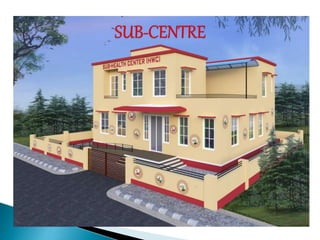
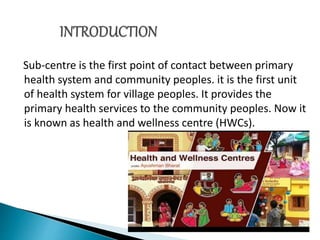
Sub-centre is the first point of contact between primary
health system and community peoples. it is the first unit
of health system for village peoples. It provides the
primary health services to the community peoples. Now it
is known as health and wellness centre (HWCs).
It covers the population of 5000 in plain area
and 3000 in hilly or tribal areas.
According to 7 February 2020 report , Total
1602 health and wellness centres functioning
in UP .
India has passed a notable landmark 1,50,000
Ayushman Bharat health and wellness centres
have been operationalised before 31
December.
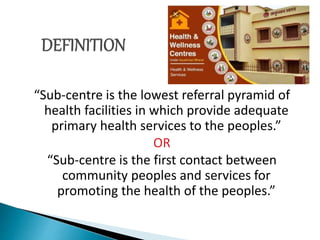
“Sub-centre is the lowest referral pyramid of
health facilities in which provide adequate
primary health services to the peoples.”
OR
“Sub-centre is the first contact between
community peoples and services for
promoting the health of the peoples.”
 National rural health mission (NRHM) is strengthen the
sub-centre to the level of Indian public health standards
which were first prescribed in early 2007.
 September 2010 , total 1,47,069 sub-centre functioning
in the country.
 In February 2018, the government of India announced
the creation of 1,50,000 health and wellness centres by
transforming existing sub-centres and PHC as the base
of pillar of Ayushman Bharat.
o To provide basic primary health care to the
community.
o To achieve and maintain acceptable standards of
quality of care.
o To make the services more responsive and sensitive to
the needs of the community.
o To facilitate supervision and monitoring of health
services.
Promotion
of health
Preventive
services
Curative
services
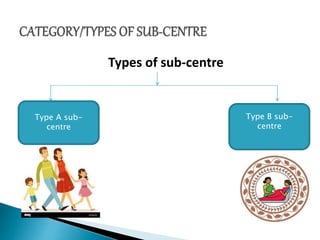
Types of sub-centre
Type A sub-
centre
Type B sub-
centre
 Total kits-16
 Sub- centre kits
 Kit A
 Kit B
 Kit C (Midwifery kit)
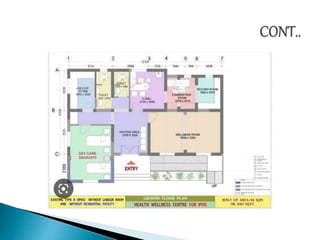
• Sub-centre should have its own building.
• Location of the centre- it should be located
within the village and no person has to travel
more than 3km to reach sub-centre.
• Building and layout- type B sub-centre
should have 4 to 5 rooms ,1 waiting room,1
labor room,1store room,1room for
office,1toilet facility , newborn corner and
ward room , one room have only 2 or 4 beds.
 Building structure should be made disaster
proof especially earthquake.
 It should not be located in low lying area.
 Fire extinguishers should available.
 Signage and furniture should also available.
 Health staff should be trained about
management and prevention of disaster.
Maternal and child health(JSY,JSSK)
Family planning and contraception
Adolescent health care
School health services
Control of endemic diseases
Safe abortion services(MTP)
Water quality monitoring
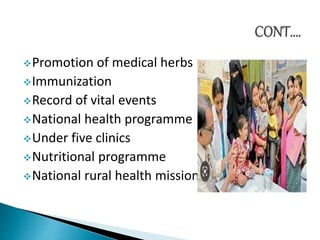
Promotion of medical herbs
Immunization
Record of vital events
National health programme
Under five clinics
Nutritional programme
National rural health mission
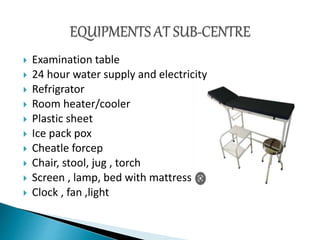
 Examination table
 24 hour water supply and electricity
 Refrigrator
 Room heater/cooler
 Plastic sheet
 Ice pack pox
 Cheatle forcep
 Chair, stool, jug , torch
 Screen , lamp, bed with mattress
 Clock , fan ,light
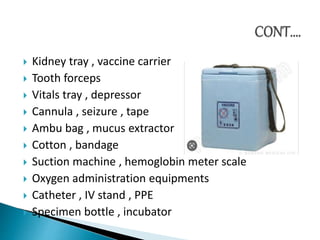
 Kidney tray , vaccine carrier
 Tooth forceps
 Vitals tray , depressor
 Cannula , seizure , tape
 Ambu bag , mucus extractor
 Cotton , bandage
 Suction machine , hemoglobin meter scale
 Oxygen administration equipments
 Catheter , IV stand , PPE
 Specimen bottle , incubator
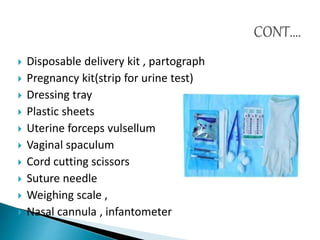
 Disposable delivery kit , partograph
 Pregnancy kit(strip for urine test)
 Dressing tray
 Plastic sheets
 Uterine forceps vulsellum
 Vaginal spaculum
 Cord cutting scissors
 Suture needle
 Weighing scale ,
 Nasal cannula , infantometer
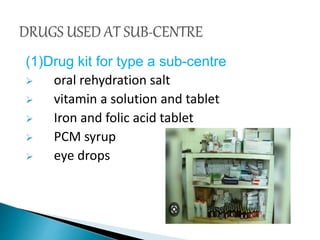
(1)Drug kit for type a sub-centre
 oral rehydration salt
 vitamin a solution and tablet
 Iron and folic acid tablet
 PCM syrup
 eye drops
(2) Drug kit for type b sub-centre
 inj. And tab . Methylergometrine
 inj . Oxytocin
 tablet and inj. Diclofenac
 inj. Magnesium sulphate , gentamycin
 tab. Mebendazle
 cap. Ampicillin , absorbent cotton, Savlon
3) Vaccines
- BCG,DPT,OPV,MEASLES,TD
- JE, Hepatitis B
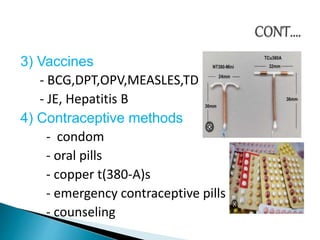
4) Contraceptive methods
- condom
- oral pills
- copper t(380-A)s
- emergency contraceptive pills
- counseling
 NRHM providing fund 10,000 to each sub-
centre .
 Fund to be kept under joint bank /post office.
 1000 fund also for maintenance of sub-centre
building.
 This fund also improve village level and
community level activities.
 Transporting emergencies available for
referral centres.
 Eligible couples
 MCH( antenatal visit , intranatal visit ,
postnatal visit)
 Under five children(immunization , growth
monitoring)
 Birth and death register
 Drug expiry register
 HIV/STD/RTI infections
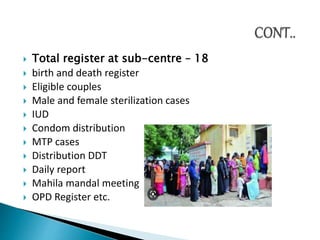
 Total register at sub-centre – 18
 birth and death register
 Eligible couples
 Male and female sterilization cases
 IUD
 Condom distribution
 MTP cases
 Distribution DDT
 Daily report
 Mahila mandal meeting
 OPD Register etc.
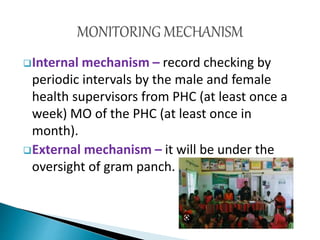
Internal mechanism – record checking by
periodic intervals by the male and female
health supervisors from PHC (at least once a
week) MO of the PHC (at least once in
month).
External mechanism – it will be under the
oversight of gram panch.
 This can be ensured through regular skill
development training / continuing medical
education(at least one training a year ) as per
guideline of NRHM.
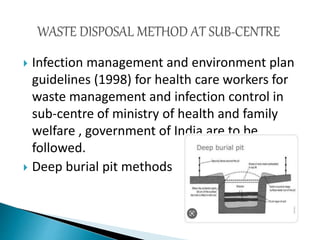
 Infection management and environment plan
guidelines (1998) for health care workers for
waste management and infection control in
sub-centre of ministry of health and family
welfare , government of India are to be
followed.
 Deep burial pit methods
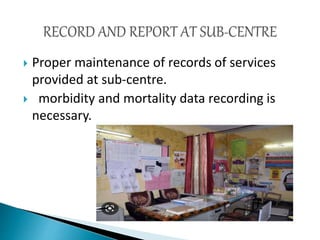
 Proper maintenance of records of services
provided at sub-centre.
 morbidity and mortality data recording is
necessary.
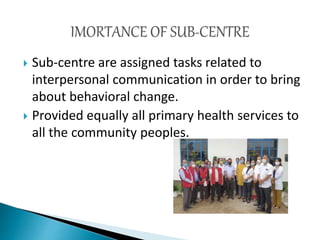
 Sub-centre are assigned tasks related to
interpersonal communication in order to bring
about behavioral change.
 Provided equally all primary health services to
all the community peoples.
1. Saxena R . P. Prof. textbook of community
health nursing . 3rd ed. Punjab : lotus
publisher.pp78-81.
2. GM Veerbhadrappa . The short textbook of
CHN . Vol 2nd.new Delhi ; the health sciences
publishers . Pp31-33.
jyoti PT  sub-centre.pptx

jyoti PT sub-centre.pptx

  • 2.
  • 4.
     Introduction  Definition Background  Objectives  Purposes  Category/types  Types of kits available at sub-centre  Physical infrastructure  manpower  Services provide at sub-centre  Equipments  Drugs
  • 5.
     Budgeting  Registrationand total register at sub-centre  Monitoring mechanism  Quality assurance  Waste disposal  Record and report  Importance  Summary  Conclusion  Bibliography
  • 6.
    Sub-centre is thefirst point of contact between primary health system and community peoples. it is the first unit of health system for village peoples. It provides the primary health services to the community peoples. Now it is known as health and wellness centre (HWCs).
  • 7.
    It covers thepopulation of 5000 in plain area and 3000 in hilly or tribal areas. According to 7 February 2020 report , Total 1602 health and wellness centres functioning in UP . India has passed a notable landmark 1,50,000 Ayushman Bharat health and wellness centres have been operationalised before 31 December.
  • 8.
    “Sub-centre is thelowest referral pyramid of health facilities in which provide adequate primary health services to the peoples.” OR “Sub-centre is the first contact between community peoples and services for promoting the health of the peoples.”
  • 9.
     National ruralhealth mission (NRHM) is strengthen the sub-centre to the level of Indian public health standards which were first prescribed in early 2007.  September 2010 , total 1,47,069 sub-centre functioning in the country.  In February 2018, the government of India announced the creation of 1,50,000 health and wellness centres by transforming existing sub-centres and PHC as the base of pillar of Ayushman Bharat.
  • 10.
    o To providebasic primary health care to the community. o To achieve and maintain acceptable standards of quality of care. o To make the services more responsive and sensitive to the needs of the community. o To facilitate supervision and monitoring of health services.
  • 11.
  • 12.
    Types of sub-centre TypeA sub- centre Type B sub- centre
  • 13.
     Total kits-16 Sub- centre kits  Kit A  Kit B  Kit C (Midwifery kit)
  • 14.
    • Sub-centre shouldhave its own building. • Location of the centre- it should be located within the village and no person has to travel more than 3km to reach sub-centre. • Building and layout- type B sub-centre should have 4 to 5 rooms ,1 waiting room,1 labor room,1store room,1room for office,1toilet facility , newborn corner and ward room , one room have only 2 or 4 beds.
  • 15.
     Building structureshould be made disaster proof especially earthquake.  It should not be located in low lying area.  Fire extinguishers should available.  Signage and furniture should also available.  Health staff should be trained about management and prevention of disaster.
  • 17.
    Maternal and childhealth(JSY,JSSK) Family planning and contraception Adolescent health care School health services Control of endemic diseases Safe abortion services(MTP) Water quality monitoring
  • 18.
    Promotion of medicalherbs Immunization Record of vital events National health programme Under five clinics Nutritional programme National rural health mission
  • 19.
     Examination table 24 hour water supply and electricity  Refrigrator  Room heater/cooler  Plastic sheet  Ice pack pox  Cheatle forcep  Chair, stool, jug , torch  Screen , lamp, bed with mattress  Clock , fan ,light
  • 20.
     Kidney tray, vaccine carrier  Tooth forceps  Vitals tray , depressor  Cannula , seizure , tape  Ambu bag , mucus extractor  Cotton , bandage  Suction machine , hemoglobin meter scale  Oxygen administration equipments  Catheter , IV stand , PPE  Specimen bottle , incubator
  • 21.
     Disposable deliverykit , partograph  Pregnancy kit(strip for urine test)  Dressing tray  Plastic sheets  Uterine forceps vulsellum  Vaginal spaculum  Cord cutting scissors  Suture needle  Weighing scale ,  Nasal cannula , infantometer
  • 22.
    (1)Drug kit fortype a sub-centre  oral rehydration salt  vitamin a solution and tablet  Iron and folic acid tablet  PCM syrup  eye drops
  • 23.
    (2) Drug kitfor type b sub-centre  inj. And tab . Methylergometrine  inj . Oxytocin  tablet and inj. Diclofenac  inj. Magnesium sulphate , gentamycin  tab. Mebendazle  cap. Ampicillin , absorbent cotton, Savlon
  • 24.
    3) Vaccines - BCG,DPT,OPV,MEASLES,TD -JE, Hepatitis B 4) Contraceptive methods - condom - oral pills - copper t(380-A)s - emergency contraceptive pills - counseling
  • 25.
     NRHM providingfund 10,000 to each sub- centre .  Fund to be kept under joint bank /post office.  1000 fund also for maintenance of sub-centre building.  This fund also improve village level and community level activities.  Transporting emergencies available for referral centres.
  • 26.
     Eligible couples MCH( antenatal visit , intranatal visit , postnatal visit)  Under five children(immunization , growth monitoring)  Birth and death register  Drug expiry register  HIV/STD/RTI infections
  • 27.
     Total registerat sub-centre – 18  birth and death register  Eligible couples  Male and female sterilization cases  IUD  Condom distribution  MTP cases  Distribution DDT  Daily report  Mahila mandal meeting  OPD Register etc.
  • 28.
    Internal mechanism –record checking by periodic intervals by the male and female health supervisors from PHC (at least once a week) MO of the PHC (at least once in month). External mechanism – it will be under the oversight of gram panch.
  • 29.
     This canbe ensured through regular skill development training / continuing medical education(at least one training a year ) as per guideline of NRHM.
  • 30.
     Infection managementand environment plan guidelines (1998) for health care workers for waste management and infection control in sub-centre of ministry of health and family welfare , government of India are to be followed.  Deep burial pit methods
  • 31.
     Proper maintenanceof records of services provided at sub-centre.  morbidity and mortality data recording is necessary.
  • 32.
     Sub-centre areassigned tasks related to interpersonal communication in order to bring about behavioral change.  Provided equally all primary health services to all the community peoples.
  • 33.
    1. Saxena R. P. Prof. textbook of community health nursing . 3rd ed. Punjab : lotus publisher.pp78-81. 2. GM Veerbhadrappa . The short textbook of CHN . Vol 2nd.new Delhi ; the health sciences publishers . Pp31-33.