Welcome
to my
Seminar
Topic –Eye Irrigation
Presented by : Pratima
B.Sc. Nursing 2nd
Year
(4th
semester)
Introduction:
Eye irrigation is a procedure that involves
flushing the eye with a saline Solution to
remove harmful chemicals And particles
from the eye.
Definition:
 Eye irrigation is an eye cleaning
method that people use to remove
a buildup of foreign bodies.
 Irrigation involves inserting liquid into
the eyes to flush the foreign bodies.
 An eye irrigation is the wasting of the
conjuctival sac by a liquid.
Purpose :
 To relive itching.
 To clean the eye.
 To remove the foreign partical
excessive secrations or discharge.
 To relive inflammation, congestion
and pain.
 To relive foreign bodies.
 To apply heat or cold.
 To treat infection.
Indications of eye irrigation-:
 Unconscious patients.
 Eye irritants.
 Preparations for surgery.
 Eye inflammation or crusting.
 Excessive secretion.
Contraindication:
 Patients with tympanic membrane
perforation.
 Patients with tympanostomy with
tubes.
 Eye surgery.
 Allergy to medication.
Complication:
 Incomplete foreign body removal
or Rusting.
 Conjunctivitis.
 Perforation of the cornea.
 Epithelial injury.
Principles involved in eye
irrigation:
 Anatomy and physiology.
 microbiology.
 Pharmacology.
 chemistry.
 Physics.
 Psychology.
Guidlines for eye
irrigation:
 Position patient in a supine position
with head turned slightly toward the
affected side.
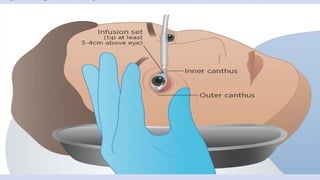
 Direct the irrigating solution along the
Conjunctiva from Inner to outer
conthes.
Equipment:
 Clean and dry work surface.
 Dressing.
 Towel or water proof cape.
 Sterile plastic undine or I. V. In fusion set.
 Sterile kidney dish.
 Universal indicator strips.
 Local anaesthetic drops, as priscribed Alc
to Local policy.
 Sterile irrigating fluid (sodium Horide
solution 0.9.1%, sterile water for irrigating
liongation or R.L.)
 A bottole of fluid is required to fill the
undine and an infusion bag should be used
with an Infusion set.
Procedure
1. Identify patient and check doctors order.2
2. Explains the purpose and procedure to the patient.
3. Prepares and administer’s medication according to
medication guidelines,” Steps to follow for all
medications.
4. Arranges the articles al along the sides of the patient.
5. Washer hands thoroughly.
6. Assists patients to low fowlers position (if possibles) with
head tilted towards affected eye:.
7. Assists patients to low fowlers position (if
possibles) With head tilted towards affected eye.
8. Places towel and basin ander patient’s cheek.
9. Cheeks PH by gently louching PH paper to secretions in the
conjunctival sac.
10. Instills ocular anaesthetic agents, if or dered or on protocol.
11. Connects tubing. JV solution and tubin tubing, Primes the.
12. Holds TV tubing about does not touch the eye. I inch from
the eye.
13.Separates eyelid with the thumb and index fingers
with non- dominant hand.
14.Directs flow of solution over the eye from inner to
outer
canthus.
15.Rechecks PH and continues to irrigate eye as
needed.
16.Checks for any Irrigation.
17.Procedur Documents the procedure in the
medication Chart.
Nursing Responsibility in Eye irrigation:
1) Read/check physicians order.
2) Explain procedure.
3) Do medical hand washing.
4) Assist pt. In sitting position /
Head tilt.
Till now we have discuss about
introduction of eye irrigation
definition, purpose, inditations of eye
irrigation, contraindicacion,
comclication, principles involved in
eye irrigation, guidlines for eye
irrigation, equipment, procedure.
Summary:
Conclusion:
Bibliography:
Thank you

EYE IRRIGATION .pptx

  • 1.
  • 2.
    Topic –Eye Irrigation Presentedby : Pratima B.Sc. Nursing 2nd Year (4th semester)
  • 3.
    Introduction: Eye irrigation isa procedure that involves flushing the eye with a saline Solution to remove harmful chemicals And particles from the eye.
  • 4.
    Definition:  Eye irrigationis an eye cleaning method that people use to remove a buildup of foreign bodies.  Irrigation involves inserting liquid into the eyes to flush the foreign bodies.  An eye irrigation is the wasting of the conjuctival sac by a liquid.
  • 6.
    Purpose :  Torelive itching.  To clean the eye.  To remove the foreign partical excessive secrations or discharge.  To relive inflammation, congestion and pain.  To relive foreign bodies.  To apply heat or cold.  To treat infection.
  • 7.
    Indications of eyeirrigation-:  Unconscious patients.  Eye irritants.  Preparations for surgery.  Eye inflammation or crusting.  Excessive secretion.
  • 8.
    Contraindication:  Patients withtympanic membrane perforation.  Patients with tympanostomy with tubes.  Eye surgery.  Allergy to medication.
  • 9.
    Complication:  Incomplete foreignbody removal or Rusting.  Conjunctivitis.  Perforation of the cornea.  Epithelial injury.
  • 10.
    Principles involved ineye irrigation:  Anatomy and physiology.  microbiology.  Pharmacology.  chemistry.  Physics.  Psychology.
  • 11.
    Guidlines for eye irrigation: Position patient in a supine position with head turned slightly toward the affected side.  Direct the irrigating solution along the Conjunctiva from Inner to outer conthes.
  • 12.
    Equipment:  Clean anddry work surface.  Dressing.  Towel or water proof cape.  Sterile plastic undine or I. V. In fusion set.  Sterile kidney dish.  Universal indicator strips.  Local anaesthetic drops, as priscribed Alc to Local policy.
  • 13.
     Sterile irrigatingfluid (sodium Horide solution 0.9.1%, sterile water for irrigating liongation or R.L.)  A bottole of fluid is required to fill the undine and an infusion bag should be used with an Infusion set.
  • 14.
    Procedure 1. Identify patientand check doctors order.2 2. Explains the purpose and procedure to the patient. 3. Prepares and administer’s medication according to medication guidelines,” Steps to follow for all medications. 4. Arranges the articles al along the sides of the patient. 5. Washer hands thoroughly. 6. Assists patients to low fowlers position (if possibles) with head tilted towards affected eye:.
  • 15.
    7. Assists patientsto low fowlers position (if possibles) With head tilted towards affected eye. 8. Places towel and basin ander patient’s cheek. 9. Cheeks PH by gently louching PH paper to secretions in the conjunctival sac. 10. Instills ocular anaesthetic agents, if or dered or on protocol. 11. Connects tubing. JV solution and tubin tubing, Primes the. 12. Holds TV tubing about does not touch the eye. I inch from the eye.
  • 16.
    13.Separates eyelid withthe thumb and index fingers with non- dominant hand. 14.Directs flow of solution over the eye from inner to outer canthus. 15.Rechecks PH and continues to irrigate eye as needed. 16.Checks for any Irrigation. 17.Procedur Documents the procedure in the medication Chart.
  • 17.
    Nursing Responsibility inEye irrigation: 1) Read/check physicians order. 2) Explain procedure. 3) Do medical hand washing. 4) Assist pt. In sitting position / Head tilt.
  • 18.
    Till now wehave discuss about introduction of eye irrigation definition, purpose, inditations of eye irrigation, contraindicacion, comclication, principles involved in eye irrigation, guidlines for eye irrigation, equipment, procedure. Summary:
  • 19.
  • 20.
  • 21.