NATIONAL HEALTH
PROGRAMMES
1.NATIONAL HEALTH PROGRAMMES
FOR NON COMMUNICABLE
DISEASES(NCD)
2.NATIONAL HEALTH PROGRAMMES
FOR COMMUNICABLE DISEASES
NATIONAL HEALTH PROGRAMMES FOR NON
COMMUNICABLE DISEASES(NCD
• 1.National Programme for Control of
Blindness & Visual Imapirment (NPCB)
• 2.National Programme for Prevention &
Control of Cancer, Diabetes , Cardio Vascular
Diseases & Stroke.(NPCDCS)
• 3.National Mental Health programme
(NMHP):
NATIONAL HEALTH PROGRAMMES FOR COMMUNICABLE
DISEASES
• National Vector Borne Disease Control
Programme (NVBDCP)
• It is an umbrella programme for prevention
and control of vector borne diseases (malaria,
dengue, chicken gunya, Japanese encephalitis,
filariasis (transmitted by mosquitoes), kala-
azar (transmitted by sand flies) etc.
Vector Control
.
• Transmission of vector borne diseases
depends on prevalence of infective vectors
and human- vector contact. Vector
management can play a crucial role in control
and elimination of vector borne diseases
Antiadult measures (destruction of
adult vectors)
• Various anti adult measures include
• Chemical Control
• 1. Residual sprays: Eg: Use of Insecticides like
DDT, Malathion etc:-
• 2. Space sprays: Eg: fogging, ultralow volume
space spray
• Genetic Control This include Sterile male
technique, chromosomal translocation, Sex
distortion, gene replacement etc.
Antilarval measures (destruction of
larvae)
• Environmental Modification:
• This include Drainage: Ensure proper drainage facilities for stagnant
water, urban and rural drainage of infested water etc.
• Filling: Water collection areas are duly filled in time.
• Solid waste management: Solid waste (non-biodegradable) items of
house hold, community and industrial wastes
• Chemical Control: Use of Oils like diesel, fuel oil, kerosene, crude oil
etc. The thin layer of oil formed on the surface of water obstructs
air supply. Use of synthetic insecticides like malathion, fenthion,
chlorpyrifos are also effective.
• Biological Control: Mosquitoes are controlled using their natural
enemies like fishes (Eg:guppies, gambusia), nematodes,
bacteria(Bacillus thuringienses), fungi (Eg:Cylindrosporum) etc:
DRY DAY
• Mosquitoes breed at a place where water
remains stagnant for a long time.
Implementation of dry day help in preventing
water collection in utensils, water tanks or
other containers for more than a week and
thereby reducing the chances of breeding
National TB Elimination Programme
(NTEP)
• In 2020 RNTCP (Revised National TB Control
Programme) Renamed as NTEP
• 1. To reduce the mortality rate due to TB
• 2. To prevent further emergence of drug
resistance and effectively manage drug
resistant TB cases
• 3. NTEP goal is to eliminate TB
What is DOTS?
• Directly observed treatment, short-course
(DOTS, also known as TBDOTS) is the name
given to the tuberculosis (TB) control strategy
recommended by the World Health
Organization. DOT means that a trained health
care worker or other designated individual
(excluding a family member) provides the
prescribed TB drugs and watches the patient
swallow every dose
ROLE OF FHW (TREATMENT
SUPPORTER) DURING & AFTER “DOTS”
• Initial and treatment follow up, counselling of the
patient and family members, supervision of treatment,
additional nutritional support, screening of adverse
reactions, psycho- social support and follow up lab
investigations.
• The patient should consume every dose of treatment
before a health worker.
• FOLLOW UP-Patient should be closely monitored for
treatment progress. Two components: 1. Clinical follow
up: should be done monthly 2. Laboratory follow up: In
pulmonary tuberculosis, sputum smear microscopy
should be done at the end of IP and end of treatment.
Long term follow up: After completion of treatment,
follow up at the end of 6,12,18 &24 months.
National AIDS Control Programme
(NACP)
• Launched in 1992,
• It is a comprehensive programme for prevention
and control of HIV/AIDS in India. National AIDS
Control Board (NACB) was constituted and an
autonomous National AIDS Control Organization
(NACO) was set up to implement the project.
Objective: To reduce the spread of HIV infection
in India. To increase India’s capacity to respond to
HIV/AIDS on a long-term basis.
SCREENING OF LEPROSY (Hansen’s
disease) PATIENTS AND THEIR
REFERRAL
• SCREENING OF LEPROSY (Hansen’s disease)
PATIENTS AND THEIR REFERRAL It is a chronic
infectious disease. It is caused by
Mycobacterium leprae. Leprosy is
characterized by the formation of nodules that
enlarge and spread with loss of sensation,
production of deformities, paralysis etc.
Screening for leprosy
• Mainly involves examination of skin lesions with loss of
sensations.
• A skin biopsy involves removing a small section of skin
from suspected area for laboratory testing.
• A Lepromin skin test is also used along with skin biopsy
for confirmation.
• . Health personnel should be able to:- Identify
suspected cases of leprosy. Demonstrate correct
method of examination of skin lesions. Follow up
patients till treatment completion. Identify
complications and proper referral.
NATIONAL FRAMEWORK FOR MALARIA
ELIMNATION PROGRAMME (2016- 30) (NFME)
• GOALS
• Eliminate malaria throughout the entire country by 2030; and
• • Maintain malaria–free status in areas where malaria transmission
has been interrupted and prevent re-introduction of malaria.
• Objectives:
• Eliminate malaria from all 26 transmission states/union territories
by 2022.
• • Reduce the incidence of malaria to less than 1 case per 1000
population per year by 2024.
• • Prevent transmission of malaria throughout the entire country,
2027.
• • Prevent the occurrence of local transmission of malaria in all
eliminated area and maintain national malaria-free status by 2030
Referral and Isolation in communicable
disease
• Referral is the transfer of care for a patient
from one clinician or clinic to another by
request. Tertiary care is usually done by
referral from primary or secondary medical
care personnel. Isolation: separates sick
people from people who are not sick.
Quarantine: separates and restricts the
movement of people who were exposed to a
contagious disease to see if they become sick.
Isolation
• If a person is suspected to have a communicable disease,
he or she should be temporarily isolated and seek medical
aid promptly. Control measures should be strictly
implemented to protect others.
• Isolation measures include:
• • Reserve separate rooms for patients.
• • Carers should attend both the physical and psychological
needs of patients
• • Staff should take appropriate protective measures
including hand hygiene, use of surgical mask and suitable
PPE when entering the rooms.
• • Isolation rooms should be available at any time and
should not be used for any other purpose.
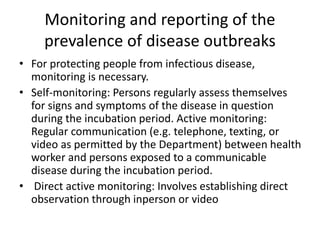
Monitoring and reporting of the
prevalence of disease outbreaks
• For protecting people from infectious disease,
monitoring is necessary.
• Self-monitoring: Persons regularly assess themselves
for signs and symptoms of the disease in question
during the incubation period. Active monitoring:
Regular communication (e.g. telephone, texting, or
video as permitted by the Department) between health
worker and persons exposed to a communicable
disease during the incubation period.
• Direct active monitoring: Involves establishing direct
observation through inperson or video
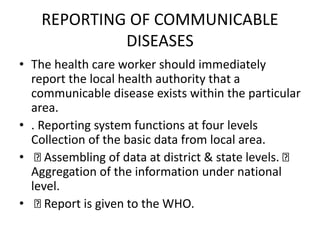
REPORTING OF COMMUNICABLE
DISEASES
• The health care worker should immediately
report the local health authority that a
communicable disease exists within the particular
area.
• . Reporting system functions at four levels
Collection of the basic data from local area.
• Assembling of data at district & state levels.
Aggregation of the information under national
level.
• Report is given to the WHO.
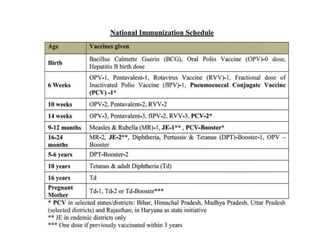
UNIVERSAL IMMUNIZATION PROGRAMME
• Immunization Programme is one of the key interventions for
protection of children from life threatening conditions, which
are preventable.
• It is one of the largest immunization programme in the world
and a major public health intervention in the country.
Immunization Programme in India was introduced in 1978 and
in 1985, expanded as Universal Immunization Programme
(UIP) to be implemented in phased manner to cover all
districts in the country by 1989-90. Under the Universal
Immunization Programme, Government of India is providing
vaccination to prevent seven vaccine preventable diseases i.e.
Diphtheria, Pertussis, Tetanus, Polio, Measles, severe form of
Childhood Tuberculosis and Hepatitis B, Haemophilus
influenza type b (Hib) and Diarrhoea.
• Importance of immunization:- Immunizations,
also known as vaccinations, help protect you
from getting an infectious disease. When you
get vaccinated, you help protect others as well
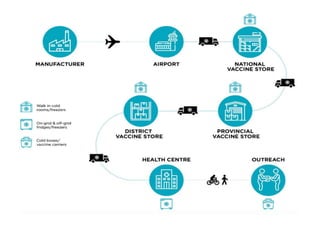
Cold chain maintenance
• : The purpose of the vaccine “cold chain” is to
maintain product quality from the time of
manufacture until the point of administration
by ensuring that vaccines are stored and
transported within WHO-recommended
temperature ranges
Failure of cold chain maintanance
• The result of failing to monitor vaccine
temperatures accurately
• Formula degradation & Loss of potency
• Waste of product and money
• Substandard immunologic responses
• Need to re-immunize patients
national health programmes.pptx

national health programmes.pptx

  • 1.
    NATIONAL HEALTH PROGRAMMES 1.NATIONAL HEALTHPROGRAMMES FOR NON COMMUNICABLE DISEASES(NCD) 2.NATIONAL HEALTH PROGRAMMES FOR COMMUNICABLE DISEASES
  • 2.
    NATIONAL HEALTH PROGRAMMESFOR NON COMMUNICABLE DISEASES(NCD • 1.National Programme for Control of Blindness & Visual Imapirment (NPCB) • 2.National Programme for Prevention & Control of Cancer, Diabetes , Cardio Vascular Diseases & Stroke.(NPCDCS) • 3.National Mental Health programme (NMHP):
  • 3.
    NATIONAL HEALTH PROGRAMMESFOR COMMUNICABLE DISEASES • National Vector Borne Disease Control Programme (NVBDCP) • It is an umbrella programme for prevention and control of vector borne diseases (malaria, dengue, chicken gunya, Japanese encephalitis, filariasis (transmitted by mosquitoes), kala- azar (transmitted by sand flies) etc.
  • 4.
    Vector Control . • Transmissionof vector borne diseases depends on prevalence of infective vectors and human- vector contact. Vector management can play a crucial role in control and elimination of vector borne diseases
  • 5.
    Antiadult measures (destructionof adult vectors) • Various anti adult measures include • Chemical Control • 1. Residual sprays: Eg: Use of Insecticides like DDT, Malathion etc:- • 2. Space sprays: Eg: fogging, ultralow volume space spray • Genetic Control This include Sterile male technique, chromosomal translocation, Sex distortion, gene replacement etc.
  • 6.
    Antilarval measures (destructionof larvae) • Environmental Modification: • This include Drainage: Ensure proper drainage facilities for stagnant water, urban and rural drainage of infested water etc. • Filling: Water collection areas are duly filled in time. • Solid waste management: Solid waste (non-biodegradable) items of house hold, community and industrial wastes • Chemical Control: Use of Oils like diesel, fuel oil, kerosene, crude oil etc. The thin layer of oil formed on the surface of water obstructs air supply. Use of synthetic insecticides like malathion, fenthion, chlorpyrifos are also effective. • Biological Control: Mosquitoes are controlled using their natural enemies like fishes (Eg:guppies, gambusia), nematodes, bacteria(Bacillus thuringienses), fungi (Eg:Cylindrosporum) etc:
  • 7.
    DRY DAY • Mosquitoesbreed at a place where water remains stagnant for a long time. Implementation of dry day help in preventing water collection in utensils, water tanks or other containers for more than a week and thereby reducing the chances of breeding
  • 8.
    National TB EliminationProgramme (NTEP) • In 2020 RNTCP (Revised National TB Control Programme) Renamed as NTEP • 1. To reduce the mortality rate due to TB • 2. To prevent further emergence of drug resistance and effectively manage drug resistant TB cases • 3. NTEP goal is to eliminate TB
  • 9.
    What is DOTS? •Directly observed treatment, short-course (DOTS, also known as TBDOTS) is the name given to the tuberculosis (TB) control strategy recommended by the World Health Organization. DOT means that a trained health care worker or other designated individual (excluding a family member) provides the prescribed TB drugs and watches the patient swallow every dose
  • 10.
    ROLE OF FHW(TREATMENT SUPPORTER) DURING & AFTER “DOTS” • Initial and treatment follow up, counselling of the patient and family members, supervision of treatment, additional nutritional support, screening of adverse reactions, psycho- social support and follow up lab investigations. • The patient should consume every dose of treatment before a health worker. • FOLLOW UP-Patient should be closely monitored for treatment progress. Two components: 1. Clinical follow up: should be done monthly 2. Laboratory follow up: In pulmonary tuberculosis, sputum smear microscopy should be done at the end of IP and end of treatment. Long term follow up: After completion of treatment, follow up at the end of 6,12,18 &24 months.
  • 11.
    National AIDS ControlProgramme (NACP) • Launched in 1992, • It is a comprehensive programme for prevention and control of HIV/AIDS in India. National AIDS Control Board (NACB) was constituted and an autonomous National AIDS Control Organization (NACO) was set up to implement the project. Objective: To reduce the spread of HIV infection in India. To increase India’s capacity to respond to HIV/AIDS on a long-term basis.
  • 12.
    SCREENING OF LEPROSY(Hansen’s disease) PATIENTS AND THEIR REFERRAL • SCREENING OF LEPROSY (Hansen’s disease) PATIENTS AND THEIR REFERRAL It is a chronic infectious disease. It is caused by Mycobacterium leprae. Leprosy is characterized by the formation of nodules that enlarge and spread with loss of sensation, production of deformities, paralysis etc.
  • 13.
    Screening for leprosy •Mainly involves examination of skin lesions with loss of sensations. • A skin biopsy involves removing a small section of skin from suspected area for laboratory testing. • A Lepromin skin test is also used along with skin biopsy for confirmation. • . Health personnel should be able to:- Identify suspected cases of leprosy. Demonstrate correct method of examination of skin lesions. Follow up patients till treatment completion. Identify complications and proper referral.
  • 14.
    NATIONAL FRAMEWORK FORMALARIA ELIMNATION PROGRAMME (2016- 30) (NFME) • GOALS • Eliminate malaria throughout the entire country by 2030; and • • Maintain malaria–free status in areas where malaria transmission has been interrupted and prevent re-introduction of malaria. • Objectives: • Eliminate malaria from all 26 transmission states/union territories by 2022. • • Reduce the incidence of malaria to less than 1 case per 1000 population per year by 2024. • • Prevent transmission of malaria throughout the entire country, 2027. • • Prevent the occurrence of local transmission of malaria in all eliminated area and maintain national malaria-free status by 2030
  • 15.
    Referral and Isolationin communicable disease • Referral is the transfer of care for a patient from one clinician or clinic to another by request. Tertiary care is usually done by referral from primary or secondary medical care personnel. Isolation: separates sick people from people who are not sick. Quarantine: separates and restricts the movement of people who were exposed to a contagious disease to see if they become sick.
  • 16.
    Isolation • If aperson is suspected to have a communicable disease, he or she should be temporarily isolated and seek medical aid promptly. Control measures should be strictly implemented to protect others. • Isolation measures include: • • Reserve separate rooms for patients. • • Carers should attend both the physical and psychological needs of patients • • Staff should take appropriate protective measures including hand hygiene, use of surgical mask and suitable PPE when entering the rooms. • • Isolation rooms should be available at any time and should not be used for any other purpose.
  • 17.
    Monitoring and reportingof the prevalence of disease outbreaks • For protecting people from infectious disease, monitoring is necessary. • Self-monitoring: Persons regularly assess themselves for signs and symptoms of the disease in question during the incubation period. Active monitoring: Regular communication (e.g. telephone, texting, or video as permitted by the Department) between health worker and persons exposed to a communicable disease during the incubation period. • Direct active monitoring: Involves establishing direct observation through inperson or video
  • 18.
    REPORTING OF COMMUNICABLE DISEASES •The health care worker should immediately report the local health authority that a communicable disease exists within the particular area. • . Reporting system functions at four levels Collection of the basic data from local area. • Assembling of data at district & state levels. Aggregation of the information under national level. • Report is given to the WHO.
  • 19.
    UNIVERSAL IMMUNIZATION PROGRAMME •Immunization Programme is one of the key interventions for protection of children from life threatening conditions, which are preventable. • It is one of the largest immunization programme in the world and a major public health intervention in the country. Immunization Programme in India was introduced in 1978 and in 1985, expanded as Universal Immunization Programme (UIP) to be implemented in phased manner to cover all districts in the country by 1989-90. Under the Universal Immunization Programme, Government of India is providing vaccination to prevent seven vaccine preventable diseases i.e. Diphtheria, Pertussis, Tetanus, Polio, Measles, severe form of Childhood Tuberculosis and Hepatitis B, Haemophilus influenza type b (Hib) and Diarrhoea.
  • 20.
    • Importance ofimmunization:- Immunizations, also known as vaccinations, help protect you from getting an infectious disease. When you get vaccinated, you help protect others as well
  • 22.
    Cold chain maintenance •: The purpose of the vaccine “cold chain” is to maintain product quality from the time of manufacture until the point of administration by ensuring that vaccines are stored and transported within WHO-recommended temperature ranges
  • 23.
    Failure of coldchain maintanance • The result of failing to monitor vaccine temperatures accurately • Formula degradation & Loss of potency • Waste of product and money • Substandard immunologic responses • Need to re-immunize patients