Ethics in Research
Madhulipika Giri
Ethics
Ethics refers to a set of moral principles or rules that guide human
behavior, particularly in contexts such as society, professional practices,
and research. Ethics concerns determining what is right and wrong, just
and unjust, and fair or unfair. It is central to ensuring that actions,
decisions, and outcomes respect individuals' rights and promote well-
being while avoiding harm or exploitation.
Key Aspects of Ethics:
1. Moral Principles: Ethics is based on fundamental moral principles,
such as:
• Justice: Fair treatment and distribution of resources or benefits.
• Respect for Autonomy: Acknowledging individuals' rights to make
their own decisions.
• Beneficence: Acting in ways that promote the well-being of others.
• Non-Maleficence: Avoiding harm or causing the least harm possible.
• Fidelity: Honoring commitments and being trustworthy.
2. Ethical Theories:
• Deontology: Emphasizes duties and rules. Actions are considered
ethical if they follow certain rules or principles, regardless of the
consequences.
• Utilitarianism: Focuses on outcomes, asserting that actions are right if
they result in the greatest good for the greatest number.
• Virtue Ethics: Centers on the character of the person performing the
action, emphasizing virtues like honesty, kindness, and fairness.
3. Ethics in Research: In the context of research, ethics ensures the integrity
of the scientific process, protects participants' rights, and promotes social
good. Ethical research involves principles such as informed consent,
confidentiality, and the minimization of harm. It also requires transparency,
honesty, and accountability in data collection, analysis, and reporting.
4. Professional Ethics: Different professions (e.g., medicine, law, business)
have specific ethical codes that guide practitioners' conduct. These codes
are designed to promote fairness, accountability, and respect for individuals
and communities.
5. Ethics in Society: On a broader scale, ethics in society involves
discussions about justice, equality, rights, and social responsibility. It
tackles questions such as how to balance individual freedoms with
collective well-being, how to ensure fairness in laws and policies, and
how to handle issues like discrimination, poverty, and environmental
sustainability.
Why Ethics Matter:
• Protects Rights and Welfare: Ethics ensures the protection of
individuals' rights and promotes their well-being, particularly in
situations involving vulnerable populations.
• Promotes Accountability and Integrity: Ethical behavior builds trust,
accountability, and respect in relationships, professions, and research.
• Guides Decision-Making: Ethical frameworks provide a basis for
making difficult decisions, particularly when choices have far-
reaching consequences.
• Fosters Social Good: Ethical actions contribute to a more just and fair
society, improving the quality of life for individuals and communities.
Ethical Principles in Research
• Ethical principles in research provide the foundation for ensuring that
research is conducted with integrity, respect for individuals, and
consideration for societal benefit. These principles are crucial in
safeguarding the rights of participants, promoting trust in research
findings, and fostering ethical behavior among researchers. Here are
the key ethical principles in research:
1. Respect for Persons
• Informed Consent: Researchers must ensure that participants are fully
informed about the nature of the research, its purpose, procedures, risks,
and potential benefits. They should have the autonomy to make an
informed decision about participation without coercion.
• Autonomy: Participants should be treated as autonomous individuals,
free to make their own decisions regarding their involvement in research.
• Protection of Vulnerable Populations: Special care must be taken when
working with vulnerable groups (e.g., children, the elderly, those with
cognitive impairments) to ensure their safety, understanding, and
voluntary participation.
2. Beneficence
• Maximizing Benefits: The principle of beneficence requires
researchers to maximize the benefits of research and minimize any
potential harm to participants.
• Risk Minimization: Researchers should evaluate and minimize risks,
ensuring that the benefits of the research outweigh the risks involved.
• Well-being of Participants: Researchers have a duty to ensure that
participants’ physical, psychological, and social well-being are
protected throughout the research process.
3. Non-Maleficence
• Do No Harm: The principle of non-maleficence requires researchers to
avoid causing harm or distress to participants. This involves ensuring
that the research design, methodology, and practices are safe and that
any negative consequences are minimized.
• Risk Assessment: Ethical research requires that potential harms,
whether physical, emotional, or social, are carefully assessed and
mitigated before starting the study.
4. Justice
• Fairness in Recruitment and Treatment: Research should be conducted
fairly, with equal opportunity for all participants to take part,
especially those from vulnerable or marginalized groups.
• Equitable Distribution of Risks and Benefits: The risks and benefits of
research should be distributed fairly. No group should bear an undue
share of the risks or be excluded from potential benefits.
• Avoiding Exploitation: Researchers must ensure that participants are
not exploited for their involvement, especially vulnerable or
underserved communities.
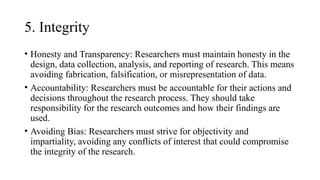
5. Integrity
• Honesty and Transparency: Researchers must maintain honesty in the
design, data collection, analysis, and reporting of research. This means
avoiding fabrication, falsification, or misrepresentation of data.
• Accountability: Researchers must be accountable for their actions and
decisions throughout the research process. They should take
responsibility for the research outcomes and how their findings are
used.
• Avoiding Bias: Researchers must strive for objectivity and
impartiality, avoiding any conflicts of interest that could compromise
the integrity of the research.
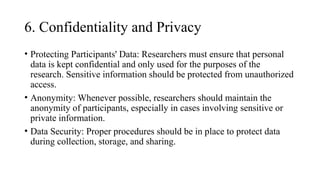
6. Confidentiality and Privacy
• Protecting Participants' Data: Researchers must ensure that personal
data is kept confidential and only used for the purposes of the
research. Sensitive information should be protected from unauthorized
access.
• Anonymity: Whenever possible, researchers should maintain the
anonymity of participants, especially in cases involving sensitive or
private information.
• Data Security: Proper procedures should be in place to protect data
during collection, storage, and sharing.
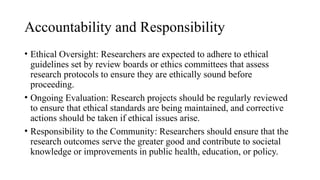
Accountability and Responsibility
• Ethical Oversight: Researchers are expected to adhere to ethical
guidelines set by review boards or ethics committees that assess
research protocols to ensure they are ethically sound before
proceeding.
• Ongoing Evaluation: Research projects should be regularly reviewed
to ensure that ethical standards are being maintained, and corrective
actions should be taken if ethical issues arise.
• Responsibility to the Community: Researchers should ensure that the
research outcomes serve the greater good and contribute to societal
knowledge or improvements in public health, education, or policy.
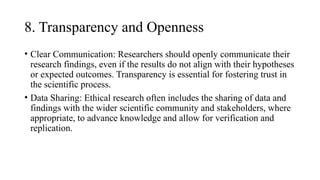
8. Transparency and Openness
• Clear Communication: Researchers should openly communicate their
research findings, even if the results do not align with their hypotheses
or expected outcomes. Transparency is essential for fostering trust in
the scientific process.
• Data Sharing: Ethical research often includes the sharing of data and
findings with the wider scientific community and stakeholders, where
appropriate, to advance knowledge and allow for verification and
replication.
9. Social and Cultural Sensitivity
• Cultural Competence: Researchers should respect the cultural values
and beliefs of the participants and communities involved in the
research. This includes considering cultural norms and ensuring that
the research design is culturally appropriate.
• Avoiding Harmful Stereotypes: Researchers should ensure that their
work does not perpetuate harmful stereotypes or biases about certain
groups or communities.
These ethical principles ensure that research is conducted responsibly,
with respect for participants, and with an awareness of its broader social
and cultural impact. Ethical research fosters public trust, enhances the
quality of science, and supports the advancement of knowledge for the
benefit of society.
Informed consent document
In research involving human participants the investigator must obtain
the informed consent of the pro spective participant. Thus, it is the
responsibility of the investigator to prepare an informed consent
document (ICD), which includes
(1) participant information sheet (PIS) and
(2) informed consent form (ICF), and get it approved by the ethical
committee (EC) and let each participant read the document carefully,
clarify all the doubts and obtain an informed written voluntary consent
from each study participant before the data collection begins in the
study.
Contd..
If a participant is not capable of giving voluntary, the consent must be
obtained from a legally acceptable/authorized representative (LAR).
Furthermore, while obtaining consent from an illiterate participant, the
presence of an impartial literate witness is mandatory during consent
process.
The main purpose of obtaining an informed written voluntary consent
from each study par- ticipant is to protect participant's freedom of
choice and respect the individual's autonomy.
Participant information sheet
It is important for the researcher to provide complete information to the
prospective participants about the study objectives, its methodology,
details about expected duration and the kind of involvement from the
par- ticipants, benefits to participants, foreseeable risks/
discomfort/inconvenience to participants, provision of
payments/reimbursement, free treatment and/or com- pensation,
assurance about confidentiality of information provided. freedom for
participants to participate or withdraw from study.
Informed consent must be sought only after the participant has read and
understood
Informed consent form
The informed consent form (ICF) is part of an information consent document,
which has the declaration, I have carefully read (someone has read) to me and I
am aware that I am being asked to participate in a research study I have had the
opportunity to ask questions and have had them answered to my satisfaction. I
voluntarily agree to participate in this research study I am not giving any legal
right by signing this form. I will be given a copy of this form. In the end, the
form has signature lines (to obtain the signature of the subject and
countersignature by the investigator who obtained the consent).
The ICD (participation information sheet (PIS) and ICF) should be ideally
prepared as a separate PIS and an ICF However, a single document (PIS and
ICF) may also work in research involving less risk. An example of ICD as a
single documem is presented-
Informed consent document for research
study Participant information sheet (PIS)
• Study title: A randomized control trial on efficacy of transparent film
dressing versus pressure dressing on prevention of bleeding and
discomfort among patients undergoing coronary angiography at
AllMS, Rishikesh
• Purpose of study: To assess and compare the efficacy of transparent
film dressing versus pressure dressing on prevention of bleeding and
discomfort among patients undergoing coronary angiography
• Principal investigator: Dr Suresh K. Sharma Professor and Principal
College of Nursing, AllMS, Rishikesh
• Sponsor: Indian Medical Counol of Research (ICMR), New Delhi
Contd...
• This a a consent form for research participant. It contains important information
about this study and what to expect if you decide to participate. Your participation is
voluntary Please consider the information carefully and feel free to ask questions
before making your decision whether or not to participate, you will be asked to sign
this form and will receive a copy of the form
• Methodology: A total of 300 patients will be randomly assigned to one of two
groups, pressure dressing or transpar ent film dressing. Outcome variables were
bleeding, patient discomfort and nurse-reported ease of observation of the groin site
• Procedure/task: After the removal of sheath, a manual pressure of 20-30 minutes
and application of transparent orange handle dressing will be applied at arterial
puricture site in femoral region in experimental group and a conven- tional dressing
in control group resured by state of central government Also your records may be
reviewed by the following group (as applicable to the research)
Contd..
• Duration: One year, but you may leave the study at any time if you decide
to stop participation in the study, there will be no penalty to you and you
will not lose any benefits to which you are otherwise entitled. Your decision
will not affect your future relationship with this institute.
• Risk and benefits: There may be the risk of bleeding at arterial puncture
site. It is expected that there will be decreased change discomfort and skin
pealing at transparent dressing
• Confidentiality: Efforts may be made to keep your study related
information confidential. Outside the study, your name will not be linked to
your data. One year after the publication of this study results, your
identifying information will be destroyed. However, during the conduct of
the study, there may be circumstances where your study-related information
may be released.
Contd..
For example, personal information regarding your participation in this study may be
disclosed required by state of central government Also your records may be reviewed
by the following group (as applicable to the research)
Office of Human Research Protection or national/statelevel regulatory agencies
Institutional Ethical Committee (IEC)
Sponsoning agency of any
• Incentive: Your dressing will be free of cost, no other incentives will be given for
participating this study
• Participation right: The Institutional Ethical Committee ECI responsible for human
participants research an AIIMS Rishaesh, reviewed this research project and found it
to be acceptable, according to the applicable ethical guidelines for biomedical
research and law of land and IEC policies designed to protect the rights and welfare of
participants in research:
Contd...
• Contacts and questions: For any question, concern, or complent
about this research study, you may contact Dr Suresh & Sharma on
300000X0293 or XXX@yahoo.com(PI).
• For questions about your rights as a participant in this study or to
discuss other study-related concerns or complaint with someone who
is not part of the research team, you may contact contact details of
chairperson/member secretary IEC
• If you are injured harmed as a result of partcipating in this study or for
questions about a study-related injury, you may contact Dr Ansuman
Darbari on XXXXXX0263 or XXX yahoo.com (Co-PI)
Informed consent form (ICF)
I have read tor someone has read to me) this form and I am aware that I
am being asked to participate in a research study I have had the
opportunity to ask questions and have had them answered to my
satisfaction I voluntarily agree to participate in this research study I am
not giving any legal right by signing this form I will be given a copy of
this form
Name of subject/ authorized person
Signature of subject/ authorized person
Date and time
Investigator/Research Staff
I have explained the research to the participant or his/her representative
before requesting the signatures above. A copy of the form has been
given to the participant or her representative
Name of person obtaining consent
Signature of person obtaining consent
Date and time
Ethics in Research scientific studies PP

Ethics in Research scientific studies PP

  • 1.
  • 2.
    Ethics Ethics refers toa set of moral principles or rules that guide human behavior, particularly in contexts such as society, professional practices, and research. Ethics concerns determining what is right and wrong, just and unjust, and fair or unfair. It is central to ensuring that actions, decisions, and outcomes respect individuals' rights and promote well- being while avoiding harm or exploitation.
  • 3.
    Key Aspects ofEthics: 1. Moral Principles: Ethics is based on fundamental moral principles, such as: • Justice: Fair treatment and distribution of resources or benefits. • Respect for Autonomy: Acknowledging individuals' rights to make their own decisions. • Beneficence: Acting in ways that promote the well-being of others. • Non-Maleficence: Avoiding harm or causing the least harm possible. • Fidelity: Honoring commitments and being trustworthy.
  • 4.
    2. Ethical Theories: •Deontology: Emphasizes duties and rules. Actions are considered ethical if they follow certain rules or principles, regardless of the consequences. • Utilitarianism: Focuses on outcomes, asserting that actions are right if they result in the greatest good for the greatest number. • Virtue Ethics: Centers on the character of the person performing the action, emphasizing virtues like honesty, kindness, and fairness.
  • 5.
    3. Ethics inResearch: In the context of research, ethics ensures the integrity of the scientific process, protects participants' rights, and promotes social good. Ethical research involves principles such as informed consent, confidentiality, and the minimization of harm. It also requires transparency, honesty, and accountability in data collection, analysis, and reporting. 4. Professional Ethics: Different professions (e.g., medicine, law, business) have specific ethical codes that guide practitioners' conduct. These codes are designed to promote fairness, accountability, and respect for individuals and communities.
  • 6.
    5. Ethics inSociety: On a broader scale, ethics in society involves discussions about justice, equality, rights, and social responsibility. It tackles questions such as how to balance individual freedoms with collective well-being, how to ensure fairness in laws and policies, and how to handle issues like discrimination, poverty, and environmental sustainability.
  • 7.
    Why Ethics Matter: •Protects Rights and Welfare: Ethics ensures the protection of individuals' rights and promotes their well-being, particularly in situations involving vulnerable populations. • Promotes Accountability and Integrity: Ethical behavior builds trust, accountability, and respect in relationships, professions, and research. • Guides Decision-Making: Ethical frameworks provide a basis for making difficult decisions, particularly when choices have far- reaching consequences. • Fosters Social Good: Ethical actions contribute to a more just and fair society, improving the quality of life for individuals and communities.
  • 8.
    Ethical Principles inResearch • Ethical principles in research provide the foundation for ensuring that research is conducted with integrity, respect for individuals, and consideration for societal benefit. These principles are crucial in safeguarding the rights of participants, promoting trust in research findings, and fostering ethical behavior among researchers. Here are the key ethical principles in research:
  • 9.
    1. Respect forPersons • Informed Consent: Researchers must ensure that participants are fully informed about the nature of the research, its purpose, procedures, risks, and potential benefits. They should have the autonomy to make an informed decision about participation without coercion. • Autonomy: Participants should be treated as autonomous individuals, free to make their own decisions regarding their involvement in research. • Protection of Vulnerable Populations: Special care must be taken when working with vulnerable groups (e.g., children, the elderly, those with cognitive impairments) to ensure their safety, understanding, and voluntary participation.
  • 10.
    2. Beneficence • MaximizingBenefits: The principle of beneficence requires researchers to maximize the benefits of research and minimize any potential harm to participants. • Risk Minimization: Researchers should evaluate and minimize risks, ensuring that the benefits of the research outweigh the risks involved. • Well-being of Participants: Researchers have a duty to ensure that participants’ physical, psychological, and social well-being are protected throughout the research process.
  • 11.
    3. Non-Maleficence • DoNo Harm: The principle of non-maleficence requires researchers to avoid causing harm or distress to participants. This involves ensuring that the research design, methodology, and practices are safe and that any negative consequences are minimized. • Risk Assessment: Ethical research requires that potential harms, whether physical, emotional, or social, are carefully assessed and mitigated before starting the study.
  • 12.
    4. Justice • Fairnessin Recruitment and Treatment: Research should be conducted fairly, with equal opportunity for all participants to take part, especially those from vulnerable or marginalized groups. • Equitable Distribution of Risks and Benefits: The risks and benefits of research should be distributed fairly. No group should bear an undue share of the risks or be excluded from potential benefits. • Avoiding Exploitation: Researchers must ensure that participants are not exploited for their involvement, especially vulnerable or underserved communities.
  • 13.
    5. Integrity • Honestyand Transparency: Researchers must maintain honesty in the design, data collection, analysis, and reporting of research. This means avoiding fabrication, falsification, or misrepresentation of data. • Accountability: Researchers must be accountable for their actions and decisions throughout the research process. They should take responsibility for the research outcomes and how their findings are used. • Avoiding Bias: Researchers must strive for objectivity and impartiality, avoiding any conflicts of interest that could compromise the integrity of the research.
  • 14.
    6. Confidentiality andPrivacy • Protecting Participants' Data: Researchers must ensure that personal data is kept confidential and only used for the purposes of the research. Sensitive information should be protected from unauthorized access. • Anonymity: Whenever possible, researchers should maintain the anonymity of participants, especially in cases involving sensitive or private information. • Data Security: Proper procedures should be in place to protect data during collection, storage, and sharing.
  • 15.
    Accountability and Responsibility •Ethical Oversight: Researchers are expected to adhere to ethical guidelines set by review boards or ethics committees that assess research protocols to ensure they are ethically sound before proceeding. • Ongoing Evaluation: Research projects should be regularly reviewed to ensure that ethical standards are being maintained, and corrective actions should be taken if ethical issues arise. • Responsibility to the Community: Researchers should ensure that the research outcomes serve the greater good and contribute to societal knowledge or improvements in public health, education, or policy.
  • 16.
    8. Transparency andOpenness • Clear Communication: Researchers should openly communicate their research findings, even if the results do not align with their hypotheses or expected outcomes. Transparency is essential for fostering trust in the scientific process. • Data Sharing: Ethical research often includes the sharing of data and findings with the wider scientific community and stakeholders, where appropriate, to advance knowledge and allow for verification and replication.
  • 17.
    9. Social andCultural Sensitivity • Cultural Competence: Researchers should respect the cultural values and beliefs of the participants and communities involved in the research. This includes considering cultural norms and ensuring that the research design is culturally appropriate. • Avoiding Harmful Stereotypes: Researchers should ensure that their work does not perpetuate harmful stereotypes or biases about certain groups or communities.
  • 18.
    These ethical principlesensure that research is conducted responsibly, with respect for participants, and with an awareness of its broader social and cultural impact. Ethical research fosters public trust, enhances the quality of science, and supports the advancement of knowledge for the benefit of society.
  • 19.
    Informed consent document Inresearch involving human participants the investigator must obtain the informed consent of the pro spective participant. Thus, it is the responsibility of the investigator to prepare an informed consent document (ICD), which includes (1) participant information sheet (PIS) and (2) informed consent form (ICF), and get it approved by the ethical committee (EC) and let each participant read the document carefully, clarify all the doubts and obtain an informed written voluntary consent from each study participant before the data collection begins in the study.
  • 20.
    Contd.. If a participantis not capable of giving voluntary, the consent must be obtained from a legally acceptable/authorized representative (LAR). Furthermore, while obtaining consent from an illiterate participant, the presence of an impartial literate witness is mandatory during consent process. The main purpose of obtaining an informed written voluntary consent from each study par- ticipant is to protect participant's freedom of choice and respect the individual's autonomy.
  • 21.
    Participant information sheet Itis important for the researcher to provide complete information to the prospective participants about the study objectives, its methodology, details about expected duration and the kind of involvement from the par- ticipants, benefits to participants, foreseeable risks/ discomfort/inconvenience to participants, provision of payments/reimbursement, free treatment and/or com- pensation, assurance about confidentiality of information provided. freedom for participants to participate or withdraw from study. Informed consent must be sought only after the participant has read and understood
  • 22.
    Informed consent form Theinformed consent form (ICF) is part of an information consent document, which has the declaration, I have carefully read (someone has read) to me and I am aware that I am being asked to participate in a research study I have had the opportunity to ask questions and have had them answered to my satisfaction. I voluntarily agree to participate in this research study I am not giving any legal right by signing this form. I will be given a copy of this form. In the end, the form has signature lines (to obtain the signature of the subject and countersignature by the investigator who obtained the consent). The ICD (participation information sheet (PIS) and ICF) should be ideally prepared as a separate PIS and an ICF However, a single document (PIS and ICF) may also work in research involving less risk. An example of ICD as a single documem is presented-
  • 23.
    Informed consent documentfor research study Participant information sheet (PIS) • Study title: A randomized control trial on efficacy of transparent film dressing versus pressure dressing on prevention of bleeding and discomfort among patients undergoing coronary angiography at AllMS, Rishikesh • Purpose of study: To assess and compare the efficacy of transparent film dressing versus pressure dressing on prevention of bleeding and discomfort among patients undergoing coronary angiography • Principal investigator: Dr Suresh K. Sharma Professor and Principal College of Nursing, AllMS, Rishikesh • Sponsor: Indian Medical Counol of Research (ICMR), New Delhi
  • 24.
    Contd... • This aa consent form for research participant. It contains important information about this study and what to expect if you decide to participate. Your participation is voluntary Please consider the information carefully and feel free to ask questions before making your decision whether or not to participate, you will be asked to sign this form and will receive a copy of the form • Methodology: A total of 300 patients will be randomly assigned to one of two groups, pressure dressing or transpar ent film dressing. Outcome variables were bleeding, patient discomfort and nurse-reported ease of observation of the groin site • Procedure/task: After the removal of sheath, a manual pressure of 20-30 minutes and application of transparent orange handle dressing will be applied at arterial puricture site in femoral region in experimental group and a conven- tional dressing in control group resured by state of central government Also your records may be reviewed by the following group (as applicable to the research)
  • 25.
    Contd.. • Duration: Oneyear, but you may leave the study at any time if you decide to stop participation in the study, there will be no penalty to you and you will not lose any benefits to which you are otherwise entitled. Your decision will not affect your future relationship with this institute. • Risk and benefits: There may be the risk of bleeding at arterial puncture site. It is expected that there will be decreased change discomfort and skin pealing at transparent dressing • Confidentiality: Efforts may be made to keep your study related information confidential. Outside the study, your name will not be linked to your data. One year after the publication of this study results, your identifying information will be destroyed. However, during the conduct of the study, there may be circumstances where your study-related information may be released.
  • 26.
    Contd.. For example, personalinformation regarding your participation in this study may be disclosed required by state of central government Also your records may be reviewed by the following group (as applicable to the research) Office of Human Research Protection or national/statelevel regulatory agencies Institutional Ethical Committee (IEC) Sponsoning agency of any • Incentive: Your dressing will be free of cost, no other incentives will be given for participating this study • Participation right: The Institutional Ethical Committee ECI responsible for human participants research an AIIMS Rishaesh, reviewed this research project and found it to be acceptable, according to the applicable ethical guidelines for biomedical research and law of land and IEC policies designed to protect the rights and welfare of participants in research:
  • 27.
    Contd... • Contacts andquestions: For any question, concern, or complent about this research study, you may contact Dr Suresh & Sharma on 300000X0293 or XXX@yahoo.com(PI). • For questions about your rights as a participant in this study or to discuss other study-related concerns or complaint with someone who is not part of the research team, you may contact contact details of chairperson/member secretary IEC • If you are injured harmed as a result of partcipating in this study or for questions about a study-related injury, you may contact Dr Ansuman Darbari on XXXXXX0263 or XXX yahoo.com (Co-PI)
  • 28.
    Informed consent form(ICF) I have read tor someone has read to me) this form and I am aware that I am being asked to participate in a research study I have had the opportunity to ask questions and have had them answered to my satisfaction I voluntarily agree to participate in this research study I am not giving any legal right by signing this form I will be given a copy of this form Name of subject/ authorized person Signature of subject/ authorized person Date and time Investigator/Research Staff
  • 29.
    Investigator/Research Staff I haveexplained the research to the participant or his/her representative before requesting the signatures above. A copy of the form has been given to the participant or her representative Name of person obtaining consent Signature of person obtaining consent Date and time