1
Biology Test ReviewBiology Test Review
State Review QuestionsState Review Questions
Test 2Test 2
2
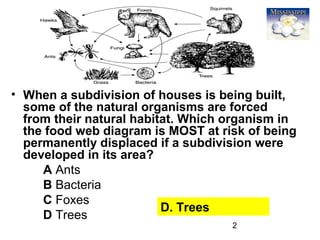
• When a subdivision of houses is being built,
some of the natural organisms are forced
from their natural habitat. Which organism in
the food web diagram is MOST at risk of being
permanently displaced if a subdivision were
developed in its area?
A Ants
B Bacteria
C Foxes
D Trees
D. Trees
3
Which of the following pairs of animals are
MOST likely to be closely related?
A Fish and crabs
B Dogs and cats
C Penguins and frogs
D Worms and snakes
B. Dogs and cats
4
A condition that PRIMARILY affects males is
probably —
A X-linked.
B autosomal.
C codominant.
D recessive.
A. X-linked
5
An experiment required that four different liquids be
heated. A student went to the chemical station to obtain
four liquids. The student returned with unlabeled test tubes
and was not sure which liquids were in each tube. The
BEST thing for the student to do is —
A heat the clearest liquid first.
B identify each liquid using sense of
smell.
C compare the test tubes to other
students’ test tubes.
D discard those samples and collect
new samples of the liquids.
D discard those samples and collect new samples of
the liquids.
6
Proteins are made of long chains of —
A lipids.
B monosaccharides.
C amino acids.
D enzymes.
C amino acids.
7
A cut on a frog’s foot will repair itself using
the process of —
A mitosis.
B meiosis.
C phagocytosis.
D pinocytosis.
A mitosis.
8
Members of all of the following animal
classes could be found in the arctic tundra
EXCEPT —
A Mammalia.
B Aves.
C Reptilia.
D Osteichthyes.
C Reptilia.
9
Plant leaves are protected by the epidermis
and the —
A petiole.
B stamen.
C stomata.
D cuticle.
D. Cuticle
10
What is photographed to create a
karyotype?
A Mutations
B Genes
C Gametes
D Chromosomes
D. Chromosomes
11
Which of the following is an important
action to follow when heating a test tube?
A Plug the mouth of the tube with a cork.
B Point the mouth of the tube away from
everyone.
C Hold the test tube steady in the hottest
part of the flame.
D Grasp the rim of the test tube with
tongs.
B Point the mouth of the tube away
from everyone
12
Which of the following is needed to transfer
and release energy?
A Calcium
B Phosphate
C Nitrate
D Potassium
B. phosphate
13
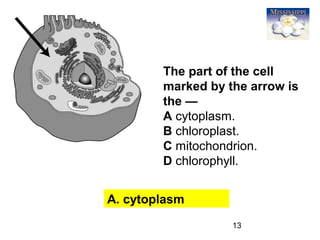
The part of the cell
marked by the arrow is
the —
A cytoplasm.
B chloroplast.
C mitochondrion.
D chlorophyll.
A. cytoplasm
14
Which of these is a description of mutualism?
A Both species exploit a common vital
resource.
B One species is more complex than the
other.
C Both species benefit from one another.
D Neither species interacts with the other.
C Both species benefit from one
another.
15
Experiments on a certain plant showed that
it would not reproduce without the presence
of water.
This plant is probably —
A leafless.
B spore producing.
C fruit producing.
D non-vascular.
D. non-vascular
16
Which of the following statements BEST
explains the relationship between the parts
of genetic materials?
A Each DNA molecule contains genes.
B Each gene contains many DNA molecules.
C Each DNA molecule contains many
chromosomes.
D Each chromosome contains DNA molecules.
D Each chromosome contains DNA molecules
17
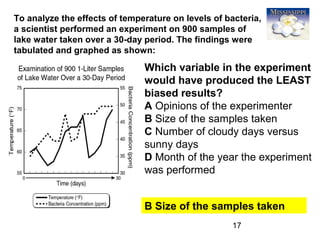
Which variable in the experiment
would have produced the LEAST
biased results?
A Opinions of the experimenter
B Size of the samples taken
C Number of cloudy days versus
sunny days
D Month of the year the experiment
was performed
B Size of the samples taken
To analyze the effects of temperature on levels of bacteria,
a scientist performed an experiment on 900 samples of
lake water taken over a 30-day period. The findings were
tabulated and graphed as shown:
18
All of the following are organic molecules
EXCEPT —
A protein.
B lipid.
C carbohydrate.
D salt.
D. salt
19
The building of proteins from amino acids
occurs on the cell’s —
A membrane.
B ribosomes.
C nucleus.
D centriole.
B. ribosomes
20
Which of the following food chains is MOST likely
found in a temperate forest biome?
A Phytoplankton → krill → cod → sea lion → polar
bear
B Seeds → mice → black snake → hawk
C Grass → zebra → hyena → lion
D Algae → krill → cod → barracuda → shark
B Seeds → mice → black snake → hawk
21
An organism that can reproduce ONLY inside a
host cell is a —
A protozoan.
B virus.
C fungus.
D bacterium.
B. virus
22
UACUGA
Which of the following represents a tRNA
complement to the codons above?
A UAGTGA
B ATCACT
C AUGACU
D TACTCA
C. AUGACU
23
After placing a slide on the microscope
stage, what should be manipulated first to
make sure the field of view has adequate
light?
A The eyepiece
B The diaphragm
C The fine adjustment knob
D The high-powered objective
B. The diaphragm
24
When excess sugar is produced in a plant,
the plant will —
A release the sugar into the soil.
B convert the sugar into minerals.
C store the sugar by forming larger
molecules.
D burn the leaves of the plant as it releases
energy.
C store the sugar by forming larger molecules
25
Materials can be moved around within a cell
by using the —
A golgi bodies.
B ribosomes.
C endoplasmic reticulum.
D mitochrondrion.
C. Endoplasmic reticulum
26
Higher than average rainfall in a dry
grassland may cause an area to have —
A larger deer populations.
B smaller plant biomass.
C less UV radiation.
D higher daily temperature.
A. Larger deer populations
27
Which of these would MOST effectively reduce the
effect of the bias of the scientists who
developed the experimental drug?
A Introduce a third drug into the experiment.
B Decrease the number of experimenters from two to one.
C Have a third researcher label and distribute the samples.
D Replace a portion of the placebos with aspirin.
C Have a third researcher label and distribute the samples.
In an experiment to test their new drug on
humans, two scientists planned to give
volunteers one of two drugs:
Drug A — experimental drug
Drug B — placebo (sugar pill)
28
Risks of having genetic mutations are
increased with excessive exposure to —
A high air pressure.
B high humidity.
C ultraviolet rays.
D oxygen.
C. ultraviolet rays
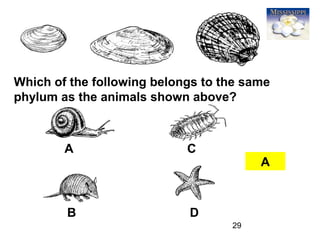
29
Which of the following belongs to the same
phylum as the animals shown above?
A
A
B
C
D
30
Which of the following BEST represents the
correct order of organizational levels?
A System, tissue, organ, cells
B Tissue, cells, system, organ
C Tissue, cells, organ, system
D Cells, tissue, organ, system
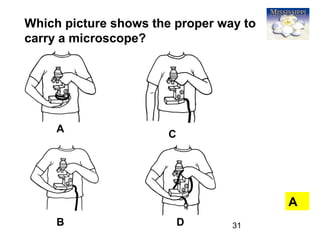
31
Which picture shows the proper way to
carry a microscope?
A
A
B
C
D
32
The tundra receives about as much rainfall
as the —
A taiga.
B deciduous forest.
C coniferous forest.
D desert.
D. Desert
33
Which of the following is NOT a
carbohydrate?
A Cellulose
B Lipids
C Monosaccharides
D Starch
B. lipids
34
ALL individuals are microscopic in the
kingdom —
A Animalia.
B Fungi.
C Archaebacteria.
D Plantae.
C. archaebacteria
35
Which of the following substances can
MOST easily travel into and out of the cell?
A Sodium ions
B Potassium ions
C Water
D Glucose
C. water
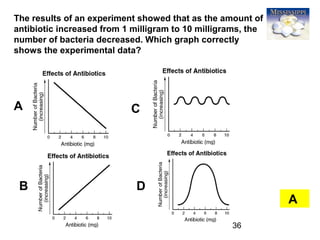
36
The results of an experiment showed that as the amount of
antibiotic increased from 1 milligram to 10 milligrams, the
number of bacteria decreased. Which graph correctly
shows the experimental data?
A
A
B
C
D
37
All of the following are classification levels
EXCEPT —
A order.
B protist.
C phylum.
D class.
B. protist
38
A species with 12 chromosomes in each
somatic cell will produce sex cells with —
A 3 chromosomes.
B 4 chromosomes.
C 6 chromosomes.
D 24 chromosomes.
C. 6 chromosomes
39
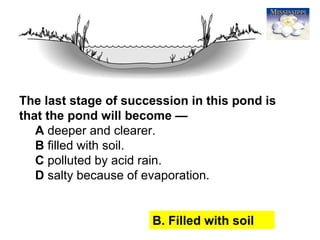
The last stage of succession in this pond is
that the pond will become —
A deeper and clearer.
B filled with soil.
C polluted by acid rain.
D salty because of evaporation.
B. Filled with soil
40
What structure could a cellular organism use
to move through its environment?
A Flagellum
B Cell wall
C Mitochondrion
D Lysosome
A. flagellum
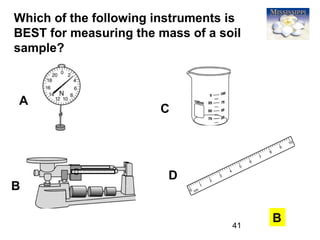
41
Which of the following instruments is
BEST for measuring the mass of a soil
sample?
B
A
B
C
D
42
A mouse population occupying two different
islands that are very close together may
become two separate species if —
A a new predator is introduced.
B the smallest mice hide underground.
C the separation between the islands widens.
D a storm eliminates a large part of the
population.
C. the separation between the islands widens.
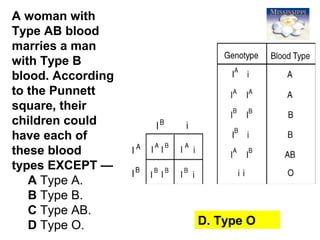
43
A woman with
Type AB blood
marries a man
with Type B
blood. According
to the Punnett
square, their
children could
have each of
these blood
types EXCEPT —
A Type A.
B Type B.
C Type AB.
D Type O. D. Type O
44
Which of these will give the MOST accurate
and precise measurement of 15 mL of liquid
to be placed in a test tube?
A A 100 mL graduated cylinder
B A 25 mL graduated cylinder
C A 10 mL beaker
D A 50 mL beaker
B. A 25 ml graduated cylinder
45
B. Larger number of identical cells
A Compared to sexual reproduction, asexual
reproduction results in a —
A greater variation in offspring.
B larger number of identical cells.
C longer life span of a cell.
D fewer number of cells dividing.
46
Compared to plants in a temperate
deciduous forest, plants in a tundra —
A produce larger dormant seeds.
B require more filtered sunlight.
C produce larger showy flowers.
D grow more quickly in the summer.
D. Grow more quickly in summer
47
A social researcher conducted an experiment to test the
effect of sleep deprivation on reaction times. Fifty working
adults in an evening study were awakened every 2 hours
during an 8-hour period at night and were asked to catch a
tennis ball fired from a machine at exactly 20 miles per hour.
A. The same participants’ reaction times tested in the middle of the day
What would be an effective control for this experiment which
would provide a basis for meaningful comparisons?
A The same participants’ reaction times tested in the middle of
the day
B Average reaction times at night for the population at large
C Average reaction times during the day for the population at
large
D The same participants after a full 8 hours of sleep
deprivation
48
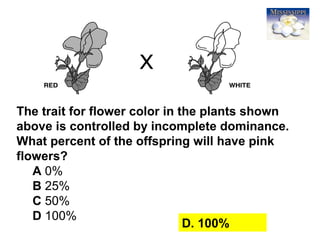
The trait for flower color in the plants shown
above is controlled by incomplete dominance.
What percent of the offspring will have pink
flowers?
A 0%
B 25%
C 50%
D 100%
D. 100%
49
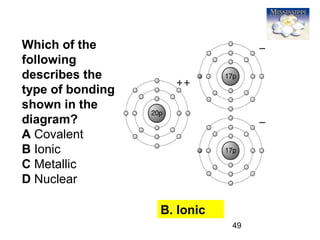
Which of the
following
describes the
type of bonding
shown in the
diagram?
A Covalent
B Ionic
C Metallic
D Nuclear
B. Ionic
50
If two organisms are in the same class, they
MUST also be in the same —
A kingdom and family.
B kingdom and phylum.
C phylum and genus.
D genus and species.
B. Kingdom and phylum
51
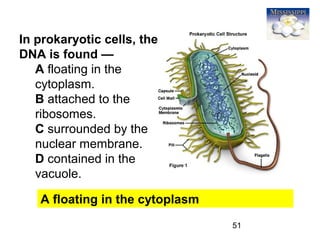
In prokaryotic cells, the
DNA is found —
A floating in the
cytoplasm.
B attached to the
ribosomes.
C surrounded by the
nuclear membrane.
D contained in the
vacuole.
A floating in the cytoplasm
52
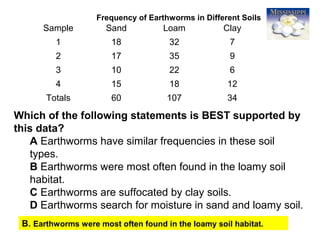
Which of the following statements is BEST supported by
this data?
A Earthworms have similar frequencies in these soil
types.
B Earthworms were most often found in the loamy soil
habitat.
C Earthworms are suffocated by clay soils.
D Earthworms search for moisture in sand and loamy soil.
B. Earthworms were most often found in the loamy soil habitat.
Sample Sand Loam Clay
1 18 32 7
2 17 35 9
3 10 22 6
4 15 18 12
Totals 60 107 34
Frequency of Earthworms in Different Soils
53
Vascular plants transport water and
nutrients to all parts of the plant through —
A diffusion.
B phagocytosis.
C xylem and phloem.
D cellular respiration and photosynthesis.
C. xylem and phloem
54
In guinea pigs, the trait for ruffled fur is
dominant over the trait for smooth fur. If a
heterozygous male is crossed with a
homozygous recessive female, what
percent of the offspring would be
expected to have ruffled fur?
A 25%
B 50%
C 75%
D 100%
B. 50%
55
Meiosis is different from mitosis because
meiosis produces —
A consistent genetic makeup of all gametes.
B larger daughter cells.
C two gametes for every original parent cell.
D cells with half the number of chromosomes.
D. cells with half the number of chromosomes.
56
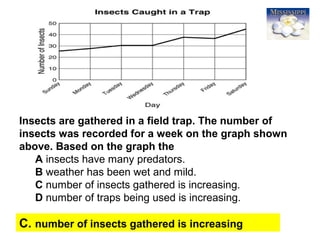
Insects are gathered in a field trap. The number of
insects was recorded for a week on the graph shown
above. Based on the graph the
A insects have many predators.
B weather has been wet and mild.
C number of insects gathered is increasing.
D number of traps being used is increasing.
C. number of insects gathered is increasing
57
Which of the following best describes the order of
events that leads to genetic
expression?
A DNA - RNA - amino acid - protein - genetic
expression
B RNA - amino acid - DNA - protein - genetic
expression
C DNA - amino acid - protein - RNA - genetic
expression
D RNA - protein – DNA - amino acid - genetic
expression
A. DNA - RNA - amino acid - protein - genetic expression
58
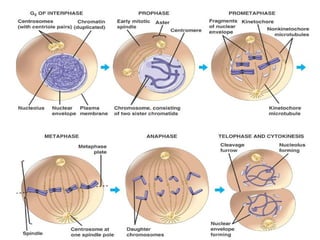
What phase of
mitosis is
represented by the
diagram?
A Metaphase
B Prophase
C Telophase
D Interphase
A. Metaphase
59
ALL members of one species that live in a
small geographic area make up one —
A phylum.
B community.
C population.
D ecosystem.
C. population
60
Assume that in humans there is a 50/50
chance that a child will be a boy. If a certain
mother and father have four sons, what are
the chances that their fifth child will be
a daughter?
A 1/2
B 1/5
C 1/16
D 1/25
A. 1/2
61
Humans have 23 pairs of chromosomes.
How many pairs are sex chromosomes?
A 1
B 2
C 3
D 4
A. 1
62
When a student is conducting an experiment,
which one of the following is most likely NOT
needed in the case of a chemical spill?
A Eyewash station
B Safety shower
C Fire extinguisher
D Chemical absorbent
C. Fire extinguisher
63
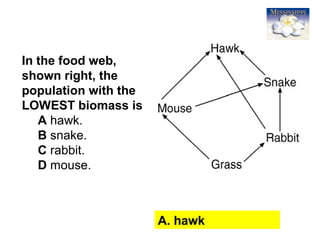
In the food web,
shown right, the
population with the
LOWEST biomass is
A hawk.
B snake.
C rabbit.
D mouse.
A. hawk
64
As respiration begins, glucose is broken
down into pyruvic acid and two molecules
of ATP are formed. What will happen next in
yeast cells if NO oxygen is available?
A Krebs cycle
B Photosynthesis
C Alcoholic fermentation
D Lactic acid fermentation
C. Alcoholic fermentation
65
The scientific name for bay live oaks that grow
along the coast is Quercus virginiana var.
maritima (Mill). Which of the following is MOST
closely related to bay live oaks?
A Batis maritima
B Carpinus carolinia var. virginiana
C Clematis virginiana L.
D Quercus falcata var. pagodaefolia (Ell.)
D. Quercus falcata var. pagodaefolia (Ell.)
66
Huntington’s disease is a genetic
disorder in humans which is controlled
by a dominant gene. If one parent is
heterozygous for the trait and the other
has normal alleles, what are their
chances of having an offspring with the
disease?
A 25%
B 50%
C 75%
D 100%
B. 50%
67
Which of the following would a cell MOST
likely use to move materials by active
transport?
A A channel protein
B A marker protein
C A phospholipid molecule
D A transfer RNA molecule
A. A channel protein
68
Which of these is kept the same for all of
the groups being tested in an experiment?
A Conclusion
B Constant
C Hypothesis
D Variable
B. Constant
69
A. overpopulate
When an organism is first introduced into
an ecosystem and has no predators, it will
A overpopulate.
B become extinct.
C become a predator.
D adapt.
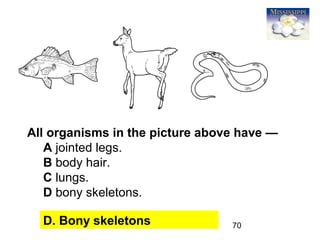
70
All organisms in the picture above have —
A jointed legs.
B body hair.
C lungs.
D bony skeletons.
D. Bony skeletons
71
During photosynthesis, energy from the sun
is trapped in —
A chemical bonds.
B the nuclei of atoms.
C enzymes.
D Golgi bodies.
A. Chemical bonds
72
Which of these types of cell has a nuclear
membrane?
A Spirillum
B Coccus
C Liver
D Bacillus
C. liver
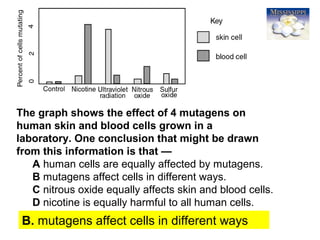
73
The graph shows the effect of 4 mutagens on
human skin and blood cells grown in a
laboratory. One conclusion that might be drawn
from this information is that —
A human cells are equally affected by mutagens.
B mutagens affect cells in different ways.
C nitrous oxide equally affects skin and blood cells.
D nicotine is equally harmful to all human cells.
B. mutagens affect cells in different ways
74
In corn plants, ragged leaves (R) are
dominant to smooth leaves (r). If two
heterozygous ragged-leaf plants are
crossed, what are the possible genotypes
of the offspring?
A Rr only
B Rr and rr only
C RR and rr only
D RR, Rr, and rr only
D. RR, Rr, and rr only
75
Proteins that regulate chemical reactions in
the body but remain unchanged by the
reaction are known as —
A lymphocytes.
B cytoplasm.
C mitochondria.
D enzymes.
D. enzymes
76
Which of these conservation methods would
result in saving renewable resources?
A Burning coal to produce electricity
B Filtering and recycling used motor oil
C Burying glass and metal containers
D Shredding and recycling paper wastes
D. Shredding and recycling paper wastes
77
The part of a eukaryotic cell that allows it to
remain separate from the outside
environment is the —
A cell membrane.
B ribosome.
C cytoplasm.
D Golgi vesicles.
A. Cell membrane
78
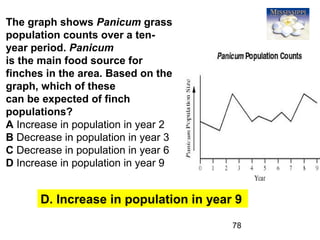
The graph shows Panicum grass
population counts over a ten-
year period. Panicum
is the main food source for
finches in the area. Based on the
graph, which of these
can be expected of finch
populations?
A Increase in population in year 2
B Decrease in population in year 3
C Decrease in population in year 6
D Increase in population in year 9
D. Increase in population in year 9
79
Usable nitrogen is released into soil from
animal wastes by the breakdown of —
A plant proteins.
B water.
C ammonia.
D sugar molecules.
C. ammonia
80
Invertebrate is to vertebrate as spider is to —
A scorpion.
B shrimp.
C snail.
D snake.
D. snake
81
The wings of fruit flies curl if the flies live
at a temperature of 25º Celsius. The wings
are straight if the flies live at a
temperature less than 25º Celsius. This is
an example of —
A the fruit flies’ need for cool
temperatures.
B the negative effects of heat on fruit fly
protein.
C the effect of the environment on genetic
expression.
D the superiority of straight wings in
desert environments.
C. the effect of the environment on genetic expression
82
Which of the following is usually measured in
micrometers?
A Specimen mass
B Organelle length
C Tree height
D Sound intensity
B. Organelle length
83
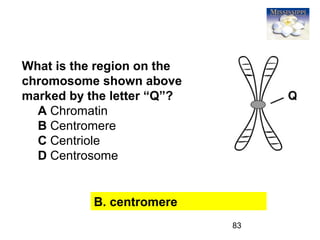
What is the region on the
chromosome shown above
marked by the letter “Q”?
A Chromatin
B Centromere
C Centriole
D Centrosome
B. centromere
84
All carbohydrates are made of —
A carbon, hydrogen, and oxygen.
B glucose, sucrose, and fructose.
C cellulose, glycogen, and starch.
D guanine, alanine, and cytosine.
A. carbon, hydrogen and oxygen
85
Which of these is TRUE of a proper scientific
experiment being conducted under
reasonably similar conditions?
A It should provide identical results.
B Anyone should be able to repeat it.
C It should disprove a hypothesis.
D Anyone should be able to influence the
results.
B. Anyone should be able to repeat it.
86
Which of the following receives the largest
amount of its energy DIRECTLY from
the sun?
A Carrots
B Eggs
C Wolves
D Chickens
A. Carrots

Biology Test Review 2

  • 1.
    1 Biology Test ReviewBiologyTest Review State Review QuestionsState Review Questions Test 2Test 2
  • 2.
    2 • When asubdivision of houses is being built, some of the natural organisms are forced from their natural habitat. Which organism in the food web diagram is MOST at risk of being permanently displaced if a subdivision were developed in its area? A Ants B Bacteria C Foxes D Trees D. Trees
  • 3.
    3 Which of thefollowing pairs of animals are MOST likely to be closely related? A Fish and crabs B Dogs and cats C Penguins and frogs D Worms and snakes B. Dogs and cats
  • 4.
    4 A condition thatPRIMARILY affects males is probably — A X-linked. B autosomal. C codominant. D recessive. A. X-linked
  • 5.
    5 An experiment requiredthat four different liquids be heated. A student went to the chemical station to obtain four liquids. The student returned with unlabeled test tubes and was not sure which liquids were in each tube. The BEST thing for the student to do is — A heat the clearest liquid first. B identify each liquid using sense of smell. C compare the test tubes to other students’ test tubes. D discard those samples and collect new samples of the liquids. D discard those samples and collect new samples of the liquids.
  • 6.
    6 Proteins are madeof long chains of — A lipids. B monosaccharides. C amino acids. D enzymes. C amino acids.
  • 7.
    7 A cut ona frog’s foot will repair itself using the process of — A mitosis. B meiosis. C phagocytosis. D pinocytosis. A mitosis.
  • 8.
    8 Members of allof the following animal classes could be found in the arctic tundra EXCEPT — A Mammalia. B Aves. C Reptilia. D Osteichthyes. C Reptilia.
  • 9.
    9 Plant leaves areprotected by the epidermis and the — A petiole. B stamen. C stomata. D cuticle. D. Cuticle
  • 10.
    10 What is photographedto create a karyotype? A Mutations B Genes C Gametes D Chromosomes D. Chromosomes
  • 11.
    11 Which of thefollowing is an important action to follow when heating a test tube? A Plug the mouth of the tube with a cork. B Point the mouth of the tube away from everyone. C Hold the test tube steady in the hottest part of the flame. D Grasp the rim of the test tube with tongs. B Point the mouth of the tube away from everyone
  • 12.
    12 Which of thefollowing is needed to transfer and release energy? A Calcium B Phosphate C Nitrate D Potassium B. phosphate
  • 13.
    13 The part ofthe cell marked by the arrow is the — A cytoplasm. B chloroplast. C mitochondrion. D chlorophyll. A. cytoplasm
  • 14.
    14 Which of theseis a description of mutualism? A Both species exploit a common vital resource. B One species is more complex than the other. C Both species benefit from one another. D Neither species interacts with the other. C Both species benefit from one another.
  • 15.
    15 Experiments on acertain plant showed that it would not reproduce without the presence of water. This plant is probably — A leafless. B spore producing. C fruit producing. D non-vascular. D. non-vascular
  • 16.
    16 Which of thefollowing statements BEST explains the relationship between the parts of genetic materials? A Each DNA molecule contains genes. B Each gene contains many DNA molecules. C Each DNA molecule contains many chromosomes. D Each chromosome contains DNA molecules. D Each chromosome contains DNA molecules
  • 17.
    17 Which variable inthe experiment would have produced the LEAST biased results? A Opinions of the experimenter B Size of the samples taken C Number of cloudy days versus sunny days D Month of the year the experiment was performed B Size of the samples taken To analyze the effects of temperature on levels of bacteria, a scientist performed an experiment on 900 samples of lake water taken over a 30-day period. The findings were tabulated and graphed as shown:
  • 18.
    18 All of thefollowing are organic molecules EXCEPT — A protein. B lipid. C carbohydrate. D salt. D. salt
  • 19.
    19 The building ofproteins from amino acids occurs on the cell’s — A membrane. B ribosomes. C nucleus. D centriole. B. ribosomes
  • 20.
    20 Which of thefollowing food chains is MOST likely found in a temperate forest biome? A Phytoplankton → krill → cod → sea lion → polar bear B Seeds → mice → black snake → hawk C Grass → zebra → hyena → lion D Algae → krill → cod → barracuda → shark B Seeds → mice → black snake → hawk
  • 21.
    21 An organism thatcan reproduce ONLY inside a host cell is a — A protozoan. B virus. C fungus. D bacterium. B. virus
  • 22.
    22 UACUGA Which of thefollowing represents a tRNA complement to the codons above? A UAGTGA B ATCACT C AUGACU D TACTCA C. AUGACU
  • 23.
    23 After placing aslide on the microscope stage, what should be manipulated first to make sure the field of view has adequate light? A The eyepiece B The diaphragm C The fine adjustment knob D The high-powered objective B. The diaphragm
  • 24.
    24 When excess sugaris produced in a plant, the plant will — A release the sugar into the soil. B convert the sugar into minerals. C store the sugar by forming larger molecules. D burn the leaves of the plant as it releases energy. C store the sugar by forming larger molecules
  • 25.
    25 Materials can bemoved around within a cell by using the — A golgi bodies. B ribosomes. C endoplasmic reticulum. D mitochrondrion. C. Endoplasmic reticulum
  • 26.
    26 Higher than averagerainfall in a dry grassland may cause an area to have — A larger deer populations. B smaller plant biomass. C less UV radiation. D higher daily temperature. A. Larger deer populations
  • 27.
    27 Which of thesewould MOST effectively reduce the effect of the bias of the scientists who developed the experimental drug? A Introduce a third drug into the experiment. B Decrease the number of experimenters from two to one. C Have a third researcher label and distribute the samples. D Replace a portion of the placebos with aspirin. C Have a third researcher label and distribute the samples. In an experiment to test their new drug on humans, two scientists planned to give volunteers one of two drugs: Drug A — experimental drug Drug B — placebo (sugar pill)
  • 28.
    28 Risks of havinggenetic mutations are increased with excessive exposure to — A high air pressure. B high humidity. C ultraviolet rays. D oxygen. C. ultraviolet rays
  • 29.
    29 Which of thefollowing belongs to the same phylum as the animals shown above? A A B C D
  • 30.
    30 Which of thefollowing BEST represents the correct order of organizational levels? A System, tissue, organ, cells B Tissue, cells, system, organ C Tissue, cells, organ, system D Cells, tissue, organ, system D Cells, tissue, organ, system
  • 31.
    31 Which picture showsthe proper way to carry a microscope? A A B C D
  • 32.
    32 The tundra receivesabout as much rainfall as the — A taiga. B deciduous forest. C coniferous forest. D desert. D. Desert
  • 33.
    33 Which of thefollowing is NOT a carbohydrate? A Cellulose B Lipids C Monosaccharides D Starch B. lipids
  • 34.
    34 ALL individuals aremicroscopic in the kingdom — A Animalia. B Fungi. C Archaebacteria. D Plantae. C. archaebacteria
  • 35.
    35 Which of thefollowing substances can MOST easily travel into and out of the cell? A Sodium ions B Potassium ions C Water D Glucose C. water
  • 36.
    36 The results ofan experiment showed that as the amount of antibiotic increased from 1 milligram to 10 milligrams, the number of bacteria decreased. Which graph correctly shows the experimental data? A A B C D
  • 37.
    37 All of thefollowing are classification levels EXCEPT — A order. B protist. C phylum. D class. B. protist
  • 38.
    38 A species with12 chromosomes in each somatic cell will produce sex cells with — A 3 chromosomes. B 4 chromosomes. C 6 chromosomes. D 24 chromosomes. C. 6 chromosomes
  • 39.
    39 The last stageof succession in this pond is that the pond will become — A deeper and clearer. B filled with soil. C polluted by acid rain. D salty because of evaporation. B. Filled with soil
  • 40.
    40 What structure coulda cellular organism use to move through its environment? A Flagellum B Cell wall C Mitochondrion D Lysosome A. flagellum
  • 41.
    41 Which of thefollowing instruments is BEST for measuring the mass of a soil sample? B A B C D
  • 42.
    42 A mouse populationoccupying two different islands that are very close together may become two separate species if — A a new predator is introduced. B the smallest mice hide underground. C the separation between the islands widens. D a storm eliminates a large part of the population. C. the separation between the islands widens.
  • 43.
    43 A woman with TypeAB blood marries a man with Type B blood. According to the Punnett square, their children could have each of these blood types EXCEPT — A Type A. B Type B. C Type AB. D Type O. D. Type O
  • 44.
    44 Which of thesewill give the MOST accurate and precise measurement of 15 mL of liquid to be placed in a test tube? A A 100 mL graduated cylinder B A 25 mL graduated cylinder C A 10 mL beaker D A 50 mL beaker B. A 25 ml graduated cylinder
  • 45.
    45 B. Larger numberof identical cells A Compared to sexual reproduction, asexual reproduction results in a — A greater variation in offspring. B larger number of identical cells. C longer life span of a cell. D fewer number of cells dividing.
  • 46.
    46 Compared to plantsin a temperate deciduous forest, plants in a tundra — A produce larger dormant seeds. B require more filtered sunlight. C produce larger showy flowers. D grow more quickly in the summer. D. Grow more quickly in summer
  • 47.
    47 A social researcherconducted an experiment to test the effect of sleep deprivation on reaction times. Fifty working adults in an evening study were awakened every 2 hours during an 8-hour period at night and were asked to catch a tennis ball fired from a machine at exactly 20 miles per hour. A. The same participants’ reaction times tested in the middle of the day What would be an effective control for this experiment which would provide a basis for meaningful comparisons? A The same participants’ reaction times tested in the middle of the day B Average reaction times at night for the population at large C Average reaction times during the day for the population at large D The same participants after a full 8 hours of sleep deprivation
  • 48.
    48 The trait forflower color in the plants shown above is controlled by incomplete dominance. What percent of the offspring will have pink flowers? A 0% B 25% C 50% D 100% D. 100%
  • 49.
    49 Which of the following describesthe type of bonding shown in the diagram? A Covalent B Ionic C Metallic D Nuclear B. Ionic
  • 50.
    50 If two organismsare in the same class, they MUST also be in the same — A kingdom and family. B kingdom and phylum. C phylum and genus. D genus and species. B. Kingdom and phylum
  • 51.
    51 In prokaryotic cells,the DNA is found — A floating in the cytoplasm. B attached to the ribosomes. C surrounded by the nuclear membrane. D contained in the vacuole. A floating in the cytoplasm
  • 52.
    52 Which of thefollowing statements is BEST supported by this data? A Earthworms have similar frequencies in these soil types. B Earthworms were most often found in the loamy soil habitat. C Earthworms are suffocated by clay soils. D Earthworms search for moisture in sand and loamy soil. B. Earthworms were most often found in the loamy soil habitat. Sample Sand Loam Clay 1 18 32 7 2 17 35 9 3 10 22 6 4 15 18 12 Totals 60 107 34 Frequency of Earthworms in Different Soils
  • 53.
    53 Vascular plants transportwater and nutrients to all parts of the plant through — A diffusion. B phagocytosis. C xylem and phloem. D cellular respiration and photosynthesis. C. xylem and phloem
  • 54.
    54 In guinea pigs,the trait for ruffled fur is dominant over the trait for smooth fur. If a heterozygous male is crossed with a homozygous recessive female, what percent of the offspring would be expected to have ruffled fur? A 25% B 50% C 75% D 100% B. 50%
  • 55.
    55 Meiosis is differentfrom mitosis because meiosis produces — A consistent genetic makeup of all gametes. B larger daughter cells. C two gametes for every original parent cell. D cells with half the number of chromosomes. D. cells with half the number of chromosomes.
  • 56.
    56 Insects are gatheredin a field trap. The number of insects was recorded for a week on the graph shown above. Based on the graph the A insects have many predators. B weather has been wet and mild. C number of insects gathered is increasing. D number of traps being used is increasing. C. number of insects gathered is increasing
  • 57.
    57 Which of thefollowing best describes the order of events that leads to genetic expression? A DNA - RNA - amino acid - protein - genetic expression B RNA - amino acid - DNA - protein - genetic expression C DNA - amino acid - protein - RNA - genetic expression D RNA - protein – DNA - amino acid - genetic expression A. DNA - RNA - amino acid - protein - genetic expression
  • 58.
    58 What phase of mitosisis represented by the diagram? A Metaphase B Prophase C Telophase D Interphase A. Metaphase
  • 59.
    59 ALL members ofone species that live in a small geographic area make up one — A phylum. B community. C population. D ecosystem. C. population
  • 60.
    60 Assume that inhumans there is a 50/50 chance that a child will be a boy. If a certain mother and father have four sons, what are the chances that their fifth child will be a daughter? A 1/2 B 1/5 C 1/16 D 1/25 A. 1/2
  • 61.
    61 Humans have 23pairs of chromosomes. How many pairs are sex chromosomes? A 1 B 2 C 3 D 4 A. 1
  • 62.
    62 When a studentis conducting an experiment, which one of the following is most likely NOT needed in the case of a chemical spill? A Eyewash station B Safety shower C Fire extinguisher D Chemical absorbent C. Fire extinguisher
  • 63.
    63 In the foodweb, shown right, the population with the LOWEST biomass is A hawk. B snake. C rabbit. D mouse. A. hawk
  • 64.
    64 As respiration begins,glucose is broken down into pyruvic acid and two molecules of ATP are formed. What will happen next in yeast cells if NO oxygen is available? A Krebs cycle B Photosynthesis C Alcoholic fermentation D Lactic acid fermentation C. Alcoholic fermentation
  • 65.
    65 The scientific namefor bay live oaks that grow along the coast is Quercus virginiana var. maritima (Mill). Which of the following is MOST closely related to bay live oaks? A Batis maritima B Carpinus carolinia var. virginiana C Clematis virginiana L. D Quercus falcata var. pagodaefolia (Ell.) D. Quercus falcata var. pagodaefolia (Ell.)
  • 66.
    66 Huntington’s disease isa genetic disorder in humans which is controlled by a dominant gene. If one parent is heterozygous for the trait and the other has normal alleles, what are their chances of having an offspring with the disease? A 25% B 50% C 75% D 100% B. 50%
  • 67.
    67 Which of thefollowing would a cell MOST likely use to move materials by active transport? A A channel protein B A marker protein C A phospholipid molecule D A transfer RNA molecule A. A channel protein
  • 68.
    68 Which of theseis kept the same for all of the groups being tested in an experiment? A Conclusion B Constant C Hypothesis D Variable B. Constant
  • 69.
    69 A. overpopulate When anorganism is first introduced into an ecosystem and has no predators, it will A overpopulate. B become extinct. C become a predator. D adapt.
  • 70.
    70 All organisms inthe picture above have — A jointed legs. B body hair. C lungs. D bony skeletons. D. Bony skeletons
  • 71.
    71 During photosynthesis, energyfrom the sun is trapped in — A chemical bonds. B the nuclei of atoms. C enzymes. D Golgi bodies. A. Chemical bonds
  • 72.
    72 Which of thesetypes of cell has a nuclear membrane? A Spirillum B Coccus C Liver D Bacillus C. liver
  • 73.
    73 The graph showsthe effect of 4 mutagens on human skin and blood cells grown in a laboratory. One conclusion that might be drawn from this information is that — A human cells are equally affected by mutagens. B mutagens affect cells in different ways. C nitrous oxide equally affects skin and blood cells. D nicotine is equally harmful to all human cells. B. mutagens affect cells in different ways
  • 74.
    74 In corn plants,ragged leaves (R) are dominant to smooth leaves (r). If two heterozygous ragged-leaf plants are crossed, what are the possible genotypes of the offspring? A Rr only B Rr and rr only C RR and rr only D RR, Rr, and rr only D. RR, Rr, and rr only
  • 75.
    75 Proteins that regulatechemical reactions in the body but remain unchanged by the reaction are known as — A lymphocytes. B cytoplasm. C mitochondria. D enzymes. D. enzymes
  • 76.
    76 Which of theseconservation methods would result in saving renewable resources? A Burning coal to produce electricity B Filtering and recycling used motor oil C Burying glass and metal containers D Shredding and recycling paper wastes D. Shredding and recycling paper wastes
  • 77.
    77 The part ofa eukaryotic cell that allows it to remain separate from the outside environment is the — A cell membrane. B ribosome. C cytoplasm. D Golgi vesicles. A. Cell membrane
  • 78.
    78 The graph showsPanicum grass population counts over a ten- year period. Panicum is the main food source for finches in the area. Based on the graph, which of these can be expected of finch populations? A Increase in population in year 2 B Decrease in population in year 3 C Decrease in population in year 6 D Increase in population in year 9 D. Increase in population in year 9
  • 79.
    79 Usable nitrogen isreleased into soil from animal wastes by the breakdown of — A plant proteins. B water. C ammonia. D sugar molecules. C. ammonia
  • 80.
    80 Invertebrate is tovertebrate as spider is to — A scorpion. B shrimp. C snail. D snake. D. snake
  • 81.
    81 The wings offruit flies curl if the flies live at a temperature of 25º Celsius. The wings are straight if the flies live at a temperature less than 25º Celsius. This is an example of — A the fruit flies’ need for cool temperatures. B the negative effects of heat on fruit fly protein. C the effect of the environment on genetic expression. D the superiority of straight wings in desert environments. C. the effect of the environment on genetic expression
  • 82.
    82 Which of thefollowing is usually measured in micrometers? A Specimen mass B Organelle length C Tree height D Sound intensity B. Organelle length
  • 83.
    83 What is theregion on the chromosome shown above marked by the letter “Q”? A Chromatin B Centromere C Centriole D Centrosome B. centromere
  • 84.
    84 All carbohydrates aremade of — A carbon, hydrogen, and oxygen. B glucose, sucrose, and fructose. C cellulose, glycogen, and starch. D guanine, alanine, and cytosine. A. carbon, hydrogen and oxygen
  • 85.
    85 Which of theseis TRUE of a proper scientific experiment being conducted under reasonably similar conditions? A It should provide identical results. B Anyone should be able to repeat it. C It should disprove a hypothesis. D Anyone should be able to influence the results. B. Anyone should be able to repeat it.
  • 86.
    86 Which of thefollowing receives the largest amount of its energy DIRECTLY from the sun? A Carrots B Eggs C Wolves D Chickens A. Carrots