VELAMMAL BODHI CAMPUS, ANUPPANADI - MADURAI
Ch : 11 – ORGANISMS AND POPULATIONS
MCQs
1.The physiological capacity of a species to produce their progeny in absence of predators,
diseases and other inhibiting factors is called
a.carrying capacity b.biotic potential c.environmental resistance d.population explosion
2.Zone of atmosphere near the earth surface is
a.stratosphere b.mesosphere c.troposphere d.thermosphere
3.Salt concentration (salinity) of the sea measured in parts per thousand is
a.10-15 b.30-70 c.0-5 d.30-35
4.Formation of tropical forests needs mean annual temperature and mean annual precipitation
as
a.18-25 and 150-400 cm b.5-15 and 50-100 cm
℃ ℃
c.30-50 and 100-150 cm d.5-15 and 100-200 cm
℃ ℃
5.Which of he following forest plants controls the light conditions at the ground?
a.Lianas and climbers b.shrubs c.tall trees d.herbs
6.Lichens are well known combination of an algae and fungus is
a.an epiphytic relationship between algae b.a parasitic relationship with the algae
c.a symbiotic relationship with the algae d.a saprophytic relationship with algae
7.What will happen to a well growing herbaceous plant in the forest if it is transplanted
outside the forest to a park?
a.It will grow normally b.It will grow well because it is planted in the same locality
c.It may not survive because of change in its micro climate
d.It grows very well because the plant gets more sunlight
8.Pneumatophores are present or common in
a.xerophytes b.hydrophytes c.mesophytes d.halophytes
9.Annual migration does not occur in case of
a.arctic tern b.salmon c.siberian crane d.salamander
10.Animals undergo inactive stage during winter is known as
a.aestivation b.hibernation c.adaptation d.acclimatisation
11.Ecotone is
a.a polluted area b.the bottom of a lake c.a zone between 2 communities d.a zone of
developing community
12.According to allen’s rule, the mammals from colder climates have
a.shorter ears & longer limbs b.longer ears & shorter limbs
c.longer ears & longer limbs d.shorter ears & shorter limbs
13.What parameters are used to tiger census in our country’s national parks and sanctuaries?
a.pug marks only b.pug marks and faecal pellets c.faecal pellets only d.actual head counts
14.What is the growth pattern demonstrated by population at time = 1 of population size of a
species over time is shown in the graph (consider the graph of question 7)
a.exponential b.oscillating c.gradual d.continual
15.Which one of the following organisms reproduce sexually only once in its life time?
a.banana plant b.mango c.tomato d.eucalyptus
16.What is the interaction between species in which the fitness of one overpowers the
presence and fitness of another called?
a.competition b.mutualism c.parasitism d.commensalism
17.Who stated that human population grows geometrically?
a.Darwin b.Lamark c.De vries d.Malthus
18.Maximum growth rate occurs in
a.senescent phase b.lag phase c.exponential phase d.stationary phase
19.species – area relationship is represented on a log scale as
a.hyperbola b.rectangular hyperbola c.linear d.inverted
20.Which letter is used to designate the immigration?
a.A b.K c.S d.I
Reason and Assertion
The questions (Q. No. 1 to 15) consist of two statements each, printed as Assertion and Reason.
While answering these questions you are required to choose any one of the following four
responses.
a. Both A and R are true and R is the correct explanation of A
b.Both A and R are true, but R is not the correct explanation of A
c.A is true, but R is false
d.A is false, but R is true
1.Assertion : Tropical rain forests are disappearing fast from developing countries such as India.
Reason : No value is attached to these forests because these are poor in biodiversity.
2.Assertion : Flora contains the actual account of habitat and distribution of plants of a given area.
Reason : Flora helps in correct identification
3.Assertion : Cold deserts too exist. Eg., Tibet, Gobi
Reason : The concept of biological species focuses our attention on the question of how
reproductive isolation comes about.
3.Assertion : Animals adopt different strategies to survive in hostile environment.
Reason : Praying mantis is green in colour which merges with plant foliage.
4.Assertion : Small sized animals are scarce in polar regions.
Reason : Small sized animals have larger surface area relative to their volume and they have to
spend much energy to generate body heat through metabolism.
5.Assertion : In sigmoid growth curve, population finally stabilizes itself.
Reason : Finally, the death rate increases than the birth rate.
6.Assertion : Natural populations are capable of rapid number increase, but remain constant in size
Reason : Human interference has led to constancy of size of natural populations.
7.Assertion : Predation is an interspecific interaction with a feeding strategy.
Reason : Predator and their prey maintain fairly stable population through time and rarely one
population become abundant or scarce.
8.Assertion : Mycorrhizae represent a mutually beneficial interspecific interaction of fungi with roots
of higher plants.
Reason : In this relationship both the organisms are involved in some sort of physiological exchange.
9.Assertion : In mutualism both the population are benefitted and neither can survive under natural
conditions without other.
Reason : Both populations are benefitted by the association but their relationships are not
obligatory.
10.Assertion: Interspecific competition is the only potent force in organic evolution.
Reason : Unexceptionally two closely related species competing for the same resources cannot
Co-exist indefinitely.
CASE BASED QUESTIONS
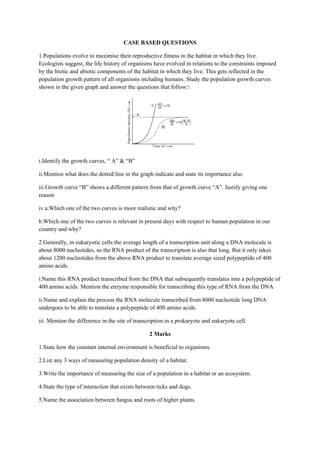
1.Populations evolve to maximise their reproductive fitness in the habitat in which they live.
Ecologists suggest, the life history of organisms have evolved in relations to the constraints imposed
by the biotic and abiotic components of the habitat in which they live. This gets reflected in the
population growth pattern of all organisms including humans. Study the population growth curves
shown in the given graph and answer the questions that follow:
i.Identify the growth curves, “ A” & “B”
ii.Mention what does the dotted line in the graph indicate and state its importance also
iii.Growth curve “B” shows a different pattern from that of growth curve “A”. Justify giving one
reason
iv.a.Which one of the two curves is more realistic and why?
b.Which one of the two curves is relevant in present days with respect to human population in our
country and why?
2.Generally, in eukaryotic cells the average length of a transcription unit along a DNA molecule is
about 8000 nucleotides, so the RNA product of the transcription is also that long. But it only takes
about 1200 nucleotides from the above RNA product to translate average sized polypeptide of 400
amino acids.
i.Name this RNA product transcribed from the DNA that subsequently translates into a polypeptide of
400 amino acids. Mention the enzyme responsible for transcribing this type of RNA from the DNA
ii.Name and explain the process the RNA molecule transcribed from 8000 nucleotide long DNA
undergoes to be able to translate a polypeptide of 400 amino acids.
iii. Mention the difference in the site of transcription in a prokaryote and eukaryote cell.
2 Marks
1.State how the constant internal environment is beneficial to organisms.
2.List any 3 ways of measuring population density of a habitat.
3.Write the importance of measuring the size of a population in a habitat or an ecosystem.
4.State the type of interaction that exists between ticks and dogs.
5.Name the association between fungus and roots of higher plants.
3 Marks
1.Difference between ectotherms and endotherms
2.List any 3 characteristics of a population and explain.
3.How are stenohaline animals different from euryhaline animals?
4.Mention the characteristics found in endoparasites.
5.Differentiate parasitism and competition.
5 Marks
1.Write about hydrophytes, xerophytes, mesophytes with suitable examples.
2.How migration help in survival in stressful habitat.
3.How does an age pyramid for human population at given point of time helps the policy-makers in
planning for future.
4.Explain brood parasitism with the help of an example.
1.Highlight the role of thymus as a lymphoid organ
2.Name the cells that are released from the above mentioned gland. Mention how they help in
immunity.
3.Name the causative agent and carrier woman of typhoid
4.What is vaccination?
5.Write 2 symptoms of cancer?
6.What is the functional difference between B-cells and T-cells?
7.Name the source used to produce hepatitis B vaccine using rDNA technology?
8.Name the types of antibodies?
9.How does the moderate and high dosage of cocaine affect the human body?
10.When does a tumour called malignant?
3 Marks
1.Draw a neat, well labelled diagram of a typical antibody.
2.Define endoparasitic protozoans
3.How is rabies caused? Write its symptoms and control measures?
4.Write about the names and five classes of antibody.
5.Explain metastasis. Why is it fatal?
6.Mention 2 applications of biotechnology in the field of medicine.
7.What are the various public health measures which you would suggest as safeguard against
infectious diseases?
8.Define congenital disease?
9.In which way has the study of biology helped us to control infectious diseases?
10.How does the transmission of each of following diseases take place?
11.Discuss with your teacher what does a suitable gene mean, in the context of DNA vaccines
12.List the harmful effects caused by alcohol / drug abuse
13.Name the primary and secondary lymphoid organs
14.Why is that once a person starts taking alcohol or drugs, it is difficult to get rid of this habit?
Discuss it with your teacher
15.How do macrophages, in the human body act as HIV factory.
5 Marks
1.What are the basic principles of immunology and their application.
2.Explain the lifecycle of malaria?
3.Differentiate adaptive or specific immunity.
4.Write about the malarial fever, it causes, symptoms control and prevention
5.Describe the structure of antibody.
6.i.Write the scientific name of the 2 species of filaria worms causing filariasis.
ii.How do they affect the body of infected persons.
iii.How does the diseases spread?
7.Explain the types of tumour and cancer.
8.Describe the main effects of alcohol drinking in human beings.
9.How would you test HIV infection in human beings
10.Name any 3 causative agents, symptoms, cause and effects, treatment, diagnostic method of
bacterial, fungal, viral, nematodes, vector diseases.
Organism and Population.docx bilogy notes

Organism and Population.docx bilogy notes

  • 1.
    VELAMMAL BODHI CAMPUS,ANUPPANADI - MADURAI Ch : 11 – ORGANISMS AND POPULATIONS MCQs 1.The physiological capacity of a species to produce their progeny in absence of predators, diseases and other inhibiting factors is called a.carrying capacity b.biotic potential c.environmental resistance d.population explosion 2.Zone of atmosphere near the earth surface is a.stratosphere b.mesosphere c.troposphere d.thermosphere 3.Salt concentration (salinity) of the sea measured in parts per thousand is a.10-15 b.30-70 c.0-5 d.30-35 4.Formation of tropical forests needs mean annual temperature and mean annual precipitation as a.18-25 and 150-400 cm b.5-15 and 50-100 cm ℃ ℃ c.30-50 and 100-150 cm d.5-15 and 100-200 cm ℃ ℃ 5.Which of he following forest plants controls the light conditions at the ground? a.Lianas and climbers b.shrubs c.tall trees d.herbs 6.Lichens are well known combination of an algae and fungus is a.an epiphytic relationship between algae b.a parasitic relationship with the algae c.a symbiotic relationship with the algae d.a saprophytic relationship with algae 7.What will happen to a well growing herbaceous plant in the forest if it is transplanted outside the forest to a park? a.It will grow normally b.It will grow well because it is planted in the same locality c.It may not survive because of change in its micro climate d.It grows very well because the plant gets more sunlight 8.Pneumatophores are present or common in a.xerophytes b.hydrophytes c.mesophytes d.halophytes 9.Annual migration does not occur in case of a.arctic tern b.salmon c.siberian crane d.salamander
  • 2.
    10.Animals undergo inactivestage during winter is known as a.aestivation b.hibernation c.adaptation d.acclimatisation 11.Ecotone is a.a polluted area b.the bottom of a lake c.a zone between 2 communities d.a zone of developing community 12.According to allen’s rule, the mammals from colder climates have a.shorter ears & longer limbs b.longer ears & shorter limbs c.longer ears & longer limbs d.shorter ears & shorter limbs 13.What parameters are used to tiger census in our country’s national parks and sanctuaries? a.pug marks only b.pug marks and faecal pellets c.faecal pellets only d.actual head counts 14.What is the growth pattern demonstrated by population at time = 1 of population size of a species over time is shown in the graph (consider the graph of question 7) a.exponential b.oscillating c.gradual d.continual 15.Which one of the following organisms reproduce sexually only once in its life time? a.banana plant b.mango c.tomato d.eucalyptus 16.What is the interaction between species in which the fitness of one overpowers the presence and fitness of another called? a.competition b.mutualism c.parasitism d.commensalism 17.Who stated that human population grows geometrically? a.Darwin b.Lamark c.De vries d.Malthus 18.Maximum growth rate occurs in a.senescent phase b.lag phase c.exponential phase d.stationary phase 19.species – area relationship is represented on a log scale as a.hyperbola b.rectangular hyperbola c.linear d.inverted 20.Which letter is used to designate the immigration? a.A b.K c.S d.I
  • 3.
    Reason and Assertion Thequestions (Q. No. 1 to 15) consist of two statements each, printed as Assertion and Reason. While answering these questions you are required to choose any one of the following four responses. a. Both A and R are true and R is the correct explanation of A b.Both A and R are true, but R is not the correct explanation of A c.A is true, but R is false d.A is false, but R is true 1.Assertion : Tropical rain forests are disappearing fast from developing countries such as India. Reason : No value is attached to these forests because these are poor in biodiversity. 2.Assertion : Flora contains the actual account of habitat and distribution of plants of a given area. Reason : Flora helps in correct identification 3.Assertion : Cold deserts too exist. Eg., Tibet, Gobi Reason : The concept of biological species focuses our attention on the question of how reproductive isolation comes about. 3.Assertion : Animals adopt different strategies to survive in hostile environment. Reason : Praying mantis is green in colour which merges with plant foliage. 4.Assertion : Small sized animals are scarce in polar regions. Reason : Small sized animals have larger surface area relative to their volume and they have to spend much energy to generate body heat through metabolism. 5.Assertion : In sigmoid growth curve, population finally stabilizes itself. Reason : Finally, the death rate increases than the birth rate. 6.Assertion : Natural populations are capable of rapid number increase, but remain constant in size Reason : Human interference has led to constancy of size of natural populations. 7.Assertion : Predation is an interspecific interaction with a feeding strategy. Reason : Predator and their prey maintain fairly stable population through time and rarely one population become abundant or scarce. 8.Assertion : Mycorrhizae represent a mutually beneficial interspecific interaction of fungi with roots of higher plants. Reason : In this relationship both the organisms are involved in some sort of physiological exchange. 9.Assertion : In mutualism both the population are benefitted and neither can survive under natural conditions without other. Reason : Both populations are benefitted by the association but their relationships are not obligatory. 10.Assertion: Interspecific competition is the only potent force in organic evolution. Reason : Unexceptionally two closely related species competing for the same resources cannot Co-exist indefinitely.
  • 4.
    CASE BASED QUESTIONS 1.Populationsevolve to maximise their reproductive fitness in the habitat in which they live. Ecologists suggest, the life history of organisms have evolved in relations to the constraints imposed by the biotic and abiotic components of the habitat in which they live. This gets reflected in the population growth pattern of all organisms including humans. Study the population growth curves shown in the given graph and answer the questions that follow: i.Identify the growth curves, “ A” & “B” ii.Mention what does the dotted line in the graph indicate and state its importance also iii.Growth curve “B” shows a different pattern from that of growth curve “A”. Justify giving one reason iv.a.Which one of the two curves is more realistic and why? b.Which one of the two curves is relevant in present days with respect to human population in our country and why? 2.Generally, in eukaryotic cells the average length of a transcription unit along a DNA molecule is about 8000 nucleotides, so the RNA product of the transcription is also that long. But it only takes about 1200 nucleotides from the above RNA product to translate average sized polypeptide of 400 amino acids. i.Name this RNA product transcribed from the DNA that subsequently translates into a polypeptide of 400 amino acids. Mention the enzyme responsible for transcribing this type of RNA from the DNA ii.Name and explain the process the RNA molecule transcribed from 8000 nucleotide long DNA undergoes to be able to translate a polypeptide of 400 amino acids. iii. Mention the difference in the site of transcription in a prokaryote and eukaryote cell. 2 Marks 1.State how the constant internal environment is beneficial to organisms. 2.List any 3 ways of measuring population density of a habitat. 3.Write the importance of measuring the size of a population in a habitat or an ecosystem. 4.State the type of interaction that exists between ticks and dogs. 5.Name the association between fungus and roots of higher plants.
  • 5.
    3 Marks 1.Difference betweenectotherms and endotherms 2.List any 3 characteristics of a population and explain. 3.How are stenohaline animals different from euryhaline animals? 4.Mention the characteristics found in endoparasites. 5.Differentiate parasitism and competition. 5 Marks 1.Write about hydrophytes, xerophytes, mesophytes with suitable examples. 2.How migration help in survival in stressful habitat. 3.How does an age pyramid for human population at given point of time helps the policy-makers in planning for future. 4.Explain brood parasitism with the help of an example. 1.Highlight the role of thymus as a lymphoid organ 2.Name the cells that are released from the above mentioned gland. Mention how they help in immunity. 3.Name the causative agent and carrier woman of typhoid 4.What is vaccination? 5.Write 2 symptoms of cancer? 6.What is the functional difference between B-cells and T-cells? 7.Name the source used to produce hepatitis B vaccine using rDNA technology? 8.Name the types of antibodies? 9.How does the moderate and high dosage of cocaine affect the human body? 10.When does a tumour called malignant? 3 Marks 1.Draw a neat, well labelled diagram of a typical antibody.
  • 6.
    2.Define endoparasitic protozoans 3.Howis rabies caused? Write its symptoms and control measures? 4.Write about the names and five classes of antibody. 5.Explain metastasis. Why is it fatal? 6.Mention 2 applications of biotechnology in the field of medicine. 7.What are the various public health measures which you would suggest as safeguard against infectious diseases? 8.Define congenital disease? 9.In which way has the study of biology helped us to control infectious diseases? 10.How does the transmission of each of following diseases take place? 11.Discuss with your teacher what does a suitable gene mean, in the context of DNA vaccines 12.List the harmful effects caused by alcohol / drug abuse 13.Name the primary and secondary lymphoid organs 14.Why is that once a person starts taking alcohol or drugs, it is difficult to get rid of this habit? Discuss it with your teacher 15.How do macrophages, in the human body act as HIV factory. 5 Marks 1.What are the basic principles of immunology and their application. 2.Explain the lifecycle of malaria? 3.Differentiate adaptive or specific immunity. 4.Write about the malarial fever, it causes, symptoms control and prevention 5.Describe the structure of antibody. 6.i.Write the scientific name of the 2 species of filaria worms causing filariasis. ii.How do they affect the body of infected persons. iii.How does the diseases spread? 7.Explain the types of tumour and cancer. 8.Describe the main effects of alcohol drinking in human beings. 9.How would you test HIV infection in human beings 10.Name any 3 causative agents, symptoms, cause and effects, treatment, diagnostic method of bacterial, fungal, viral, nematodes, vector diseases.