N A S H I K
Government of MaharashtraNashik Municipal Corporation
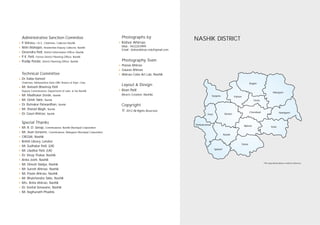
Nashik
Malegaon Municipal Corporation
Malegaon
Maharashtra Shasan
Baglan
Malegaon
Deola
Nandgaon
Yeola
Sinnar
Igatpuri
Trimbakeshwar
DindoriPeint
Surgana Kalwan
Chandwad
Niphad
Nashik
*The map shown above is only for reference.
Technical Committee
Dr. Kailas Kamod
Chairman, Maharashtra State OBC finance & Dvpt. Corp.
Mr. Avinash Bhamray Patil
Deputy Commissioner, Department of sales & Tax Nashik
Mr. Madhukar Zende, Nashik
Mr. Girish Takle, Nashik
Dr. Ratnakar Patwardhan, Nashik
Mr. Sharad Wagh, Nashik
Dr. Gauri Ahirrao, Nashik
Special Thanks
Mr. B. D. Sanap, Commissioner, Nashik Municipal Corporation
Mr. Jivan Sonavne, Commissioner, Malegaon Municipal Corporation
CREDAI, Nashik
British Library, London
Mr. Sudhakar Patil, (UK)
Mr. Liladhar Patil, (UK)
Dr. Vinay Thakar, Nashik
Anita Joshi, Nashik
Mr. Dinesh Vaidya, Nashik
Mr. Suresh Ahirrao, Nashik
Mr. Pravin Ahirrao, Nashik
Mr. Bhalchandra Takle, Nashik
Mrs. Anita Ahirrao, Nashik
Dr. Snehal Sonavane, Nashik
Mr. Raghunath Phadnis
Copyright
© 2012 All Rights Reserved.
Photographs by
Kishor Ahirrao
Mob : 9422253999
Email : kishorahirrao.nsk@gmail.com
Photography Team
Pranav Ahirrao
Gaurav Ahirrao
Ahirrao Color Art Lab, Nashik
Layout & Design
Kiran Patil
(Kiran's Creation, Nashik)
Administrative Sanction Commitee
P. Velrasu, I.A.S., Chairman, Collector Nashik
Nitin Mahajan, Residential Deputy Collector, Nashik
Devendra Patil, District Information Officer, Nashik
P. K. Patil, Former District Planning Officer, Nashik
Pradip Potdar, District Planning Officer, Nashik
NASHIK DISTRICT
Governor
Maharashtra
{Oëhm{YH$mar H$m`m©b`mÀ`m dVrZo Zm{eH$ {OëømMr Eo{Vhm{gH$, Ym{_©H$, gm§ñH¥${VH$,
gm_m{OH$ d n`©Q>Z `m joÌm§Mr _hVr N>m`m{MÌm§À`m ghmæ`mZo R>iH$nUo ZOaog AmUwZ XoUmar
_m{hVr nwpñVH$m (Coffee Table Book) àH$m{eV H$aÊ`mV `oV Amho. hr nwpñVH$m V`ma
H$aUoH$m_r _mÂ`m AJmoXaMo {Oëhm{YH$mar (My immediate predecessor) lr. nr. dobamgy
`m§ZrA{Ve`_ohZVKodyZhrAË`§V_hËdnwU©nwpñVH$mV`maHo$brAmho.
Zm{eH$ ho àmMrZ H$mimngwZ {d{dY AÜ`mpË_H$, Ym{_©H$ d Eo{Vhm{gH$ KQ>Zm§gmR>r à{gÜX Ago
_hmamîQ´>mVrb EH$ d¡{eîQ>çnwU© eha Amho. Zm{eH$ ehamMr AmVm _§Ì^y_rH$Sw>Z `§Ì_w_rH$S>o
Aer Am¡Úmo{JH$ {dH$mgmMr àJVr Va PmbrM Amho Am{U AënmdYrVM _m[hVr V§ÌkmZ d
n`©Q>Z `m joÌmVhr Zm{eH$ {Oëhm _moR>r ^amar KoV Amho. `m _m[hVr nwpñVHo$V {OëømVrb
Eo{Vhm{gH$, Ym{_©H$, gm§ñH¥${VH$ d n`©Q>Z `m gd© joÌmVrb {d{dY ~m~tMr _m[hVr R>iH$nUo
N>m`m{MÌm§gh àH$m{eV H$aÊ`mV `oV Amho. hr nwpñVH$m Xoe {dXoemVrb n`©Q>H$, Aä`mgH$,
{dÚmWu, gm_m{OH$ d Am¡Úmo{JH$ g§ñWm `m§Zm, VgoM AJm_r {g§hñW Hw§$^_où`mg `oUmè`m
^m{dH$m§ZmAË`§VCn`wº$d_mJ©Xe©H$R>aobAgm_bm{dídmgAmho.
`mZm{eH${OëømÀ`mH$m°$sQ>o~bnwpñVHo$g_mÂ`mhm{X©H$ew^oÀN>m!
{dbmg ~m. nmQ>rb
^m.à.go.
{Oëhm{YH$mar VWm {OëhmX§S>m{YH$mar
_hmamï´> emgZ
{dbmg ~m. nmQ>rb
Zm{eH$ {OëømMr g§nyU© _m{hVr XoUmao ""H$m°$s Q>o~b ~wH$'' ho nwñVH$ àH$m{eV H$aÊ`mV `oV
Agë`mMog_OyZAmZ§XPmbm.
Zm{eH$ {Oëhm Am{U Zm{eH$ eha PnmQ>çmZo {dH${gV hmoV AgyZ Am¡Úmo{JH$ ZJar åhUyZ
Zm{eH$ {Oëhm Zmdmê$nmbm `oV Amho. Ago Agbo Varhr H¥${f CËnÞmVhr Zm{eH$ {Oëhm
AmKmS>rda Amho. Ym{_©H$, gm§ñH¥${VH$ Am{U n`©Q>Z joÌmV Zm[eH$ {OëømMr doJir AmoiI
{Z_m©U Pmbr Amho. Zm{eH$ {OëømMr gd©g_mdoeH$ _m{hVr AgUmao ""H$m°$r Q>o~b ~wH$''
n«H$m{eVPmë`mZo`m{OëømMrZì`mZoAmoiI{Z_m©UhmoÊ`mg_XVhmoB©b.
""H$m°$s Q>o~b ~wH$'' _wio Zm{eH$ {OëømMm B{Vhmg AmOÀ`m {nT>rg_moa `oB©b. `m nwñVH$mV
Zm{eH$ {OëøVrb Eo{Vhm{gH$ ñWim§Mr VgoM n`©Q>Z ñWim§Mr N>m`m{MÌo N>mnÊ`mV `oUma
Agë`mZo, XoemVrb d naXoemVrb n`©Q>H$m§Zm AmH${f©V H$ê$Z n`©Q>Z CÚmoJ dmT>Ê`mgmR>r
Cn`wº$R>aob,Agm_bm{dídmgdmQ>Vmo.
Zm{eH$ {OëøVrb Ym{_©H$, Eo{Vhm{gH$, gm§ñH¥${VH$, n`©Q>Z joÌmVrb _m{hVr XoUmao ""H$m°$s
Q>o~b~wH$''honwñVH$n«H$m{eVH$aÊ`mÀ`m,Amnë`m`mñVwË`CnH«$_mg_mÂ`mhm{X©H$ew^oÀN>m!
O`ÝV Hw$_ma ~m±{R>`m
_w»` g{Md,
_§Ìmb`, _w§~B© 400 032
O`ÝV Hw$_ma ~m±{R>`m
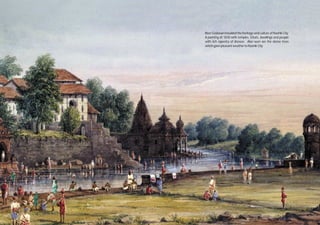
River Godavari moulded the heritage and culture of Nashik City.
A painting dt 1830 with temples, Ghats, dwellings and people
with rich tapestry of dresses . Also seen are the dense trees
which gave pleasant weather to Nashik City.
INDEX
Introduction 1
A Historical Perspective 3
Nature 17
Temples In Nashik 25
Temples around Nashik 41
Religion 55
Festivals of Nashik 69
Forts and Wadas 91
People 113
Crops of Nashik 135
Art and Paintings 147
Government Offices 171
Educational Institutes 183
Industries 195
Infrastructure 207
NASHIK DISTRICT... AN INTRODUCTION
Nashik district endowed with beautiful landscape, located between 19°35' and
20°52' north latitude and 73°16' and 74°56' east longitude in the northwestern part
of Maharashtra state. It is well known for the rugged mountain ranges with large
number of forts, Nashik district has 15582 sq. kms geographical area with fifteen
talukas as sub administration units. Nashik which is its district Head Quarter, is one of
the oldest and deeply religious cities of India. Origin of the word Nashik has two
interesting features. As one of the story goes in Ramayana, this is the place where
Lakshman is said to have cut - off the nose (nasika) of Shurpanakha. The other relates
to the geographical feature of the town, which is situated on the nine hills or
navashikhara (Durga, Ganesh, Chitraghanta, Pandav, DingerAli, Mhasarul,
Jogwada, Pathanpura and Konkani).
Nashik was known as 'Trikantak' in Kritayuga,, as 'Janasthana' in Dwaparyuga and
later in Kaliyuga it became 'Navashikh' or 'Nashik'. Renowned poets like Valmiki,
Kalidas and Bhavabhooti have paid rich tributes to Nashik through their literature.
Nashik is believed to be one of the country's largest market place in 150 BC. From
1487 A.D, this province came under the rule of Mughals and was then known as
'Gulshanabad'. It was also home of Emperor Akbar for some period and he has
written at length about Nashik in 'Ein-e-Akbari'.
It is believed that Lord Rama along with Sita and Laxmana spent 14 years of exile at
Tapovan in Nashik. After Mughal, Nashik came under Peshwas followed by British
rule. In 1862 Nashik Road railway station was built and two years later Nashik
Municipality was formed. The territory of Nashik district was formed in 1869, with
areas drawn partly from Khandesh district and partly from Ahmadnagar district. Yeola
taluka was then known as Patoda taluka. Igatpuri taluka was earlier known as Karnai
taluka. Peth taluka became part of district in 1878. Surgana which was a princely
state was made part of district in 1949.
Many famous freedom fighters who staunchly opposed the British rule were from Nashik. In
1909, seventeen years old Anant Kanhere shot dead the then collector of Nashik Mr. Jackson in
Vijayananda theater. Anant Laxman Kanhere, Krishnaji Gopal karve and Vinayak Ramchandra
Desphande were sentenced to death by hanging after the trial for the murder. In 1910 police
training school was established in Nashik and in 1922 distillery was established at Nashik road. In
1927 Security press was established in Nashik by the British. Between 1930 and 32 Nashik
satyagraha also known as Kalaram Mandir Pravesh satyagraha, was launched under the
leadership of Dr. Babasaheb Ambedkar for abolition of untouchability. In 1941 Artillery centre was
shifted to Nashik Road from Quetta, now in Pakistan.
Nashik was home to many famous personalities like Yeshvant Mahadev Bhosekar who is known
as Dev Mamaledar, Kusumagraj (V. V. Shirwadkar) a great Marathi poet, Dadasaheb Phalke who is
known as the father of Indian Cinema, Vinayak Damodar Savarkar, Anant Kanhere, Krishnaji and
Gopal Karve who were Great freedom fighters .
Nashik City is known for its picturesque surroundings and pleasant climate. Nashik district is
gifted with beautiful mountain ranges, like Selbari, Satmala, Trimbek-Anjaneri which spread east
west across the western ghats. All these ranges have great forts which played a major role in the
history of Nashik region. The forts guarded the high road from Khandesh to the Deccan and were
witness to many engagements during Maratha wars. The ankai-tankai dominated the road
leading from North to Ahmad Nagar. All these forts played strategic role in access control to
various regions. The important shrines like Trimbakeshwar, Saptashrunghi are located in beautiful
locations in these mountain range. The Great Trap Region of the Deccan covers the whole district
which is entirely made of volcanic formation.
This district has three major river basins namely Godavari, Girna and a small konkan rivers basin.
There are efforts going on to divert the westward flowing rivers in the district to east through river
diversion schemes. Godavari is the most revered river in India which originates near
Trimbakeshwar. The river takes a southern turn towards the city of Nashik which is considered
very auspicious place by Hindus. Sinhastha kumbhmela is organised every twelve years where
ocean of humanity converge on the banks of Godavari.
The district has a population of about 6.3 millions as per census 2011. Even though most of the
population lives in urban areas, there are many places in the district which are very remote in
terms of accessibility and have virgin areas unexplored by outsiders. Even though there are many
cities and towns in the district where the majority of the population lives, one can leave behind all
urban areas within 20 to 30 minutes and enjoy the rural and pristine landscape.
P. VELRASU
IAS
DISTRICT COLLECTOR, NASHIK
15/05/2012
1
Efforts are being made to promote the growth of an export-oriented floriculture and wine
industry in the district. There are five "Industrial Zones" in Nashik city and its immediate periphery
areas. (Satpur, Ambad, Sinnar, Igatpuri and Dindori). Nashik has a number of sugar mills. It is also
chief exporter of onions and pomegranates, along with grapes.
Nashik has prestigious public sector undertakings like Hindustan Aeronautics Limited at Ozhar,
India Security Press and Currency Note Press at Nashik Road, Thermal Power Plant at Eklahare,
Artillery Centre at Nasik Road Camp, School of Artillery at Deolali, Maharashtra Engineering
Research Institute (MERI), Maharashtra State Health University (MUHS), Yashwantrao Chavan
Mahrashtra open university (YCMOU), Maharashtra Police Academy (MPA), Indian Railways
Institute of Electrical Engineering (IRIEEN) at Nasik Road, Cantonment Board at Deolali, and
Combat Army Aviation Centre.
Bosch India, Mahindra and Mahindra, CEAT, Thyssen Krupp, Samsonite, Atlas Copco, Crompton
Greaves, ABB, Glaxo Smith Kline, Cipla, L & T, Schneider Electric, Jindal Steel, Garware, Coca
Cola, Siemens are some of the prominent private sector industrial units located in Nashik. MIDC
as a joint venture is setting up a Multipurpose SEZ at Sinnar near Nashik over an area of 2500
hectares. It is first and largest multipurpose SEZ in Maharashtra.
Nashik is famous for grapes, onions, tomatoes and vegetables. Nashik has been famous for its
table grapes for a very long time. Now table grapes are being exported to Europe, Middle East,
and many other countries.
Nashik has been the educational hub of North Maharashtra. The city has two state-run
universities, the Yashwantrao Chavan Maharashtra Open University and the Maharashtra
University of Health Sciences. Today the city has a large number of private and governmental
educational institutions offering higher education in Medicine, Engineering & Technology,
Architecture, Pharmacy, Military Management among others. Bhonsala Military School is one of
the oldest residential schools in Nashik. Indian Railway has also established its Advanced
Training Institute for electrical engineers namely, Indian Railway Institute of Electrical Engineers
IREEN at Nashik. Nashik has also Dr. Babasaheb Ambedkar Institute of Rural Technology &
Training run by KVIC.
In remote area like Surgana Block, many tribals are engaged in Carpet weaving. Export quality
carpets are prepared in and around Umbarthan (Tal. Surgana). NABARD has selected Yeola Block
for development of Paithani Cluster. A software Technology Park (STP) has been established in
Nashik.
Nashik today is one of the fastest growing cities of India and has been identified as a tier-2 metro.
Infrastructure is growing very fast in Nashik with excellent six lane road from Ghoti to
Pimpalgaon with a six kilometer long fly -over which will help to ease the traffic congestion in the
city. A modern civilian Airport is also planned at Ozar at an estimated cost of 60 crores which is
likely to be completed before 2014 and there are efforts going on to develop Agricultural terminal
market at Auda near Nashik Road. The State Government has already approved a
comprehensive tourism development plan for Gangapur dam which consists of adventure water
sports complex. There are many other projects which are in different stages of development.
Nashik is truly a green city with a perfect harmony between modernism and conservatism. This
city has preserved its roots and basic religious character of the place will hold the city in good
stead for eternity.
This coffee table book is an attempt to bring to the reader different aspects of Nashik district at a
glance and to give visual perspective of Nashik district. This book is an invitation to the readers to
visit Nashik and enjoy good environs of Nashik.
As a young Collector of Nashik, I have worked for more than three years in Nashik and at no point
of time this place gives you the same view. It has been a kaleidoscopic ride for me and there has
been urge within me to produce a coffee table book which captures the essence of Nashik. I am
very happy to put on record that this book is published at a very crucial point of time in the history
of Nashik and I sincerely hope that book shall serve the purpose of stoking imagination of the
readers about this mystic and God blessed place.
After all, this is where God actually lived…
2
P. VELRASU
A HISTORICAL PERSPECTIVE
Nashik has been a very old human settlement as per the archaeological
excavation record from the Chalcolithic period on the banks of Godavari.
st
The Buddhist rock cut caves are very old, dating back to 1 century BC to
th
6 Century AD. Trirashmi hills caves have inscriptions written in Brahmi
script ans Prakrit language. In early period Satavahana dynasty and
Shaka Kshatrapa dynasty were ruling this area. After these dynasties, the
Abhira, Traikutaka, chalukya, Harishchandra, Rashtrakuta and Yadava
ruled this part of Maharashtra. The district has Jain caves at Chambhar
lena, Anjaneri, Ankai Tankai and Tringalwadi. There were many forts on
hills which served many purposes for the rulers. The Chinese pilgrim
Hiuen Tsang had visited Nashik. In the mediaeval period Nashik was
controlled by Governors of Devagiri and Bahamani kings of Gulbarga
and Nizamshahi kings of Ahmad Nagar. Baglana is described in Ain-i-
Akbari as a mountainous but well populated country between Surat and
Nandurbar. It had seven forts of which Mulher and Salher were places of
unusual strength. In 1656-57 Chhatrapati Shivaji came into conflict with
Moghul and raided Ahmadnagar and Junnar. There was also a famous
battle of Ramshej in which even after sustained attempts by the Moghul
army the fort could not be conquered.
Raghunathrao who had a tussle with Peshava for long time was
promised assistance by the British. But after the treaty of Salbai in 1782,
the protection by British was withdrawn. He retired with his family to
Kopargaon in Ahmadnagar district. After his death in the year 1783, his
widow Anadibai with son Chimaji appa lived in Kopargaon till 1793 and
later they were moved to Anandvalli in Nashik. After the death of the
Peshva Madhavrao-II in 1796, Bajirao was made Peshva and because of
continued infighting Bajirao fled from Poona in 1802. As the British
troops marched towards Poona, Amritrao defeated the troops of Raje
Bahadur of Malegaon, and also ransacked Nashik. During the Bhill
trouble from 1802 to 1816, the Arab Mercenaries were called by the
Chiefs and landlords and soon the Arab mercenaries became chief
money lenders of the district. In 1817 the Peshva declared war against
the British but the British troops led by Sir John Malcom and Sir Thomas
Hislop won the war. Surrender of Peshva Bajirao in May 1818, finally
ended the Maratha power in this region.
3
The British during their regime conquered the Chandwad, Galna, Ankai-Tankai, Trimbakeshwar,
Malegaon and Rajdeir fort. Nashik suffered from the Koli rebellion in 1844 to 1848. During the
revolt of 1857 Nashik was the scene of considerable disturbance which was mainly caused by
Rohilas, Arabs, Thakurs and Bhils of Southern Nashik. Bhils grouped under the leadership of
Bhagoji naik of Nandur Shingote village in Sinner gave a major challenge to the British and also
there was a rebellion in Peth where the mamaldar was taken as prisoner. However, from 1860
there was continuous peace in the area and in 1869 Nashik was made a full fledged district. The
railway route which was constructed five kms away from the main city, made the town a major
trade center.
In 1840 the public library was opened in Nashik and in 1861 an Anglo-vernacular school was
started. In 1864 the municipality was started. Yashwant mahadev Bhosekar who was known as
Dev Mamledar and revered by the people lived during that time in Baglan. In 1869 “Nasik Vritta” a
weekly was started. In 1906, Savarkar before departing for England to become barrister gave a
fiery speech in Nashik. Lokmanya Tilak presided a meeting arranged in Nashik to protest against
Ristay circular in 1907. In 1909, Mr. Anant Laxman Kanhere with help of his friends shot dead the
then Collector of Nashik Mr. Jackson. [ shri. Anant Laxman kanhere, Shri. Krishnaji gopal karve
and Shri. Vinayak Narayan Deshpande were handed over death punishment ]. In 1914, the
Maratha Vidya Prasarak samaj was founded in Nashik, which plays a major role in education
sector. In 1916 seventeenth Bombay provincial Conference was held in Nashik under the
presidentship of Shrinivas Shastri. In 1924, a college was started in Nashik which is known as
Hansraj Pragji Thackersey College (HPT College) which brought a slow but sure revolution in the
social outlook of the city. In 1932 Dr. Ambedkar started the Kalaram temple entry movement in
Nashik. In 1932, Bhonsla military school was started in Nashik by Dr. B. S. Moonje. Ganesh Shastri
Lele, Narayan Vaman Tilak, Govind kavi, Laxmibai Tilak, Sopandev Chaudhari, Vasant Kanetkar
and Kusumagraj ( V. V. Shirvadkar) have contributed immesnsly to literary tradition of Nashik. The
father of Indian Cinema, Dadasaheb Phalke established cinema industry in Nashik. The Christian
missionary organisations lead by Miss. Harvey opened a lepers` asylum, an orphanage, a free
hospital and veterinary hospital. Nashik is an important place for the religious people. Priest
families,maintain family records of generations of pilgrims visiting Nashik from all over India. On
the Ghats of Godavari, Kumbhmela is organised every 12 years during which millions of people
congregate. Dr. Kurtakoti ( Shankaracharya of Karaveer) made Nashik his residence for a number
of years and his influence spread widely in favour of religious and social reform from his math at
Panchvati. Deolali town and areas near Nashik Road grew rapidly during the period 1920 to 1950
due to establishment of Nashik distillery, Central jail and Government of India security press.
Nashik after independence has grown very rapidly and in the recent times it has emerged as one
of the cosmopolitan towns of India with a modern outlook entwined with long religious history.
4
An old photo depicting the Ganga Ghat with majestic temples showing the
grand display of size and proportion. Godavari reflecting the grand scene
with an onlooker wearing a traditional attire.
5
Old Ganga ghat with people doing their daily chores on both the sides.
Even though this photo does not show the Ram Setu, currently the bridge
stands there. Also seen is the Balaji mandir.
6

Nashik coffee table book-1

  • 1.
    N A SH I K Government of MaharashtraNashik Municipal Corporation Nashik Malegaon Municipal Corporation Malegaon Maharashtra Shasan
  • 2.
    Baglan Malegaon Deola Nandgaon Yeola Sinnar Igatpuri Trimbakeshwar DindoriPeint Surgana Kalwan Chandwad Niphad Nashik *The mapshown above is only for reference. Technical Committee Dr. Kailas Kamod Chairman, Maharashtra State OBC finance & Dvpt. Corp. Mr. Avinash Bhamray Patil Deputy Commissioner, Department of sales & Tax Nashik Mr. Madhukar Zende, Nashik Mr. Girish Takle, Nashik Dr. Ratnakar Patwardhan, Nashik Mr. Sharad Wagh, Nashik Dr. Gauri Ahirrao, Nashik Special Thanks Mr. B. D. Sanap, Commissioner, Nashik Municipal Corporation Mr. Jivan Sonavne, Commissioner, Malegaon Municipal Corporation CREDAI, Nashik British Library, London Mr. Sudhakar Patil, (UK) Mr. Liladhar Patil, (UK) Dr. Vinay Thakar, Nashik Anita Joshi, Nashik Mr. Dinesh Vaidya, Nashik Mr. Suresh Ahirrao, Nashik Mr. Pravin Ahirrao, Nashik Mr. Bhalchandra Takle, Nashik Mrs. Anita Ahirrao, Nashik Dr. Snehal Sonavane, Nashik Mr. Raghunath Phadnis Copyright © 2012 All Rights Reserved. Photographs by Kishor Ahirrao Mob : 9422253999 Email : kishorahirrao.nsk@gmail.com Photography Team Pranav Ahirrao Gaurav Ahirrao Ahirrao Color Art Lab, Nashik Layout & Design Kiran Patil (Kiran's Creation, Nashik) Administrative Sanction Commitee P. Velrasu, I.A.S., Chairman, Collector Nashik Nitin Mahajan, Residential Deputy Collector, Nashik Devendra Patil, District Information Officer, Nashik P. K. Patil, Former District Planning Officer, Nashik Pradip Potdar, District Planning Officer, Nashik NASHIK DISTRICT
  • 3.
  • 7.
    {Oëhm{YH$mar H$m`m©b`mÀ`m dVrZoZm{eH$ {OëømMr Eo{Vhm{gH$, Ym{_©H$, gm§ñH¥${VH$, gm_m{OH$ d n`©Q>Z `m joÌm§Mr _hVr N>m`m{MÌm§À`m ghmæ`mZo R>iH$nUo ZOaog AmUwZ XoUmar _m{hVr nwpñVH$m (Coffee Table Book) àH$m{eV H$aÊ`mV `oV Amho. hr nwpñVH$m V`ma H$aUoH$m_r _mÂ`m AJmoXaMo {Oëhm{YH$mar (My immediate predecessor) lr. nr. dobamgy `m§ZrA{Ve`_ohZVKodyZhrAË`§V_hËdnwU©nwpñVH$mV`maHo$brAmho. Zm{eH$ ho àmMrZ H$mimngwZ {d{dY AÜ`mpË_H$, Ym{_©H$ d Eo{Vhm{gH$ KQ>Zm§gmR>r à{gÜX Ago _hmamîQ´>mVrb EH$ d¡{eîQ>çnwU© eha Amho. Zm{eH$ ehamMr AmVm _§Ì^y_rH$Sw>Z `§Ì_w_rH$S>o Aer Am¡Úmo{JH$ {dH$mgmMr àJVr Va PmbrM Amho Am{U AënmdYrVM _m[hVr V§ÌkmZ d n`©Q>Z `m joÌmVhr Zm{eH$ {Oëhm _moR>r ^amar KoV Amho. `m _m[hVr nwpñVHo$V {OëømVrb Eo{Vhm{gH$, Ym{_©H$, gm§ñH¥${VH$ d n`©Q>Z `m gd© joÌmVrb {d{dY ~m~tMr _m[hVr R>iH$nUo N>m`m{MÌm§gh àH$m{eV H$aÊ`mV `oV Amho. hr nwpñVH$m Xoe {dXoemVrb n`©Q>H$, Aä`mgH$, {dÚmWu, gm_m{OH$ d Am¡Úmo{JH$ g§ñWm `m§Zm, VgoM AJm_r {g§hñW Hw§$^_où`mg `oUmè`m ^m{dH$m§ZmAË`§VCn`wº$d_mJ©Xe©H$R>aobAgm_bm{dídmgAmho. `mZm{eH${OëømÀ`mH$m°$sQ>o~bnwpñVHo$g_mÂ`mhm{X©H$ew^oÀN>m! {dbmg ~m. nmQ>rb ^m.à.go. {Oëhm{YH$mar VWm {OëhmX§S>m{YH$mar _hmamï´> emgZ {dbmg ~m. nmQ>rb Zm{eH$ {OëømMr g§nyU© _m{hVr XoUmao ""H$m°$s Q>o~b ~wH$'' ho nwñVH$ àH$m{eV H$aÊ`mV `oV Agë`mMog_OyZAmZ§XPmbm. Zm{eH$ {Oëhm Am{U Zm{eH$ eha PnmQ>çmZo {dH${gV hmoV AgyZ Am¡Úmo{JH$ ZJar åhUyZ Zm{eH$ {Oëhm Zmdmê$nmbm `oV Amho. Ago Agbo Varhr H¥${f CËnÞmVhr Zm{eH$ {Oëhm AmKmS>rda Amho. Ym{_©H$, gm§ñH¥${VH$ Am{U n`©Q>Z joÌmV Zm[eH$ {OëømMr doJir AmoiI {Z_m©U Pmbr Amho. Zm{eH$ {OëømMr gd©g_mdoeH$ _m{hVr AgUmao ""H$m°$r Q>o~b ~wH$'' n«H$m{eVPmë`mZo`m{OëømMrZì`mZoAmoiI{Z_m©UhmoÊ`mg_XVhmoB©b. ""H$m°$s Q>o~b ~wH$'' _wio Zm{eH$ {OëømMm B{Vhmg AmOÀ`m {nT>rg_moa `oB©b. `m nwñVH$mV Zm{eH$ {OëøVrb Eo{Vhm{gH$ ñWim§Mr VgoM n`©Q>Z ñWim§Mr N>m`m{MÌo N>mnÊ`mV `oUma Agë`mZo, XoemVrb d naXoemVrb n`©Q>H$m§Zm AmH${f©V H$ê$Z n`©Q>Z CÚmoJ dmT>Ê`mgmR>r Cn`wº$R>aob,Agm_bm{dídmgdmQ>Vmo. Zm{eH$ {OëøVrb Ym{_©H$, Eo{Vhm{gH$, gm§ñH¥${VH$, n`©Q>Z joÌmVrb _m{hVr XoUmao ""H$m°$s Q>o~b~wH$''honwñVH$n«H$m{eVH$aÊ`mÀ`m,Amnë`m`mñVwË`CnH«$_mg_mÂ`mhm{X©H$ew^oÀN>m! O`ÝV Hw$_ma ~m±{R>`m _w»` g{Md, _§Ìmb`, _w§~B© 400 032 O`ÝV Hw$_ma ~m±{R>`m
  • 8.
    River Godavari mouldedthe heritage and culture of Nashik City. A painting dt 1830 with temples, Ghats, dwellings and people with rich tapestry of dresses . Also seen are the dense trees which gave pleasant weather to Nashik City.
  • 9.
    INDEX Introduction 1 A HistoricalPerspective 3 Nature 17 Temples In Nashik 25 Temples around Nashik 41 Religion 55 Festivals of Nashik 69 Forts and Wadas 91 People 113 Crops of Nashik 135 Art and Paintings 147 Government Offices 171 Educational Institutes 183 Industries 195 Infrastructure 207
  • 11.
    NASHIK DISTRICT... ANINTRODUCTION Nashik district endowed with beautiful landscape, located between 19°35' and 20°52' north latitude and 73°16' and 74°56' east longitude in the northwestern part of Maharashtra state. It is well known for the rugged mountain ranges with large number of forts, Nashik district has 15582 sq. kms geographical area with fifteen talukas as sub administration units. Nashik which is its district Head Quarter, is one of the oldest and deeply religious cities of India. Origin of the word Nashik has two interesting features. As one of the story goes in Ramayana, this is the place where Lakshman is said to have cut - off the nose (nasika) of Shurpanakha. The other relates to the geographical feature of the town, which is situated on the nine hills or navashikhara (Durga, Ganesh, Chitraghanta, Pandav, DingerAli, Mhasarul, Jogwada, Pathanpura and Konkani). Nashik was known as 'Trikantak' in Kritayuga,, as 'Janasthana' in Dwaparyuga and later in Kaliyuga it became 'Navashikh' or 'Nashik'. Renowned poets like Valmiki, Kalidas and Bhavabhooti have paid rich tributes to Nashik through their literature. Nashik is believed to be one of the country's largest market place in 150 BC. From 1487 A.D, this province came under the rule of Mughals and was then known as 'Gulshanabad'. It was also home of Emperor Akbar for some period and he has written at length about Nashik in 'Ein-e-Akbari'. It is believed that Lord Rama along with Sita and Laxmana spent 14 years of exile at Tapovan in Nashik. After Mughal, Nashik came under Peshwas followed by British rule. In 1862 Nashik Road railway station was built and two years later Nashik Municipality was formed. The territory of Nashik district was formed in 1869, with areas drawn partly from Khandesh district and partly from Ahmadnagar district. Yeola taluka was then known as Patoda taluka. Igatpuri taluka was earlier known as Karnai taluka. Peth taluka became part of district in 1878. Surgana which was a princely state was made part of district in 1949. Many famous freedom fighters who staunchly opposed the British rule were from Nashik. In 1909, seventeen years old Anant Kanhere shot dead the then collector of Nashik Mr. Jackson in Vijayananda theater. Anant Laxman Kanhere, Krishnaji Gopal karve and Vinayak Ramchandra Desphande were sentenced to death by hanging after the trial for the murder. In 1910 police training school was established in Nashik and in 1922 distillery was established at Nashik road. In 1927 Security press was established in Nashik by the British. Between 1930 and 32 Nashik satyagraha also known as Kalaram Mandir Pravesh satyagraha, was launched under the leadership of Dr. Babasaheb Ambedkar for abolition of untouchability. In 1941 Artillery centre was shifted to Nashik Road from Quetta, now in Pakistan. Nashik was home to many famous personalities like Yeshvant Mahadev Bhosekar who is known as Dev Mamaledar, Kusumagraj (V. V. Shirwadkar) a great Marathi poet, Dadasaheb Phalke who is known as the father of Indian Cinema, Vinayak Damodar Savarkar, Anant Kanhere, Krishnaji and Gopal Karve who were Great freedom fighters . Nashik City is known for its picturesque surroundings and pleasant climate. Nashik district is gifted with beautiful mountain ranges, like Selbari, Satmala, Trimbek-Anjaneri which spread east west across the western ghats. All these ranges have great forts which played a major role in the history of Nashik region. The forts guarded the high road from Khandesh to the Deccan and were witness to many engagements during Maratha wars. The ankai-tankai dominated the road leading from North to Ahmad Nagar. All these forts played strategic role in access control to various regions. The important shrines like Trimbakeshwar, Saptashrunghi are located in beautiful locations in these mountain range. The Great Trap Region of the Deccan covers the whole district which is entirely made of volcanic formation. This district has three major river basins namely Godavari, Girna and a small konkan rivers basin. There are efforts going on to divert the westward flowing rivers in the district to east through river diversion schemes. Godavari is the most revered river in India which originates near Trimbakeshwar. The river takes a southern turn towards the city of Nashik which is considered very auspicious place by Hindus. Sinhastha kumbhmela is organised every twelve years where ocean of humanity converge on the banks of Godavari. The district has a population of about 6.3 millions as per census 2011. Even though most of the population lives in urban areas, there are many places in the district which are very remote in terms of accessibility and have virgin areas unexplored by outsiders. Even though there are many cities and towns in the district where the majority of the population lives, one can leave behind all urban areas within 20 to 30 minutes and enjoy the rural and pristine landscape. P. VELRASU IAS DISTRICT COLLECTOR, NASHIK 15/05/2012 1
  • 12.
    Efforts are beingmade to promote the growth of an export-oriented floriculture and wine industry in the district. There are five "Industrial Zones" in Nashik city and its immediate periphery areas. (Satpur, Ambad, Sinnar, Igatpuri and Dindori). Nashik has a number of sugar mills. It is also chief exporter of onions and pomegranates, along with grapes. Nashik has prestigious public sector undertakings like Hindustan Aeronautics Limited at Ozhar, India Security Press and Currency Note Press at Nashik Road, Thermal Power Plant at Eklahare, Artillery Centre at Nasik Road Camp, School of Artillery at Deolali, Maharashtra Engineering Research Institute (MERI), Maharashtra State Health University (MUHS), Yashwantrao Chavan Mahrashtra open university (YCMOU), Maharashtra Police Academy (MPA), Indian Railways Institute of Electrical Engineering (IRIEEN) at Nasik Road, Cantonment Board at Deolali, and Combat Army Aviation Centre. Bosch India, Mahindra and Mahindra, CEAT, Thyssen Krupp, Samsonite, Atlas Copco, Crompton Greaves, ABB, Glaxo Smith Kline, Cipla, L & T, Schneider Electric, Jindal Steel, Garware, Coca Cola, Siemens are some of the prominent private sector industrial units located in Nashik. MIDC as a joint venture is setting up a Multipurpose SEZ at Sinnar near Nashik over an area of 2500 hectares. It is first and largest multipurpose SEZ in Maharashtra. Nashik is famous for grapes, onions, tomatoes and vegetables. Nashik has been famous for its table grapes for a very long time. Now table grapes are being exported to Europe, Middle East, and many other countries. Nashik has been the educational hub of North Maharashtra. The city has two state-run universities, the Yashwantrao Chavan Maharashtra Open University and the Maharashtra University of Health Sciences. Today the city has a large number of private and governmental educational institutions offering higher education in Medicine, Engineering & Technology, Architecture, Pharmacy, Military Management among others. Bhonsala Military School is one of the oldest residential schools in Nashik. Indian Railway has also established its Advanced Training Institute for electrical engineers namely, Indian Railway Institute of Electrical Engineers IREEN at Nashik. Nashik has also Dr. Babasaheb Ambedkar Institute of Rural Technology & Training run by KVIC. In remote area like Surgana Block, many tribals are engaged in Carpet weaving. Export quality carpets are prepared in and around Umbarthan (Tal. Surgana). NABARD has selected Yeola Block for development of Paithani Cluster. A software Technology Park (STP) has been established in Nashik. Nashik today is one of the fastest growing cities of India and has been identified as a tier-2 metro. Infrastructure is growing very fast in Nashik with excellent six lane road from Ghoti to Pimpalgaon with a six kilometer long fly -over which will help to ease the traffic congestion in the city. A modern civilian Airport is also planned at Ozar at an estimated cost of 60 crores which is likely to be completed before 2014 and there are efforts going on to develop Agricultural terminal market at Auda near Nashik Road. The State Government has already approved a comprehensive tourism development plan for Gangapur dam which consists of adventure water sports complex. There are many other projects which are in different stages of development. Nashik is truly a green city with a perfect harmony between modernism and conservatism. This city has preserved its roots and basic religious character of the place will hold the city in good stead for eternity. This coffee table book is an attempt to bring to the reader different aspects of Nashik district at a glance and to give visual perspective of Nashik district. This book is an invitation to the readers to visit Nashik and enjoy good environs of Nashik. As a young Collector of Nashik, I have worked for more than three years in Nashik and at no point of time this place gives you the same view. It has been a kaleidoscopic ride for me and there has been urge within me to produce a coffee table book which captures the essence of Nashik. I am very happy to put on record that this book is published at a very crucial point of time in the history of Nashik and I sincerely hope that book shall serve the purpose of stoking imagination of the readers about this mystic and God blessed place. After all, this is where God actually lived… 2 P. VELRASU
  • 13.
    A HISTORICAL PERSPECTIVE Nashikhas been a very old human settlement as per the archaeological excavation record from the Chalcolithic period on the banks of Godavari. st The Buddhist rock cut caves are very old, dating back to 1 century BC to th 6 Century AD. Trirashmi hills caves have inscriptions written in Brahmi script ans Prakrit language. In early period Satavahana dynasty and Shaka Kshatrapa dynasty were ruling this area. After these dynasties, the Abhira, Traikutaka, chalukya, Harishchandra, Rashtrakuta and Yadava ruled this part of Maharashtra. The district has Jain caves at Chambhar lena, Anjaneri, Ankai Tankai and Tringalwadi. There were many forts on hills which served many purposes for the rulers. The Chinese pilgrim Hiuen Tsang had visited Nashik. In the mediaeval period Nashik was controlled by Governors of Devagiri and Bahamani kings of Gulbarga and Nizamshahi kings of Ahmad Nagar. Baglana is described in Ain-i- Akbari as a mountainous but well populated country between Surat and Nandurbar. It had seven forts of which Mulher and Salher were places of unusual strength. In 1656-57 Chhatrapati Shivaji came into conflict with Moghul and raided Ahmadnagar and Junnar. There was also a famous battle of Ramshej in which even after sustained attempts by the Moghul army the fort could not be conquered. Raghunathrao who had a tussle with Peshava for long time was promised assistance by the British. But after the treaty of Salbai in 1782, the protection by British was withdrawn. He retired with his family to Kopargaon in Ahmadnagar district. After his death in the year 1783, his widow Anadibai with son Chimaji appa lived in Kopargaon till 1793 and later they were moved to Anandvalli in Nashik. After the death of the Peshva Madhavrao-II in 1796, Bajirao was made Peshva and because of continued infighting Bajirao fled from Poona in 1802. As the British troops marched towards Poona, Amritrao defeated the troops of Raje Bahadur of Malegaon, and also ransacked Nashik. During the Bhill trouble from 1802 to 1816, the Arab Mercenaries were called by the Chiefs and landlords and soon the Arab mercenaries became chief money lenders of the district. In 1817 the Peshva declared war against the British but the British troops led by Sir John Malcom and Sir Thomas Hislop won the war. Surrender of Peshva Bajirao in May 1818, finally ended the Maratha power in this region. 3
  • 14.
    The British duringtheir regime conquered the Chandwad, Galna, Ankai-Tankai, Trimbakeshwar, Malegaon and Rajdeir fort. Nashik suffered from the Koli rebellion in 1844 to 1848. During the revolt of 1857 Nashik was the scene of considerable disturbance which was mainly caused by Rohilas, Arabs, Thakurs and Bhils of Southern Nashik. Bhils grouped under the leadership of Bhagoji naik of Nandur Shingote village in Sinner gave a major challenge to the British and also there was a rebellion in Peth where the mamaldar was taken as prisoner. However, from 1860 there was continuous peace in the area and in 1869 Nashik was made a full fledged district. The railway route which was constructed five kms away from the main city, made the town a major trade center. In 1840 the public library was opened in Nashik and in 1861 an Anglo-vernacular school was started. In 1864 the municipality was started. Yashwant mahadev Bhosekar who was known as Dev Mamledar and revered by the people lived during that time in Baglan. In 1869 “Nasik Vritta” a weekly was started. In 1906, Savarkar before departing for England to become barrister gave a fiery speech in Nashik. Lokmanya Tilak presided a meeting arranged in Nashik to protest against Ristay circular in 1907. In 1909, Mr. Anant Laxman Kanhere with help of his friends shot dead the then Collector of Nashik Mr. Jackson. [ shri. Anant Laxman kanhere, Shri. Krishnaji gopal karve and Shri. Vinayak Narayan Deshpande were handed over death punishment ]. In 1914, the Maratha Vidya Prasarak samaj was founded in Nashik, which plays a major role in education sector. In 1916 seventeenth Bombay provincial Conference was held in Nashik under the presidentship of Shrinivas Shastri. In 1924, a college was started in Nashik which is known as Hansraj Pragji Thackersey College (HPT College) which brought a slow but sure revolution in the social outlook of the city. In 1932 Dr. Ambedkar started the Kalaram temple entry movement in Nashik. In 1932, Bhonsla military school was started in Nashik by Dr. B. S. Moonje. Ganesh Shastri Lele, Narayan Vaman Tilak, Govind kavi, Laxmibai Tilak, Sopandev Chaudhari, Vasant Kanetkar and Kusumagraj ( V. V. Shirvadkar) have contributed immesnsly to literary tradition of Nashik. The father of Indian Cinema, Dadasaheb Phalke established cinema industry in Nashik. The Christian missionary organisations lead by Miss. Harvey opened a lepers` asylum, an orphanage, a free hospital and veterinary hospital. Nashik is an important place for the religious people. Priest families,maintain family records of generations of pilgrims visiting Nashik from all over India. On the Ghats of Godavari, Kumbhmela is organised every 12 years during which millions of people congregate. Dr. Kurtakoti ( Shankaracharya of Karaveer) made Nashik his residence for a number of years and his influence spread widely in favour of religious and social reform from his math at Panchvati. Deolali town and areas near Nashik Road grew rapidly during the period 1920 to 1950 due to establishment of Nashik distillery, Central jail and Government of India security press. Nashik after independence has grown very rapidly and in the recent times it has emerged as one of the cosmopolitan towns of India with a modern outlook entwined with long religious history. 4
  • 15.
    An old photodepicting the Ganga Ghat with majestic temples showing the grand display of size and proportion. Godavari reflecting the grand scene with an onlooker wearing a traditional attire. 5
  • 16.
    Old Ganga ghatwith people doing their daily chores on both the sides. Even though this photo does not show the Ram Setu, currently the bridge stands there. Also seen is the Balaji mandir. 6