Extractables from Single Use
Bioreactors and Impact on Cell
Culture Performance
Yasser Nashed-Samuel, Ph.D.
Process Development
Amgen, Inc. – Thousand Oaks, CA,
USA
2016 PepTalk
Single-Use Technologies and Continuous
Processing
San Diego, CA – January 18-22
Overview
• Extractable/Leachable potential impact
• Inconsistent cell culture yield in Single Use
Bioreactors/Bags (SUB)
• ID Extractables
• Extractable impact on cell culture
2
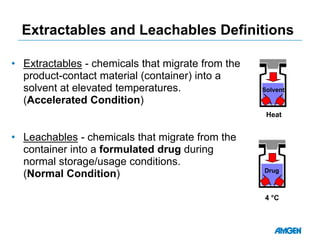
Extractables and Leachables Definitions
• Extractables - chemicals that migrate from the
product-contact material (container) into a
solvent at elevated temperatures.
(Accelerated Condition)
• Leachables - chemicals that migrate from the
container into a formulated drug during
normal storage/usage conditions.
(Normal Condition)
Solvent
Drug
4 °C
Heat
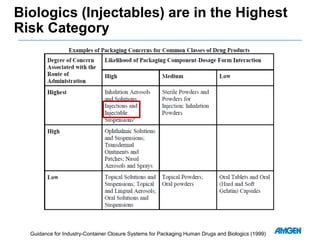
Biologics (Injectables) are in the Highest
Risk Category
Guidance for Industry-Container Closure Systems for Packaging Human Drugs and Biologics (1999)
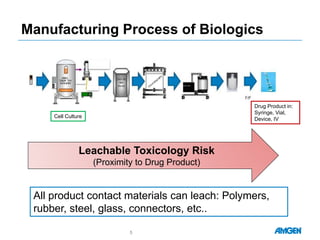
Manufacturing Process of Biologics
5
Cell Culture
Drug Product in:
Syringe, Vial,
Device, IV
Leachable Toxicology Risk
(Proximity to Drug Product)
All product contact materials can leach: Polymers,
rubber, steel, glass, connectors, etc..
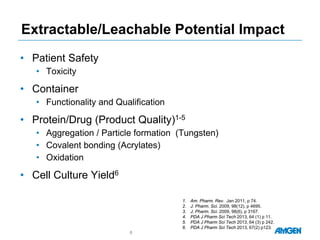
Extractable/Leachable Potential Impact
• Patient Safety
• Toxicity
• Container
• Functionality and Qualification
• Protein/Drug (Product Quality)1-5
• Aggregation / Particle formation (Tungsten)
• Covalent bonding (Acrylates)
• Oxidation
• Cell Culture Yield6
6
1. Am. Pharm. Rev. Jan 2011, p 74.
2. J. Pharm. Sci. 2009, 98(12), p 4695.
3. J. Pharm. Sci. 2009, 98(6), p 3167.
4. PDA J Pharm Sci Tech 2013, 64 (1) p 11.
5. PDA J Pharm Sci Tech 2013, 64 (3) p 242.
6. PDA J Pharm Sci Tech 2013, 67(2) p123.
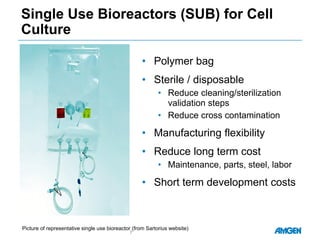
Single Use Bioreactors (SUB) for Cell
Culture
• Polymer bag
• Sterile / disposable
• Reduce cleaning/sterilization
validation steps
• Reduce cross contamination
• Manufacturing flexibility
• Reduce long term cost
• Maintenance, parts, steel, labor
• Short term development costs
7
Picture of representative single use bioreactor (from Sartorius website)
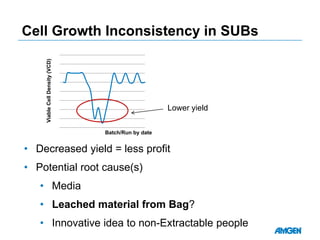
Cell Growth Inconsistency in SUBs
Batch/Run by date
ViableCellDensity(VCD)
• Decreased yield = less profit
• Potential root cause(s)
• Media
• Leached material from Bag?
• Innovative idea to non-Extractable people
Lower yield
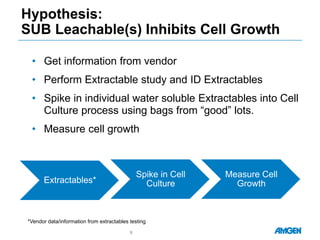
Hypothesis:
SUB Leachable(s) Inhibits Cell Growth
• Get information from vendor
• Perform Extractable study and ID Extractables
• Spike in individual water soluble Extractables into Cell
Culture process using bags from “good” lots.
• Measure cell growth
9
Extractables*
Spike in Cell
Culture
Measure Cell
Growth
*Vendor data/information from extractables testing
Finishing
OEM
Vendors
Polymer
• Resins
Additives
• Stabilizers
• Processing aids
Pellets
Extrusion
• Film
• Sheet, Coating
Finishing/Assembly
• Printing, Fittings
• Gluing
• Etc..
Bag
suppliers
Etc..
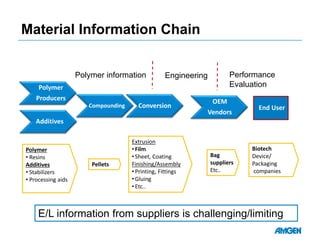
Material Information Chain
Polymer
Producers
Compounding Conversion
Biotech
Device/
Packaging
companies
Additives
End User
Polymer information Performance
Evaluation
Engineering
E/L information from suppliers is challenging/limiting
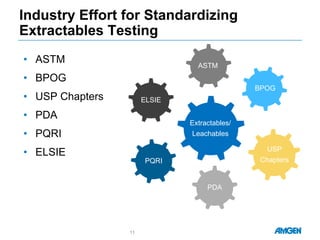
Industry Effort for Standardizing
Extractables Testing
• ASTM
• BPOG
• USP Chapters
• PDA
• PQRI
• ELSIE
11
ELSIE
ASTM
PDA
USP
ChaptersPQRI
BPOG
Extractables/
Leachables
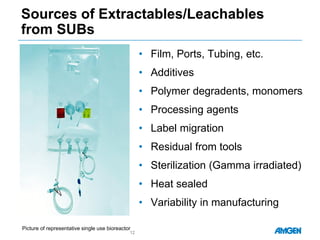
Sources of Extractables/Leachables
from SUBs
• Film, Ports, Tubing, etc.
• Additives
• Polymer degradents, monomers
• Processing agents
• Label migration
• Residual from tools
• Sterilization (Gamma irradiated)
• Heat sealed
• Variability in manufacturing
12
Picture of representative single use bioreactor
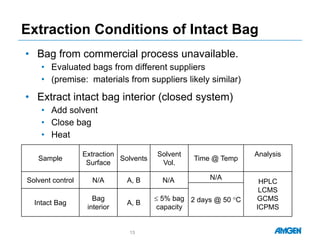
Extraction Conditions of Intact Bag
13
Sample
Extraction
Surface
Solvents
Solvent
Vol.
Time @ Temp
Analysis
Solvent control N/A A, B N/A N/A
HPLC
LCMS
GCMS
ICPMS
2 days @ 50 °CIntact Bag
Bag
interior
A, B
≤ 5% bag
capacity
• Bag from commercial process unavailable.
• Evaluated bags from different suppliers
• (premise: materials from suppliers likely similar)
• Extract intact bag interior (closed system)
• Add solvent
• Close bag
• Heat
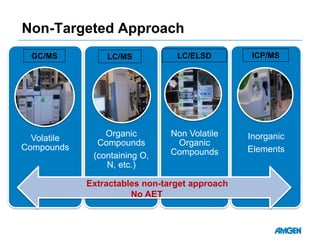
Non-Targeted Approach
Volatile
Compounds
Organic
Compounds
(containing O,
N, etc.)
Non Volatile
Organic
Compounds
Inorganic
Elements
Extractables non-target approach
No AET
GC/MS LC/MS ICP/MSLC/ELSD
Bag Extractables
• Identified 20-40+ extractable molecules per bag
• Database (30%)
• Structure Elucidation (70%)
• Antioxidants
• Plasticizers
• Organic acids
• Miscellaneous additives
• Nylon related components
• Polymeric related materials
• Inorganic elements
• Extractable profile similar and different for each bag
vendor
15
4.00 6.00 8.00 10.00 12.00 14.00 16.00 18.00 20.00
10000
15000
20000
25000
30000
35000
40000
45000
50000
55000
60000
65000
70000
75000
80000
85000
90000
95000
Time-->
Abundance
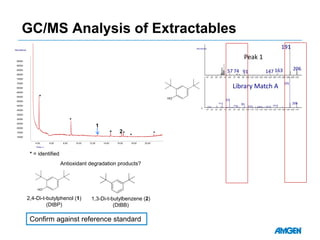
GC/MS Analysis of Extractables
2,4-Di-t-butylphenol (1)
(DtBP)
1,3-Di-t-butylbenzene (2)
(DtBB)
1
2
*
*
* ** *
HO
10 20 30 40 50 60 70 80 90 100 110 120 130 140 150 160 170 180 190 200 210
Abundance
Peak 1
191
20616374 14791
10 20 30 40 50 60 70 80 90 100 110 120 130 140 150 160 170 180 190 200 210
0
Library Match A
191
57
20641.0
163.074.0 91 107.0 147.0128.015.0
57
10 2
0
30 40 50 60 70 80 90 100 110 120 130 140 150 160 170 180 190 200 210
191
57
20641.0
135.0
91 107.074.0 163.015.0
191
5741
2061319174.27 163115 147 177
OH
OH
Library Match B
Library Match C
HO
Confirm against reference standard
* = identified
Antioxidant degradation products?
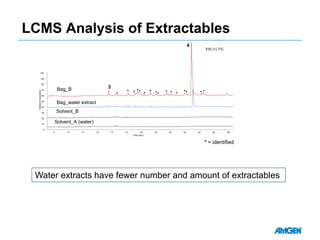
LCMS Analysis of Extractables
4 6 8 10 12 14 16 18 20 22 24 26 28
Time (min)
0
10
20
30
40
50
60
70
80
90
100
RelativeAbundance
3
4
Bag_B
Bag_water extract
Solvent_B
Solvent_A (water)
ESI (+) TIC
*
* * ** ** ** * * * ** * *
* = identified
Water extracts have fewer number and amount of extractables
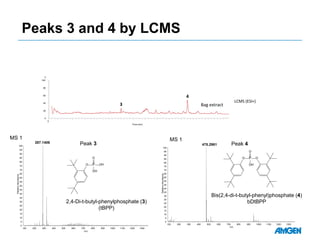
Peaks 3 and 4 by LCMS
0
Time (min)
0
20
40
60
80
100
0
3 Bag extract
Standard
Standard
4
3
4
100 200 300 400 500 600 700 800 900 1000 1100 1200 1300
m/z
0
5
10
15
20
25
30
35
40
45
50
55
60
65
70
75
80
85
90
95
100
RelativeAbundance
287.1406
100 200 300 400 500 600 700 800 900 1000 1100 1200 1300
m/z
0
5
10
15
20
25
30
35
40
45
50
55
60
65
70
75
80
85
90
95
100
RelativeAbundance
475.2981
2,4-Di-t-butyl-phenylphosphate (3)
(tBPP)
Bis(2,4-di-t-butyl-phenyl)phosphate (4)
bDtBPP
Peak 3 Peak 4
OP
OH
O
O
OHP
OH
O
O
LCMS (ESI+)
MS 1 MS 1
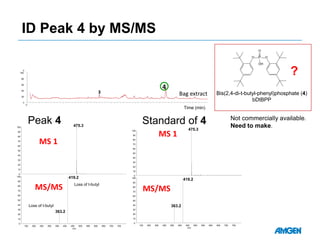
ID Peak 4 by MS/MS
Peak 4
OP
OH
O
O
Bis(2,4-di-t-butyl-phenyl)phosphate (4)
bDtBPP
150 200 250 300 350 400 450 500 550 600 650 700 750
m/z
0
10
20
30
40
50
60
70
80
90
100
0
10
20
30
40
50
60
70
80
90
100 475.3
419.2
363.2
MS 1
MS/MS
150 200 250 300 350 400 450 500 550 600 650 700 750
m/z
0
10
20
30
40
50
60
70
80
90
100
0
10
20
30
40
50
60
70
80
90
100 475.3
419.2
363.2
Standard of 4
MS 1
MS/MS
Loss of t-butyl
Loss of t-butyl
0
Time (min)
0
20
40
60
80
100
0
3 Bag extract
Standard
Standard
4
3
4
?
Not commercially available.
Need to make.
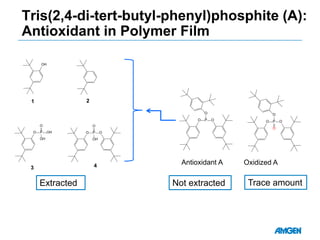
Tris(2,4-di-tert-butyl-phenyl)phosphite (A):
Antioxidant in Polymer Film
21
4
OHP
OH
O
O
OP
OH
O
O
OH
3
Antioxidant A
Not extracted
OP
O
O
O
OPO
O
Oxidized A
Extracted Trace amount
21
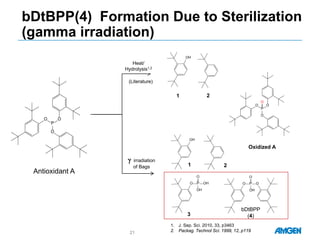
γ irradiation
of Bags
Heat/
Hydrolysis1,2
bDtBPP(4) Formation Due to Sterilization
(gamma irradiation)
P
O O
O
OH
OHP
OH
O
O
OP
OH
O
O
OH
P
O O
O
O
Antioxidant A
1. J. Sep. Sci. 2010, 33, p3463
2. Packag. Technol Sci. 1999, 12, p119
(Literature)
21
3
21
Oxidized A
bDtBPP
(4)
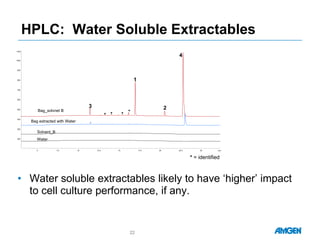
HPLC: Water Soluble Extractables
• Water soluble extractables likely to have ‘higher’ impact
to cell culture performance, if any.
22
min5 7.5 10 12.5 15 17.5 20 22.5 25
mAU
200
300
400
500
600
700
800
900
1000
Bag_solvnet B
Water
Solvent_B
Bag extracted with Water
1
* *
23
4
**
* = identified
Extractable Detrimental Impact on Cell
Culture
23
HO
OH
O
HO
O
O
OO
Amgen Confidential. PDA J Pharm Sci Tech 2013, 67(2) p123
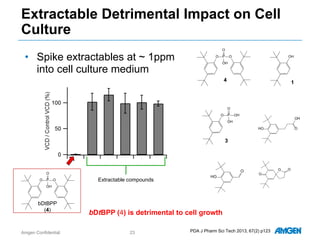
• Spike extractables at ~ 1ppm
into cell culture medium
OP
OH
O
O
Extractable compounds
OP
OH
O
O
OH
OHP
OH
O
O
bDtBPP
(4)
4
3
1
bDtBPP (4) is detrimental to cell growth
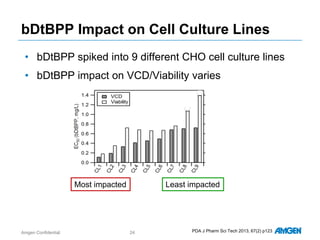
bDtBPP Impact on Cell Culture Lines
24Amgen Confidential. PDA J Pharm Sci Tech 2013, 67(2) p123
• bDtBPP spiked into 9 different CHO cell culture lines
• bDtBPP impact on VCD/Viability varies
Most impacted Least impacted
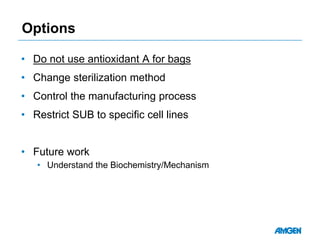
Options
• Do not use antioxidant A for bags
• Change sterilization method
• Control the manufacturing process
• Restrict SUB to specific cell lines
• Future work
• Understand the Biochemistry/Mechanism
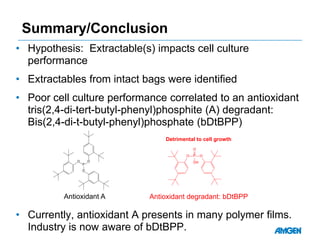
Summary/Conclusion
• Hypothesis: Extractable(s) impacts cell culture
performance
• Extractables from intact bags were identified
• Poor cell culture performance correlated to an antioxidant
tris(2,4-di-tert-butyl-phenyl)phosphite (A) degradant:
Bis(2,4-di-t-butyl-phenyl)phosphate (bDtBPP)
• Currently, antioxidant A presents in many polymer films.
Industry is now aware of bDtBPP.
P
O O
O
Antioxidant A
OP
OH
O
O
Antioxidant degradant: bDtBPP
Detrimental to cell growth
Acknowledgements
Process Development
• Hans Lee
• Kiyoshi Fujimori
• Mike Ronk
• Jian Liu
• Yanxin Luo
• Ping Yeh
• Pavel Bondarenko
• David Semin
• Janet Cheetham
27
Cell Culture
• Heather Nunn
• Matt Hammond
• Mirna Mujacic
• Carole Heath
• Guy Caspary
• Dina Fomina-Yadlin
• Kathy Maggiora
• Rebecca Hernandez
• Dave Treiber

Nashed-Samuel_Yasser

  • 1.
    Extractables from SingleUse Bioreactors and Impact on Cell Culture Performance Yasser Nashed-Samuel, Ph.D. Process Development Amgen, Inc. – Thousand Oaks, CA, USA 2016 PepTalk Single-Use Technologies and Continuous Processing San Diego, CA – January 18-22
  • 2.
    Overview • Extractable/Leachable potentialimpact • Inconsistent cell culture yield in Single Use Bioreactors/Bags (SUB) • ID Extractables • Extractable impact on cell culture 2
  • 3.
    Extractables and LeachablesDefinitions • Extractables - chemicals that migrate from the product-contact material (container) into a solvent at elevated temperatures. (Accelerated Condition) • Leachables - chemicals that migrate from the container into a formulated drug during normal storage/usage conditions. (Normal Condition) Solvent Drug 4 °C Heat
  • 4.
    Biologics (Injectables) arein the Highest Risk Category Guidance for Industry-Container Closure Systems for Packaging Human Drugs and Biologics (1999)
  • 5.
    Manufacturing Process ofBiologics 5 Cell Culture Drug Product in: Syringe, Vial, Device, IV Leachable Toxicology Risk (Proximity to Drug Product) All product contact materials can leach: Polymers, rubber, steel, glass, connectors, etc..
  • 6.
    Extractable/Leachable Potential Impact •Patient Safety • Toxicity • Container • Functionality and Qualification • Protein/Drug (Product Quality)1-5 • Aggregation / Particle formation (Tungsten) • Covalent bonding (Acrylates) • Oxidation • Cell Culture Yield6 6 1. Am. Pharm. Rev. Jan 2011, p 74. 2. J. Pharm. Sci. 2009, 98(12), p 4695. 3. J. Pharm. Sci. 2009, 98(6), p 3167. 4. PDA J Pharm Sci Tech 2013, 64 (1) p 11. 5. PDA J Pharm Sci Tech 2013, 64 (3) p 242. 6. PDA J Pharm Sci Tech 2013, 67(2) p123.
  • 7.
    Single Use Bioreactors(SUB) for Cell Culture • Polymer bag • Sterile / disposable • Reduce cleaning/sterilization validation steps • Reduce cross contamination • Manufacturing flexibility • Reduce long term cost • Maintenance, parts, steel, labor • Short term development costs 7 Picture of representative single use bioreactor (from Sartorius website)
  • 8.
    Cell Growth Inconsistencyin SUBs Batch/Run by date ViableCellDensity(VCD) • Decreased yield = less profit • Potential root cause(s) • Media • Leached material from Bag? • Innovative idea to non-Extractable people Lower yield
  • 9.
    Hypothesis: SUB Leachable(s) InhibitsCell Growth • Get information from vendor • Perform Extractable study and ID Extractables • Spike in individual water soluble Extractables into Cell Culture process using bags from “good” lots. • Measure cell growth 9 Extractables* Spike in Cell Culture Measure Cell Growth *Vendor data/information from extractables testing
  • 10.
    Finishing OEM Vendors Polymer • Resins Additives • Stabilizers •Processing aids Pellets Extrusion • Film • Sheet, Coating Finishing/Assembly • Printing, Fittings • Gluing • Etc.. Bag suppliers Etc.. Material Information Chain Polymer Producers Compounding Conversion Biotech Device/ Packaging companies Additives End User Polymer information Performance Evaluation Engineering E/L information from suppliers is challenging/limiting
  • 11.
    Industry Effort forStandardizing Extractables Testing • ASTM • BPOG • USP Chapters • PDA • PQRI • ELSIE 11 ELSIE ASTM PDA USP ChaptersPQRI BPOG Extractables/ Leachables
  • 12.
    Sources of Extractables/Leachables fromSUBs • Film, Ports, Tubing, etc. • Additives • Polymer degradents, monomers • Processing agents • Label migration • Residual from tools • Sterilization (Gamma irradiated) • Heat sealed • Variability in manufacturing 12 Picture of representative single use bioreactor
  • 13.
    Extraction Conditions ofIntact Bag 13 Sample Extraction Surface Solvents Solvent Vol. Time @ Temp Analysis Solvent control N/A A, B N/A N/A HPLC LCMS GCMS ICPMS 2 days @ 50 °CIntact Bag Bag interior A, B ≤ 5% bag capacity • Bag from commercial process unavailable. • Evaluated bags from different suppliers • (premise: materials from suppliers likely similar) • Extract intact bag interior (closed system) • Add solvent • Close bag • Heat
  • 14.
    Non-Targeted Approach Volatile Compounds Organic Compounds (containing O, N,etc.) Non Volatile Organic Compounds Inorganic Elements Extractables non-target approach No AET GC/MS LC/MS ICP/MSLC/ELSD
  • 15.
    Bag Extractables • Identified20-40+ extractable molecules per bag • Database (30%) • Structure Elucidation (70%) • Antioxidants • Plasticizers • Organic acids • Miscellaneous additives • Nylon related components • Polymeric related materials • Inorganic elements • Extractable profile similar and different for each bag vendor 15
  • 16.
    4.00 6.00 8.0010.00 12.00 14.00 16.00 18.00 20.00 10000 15000 20000 25000 30000 35000 40000 45000 50000 55000 60000 65000 70000 75000 80000 85000 90000 95000 Time--> Abundance GC/MS Analysis of Extractables 2,4-Di-t-butylphenol (1) (DtBP) 1,3-Di-t-butylbenzene (2) (DtBB) 1 2 * * * ** * HO 10 20 30 40 50 60 70 80 90 100 110 120 130 140 150 160 170 180 190 200 210 Abundance Peak 1 191 20616374 14791 10 20 30 40 50 60 70 80 90 100 110 120 130 140 150 160 170 180 190 200 210 0 Library Match A 191 57 20641.0 163.074.0 91 107.0 147.0128.015.0 57 10 2 0 30 40 50 60 70 80 90 100 110 120 130 140 150 160 170 180 190 200 210 191 57 20641.0 135.0 91 107.074.0 163.015.0 191 5741 2061319174.27 163115 147 177 OH OH Library Match B Library Match C HO Confirm against reference standard * = identified Antioxidant degradation products?
  • 17.
    LCMS Analysis ofExtractables 4 6 8 10 12 14 16 18 20 22 24 26 28 Time (min) 0 10 20 30 40 50 60 70 80 90 100 RelativeAbundance 3 4 Bag_B Bag_water extract Solvent_B Solvent_A (water) ESI (+) TIC * * * ** ** ** * * * ** * * * = identified Water extracts have fewer number and amount of extractables
  • 18.
    Peaks 3 and4 by LCMS 0 Time (min) 0 20 40 60 80 100 0 3 Bag extract Standard Standard 4 3 4 100 200 300 400 500 600 700 800 900 1000 1100 1200 1300 m/z 0 5 10 15 20 25 30 35 40 45 50 55 60 65 70 75 80 85 90 95 100 RelativeAbundance 287.1406 100 200 300 400 500 600 700 800 900 1000 1100 1200 1300 m/z 0 5 10 15 20 25 30 35 40 45 50 55 60 65 70 75 80 85 90 95 100 RelativeAbundance 475.2981 2,4-Di-t-butyl-phenylphosphate (3) (tBPP) Bis(2,4-di-t-butyl-phenyl)phosphate (4) bDtBPP Peak 3 Peak 4 OP OH O O OHP OH O O LCMS (ESI+) MS 1 MS 1
  • 19.
    ID Peak 4by MS/MS Peak 4 OP OH O O Bis(2,4-di-t-butyl-phenyl)phosphate (4) bDtBPP 150 200 250 300 350 400 450 500 550 600 650 700 750 m/z 0 10 20 30 40 50 60 70 80 90 100 0 10 20 30 40 50 60 70 80 90 100 475.3 419.2 363.2 MS 1 MS/MS 150 200 250 300 350 400 450 500 550 600 650 700 750 m/z 0 10 20 30 40 50 60 70 80 90 100 0 10 20 30 40 50 60 70 80 90 100 475.3 419.2 363.2 Standard of 4 MS 1 MS/MS Loss of t-butyl Loss of t-butyl 0 Time (min) 0 20 40 60 80 100 0 3 Bag extract Standard Standard 4 3 4 ? Not commercially available. Need to make.
  • 20.
    Tris(2,4-di-tert-butyl-phenyl)phosphite (A): Antioxidant inPolymer Film 21 4 OHP OH O O OP OH O O OH 3 Antioxidant A Not extracted OP O O O OPO O Oxidized A Extracted Trace amount
  • 21.
    21 γ irradiation of Bags Heat/ Hydrolysis1,2 bDtBPP(4)Formation Due to Sterilization (gamma irradiation) P O O O OH OHP OH O O OP OH O O OH P O O O O Antioxidant A 1. J. Sep. Sci. 2010, 33, p3463 2. Packag. Technol Sci. 1999, 12, p119 (Literature) 21 3 21 Oxidized A bDtBPP (4)
  • 22.
    HPLC: Water SolubleExtractables • Water soluble extractables likely to have ‘higher’ impact to cell culture performance, if any. 22 min5 7.5 10 12.5 15 17.5 20 22.5 25 mAU 200 300 400 500 600 700 800 900 1000 Bag_solvnet B Water Solvent_B Bag extracted with Water 1 * * 23 4 ** * = identified
  • 23.
    Extractable Detrimental Impacton Cell Culture 23 HO OH O HO O O OO Amgen Confidential. PDA J Pharm Sci Tech 2013, 67(2) p123 • Spike extractables at ~ 1ppm into cell culture medium OP OH O O Extractable compounds OP OH O O OH OHP OH O O bDtBPP (4) 4 3 1 bDtBPP (4) is detrimental to cell growth
  • 24.
    bDtBPP Impact onCell Culture Lines 24Amgen Confidential. PDA J Pharm Sci Tech 2013, 67(2) p123 • bDtBPP spiked into 9 different CHO cell culture lines • bDtBPP impact on VCD/Viability varies Most impacted Least impacted
  • 25.
    Options • Do notuse antioxidant A for bags • Change sterilization method • Control the manufacturing process • Restrict SUB to specific cell lines • Future work • Understand the Biochemistry/Mechanism
  • 26.
    Summary/Conclusion • Hypothesis: Extractable(s)impacts cell culture performance • Extractables from intact bags were identified • Poor cell culture performance correlated to an antioxidant tris(2,4-di-tert-butyl-phenyl)phosphite (A) degradant: Bis(2,4-di-t-butyl-phenyl)phosphate (bDtBPP) • Currently, antioxidant A presents in many polymer films. Industry is now aware of bDtBPP. P O O O Antioxidant A OP OH O O Antioxidant degradant: bDtBPP Detrimental to cell growth
  • 27.
    Acknowledgements Process Development • HansLee • Kiyoshi Fujimori • Mike Ronk • Jian Liu • Yanxin Luo • Ping Yeh • Pavel Bondarenko • David Semin • Janet Cheetham 27 Cell Culture • Heather Nunn • Matt Hammond • Mirna Mujacic • Carole Heath • Guy Caspary • Dina Fomina-Yadlin • Kathy Maggiora • Rebecca Hernandez • Dave Treiber