BIOCOMPATIBILITY
TESTING OF POLYMERS
05/30/16 SAGAR SAVALE 1
What is biocompatibility?
 Biocompatibility - ability of material to elicit an
appropriate biological response on a given
application in the body.
 The ability of a material to perform with an
appropriate host response in a specific
application", Williams' definition.
 "The quality of not having toxic or injurious
effects on biological systems".
05/30/16 SAGAR SAVALE 2
Medical devices and their component materials may leach
compounds or have surface characteristics that may produce
undesirable effects when used clinically. The selection and
evaluation of materials and devices intended for use in
humans requires a structured program of assessment to
establish biocompatibility and safety.
Current regulations, whether in accordance with the U.S.
Food and Drug Administration (FDA), the International
Organization for Standardization (ISO), or the Japanese
Ministry of Health, Labor and Welfare (JMHLW), require that
manufacturers conduct adequate safety testing of their
finished devices through pre-clinical and clinical phases as
part of the regulatory clearance process.
NEED
BIOCOMPATIBILITY TESTING
05/30/16 SAGAR SAVALE 3
ISO 10993-1 and FDA G95-1 Guidelines
Guidelines
05/30/16 SAGAR SAVALE 4
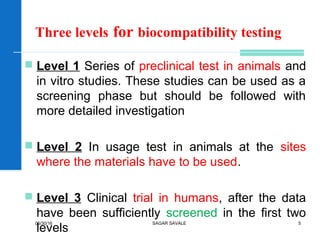
Three levels for biocompatibility testing
 Level 1 Series of preclinical test in animals and
in vitro studies. These studies can be used as a
screening phase but should be followed with
more detailed investigation
 Level 2 In usage test in animals at the sites
where the materials have to be used.
 Level 3 Clinical trial in humans, after the data
have been sufficiently screened in the first two
levels
05/30/16 SAGAR SAVALE 5
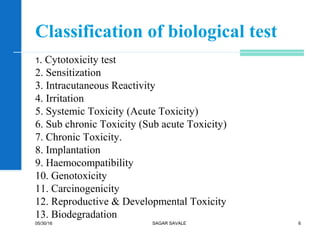
Classification of biological test
1. Cytotoxicity test
2. Sensitization
3. Intracutaneous Reactivity
4. Irritation
5. Systemic Toxicity (Acute Toxicity)
6. Sub chronic Toxicity (Sub acute Toxicity)
7. Chronic Toxicity.
8. Implantation
9. Haemocompatibility
10. Genotoxicity
11. Carcinogenicity
12. Reproductive & Developmental Toxicity
13. Biodegradation
05/30/16 SAGAR SAVALE 6
Cytotoxicity
 Cytotoxicity test asses cell death caused by
a material measuring cell number or growth
before and after exposure to that material .
05/30/16 SAGAR SAVALE 7
Sensitization
 These tests estimate the potential for contact
sensitization of medical devices, materials
and / or their extracts using suitable animal
models. These tests are appropriate because
exposure or contact to even minute quantities
of potential leachables can result in allergic
or sensitization reactions Mandatory for all
biomaterials
05/30/16 SAGAR SAVALE 8
Irritation Test
 These tests estimate the irritation potential of
medical devices, materials or their extracts,
using appropriate sites for implant tissue such
as Skin Eye Mucous membrane in a suitable
animal model. These tests are performed
using appropriate route (skin, eye or mucosa)
and duration of exposure or contact to
determine irritant effects of materials or
potential leachables.
05/30/16 SAGAR SAVALE 9
Intracutaneous Reactivity
 Intracutaneous Reactivity Assesses the
localized reaction of tissue to medical device /
material extracts. These tests are carried out
in such devices, where determination of
irritation by dermal or mucosal tests are not
appropriate
 Eg : Devices having access to the blood path
OR where material extractables are
hydrophobic
05/30/16 SAGAR SAVALE 10
Systemic Toxicity (Acute Toxicity)
 Systemic Toxicity (Acute Toxicity) Estimates
the potential harmful effects of either single or
multiple exposures, during the period of less
than 24 hours, to medical devices, materials
or their extracts in suitable animal model
05/30/16 SAGAR SAVALE 11
Sub chronic Toxicity
(Sub acute Toxicity)
 Sub chronic Toxicity (Sub acute Toxicity)
Estimates the potential harmful effects of
either single or multiple exposures, during the
period of NOT less than 24 hours to a period
not greater than 10% of the life span of the
animal model, to medical devices, materials
or their extracts in suitable animal model
 Note: These tests may be waived for
materials which has chronic toxicity data
05/30/16 SAGAR SAVALE 12
Pyrogenicity tests carried out to detect
material mediated pyrogenic reactions of
extracts of medical devices or materials
Note :Pyrogenicity tests are also conducted
to ensure the safe level of endotoxins in the
finished / sterlized product
Pyrogenicity tests
05/30/16 SAGAR SAVALE 13
Genotoxicity
 Genotoxicity These tests apply mammalian or
non-mammalian cell culture techniques to
determine gene mutations changes in
chromosomal structure and number other
 DNA or gene toxicities caused by the device,
material or their extracts.
05/30/16 SAGAR SAVALE 14
Implantation
 Implantation Assesses the local pathological
effects on the living tissue, at both the gross
level and microscopic levels Sample of the
material or the device is surgically implanted
in an appropriate site (muscle, dentin or
bone) based on the intended application
 Note: For a material, these tests are
equivalent to sub chronic toxicity tests, if
systemic effects are also investigated.
05/30/16 SAGAR SAVALE 15
Haemocompatibility
 Haemocompatibility Evaluates the effects
on blood or blood components by blood
contacting devices or materials. Haemolysis
tests determine the degree of blood cell
lysis and release of haemoglobin caused by
device / material samples.
05/30/16 SAGAR SAVALE 16
Chronic Toxicity
 Chronic Toxicity Estimates the effects of
either single or multiple exposures, during
the period of at least 10% of the life span of
the animal model, to medical devices,
materials or their extracts in suitable animal
model.
05/30/16 SAGAR SAVALE 17
Carcinogenicity
 These tests determine the tumorigenic
potential of medical devices, materials or their
extracts. The test duration shall cover a period
over the major portion of the life span of the
animal model Can be carried out along with
chronic toxicity studies
 Note: Required to be conducted only if there
are suggestive data from other sources
05/30/16 SAGAR SAVALE 18
Reproductive & Developmental
Toxicity
 It studies the potential effects on reproductive
function embryonic development (teratogenicity)
prenatal and early post natal development
 Note : Need to be conducted only if the device
has potential impact on the reproductive
potential of the subject
05/30/16 SAGAR SAVALE 19
Biodegradation
 Where the potential for resorption /
degradation exists, these tests determine the
process of degradation biotransformation
elimination of degradation products
 Note : ISO 10993 is not very specific on the
norms for selection of biodegradation studies;
only the method is described.
05/30/16 SAGAR SAVALE 20
05/30/16 SAGAR SAVALE 21
05/30/16 SAGAR SAVALE 22
05/30/16 SAGAR SAVALE 23
05/30/16 SAGAR SAVALE 24

Biocompatibility

  • 1.
  • 2.
    What is biocompatibility? Biocompatibility - ability of material to elicit an appropriate biological response on a given application in the body.  The ability of a material to perform with an appropriate host response in a specific application", Williams' definition.  "The quality of not having toxic or injurious effects on biological systems". 05/30/16 SAGAR SAVALE 2
  • 3.
    Medical devices andtheir component materials may leach compounds or have surface characteristics that may produce undesirable effects when used clinically. The selection and evaluation of materials and devices intended for use in humans requires a structured program of assessment to establish biocompatibility and safety. Current regulations, whether in accordance with the U.S. Food and Drug Administration (FDA), the International Organization for Standardization (ISO), or the Japanese Ministry of Health, Labor and Welfare (JMHLW), require that manufacturers conduct adequate safety testing of their finished devices through pre-clinical and clinical phases as part of the regulatory clearance process. NEED BIOCOMPATIBILITY TESTING 05/30/16 SAGAR SAVALE 3
  • 4.
    ISO 10993-1 andFDA G95-1 Guidelines Guidelines 05/30/16 SAGAR SAVALE 4
  • 5.
    Three levels forbiocompatibility testing  Level 1 Series of preclinical test in animals and in vitro studies. These studies can be used as a screening phase but should be followed with more detailed investigation  Level 2 In usage test in animals at the sites where the materials have to be used.  Level 3 Clinical trial in humans, after the data have been sufficiently screened in the first two levels 05/30/16 SAGAR SAVALE 5
  • 6.
    Classification of biologicaltest 1. Cytotoxicity test 2. Sensitization 3. Intracutaneous Reactivity 4. Irritation 5. Systemic Toxicity (Acute Toxicity) 6. Sub chronic Toxicity (Sub acute Toxicity) 7. Chronic Toxicity. 8. Implantation 9. Haemocompatibility 10. Genotoxicity 11. Carcinogenicity 12. Reproductive & Developmental Toxicity 13. Biodegradation 05/30/16 SAGAR SAVALE 6
  • 7.
    Cytotoxicity  Cytotoxicity testasses cell death caused by a material measuring cell number or growth before and after exposure to that material . 05/30/16 SAGAR SAVALE 7
  • 8.
    Sensitization  These testsestimate the potential for contact sensitization of medical devices, materials and / or their extracts using suitable animal models. These tests are appropriate because exposure or contact to even minute quantities of potential leachables can result in allergic or sensitization reactions Mandatory for all biomaterials 05/30/16 SAGAR SAVALE 8
  • 9.
    Irritation Test  Thesetests estimate the irritation potential of medical devices, materials or their extracts, using appropriate sites for implant tissue such as Skin Eye Mucous membrane in a suitable animal model. These tests are performed using appropriate route (skin, eye or mucosa) and duration of exposure or contact to determine irritant effects of materials or potential leachables. 05/30/16 SAGAR SAVALE 9
  • 10.
    Intracutaneous Reactivity  IntracutaneousReactivity Assesses the localized reaction of tissue to medical device / material extracts. These tests are carried out in such devices, where determination of irritation by dermal or mucosal tests are not appropriate  Eg : Devices having access to the blood path OR where material extractables are hydrophobic 05/30/16 SAGAR SAVALE 10
  • 11.
    Systemic Toxicity (AcuteToxicity)  Systemic Toxicity (Acute Toxicity) Estimates the potential harmful effects of either single or multiple exposures, during the period of less than 24 hours, to medical devices, materials or their extracts in suitable animal model 05/30/16 SAGAR SAVALE 11
  • 12.
    Sub chronic Toxicity (Subacute Toxicity)  Sub chronic Toxicity (Sub acute Toxicity) Estimates the potential harmful effects of either single or multiple exposures, during the period of NOT less than 24 hours to a period not greater than 10% of the life span of the animal model, to medical devices, materials or their extracts in suitable animal model  Note: These tests may be waived for materials which has chronic toxicity data 05/30/16 SAGAR SAVALE 12
  • 13.
    Pyrogenicity tests carriedout to detect material mediated pyrogenic reactions of extracts of medical devices or materials Note :Pyrogenicity tests are also conducted to ensure the safe level of endotoxins in the finished / sterlized product Pyrogenicity tests 05/30/16 SAGAR SAVALE 13
  • 14.
    Genotoxicity  Genotoxicity Thesetests apply mammalian or non-mammalian cell culture techniques to determine gene mutations changes in chromosomal structure and number other  DNA or gene toxicities caused by the device, material or their extracts. 05/30/16 SAGAR SAVALE 14
  • 15.
    Implantation  Implantation Assessesthe local pathological effects on the living tissue, at both the gross level and microscopic levels Sample of the material or the device is surgically implanted in an appropriate site (muscle, dentin or bone) based on the intended application  Note: For a material, these tests are equivalent to sub chronic toxicity tests, if systemic effects are also investigated. 05/30/16 SAGAR SAVALE 15
  • 16.
    Haemocompatibility  Haemocompatibility Evaluatesthe effects on blood or blood components by blood contacting devices or materials. Haemolysis tests determine the degree of blood cell lysis and release of haemoglobin caused by device / material samples. 05/30/16 SAGAR SAVALE 16
  • 17.
    Chronic Toxicity  ChronicToxicity Estimates the effects of either single or multiple exposures, during the period of at least 10% of the life span of the animal model, to medical devices, materials or their extracts in suitable animal model. 05/30/16 SAGAR SAVALE 17
  • 18.
    Carcinogenicity  These testsdetermine the tumorigenic potential of medical devices, materials or their extracts. The test duration shall cover a period over the major portion of the life span of the animal model Can be carried out along with chronic toxicity studies  Note: Required to be conducted only if there are suggestive data from other sources 05/30/16 SAGAR SAVALE 18
  • 19.
    Reproductive & Developmental Toxicity It studies the potential effects on reproductive function embryonic development (teratogenicity) prenatal and early post natal development  Note : Need to be conducted only if the device has potential impact on the reproductive potential of the subject 05/30/16 SAGAR SAVALE 19
  • 20.
    Biodegradation  Where thepotential for resorption / degradation exists, these tests determine the process of degradation biotransformation elimination of degradation products  Note : ISO 10993 is not very specific on the norms for selection of biodegradation studies; only the method is described. 05/30/16 SAGAR SAVALE 20
  • 21.
  • 22.
  • 23.
  • 24.