

EXTRACTABLES AND LEACHABLES-
REGULATORY PERSPECTIVES
Integrity*Team Work*Passion for Excellence*Customer Focus*Respect and Care*Entrepreneurial spirit
KISHORE KUMAR HOTHA, Ph.D.
LUPIN SOMERSET is a subsidiary of Lupin Pharmaceuticals Inc., specializing in difficult-to-develop,
technology-driven specialty generics for the US market.
Analytical Technology and Deformulations is a specialized group in analytical research and development
which resolves complex analytical challenges in support of product submissions and commercial
products. The group’s responsibilities includes material characterization, impurity profiling, and
extractable and leachable studies.
ABOUT LUPIN SOMERSET
ACKNOWLEDGEMENTS
Shawn Watson, Vice President - Analytical R&D, LUPIN SOMERSET
Dr. Kurt Nielsen, President, LUPIN SOMERSET
LUPIN Analytical Research & Development Team
Isabelle-Waters Corporation
THE US REGULATORY SITUATION
In the US, both adulterated and misbranded products are banned from interstate commerce,
under the provisions of the Federal Food, Drug and Cosmetic Act. Anything that is not
intentionally added could, potentially, cause the product to be considered adulterated, even if it
remains safe. Any extractable or leachable that finds its way into the drug product is
automatically deemed an adulterant. The Act, in its clause on adulteration, also specifies that "if
the container is composed, in whole or in part, of any poisonous or deleterious substance which
may render the contents injurious to health," the product is equally deemed to be adulterated
Reference:
Extractables and Leachables: Best Practices to Ensure Patient Safety. The author presents best practices for extractables and leachables. May 01, 2013 By Thomas Feinberg, PhD
BioPharm International Volume 26, Issue 5
AGENDA
INTRODUCTION
CRITICAL ATTRIBUTES OF EL (Extractables & Leachables)
RISK ASSESSMENT
EL PROCESS
FDA DEFICIENCIES
CONCLUSION
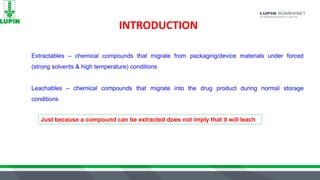
INTRODUCTION
Extractables – chemical compounds that migrate from packaging/device materials under forced
(strong solvents & high temperature) conditions
Leachables – chemical compounds that migrate into the drug product during normal storage
conditions
Just because a compound can be extracted does not imply that it will leach
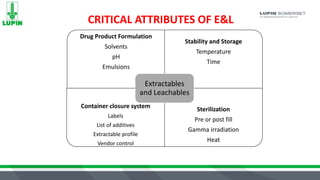
CRITICAL ATTRIBUTES OF E&L
Drug Product Formulation
Solvents
pH
Emulsions
Stability and Storage
Temperature
Time
Container closure system
Labels
List of additives
Extractable profile
Vendor control
Sterilization
Pre or post fill
Gamma irradiation
Heat
Extractables
and Leachables
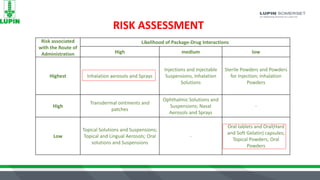
RISK ASSESSMENT
Risk associated
with the Route of
Administration
Likelihood of Package-Drug Interactions
High medium low
Highest Inhalation aerosols and Sprays
Injections and Injectable
Suspensions, Inhalation
Solutions
Sterile Powders and Powders
for Injection; Inhalation
Powders
High
Transdermal ointments and
patches
Ophthalmic Solutions and
Suspensions; Nasal
Aerosols and Sprays
-
Low
Topical Solutions and Suspensions;
Topical and Lingual Aerosols; Oral
solutions and Suspensions
-
Oral tablets and Oral(Hard
and Soft Gelatin) capsules;
Topical Powders; Oral
Powders
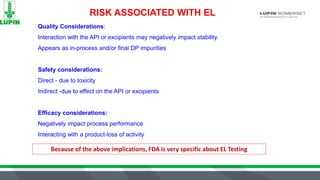
RISK ASSOCIATED WITH EL
Quality Considerations:
Interaction with the API or excipients may negatively impact stability.
Appears as in-process and/or final DP impurities
Safety considerations:
Direct - due to toxicity
Indirect -due to effect on the API or excipients
Efficacy considerations:
Negatively impact process performance
Interacting with a product-loss of activity
Because of the above implications, FDA is very specific about EL Testing
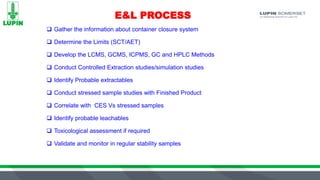
E&L PROCESS
 Gather the information about container closure system
 Determine the Limits (SCT/AET)
 Develop the LCMS, GCMS, ICPMS, GC and HPLC Methods
 Conduct Controlled Extraction studies/simulation studies
 Identify Probable extractables
 Conduct stressed sample studies with Finished Product
 Correlate with CES Vs stressed samples
 Identify probable leachables
 Toxicological assessment if required
 Validate and monitor in regular stability samples
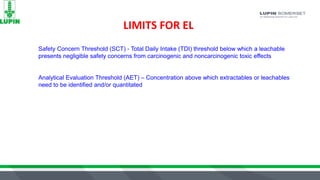
LIMITS FOR EL
Safety Concern Threshold (SCT) - Total Daily Intake (TDI) threshold below which a leachable
presents negligible safety concerns from carcinogenic and noncarcinogenic toxic effects
Analytical Evaluation Threshold (AET) – Concentration above which extractables or leachables
need to be identified and/or quantitated
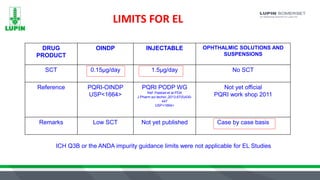
LIMITS FOR EL
DRUG
PRODUCT
OINDP INJECTABLE OPHTHALMIC SOLUTIONS AND
SUSPENSIONS
SCT 0.15µg/day 1.5µg/day No SCT
Reference PQRI-OINDP
USP<1664>
PQRI PODP WG
Ref: Paskiet et al PDA
J.Pharm.sci.techol.,2013,67(5)430-
447
USP<1664>
Not yet official
PQRI work shop 2011
Remarks Low SCT Not yet published Case by case basis
ICH Q3B or the ANDA impurity guidance limits were not applicable for EL Studies
CONTROLLED EXTRACTION STUDIES
 Concept of the container closure system
 Finished product excipients
 Logical Selection of solvents of varying polarity
 Case by Case Basis depends on the dosage form and risk
 Experiments to be selected for obtaining meaningful correlation
A Controlled Extraction Study is a laboratory investigation into the qualitative and quantitative nature of
extractable profiles from critical components of a container/closure system.
WHY CONTROLLED EXTRACTION STUDIES
• To make an informed selection of
materials.
• To meet regulatory expectations.
• To control leachables.
• To control materials from lot to lot.
• To correlate extractables data to
leachables.
• To evaluate the safety of the materials.
• To predict worst case of end- of shelf life
leachables.
• To qualify packaging materials.
• To obtain a comprehensive extractables
profile.
SELECTION OF STANDARD FOR CONTROL EXTRACTION STUDIES:
 Based on the vendor information/literature
 Use surrogate standards in case of non availability
 Compatible with the CES solvent/ similar to the suspected extractables
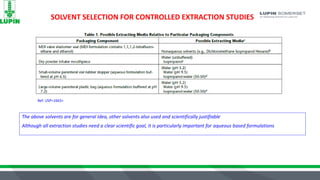
SOLVENT SELECTION FOR CONTROLLED EXTRACTION STUDIES
The above solvents are for general Idea, other solvents also used and scientifically justifiable
Although all extraction studies need a clear scientific goal, it is particularly important for aqueous based formulations
Ref: USP<1663>
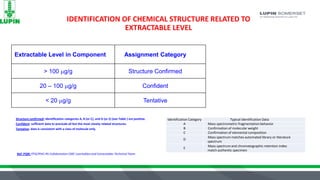
IDENTIFICATION OF CHEMICAL STRUCTURE RELATED TO
EXTRACTABLE LEVEL
Extractable Level in Component Assignment Category
> 100 g/g Structure Confirmed
20 – 100 g/g Confident
< 20 g/g Tentative
Structure confirmed: identification categories A, B (or C), and D (or E) (see Table ) are positive.
Confident: sufficient data to preclude all but the most closely related structures.
Tentative: data is consistent with a class of molecule only.
Identification Category Typical Identification Data
A Mass spectrometric fragmentation behavior
B Confirmation of molecular weight
C Confirmation of elemental composition
D
Mass spectrum matches automated library or literature
spectrum
E
Mass spectrum and chromatographic retention index
match authentic specimen
Ref: PQRI ITFG/IPAC-RS Collaboration CMC Leachables and Extractables Technical Team
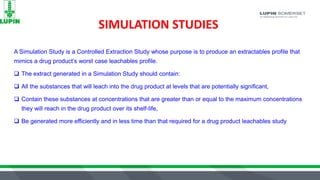
SIMULATION STUDIES
A Simulation Study is a Controlled Extraction Study whose purpose is to produce an extractables profile that
mimics a drug product’s worst case leachables profile.
 The extract generated in a Simulation Study should contain:
 All the substances that will leach into the drug product at levels that are potentially significant,
 Contain these substances at concentrations that are greater than or equal to the maximum concentrations
they will reach in the drug product over its shelf-life,
 Be generated more efficiently and in less time than that required for a drug product leachables study
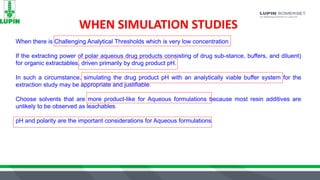
WHEN SIMULATION STUDIES
When there is Challenging Analytical Thresholds which is very low concentration
If the extracting power of polar aqueous drug products consisting of drug sub-stance, buffers, and diluent)
for organic extractables, driven primarily by drug product pH.
In such a circumstance, simulating the drug product pH with an analytically viable buffer system for the
extraction study may be appropriate and justifiable.
Choose solvents that are more product-like for Aqueous formulations because most resin additives are
unlikely to be observed as leachables
pH and polarity are the important considerations for Aqueous formulations
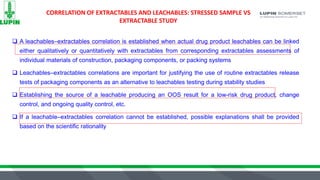
CORRELATION OF EXTRACTABLES AND LEACHABLES: STRESSED SAMPLE VS
EXTRACTABLE STUDY
 A leachables–extractables correlation is established when actual drug product leachables can be linked
either qualitatively or quantitatively with extractables from corresponding extractables assessments of
individual materials of construction, packaging components, or packing systems
 Leachables–extractables correlations are important for justifying the use of routine extractables release
tests of packaging components as an alternative to leachables testing during stability studies
 Establishing the source of a leachable producing an OOS result for a low-risk drug product, change
control, and ongoing quality control, etc.
 If a leachable–extractables correlation cannot be established, possible explanations shall be provided
based on the scientific rationality
FDA DEFICIENCIES
What are some of the common deficiencies for solutions or suspensions as it relates to container
closure systems?
The analytical methods should be appropriate for detection of the extractables and leachables
from the container closure system. Applicants should also be mindful that when establishing
limits for extractables/leachables, those limits are not addressed by ICH or the ANDA impurity
guidance. Therefore, acceptance criteria should be supported by scientific rationale and based
on publicly available toxicological information or applicable information in the CFR sections
FDA DEFICIENCIES
What information does FDA typically expect regarding the analytical methods used for analysis of
the extractables and leachables?
Some common deficiencies are the failure to provide extractable and leachable testing for the
stopper or other container materials. In some cases, information related to dye or adhesive
migration from labeling should be provided. Firms should carefully assess potential issues that
should be evaluated that are unique to the drug product and proposed container closure system
REQUIREMENTS FOR DRUG PRODUCT-FDA
 Extractable leachable studies for the container closure system
 Migration studies for the Label and adhesive
 Compatibility studies with the manufacturing equipment
 Compatibility studies with the process variables (tubes and containers used during the filling process)
 Caps and Dosing cup compatibility studies
CONCLUSIONS
 Assessments of extractables and leachables should begin as early as reasonably possible during
development.
 Instrument selection, assessment of vendor information, Selection of standards should be thoroughly
reviewed prior to start the study and to end up in delays
 Drug product formulation and Container closure system/labels are the key considerations for designing the
study
 Logical evaluation, Literature review, AET and SCT threshold are the key factors for the execution
 USP <1664> and <1663> provide the insight for the initiation. Actual experiments should be conducted
based on the requirement and scientifically acceptable considerations
Extractables and leachables regulatory perspectives

Extractables and leachables regulatory perspectives

  • 1.
    EXTRACTABLES AND LEACHABLES- REGULATORYPERSPECTIVES Integrity*Team Work*Passion for Excellence*Customer Focus*Respect and Care*Entrepreneurial spirit KISHORE KUMAR HOTHA, Ph.D.
  • 2.
    LUPIN SOMERSET isa subsidiary of Lupin Pharmaceuticals Inc., specializing in difficult-to-develop, technology-driven specialty generics for the US market. Analytical Technology and Deformulations is a specialized group in analytical research and development which resolves complex analytical challenges in support of product submissions and commercial products. The group’s responsibilities includes material characterization, impurity profiling, and extractable and leachable studies. ABOUT LUPIN SOMERSET
  • 3.
    ACKNOWLEDGEMENTS Shawn Watson, VicePresident - Analytical R&D, LUPIN SOMERSET Dr. Kurt Nielsen, President, LUPIN SOMERSET LUPIN Analytical Research & Development Team Isabelle-Waters Corporation
  • 4.
    THE US REGULATORYSITUATION In the US, both adulterated and misbranded products are banned from interstate commerce, under the provisions of the Federal Food, Drug and Cosmetic Act. Anything that is not intentionally added could, potentially, cause the product to be considered adulterated, even if it remains safe. Any extractable or leachable that finds its way into the drug product is automatically deemed an adulterant. The Act, in its clause on adulteration, also specifies that "if the container is composed, in whole or in part, of any poisonous or deleterious substance which may render the contents injurious to health," the product is equally deemed to be adulterated Reference: Extractables and Leachables: Best Practices to Ensure Patient Safety. The author presents best practices for extractables and leachables. May 01, 2013 By Thomas Feinberg, PhD BioPharm International Volume 26, Issue 5
  • 5.
    AGENDA INTRODUCTION CRITICAL ATTRIBUTES OFEL (Extractables & Leachables) RISK ASSESSMENT EL PROCESS FDA DEFICIENCIES CONCLUSION
  • 6.
    INTRODUCTION Extractables – chemicalcompounds that migrate from packaging/device materials under forced (strong solvents & high temperature) conditions Leachables – chemical compounds that migrate into the drug product during normal storage conditions Just because a compound can be extracted does not imply that it will leach
  • 7.
    CRITICAL ATTRIBUTES OFE&L Drug Product Formulation Solvents pH Emulsions Stability and Storage Temperature Time Container closure system Labels List of additives Extractable profile Vendor control Sterilization Pre or post fill Gamma irradiation Heat Extractables and Leachables
  • 8.
    RISK ASSESSMENT Risk associated withthe Route of Administration Likelihood of Package-Drug Interactions High medium low Highest Inhalation aerosols and Sprays Injections and Injectable Suspensions, Inhalation Solutions Sterile Powders and Powders for Injection; Inhalation Powders High Transdermal ointments and patches Ophthalmic Solutions and Suspensions; Nasal Aerosols and Sprays - Low Topical Solutions and Suspensions; Topical and Lingual Aerosols; Oral solutions and Suspensions - Oral tablets and Oral(Hard and Soft Gelatin) capsules; Topical Powders; Oral Powders
  • 9.
    RISK ASSOCIATED WITHEL Quality Considerations: Interaction with the API or excipients may negatively impact stability. Appears as in-process and/or final DP impurities Safety considerations: Direct - due to toxicity Indirect -due to effect on the API or excipients Efficacy considerations: Negatively impact process performance Interacting with a product-loss of activity Because of the above implications, FDA is very specific about EL Testing
  • 10.
    E&L PROCESS  Gatherthe information about container closure system  Determine the Limits (SCT/AET)  Develop the LCMS, GCMS, ICPMS, GC and HPLC Methods  Conduct Controlled Extraction studies/simulation studies  Identify Probable extractables  Conduct stressed sample studies with Finished Product  Correlate with CES Vs stressed samples  Identify probable leachables  Toxicological assessment if required  Validate and monitor in regular stability samples
  • 11.
    LIMITS FOR EL SafetyConcern Threshold (SCT) - Total Daily Intake (TDI) threshold below which a leachable presents negligible safety concerns from carcinogenic and noncarcinogenic toxic effects Analytical Evaluation Threshold (AET) – Concentration above which extractables or leachables need to be identified and/or quantitated
  • 12.
    LIMITS FOR EL DRUG PRODUCT OINDPINJECTABLE OPHTHALMIC SOLUTIONS AND SUSPENSIONS SCT 0.15µg/day 1.5µg/day No SCT Reference PQRI-OINDP USP<1664> PQRI PODP WG Ref: Paskiet et al PDA J.Pharm.sci.techol.,2013,67(5)430- 447 USP<1664> Not yet official PQRI work shop 2011 Remarks Low SCT Not yet published Case by case basis ICH Q3B or the ANDA impurity guidance limits were not applicable for EL Studies
  • 13.
    CONTROLLED EXTRACTION STUDIES Concept of the container closure system  Finished product excipients  Logical Selection of solvents of varying polarity  Case by Case Basis depends on the dosage form and risk  Experiments to be selected for obtaining meaningful correlation A Controlled Extraction Study is a laboratory investigation into the qualitative and quantitative nature of extractable profiles from critical components of a container/closure system.
  • 14.
    WHY CONTROLLED EXTRACTIONSTUDIES • To make an informed selection of materials. • To meet regulatory expectations. • To control leachables. • To control materials from lot to lot. • To correlate extractables data to leachables. • To evaluate the safety of the materials. • To predict worst case of end- of shelf life leachables. • To qualify packaging materials. • To obtain a comprehensive extractables profile.
  • 15.
    SELECTION OF STANDARDFOR CONTROL EXTRACTION STUDIES:  Based on the vendor information/literature  Use surrogate standards in case of non availability  Compatible with the CES solvent/ similar to the suspected extractables
  • 16.
    SOLVENT SELECTION FORCONTROLLED EXTRACTION STUDIES The above solvents are for general Idea, other solvents also used and scientifically justifiable Although all extraction studies need a clear scientific goal, it is particularly important for aqueous based formulations Ref: USP<1663>
  • 17.
    IDENTIFICATION OF CHEMICALSTRUCTURE RELATED TO EXTRACTABLE LEVEL Extractable Level in Component Assignment Category > 100 g/g Structure Confirmed 20 – 100 g/g Confident < 20 g/g Tentative Structure confirmed: identification categories A, B (or C), and D (or E) (see Table ) are positive. Confident: sufficient data to preclude all but the most closely related structures. Tentative: data is consistent with a class of molecule only. Identification Category Typical Identification Data A Mass spectrometric fragmentation behavior B Confirmation of molecular weight C Confirmation of elemental composition D Mass spectrum matches automated library or literature spectrum E Mass spectrum and chromatographic retention index match authentic specimen Ref: PQRI ITFG/IPAC-RS Collaboration CMC Leachables and Extractables Technical Team
  • 18.
    SIMULATION STUDIES A SimulationStudy is a Controlled Extraction Study whose purpose is to produce an extractables profile that mimics a drug product’s worst case leachables profile.  The extract generated in a Simulation Study should contain:  All the substances that will leach into the drug product at levels that are potentially significant,  Contain these substances at concentrations that are greater than or equal to the maximum concentrations they will reach in the drug product over its shelf-life,  Be generated more efficiently and in less time than that required for a drug product leachables study
  • 19.
    WHEN SIMULATION STUDIES Whenthere is Challenging Analytical Thresholds which is very low concentration If the extracting power of polar aqueous drug products consisting of drug sub-stance, buffers, and diluent) for organic extractables, driven primarily by drug product pH. In such a circumstance, simulating the drug product pH with an analytically viable buffer system for the extraction study may be appropriate and justifiable. Choose solvents that are more product-like for Aqueous formulations because most resin additives are unlikely to be observed as leachables pH and polarity are the important considerations for Aqueous formulations
  • 20.
    CORRELATION OF EXTRACTABLESAND LEACHABLES: STRESSED SAMPLE VS EXTRACTABLE STUDY  A leachables–extractables correlation is established when actual drug product leachables can be linked either qualitatively or quantitatively with extractables from corresponding extractables assessments of individual materials of construction, packaging components, or packing systems  Leachables–extractables correlations are important for justifying the use of routine extractables release tests of packaging components as an alternative to leachables testing during stability studies  Establishing the source of a leachable producing an OOS result for a low-risk drug product, change control, and ongoing quality control, etc.  If a leachable–extractables correlation cannot be established, possible explanations shall be provided based on the scientific rationality
  • 21.
    FDA DEFICIENCIES What aresome of the common deficiencies for solutions or suspensions as it relates to container closure systems? The analytical methods should be appropriate for detection of the extractables and leachables from the container closure system. Applicants should also be mindful that when establishing limits for extractables/leachables, those limits are not addressed by ICH or the ANDA impurity guidance. Therefore, acceptance criteria should be supported by scientific rationale and based on publicly available toxicological information or applicable information in the CFR sections
  • 22.
    FDA DEFICIENCIES What informationdoes FDA typically expect regarding the analytical methods used for analysis of the extractables and leachables? Some common deficiencies are the failure to provide extractable and leachable testing for the stopper or other container materials. In some cases, information related to dye or adhesive migration from labeling should be provided. Firms should carefully assess potential issues that should be evaluated that are unique to the drug product and proposed container closure system
  • 23.
    REQUIREMENTS FOR DRUGPRODUCT-FDA  Extractable leachable studies for the container closure system  Migration studies for the Label and adhesive  Compatibility studies with the manufacturing equipment  Compatibility studies with the process variables (tubes and containers used during the filling process)  Caps and Dosing cup compatibility studies
  • 24.
    CONCLUSIONS  Assessments ofextractables and leachables should begin as early as reasonably possible during development.  Instrument selection, assessment of vendor information, Selection of standards should be thoroughly reviewed prior to start the study and to end up in delays  Drug product formulation and Container closure system/labels are the key considerations for designing the study  Logical evaluation, Literature review, AET and SCT threshold are the key factors for the execution  USP <1664> and <1663> provide the insight for the initiation. Actual experiments should be conducted based on the requirement and scientifically acceptable considerations