Berthold Boedeker
Bayer Pharma AG; Biologics - Biotech Development
Bio-manufacturing and Facility of the Future:
benefits and challenges of recent innovations
9th Bioinnovation Leaders Summit
Berlin, Feb. 2016
Page 1
Page 2
Agenda   New Bayer
  Status Quo of biologics manufacturing
  Disposables – benefits and limitations
  Facility of the Future / modern plant design
  Continuous processing
  Comparison of a standard fed-batch steel versus a continuous
processing based disposable facility
  Conclusion and outlook
Bayer provides solutions based on
innovations
Page 3
In all areas of our business, we invent, develop and market new molecules which influence
the biochemical processes in living organisms.
Our Life Science businesses
hold leadership positions
Page 4
Life Sciences
!  Strong in research and
development
!  Leadership positions in core
therapeutic areas, e.g. in
cardiology, ophthalmology,
women‘s health & certain
segments of oncology
!  Successful market launches,
e.g. Xarelto, Eylea, Xofigo
!  Crop Protection: no. 2 with a
highly diversified R&D portfolio
!  Seeds: no. 7 but with leading
positions in canola, cotton,
vegetables and rice
!  Animal Health: no. 3 in the
companion animal market
(CAP)2
Crop Science1Pharmaceuticals Consumer Health
!  No. 2 with leadership positions
in key categories
(dermatology, gastrointestinal
disease) and strong brand
recognition
!  Strong geographic footprint
!  Focused on consumer-centric
innovation
≈26,800≈38,000 ≈11,700
Unique and diversified portfolio mitigates risks
1 Incl. Animal Health (will report as a business unit directly to Liam Condon)
2 Companion animal products
3 Expected headcount on January 1, 2016
FTE3
Best-Selling Pharmaceutical Products
Page 5
[ € million ]
%
First Nine
Months 2015
First Nine
Months 2014
Change
Fx adj.
%
3rd Quarter
2015
Xarelto™ 1,163 1,602 +37.7 +37.1
Eylea™ 540 874 +61.9 +57.1
Kogenate™ 808 869 +7.5 +0.7
Mirena™ product family 594 742 +24.9 +9.8
Nexavar™ 571 661 +15.8 +6.1
Betaferon™/Betaseron™ 629 634 +0.8 -9.2
YAZ™/Yasmin™/Yasminelle™ 570 538 -5.6 -5.0
Adalat™ 435 481 +10.6 +0.8
Aspirin™ Cardio 356 393 +10.4 +2.3
Glucobay™ 310 381 +22.9 +4.1
Avalox™/Avelox™ 285 294 +3.2 -3.5
Stivarga™ 161 236 +46.6 +29.3
Xofigo™ 128 188 +46.9 +27.5
Total 6,861 8,189 +19.4 +12.0
Proportion of Pharmaceuticals sales 78% 80%
Fx & p adj. = currency- and portfolio-adjusted
Drug Discovery - Biologics
Page 6
Biologics
Research
Biologics
Development
Elberfeld, Wuppertal
! Monoclonal antibody
process development
and clinical manufacture
! Batch-fed fermentation
! Microbial fermentation
! Antibody drug conjugate
production
Berkeley, California
! Process development
and clinical manufacture
of hemophilia pipeline
! Perfusion-based
fermentation
! Production cell line and
MCB generation
Page 7
Agenda   New Bayer
  Status Quo of biologics manufacturing
  Disposables – benefits and limitations
  Facility of the Future / modern plant design
  Continuous processing
  Comparison of a standard fed-batch steel versus a continuous
processing based disposable facility
  Conclusion and outlook
Biologics Landscape
•  Access to medicine
•  Health Care costs / reimbursement
•  Personalized medicine
-  From blockbuster to specifically patient designed biologics
•  Regional production set-up
•  Biosimilars
-  Opportunities
-  Regulation
-  Pricing
" Consequences for industry
" CoGs pressure
" Fast product turnover in flexible multi-product plants
Page 8
Technology drivers for cell culture industry
•  High titer cell line
•  Chemically defined media
•  Fast and efficient PD
•  Robust production processes
•  Disposable technology
•  Closed systems operation
•  Modular plant
•  Ball-room plant
•  Continuous processing
Page 9
New products after replacement proteins
and mAbs
Complex and specifically designed molecules
-  Bispecific / multispecific
-  Sort half life molecules
-  ADCs / RIA
-  Cancer immunotherapies
-  Active site molecules
will need new / modified production technologies
Cell therapies
Renaissance of gene therapy?
Page 10
Status Quo in Commercial Manufacturing of
Biologics from Mammalian Cell Culture
•  85 – 90 % of all products are produces in fed-batch culture, most in
large facilities (“steel temples”) in a complex GMP infrastructure with
high degree of segregation and automation
•  10 – 15 % are produced in perfusion culture at high cell density by
cell retention using a similar GMP and segregation environment,
which represent a continuous upstream operation followed by
classical batch purification
Page 11
New Trends in Mammalian Production
•  Smaller fermenter volumes needed because of personalized medicine
and high production titers
•  Use of disposables instead of hard-piped equipment
•  Development of upstream and downstream completely or functionally
closed systems based mainly on disposables, which should reduce
environmental segregation and simplify facility design and operation
(ballroom plant concept)
•  Desire to produces several products in parallel (several products at a
time) in addition to the current campaign mode (one product at a time
per suite)
•  Regional production set-up needs facilities which are faster and
inexpensive to built
Page 12
Page 13
Agenda   New Bayer
  Status Quo of biologics manufacturing
  Disposables – benefits and limitations
  Facility of the Future / modern plant design
  Continuous processing
  Comparison of a standard fed-batch steel versus a continuous
processing based disposable facility
  Conclusion and outlook
Impact of Disposables on Protein Production
from Mammalian Cells
•  Complete production processing for biologics can be done in disposables, except:
-  Centrifugation
-  Chromatography skids
-  Large UF / DF
•  The following unit operations are available:
-  Mixing / holding / distribution of media and buffers
-  Seed expansion and production fermentation
-  Cell removal by depth filters
-  Chromatography columns
-  UF / DF/ virus filtration
However, different vendors with different hook-up and connection systems often result in
custom made (expensive) solutions
Page 14
Benefits of disposables
•  Simplification of processing by replacing highly controlled, hard-piped
equipment and utilities by single-use based, stand-alone equipment
connected through flexible tubings
Main advantages of single use:
-  plant design and construction: easier, faster, less expensive, less complex
-  construction in a „lab-like“ infrastructure possible
-  plant qualification/valiation: faster, less effort
-  plant operation: overall cost-efficient, main savings in utilities, water, steam,
CIP, SIP, etc., less depriciation
-  faster product change
-  lower COGs
-  fast and low risk transfer to different sites (emerging markets)
Page 15
General Limitations in Disposable Use
•  Different units from different vendors
-  Interchangeable connections missing
-  Lack of “standardization” among supplier
•  2nd supplier concept
•  Validation packages
-  Extractables, leachables
•  Quality oversight of disposable vendors
•  Regulatory support files
•  Routine production measures
(avoid human errors)
Page 16
Risk Mitigation Strategies Using Disposables
•  Work with vendors on improving quality standards
-  pressure testing of bags
-  in depth inspection for particles , etc.
-  in depth quality control audits
-  visualization of complete manufacturing process for dsiposables
•  Initiative by industry for joint vendors standardization
•  Implement 2nd supplier concept
-  easy for hold bags, filters, catridges, etc
-  difficult and time consuming for single use bioreactors
Page 17
Example of a Current Disposable-based
Fed-Batch Process
Page 18
200 L BIOSTAT® STR
~ 4 days
1000 L BIOSTAT® STR
14 - 18 days
Cell Sep:
Dead-End Filtration
Clarified
Harvest
Cell Culture: ~ 35 days
Seed-Train Expansion
1 mL cryo-vial/Shaker Flasks
~ 14 days
Page 19
Agenda   New Bayer
  Status Quo of biologics manufacturing
  Disposables – benefits and limitations
  Facility of the Future / modern plant design
  Continuous processing
  Comparison of a standard fed-batch steel versus a continuous
processing based disposable facility
  Conclusion and outlook
Page 20
New Trends in Mammalian Production Plants
Upstream and downstream completely or functionally closed systems
based mainly on disposables
Produce several products in parallel (several products at a time) in
addition to the current campaign mode (one product at a time per suite)
Reduction in HVAC/seggregation requirements (ballroom concept)
Reduction/avoidance in hard-piping (SIP/CIP)
Faster and inexpensive to build
Based on ballroom design ?
Single Use versus Steel based Plant Design
using the current Containment Concepts (1)
Same seggregation/airlocks/room classification/gowning/dedicated equipment and
personell concept as currently state of the art
Simplification of processing by replacing highly controlled, hard-piped equipment and
utilities by single-use based, stand-alone equipment connected through felxible
tubings
Main advantages of single use:
- plant design and construction: easier, faster, less expensive, less complex
- construction in a „lab-like“ infrastructure possible
- plant qualification/valiation: faster, less effort-
- plant operation: overall cost-efficient, main savings in utilities, water,
steam, CIP, SIP, etc., less depriciation
- faster product change
- lower COGs
Page 21
Single Use versus Steel based Plant Design
using the current Containment Concepts (2)
Main disadvantages of single use:
- limited in size of operation units (bags)
- labor intensive
- manual operations
- potential for operator failures
- dependency on bag vendor quality
- more waste - inactivation followed by incineration
Current new plants are often constructed as mixed mode plant combining
disposable and hard-piped processing steps
Page 22
Ballroom Plant Design Concept (1)
Represents innovative concept to enable parallel processing of different
products in the same low classification containment without upstream and
downstream seggregation
Concept addressed in the following paper:
Simon Chalk et.al., „Challenging the Cleanroom Paradigm for
Biopharmaceutical Manufacturing of Bulk Drug Substances“, BioPharm
International, Aug. 1, 2011.
Based on the key assumptions that technological advances including single use
sytems have continuously reduced the risk of environmental impact on
processing. Most steps can be securely performed closed or functionally closed.
The few remaining open processing steps have to be addressed independently
(i.e. portable laminar flow hood, isolator technology)
Page 23
Ballroom Plant Design Concept (2)
Basic thinking is that in a closed or functionally closed system, the process stream is
isolated from the environment
Remaining open operations (cell expansion, column packing, powder additions) have to be
addressed separetely, i.e. in small areas with classical containment set up
Potential breach of the closed system is the major risk, which has to be addressed:
- prove no contamination or cross-contamination
- intense microbial monitoring
Maintaining the closed system status has to be addresse by a risk based approach with
appropiate risk mitigation strategies considering each process step or operation
Page 24
Ballroom Plant Design Concept (3)
The following risks were addressed and mitigation strategies provided using
detailed failure mode and effects analysis tools:
- temporary breakable connections
- open manipulation in process stream
- charging raw materials during media or solution prep
- equipment prep
- cleaning or maintenance
- in-process sampling
- unexpected breach of a closed system element
There are indeed first facilities, which were designed, built and qualified
according to the concept of using risk-mitigated closed systems, which have
much lower containment /room classification requirements and are used for at
least clinical production
Page 25
Page 26
Agenda   New Bayer
  Status Quo of biologics manufacturing
  Disposables – benefits and limitations
  Facility of the Future / modern plant design
  Continuous processing
  Comparison of a standard fed-batch steel versus a continuous
processing based disposable facility
  Conclusion and outlook
Scheme for Continuous Perfusion Culture
with External Retention Device
Page 27
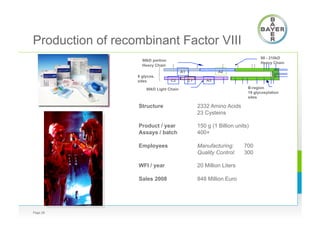
Production of recombinant Factor VIII
Page 28
Structure 2332 Amino Acids
23 Cysteins
Product / year 150 g (1 Billion units)
Assays / batch 400+
Employees Manufacturing: 700
Quality Control: 300
WFI / year 20 Million Liters
Sales 2008 848 Million Euro
B
Heavy Chain
90 - 210kD
B-region
19 glycosylation
sites
80kD Light Chain
90kD portion
Heavy Chain
A1
C2 C1 A3
B
A2
6 glycos.
sites
Long Term Continuous Fermentation of
rec FVIII
Page 29
Time t [d]
Cellconcentration[106vc/mL]
Viability[%]
10
100
1
10
100
0 20 40 60 80 100 120 140
1
Cell concentration
Viability
production of unstable
protein
q/V = 10 /d
Dr. Konstantinov, Bayer Corp.,
Dechema 2002, Frankfurt
Perfusion Culture Features
•  High volumetric throughput (perfusion 1 – 15 fermenter volumes /
day)
•  Low residence time of product in the fermenter – low impact of “-ase”
activities, degradation
•  Physiological steady state conditions
-  Adjusted by specific perfusion rate
•  Small scale fermenters for commercial production
" Product types
-  Low titer
-  Productivity correlated to cell growth
-  Fragile, fast degrading proteins
-  toxic
Page 30
Continuous Bio-Manufacturing
•  Currently hot topic in the industry
•  Advocated by regulatory authorities in the context of lean, low costs
and well controlled production
•  Well established for chemical compounds
•  Goal is to define a continuous process using perfusion technology
combined with continuous filtration and chromatography operations
Page 31
Differences between perfusion and
continuous processing
Perfusion
•  Batch-wise harvest collection
•  One or several harvest batches
are then combined to one DSP
batch
•  Each product batch represents a
certain time interval of perfusion
fermentation
Continuous Processing
•  Completely continuous operation
without harvest collection
•  Cell removal is either done
-  by the cell retention system or
-  by continuous depth filtration
using 2 filters per line (1 in
use, the other ready for use)
Page 32
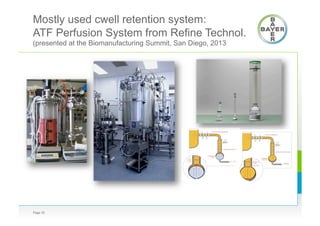
Mostly used cwell retention system:
ATF Perfusion System from Refine Technol.
(presented at the Biomanufacturing Summit, San Diego, 2013
Page 33
Features of the ATF System
•  Scalable
•  Operation in dual mode
-  One unit in use, the other prepared to be used
•  Perfusion rates of 1 – 3 fermenter volumes per day
•  Complete cell retention avoiding cell clarification step
•  Accumulation of dead cells and debris – cell bleed needed
Page 34
Options for Continuous Downstream
Processing
•  Continuous chromatography using a battery of small scale columns
operated sequentially
•  Continuous operation of membrane absorbers in bind / elute mode as
alternative to column chromatography
•  Continuous operation of membrane absorbers in flow-through mode
Status:
•  Currently established for continuous operaton up to capture step
Protein A for mAbs
•  Several units commercially available
Page 35
Options and Limits of Continuous
Processing
Pros
•  Small investment in equipment
and facility
•  Large scale GMP production in a
lab-like environment
•  Easy scale-up by adding same
size units
•  Easy transfer to other sites
(decentralized production)
Cons
•  Complex operation
•  Technical feasibility not
established yet
•  Batch definition ?
•  Potential product quality issues
by long term fermentation
•  Increased validation effort
Page 36
Page 37
Agenda   New Bayer
  Status Quo of biologics manufacturing
  Disposables – benefits and limitations
  Facility of the Future / modern plant design
  Continuous processing
  Comparison of a standard fed-batch versus a continuous
processing based disposable facility
  Conclusion and outlook
Page 38
Cell culture pilot plant in Wuppertal
Purpose
•  Produce material for phase 3 clinical trials
Design
•  Stainless steel equipment
•  Functionally closed processing
•  Fed-batch fermentation
•  Operations are separated in different rooms
Comparison of a fed-batch facility with a
disposable facility using continuous processing
Biofacility of the future
Purpose
•  Production for market
Design
•  100 % S.U. process equipment
•  Closed processing
•  Continuous processing
•  Ballroom production
Building Concept
•  5 levels
•  ~ 5000 m2 total area
•  ~ 1400 m2 cleanroom (class D and C)
Building Concept
•  2 levels
•  ~ 1200 m2 total area
•  ~ 360 m2 cleanroom (class D and C)
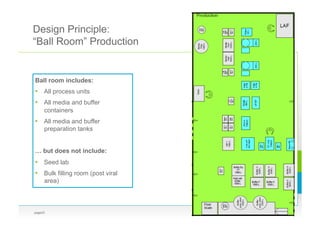
Design Principle:
“Ball Room” Production
page23
Ball room includes:
•  All process units
•  All media and buffer
containers
•  All media and buffer
preparation tanks
… but does not include:
•  Seed lab
•  Bulk filling room (post viral
area)
Pag 40
Flows
Personnel
Material
Product
Waste
Layout 1st floor –
Production Level
Cleanroom classification
Black
Class E
Class D
Class C
Page 41
Agenda   New Bayer
  Status Quo of biologics manufacturing
  Disposables – benefits and limitations
  Facility of the Future / modern plant design
  Continuous processing
  Comparison of a standard fed-batch steel versus a continuous
processing based disposable facility
  Conclusion and outlook
Summary and Conclusions
Single-use technologies are maturing allowing to produce most cell culture process steps in
disposables instead of hard-piped systems
•  Simpler operation in a lab-like environment
•  Issues: 2nd supplier, standardization and regulatory support files
Disposable based flexible facilities with functionally closed operation units are developing
into an alternative or supplement to the standard hard-piped based steel plants:
•  For lower volume products
•  Faster to build, smaller foot print, less complex in Engineering, simpler to qualify
and validate, lower in costs, easier to operate, lower COGs
•  Similar containment and seggregation concept compared to classical plants
Single –use technologies and continuous processing further reduce the footprint of flexible
ballroom plants with less or no seggregation and containment (facility-of-the-future):
•  Different products at a time, no seggregation upstream/downstream
•  Issue: How to handle steps, which still need (functionally) closed systems?
•  Regulatory acceptance/complexity of continuous operations
Page 42
Thank you!
Page 43
Please restrict your content to this area
5.00
0.00
1.30
7.60
5.92
Content area and guides
Page 44

Boedeker Bayer BILS 2016

  • 1.
    Berthold Boedeker Bayer PharmaAG; Biologics - Biotech Development Bio-manufacturing and Facility of the Future: benefits and challenges of recent innovations 9th Bioinnovation Leaders Summit Berlin, Feb. 2016 Page 1
  • 2.
    Page 2 Agenda  New Bayer   Status Quo of biologics manufacturing   Disposables – benefits and limitations   Facility of the Future / modern plant design   Continuous processing   Comparison of a standard fed-batch steel versus a continuous processing based disposable facility   Conclusion and outlook
  • 3.
    Bayer provides solutionsbased on innovations Page 3 In all areas of our business, we invent, develop and market new molecules which influence the biochemical processes in living organisms.
  • 4.
    Our Life Sciencebusinesses hold leadership positions Page 4 Life Sciences !  Strong in research and development !  Leadership positions in core therapeutic areas, e.g. in cardiology, ophthalmology, women‘s health & certain segments of oncology !  Successful market launches, e.g. Xarelto, Eylea, Xofigo !  Crop Protection: no. 2 with a highly diversified R&D portfolio !  Seeds: no. 7 but with leading positions in canola, cotton, vegetables and rice !  Animal Health: no. 3 in the companion animal market (CAP)2 Crop Science1Pharmaceuticals Consumer Health !  No. 2 with leadership positions in key categories (dermatology, gastrointestinal disease) and strong brand recognition !  Strong geographic footprint !  Focused on consumer-centric innovation ≈26,800≈38,000 ≈11,700 Unique and diversified portfolio mitigates risks 1 Incl. Animal Health (will report as a business unit directly to Liam Condon) 2 Companion animal products 3 Expected headcount on January 1, 2016 FTE3
  • 5.
    Best-Selling Pharmaceutical Products Page5 [ € million ] % First Nine Months 2015 First Nine Months 2014 Change Fx adj. % 3rd Quarter 2015 Xarelto™ 1,163 1,602 +37.7 +37.1 Eylea™ 540 874 +61.9 +57.1 Kogenate™ 808 869 +7.5 +0.7 Mirena™ product family 594 742 +24.9 +9.8 Nexavar™ 571 661 +15.8 +6.1 Betaferon™/Betaseron™ 629 634 +0.8 -9.2 YAZ™/Yasmin™/Yasminelle™ 570 538 -5.6 -5.0 Adalat™ 435 481 +10.6 +0.8 Aspirin™ Cardio 356 393 +10.4 +2.3 Glucobay™ 310 381 +22.9 +4.1 Avalox™/Avelox™ 285 294 +3.2 -3.5 Stivarga™ 161 236 +46.6 +29.3 Xofigo™ 128 188 +46.9 +27.5 Total 6,861 8,189 +19.4 +12.0 Proportion of Pharmaceuticals sales 78% 80% Fx & p adj. = currency- and portfolio-adjusted
  • 6.
    Drug Discovery -Biologics Page 6 Biologics Research Biologics Development Elberfeld, Wuppertal ! Monoclonal antibody process development and clinical manufacture ! Batch-fed fermentation ! Microbial fermentation ! Antibody drug conjugate production Berkeley, California ! Process development and clinical manufacture of hemophilia pipeline ! Perfusion-based fermentation ! Production cell line and MCB generation
  • 7.
    Page 7 Agenda  New Bayer   Status Quo of biologics manufacturing   Disposables – benefits and limitations   Facility of the Future / modern plant design   Continuous processing   Comparison of a standard fed-batch steel versus a continuous processing based disposable facility   Conclusion and outlook
  • 8.
    Biologics Landscape •  Accessto medicine •  Health Care costs / reimbursement •  Personalized medicine -  From blockbuster to specifically patient designed biologics •  Regional production set-up •  Biosimilars -  Opportunities -  Regulation -  Pricing " Consequences for industry " CoGs pressure " Fast product turnover in flexible multi-product plants Page 8
  • 9.
    Technology drivers forcell culture industry •  High titer cell line •  Chemically defined media •  Fast and efficient PD •  Robust production processes •  Disposable technology •  Closed systems operation •  Modular plant •  Ball-room plant •  Continuous processing Page 9
  • 10.
    New products afterreplacement proteins and mAbs Complex and specifically designed molecules -  Bispecific / multispecific -  Sort half life molecules -  ADCs / RIA -  Cancer immunotherapies -  Active site molecules will need new / modified production technologies Cell therapies Renaissance of gene therapy? Page 10
  • 11.
    Status Quo inCommercial Manufacturing of Biologics from Mammalian Cell Culture •  85 – 90 % of all products are produces in fed-batch culture, most in large facilities (“steel temples”) in a complex GMP infrastructure with high degree of segregation and automation •  10 – 15 % are produced in perfusion culture at high cell density by cell retention using a similar GMP and segregation environment, which represent a continuous upstream operation followed by classical batch purification Page 11
  • 12.
    New Trends inMammalian Production •  Smaller fermenter volumes needed because of personalized medicine and high production titers •  Use of disposables instead of hard-piped equipment •  Development of upstream and downstream completely or functionally closed systems based mainly on disposables, which should reduce environmental segregation and simplify facility design and operation (ballroom plant concept) •  Desire to produces several products in parallel (several products at a time) in addition to the current campaign mode (one product at a time per suite) •  Regional production set-up needs facilities which are faster and inexpensive to built Page 12
  • 13.
    Page 13 Agenda  New Bayer   Status Quo of biologics manufacturing   Disposables – benefits and limitations   Facility of the Future / modern plant design   Continuous processing   Comparison of a standard fed-batch steel versus a continuous processing based disposable facility   Conclusion and outlook
  • 14.
    Impact of Disposableson Protein Production from Mammalian Cells •  Complete production processing for biologics can be done in disposables, except: -  Centrifugation -  Chromatography skids -  Large UF / DF •  The following unit operations are available: -  Mixing / holding / distribution of media and buffers -  Seed expansion and production fermentation -  Cell removal by depth filters -  Chromatography columns -  UF / DF/ virus filtration However, different vendors with different hook-up and connection systems often result in custom made (expensive) solutions Page 14
  • 15.
    Benefits of disposables • Simplification of processing by replacing highly controlled, hard-piped equipment and utilities by single-use based, stand-alone equipment connected through flexible tubings Main advantages of single use: -  plant design and construction: easier, faster, less expensive, less complex -  construction in a „lab-like“ infrastructure possible -  plant qualification/valiation: faster, less effort -  plant operation: overall cost-efficient, main savings in utilities, water, steam, CIP, SIP, etc., less depriciation -  faster product change -  lower COGs -  fast and low risk transfer to different sites (emerging markets) Page 15
  • 16.
    General Limitations inDisposable Use •  Different units from different vendors -  Interchangeable connections missing -  Lack of “standardization” among supplier •  2nd supplier concept •  Validation packages -  Extractables, leachables •  Quality oversight of disposable vendors •  Regulatory support files •  Routine production measures (avoid human errors) Page 16
  • 17.
    Risk Mitigation StrategiesUsing Disposables •  Work with vendors on improving quality standards -  pressure testing of bags -  in depth inspection for particles , etc. -  in depth quality control audits -  visualization of complete manufacturing process for dsiposables •  Initiative by industry for joint vendors standardization •  Implement 2nd supplier concept -  easy for hold bags, filters, catridges, etc -  difficult and time consuming for single use bioreactors Page 17
  • 18.
    Example of aCurrent Disposable-based Fed-Batch Process Page 18 200 L BIOSTAT® STR ~ 4 days 1000 L BIOSTAT® STR 14 - 18 days Cell Sep: Dead-End Filtration Clarified Harvest Cell Culture: ~ 35 days Seed-Train Expansion 1 mL cryo-vial/Shaker Flasks ~ 14 days
  • 19.
    Page 19 Agenda  New Bayer   Status Quo of biologics manufacturing   Disposables – benefits and limitations   Facility of the Future / modern plant design   Continuous processing   Comparison of a standard fed-batch steel versus a continuous processing based disposable facility   Conclusion and outlook
  • 20.
    Page 20 New Trendsin Mammalian Production Plants Upstream and downstream completely or functionally closed systems based mainly on disposables Produce several products in parallel (several products at a time) in addition to the current campaign mode (one product at a time per suite) Reduction in HVAC/seggregation requirements (ballroom concept) Reduction/avoidance in hard-piping (SIP/CIP) Faster and inexpensive to build Based on ballroom design ?
  • 21.
    Single Use versusSteel based Plant Design using the current Containment Concepts (1) Same seggregation/airlocks/room classification/gowning/dedicated equipment and personell concept as currently state of the art Simplification of processing by replacing highly controlled, hard-piped equipment and utilities by single-use based, stand-alone equipment connected through felxible tubings Main advantages of single use: - plant design and construction: easier, faster, less expensive, less complex - construction in a „lab-like“ infrastructure possible - plant qualification/valiation: faster, less effort- - plant operation: overall cost-efficient, main savings in utilities, water, steam, CIP, SIP, etc., less depriciation - faster product change - lower COGs Page 21
  • 22.
    Single Use versusSteel based Plant Design using the current Containment Concepts (2) Main disadvantages of single use: - limited in size of operation units (bags) - labor intensive - manual operations - potential for operator failures - dependency on bag vendor quality - more waste - inactivation followed by incineration Current new plants are often constructed as mixed mode plant combining disposable and hard-piped processing steps Page 22
  • 23.
    Ballroom Plant DesignConcept (1) Represents innovative concept to enable parallel processing of different products in the same low classification containment without upstream and downstream seggregation Concept addressed in the following paper: Simon Chalk et.al., „Challenging the Cleanroom Paradigm for Biopharmaceutical Manufacturing of Bulk Drug Substances“, BioPharm International, Aug. 1, 2011. Based on the key assumptions that technological advances including single use sytems have continuously reduced the risk of environmental impact on processing. Most steps can be securely performed closed or functionally closed. The few remaining open processing steps have to be addressed independently (i.e. portable laminar flow hood, isolator technology) Page 23
  • 24.
    Ballroom Plant DesignConcept (2) Basic thinking is that in a closed or functionally closed system, the process stream is isolated from the environment Remaining open operations (cell expansion, column packing, powder additions) have to be addressed separetely, i.e. in small areas with classical containment set up Potential breach of the closed system is the major risk, which has to be addressed: - prove no contamination or cross-contamination - intense microbial monitoring Maintaining the closed system status has to be addresse by a risk based approach with appropiate risk mitigation strategies considering each process step or operation Page 24
  • 25.
    Ballroom Plant DesignConcept (3) The following risks were addressed and mitigation strategies provided using detailed failure mode and effects analysis tools: - temporary breakable connections - open manipulation in process stream - charging raw materials during media or solution prep - equipment prep - cleaning or maintenance - in-process sampling - unexpected breach of a closed system element There are indeed first facilities, which were designed, built and qualified according to the concept of using risk-mitigated closed systems, which have much lower containment /room classification requirements and are used for at least clinical production Page 25
  • 26.
    Page 26 Agenda  New Bayer   Status Quo of biologics manufacturing   Disposables – benefits and limitations   Facility of the Future / modern plant design   Continuous processing   Comparison of a standard fed-batch steel versus a continuous processing based disposable facility   Conclusion and outlook
  • 27.
    Scheme for ContinuousPerfusion Culture with External Retention Device Page 27
  • 28.
    Production of recombinantFactor VIII Page 28 Structure 2332 Amino Acids 23 Cysteins Product / year 150 g (1 Billion units) Assays / batch 400+ Employees Manufacturing: 700 Quality Control: 300 WFI / year 20 Million Liters Sales 2008 848 Million Euro B Heavy Chain 90 - 210kD B-region 19 glycosylation sites 80kD Light Chain 90kD portion Heavy Chain A1 C2 C1 A3 B A2 6 glycos. sites
  • 29.
    Long Term ContinuousFermentation of rec FVIII Page 29 Time t [d] Cellconcentration[106vc/mL] Viability[%] 10 100 1 10 100 0 20 40 60 80 100 120 140 1 Cell concentration Viability production of unstable protein q/V = 10 /d Dr. Konstantinov, Bayer Corp., Dechema 2002, Frankfurt
  • 30.
    Perfusion Culture Features • High volumetric throughput (perfusion 1 – 15 fermenter volumes / day) •  Low residence time of product in the fermenter – low impact of “-ase” activities, degradation •  Physiological steady state conditions -  Adjusted by specific perfusion rate •  Small scale fermenters for commercial production " Product types -  Low titer -  Productivity correlated to cell growth -  Fragile, fast degrading proteins -  toxic Page 30
  • 31.
    Continuous Bio-Manufacturing •  Currentlyhot topic in the industry •  Advocated by regulatory authorities in the context of lean, low costs and well controlled production •  Well established for chemical compounds •  Goal is to define a continuous process using perfusion technology combined with continuous filtration and chromatography operations Page 31
  • 32.
    Differences between perfusionand continuous processing Perfusion •  Batch-wise harvest collection •  One or several harvest batches are then combined to one DSP batch •  Each product batch represents a certain time interval of perfusion fermentation Continuous Processing •  Completely continuous operation without harvest collection •  Cell removal is either done -  by the cell retention system or -  by continuous depth filtration using 2 filters per line (1 in use, the other ready for use) Page 32
  • 33.
    Mostly used cwellretention system: ATF Perfusion System from Refine Technol. (presented at the Biomanufacturing Summit, San Diego, 2013 Page 33
  • 34.
    Features of theATF System •  Scalable •  Operation in dual mode -  One unit in use, the other prepared to be used •  Perfusion rates of 1 – 3 fermenter volumes per day •  Complete cell retention avoiding cell clarification step •  Accumulation of dead cells and debris – cell bleed needed Page 34
  • 35.
    Options for ContinuousDownstream Processing •  Continuous chromatography using a battery of small scale columns operated sequentially •  Continuous operation of membrane absorbers in bind / elute mode as alternative to column chromatography •  Continuous operation of membrane absorbers in flow-through mode Status: •  Currently established for continuous operaton up to capture step Protein A for mAbs •  Several units commercially available Page 35
  • 36.
    Options and Limitsof Continuous Processing Pros •  Small investment in equipment and facility •  Large scale GMP production in a lab-like environment •  Easy scale-up by adding same size units •  Easy transfer to other sites (decentralized production) Cons •  Complex operation •  Technical feasibility not established yet •  Batch definition ? •  Potential product quality issues by long term fermentation •  Increased validation effort Page 36
  • 37.
    Page 37 Agenda  New Bayer   Status Quo of biologics manufacturing   Disposables – benefits and limitations   Facility of the Future / modern plant design   Continuous processing   Comparison of a standard fed-batch versus a continuous processing based disposable facility   Conclusion and outlook
  • 38.
    Page 38 Cell culturepilot plant in Wuppertal Purpose •  Produce material for phase 3 clinical trials Design •  Stainless steel equipment •  Functionally closed processing •  Fed-batch fermentation •  Operations are separated in different rooms Comparison of a fed-batch facility with a disposable facility using continuous processing Biofacility of the future Purpose •  Production for market Design •  100 % S.U. process equipment •  Closed processing •  Continuous processing •  Ballroom production Building Concept •  5 levels •  ~ 5000 m2 total area •  ~ 1400 m2 cleanroom (class D and C) Building Concept •  2 levels •  ~ 1200 m2 total area •  ~ 360 m2 cleanroom (class D and C)
  • 39.
    Design Principle: “Ball Room”Production page23 Ball room includes: •  All process units •  All media and buffer containers •  All media and buffer preparation tanks … but does not include: •  Seed lab •  Bulk filling room (post viral area)
  • 40.
    Pag 40 Flows Personnel Material Product Waste Layout 1stfloor – Production Level Cleanroom classification Black Class E Class D Class C
  • 41.
    Page 41 Agenda  New Bayer   Status Quo of biologics manufacturing   Disposables – benefits and limitations   Facility of the Future / modern plant design   Continuous processing   Comparison of a standard fed-batch steel versus a continuous processing based disposable facility   Conclusion and outlook
  • 42.
    Summary and Conclusions Single-usetechnologies are maturing allowing to produce most cell culture process steps in disposables instead of hard-piped systems •  Simpler operation in a lab-like environment •  Issues: 2nd supplier, standardization and regulatory support files Disposable based flexible facilities with functionally closed operation units are developing into an alternative or supplement to the standard hard-piped based steel plants: •  For lower volume products •  Faster to build, smaller foot print, less complex in Engineering, simpler to qualify and validate, lower in costs, easier to operate, lower COGs •  Similar containment and seggregation concept compared to classical plants Single –use technologies and continuous processing further reduce the footprint of flexible ballroom plants with less or no seggregation and containment (facility-of-the-future): •  Different products at a time, no seggregation upstream/downstream •  Issue: How to handle steps, which still need (functionally) closed systems? •  Regulatory acceptance/complexity of continuous operations Page 42
  • 43.
  • 44.
    Please restrict yourcontent to this area 5.00 0.00 1.30 7.60 5.92 Content area and guides Page 44