By Gruvin
 A narrative is not the same as a story.
 A story refers to the base, including events,
places and people.
 Although, a narrative is how a story is told. Giving
it shape, structure and perspective. It is about
organising the story material and making choices
about how to put it together.
 Not all narratives follow the beginning-middle-
end arrangement. Writers choose to play around
with the narrative to manipulate the audience,
keeping them guessing and challenging
expectations.
 Vladimir Propp was a Russian theorist and
based his theory on folk tales that he’s
studied.
 After analysing over 100 russian folk tales, he
suggested that you are able to classify
characters and their actions into 8 character
types.
 These character types were heavily influenced
in Hollywood films. You are able to distinguish
between each character and classify them.
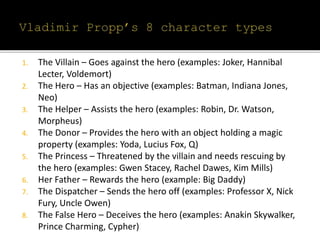
1. The Villain – Goes against the hero (examples: Joker, Hannibal
Lecter, Voldemort)
2. The Hero – Has an objective (examples: Batman, Indiana Jones,
Neo)
3. The Helper – Assists the hero (examples: Robin, Dr. Watson,
Morpheus)
4. The Donor – Provides the hero with an object holding a magic
property (examples: Yoda, Lucius Fox, Q)
5. The Princess – Threatened by the villain and needs rescuing by
the hero (examples: Gwen Stacey, Rachel Dawes, Kim Mills)
6. Her Father – Rewards the hero (example: Big Daddy)
7. The Dispatcher – Sends the hero off (examples: Professor X, Nick
Fury, Uncle Owen)
8. The False Hero – Deceives the hero (examples: Anakin Skywalker,
Prince Charming, Cypher)
 Tzvetan Todorov was a Bulgarian literary
theorist.
 Wrote several books and essays about literary
theory. 21 books published in total.
 He was a visiting professor at numerous
universities, including Harvard.
 Todorov’s theory suggests that each narrative
are structured in 5 stages.
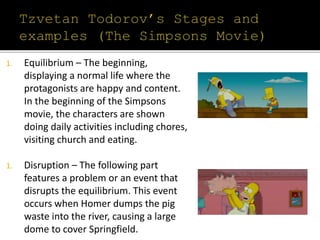
1. Equilibrium – The beginning,
displaying a normal life where the
protagonists are happy and content.
In the beginning of the Simpsons
movie, the characters are shown
doing daily activities including chores,
visiting church and eating.
1. Disruption – The following part
features a problem or an event that
disrupts the equilibrium. This event
occurs when Homer dumps the pig
waste into the river, causing a large
dome to cover Springfield.
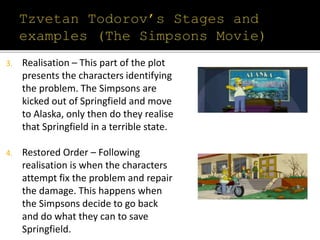
3. Realisation – This part of the plot
presents the characters identifying
the problem. The Simpsons are
kicked out of Springfield and move
to Alaska, only then do they realise
that Springfield in a terrible state.
4. Restored Order – Following
realisation is when the characters
attempt fix the problem and repair
the damage. This happens when
the Simpsons decide to go back
and do what they can to save
Springfield.
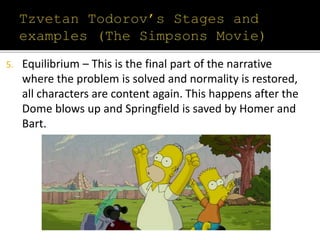
5. Equilibrium – This is the final part of the narrative
where the problem is solved and normality is restored,
all characters are content again. This happens after the
Dome blows up and Springfield is saved by Homer and
Bart.
 Rolland Barthes was a French social and
literary critic.
 Being a 20th century philosopher, Barthes
studied structuralism (human behaviour,
culture and experience) and semiotics
(interpretation of signs and symbols.
 Rolland created a theory which suggests that
a narrative could be distinguished between 5
codes.
1. Hermeneutic Code – Elements of the story that are
not fully explained, creating a mysterious effect on
the audience. This is used to try and intrigue the
audience, keeping them questioning until answers
are revealed.
2. Proairetic Code – When tension builds from an action
resulting into another action. This is also used to
keep the audience anticipating. The hermeneutic
code and proairetic code work together to help
create a narrative based around a mystery genre.
3. Semantic Code – Refers to parts in the narrative that
suggests additional meanings.
4. Symbolic Code – Relates to the semantic
code but in a deeper level. This code is about
symbolism within the narrative, it
emphasises opposites to show contrast,
create tension or a greater meaning and
develops a character.
5. Cultural code – Looks at the wider
knowledge, morality and ideology of the
audience. This usually involves science and
religion.

Narrative Theory

  • 1.
  • 2.
     A narrativeis not the same as a story.  A story refers to the base, including events, places and people.  Although, a narrative is how a story is told. Giving it shape, structure and perspective. It is about organising the story material and making choices about how to put it together.  Not all narratives follow the beginning-middle- end arrangement. Writers choose to play around with the narrative to manipulate the audience, keeping them guessing and challenging expectations.
  • 3.
     Vladimir Proppwas a Russian theorist and based his theory on folk tales that he’s studied.  After analysing over 100 russian folk tales, he suggested that you are able to classify characters and their actions into 8 character types.  These character types were heavily influenced in Hollywood films. You are able to distinguish between each character and classify them.
  • 4.
    1. The Villain– Goes against the hero (examples: Joker, Hannibal Lecter, Voldemort) 2. The Hero – Has an objective (examples: Batman, Indiana Jones, Neo) 3. The Helper – Assists the hero (examples: Robin, Dr. Watson, Morpheus) 4. The Donor – Provides the hero with an object holding a magic property (examples: Yoda, Lucius Fox, Q) 5. The Princess – Threatened by the villain and needs rescuing by the hero (examples: Gwen Stacey, Rachel Dawes, Kim Mills) 6. Her Father – Rewards the hero (example: Big Daddy) 7. The Dispatcher – Sends the hero off (examples: Professor X, Nick Fury, Uncle Owen) 8. The False Hero – Deceives the hero (examples: Anakin Skywalker, Prince Charming, Cypher)
  • 5.
     Tzvetan Todorovwas a Bulgarian literary theorist.  Wrote several books and essays about literary theory. 21 books published in total.  He was a visiting professor at numerous universities, including Harvard.  Todorov’s theory suggests that each narrative are structured in 5 stages.
  • 6.
    1. Equilibrium –The beginning, displaying a normal life where the protagonists are happy and content. In the beginning of the Simpsons movie, the characters are shown doing daily activities including chores, visiting church and eating. 1. Disruption – The following part features a problem or an event that disrupts the equilibrium. This event occurs when Homer dumps the pig waste into the river, causing a large dome to cover Springfield.
  • 7.
    3. Realisation –This part of the plot presents the characters identifying the problem. The Simpsons are kicked out of Springfield and move to Alaska, only then do they realise that Springfield in a terrible state. 4. Restored Order – Following realisation is when the characters attempt fix the problem and repair the damage. This happens when the Simpsons decide to go back and do what they can to save Springfield.
  • 8.
    5. Equilibrium –This is the final part of the narrative where the problem is solved and normality is restored, all characters are content again. This happens after the Dome blows up and Springfield is saved by Homer and Bart.
  • 9.
     Rolland Bartheswas a French social and literary critic.  Being a 20th century philosopher, Barthes studied structuralism (human behaviour, culture and experience) and semiotics (interpretation of signs and symbols.  Rolland created a theory which suggests that a narrative could be distinguished between 5 codes.
  • 10.
    1. Hermeneutic Code– Elements of the story that are not fully explained, creating a mysterious effect on the audience. This is used to try and intrigue the audience, keeping them questioning until answers are revealed. 2. Proairetic Code – When tension builds from an action resulting into another action. This is also used to keep the audience anticipating. The hermeneutic code and proairetic code work together to help create a narrative based around a mystery genre. 3. Semantic Code – Refers to parts in the narrative that suggests additional meanings.
  • 11.
    4. Symbolic Code– Relates to the semantic code but in a deeper level. This code is about symbolism within the narrative, it emphasises opposites to show contrast, create tension or a greater meaning and develops a character. 5. Cultural code – Looks at the wider knowledge, morality and ideology of the audience. This usually involves science and religion.