Narrative Theory 
Take Three Productions – 
Jasdeep Kaur Jabbal
Narrative 
By definition, a narrative is a way in which a story is told in both 
fictional and non-fictional media texts. 
The 4 main narrative theorists are Todorov, Propp, Mulvey and 
Levi-Strauss.
Todorov 
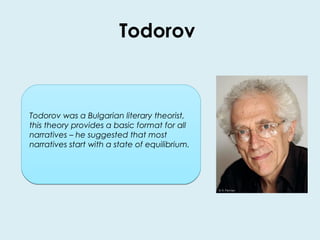
Todorov was a Bulgarian literary theorist, 
this theory provides a basic format for all 
narratives – he suggested that most 
narratives start with a state of equilibrium.
Tzvetan Todorov 
He then goes on to describe five stages that structure 
conventional narratives: 
1. A state of equilibrium (All is as it should be.) 
2. A disruption of that order by an event. 
3. A recognition that the disorder has occurred. 
4. An attempt to repair the damage of the 
disruption. 
5. A return or restoration of a NEW equilibrium
Todorov Theory – Our Production 
• This structure is valid to our own production, Life Is a Journey, but the states are 
not in the same order. 
• At the beginning it starts of with the recognition that the disorder has occurred 
by Tom who waits and watch’s Anna packing her bag. 
• Then there is an attempt to repair the damage of the disruption by when Tom 
stops Anna packing and push’s her to the wall. 
• Also the state of disruption is when Tom and Anna get into a heated argument; 
this is a disruption of the equilibrium which is at the beginning. 
• Then there is a rewind of everything to the state of equilibrium, where there is a 
montage of both Anna and Tom, this allows the audience to gain an 
understanding and a strong liking towards both characters. 
• Finally towards the ending the state of disruption is shown again; this is when Tom 
and Anna get into a heated argument; this is a disruption of the equilibrium. 
• From this, we get the audience to not only experience the idea of how they met, 
both characters are reminiscing and remember how they got together, and 
why they are still together – this also adds to the attempt to repair the 
disruption and also the question about the disruption.
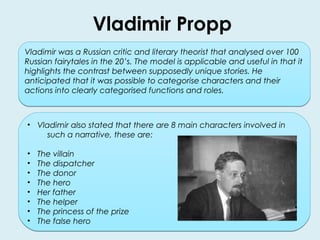
Vladimir Propp 
Vladimir was a Russian critic and literary theorist that analysed over 100 
Russian fairytales in the 20’s. The model is applicable and useful in that it 
highlights the contrast between supposedly unique stories. He 
anticipated that it was possible to categorise characters and their 
actions into clearly categorised functions and roles. 
• Vladimir also stated that there are 8 main characters involved in 
such a narrative, these are: 
• The villain 
• The dispatcher 
• The donor 
• The hero 
• Her father 
• The helper 
• The princess of the prize 
• The false hero
Propp Theory – Our 
Production 
It does not seem as though this narrative will be applicable to our short 
film, the reason being, our short film only has two characters, both of 
which are in love and there is no such villain or father, or a helper or a 
princess, etc.
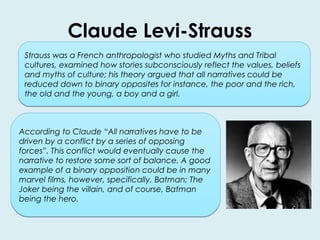
Claude Levi-Strauss 
Strauss was a French anthropologist who studied Myths and Tribal 
cultures, examined how stories subconsciously reflect the values, beliefs 
and myths of culture; his theory argued that all narratives could be 
reduced down to binary opposites for instance, the poor and the rich, 
the old and the young, a boy and a girl. 
According to Claude “All narratives have to be 
driven by a conflict by a series of opposing 
forces”. This conflict would eventually cause the 
narrative to restore some sort of balance. A good 
example of a binary opposition could be in many 
marvel films, however, specifically, Batman; The 
Joker being the villain, and of course, Batman 
being the hero.
Claude Theory – Our 
Production 
Within the media industry, this theory is used very frequently in films, 
however perhaps not so much my own. There may be a binary 
opposite as there are two characters, one is a boy, the other a girl, and 
so, once they argue, this may show a binary opposition.
Laura Mulvey 
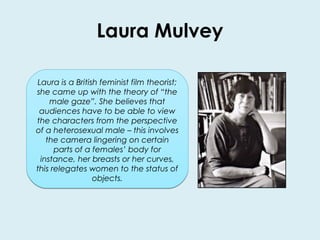
Laura is a British feminist film theorist; 
she came up with the theory of “the 
male gaze”. She believes that 
audiences have to be able to view 
the characters from the perspective 
of a heterosexual male – this involves 
the camera lingering on certain 
parts of a females’ body for 
instance, her breasts or her curves, 
this relegates women to the status of 
objects.
Laura Mulvey Theory – Our 
Production 
For our production, it may be likely that this theory is to be used as we 
are using a young, beautiful girl and therefore, it may inevitable that 
people are to ‘gaze’ at her feminine aspects, such as her curves. 
Also, due to the fact that both characters are to be in a relationship, 
Tom, the male character may present Anna in such a light that she will 
be desirable for those in our target audience that are males as out 
production is to be aimed at both males and females.

Narrative Theory

  • 1.
    Narrative Theory TakeThree Productions – Jasdeep Kaur Jabbal
  • 2.
    Narrative By definition,a narrative is a way in which a story is told in both fictional and non-fictional media texts. The 4 main narrative theorists are Todorov, Propp, Mulvey and Levi-Strauss.
  • 3.
    Todorov Todorov wasa Bulgarian literary theorist, this theory provides a basic format for all narratives – he suggested that most narratives start with a state of equilibrium.
  • 4.
    Tzvetan Todorov Hethen goes on to describe five stages that structure conventional narratives: 1. A state of equilibrium (All is as it should be.) 2. A disruption of that order by an event. 3. A recognition that the disorder has occurred. 4. An attempt to repair the damage of the disruption. 5. A return or restoration of a NEW equilibrium
  • 5.
    Todorov Theory –Our Production • This structure is valid to our own production, Life Is a Journey, but the states are not in the same order. • At the beginning it starts of with the recognition that the disorder has occurred by Tom who waits and watch’s Anna packing her bag. • Then there is an attempt to repair the damage of the disruption by when Tom stops Anna packing and push’s her to the wall. • Also the state of disruption is when Tom and Anna get into a heated argument; this is a disruption of the equilibrium which is at the beginning. • Then there is a rewind of everything to the state of equilibrium, where there is a montage of both Anna and Tom, this allows the audience to gain an understanding and a strong liking towards both characters. • Finally towards the ending the state of disruption is shown again; this is when Tom and Anna get into a heated argument; this is a disruption of the equilibrium. • From this, we get the audience to not only experience the idea of how they met, both characters are reminiscing and remember how they got together, and why they are still together – this also adds to the attempt to repair the disruption and also the question about the disruption.
  • 6.
    Vladimir Propp Vladimirwas a Russian critic and literary theorist that analysed over 100 Russian fairytales in the 20’s. The model is applicable and useful in that it highlights the contrast between supposedly unique stories. He anticipated that it was possible to categorise characters and their actions into clearly categorised functions and roles. • Vladimir also stated that there are 8 main characters involved in such a narrative, these are: • The villain • The dispatcher • The donor • The hero • Her father • The helper • The princess of the prize • The false hero
  • 7.
    Propp Theory –Our Production It does not seem as though this narrative will be applicable to our short film, the reason being, our short film only has two characters, both of which are in love and there is no such villain or father, or a helper or a princess, etc.
  • 8.
    Claude Levi-Strauss Strausswas a French anthropologist who studied Myths and Tribal cultures, examined how stories subconsciously reflect the values, beliefs and myths of culture; his theory argued that all narratives could be reduced down to binary opposites for instance, the poor and the rich, the old and the young, a boy and a girl. According to Claude “All narratives have to be driven by a conflict by a series of opposing forces”. This conflict would eventually cause the narrative to restore some sort of balance. A good example of a binary opposition could be in many marvel films, however, specifically, Batman; The Joker being the villain, and of course, Batman being the hero.
  • 9.
    Claude Theory –Our Production Within the media industry, this theory is used very frequently in films, however perhaps not so much my own. There may be a binary opposite as there are two characters, one is a boy, the other a girl, and so, once they argue, this may show a binary opposition.
  • 10.
    Laura Mulvey Laurais a British feminist film theorist; she came up with the theory of “the male gaze”. She believes that audiences have to be able to view the characters from the perspective of a heterosexual male – this involves the camera lingering on certain parts of a females’ body for instance, her breasts or her curves, this relegates women to the status of objects.
  • 11.
    Laura Mulvey Theory– Our Production For our production, it may be likely that this theory is to be used as we are using a young, beautiful girl and therefore, it may inevitable that people are to ‘gaze’ at her feminine aspects, such as her curves. Also, due to the fact that both characters are to be in a relationship, Tom, the male character may present Anna in such a light that she will be desirable for those in our target audience that are males as out production is to be aimed at both males and females.