FUTURE HERO
Short Film Analysis
https://www.youtube.com/w
atch?v=x2w5WXpzVUM
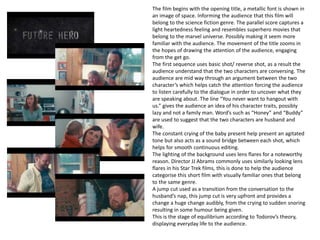
The film begins with the opening title, a metallic font is shown in
an image of space. Informing the audience that this film will
belong to the science fiction genre. The parallel score captures a
light heartedness feeling and resembles superhero movies that
belong to the marvel universe. Possibly making it seem more
familiar with the audience. The movement of the title zooms in
the hopes of drawing the attention of the audience, engaging
from the get go.
The first sequence uses basic shot/ reverse shot, as a result the
audience understand that the two characters are conversing. The
audience are mid way through an argument between the two
character’s which helps catch the attention forcing the audience
to listen carefully to the dialogue in order to uncover what they
are speaking about. The line “You never want to hangout with
us.” gives the audience an idea of his character traits, possibly
lazy and not a family man. Word’s such as “Honey” and “Buddy”
are used to suggest that the two characters are husband and
wife.
The constant crying of the baby present help present an agitated
tone but also acts as a sound bridge between each shot, which
helps for smooth continuous editing.
The lighting of the background uses lens flares for a noteworthy
reason. Director JJ Abrams commonly uses similarly looking lens
flares in his Star Trek films, this is done to help the audience
categorise this short film with visually familiar ones that belong
to the same genre.
A jump cut used as a transition from the conversation to the
husband’s nap, this jump cut is very upfront and provides a
change a huge change audibly, from the crying to sudden snoring
resulting in some humour being given.
This is the stage of equilibrium according to Todorov’s theory,
displaying everyday life to the audience.
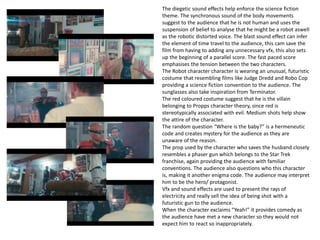
The diegetic sound effects help enforce the science fiction
theme. The synchronous sound of the body movements
suggest to the audience that he is not human and uses the
suspension of belief to analyse that he might be a robot aswell
as the robotic distorted voice. The blast sound effect can infer
the element of time travel to the audience, this cam save the
film from having to adding any unnecessary vfx, this also sets
up the beginning of a parallel score. The fast paced score
emphasises the tension between the two characters.
The Robot character character is wearing an unusual, futuristic
costume that resembling films like Judge Dredd and Robo Cop
providing a science fiction convention to the audience. The
sunglasses also take inspiration from Terminator.
The red coloured costume suggest that he is the villain
belonging to Propps character theory, since red is
stereotypically associated with evil. Medium shots help show
the attire of the character.
The random question “Where is the baby?” is a hermeneutic
code and creates mystery for the audience as they are
unaware of the reason.
The prop used by the character who saves the husband closely
resembles a phaser gun which belongs to the Star Trek
franchise, again providing the audience with familiar
conventions. The audience also questions who this character
is, making it another enigma code. The audience may interpret
him to be the hero/ protagonist.
Vfx and sound effects are used to present the rays of
electricity and really sell the idea of being shot with a
futuristic gun to the audience.
When the character exclaims “Yeah!” it provides comedy as
the audience have met a new character so they would not
expect him to react so inappropriately.
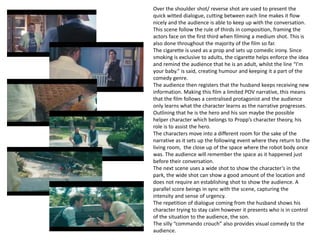
Over the shoulder shot/ reverse shot are used to present the
quick witted dialogue, cutting between each line makes it flow
nicely and the audience is able to keep up with the conversation.
This scene follow the rule of thirds in composition, framing the
actors face on the first third when filming a medium shot. This is
also done throughout the majority of the film so far.
The cigarette is used as a prop and sets up comedic irony. Since
smoking is exclusive to adults, the cigarette helps enforce the idea
and remind the audience that he is an adult, whilst the line “I’m
your baby.” is said, creating humour and keeping it a part of the
comedy genre.
The audience then registers that the husband keeps receiving new
information. Making this film a limited POV narrative, this means
that the film follows a centralised protagonist and the audience
only learns what the character learns as the narrative progresses.
Outlining that he is the hero and his son maybe the possible
helper character which belongs to Propp’s character theory, his
role is to assist the hero.
The characters move into a different room for the sake of the
narrative as it sets up the following event where they return to the
living room, the close up of the space where the robot body once
was. The audience will remember the space as it happened just
before their conversation.
The next scene uses a wide shot to show the character’s in the
park, the wide shot can show a good amount of the location and
does not require an establishing shot to show the audience. A
parallel score beings in sync with the scene, capturing the
intensity and sense of urgency.
The repetition of dialogue coming from the husband shows his
character trying to stay calm however it presents who is in control
of the situation to the audience, the son.
The silly “commando crouch” also provides visual comedy to the
audience.
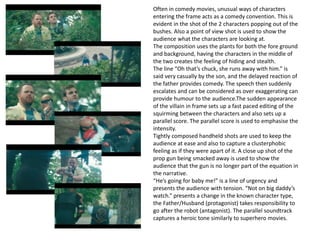
Often in comedy movies, unusual ways of characters
entering the frame acts as a comedy convention. This is
evident in the shot of the 2 characters popping out of the
bushes. Also a point of view shot is used to show the
audience what the characters are looking at.
The composition uses the plants for both the fore ground
and background, having the characters in the middle of
the two creates the feeling of hiding and stealth.
The line “Oh that’s chuck, she runs away with him.” is
said very casually by the son, and the delayed reaction of
the father provides comedy. The speech then suddenly
escalates and can be considered as over exaggerating can
provide humour to the audience.The sudden appearance
of the villain in frame sets up a fast paced editing of the
squirming between the characters and also sets up a
parallel score. The parallel score is used to emphasise the
intensity.
Tightly composed handheld shots are used to keep the
audience at ease and also to capture a clusterphobic
feeling as if they were apart of it. A close up shot of the
prop gun being smacked away is used to show the
audience that the gun is no longer part of the equation in
the narrative.
“He’s going for baby me!” is a line of urgency and
presents the audience with tension. “Not on big daddy’s
watch.” presents a change in the known character type,
the Father/Husband (protagonist) takes responsibility to
go after the robot (antagonist). The parallel soundtrack
captures a heroic tone similarly to superhero movies.
According to Todorov’s stages of narrative, this event would
belong under restoring order where a character attempts to
save the day.
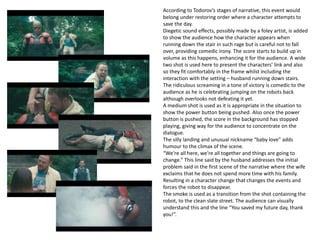
Diegetic sound effects, possibly made by a foley artist, is added
to show the audience how the character appears when
running down the stair in such rage but is careful not to fall
over, providing comedic irony. The score starts to build up in
volume as this happens, enhancing it for the audience. A wide
two shot is used here to present the characters’ link and also
so they fit comfortably in the frame whilst including the
interaction with the setting – husband running down stairs.
The ridiculous screaming in a tone of victory is comedic to the
audience as he is celebrating jumping on the robots back
although overlooks not defeating it yet.
A medium shot is used as it is appropriate in the situation to
show the power button being pushed. Also once the power
button is pushed, the score in the background has stopped
playing, giving way for the audience to concentrate on the
dialogue.
The silly landing and unusual nickname “baby love” adds
humour to the climax of the scene.
“We’re all here, we’re all together and things are going to
change.” This line said by the husband addresses the initial
problem said in the first scene of the narrative where the wife
exclaims that he does not spend more time with his family.
Resulting in a character change that changes the events and
forces the robot to disappear.
The smoke is used as a transition from the shot containing the
robot, to the clean slate street. The audience can visually
understand this and the line “You saved my future day, thank
you!”.
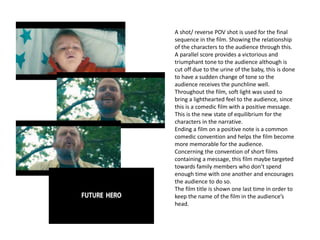
A shot/ reverse POV shot is used for the final
sequence in the film. Showing the relationship
of the characters to the audience through this.
A parallel score provides a victorious and
triumphant tone to the audience although is
cut off due to the urine of the baby, this is done
to have a sudden change of tone so the
audience receives the punchline well.
Throughout the film, soft light was used to
bring a lighthearted feel to the audience, since
this is a comedic film with a positive message.
This is the new state of equilibrium for the
characters in the narrative.
Ending a film on a positive note is a common
comedic convention and helps the film become
more memorable for the audience.
Concerning the convention of short films
containing a message, this film maybe targeted
towards family members who don’t spend
enough time with one another and encourages
the audience to do so.
The film title is shown one last time in order to
keep the name of the film in the audience’s
head.

Future hero

  • 1.
    FUTURE HERO Short FilmAnalysis https://www.youtube.com/w atch?v=x2w5WXpzVUM
  • 2.
    The film beginswith the opening title, a metallic font is shown in an image of space. Informing the audience that this film will belong to the science fiction genre. The parallel score captures a light heartedness feeling and resembles superhero movies that belong to the marvel universe. Possibly making it seem more familiar with the audience. The movement of the title zooms in the hopes of drawing the attention of the audience, engaging from the get go. The first sequence uses basic shot/ reverse shot, as a result the audience understand that the two characters are conversing. The audience are mid way through an argument between the two character’s which helps catch the attention forcing the audience to listen carefully to the dialogue in order to uncover what they are speaking about. The line “You never want to hangout with us.” gives the audience an idea of his character traits, possibly lazy and not a family man. Word’s such as “Honey” and “Buddy” are used to suggest that the two characters are husband and wife. The constant crying of the baby present help present an agitated tone but also acts as a sound bridge between each shot, which helps for smooth continuous editing. The lighting of the background uses lens flares for a noteworthy reason. Director JJ Abrams commonly uses similarly looking lens flares in his Star Trek films, this is done to help the audience categorise this short film with visually familiar ones that belong to the same genre. A jump cut used as a transition from the conversation to the husband’s nap, this jump cut is very upfront and provides a change a huge change audibly, from the crying to sudden snoring resulting in some humour being given. This is the stage of equilibrium according to Todorov’s theory, displaying everyday life to the audience.
  • 3.
    The diegetic soundeffects help enforce the science fiction theme. The synchronous sound of the body movements suggest to the audience that he is not human and uses the suspension of belief to analyse that he might be a robot aswell as the robotic distorted voice. The blast sound effect can infer the element of time travel to the audience, this cam save the film from having to adding any unnecessary vfx, this also sets up the beginning of a parallel score. The fast paced score emphasises the tension between the two characters. The Robot character character is wearing an unusual, futuristic costume that resembling films like Judge Dredd and Robo Cop providing a science fiction convention to the audience. The sunglasses also take inspiration from Terminator. The red coloured costume suggest that he is the villain belonging to Propps character theory, since red is stereotypically associated with evil. Medium shots help show the attire of the character. The random question “Where is the baby?” is a hermeneutic code and creates mystery for the audience as they are unaware of the reason. The prop used by the character who saves the husband closely resembles a phaser gun which belongs to the Star Trek franchise, again providing the audience with familiar conventions. The audience also questions who this character is, making it another enigma code. The audience may interpret him to be the hero/ protagonist. Vfx and sound effects are used to present the rays of electricity and really sell the idea of being shot with a futuristic gun to the audience. When the character exclaims “Yeah!” it provides comedy as the audience have met a new character so they would not expect him to react so inappropriately.
  • 4.
    Over the shouldershot/ reverse shot are used to present the quick witted dialogue, cutting between each line makes it flow nicely and the audience is able to keep up with the conversation. This scene follow the rule of thirds in composition, framing the actors face on the first third when filming a medium shot. This is also done throughout the majority of the film so far. The cigarette is used as a prop and sets up comedic irony. Since smoking is exclusive to adults, the cigarette helps enforce the idea and remind the audience that he is an adult, whilst the line “I’m your baby.” is said, creating humour and keeping it a part of the comedy genre. The audience then registers that the husband keeps receiving new information. Making this film a limited POV narrative, this means that the film follows a centralised protagonist and the audience only learns what the character learns as the narrative progresses. Outlining that he is the hero and his son maybe the possible helper character which belongs to Propp’s character theory, his role is to assist the hero. The characters move into a different room for the sake of the narrative as it sets up the following event where they return to the living room, the close up of the space where the robot body once was. The audience will remember the space as it happened just before their conversation. The next scene uses a wide shot to show the character’s in the park, the wide shot can show a good amount of the location and does not require an establishing shot to show the audience. A parallel score beings in sync with the scene, capturing the intensity and sense of urgency. The repetition of dialogue coming from the husband shows his character trying to stay calm however it presents who is in control of the situation to the audience, the son. The silly “commando crouch” also provides visual comedy to the audience.
  • 5.
    Often in comedymovies, unusual ways of characters entering the frame acts as a comedy convention. This is evident in the shot of the 2 characters popping out of the bushes. Also a point of view shot is used to show the audience what the characters are looking at. The composition uses the plants for both the fore ground and background, having the characters in the middle of the two creates the feeling of hiding and stealth. The line “Oh that’s chuck, she runs away with him.” is said very casually by the son, and the delayed reaction of the father provides comedy. The speech then suddenly escalates and can be considered as over exaggerating can provide humour to the audience.The sudden appearance of the villain in frame sets up a fast paced editing of the squirming between the characters and also sets up a parallel score. The parallel score is used to emphasise the intensity. Tightly composed handheld shots are used to keep the audience at ease and also to capture a clusterphobic feeling as if they were apart of it. A close up shot of the prop gun being smacked away is used to show the audience that the gun is no longer part of the equation in the narrative. “He’s going for baby me!” is a line of urgency and presents the audience with tension. “Not on big daddy’s watch.” presents a change in the known character type, the Father/Husband (protagonist) takes responsibility to go after the robot (antagonist). The parallel soundtrack captures a heroic tone similarly to superhero movies.
  • 6.
    According to Todorov’sstages of narrative, this event would belong under restoring order where a character attempts to save the day. Diegetic sound effects, possibly made by a foley artist, is added to show the audience how the character appears when running down the stair in such rage but is careful not to fall over, providing comedic irony. The score starts to build up in volume as this happens, enhancing it for the audience. A wide two shot is used here to present the characters’ link and also so they fit comfortably in the frame whilst including the interaction with the setting – husband running down stairs. The ridiculous screaming in a tone of victory is comedic to the audience as he is celebrating jumping on the robots back although overlooks not defeating it yet. A medium shot is used as it is appropriate in the situation to show the power button being pushed. Also once the power button is pushed, the score in the background has stopped playing, giving way for the audience to concentrate on the dialogue. The silly landing and unusual nickname “baby love” adds humour to the climax of the scene. “We’re all here, we’re all together and things are going to change.” This line said by the husband addresses the initial problem said in the first scene of the narrative where the wife exclaims that he does not spend more time with his family. Resulting in a character change that changes the events and forces the robot to disappear. The smoke is used as a transition from the shot containing the robot, to the clean slate street. The audience can visually understand this and the line “You saved my future day, thank you!”.
  • 7.
    A shot/ reversePOV shot is used for the final sequence in the film. Showing the relationship of the characters to the audience through this. A parallel score provides a victorious and triumphant tone to the audience although is cut off due to the urine of the baby, this is done to have a sudden change of tone so the audience receives the punchline well. Throughout the film, soft light was used to bring a lighthearted feel to the audience, since this is a comedic film with a positive message. This is the new state of equilibrium for the characters in the narrative. Ending a film on a positive note is a common comedic convention and helps the film become more memorable for the audience. Concerning the convention of short films containing a message, this film maybe targeted towards family members who don’t spend enough time with one another and encourages the audience to do so. The film title is shown one last time in order to keep the name of the film in the audience’s head.