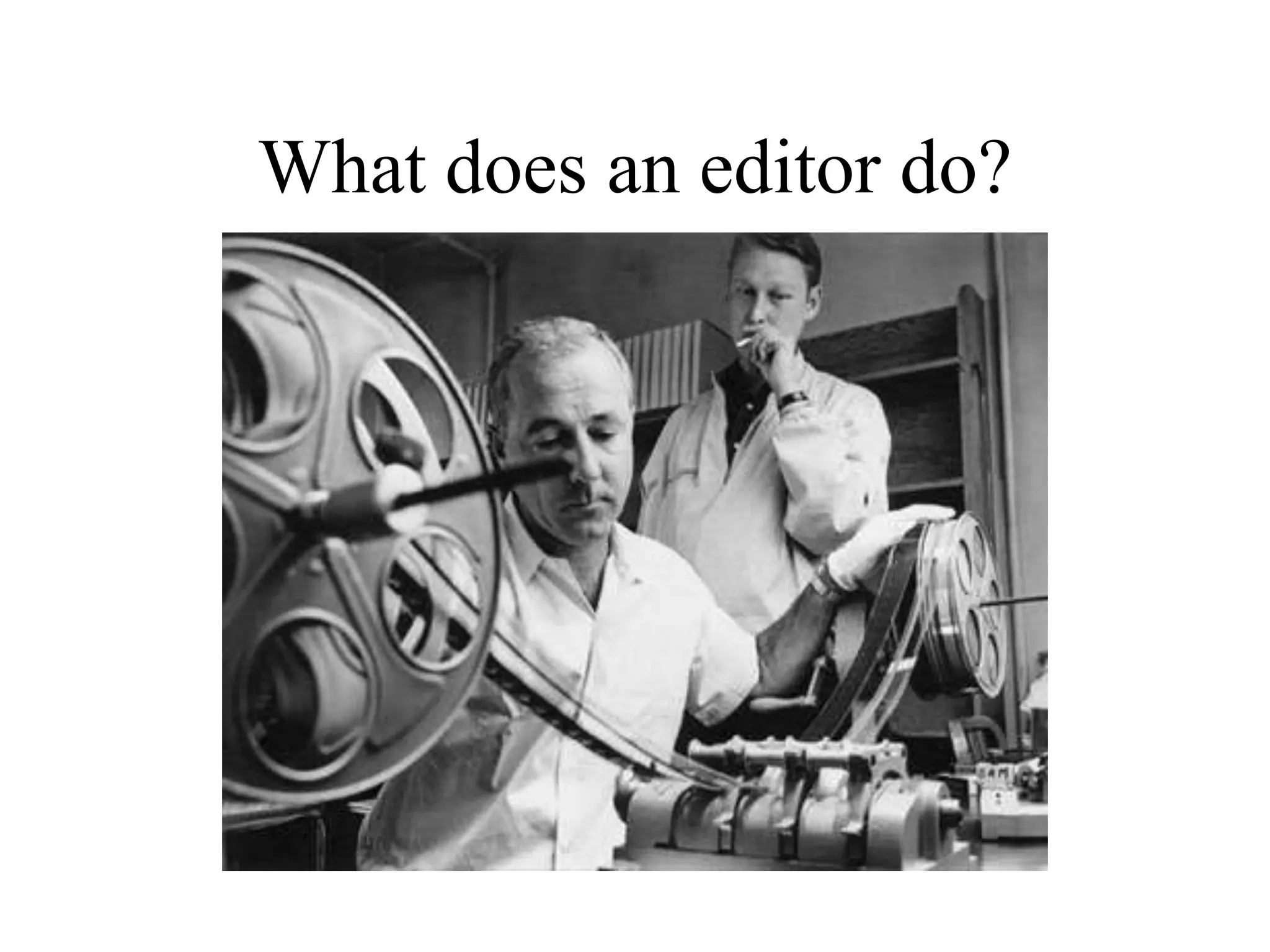
What does an editor do?
The Editor
• Selects and arranges shots in a way that
conveys specific meanings to the film
audience.
The 4 transition types
• Cut
• Dissolve
• Fade
• Wipe
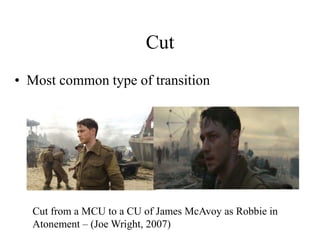
Cut
• Most common type of transition
Cut from a MCU to a CU of James McAvoy as Robbie in
Atonement – (Joe Wright, 2007)
Why do we use it?
• Most invisible, looks realistic
• Does not break the viewer’s suspension of
disbelief
• change the scene
• compress time
• vary the point of view
• build up an image or idea
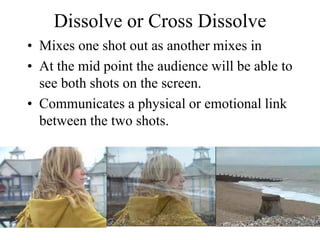
Dissolve or Cross Dissolve
• Mixes one shot out as another mixes in
• At the mid point the audience will be able to
see both shots on the screen.
• Communicates a physical or emotional link
between the two shots.
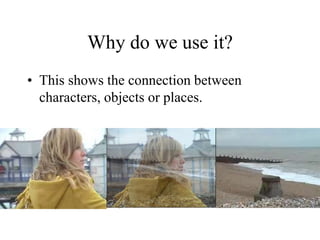
Why do we use it?
• This shows the connection between
characters, objects or places.
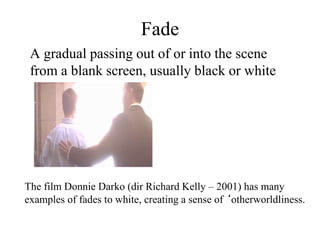
Fade
A gradual passing out of or into the scene
from a blank screen, usually black or white
The film Donnie Darko (dir Richard Kelly – 2001) has many
examples of fades to white, creating a sense of ‘otherworldliness.
Why do we use it?
• This can signal the end of a particular
section of time and space within the
narrative or to suggest the importance of the
image which has just “faded”. It can also
help to create a sense of disconnection with
thought processes.
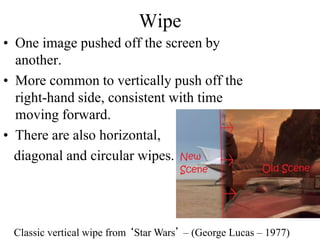
Wipe
• One image pushed off the screen by
another.
• More common to vertically push off the
right-hand side, consistent with time
moving forward.
• There are also horizontal,
diagonal and circular wipes.
Classic vertical wipe from ‘Star Wars’ – (George Lucas – 1977)
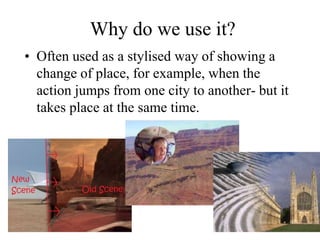
Why do we use it?
• Often used as a stylised way of showing a
change of place, for example, when the
action jumps from one city to another- but it
takes place at the same time.
Transitions
• So to summarise how to use and not use
transitions
How to do transitions
Dracula Chapter 15
The 2 types of editing
• Continuity
• Montage
Continuity Editing
• The usual style of Hollywood realist feature
films. Cuts are unobtrusive, supporting
rather than dominating the narrative. It
takes the film from one shot to the next,
moving forward in time.
• The editing isn’t really invisible but the
conventions have become so familiar to
visual literates that we don’t notice them.
How it’s done
• Match cuts, not jump cuts
• Motivated cuts- Shot-reverse-shot
• Change of camera position –Outside – In-
reads as continuous action
The use of the sound bridge-fluid
• Parallel development – an intercut sequence
of shots - chase sequences
Casino Royale – (Martin Campbell, 2006)
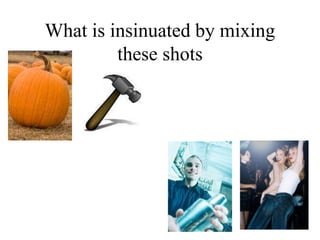
What is insinuated by mixing
these shots
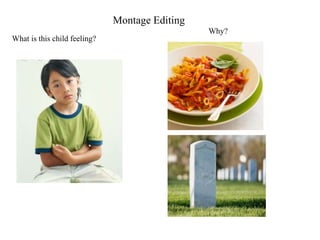
Montage Editing
• The juxtaposition of shots to represent
action or ideas, using conspicuous
techniques.
• It creates impact as the viewer is forced to
make connections between the images
shown.
Montage Editing
What is this child feeling?
Why?
How it’s done
• Relatively frequent cuts
• Use of close ups
• Dissolves
• Superimposition
• Fades
• Jump cuts
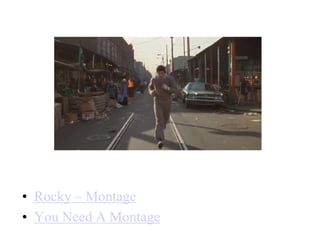
• Rocky – Montage
• You Need A Montage
• The Grammar of TV and Film

Editing techniques

  • 1.
    What does aneditor do?
  • 2.
    The Editor • Selectsand arranges shots in a way that conveys specific meanings to the film audience.
  • 3.
    The 4 transitiontypes • Cut • Dissolve • Fade • Wipe
  • 4.
    Cut • Most commontype of transition Cut from a MCU to a CU of James McAvoy as Robbie in Atonement – (Joe Wright, 2007)
  • 5.
    Why do weuse it? • Most invisible, looks realistic • Does not break the viewer’s suspension of disbelief • change the scene • compress time • vary the point of view • build up an image or idea
  • 6.
    Dissolve or CrossDissolve • Mixes one shot out as another mixes in • At the mid point the audience will be able to see both shots on the screen. • Communicates a physical or emotional link between the two shots.
  • 7.
    Why do weuse it? • This shows the connection between characters, objects or places.
  • 8.
    Fade A gradual passingout of or into the scene from a blank screen, usually black or white The film Donnie Darko (dir Richard Kelly – 2001) has many examples of fades to white, creating a sense of ‘otherworldliness.
  • 9.
    Why do weuse it? • This can signal the end of a particular section of time and space within the narrative or to suggest the importance of the image which has just “faded”. It can also help to create a sense of disconnection with thought processes.
  • 10.
    Wipe • One imagepushed off the screen by another. • More common to vertically push off the right-hand side, consistent with time moving forward. • There are also horizontal, diagonal and circular wipes. Classic vertical wipe from ‘Star Wars’ – (George Lucas – 1977)
  • 11.
    Why do weuse it? • Often used as a stylised way of showing a change of place, for example, when the action jumps from one city to another- but it takes place at the same time.
  • 12.
    Transitions • So tosummarise how to use and not use transitions How to do transitions Dracula Chapter 15
  • 13.
    The 2 typesof editing • Continuity • Montage
  • 14.
    Continuity Editing • Theusual style of Hollywood realist feature films. Cuts are unobtrusive, supporting rather than dominating the narrative. It takes the film from one shot to the next, moving forward in time. • The editing isn’t really invisible but the conventions have become so familiar to visual literates that we don’t notice them.
  • 15.
    How it’s done •Match cuts, not jump cuts • Motivated cuts- Shot-reverse-shot • Change of camera position –Outside – In- reads as continuous action The use of the sound bridge-fluid • Parallel development – an intercut sequence of shots - chase sequences Casino Royale – (Martin Campbell, 2006)
  • 16.
    What is insinuatedby mixing these shots
  • 17.
    Montage Editing • Thejuxtaposition of shots to represent action or ideas, using conspicuous techniques. • It creates impact as the viewer is forced to make connections between the images shown.
  • 18.
    Montage Editing What isthis child feeling? Why?
  • 19.
    How it’s done •Relatively frequent cuts • Use of close ups • Dissolves • Superimposition • Fades • Jump cuts
  • 20.
    • Rocky –Montage • You Need A Montage
  • 21.
    • The Grammarof TV and Film