Cr
Anisotropic electrical conduction of surfaces by ion beam nanopatterning
Basanta Kumar Parida and Subhendu Sarkar
Surface Modifications and Applications Laboratory (SMAL)
Department of Physics, Indian Institute of Technology Ropar, Punjab- 140001 India
Ion beam nanopatterning Monoelemental compound nanopatterning
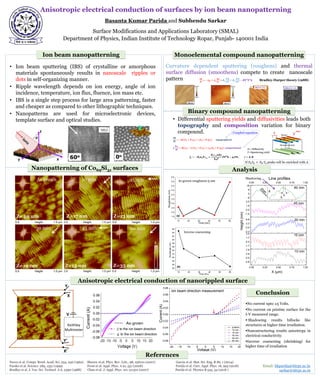
No current upto ±5 Volts.
No current on pristine surface for the
I-V measured range.
 Shadowing results hillocks like
structures at higher time irradiation.
Nanostructuring results anisotropy in
electrical conductivity.
Inverse coarsening (shrinking) for
higher time of irradiation
Email: bkparida@iitrpr.ac.in
sarkar@iitrpr.ac.in
• Ion beam sputtering (IBS) of crystalline or amorphous
materials spontaneously results in nanoscale ripples or
dots in self-organizing manner.
• Ripple wavelength depends on ion energy, angle of ion
incidence, temperature, ion flux, fluence, ion mass etc.
• IBS is a single step process for large area patterning, faster
and cheaper as compared to other lithographic techniques.
• Nanopatterns are used for microelectronic devices,
template surface and optical studies. • Differential sputtering yields and diffusivities leads both
topography and composition variation for binary
compound.
𝝏𝒉
𝝏𝒕
= −𝜴 𝑭 𝑨 + 𝜵. 𝑱 𝑨 + 𝑭 𝑩 + 𝜵. 𝑱 𝑩 𝐭𝐨𝐩𝐨𝐠𝐫𝐚𝐩𝐡𝐢𝐜𝐚𝐥
∆
𝝏𝒄 𝒔
𝝏𝒕
= 𝛀 𝒄 𝒃 − 𝟏 𝑭 𝑨 + 𝜵. 𝑱 𝑨 + 𝒄 𝒃 𝑭 𝑩 + 𝜵. 𝑱 𝑩 𝐜𝐨𝐦𝐩𝐨𝐬𝐢𝐭𝐢𝐨𝐧𝐚𝐥
𝑱𝒊 = −𝑫𝒊 𝒏 𝒔 𝜵𝑐 𝑠 𝒊 +
𝑫𝒊 𝑐 𝑠 𝒊 𝒏𝜴𝜸
𝒌 𝑩 𝑻
𝜵𝜵 𝟐 𝐡 − 𝝁𝒊 𝜵𝒉 , 𝐢 = 𝐀, 𝐁
Coupled equation
If 𝐷𝐴 𝑌𝐵 < 𝐷 𝐵 𝑌𝐴 peaks will be enriched with A
A
Binary
Monoelemental
B
Curvature dependent sputtering (roughens) and thermal
surface diffusion (smoothens) compete to create nanoscale
pattern
800 eV Ar+ → Cu 2000 eV Ar+ → Au
-20 -15 -10 -5 0 5 10 15 20
-0.08
-0.06
-0.04
-0.02
0.00
0.02
0.04
0.06
0.08
Current(A)
Voltage (V)
pristine
10 min
15 min
30 min
45 min
60 min
ion beam direction measurement
10 20 30 40 50 60
1.5
2.0
2.5
3.0
3.5
4.0
4.5
5.0
5.5
6.0
Roughness(nm)
Time (min)
(a)
10 20 30 40 50 60
34
36
38
40
42
44
46
48
50
52
54
56
(b)
Wavelength(nm)
Time (min)
Z=17 nm Z=13 nm
Z=19 nm Z=13 nm Z=35 nm
Z=40 nm
Z
As grown 10 min
30 min 45 min
15 min
60 min
Nanopatterning of Co69Si31 surfaces Analysis
0.00 0.25 0.50 0.75 1.00
-3.8
0.0
3.8
7.6
-1.7
0.0
1.7
3.4
-3.3
0.0
3.3
6.6
-1.5
0.0
1.5
3.0
-9
0
9
18
0.00 0.25 0.50 0.75 1.00
60 min
45 min
30 min
15 min
10 min
X (µm)
slope


Height(nm)
Line profiles
h
As grown roughness-5 nm
Inverse coarsening
Shadowing
Anisotropic electrical conduction of nanorippled surface
Conclusion
References
Navez et al. Compt. Rend. Acad. Sci. 254, 240 (1962) Shenoy et.al. Phys. Rev. Lett., 98, 256101 (2007) Garcia et al. Mat. Sci. Eng. R 86, 1 (2014)
Facsko et al. Science. 285, 1551 (1999) Frost et al. Appl. Phys. A 91, 551 (2008) Parida et al. Curr. Appl. Phys. 18, 993 (2018)
Bradley et al. J. Vac. Sci. Technol. A 6, 2390 (1988) Chan et al. J. Appl. Phys. 101 121301 (2007) Parida et al. Physica B 545, 34 (2018 )
Binary compound nanopatterning
𝝏𝒉
𝝏𝒕
= −𝒗 𝟎 + 𝜸 𝒙
𝝏𝒉
𝝏𝒙
+ 𝝑 𝒙
𝝏 𝟐 𝒉
𝝏𝒙 𝟐 + 𝝑 𝒚
𝝏 𝟐 𝒉
𝝏𝒚 𝟐 − 𝑩𝛁 𝟐
𝛁 𝟐
𝒉 Bradley-Harper theory (1988)
𝐷= Diffusivity
𝑌=Sputtering yield

Nanoripples for anisotropic electrical conduction

  • 1.
    Cr Anisotropic electrical conductionof surfaces by ion beam nanopatterning Basanta Kumar Parida and Subhendu Sarkar Surface Modifications and Applications Laboratory (SMAL) Department of Physics, Indian Institute of Technology Ropar, Punjab- 140001 India Ion beam nanopatterning Monoelemental compound nanopatterning No current upto ±5 Volts. No current on pristine surface for the I-V measured range.  Shadowing results hillocks like structures at higher time irradiation. Nanostructuring results anisotropy in electrical conductivity. Inverse coarsening (shrinking) for higher time of irradiation Email: bkparida@iitrpr.ac.in sarkar@iitrpr.ac.in • Ion beam sputtering (IBS) of crystalline or amorphous materials spontaneously results in nanoscale ripples or dots in self-organizing manner. • Ripple wavelength depends on ion energy, angle of ion incidence, temperature, ion flux, fluence, ion mass etc. • IBS is a single step process for large area patterning, faster and cheaper as compared to other lithographic techniques. • Nanopatterns are used for microelectronic devices, template surface and optical studies. • Differential sputtering yields and diffusivities leads both topography and composition variation for binary compound. 𝝏𝒉 𝝏𝒕 = −𝜴 𝑭 𝑨 + 𝜵. 𝑱 𝑨 + 𝑭 𝑩 + 𝜵. 𝑱 𝑩 𝐭𝐨𝐩𝐨𝐠𝐫𝐚𝐩𝐡𝐢𝐜𝐚𝐥 ∆ 𝝏𝒄 𝒔 𝝏𝒕 = 𝛀 𝒄 𝒃 − 𝟏 𝑭 𝑨 + 𝜵. 𝑱 𝑨 + 𝒄 𝒃 𝑭 𝑩 + 𝜵. 𝑱 𝑩 𝐜𝐨𝐦𝐩𝐨𝐬𝐢𝐭𝐢𝐨𝐧𝐚𝐥 𝑱𝒊 = −𝑫𝒊 𝒏 𝒔 𝜵𝑐 𝑠 𝒊 + 𝑫𝒊 𝑐 𝑠 𝒊 𝒏𝜴𝜸 𝒌 𝑩 𝑻 𝜵𝜵 𝟐 𝐡 − 𝝁𝒊 𝜵𝒉 , 𝐢 = 𝐀, 𝐁 Coupled equation If 𝐷𝐴 𝑌𝐵 < 𝐷 𝐵 𝑌𝐴 peaks will be enriched with A A Binary Monoelemental B Curvature dependent sputtering (roughens) and thermal surface diffusion (smoothens) compete to create nanoscale pattern 800 eV Ar+ → Cu 2000 eV Ar+ → Au -20 -15 -10 -5 0 5 10 15 20 -0.08 -0.06 -0.04 -0.02 0.00 0.02 0.04 0.06 0.08 Current(A) Voltage (V) pristine 10 min 15 min 30 min 45 min 60 min ion beam direction measurement 10 20 30 40 50 60 1.5 2.0 2.5 3.0 3.5 4.0 4.5 5.0 5.5 6.0 Roughness(nm) Time (min) (a) 10 20 30 40 50 60 34 36 38 40 42 44 46 48 50 52 54 56 (b) Wavelength(nm) Time (min) Z=17 nm Z=13 nm Z=19 nm Z=13 nm Z=35 nm Z=40 nm Z As grown 10 min 30 min 45 min 15 min 60 min Nanopatterning of Co69Si31 surfaces Analysis 0.00 0.25 0.50 0.75 1.00 -3.8 0.0 3.8 7.6 -1.7 0.0 1.7 3.4 -3.3 0.0 3.3 6.6 -1.5 0.0 1.5 3.0 -9 0 9 18 0.00 0.25 0.50 0.75 1.00 60 min 45 min 30 min 15 min 10 min X (µm) slope   Height(nm) Line profiles h As grown roughness-5 nm Inverse coarsening Shadowing Anisotropic electrical conduction of nanorippled surface Conclusion References Navez et al. Compt. Rend. Acad. Sci. 254, 240 (1962) Shenoy et.al. Phys. Rev. Lett., 98, 256101 (2007) Garcia et al. Mat. Sci. Eng. R 86, 1 (2014) Facsko et al. Science. 285, 1551 (1999) Frost et al. Appl. Phys. A 91, 551 (2008) Parida et al. Curr. Appl. Phys. 18, 993 (2018) Bradley et al. J. Vac. Sci. Technol. A 6, 2390 (1988) Chan et al. J. Appl. Phys. 101 121301 (2007) Parida et al. Physica B 545, 34 (2018 ) Binary compound nanopatterning 𝝏𝒉 𝝏𝒕 = −𝒗 𝟎 + 𝜸 𝒙 𝝏𝒉 𝝏𝒙 + 𝝑 𝒙 𝝏 𝟐 𝒉 𝝏𝒙 𝟐 + 𝝑 𝒚 𝝏 𝟐 𝒉 𝝏𝒚 𝟐 − 𝑩𝛁 𝟐 𝛁 𝟐 𝒉 Bradley-Harper theory (1988) 𝐷= Diffusivity 𝑌=Sputtering yield