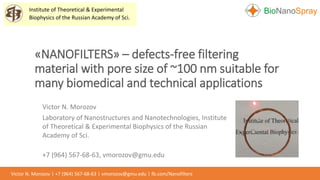
«NANOFILTERS» – defects-free filtering
material with pore size of ~100 nm suitable for
many biomedical and technical applications
Victor N. Morozov
Laboratory of Nanostructures and Nanotechnologies, Institute
of Theoretical & Experimental Biophysics of the Russian
Academy of Sci.
+7 (964) 567-68-63, vmorozov@gmu.edu
Victor N. Morozov | +7 (964) 567-68-63 | vmorozov@gmu.edu | fb.com/Nanofilters
Institute of Theoretical & Experimental
Biophysics of the Russian Academy of Sci.
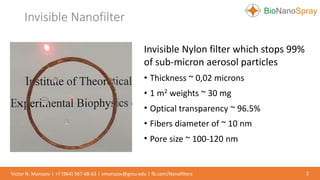
Invisible Nylon filter which stops 99%
of sub-micron aerosol particles
• Thickness ~ 0,02 microns
• 1 m2 weights ~ 30 mg
• Optical transparency ~ 96.5%
• Fibers diameter of ~ 10 nm
• Pore size ~ 100-120 nm
Invisible Nanofilter
2Victor N. Morozov | +7 (964) 567-68-63 | vmorozov@gmu.edu | fb.com/Nanofilters
Invisible Nanofilter (more information)
3Victor N. Morozov | +7 (964) 567-68-63 | vmorozov@gmu.edu | fb.com/Nanofilters
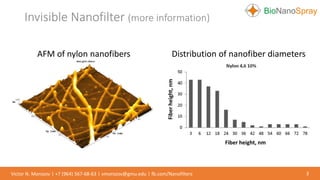
AFM of nylon nanofibers Distribution of nanofiber diameters
Fiber height, nm
Fiberheight,nm
Possible materials
4Victor N. Morozov | +7 (964) 567-68-63 | vmorozov@gmu.edu | fb.com/Nanofilters
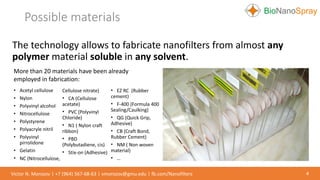
The technology allows to fabricate nanofilters from almost any
polymer material soluble in any solvent.
• Acetyl cellulose
• Nylon
• Polyvinyl alcohol
• Nitrocellulose
• Polystyrene
• Polyacryle nitril
• Polyvinyl
pirrolidone
• Gelatin
• NC (Nitrocellulose,
Cellulose nitrate)
• CA (Cellulose
acetate)
• PVC (Polyvinyl
Chloride)
• N1 ( Nylon craft
ribbon)
• PBD
(Polybutadiene, cis)
• Stix-on (Adhesive)
• EZ RC (Rubber
cement)
• F-400 (Formula 400
Sealing/Caulking)
• QG (Quick Grip,
Adhesive)
• CB (Craft Bond,
Rubber Cement)
• NM ( Non woven
material)
• …
More than 20 materials have been already
employed in fabrication:
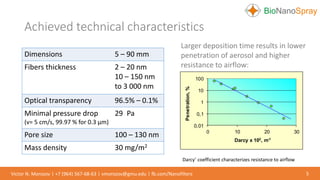
Achieved technical characteristics
5
Dimensions 5 – 90 mm
Fibers thickness 2 – 20 nm
10 – 150 nm
to 3 000 nm
Optical transparency 96.5% – 0.1%
Minimal pressure drop
(v= 5 cm/s, 99.97 % for 0.3 µm)
29 Pa
Pore size 100 – 130 nm
Mass density 30 mg/m2
Victor N. Morozov | +7 (964) 567-68-63 | vmorozov@gmu.edu | fb.com/Nanofilters
0,01
0,1
1
10
100
0 10 20 30
Penetration,%
Darcy x 102
, m-1
Larger deposition time results in lower
penetration of aerosol and higher
resistance to airflow:
Darcy’ coefficient characterizes resistance to airflow
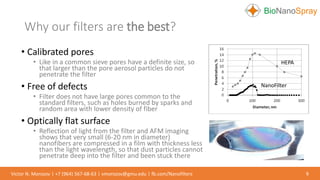
• Calibrated pores
• Like in a common sieve pores have a definite size, so
that larger than the pore aerosol particles do not
penetrate the filter
• Free of defects
• Filter does not have large pores common to the
standard filters, such as holes burned by sparks and
random area with lower density of fiber
• Optically flat surface
• Reflection of light from the filter and AFM imaging
shows that very small (6-20 nm in diameter)
nanofibers are compressed in a film with thickness less
than the light wavelength, so that dust particles cannot
penetrate deep into the filter and been stuck there
Why our filters are the best?
6Victor N. Morozov | +7 (964) 567-68-63 | vmorozov@gmu.edu | fb.com/Nanofilters
HEPA
NanoFilter
Our filter have calibrated pores
7Victor N. Morozov | +7 (964) 567-68-63 | vmorozov@gmu.edu | fb.com/Nanofilters
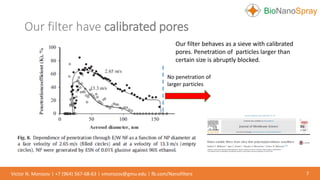
Our filter behaves as a sieve with calibrated
pores. Penetration of particles larger than
certain size is abruptly blocked.
No penetration of
larger particles
Our filter have calibrated pores
8Victor N. Morozov | +7 (964) 567-68-63 | vmorozov@gmu.edu | fb.com/Nanofilters
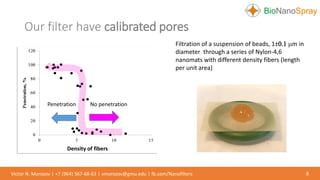
Filtration of a suspension of beads, 1±0.1 mm in
diameter through a series of Nylon-4,6
nanomats with different density fibers (length
per unit area)
June 17
Density of fibers
Penetration No penetration
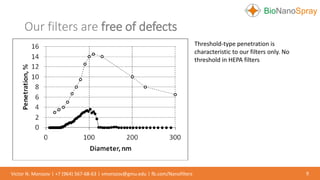
Our filters are free of defects
9Victor N. Morozov | +7 (964) 567-68-63 | vmorozov@gmu.edu | fb.com/Nanofilters
Threshold-type penetration is
characteristic to our filters only. No
threshold in HEPA filters
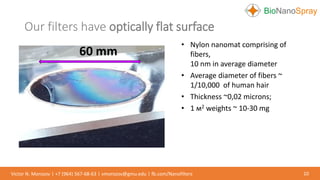
Our filters have optically flat surface
10Victor N. Morozov | +7 (964) 567-68-63 | vmorozov@gmu.edu | fb.com/Nanofilters
• Nylon nanomat comprising of
fibers,
10 nm in average diameter
• Average diameter of fibers ~
1/10,000 of human hair
• Thickness ~0,02 microns;
• 1 м2 weights ~ 10-30 mg
60 mm
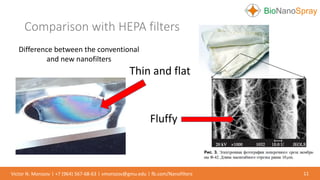
Comparison with HEPA filters
11Victor N. Morozov | +7 (964) 567-68-63 | vmorozov@gmu.edu | fb.com/Nanofilters
Difference between the conventional
and new nanofilters
Thin and flat
Fluffy
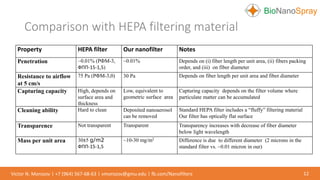
Comparison with HEPA filtering material
12Victor N. Morozov | +7 (964) 567-68-63 | vmorozov@gmu.edu | fb.com/Nanofilters
Property HEPA filter Our nanofilter Notes
Penetration ~0.01% (РФМ-3,
ФПП-15-1,5)
~0.01% Depends on (i) fiber length per unit area, (ii) fibers packing
order, and (iii) on fiber diameter
Resistance to airflow
at 5 cm/s
75 Pa (РФМ-3,0) 30 Pa Depends on fiber length per unit area and fiber diameter
Capturing capacity High, depends on
surface area and
thickness
Low, equivalent to
geometric surface area
Capturing capacity depends on the filter volume where
particulate matter can be accumulated
Cleaning ability Hard to clean Deposited nanoaerosol
can be removed
Standard HEPA filter includes a “fluffy” filtering material
Our filter has optically flat surface
Transparence Not transparent Transparent Transparency increases with decrease of fiber diameter
below light wavelength
Mass per unit area 30±5 g/m2
ФПП-15-1,5
~10-30 mg/m2 Difference is due to different diameter (2 microns in the
standard filter vs. ~0.01 micron in our)
Comparison with filters fabricated by
the conventional technology
13Victor N. Morozov | +7 (964) 567-68-63 | vmorozov@gmu.edu | fb.com/Nanofilters
Resistances to airflow of different electrospun
nanofilters having 99.97% collection
efficiencya for 0.3 µm aerosol particles at a
face velocity of 5 m/sec.
Filtering properties of Nylon nanomats,
manufactured by our and conventional
techniques.
Polymer ( span from solvent)
Knudsen number
(fibers diameter,
nm)
Pressure
dropb, Pa
OUR FILTER Nylon-4,6 (formic acid) [1] 6 (12) 29.5
Nylon-6 (formic acid) [2] 0.65-3.25 (20-100) 125.5
Nylon-6 (formic acid) [3] 0.69 (94) 224.4
Nylon-6 (formic acid) [4] 0.33 (200) 555
Polyurethanea (DMF) [5] 0.36 (180) 272.9
PLA (DCM 9%-DMAc 91%) [6] 0.24 (274) 111
HEPA[4] <0.1 (>650) >390
References
1. A.Y. Mikheev, Y.M. Shlyapnikov, I.L. Kanev, A.V. Avseenko, V.N.
Morozov, European Polymer Journal, 2016, 75, 317–328.
2. Y. Y. Kuo, F. C. Bruno, J. Wang, Aerosol Sci. Technol. 2014, 48, 1332–1344.
3. C. H. Hung, W. W. F. Leung, Sep. Purif. Technol. 2011, 79, 34–42.
4. Y. C. Ahn, S. K. Park, G. T. Kim, Y. J. Hwang, C. G. Lee, H. S. Shin, J. K. Lee,
Curr. Appl. Phys. 2006, 6, 1030–1035.
5. H. J. Choi, S. B. Kim, S. H. Kim, M. H. Lee, J. Air. Waste Manag. Assoc.
2014, 64, 322–329.
6. Z.Wang C. Zhao Z. Pan, J. Colloid and Interface Sci. 2015, 441, 121–129.
Notes to Table 1
aCollection efficiency for this filter was measured at a face velocity of 0.5 m/sec,
in all other cases at 5 m/sec.
bPressure drop on filters at a face velocity of 5 cm/sec.
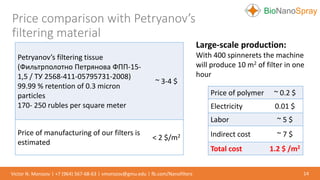
Price comparison with Petryanov’s
filtering material
14Victor N. Morozov | +7 (964) 567-68-63 | vmorozov@gmu.edu | fb.com/Nanofilters
Large-scale production:
With 400 spinnerets the machine
will produce 10 m2 of filter in one
hour
Petryanov’s filtering tissue
(Фильтрполотно Петрянова ФПП-15-
1,5 / ТУ 2568-411-05795731-2008)
99.99 % retention of 0.3 micron
particles
170- 250 rubles per square meter
~ 3-4 $
Price of manufacturing of our filters is
estimated
< 2 $/m2
Price of polymer ~ 0.2 $
Electricity 0.01 $
Labor ~ 5 $
Indirect cost ~ 7 $
Total cost 1.2 $ /m2
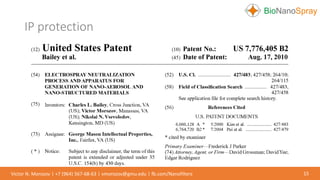
IP protection
15Victor N. Morozov | +7 (964) 567-68-63 | vmorozov@gmu.edu | fb.com/Nanofilters
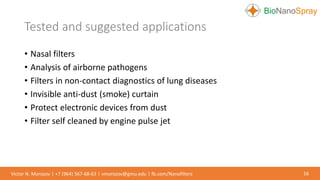
• Nasal filters
• Analysis of airborne pathogens
• Filters in non-contact diagnostics of lung diseases
• Invisible anti-dust (smoke) curtain
• Protect electronic devices from dust
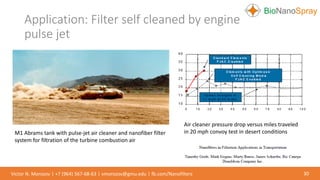
• Filter self cleaned by engine pulse jet
Tested and suggested applications
16Victor N. Morozov | +7 (964) 567-68-63 | vmorozov@gmu.edu | fb.com/Nanofilters
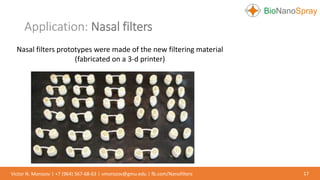
Application: Nasal filters
17Victor N. Morozov | +7 (964) 567-68-63 | vmorozov@gmu.edu | fb.com/Nanofilters
Nasal filters prototypes were made of the new filtering material
(fabricated on a 3-d printer)
Application: Nasal filters
18Victor N. Morozov | +7 (964) 567-68-63 | vmorozov@gmu.edu | fb.com/Nanofilters
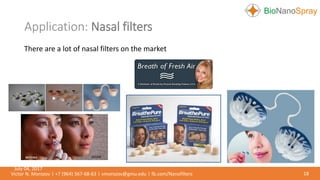
There are a lot of nasal filters on the market
July 04, 2017
Application: Nasal filters
19Victor N. Morozov | +7 (964) 567-68-63 | vmorozov@gmu.edu | fb.com/Nanofilters
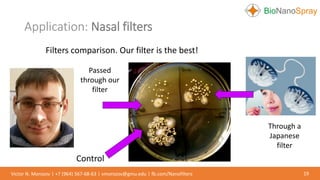
Filters comparison. Our filter is the best!
Through a
Japanese
filter
Passed
through our
filter
Control
Application: Nasal filters
20Victor N. Morozov | +7 (964) 567-68-63 | vmorozov@gmu.edu | fb.com/Nanofilters
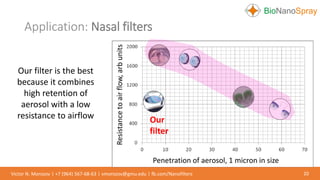
Our filter is the best
because it combines
high retention of
aerosol with a low
resistance to airflow
June 17 20Penetration of aerosol, 1 micron in size
Resistancetoairflow,arbunits Our
filter
Application: Analysis of airborne pathogens
21Victor N. Morozov | +7 (964) 567-68-63 | vmorozov@gmu.edu | fb.com/Nanofilters
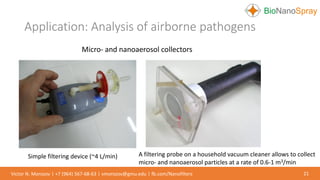
Micro- and nanoaerosol collectors
Simple filtering device (~4 L/min) A filtering probe on a household vacuum cleaner allows to collect
micro- and nanoaerosol particles at a rate of 0.6-1 m3/min
Application: Analysis of airborne pathogens
22Victor N. Morozov | +7 (964) 567-68-63 | vmorozov@gmu.edu | fb.com/Nanofilters
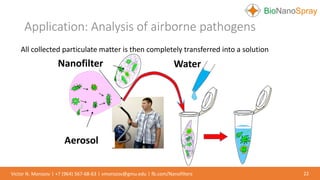
All collected particulate matter is then completely transferred into a solution
Nanofilter Water
Aerosol
Application: Analysis of airborne pathogens
23Victor N. Morozov | +7 (964) 567-68-63 | vmorozov@gmu.edu | fb.com/Nanofilters
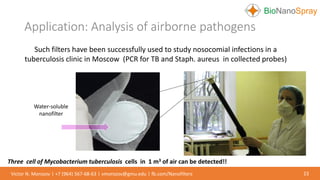
Such filters have been successfully used to study nosocomial infections in a
tuberculosis clinic in Moscow (PCR for TB and Staph. aureus in collected probes)
Three cell of Mycobacterium tuberculosis cells in 1 m3 of air can be detected!!
Water-soluble
nanofilter
Application: Analysis of airborne pathogens
24Victor N. Morozov | +7 (964) 567-68-63 | vmorozov@gmu.edu | fb.com/Nanofilters
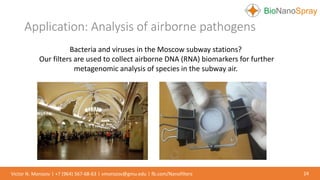
Bacteria and viruses in the Moscow subway stations?
Our filters are used to collect airborne DNA (RNA) biomarkers for further
metagenomic analysis of species in the subway air.
Application: Analysis of airborne pathogens
25Victor N. Morozov | +7 (964) 567-68-63 | vmorozov@gmu.edu | fb.com/Nanofilters
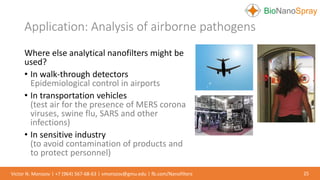
Where else analytical nanofilters might be
used?
• In walk-through detectors
Epidemiological control in airports
• In transportation vehicles
(test air for the presence of MERS corona
viruses, swine flu, SARS and other
infections)
• In sensitive industry
(to avoid contamination of products and
to protect personnel)
Application: Filters in non-contact
diagnostics of lung diseases
26Victor N. Morozov | +7 (964) 567-68-63 | vmorozov@gmu.edu | fb.com/Nanofilters
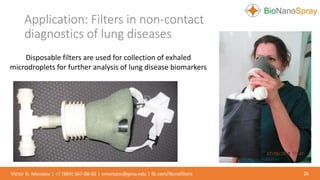
Disposable filters are used for collection of exhaled
microdroplets for further analysis of lung disease biomarkers
Application: Invisible anti-dust curtain
27Victor N. Morozov | +7 (964) 567-68-63 | vmorozov@gmu.edu | fb.com/Nanofilters
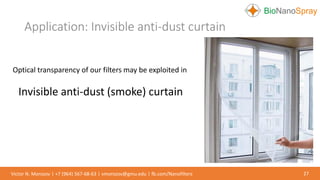
Optical transparency of our filters may be exploited in
Invisible anti-dust (smoke) curtain
Application: protection of electronic devices
28Victor N. Morozov | +7 (964) 567-68-63 | vmorozov@gmu.edu | fb.com/Nanofilters
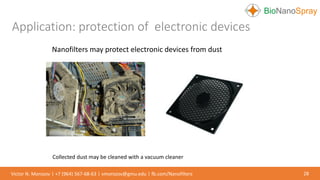
Nanofilters may protect electronic devices from dust
Collected dust may be cleaned with a vacuum cleaner
Application: protection of home appliances
29Victor N. Morozov | +7 (964) 567-68-63 | vmorozov@gmu.edu | fb.com/Nanofilters
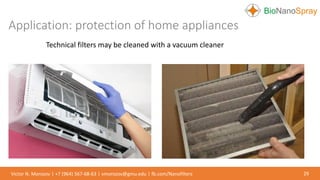
Technical filters may be cleaned with a vacuum cleaner
Application: Filter self cleaned by engine
pulse jet
30Victor N. Morozov | +7 (964) 567-68-63 | vmorozov@gmu.edu | fb.com/Nanofilters
Air cleaner pressure drop versus miles traveled
in 20 mph convoy test in desert conditionsM1 Abrams tank with pulse-jet air cleaner and nanofiber filter
system for filtration of the turbine combustion air
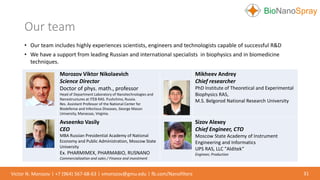
Our team
31
• Our team includes highly experiences scientists, engineers and technologists capable of successful R&D
• We have a support from leading Russian and international specialists in biophysics and in biomedicine
techniques.
Morozov Viktor Nikolaevich
Science Director
Doctor of phys. math., professor
Head of Department Laboratory of Nanotechnologies and
Nanostructures at ITEB RAS. Pushchino, Russia.
Res. Assistant Professor of the National Center for
Biodefense and Infectious Diseases, George Mason
University, Manassas, Virginia.
Mikheev Andrey
Chief researcher
PhD Institute of Theoretical and Experimental
Biophysics RAS,
M.S. Belgorod National Research University
Avseenko Vasily
CEO
MBA Russian Presidential Academy of National
Economy and Public Administration, Moscow State
University
Ex. PHARMIMEX, PHARMABIO, RUSNANO
Commercialization and sales / Finance and investment
Sizov Alexey
Chief Engineer, CTO
Moscow State Academy of Instrument
Engineering and Informatics
UPS RAS, LLC "Alditek“
Engineer, Production
Victor N. Morozov | +7 (964) 567-68-63 | vmorozov@gmu.edu | fb.com/Nanofilters
• We are looking for a STRATEGIC
PARTNER in development of
new application for our filtering
material
Thank You!
Contact info
Victor N. Morozov
vmorozov@gmu.edu
+7 (964) 567-68-63
Andrey Mikheev
2miheev@gmail.com
+7 (965) 313-81-82
Vasiliy Avseenko
avseenko@gmail.com
+7 (985) 970-04-85
What are we looking for?
32Victor N. Morozov | +7 (964) 567-68-63 | vmorozov@gmu.edu | fb.com/Nanofilters

NANOFILTERS

  • 1.
    «NANOFILTERS» – defects-freefiltering material with pore size of ~100 nm suitable for many biomedical and technical applications Victor N. Morozov Laboratory of Nanostructures and Nanotechnologies, Institute of Theoretical & Experimental Biophysics of the Russian Academy of Sci. +7 (964) 567-68-63, vmorozov@gmu.edu Victor N. Morozov | +7 (964) 567-68-63 | vmorozov@gmu.edu | fb.com/Nanofilters Institute of Theoretical & Experimental Biophysics of the Russian Academy of Sci.
  • 2.
    Invisible Nylon filterwhich stops 99% of sub-micron aerosol particles • Thickness ~ 0,02 microns • 1 m2 weights ~ 30 mg • Optical transparency ~ 96.5% • Fibers diameter of ~ 10 nm • Pore size ~ 100-120 nm Invisible Nanofilter 2Victor N. Morozov | +7 (964) 567-68-63 | vmorozov@gmu.edu | fb.com/Nanofilters
  • 3.
    Invisible Nanofilter (moreinformation) 3Victor N. Morozov | +7 (964) 567-68-63 | vmorozov@gmu.edu | fb.com/Nanofilters AFM of nylon nanofibers Distribution of nanofiber diameters Fiber height, nm Fiberheight,nm
  • 4.
    Possible materials 4Victor N.Morozov | +7 (964) 567-68-63 | vmorozov@gmu.edu | fb.com/Nanofilters The technology allows to fabricate nanofilters from almost any polymer material soluble in any solvent. • Acetyl cellulose • Nylon • Polyvinyl alcohol • Nitrocellulose • Polystyrene • Polyacryle nitril • Polyvinyl pirrolidone • Gelatin • NC (Nitrocellulose, Cellulose nitrate) • CA (Cellulose acetate) • PVC (Polyvinyl Chloride) • N1 ( Nylon craft ribbon) • PBD (Polybutadiene, cis) • Stix-on (Adhesive) • EZ RC (Rubber cement) • F-400 (Formula 400 Sealing/Caulking) • QG (Quick Grip, Adhesive) • CB (Craft Bond, Rubber Cement) • NM ( Non woven material) • … More than 20 materials have been already employed in fabrication:
  • 5.
    Achieved technical characteristics 5 Dimensions5 – 90 mm Fibers thickness 2 – 20 nm 10 – 150 nm to 3 000 nm Optical transparency 96.5% – 0.1% Minimal pressure drop (v= 5 cm/s, 99.97 % for 0.3 µm) 29 Pa Pore size 100 – 130 nm Mass density 30 mg/m2 Victor N. Morozov | +7 (964) 567-68-63 | vmorozov@gmu.edu | fb.com/Nanofilters 0,01 0,1 1 10 100 0 10 20 30 Penetration,% Darcy x 102 , m-1 Larger deposition time results in lower penetration of aerosol and higher resistance to airflow: Darcy’ coefficient characterizes resistance to airflow
  • 6.
    • Calibrated pores •Like in a common sieve pores have a definite size, so that larger than the pore aerosol particles do not penetrate the filter • Free of defects • Filter does not have large pores common to the standard filters, such as holes burned by sparks and random area with lower density of fiber • Optically flat surface • Reflection of light from the filter and AFM imaging shows that very small (6-20 nm in diameter) nanofibers are compressed in a film with thickness less than the light wavelength, so that dust particles cannot penetrate deep into the filter and been stuck there Why our filters are the best? 6Victor N. Morozov | +7 (964) 567-68-63 | vmorozov@gmu.edu | fb.com/Nanofilters HEPA NanoFilter
  • 7.
    Our filter havecalibrated pores 7Victor N. Morozov | +7 (964) 567-68-63 | vmorozov@gmu.edu | fb.com/Nanofilters Our filter behaves as a sieve with calibrated pores. Penetration of particles larger than certain size is abruptly blocked. No penetration of larger particles
  • 8.
    Our filter havecalibrated pores 8Victor N. Morozov | +7 (964) 567-68-63 | vmorozov@gmu.edu | fb.com/Nanofilters Filtration of a suspension of beads, 1±0.1 mm in diameter through a series of Nylon-4,6 nanomats with different density fibers (length per unit area) June 17 Density of fibers Penetration No penetration
  • 9.
    Our filters arefree of defects 9Victor N. Morozov | +7 (964) 567-68-63 | vmorozov@gmu.edu | fb.com/Nanofilters Threshold-type penetration is characteristic to our filters only. No threshold in HEPA filters
  • 10.
    Our filters haveoptically flat surface 10Victor N. Morozov | +7 (964) 567-68-63 | vmorozov@gmu.edu | fb.com/Nanofilters • Nylon nanomat comprising of fibers, 10 nm in average diameter • Average diameter of fibers ~ 1/10,000 of human hair • Thickness ~0,02 microns; • 1 м2 weights ~ 10-30 mg 60 mm
  • 11.
    Comparison with HEPAfilters 11Victor N. Morozov | +7 (964) 567-68-63 | vmorozov@gmu.edu | fb.com/Nanofilters Difference between the conventional and new nanofilters Thin and flat Fluffy
  • 12.
    Comparison with HEPAfiltering material 12Victor N. Morozov | +7 (964) 567-68-63 | vmorozov@gmu.edu | fb.com/Nanofilters Property HEPA filter Our nanofilter Notes Penetration ~0.01% (РФМ-3, ФПП-15-1,5) ~0.01% Depends on (i) fiber length per unit area, (ii) fibers packing order, and (iii) on fiber diameter Resistance to airflow at 5 cm/s 75 Pa (РФМ-3,0) 30 Pa Depends on fiber length per unit area and fiber diameter Capturing capacity High, depends on surface area and thickness Low, equivalent to geometric surface area Capturing capacity depends on the filter volume where particulate matter can be accumulated Cleaning ability Hard to clean Deposited nanoaerosol can be removed Standard HEPA filter includes a “fluffy” filtering material Our filter has optically flat surface Transparence Not transparent Transparent Transparency increases with decrease of fiber diameter below light wavelength Mass per unit area 30±5 g/m2 ФПП-15-1,5 ~10-30 mg/m2 Difference is due to different diameter (2 microns in the standard filter vs. ~0.01 micron in our)
  • 13.
    Comparison with filtersfabricated by the conventional technology 13Victor N. Morozov | +7 (964) 567-68-63 | vmorozov@gmu.edu | fb.com/Nanofilters Resistances to airflow of different electrospun nanofilters having 99.97% collection efficiencya for 0.3 µm aerosol particles at a face velocity of 5 m/sec. Filtering properties of Nylon nanomats, manufactured by our and conventional techniques. Polymer ( span from solvent) Knudsen number (fibers diameter, nm) Pressure dropb, Pa OUR FILTER Nylon-4,6 (formic acid) [1] 6 (12) 29.5 Nylon-6 (formic acid) [2] 0.65-3.25 (20-100) 125.5 Nylon-6 (formic acid) [3] 0.69 (94) 224.4 Nylon-6 (formic acid) [4] 0.33 (200) 555 Polyurethanea (DMF) [5] 0.36 (180) 272.9 PLA (DCM 9%-DMAc 91%) [6] 0.24 (274) 111 HEPA[4] <0.1 (>650) >390 References 1. A.Y. Mikheev, Y.M. Shlyapnikov, I.L. Kanev, A.V. Avseenko, V.N. Morozov, European Polymer Journal, 2016, 75, 317–328. 2. Y. Y. Kuo, F. C. Bruno, J. Wang, Aerosol Sci. Technol. 2014, 48, 1332–1344. 3. C. H. Hung, W. W. F. Leung, Sep. Purif. Technol. 2011, 79, 34–42. 4. Y. C. Ahn, S. K. Park, G. T. Kim, Y. J. Hwang, C. G. Lee, H. S. Shin, J. K. Lee, Curr. Appl. Phys. 2006, 6, 1030–1035. 5. H. J. Choi, S. B. Kim, S. H. Kim, M. H. Lee, J. Air. Waste Manag. Assoc. 2014, 64, 322–329. 6. Z.Wang C. Zhao Z. Pan, J. Colloid and Interface Sci. 2015, 441, 121–129. Notes to Table 1 aCollection efficiency for this filter was measured at a face velocity of 0.5 m/sec, in all other cases at 5 m/sec. bPressure drop on filters at a face velocity of 5 cm/sec.
  • 14.
    Price comparison withPetryanov’s filtering material 14Victor N. Morozov | +7 (964) 567-68-63 | vmorozov@gmu.edu | fb.com/Nanofilters Large-scale production: With 400 spinnerets the machine will produce 10 m2 of filter in one hour Petryanov’s filtering tissue (Фильтрполотно Петрянова ФПП-15- 1,5 / ТУ 2568-411-05795731-2008) 99.99 % retention of 0.3 micron particles 170- 250 rubles per square meter ~ 3-4 $ Price of manufacturing of our filters is estimated < 2 $/m2 Price of polymer ~ 0.2 $ Electricity 0.01 $ Labor ~ 5 $ Indirect cost ~ 7 $ Total cost 1.2 $ /m2
  • 15.
    IP protection 15Victor N.Morozov | +7 (964) 567-68-63 | vmorozov@gmu.edu | fb.com/Nanofilters
  • 16.
    • Nasal filters •Analysis of airborne pathogens • Filters in non-contact diagnostics of lung diseases • Invisible anti-dust (smoke) curtain • Protect electronic devices from dust • Filter self cleaned by engine pulse jet Tested and suggested applications 16Victor N. Morozov | +7 (964) 567-68-63 | vmorozov@gmu.edu | fb.com/Nanofilters
  • 17.
    Application: Nasal filters 17VictorN. Morozov | +7 (964) 567-68-63 | vmorozov@gmu.edu | fb.com/Nanofilters Nasal filters prototypes were made of the new filtering material (fabricated on a 3-d printer)
  • 18.
    Application: Nasal filters 18VictorN. Morozov | +7 (964) 567-68-63 | vmorozov@gmu.edu | fb.com/Nanofilters There are a lot of nasal filters on the market July 04, 2017
  • 19.
    Application: Nasal filters 19VictorN. Morozov | +7 (964) 567-68-63 | vmorozov@gmu.edu | fb.com/Nanofilters Filters comparison. Our filter is the best! Through a Japanese filter Passed through our filter Control
  • 20.
    Application: Nasal filters 20VictorN. Morozov | +7 (964) 567-68-63 | vmorozov@gmu.edu | fb.com/Nanofilters Our filter is the best because it combines high retention of aerosol with a low resistance to airflow June 17 20Penetration of aerosol, 1 micron in size Resistancetoairflow,arbunits Our filter
  • 21.
    Application: Analysis ofairborne pathogens 21Victor N. Morozov | +7 (964) 567-68-63 | vmorozov@gmu.edu | fb.com/Nanofilters Micro- and nanoaerosol collectors Simple filtering device (~4 L/min) A filtering probe on a household vacuum cleaner allows to collect micro- and nanoaerosol particles at a rate of 0.6-1 m3/min
  • 22.
    Application: Analysis ofairborne pathogens 22Victor N. Morozov | +7 (964) 567-68-63 | vmorozov@gmu.edu | fb.com/Nanofilters All collected particulate matter is then completely transferred into a solution Nanofilter Water Aerosol
  • 23.
    Application: Analysis ofairborne pathogens 23Victor N. Morozov | +7 (964) 567-68-63 | vmorozov@gmu.edu | fb.com/Nanofilters Such filters have been successfully used to study nosocomial infections in a tuberculosis clinic in Moscow (PCR for TB and Staph. aureus in collected probes) Three cell of Mycobacterium tuberculosis cells in 1 m3 of air can be detected!! Water-soluble nanofilter
  • 24.
    Application: Analysis ofairborne pathogens 24Victor N. Morozov | +7 (964) 567-68-63 | vmorozov@gmu.edu | fb.com/Nanofilters Bacteria and viruses in the Moscow subway stations? Our filters are used to collect airborne DNA (RNA) biomarkers for further metagenomic analysis of species in the subway air.
  • 25.
    Application: Analysis ofairborne pathogens 25Victor N. Morozov | +7 (964) 567-68-63 | vmorozov@gmu.edu | fb.com/Nanofilters Where else analytical nanofilters might be used? • In walk-through detectors Epidemiological control in airports • In transportation vehicles (test air for the presence of MERS corona viruses, swine flu, SARS and other infections) • In sensitive industry (to avoid contamination of products and to protect personnel)
  • 26.
    Application: Filters innon-contact diagnostics of lung diseases 26Victor N. Morozov | +7 (964) 567-68-63 | vmorozov@gmu.edu | fb.com/Nanofilters Disposable filters are used for collection of exhaled microdroplets for further analysis of lung disease biomarkers
  • 27.
    Application: Invisible anti-dustcurtain 27Victor N. Morozov | +7 (964) 567-68-63 | vmorozov@gmu.edu | fb.com/Nanofilters Optical transparency of our filters may be exploited in Invisible anti-dust (smoke) curtain
  • 28.
    Application: protection ofelectronic devices 28Victor N. Morozov | +7 (964) 567-68-63 | vmorozov@gmu.edu | fb.com/Nanofilters Nanofilters may protect electronic devices from dust Collected dust may be cleaned with a vacuum cleaner
  • 29.
    Application: protection ofhome appliances 29Victor N. Morozov | +7 (964) 567-68-63 | vmorozov@gmu.edu | fb.com/Nanofilters Technical filters may be cleaned with a vacuum cleaner
  • 30.
    Application: Filter selfcleaned by engine pulse jet 30Victor N. Morozov | +7 (964) 567-68-63 | vmorozov@gmu.edu | fb.com/Nanofilters Air cleaner pressure drop versus miles traveled in 20 mph convoy test in desert conditionsM1 Abrams tank with pulse-jet air cleaner and nanofiber filter system for filtration of the turbine combustion air
  • 31.
    Our team 31 • Ourteam includes highly experiences scientists, engineers and technologists capable of successful R&D • We have a support from leading Russian and international specialists in biophysics and in biomedicine techniques. Morozov Viktor Nikolaevich Science Director Doctor of phys. math., professor Head of Department Laboratory of Nanotechnologies and Nanostructures at ITEB RAS. Pushchino, Russia. Res. Assistant Professor of the National Center for Biodefense and Infectious Diseases, George Mason University, Manassas, Virginia. Mikheev Andrey Chief researcher PhD Institute of Theoretical and Experimental Biophysics RAS, M.S. Belgorod National Research University Avseenko Vasily CEO MBA Russian Presidential Academy of National Economy and Public Administration, Moscow State University Ex. PHARMIMEX, PHARMABIO, RUSNANO Commercialization and sales / Finance and investment Sizov Alexey Chief Engineer, CTO Moscow State Academy of Instrument Engineering and Informatics UPS RAS, LLC "Alditek“ Engineer, Production Victor N. Morozov | +7 (964) 567-68-63 | vmorozov@gmu.edu | fb.com/Nanofilters
  • 32.
    • We arelooking for a STRATEGIC PARTNER in development of new application for our filtering material Thank You! Contact info Victor N. Morozov vmorozov@gmu.edu +7 (964) 567-68-63 Andrey Mikheev 2miheev@gmail.com +7 (965) 313-81-82 Vasiliy Avseenko avseenko@gmail.com +7 (985) 970-04-85 What are we looking for? 32Victor N. Morozov | +7 (964) 567-68-63 | vmorozov@gmu.edu | fb.com/Nanofilters