Name:
Date:
SOCI1010 Unit 3 Touchstone Sample
Complete the following template, including all parts, using
complete sentences.
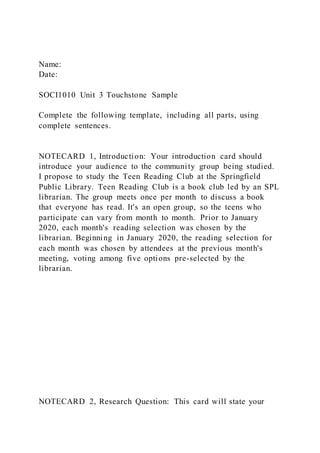
NOTECARD 1, Introduction: Your introduction card should
introduce your audience to the community group being studied.
I propose to study the Teen Reading Club at the Springfield
Public Library. Teen Reading Club is a book club led by an SPL
librarian. The group meets once per month to discuss a book
that everyone has read. It's an open group, so the teens who
participate can vary from month to month. Prior to January
2020, each month's reading selection was chosen by the
librarian. Beginning in January 2020, the reading selection for
each month was chosen by attendees at the previous month's
meeting, voting among five options pre-selected by the
librarian.
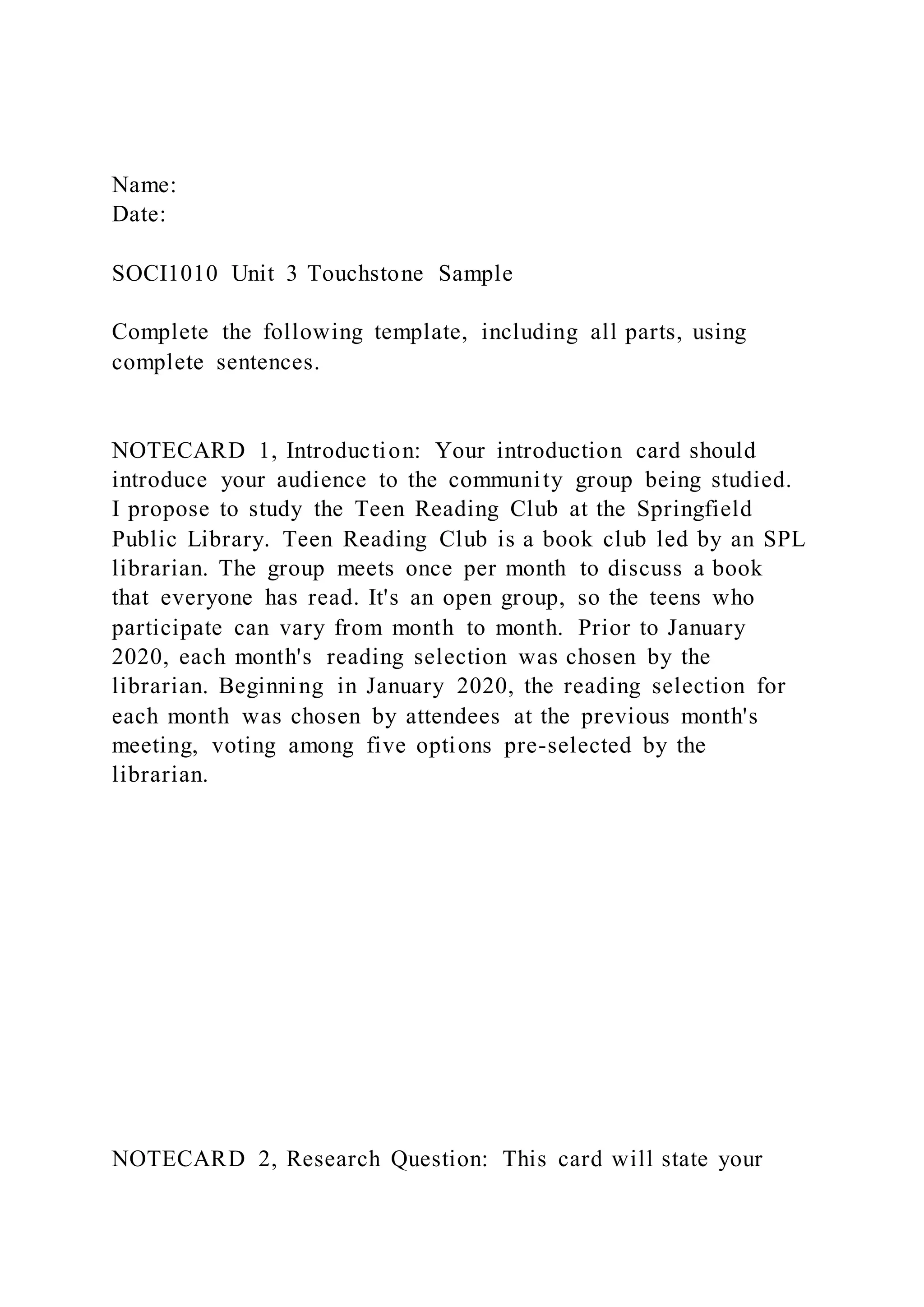
NOTECARD 2, Research Question: This card will state your
research question.
Does the method of selecting a reading for the Teen Reading
Club have a measurable impact on the diversity of the readings
selected?
NOTECARD 3, Literature Review: Describe the information
and analysis you performed in Step 2 for the first source in your
literature review.
Sofya Aptekar, 2019
The Public Library as Resistive Space in the Neoliberal City
https://www.onlinelibrary.wiley.com/doi/10.1111/cico.12417
Sofya Aptekar is a sociology professor at UMass Boston. She
did ethnographic research in a public library in Queens, New
York City. She was interested in studying how people of
different classes and backgrounds interacted in a library space
within a diverse neighborhood. She found that the library is a
place where middle class people and lower class people have
authentic interactions and where middle class people try to bend
the rules in order to help lower class people. This is relevant to
my proposed study because Aptekar discusses how diversity --
in this case, economic diversity -- impacts relationships and
programming at an urban public library.
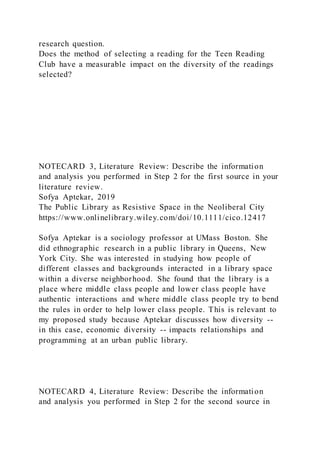
NOTECARD 4, Literature Review: Describe the information
and analysis you performed in Step 2 for the second source in
your literature review.
Similar to Notecard 3, create the following for your second
source:
· Bibliography information for your second source
· Description and analysis
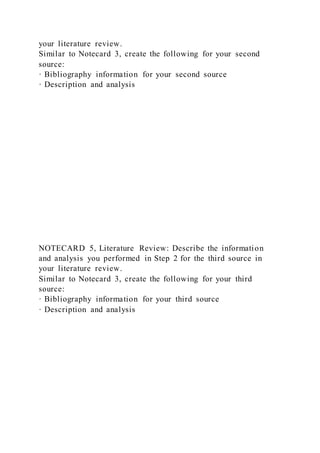
NOTECARD 5, Literature Review: Describe the information
and analysis you performed in Step 2 for the third source in
your literature review.
Similar to Notecard 3, create the following for your third
source:
· Bibliography information for your third source
· Description and analysis
NOTECARD 6, Literature Review: Describe the information
and analysis you performed in Step 2 for the fourth source in
your literature review.
Similar to Notecard 3, create the following for your fourth
source:
· Bibliography information for your fourth source
· Description and analysis
NOTECARD 7, Literature Review: Describe the information
and analysis you performed in Step 2 for the fifth source in your
literature review. Skip this card if you only have four sources.
Similar to Notecard 3, create the following for your fifth
source:
· Bibliography information for your fifth source
· Description and analysis
NOTECARD 8, LIterature Review: Describe the information
and analysis you performed in Step 2 for the sixth source in
your literature review. Skip this card if you only have four
sources.
Similar to Notecard 3, create the following for your sixth
source:
· Bibliography information for your sixth source
· Description and analysis
NOTECARD 9, Hypothesis: State your hypothesis.
If the attendees select the books, then the readings selected will
exhibit a decrease in diversity of the writers, compared to when
the librarian selects the books.
NOTECARD 10, Operational definitions: Include and explain
any operational definitions you developed for your study. You
may skip this card if you have none.
Attendees = the teens who attended the previous month's
reading group and who voted on the next month's reading.
Librarian = the professional SPL librarian leading the reading
group any given month. Note that multiple librarians have led
the reading group in the period of time included in my study.
Writer diversity = the diversity of the identities of the authors
of the selected readings will be assessed based on the writers'
Wikipedia pages. Diversity will be measured based on race and
ethnicity, gender, sexual orientation, and religion.
NOTECARD 11, Proposed Research Method: Introduce your
proposed research method and explain how you propose to
conduct your research.
I will ask the librarian for a list of the readings for the teen
reading group from January 2017 up until the most recent month
available. I will analyze this data to determine whether the
diversity of the writers represented increased or decreased since
the change to the book selection process in January 2020. I will
assign a score to each writer based on publicly available
information about their identities, according to the following
criteria:
Race and ethnicity:
If the writer is a person of color and/or Hispanic, +1
If race and ethnicity are unknown, 0
If the writer is non-Hispanic white, -1
Gender:
If the writer is a woman, non-binary, transgender, or another
gender minority, +1
If the writer's gender is unknown, 0
If the writer is a cisgendered man, -1
Sexual orientation:
If the writer is openly queer (or, for writers from prior
generations who are deceased, if historians largely consider
them to have been queer), +1
If the writer's sexual orientation is unknow n, 0
If the writer is heterosexual, -1
Religion:
If the writer practices a minority religion in the USA or is
strongly connected to a minority religion heritage, +1
If the writer's religion is unknown or if they have no religious
affiliation, 0
If the writer is Protestant or Catholic, 0
For instance, J.K Rowling would receive a total score of -2,
because she is a straight, white, Christian woman. Angie
Thomas would receive a total score of 1, because she is a Black
Christian woman of unknown sexual orientation.
After assigning scores, I will find the average score for all
writers selected between January 2017 and December 2019, and
the average score for all writers selected between January 2020
and the latest available data. Comparing the average scores for
the two time periods will show whether my hypothesis is
correct.
Name:
Date:
SOCI1010 Unit 3 Touchstone Template
Complete the following template, including all parts, using
complete sentences.
NOTECARD 1, Introduction: Your introduction card should
introduce your audience to the community group being studied.
· Name of your community group
· Description of your community group
NOTECARD 2, Research Question: This card will state your
research question.
· State your research question
NOTECARD 3, Literature Review: Describe the information
and analysis you performed in Step 2 for the first source in your
literature review.
· Bibliography information for your first source
· Description and analysis
NOTECARD 4, Literature Review: Describe the information
and analysis you performed in Step 2 for the second source in
your literature review.
· Bibliography information for your second source
· Description and analysis
NOTECARD 5, Literature Review: Describe the information
and analysis you performed in Step 2 for the third source in
your literature review.
· Bibliography information for your third source
· Description and analysis
NOTECARD 6, Literature Review: Describe the information
and analysis you performed in Step 2 for the fourth source in
your literature review.
· Bibliography information for your fourth source
· Description and analysis
NOTECARD 7, Literature Review: Describe the information
and analysis you performed in Step 2 for the fifth source in your
literature review. Skip this card if you only have four sources.
· Bibliography information for your fifth source
· Description and analysis
NOTECARD 8, LIterature Review: Describe the information
and analysis you performed in Step 2 for the sixth source in
your literature review. Skip this card if you only have four
sources.
· Bibliography information for your sixth source
· Description and analysis
NOTECARD 9, Hypothesis: State your hypothesis.
· State your hypothesis
NOTECARD 10, Operational definitions: Include and explain
any operational definitions you developed for your study. You
may skip this card if you have none.
· Explanation of operational definitions
NOTECARD 11, Proposed Research Method: Introduce your
proposed research method and explain how you propose to
conduct your research.
· Description of your proposed research method
· Explanation of how you propose to conduct your research

Name date soci1010 unit 3 touchstone samplecomplete the

  • 1.
    Name: Date: SOCI1010 Unit 3Touchstone Sample Complete the following template, including all parts, using complete sentences. NOTECARD 1, Introduction: Your introduction card should introduce your audience to the community group being studied. I propose to study the Teen Reading Club at the Springfield Public Library. Teen Reading Club is a book club led by an SPL librarian. The group meets once per month to discuss a book that everyone has read. It's an open group, so the teens who participate can vary from month to month. Prior to January 2020, each month's reading selection was chosen by the librarian. Beginning in January 2020, the reading selection for each month was chosen by attendees at the previous month's meeting, voting among five options pre-selected by the librarian. NOTECARD 2, Research Question: This card will state your
  • 2.
    research question. Does themethod of selecting a reading for the Teen Reading Club have a measurable impact on the diversity of the readings selected? NOTECARD 3, Literature Review: Describe the information and analysis you performed in Step 2 for the first source in your literature review. Sofya Aptekar, 2019 The Public Library as Resistive Space in the Neoliberal City https://www.onlinelibrary.wiley.com/doi/10.1111/cico.12417 Sofya Aptekar is a sociology professor at UMass Boston. She did ethnographic research in a public library in Queens, New York City. She was interested in studying how people of different classes and backgrounds interacted in a library space within a diverse neighborhood. She found that the library is a place where middle class people and lower class people have authentic interactions and where middle class people try to bend the rules in order to help lower class people. This is relevant to my proposed study because Aptekar discusses how diversity -- in this case, economic diversity -- impacts relationships and programming at an urban public library. NOTECARD 4, Literature Review: Describe the information and analysis you performed in Step 2 for the second source in
  • 3.
    your literature review. Similarto Notecard 3, create the following for your second source: · Bibliography information for your second source · Description and analysis NOTECARD 5, Literature Review: Describe the information and analysis you performed in Step 2 for the third source in your literature review. Similar to Notecard 3, create the following for your third source: · Bibliography information for your third source · Description and analysis
  • 4.
    NOTECARD 6, LiteratureReview: Describe the information and analysis you performed in Step 2 for the fourth source in your literature review. Similar to Notecard 3, create the following for your fourth source: · Bibliography information for your fourth source · Description and analysis NOTECARD 7, Literature Review: Describe the information and analysis you performed in Step 2 for the fifth source in your literature review. Skip this card if you only have four sources. Similar to Notecard 3, create the following for your fifth source: · Bibliography information for your fifth source · Description and analysis
  • 5.
    NOTECARD 8, LIteratureReview: Describe the information and analysis you performed in Step 2 for the sixth source in your literature review. Skip this card if you only have four sources. Similar to Notecard 3, create the following for your sixth source: · Bibliography information for your sixth source · Description and analysis
  • 6.
    NOTECARD 9, Hypothesis:State your hypothesis. If the attendees select the books, then the readings selected will exhibit a decrease in diversity of the writers, compared to when the librarian selects the books. NOTECARD 10, Operational definitions: Include and explain any operational definitions you developed for your study. You may skip this card if you have none. Attendees = the teens who attended the previous month's reading group and who voted on the next month's reading. Librarian = the professional SPL librarian leading the reading group any given month. Note that multiple librarians have led the reading group in the period of time included in my study. Writer diversity = the diversity of the identities of the authors of the selected readings will be assessed based on the writers' Wikipedia pages. Diversity will be measured based on race and ethnicity, gender, sexual orientation, and religion. NOTECARD 11, Proposed Research Method: Introduce your proposed research method and explain how you propose to conduct your research.
  • 7.
    I will askthe librarian for a list of the readings for the teen reading group from January 2017 up until the most recent month available. I will analyze this data to determine whether the diversity of the writers represented increased or decreased since the change to the book selection process in January 2020. I will assign a score to each writer based on publicly available information about their identities, according to the following criteria: Race and ethnicity: If the writer is a person of color and/or Hispanic, +1 If race and ethnicity are unknown, 0 If the writer is non-Hispanic white, -1 Gender: If the writer is a woman, non-binary, transgender, or another gender minority, +1 If the writer's gender is unknown, 0 If the writer is a cisgendered man, -1 Sexual orientation: If the writer is openly queer (or, for writers from prior generations who are deceased, if historians largely consider them to have been queer), +1 If the writer's sexual orientation is unknow n, 0 If the writer is heterosexual, -1 Religion: If the writer practices a minority religion in the USA or is strongly connected to a minority religion heritage, +1 If the writer's religion is unknown or if they have no religious affiliation, 0 If the writer is Protestant or Catholic, 0 For instance, J.K Rowling would receive a total score of -2, because she is a straight, white, Christian woman. Angie Thomas would receive a total score of 1, because she is a Black Christian woman of unknown sexual orientation.
  • 8.
    After assigning scores,I will find the average score for all writers selected between January 2017 and December 2019, and the average score for all writers selected between January 2020 and the latest available data. Comparing the average scores for the two time periods will show whether my hypothesis is correct. Name: Date: SOCI1010 Unit 3 Touchstone Template Complete the following template, including all parts, using complete sentences. NOTECARD 1, Introduction: Your introduction card should introduce your audience to the community group being studied. · Name of your community group · Description of your community group
  • 9.
    NOTECARD 2, ResearchQuestion: This card will state your research question. · State your research question NOTECARD 3, Literature Review: Describe the information and analysis you performed in Step 2 for the first source in your literature review. · Bibliography information for your first source · Description and analysis
  • 10.
    NOTECARD 4, LiteratureReview: Describe the information and analysis you performed in Step 2 for the second source in your literature review. · Bibliography information for your second source · Description and analysis NOTECARD 5, Literature Review: Describe the information and analysis you performed in Step 2 for the third source in your literature review. · Bibliography information for your third source · Description and analysis
  • 11.
    NOTECARD 6, LiteratureReview: Describe the information and analysis you performed in Step 2 for the fourth source in your literature review. · Bibliography information for your fourth source · Description and analysis NOTECARD 7, Literature Review: Describe the information and analysis you performed in Step 2 for the fifth source in your literature review. Skip this card if you only have four sources. · Bibliography information for your fifth source · Description and analysis
  • 12.
    NOTECARD 8, LIteratureReview: Describe the information and analysis you performed in Step 2 for the sixth source in your literature review. Skip this card if you only have four sources. · Bibliography information for your sixth source · Description and analysis NOTECARD 9, Hypothesis: State your hypothesis. · State your hypothesis
  • 13.
    NOTECARD 10, Operationaldefinitions: Include and explain any operational definitions you developed for your study. You may skip this card if you have none. · Explanation of operational definitions NOTECARD 11, Proposed Research Method: Introduce your proposed research method and explain how you propose to
  • 14.
    conduct your research. ·Description of your proposed research method · Explanation of how you propose to conduct your research