Management Skills Development of skills for various roles
Welcome to Manager Skills Development Training
Dile m ma:  Is a manager born, or is a manager developed ?
How do they have in common ?  Milan  is a successful entrepreneur Janko  is a good manager   Marko  is a great leader
Entrepreneur ,  Ma na g er  and  Leader   are specific roles
Use of Entrepreneurial Skills Story of  “Tapos” Situation   No .1
Use of Management Skills Story  of  “Tapos” Situa tion   No .2
Use of Leadership Skills Story of  “Tapos” Situa tion   No .3
Errors in management  positioning may cost a lot !
What is a conflict ?
Conflict Management  - ta c ti cs Avoidance, suppression, evasion Adaptation Competition C ompromis e C o l labora tion .
  How Managers Cope with Conflict Create the climate of trust and respect Separate people from problems Focus on interests, not on options Use objective criteria Spread information objectively and in time.
Causes of Conflicts As long as one party believes that the  other party threatens their interests, the conditions are favourable for conflict generation
Consequences of Conflicts In personal domain In organizational domain .
Motivation Skills “ There isn’t a person anywhere that isn’t capable of doing more than he  thinks he is .” Henr y  Ford
Motivation Skills “ Our competitors’ experts have the same education as our experts. That is the reason why, if we wish to win the advantage of 5% over the competition, we have to encourage our people to ‘grab’ the work ” Maucher,  President of  “Nestle”
Motivation Theories Maslo w’s Theory of Motivation Her z be r g ’s Two Factor Motivation Theory Vr u um ’s   M odel  of Motivation
Demotivators are  the most powerful reasons we do not accomplish success we are predetermined to make
How to deal with  demotivators
The road to realization of true, full life starts  with knowing yourself
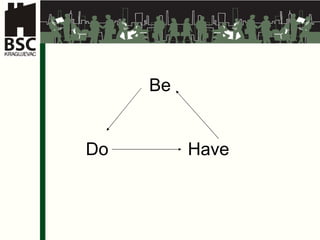
Be Do   Have
Technique of knowing your true wishes Asking questions What do I want? What do I have to do to get it? How would I feel if I had it?
Well established goals : Motivate us Can be accomplished Can be measured Are set to meet the deadlines Are clearly defined
Results are not about intentions –  they require action
We may have a clear goal and a good plan, and yet fail. Why?
Success requires taking responsibility  –  have  the attitude that success  of all your plans  depend on yourself
Presentation Skills To know something is the easier part,  to say it aloud is  the more difficult part
Presentation Skills   We all wish presenters to talk to us,  not to give us speeches
Principles of Presentation Skills Development  Make a decision to become a good speaker   Get inspiration from the experiences of others Program m e  yourself for success Use every opportunity to practise
Presentation Skills Practice, harmony of thoughts, emotions, voice and body are prerequisites of  a good presentation
Excellent Image   Smart Sympathetic Well dressed Friendly   Confidential   Natural Decent Versatile Helpful to others Respond quickly
How to a message more effective -tactics Get and keep attention Emphasize usefulness for listeners Ensure your messages are remembered
Your well structured presentation comprises :  Introduction  ( Tell them what you are  going to talk about )  Body  ( Tell them what you want to tell them )  Ending  ( Tell them what you have just told them )
Become a speaker who  people like listening to  and whose  ideas they accept !!!!
Team Building Skills The times of Renaissance man and Superman have long gone Efficient teams today do not need heroes Future lies in systematic thinking and team work
Relation between a team and a group Every team is a group, every group is not a team
Team work features Team has a clear task, a goal  Team finds solutions to main problems Team gathers ideas of all its members in order to find a quality solution Team work is based on respect and trust Team work supports clearly defined roles
Team roles and functions Team role Contribution to the team is based on personal ability and qualities Func t ion Contribution to the team is based on knowledge and professional experience
Role of Team Leader Builds  ( with the other team members ) standard s   and principles of work and behaviour Adapt their own role to current problems Encourages members to get involved in finding new solutions Creates and improves the climate for team work Faces problems Encourages and prizes success in task accomplishment .
Team work in goals setting Case study:  “CINI” Čačak Should we start the production of  solid fuel heaters ?
Team work in Development and Implementation of Strategy Case study: Tourist Organisation of Valjevo Development Strategy of  Divčibar e

Nadezda Tosic - Management Skills

  • 1.
    Management Skills Developmentof skills for various roles
  • 2.
    Welcome to ManagerSkills Development Training
  • 3.
    Dile m ma: Is a manager born, or is a manager developed ?
  • 4.
    How do theyhave in common ? Milan is a successful entrepreneur Janko is a good manager Marko is a great leader
  • 5.
    Entrepreneur , Ma na g er and Leader are specific roles
  • 6.
    Use of EntrepreneurialSkills Story of “Tapos” Situation No .1
  • 7.
    Use of ManagementSkills Story of “Tapos” Situa tion No .2
  • 8.
    Use of LeadershipSkills Story of “Tapos” Situa tion No .3
  • 9.
    Errors in management positioning may cost a lot !
  • 10.
    What is aconflict ?
  • 11.
    Conflict Management - ta c ti cs Avoidance, suppression, evasion Adaptation Competition C ompromis e C o l labora tion .
  • 12.
    HowManagers Cope with Conflict Create the climate of trust and respect Separate people from problems Focus on interests, not on options Use objective criteria Spread information objectively and in time.
  • 13.
    Causes of ConflictsAs long as one party believes that the other party threatens their interests, the conditions are favourable for conflict generation
  • 14.
    Consequences of ConflictsIn personal domain In organizational domain .
  • 15.
    Motivation Skills “There isn’t a person anywhere that isn’t capable of doing more than he thinks he is .” Henr y Ford
  • 16.
    Motivation Skills “Our competitors’ experts have the same education as our experts. That is the reason why, if we wish to win the advantage of 5% over the competition, we have to encourage our people to ‘grab’ the work ” Maucher, President of “Nestle”
  • 17.
    Motivation Theories Maslow’s Theory of Motivation Her z be r g ’s Two Factor Motivation Theory Vr u um ’s M odel of Motivation
  • 18.
    Demotivators are the most powerful reasons we do not accomplish success we are predetermined to make
  • 19.
    How to dealwith demotivators
  • 20.
    The road torealization of true, full life starts with knowing yourself
  • 21.
    Be Do Have
  • 22.
    Technique of knowingyour true wishes Asking questions What do I want? What do I have to do to get it? How would I feel if I had it?
  • 23.
    Well established goals: Motivate us Can be accomplished Can be measured Are set to meet the deadlines Are clearly defined
  • 24.
    Results are notabout intentions – they require action
  • 25.
    We may havea clear goal and a good plan, and yet fail. Why?
  • 26.
    Success requires takingresponsibility – have the attitude that success of all your plans depend on yourself
  • 27.
    Presentation Skills Toknow something is the easier part, to say it aloud is the more difficult part
  • 28.
    Presentation Skills We all wish presenters to talk to us, not to give us speeches
  • 29.
    Principles of PresentationSkills Development Make a decision to become a good speaker Get inspiration from the experiences of others Program m e yourself for success Use every opportunity to practise
  • 30.
    Presentation Skills Practice,harmony of thoughts, emotions, voice and body are prerequisites of a good presentation
  • 31.
    Excellent Image Smart Sympathetic Well dressed Friendly Confidential Natural Decent Versatile Helpful to others Respond quickly
  • 32.
    How to amessage more effective -tactics Get and keep attention Emphasize usefulness for listeners Ensure your messages are remembered
  • 33.
    Your well structuredpresentation comprises : Introduction ( Tell them what you are going to talk about ) Body ( Tell them what you want to tell them ) Ending ( Tell them what you have just told them )
  • 34.
    Become a speakerwho people like listening to and whose ideas they accept !!!!
  • 35.
    Team Building SkillsThe times of Renaissance man and Superman have long gone Efficient teams today do not need heroes Future lies in systematic thinking and team work
  • 36.
    Relation between ateam and a group Every team is a group, every group is not a team
  • 37.
    Team work featuresTeam has a clear task, a goal Team finds solutions to main problems Team gathers ideas of all its members in order to find a quality solution Team work is based on respect and trust Team work supports clearly defined roles
  • 38.
    Team roles andfunctions Team role Contribution to the team is based on personal ability and qualities Func t ion Contribution to the team is based on knowledge and professional experience
  • 39.
    Role of TeamLeader Builds ( with the other team members ) standard s and principles of work and behaviour Adapt their own role to current problems Encourages members to get involved in finding new solutions Creates and improves the climate for team work Faces problems Encourages and prizes success in task accomplishment .
  • 40.
    Team work ingoals setting Case study: “CINI” Čačak Should we start the production of solid fuel heaters ?
  • 41.
    Team work inDevelopment and Implementation of Strategy Case study: Tourist Organisation of Valjevo Development Strategy of Divčibar e